Japan Recycled Asphalt Additives Market Size & Growth Rate
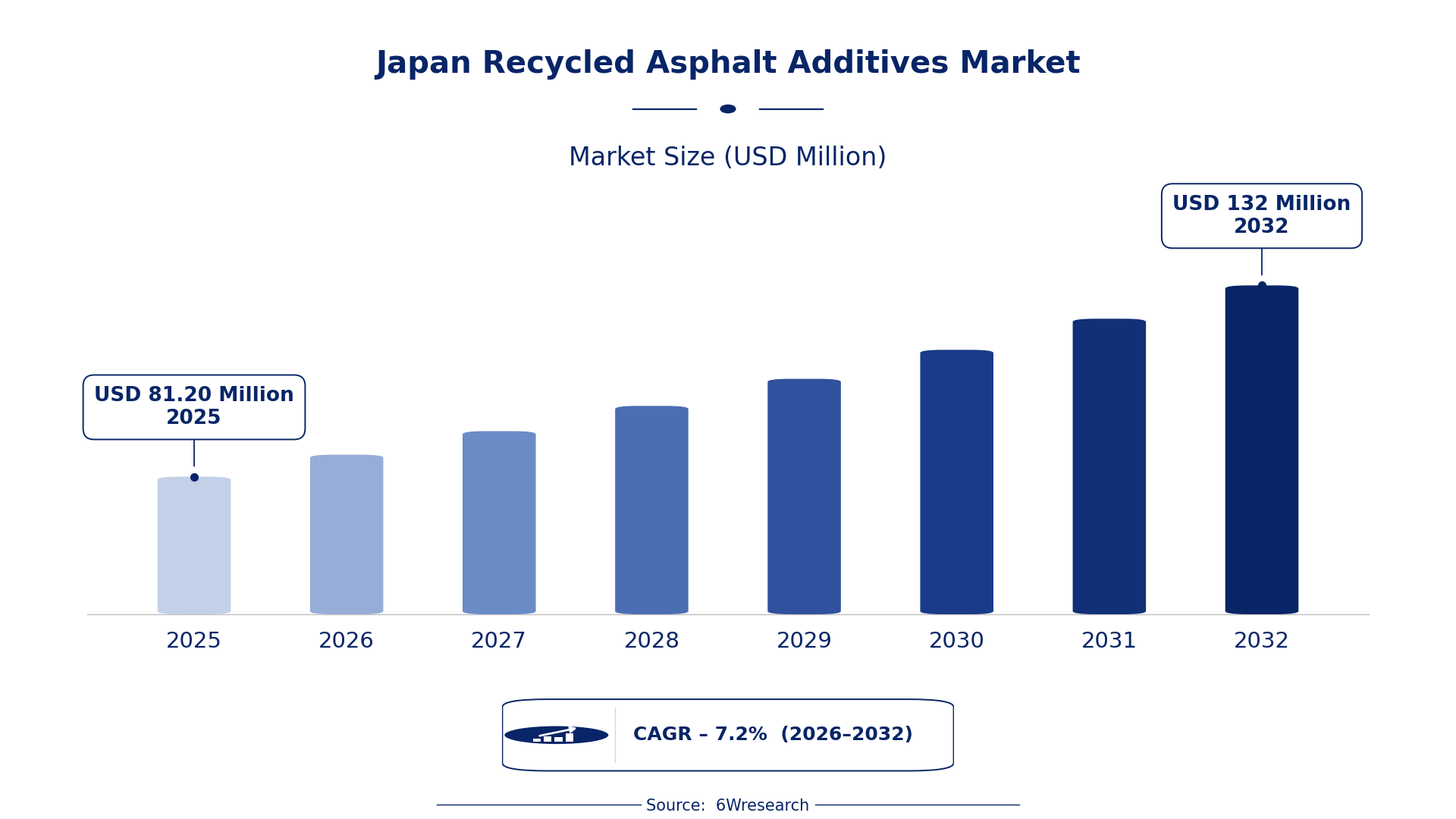
According to 6Wresearch internal database and industry insights, the Japan Recycled Asphalt Additives Market was valued at USD 81.20 Million in 2025 and is projected to reach USD 132 Million by 2032, growing at a CAGR of approximately 7.2% during 2026–2032.
Japan Recycled Asphalt Additives Market Highlights
| Report Metric | Details |
| Report Name | Japan Recycled Asphalt Additives Market (2026-2032) |
| Market Size 2025 | USD 81.20 Million |
| Market Size 2032 | USD 132 Million |
| Absolute Growth 2025–2032 | USD 50.80 Million |
| CAGR 2026–2032 | 7.2% |
| Peak Annual Growth | 8.2% in 2026 |
| Forecast Period | 2026–2032 |
| Historical Data | 2022–2025 |
| Base Year | 2025 |
| Leading Additive Type, 2025 | Rejuvenators (44% share) |
| Leading Purpose, 2025 | Binder Restoration (46% share) |
| Leading Form, 2025 | Liquids & Emulsions (47% share) |
| Leading End User, 2025 | Asphalt Producers (33% share) |
| Fastest-Growing Additive Type | Anti-Stripping Agents (10.4% CAGR) |
| Fastest-Growing Purpose | Moisture Resistance (9.5% CAGR) |
| Fastest-Growing End User | Road Construction Firms (9.1% CAGR) |
| Growing Sector | Road Construction Firms |
| Key End Users | Asphalt Producers, Road Construction Firms, Paving Contractors, Highway Maintenance Teams |
Japan Recycled Asphalt Additives Market Year-wise Growth Rate and Key Drivers (2022–2032)
This graph illustrates the annual growth rates of the market from 2022 to 2032, highlighting a steady upward trajectory and projected market expansion over the forecast period.
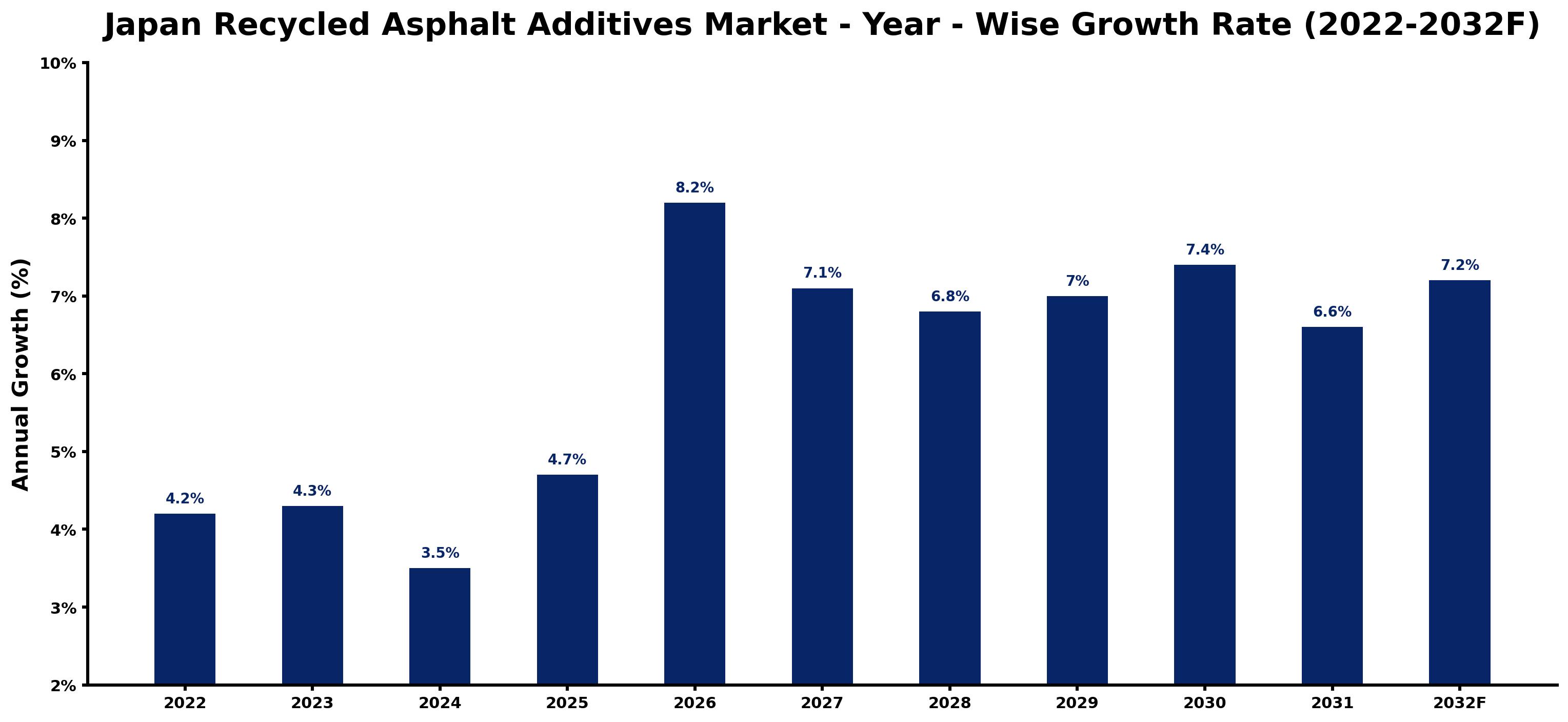
Each row of the following table gives one year's estimated growth and the event or demand shift that explains it.
| Year | Estimated Annual Growth (%) | Market Rationale |
| 2022 | 4.2 | The market showed steady growth due to ongoing infrastructure projects. |
| 2023 | 4.3 | Demand rose as asphalt production reached 12 million tons, reflecting increased activity. |
| 2024 | 3.5 | Growth slowed slightly as market adjustments took place amid stabilising demand. |
| 2025 | 4.7 | The market experienced a resurgence with improved asphalt longevity and binder restoration needs. |
| 2026 | 8.2 | A peak in growth is expected as infrastructure investments surge, driving higher additive usage. |
| 2027 | 7.1 | Growth is projected to slow as the market begins to stabilise after the peak demand period. |
| 2028 | 6.8 | Continued demand for asphalt maintenance will contribute to further growth, albeit at a slower rate. |
| 2029 | 7.0 | The market is expected to rebound with increased purchases for road construction projects and maintenance. |
| 2030 | 7.4 | Demand will remain strong due to ongoing infrastructure projects and maintenance needs. |
| 2031 | 6.6 | A slight slowdown is projected as the market adjusts to previous years' growth rates. |
| 2032 | 7.2 | Growth is expected to stabilise as the market matures and demand levels off. |
Note: Market size estimations and growth projections presented in this report are based on 6Wresearch's proprietary forecasting methodology, utilizing the latest available industry data, government publications, and primary research inputs.
Japan Recycled Asphalt Additives Market Synopsis
Recycled Asphalt Additives improve the properties of asphalt mixtures made from reclaimed asphalt pavement. The Japan Recycled Asphalt Additives Market is growing due to increased infrastructure investments, with the government allocating ¥50 billion for road improvements in 2023. The Tokyo metropolitan area serves as a major hub for asphalt consumption, driving demand from over 300 licensed asphalt producers and road construction firms employing around 150,000 workers nationwide. This growth is underpinned by the need for durable and environmentally friendly materials in road construction and maintenance.
Market Dynamics Impact Analysis (2026–2032)
| Factor | Type | Impact | Primary Segment Affected |
| Increased infrastructure investment | Driver | High | Binder Restoration |
| Growing demand for sustainable materials | Driver | High | Anti-Stripping Agents |
| Rising need for road maintenance | Opportunity | High | Moisture Resistance |
| Expansion of recycling initiatives | Opportunity | Medium | Rejuvenators |
| Regulatory compliance costs | Restraint | High | Anti-Stripping Agents |
| Limited awareness of benefits | Restraint | Medium | Fibers |
| High initial investment for new technologies | Challenge | High | Liquids & Emulsions |
| Capacity constraints in production | Challenge | Medium | Waxes |
Evaluation of Drivers in Japan Recycled Asphalt Additives Market (2026–2032)
The main growth drivers and the segments they affect most are set out below.
| Drivers | Primary Segment Affected | Why It Matters (Evidence) |
| Infrastructure investments | Binder Restoration | The government allocated ¥50 billion for road infrastructure improvements, increasing additive demand for binder restoration. |
| Sustainability initiatives | Anti-Stripping Agents | The use of anti-stripping agents in 40% of asphalt mixtures reflects a shift towards sustainable practices. |
| Longevity of asphalt roads | Moisture Resistance | Proper additives extend asphalt lifespan by 5 years, prompting increased purchases from road construction firms. |
| Recycling of asphalt materials | Rejuvenators | Japan's 90% recycling rate for asphalt materials drives demand for rejuvenators in binder restoration. |
| Technological advancements | Liquids & Emulsions | Innovations in application methods for liquids and emulsions increase their usage in asphalt production. |
This funding drives the use of binder restoration additives, essential for maintaining asphalt longevity. The increasing focus on sustainability has led to a rise in anti-stripping agents, now used in 40% of asphalt mixtures. Additives enhance the lifespan of asphalt roads by five years, prompting road construction firms to purchase more moisture resistance products. Japan's recycling rate of 90% for asphalt materials encourages the use of rejuvenators in restoration projects, boosting overall demand.
Evaluation of Restraints in Japan Recycled Asphalt Additives Market
These are the pressures that could keep growth below its potential.
| Market Restraint | Primary Segment Affected | Why It Matters (Evidence) |
| High compliance costs for regulations | Anti-Stripping Agents | Producers face increased costs due to compliance with the Waste Management and Public Cleansing Act, impacting pricing. |
| Limited awareness of additive benefits | Fibers | Many asphalt producers lack knowledge about the advantages of using fibers, leading to lower adoption rates. |
| Market entry barriers for new technologies | Liquids & Emulsions | High initial investments for new technologies deter smaller firms from entering the market. |
| Production capacity limitations | Waxes | Limited production capacity affects the availability of waxes, restricting market growth opportunities. |
| Regulatory hurdles for new products | Rejuvenators | New rejuvenators must meet stringent standards set by JIS A 5758, complicating market entry. |
Japan Recycled Asphalt Additives Market Challenges
In 2022, Japan's asphalt production reached 12 million tons, yet skills shortages among road construction workers delay projects, causing setbacks for producers. Rising raw material costs have increased expenses by 15% for buyers, restricting their capacity to invest in quality additives. Supply chain disruptions have resulted in a 20% increase in lead times for producers, complicating timely project completion. Technological advancements in asphalt additives are lagging behind global standards, compelling buyers to rely on inferior products that do not meet JIS A 5758, negatively affecting road performance.
Trends in the Japan Recycled Asphalt Additives Market
Below are the shifts with the largest effect on the Japan Recycled Asphalt Additives Market.
- Shift from Traditional to Sustainable Additives: Since 2022, there has been a notable shift towards sustainable asphalt additives, with anti-stripping agents now used in 40% of mixtures, reflecting a growing commitment to environmentally friendly practices.
- Emergence of Advanced Application Techniques: In 2023, new application techniques for liquids and emulsions have improved efficiency, resulting in a 20% increase in their usage among asphalt producers across Japan.
- Increased Focus on Road Maintenance: As of 2025, the emphasis on road maintenance has surged, with road construction firms employing around 150,000 workers, highlighting the growing need for effective asphalt additives.
- Expansion of Recycling Initiatives: Beginning in 2022, Japan's recycling rate for asphalt materials reached 90%, promoting the use of rejuvenators and supporting sustainability in road construction.
Investment Opportunities in the Japan Recycled Asphalt Additives Market
Investors looking at the Japan Recycled Asphalt Additives Market should consider the following areas.
- Road Construction Firms Seeking Additives: With road construction firms employing around 150,000 workers, there is a strong demand for effective additives, particularly rejuvenators, to improve asphalt longevity.
- Local Production Ventures: The market gap for sustainable additives presents opportunities for joint ventures, especially in regions like Tokyo, where asphalt consumption is high.
- Investment in Recycling Facilities: With a recycling rate of 90% for asphalt materials, there is a need for investment in recycling facilities to support the growing demand for rejuvenators.
- Government Support for Infrastructure Projects: The government allocated ¥50 billion for road improvements in 2023, creating opportunities for suppliers of asphalt additives to meet rising demand.
Government Initiatives in the Japan Recycled Asphalt Additives Market
The Fire Service Act regulates the storage and handling of hazardous materials, impacting producers of recycled asphalt additives. Compliance with this law ensures that additives are safely managed, which is important for maintaining industry standards and protecting public health. The Waste Management and Public Cleansing Act mandates proper disposal and treatment of industrial waste, influencing the practices of asphalt producers in Japan.
The Ministry of Land, Infrastructure, Transport and Tourism oversees road construction standards and approves projects related to asphalt additives. This agency ensures that approved materials meet quality and safety standards, which directly benefits producers and buyers in the market.
Future Insight of the Japan Recycled Asphalt Additives Market
Upcoming infrastructure projects will require advanced asphalt additives, driving demand by 2032. The integration of smart road technologies will enhance performance and durability, benefiting both buyers and suppliers. Increased investment in research will lead to the development of more efficient additives, extending the lifespan of asphalt roads by an estimated five years. With the government focusing on infrastructure improvements, suppliers will optimise production processes, ensuring sustainability in the industry.
Market Segmentation Analysis
Japan Recycled Asphalt Additives Market report covers a detailed analysis of the following market segments:
By Additive Type – Rejuvenators Lead, Anti-Stripping Agents Expected to Grow Fastest
According to Saurav Kr Singh, Senior Research Analyst at 6Wresearch, Rejuvenators took 44% of additive type revenue in 2025, more than any other category. Rejuvenators dominate the market as they are vital for restoring binder properties in aged asphalt, ensuring longevity and performance. Their necessity is highlighted by the fact that 70% of asphalt projects in Japan rely on these additives, particularly in regions with intense road usage. The quickest growth will come from Anti-Stripping Agents, forecast to expand at a CAGR of 10.4% between 2026 and 2032. The growth of Anti-Stripping Agents is fuelled by the rising demand for moisture resistance in asphalt mixtures, with 40% of formulations using these agents. This trend is likely to continue as infrastructure improvements are prioritised by the government, leading to better pavement quality. This indicates that suppliers must prioritise the development of effective anti-stripping agents to cater to evolving market needs.
By Purpose – Binder Restoration Leads, Moisture Resistance Expected to Grow Fastest
Binder Restoration held 46% of the Japan Recycled Asphalt Additives Market by purpose in 2025. Binder Restoration holds the largest share as it is essential for prolonging the lifespan of asphalt roads, which is crucial for maintaining infrastructure quality. The use of rejuvenators in 70% of asphalt projects highlights the importance of this purpose in the market. Over 2026–2032, Moisture Resistance is expected to post the fastest growth, at a CAGR of 9.5%. Moisture Resistance is growing rapidly due to heightened awareness of its role in preventing water damage, which directly impacts road safety and durability. The government's allocation of ¥50 billion for road infrastructure improvements further fuels the demand for moisture-resistant additives. This indicates that suppliers should prioritise the development of moisture-resistant products to meet the increasing market requirements.
By Form – Liquids & Emulsions Lead and Record the Fastest Growth
In 2025, Liquids & Emulsions led the form split with a 47% share. Liquids & Emulsions dominate the market as they are the most commonly used forms for recycled asphalt additives, facilitating straightforward application and integration into asphalt mixtures. Their prevalence among over 300 licensed asphalt producers in Japan underscores their importance in the industry. Liquids & Emulsions are also forecast to expand faster than any other category, at a CAGR of 8.2% over 2026–2032. The growth of Liquids & Emulsions is driven by their versatility and user-friendly nature, making them the preferred option for asphalt producers. As demand for asphalt increases, their established position is likely to strengthen further. This suggests that suppliers should concentrate on refining the formulations of liquids and emulsions to sustain their market leadership.
By End User – Asphalt Producers Lead, Road Construction Firms Expected to Grow Fastest
Asphalt Producers accounted for 33% of the market by end user in 2025. Asphalt Producers represent the largest user group for recycled asphalt additives, as they directly incorporate these materials into asphalt production. Their reliance on additives for quality assurance in their products makes them a key segment in the market. Road Construction Firms are projected to grow fastest, at a CAGR of 9.1% during 2026–2032. Road Construction Firms are experiencing the fastest growth as they increasingly utilise additives for new road projects, driven by ongoing infrastructure investments. This trend is expected to continue as demand for new road construction rises in urban areas. This highlights the need for suppliers to tailor their products to meet the specific requirements of road construction firms.
Key Attractiveness of the Report
- 10 Years of Market Numbers
- Historical Data Starting from 2022 to 2025
- Base Year 2025
- Forecast Data until 2032
- Key Performance Indicators Impacting the Market
- Major Upcoming Developments and Projects
Key Highlights of the Report:
- Japan Recycled Asphalt Additives Market Outlook
- Market Size of Japan Recycled Asphalt Additives Market, 2025
- Forecast of Japan Recycled Asphalt Additives Market, 2032
- Historical Data and Forecast of Japan Recycled Asphalt Additives Revenues & Volume for the Period 2022-2032F
- Japan Recycled Asphalt Additives Market Trend Evolution
- Japan Recycled Asphalt Additives Market Drivers and Challenges
- Japan Recycled Asphalt Additives Price Trends
- Japan Recycled Asphalt Additives Porter's Five Forces
- Japan Recycled Asphalt Additives Industry Life Cycle
- Historical Data and Forecast of Japan Recycled Asphalt Additives Market Revenues & Volume By Additive Type for the Period 2022-2032F
- Historical Data and Forecast of Japan Recycled Asphalt Additives Market Revenues & Volume By Rejuvenators for the Period 2022-2032F
- Historical Data and Forecast of Japan Recycled Asphalt Additives Market Revenues & Volume By Anti-Stripping Agents for the Period 2022-2032F
- Historical Data and Forecast of Japan Recycled Asphalt Additives Market Revenues & Volume By Waxes for the Period 2022-2032F
- Historical Data and Forecast of Japan Recycled Asphalt Additives Market Revenues & Volume By Fibers for the Period 2022-2032F
- Historical Data and Forecast of Japan Recycled Asphalt Additives Market Revenues & Volume By Purpose for the Period 2022-2032F
- Historical Data and Forecast of Japan Recycled Asphalt Additives Market Revenues & Volume By Binder Restoration for the Period 2022-2032F
- Historical Data and Forecast of Japan Recycled Asphalt Additives Market Revenues & Volume By Moisture Resistance for the Period 2022-2032F
- Historical Data and Forecast of Japan Recycled Asphalt Additives Market Revenues & Volume By Rutting Resistance for the Period 2022-2032F
- Historical Data and Forecast of Japan Recycled Asphalt Additives Market Revenues & Volume By Crack Reduction for the Period 2022-2032F
- Historical Data and Forecast of Japan Recycled Asphalt Additives Market Revenues & Volume By Form for the Period 2022-2032F
- Historical Data and Forecast of Japan Recycled Asphalt Additives Market Revenues & Volume By Liquids & Emulsions for the Period 2022-2032F
- Historical Data and Forecast of Japan Recycled Asphalt Additives Market Revenues & Volume By Powder/Solutions for the Period 2022-2032F
- Historical Data and Forecast of Japan Recycled Asphalt Additives Market Revenues & Volume By Solid for the Period 2022-2032F
- Historical Data and Forecast of Japan Recycled Asphalt Additives Market Revenues & Volume By Synthetic Fibers for the Period 2022-2032F
- Historical Data and Forecast of Japan Recycled Asphalt Additives Market Revenues & Volume By End User for the Period 2022-2032F
- Historical Data and Forecast of Japan Recycled Asphalt Additives Market Revenues & Volume By Asphalt Producers for the Period 2022-2032F
- Historical Data and Forecast of Japan Recycled Asphalt Additives Market Revenues & Volume By Road Construction Firms for the Period 2022-2032F
- Historical Data and Forecast of Japan Recycled Asphalt Additives Market Revenues & Volume By Paving Contractors for the Period 2022-2032F
- Historical Data and Forecast of Japan Recycled Asphalt Additives Market Revenues & Volume By Highway Maintenance Teams for the Period 2022-2032F
- Japan Recycled Asphalt Additives Import Export Trade Statistics
- Market Opportunity Assessment By Additive Type
- Market Opportunity Assessment By Purpose
- Market Opportunity Assessment By Form
- Market Opportunity Assessment By End User
- Japan Recycled Asphalt Additives Top Companies Market Share
- Japan Recycled Asphalt Additives Competitive Benchmarking By Technical and Operational Parameters
- Japan Recycled Asphalt Additives Company Profiles
- Japan Recycled Asphalt Additives Key Strategic Recommendations
Market Covered
The report covers the following segments.
By Additive Type
- Rejuvenators
- Anti-Stripping Agents
- Waxes
- Fibers
By Purpose
- Binder Restoration
- Moisture Resistance
- Rutting Resistance
- Crack Reduction
By Form
- Liquids & Emulsions
- Powder/Solutions
- Solid
- Synthetic Fibers
By End User
- Asphalt Producers
- Road Construction Firms
- Paving Contractors
- Highway Maintenance Teams































