Japan Redundant Flight Computer Market Size & Growth Rate
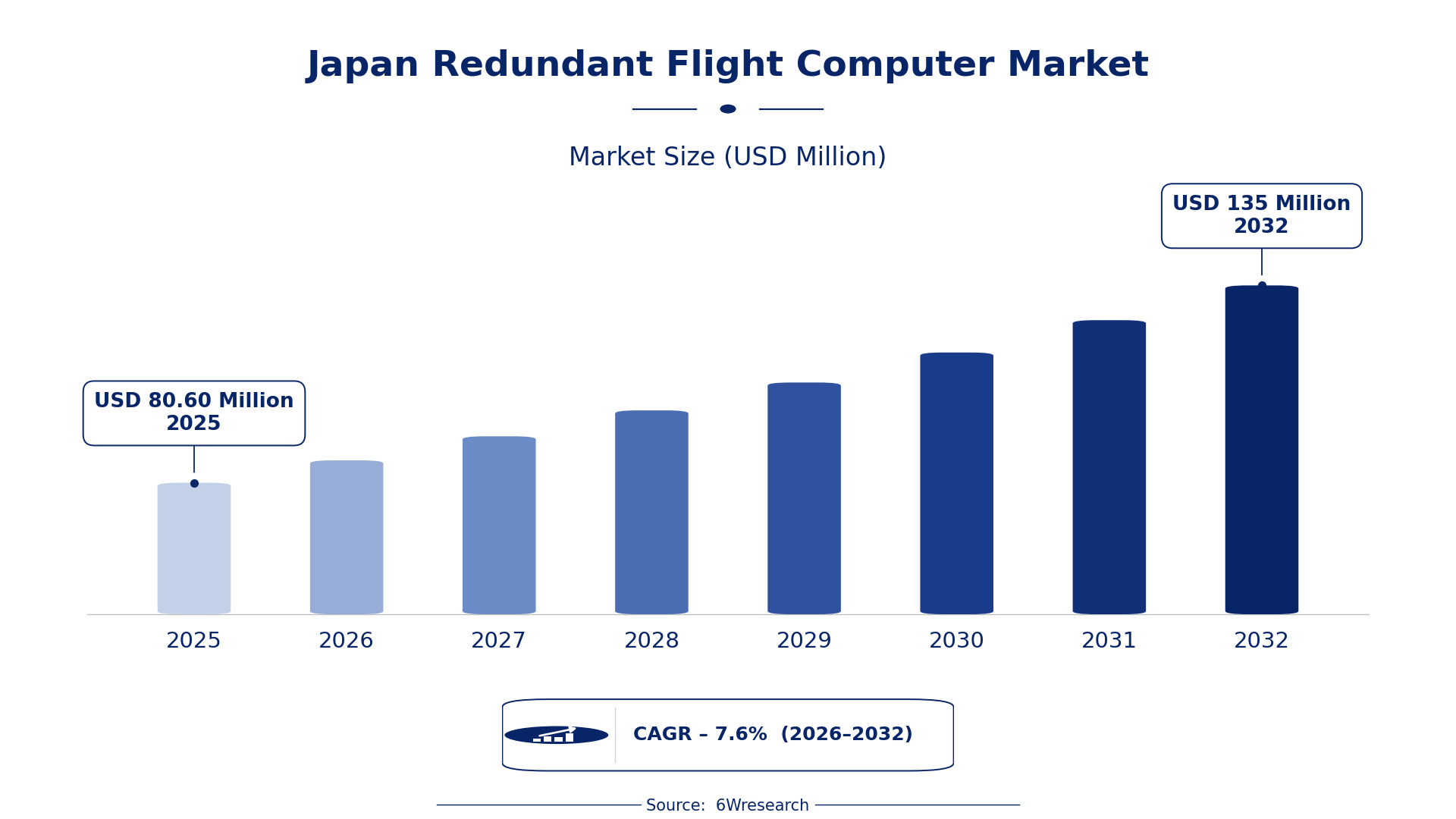
According to 6Wresearch internal database and industry insights, the Japan Redundant Flight Computer Market was valued at USD 80.60 Million in 2025 and is projected to reach USD 135 Million by 2032, growing at a CAGR of approximately 7.6% during 2026–2032.
Japan Redundant Flight Computer Market Highlights
| Report Metric | Details |
| Report Name | Japan Redundant Flight Computer Market (2026-2032) |
| Market Size 2025 | USD 80.60 Million |
| Market Size 2032 | USD 135 Million |
| Absolute Growth 2025–2032 | USD 54.40 Million |
| CAGR 2026–2032 | 7.6% |
| Peak Annual Growth | 8.9% in 2032 |
| Forecast Period | 2026–2032 |
| Historical Data | 2022–2025 |
| Base Year | 2025 |
| Leading Computer Type, 2025 | Triple Modular Redundancy (TMR) (46% share) |
| Leading Redundancy Architecture, 2025 | Triple CPU (42% share) |
| Leading Certificate Level, 2025 | DO-178C DAL A (43% share) |
| Leading End User, 2025 | Commercial Aircraft OEMs (40% share) |
| Fastest-Growing Computer Type | Dual-Redundant Units (10.7% CAGR) |
| Fastest-Growing Redundancy Architecture | Hot/Cold Standby (10.1% CAGR) |
| Fastest-Growing Certificate Level | MIL-STD (10.0% CAGR) |
| Fastest-Growing End User | Military Aircraft (10.2% CAGR) |
| Growing Sector | Aerospace |
| Key End Users | Commercial Aircraft OEMs, Military Aircraft, UAV Developers |
Japan Redundant Flight Computer Market Year-wise Growth Rate and Key Drivers (2022–2032)
This graph illustrates the annual growth rates of the market from 2022 to 2032, highlighting a steady upward trajectory and projected market expansion over the forecast period.
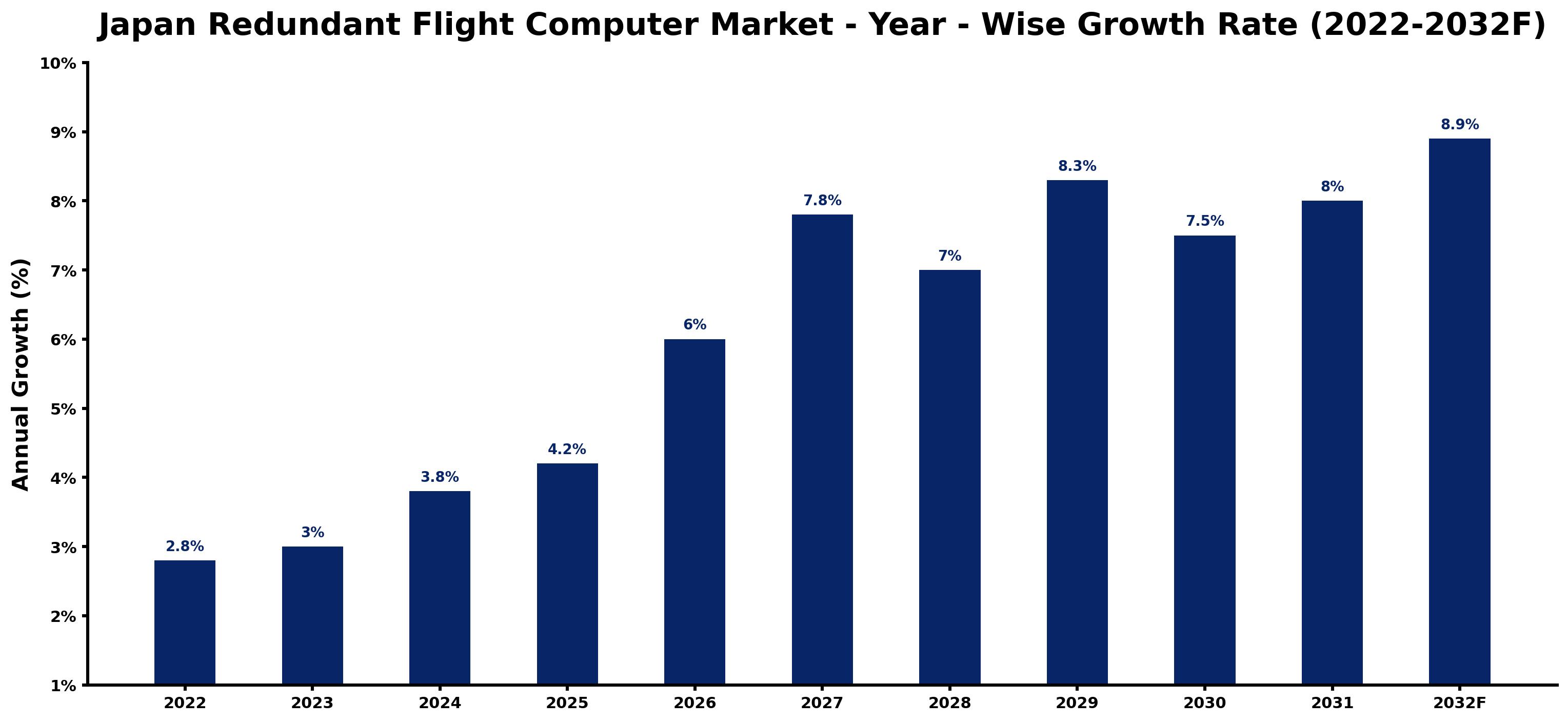
The following figures match every annual growth estimate with the main market development of that year, giving the reasoning behind each rise or slowdown.
| Year | Estimated Annual Growth (%) | Market Rationale |
| 2022 | 2.8 | The market experienced steady growth due to ongoing demand from domestic manufacturers. |
| 2023 | 3.0 | Increased military contracts contributed to a growth rate faster than the previous year. |
| 2024 | 3.8 | The rise in aircraft upgrades and modernization efforts accelerated market expansion. |
| 2025 | 4.2 | Demand surged as military aircraft upgrades were prioritized in government spending. |
| 2026 | 6.0 | Investment in aerospace technology is expected to drive market growth. |
| 2027 | 7.8 | Growing interest in UAV technology is anticipated to further boost demand. |
| 2028 | 7.0 | A slight slowdown occurred as the market adjusted to prior rapid growth rates. |
| 2029 | 8.3 | Renewed focus on military capabilities is projected to improve market performance. |
| 2030 | 7.5 | Investment in sustainable aerospace technologies is expected to slow growth slightly. |
| 2031 | 8.0 | Increased defense spending is likely to stimulate market demand again. |
| 2032 | 8.9 | The market is projected to peak as advanced technologies gain widespread adoption. |
Note: Market size estimations and growth projections presented in this report are based on 6Wresearch's proprietary forecasting methodology, utilizing the latest available industry data, government publications, and primary research inputs.
Japan Redundant Flight Computer Market Synopsis
Redundant Flight Computers are sophisticated avionics systems that ensure the reliability and safety of aircraft operations, primarily used in critical flight control, navigation, and communication functions. The Japan Redundant Flight Computer Market is growing due to increasing demand from domestic manufacturers and military contracts. The aerospace sector, valued at approximately 2 trillion yen, is attracting substantial investments, including a 5 billion yen allocation by the Ministry of Defense for military upgrades in 2023, which propels further growth in this important market.
Market Dynamics Impact Analysis (2026–2032)
| Factor | Type | Impact | Primary Segment Affected |
| Rising military contracts drive demand for advanced avionics systems. | Driver | High | Triple Modular Redundancy (TMR) |
| Increased aircraft upgrades necessitate reliable flight computers. | Driver | High | Dual-Redundant Units |
| Growing UAV market creates opportunities for innovative flight systems. | Opportunity | Medium | UAV & Autonomy Developers |
| Investment in military aircraft modernization presents new avenues. | Opportunity | High | Military Aircraft |
| High certification standards can limit market entry for new players. | Restraint | High | DO-178C DAL A |
| Rising costs of advanced components may affect pricing strategies. | Restraint | Medium | Triple CPU |
| Compliance with stringent regulations can delay product launches. | Challenge | High | Fault Tolerance |
| Limited domestic production capacity may hinder supply chain efficiency. | Challenge | Medium | Backup Flight Computers |
Evaluation of Drivers in Japan Redundant Flight Computer Market (2026–2032)
Key forces behind demand, with the segment each one moves most, are listed below.
| Drivers | Primary Segment Affected | Why It Matters (Evidence) |
| Increased military spending drives demand for advanced avionics. | Military Aircraft | The Ministry of Defense allocated 5 billion yen for aircraft upgrades in 2023. |
| Technological advancements in UAVs boost flight computer requirements. | UAV & Autonomy Developers | The number of UAVs in Japan is projected to exceed 10,000 by 2025. |
| Growing commercial aircraft fleet necessitates dependable systems. | Commercial Aircraft OEMs | The average age of commercial aircraft in Japan is around 12 years. |
| Rising safety standards drive demand for certified systems. | DO-178C DAL A | Certification is mandatory for all commercial avionics software in Japan. |
| Increased collaboration within the aerospace sector stimulates innovation. | Triple Modular Redundancy (TMR) | This association promotes collaboration to improve capabilities. |
Much of the new demand traces back to increased military spending, with 5 billion yen allocated for aircraft upgrades in 2023. The growing UAV market, projected to exceed 10,000 units by 2025, drives requirements for advanced flight computers. The average age of commercial aircraft in Japan is around 12 years, necessitating dependable systems for upgrades. Collaboration within the Tokyo Aerospace and Defense Industry Association stimulates innovation and capability across the sector, further driving demand.
Evaluation of Restraints in Japan Redundant Flight Computer Market
The table below lists the restraints and the evidence behind each.
| Market Restraint | Primary Segment Affected | Why It Matters (Evidence) |
| High certification standards can limit market entry for new players. | DO-178C DAL A | Compliance with stringent regulations requires investment in testing and certification. |
| Rising costs of advanced components may affect pricing strategies. | Triple CPU | Increased material costs impact the overall pricing of flight computer systems. |
| Manufacturers must navigate complex regulatory environments, leading to longer development times. | Fault Tolerance | Compliance with stringent regulations can delay product launches. |
| Dependence on imports for certain components can disrupt supply chains. | Backup Flight Computers | Limited domestic production capacity may hinder supply chain efficiency. |
| Fewer players in the market can lead to higher prices and reduced innovation. | Dual-Redundant Units | Market consolidation may limit competition among suppliers. |
Japan Redundant Flight Computer Market Challenges
Intense competition among manufacturers compresses profit margins, as numerous domestic and international players strive to capture market share. This situation arises from Japan's aerospace sector, valued at approximately 2 trillion yen, which restricts producers' capacity to invest in quality improvements. Skills shortages in avionics engineering create production bottlenecks, delaying project timelines by up to six months for manufacturers. Rapid technological advancements necessitate frequent updates to systems, and many producers find it challenging to achieve DO-178C DAL A certification, potentially causing delays of three months for buyers requiring timely product delivery.
Trends in the Japan Redundant Flight Computer Market
The following changes are redrawing the Japan Redundant Flight Computer Market.
- Shift from Traditional to Advanced Avionics Systems: The Tokyo region is experiencing a shift towards advanced avionics systems, driven by increased military contracts and modernization efforts. The Ministry of Defense's 5 billion yen allocation for military upgrades in 2023 supports this trend.
- Transition from Manual to Automated Flight Systems: The change towards automated flight systems is evident in military aircraft, with UAV numbers projected to exceed 10,000 by 2025. This transition improves operational efficiency and safety in aviation.
- Emergence of Sustainable Aviation Technologies: Japan's aerospace industry is prioritising sustainability, as seen in the new aerospace technology strategy implemented in 2023. This strategy aims to integrate sustainable practices across the sector, aligning with global environmental goals.
- Increased Collaboration in Aerospace Innovation: The Tokyo Aerospace and Defense Industry Association is promoting collaboration among manufacturers, enhancing innovation in flight computer technologies. This collaboration is essential for meeting the evolving demands of the aerospace sector.
Investment Opportunities in the Japan Redundant Flight Computer Market
The following areas offer the clearest openings for investors and suppliers in the Japan Redundant Flight Computer Market.
- Military Aircraft Modernization Needs: Military aircraft manufacturers are seeking advanced flight computers, supported by a 5 billion yen investment for upgrades. Suppliers can enter this market through partnerships with local defense contractors.
- Rising UAV Demand: The growing UAV market, projected to exceed 10,000 units by 2025, presents opportunities for advanced flight systems. Companies can engage with UAV developers to supply avionics.
- Investment in Sustainable Technologies: The timing is ripe as Japan implements a new aerospace technology strategy focusing on sustainability. Suppliers can invest in eco-friendly flight computer technologies to meet emerging standards.
- Collaboration with Aerospace Associations: Engaging with the Tokyo Aerospace and Defense Industry Association can open avenues for innovation. Suppliers should consider partnerships to improve their market presence.
Government Initiatives in the Japan Redundant Flight Computer Market
The Green Growth Strategy, adopted in December 2020 and updated in 2021, identifies 14 growth sectors, including aerospace, with a focus on sustainability and innovation. This initiative aligns with Japan's broader goals for technological advancement in the aerospace sector. The GX Promotion Act, enacted in 2023, establishes the framework for the GX strategy, aiming for substantial public-private decarbonisation investment over the next decade, which will influence Redundant Flight Computer manufacturers by promoting sustainable practices.
The Japan Aerospace Exploration Agency (JAXA) oversees satellite and spacecraft development, ensuring adherence to national standards. The agency's funding for various aerospace projects supports advancements in flight computer technologies, benefiting both manufacturers and buyers. The Aerospace Industry Association of Japan also contributes to promoting industry standards and practices, facilitating smoother certification processes for new technologies.
Future Insight of the Japan Redundant Flight Computer Market
Investment in the aerospace sector is set to increase as the Japanese government raises defense spending to 2% of GDP by 2025, driving demand for redundant flight computers. By 2032, advancements in UAV technology will lead to a fleet exceeding 10,000 units, prompting suppliers to innovate their product lines. Collaborative initiatives, supported by the Japan Aerospace Exploration Agency, will facilitate technological progress and boost production efficiency. Buyers will benefit from improved reliability and safety in aircraft operations as producers adopt new industry standards.
Market Segmentation Analysis
Japan Redundant Flight Computer Market report covers a detailed analysis of the following market segments:
By Computer Type – Triple Modular Redundancy (TMR) Leads, Dual-Redundant Units Expected to Grow Fastest
According to Saurav Kr Singh, Senior Research Analyst at 6Wresearch, with 46% of computer type revenue in 2025, Triple Modular Redundancy (TMR) was the largest category. Triple Modular Redundancy (TMR) holds the largest share as it is essential for safety-critical applications, especially in commercial aviation where operational reliability is paramount. With over 1,500 certified flight computers in Japan, TMR systems are indispensable for ensuring safe operations in both commercial and military aircraft. The quickest growth will come from Dual-Redundant Units, forecast to expand at a CAGR of 10.7% between 2026 and 2032. The growth of Dual-Redundant Units is propelled by the increasing need for backup systems in critical applications, particularly with the projected rise of UAVs to over 10,000 by 2025. This trend reflects a broader commitment to enhancing safety measures in aviation operations. Suppliers must focus on advancing TMR technologies while also broadening their range of dual-redundant systems to meet evolving market needs.
By Redundancy Architecture – Triple CPU Leads, Hot/Cold Standby Expected to Grow Fastest
Triple CPU held 42% of the Japan Redundant Flight Computer Market by redundancy architecture in 2025. Triple CPU architecture leads the market as it guarantees fault tolerance, which is crucial for maintaining operational integrity in aircraft systems. Its extensive use is vital among manufacturers aiming to meet stringent safety standards in Japan's aerospace sector. Over 2026–2032, Hot/Cold Standby is expected to post the fastest growth, at a CAGR of 10.1%. Hot/Cold Standby is experiencing rapid growth due to its ability to ensure seamless operational continuity, a feature increasingly demanded in military applications. The government's focus on strengthening defense capabilities further fuels this trend. Buyers will benefit from investing in advanced redundancy architectures that ensure reliability and compliance with safety regulations.
By Certificate Level – DO-178C DAL A Leads, MIL-STD Expected to Grow Fastest
DO-178C DAL A accounted for 43% of the market by certificate level in 2025. DO-178C DAL A certification dominates the market as it is a mandatory requirement for software safety in commercial avionics, ensuring that systems meet high safety standards. This certification is vital for all commercial aircraft operations in Japan, reinforcing its importance in the market. MIL-STD is projected to grow fastest, at a CAGR of 10.0% during 2026–2032. The MIL-STD certification is gaining traction as military applications expand, necessitating compliance with stringent military standards. The Japanese government's increased defense spending highlights the urgency for certified systems in military aircraft. Suppliers must prioritise obtaining relevant certifications to align with market demands and regulatory requirements.
By End User – Commercial Aircraft OEMs Lead, Military Aircraft Expected to Grow Fastest
Commercial Aircraft OEMs took 40% of end user revenue in 2025, more than any other category. Commercial Aircraft OEMs constitute the largest segment as they are the primary users of redundant flight computers, motivated by the need for improved safety in commercial aviation. The average age of commercial aircraft in Japan, approximately 12 years, suggests a considerable installed base that requires upgrades. Military Aircraft is set to record the highest CAGR in this split, 10.2% over 2026–2032. Military Aircraft is the fastest-growing segment, fuelled by substantial government investment in defense upgrades, including a 5 billion yen allocation for military aircraft in 2023. This funding indicates a strategic focus on modernising military capabilities. Suppliers should customise their strategies to meet the distinct requirements of both commercial and military sectors to optimise market opportunities.
Key Attractiveness of the Report
- 10 Years of Market Numbers
- Historical Data Starting from 2022 to 2025
- Base Year 2025
- Forecast Data until 2032
- Key Performance Indicators Impacting the Market
- Major Upcoming Developments and Projects
Key Highlights of the Report:
- Japan Redundant Flight Computer Market Outlook
- Market Size of Japan Redundant Flight Computer Market, 2025
- Forecast of Japan Redundant Flight Computer Market, 2032
- Historical Data and Forecast of Japan Redundant Flight Computer Revenues & Volume for the Period 2022-2032F
- Japan Redundant Flight Computer Market Trend Evolution
- Japan Redundant Flight Computer Market Drivers and Challenges
- Japan Redundant Flight Computer Price Trends
- Japan Redundant Flight Computer Porter's Five Forces
- Japan Redundant Flight Computer Industry Life Cycle
- Historical Data and Forecast of Japan Redundant Flight Computer Market Revenues & Volume By Computer Type for the Period 2022-2032F
- Historical Data and Forecast of Japan Redundant Flight Computer Market Revenues & Volume By Triple Modular Redundancy (TMR) for the Period 2022-2032F
- Historical Data and Forecast of Japan Redundant Flight Computer Market Revenues & Volume By Dual-Redundant Units for the Period 2022-2032F
- Historical Data and Forecast of Japan Redundant Flight Computer Market Revenues & Volume By Distributed Flight Computers for the Period 2022-2032F
- Historical Data and Forecast of Japan Redundant Flight Computer Market Revenues & Volume By Backup Flight Computers for the Period 2022-2032F
- Historical Data and Forecast of Japan Redundant Flight Computer Market Revenues & Volume By Redundancy Architecture for the Period 2022-2032F
- Historical Data and Forecast of Japan Redundant Flight Computer Market Revenues & Volume By Triple CPU for the Period 2022-2032F
- Historical Data and Forecast of Japan Redundant Flight Computer Market Revenues & Volume By Hot/Cold Standby for the Period 2022-2032F
- Historical Data and Forecast of Japan Redundant Flight Computer Market Revenues & Volume By Networked Modules for the Period 2022-2032F
- Historical Data and Forecast of Japan Redundant Flight Computer Market Revenues & Volume By Fail-Operational for the Period 2022-2032F
- Historical Data and Forecast of Japan Redundant Flight Computer Market Revenues & Volume By Certificate Level for the Period 2022-2032F
- Historical Data and Forecast of Japan Redundant Flight Computer Market Revenues & Volume By DO-178C DAL A for the Period 2022-2032F
- Historical Data and Forecast of Japan Redundant Flight Computer Market Revenues & Volume By MIL-STD for the Period 2022-2032F
- Historical Data and Forecast of Japan Redundant Flight Computer Market Revenues & Volume By Fault Tolerance for the Period 2022-2032F
- Historical Data and Forecast of Japan Redundant Flight Computer Market Revenues & Volume By Type-Certified for the Period 2022-2032F
- Historical Data and Forecast of Japan Redundant Flight Computer Market Revenues & Volume By End User for the Period 2022-2032F
- Historical Data and Forecast of Japan Redundant Flight Computer Market Revenues & Volume By Commercial Aircraft OEMs for the Period 2022-2032F
- Historical Data and Forecast of Japan Redundant Flight Computer Market Revenues & Volume By Military Aircraft for the Period 2022-2032F
- Historical Data and Forecast of Japan Redundant Flight Computer Market Revenues & Volume By UAV & Autonomy Developers for the Period 2022-2032F
- Historical Data and Forecast of Japan Redundant Flight Computer Market Revenues & Volume By Spacecraft & Satellites for the Period 2022-2032F
- Japan Redundant Flight Computer Import Export Trade Statistics
- Market Opportunity Assessment By Computer Type
- Market Opportunity Assessment By Redundancy Architecture
- Market Opportunity Assessment By Certificate Level
- Market Opportunity Assessment By End User
- Japan Redundant Flight Computer Top Companies Market Share
- Japan Redundant Flight Computer Competitive Benchmarking By Technical and Operational Parameters
- Japan Redundant Flight Computer Company Profiles
- Japan Redundant Flight Computer Key Strategic Recommendations
Market Covered
Segments analysed in this report are listed below.
By Computer Type
- Triple Modular Redundancy (TMR)
- Dual-Redundant Units
- Distributed Flight Computers
- Backup Flight Computers
By Redundancy Architecture
- Triple CPU
- Hot/Cold Standby
- Networked Modules
- Fail-Operational
By Certificate Level
- DO-178C DAL A
- MIL-STD
- Fault Tolerance
- Type-Certified
By End User
- Commercial Aircraft OEMs
- Military Aircraft
- UAV & Autonomy Developers
- Spacecraft & Satellites






































