Japan Redundant Ignition Unit Market Size & Growth Rate
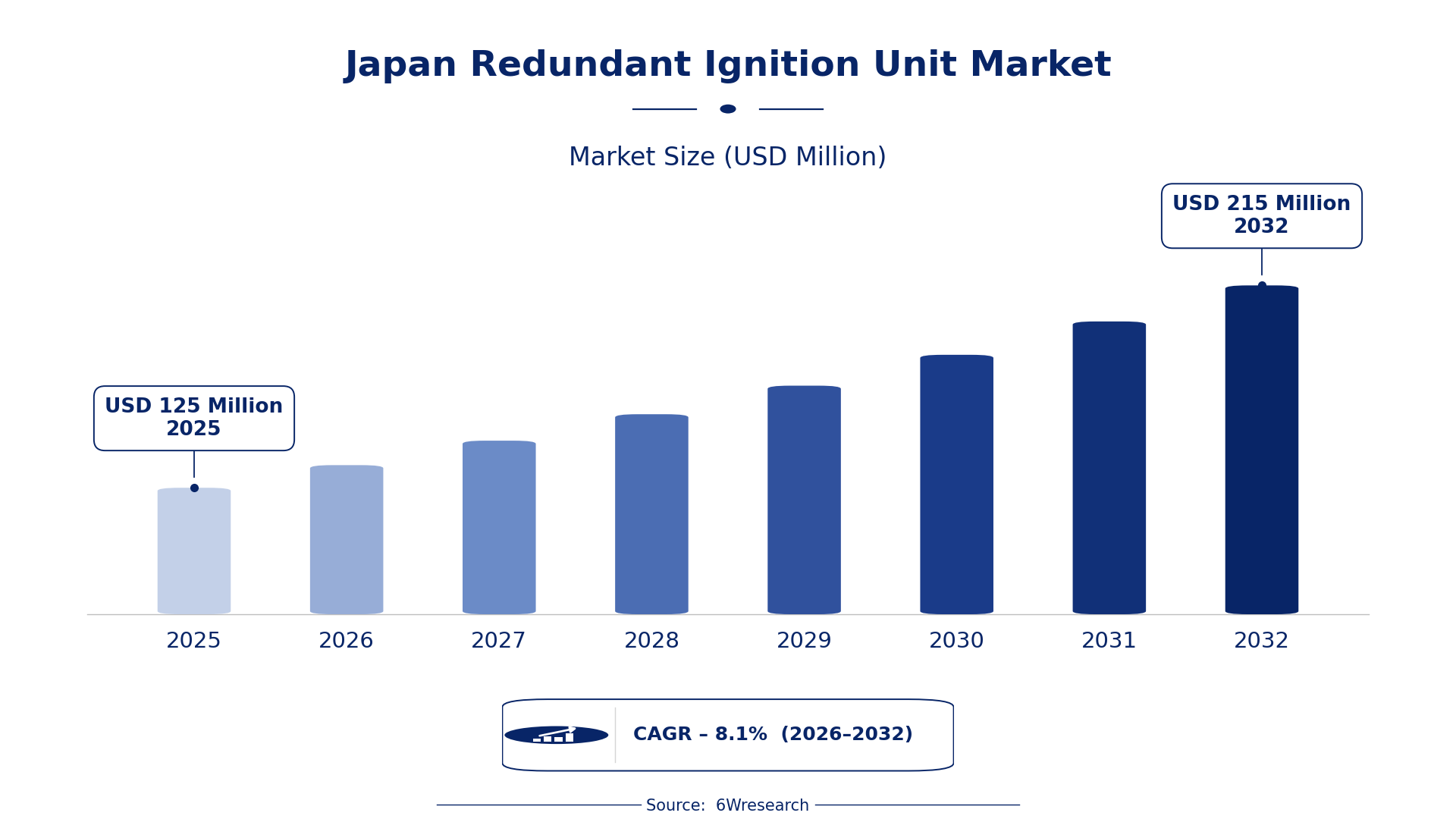
According to 6Wresearch internal database and industry insights, the Japan Redundant Ignition Unit Market was valued at USD 125 Million in 2025 and is projected to reach USD 215 Million by 2032, growing at a CAGR of approximately 8.1% during 2026–2032.
Japan Redundant Ignition Unit Market Highlights
| Report Metric | Details |
| Report Name | Japan Redundant Ignition Unit Market (2026-2032) |
| Market Size 2025 | USD 125 Million |
| Market Size 2032 | USD 215 Million |
| Absolute Growth 2025–2032 | USD 90 Million |
| CAGR 2026–2032 | 8.1% |
| Peak Annual Growth | 9.2% in 2032 |
| Forecast Period | 2026–2032 |
| Historical Data | 2022–2025 |
| Base Year | 2025 |
| Leading Unit Type, 2025 | Dual Igniters (36% share) |
| Leading Redundancy Mode, 2025 | Twin-Plug Configuration (42% share) |
| Leading Ignition Type, 2025 | Spark/Igniter (48% share) |
| Leading End User, 2025 | Aircraft & Engine OEMs (43% share) |
| Fastest-Growing Unit Type | Backup Ignition Modules (11.4% CAGR) |
| Fastest-Growing Redundancy Mode | Hot Standby (10.6% CAGR) |
| Fastest-Growing Ignition Type | Electronic Control (11.6% CAGR) |
| Fastest-Growing End User | Military Engines (10.7% CAGR) |
| Growing Sector | Aerospace |
| Key End Users | Aircraft & Engine OEMs, Military Engines, Space Launch Vehicles |
Japan Redundant Ignition Unit Market Year-wise Growth Rate and Key Drivers (2022–2032)
This graph illustrates the annual growth rates of the market from 2022 to 2032, highlighting a steady upward trajectory and projected market expansion over the forecast period.
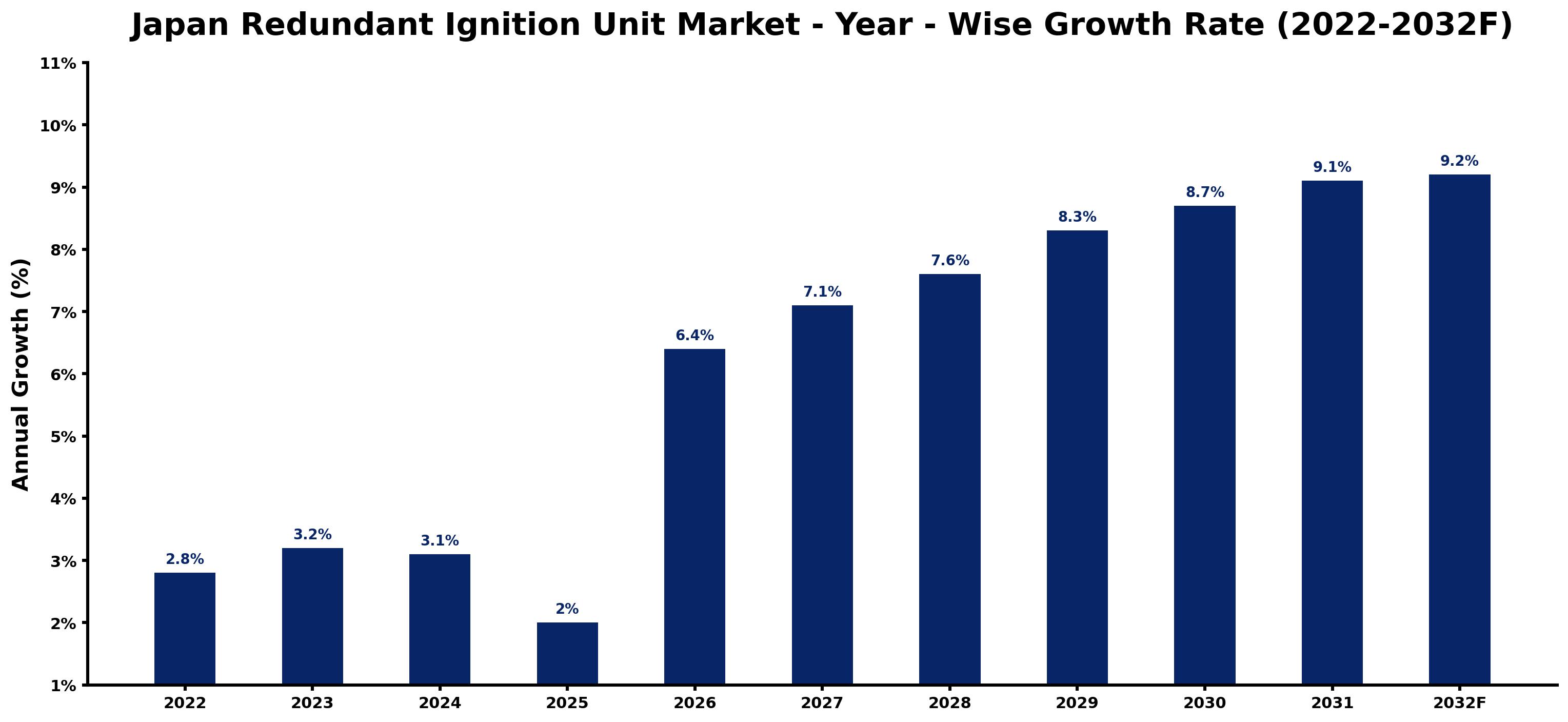
Year by year, the estimates below pair each growth rate with the development that shaped it.
| Year | Estimated Annual Growth (%) | Market Rationale |
| 2022 | 2.8 | The market showed steady growth due to existing demand from aerospace manufacturers. |
| 2023 | 3.2 | Growth accelerated as the aerospace sector increased production capabilities. |
| 2024 | 3.1 | A slight slowdown occurred as manufacturers adjusted to new supply chain conditions. |
| 2025 | 2.0 | Demand continued to grow, but at a slower pace as market conditions stabilised. |
| 2026 | 6.4 | Strong growth is anticipated as new aerospace technology programmes launch. |
| 2027 | 7.1 | Increased investment in military engines drives further expansion in demand. |
| 2028 | 7.6 | The market will grow as technological advancements improve ignition systems. |
| 2029 | 8.3 | Rising demand for space launch vehicles will contribute to market growth. |
| 2030 | 8.7 | The introduction of new aerospace standards will boost production and demand. |
| 2031 | 9.1 | Growing military budgets will support increased procurement of ignition systems. |
| 2032 | 9.2 | The market peaks as advanced aerospace projects come to fruition. |
Note: Market size estimations and growth projections presented in this report are based on 6Wresearch's proprietary forecasting methodology, utilizing the latest available industry data, government publications, and primary research inputs.
Japan Redundant Ignition Unit Market Synopsis
A Redundant Ignition Unit is crucial for aerospace applications, ensuring reliable ignition systems in aircraft engines and space launch vehicles. Manufactured with advanced materials, it improves safety and performance. The Japan Redundant Ignition Unit Market is growing, driven by the aerospace industry's expansion, highlighted by a $100 million aerospace technology programme launched in 2023. Demand from Aircraft & Engine OEMs and military applications further propels this growth, suggesting a robust future for the sector.
Market Dynamics Impact Analysis (2026–2032)
| Factor | Type | Impact | Primary Segment Affected |
| Increasing production of military engines | Driver | High | Military Engines |
| Technological advancements in ignition systems | Driver | High | Redundant Ignition Systems |
| Rising investments in aerospace technology | Opportunity | High | Aircraft & Engine OEMs |
| Growing demand for space launch vehicles | Opportunity | High | Space Launch Vehicles |
| Regulatory requirements for redundancy in military applications | Restraint | High | Redundant Ignition Systems |
| High manufacturing costs for advanced ignition technologies | Restraint | Medium | Backup Ignition Modules |
| Supply chain disruptions affecting component availability | Challenge | High | Redundant Ignition Systems |
| Competition from emerging ignition technologies | Challenge | Medium | Dual Igniters |
Evaluation of Drivers in Japan Redundant Ignition Unit Market (2026–2032)
Below are the drivers that matter most for revenue growth, with supporting evidence.
| Drivers | Primary Segment Affected | Why It Matters (Evidence) |
| Growing military budgets | Military Engines | Japan's defense budget for aerospace technology is projected at $5 billion for 2023, driving demand for reliable ignition systems. |
| Technological advancements | Redundant Ignition Systems | The adoption of ISO 9001 standards in aerospace manufacturing enhances quality, leading to increased purchases of advanced ignition units. |
| Increased production of space launch vehicles | Space Launch Vehicles | With around 10 active space launch vehicles, demand for redundant ignition units is rising to ensure mission success. |
| Expansion of the aerospace workforce | Aircraft & Engine OEMs | Over 100,000 skilled professionals in Japan's aerospace sector are boosting production capabilities and driving demand for ignition systems. |
| New aerospace technology programs | Backup Ignition Modules | The $100 million aerospace technology program launched in 2023 is expected to enhance innovation and demand for backup systems. |
Volumes grow on the back of increased military spending, with Japan's defense budget for aerospace technology projected at $5 billion in 2023, which drives demand for reliable ignition systems. Advancements in ignition systems improve quality and increase purchases. The active fleet of around 10 space launch vehicles boosts demand for redundant ignition units to ensure mission success. The aerospace workforce, comprising over 100,000 skilled professionals, strengthens production capabilities, creating a need for advanced ignition technologies.
Evaluation of Restraints in Japan Redundant Ignition Unit Market
The following restraints limit how fast demand can grow.
| Market Restraint | Primary Segment Affected | Why It Matters (Evidence) |
| Regulatory compliance costs for military applications | Redundant Ignition Systems | Compliance with stringent regulations increases production costs, impacting pricing for military customers. |
| High manufacturing costs for advanced technologies | Backup Ignition Modules | The complexity of advanced ignition systems raises manufacturing costs, limiting affordability for smaller manufacturers. |
| Supply chain disruptions | Redundant Ignition Systems | Recent global supply chain issues have delayed component availability, affecting production schedules and deliveries. |
| Limited market for niche ignition technologies | Dual Igniters | The specialized nature of dual igniters restricts their market size, resulting in slower growth compared to mainstream products. |
| Competition from emerging technologies | Dual Igniters | New ignition technologies are being developed, posing a threat to the traditional dual igniter market. |
Japan Redundant Ignition Unit Market Challenges
Buyers in the aerospace sector face supply chain disruptions due to reliance on a limited number of suppliers for critical components, which can delay production timelines by three months. Competition from international manufacturers forces suppliers to reduce prices, risking profit margins by around 15%. Regulatory compliance with ISO 9001 standards increases operational costs for producers, potentially raising expenses by 10%. Smaller manufacturers encounter challenges in adopting new technologies in ignition systems, diverting funds from innovation and hindering their competitiveness in the market.
Trends in the Japan Redundant Ignition Unit Market
The following changes are redrawing the Japan Redundant Ignition Unit Market.
- Shift towards Advanced Ignition Technologies: In 2023, the aerospace industry is increasingly adopting advanced ignition technologies, with the Japan Aerospace Exploration Agency (JAXA) focusing on new designs. This shift is projected to improve performance and reliability in aerospace applications, aligning with the $2 billion space exploration budget.
- Growing Demand for Military Applications: Military Engines are experiencing heightened demand as Japan's defense budget reaches $5 billion in 2023. This increase is driving innovation and procurement of advanced ignition systems, ensuring reliability in defense operations.
- Transition from Traditional to Electronic Control Systems: The adoption of Electronic Control systems is on the rise, with a projected CAGR of 11.6% from 2026 to 2032. This trend reflects the industry's move towards more efficient and reliable ignition management in aerospace applications.
- Increase in Space Launch Vehicle Development: Japan's active space launch vehicle fleet of around 10 units is driving innovation in ignition systems. As the government invests in aerospace technology, demand for reliable ignition units is set to rise.
Investment Opportunities in the Japan Redundant Ignition Unit Market
Investors looking at the Japan Redundant Ignition Unit Market should consider the following areas.
- Timing is Right for Investment in Backup Systems: With Japan's aerospace technology programme budgeted at $100 million, now is the time to invest in backup ignition modules to meet rising demand from Aircraft & Engine OEMs.
- Entry through Joint Ventures in Aerospace: Local partnerships are essential for entering Japan's aerospace market, particularly for supplying redundant ignition systems to military engines, supported by the growing defense budget.
- Focus on Tokyo and Nagoya for Aerospace Components: Tokyo and Nagoya are key industrial regions for aerospace components, presenting opportunities for suppliers of redundant ignition units to establish a local presence.
- Supply Advanced Ignition Technologies: Investing in advanced ignition technologies aligns with the increasing demand from space launch vehicles, driven by Japan's commitment to improving its aerospace capabilities.
Government Initiatives in the Japan Redundant Ignition Unit Market
The Electrical Appliance and Material Safety Act, updated in 1961, regulates safety standards for ignition systems, ensuring that all products meet stringent safety requirements. This act complements the Semiconductor and Digital Industry Strategy from June 2021, which aims to secure domestic semiconductor manufacturing, vital for advanced ignition technology development.
Support from the Ministry of Economy, Trade and Industry (METI) facilitates innovation in ignition systems through funding programmes. The Tokyo Metropolitan Government also provides funding to aerospace startups, facilitating the development of advanced technologies in the region.
Future Insight of the Japan Redundant Ignition Unit Market
A new aerospace technology programme will launch with a $100 million budget by 2032, improving the reliability of ignition systems. As Japan aims to increase domestic aerospace production by 20% by 2025, suppliers will benefit from heightened demand for components. Collaboration between the Japan Aerospace Exploration Agency and local manufacturers will aid in integrating advanced technologies in ignition systems. The focus on dual-use technology will provide opportunities for suppliers to broaden their product offerings and meet specific market needs.
Market Segmentation Analysis
Japan Redundant Ignition Unit Market report covers a detailed analysis of the following market segments:
By Unit Type – Dual Igniters Lead, Backup Ignition Modules Expected to Grow Fastest
According to Saurav Kr Singh, Senior Research Analyst at 6Wresearch, Dual Igniters held 36% of the Japan Redundant Ignition Unit Market by unit type in 2025. Dual Igniters hold the largest share due to their critical role in ensuring reliable ignition in aircraft engines, particularly in the Tokyo region, a hub for aerospace manufacturing. The substantial installed base of military aircraft, approximately 1,500 units, drives consistent demand for this technology. The quickest growth will come from Backup Ignition Modules, forecast to expand at a CAGR of 11.4% between 2026 and 2032. The rapid growth of Backup Ignition Modules stems from the increasing need for redundancy to prevent failures in critical systems, especially as Japan's defense budget for aerospace technology reaches $5 billion in 2023. Given the emphasis on reliability, Dual Igniters will likely maintain and expand their lead. Suppliers should prioritise advancements in Dual Igniters while also investing in Backup Ignition Modules to meet market demands.
By Redundancy Mode – Twin-Plug Configuration Leads, Hot Standby Expected to Grow Fastest
With 42% of redundancy mode revenue in 2025, Twin-Plug Configuration was the largest category. The Twin-Plug Configuration leads the market as it significantly enhances ignition reliability in high-performance engines prevalent in Japan's aerospace sector. This configuration is essential for compliance with widely adopted ISO 9001 standards in aerospace manufacturing. Hot Standby is projected to grow fastest, at a CAGR of 10.6% during 2026–2032. Hot Standby is experiencing swift growth due to its ability to provide immediate backup in case of failure, aligning with the government's focus on dual-use technology in aerospace. The increasing emphasis on safety will likely bolster the dominance of Twin-Plug Configuration. Buyers will benefit from suppliers prioritising advanced redundancy solutions like Twin-Plug Configuration and Hot Standby to enhance safety and reliability.
By Ignition Type – Spark/Igniter Leads, Electronic Control Expected to Grow Fastest
The largest ignition type category in 2025 was Spark/Igniter, at 48% of revenue. Spark/Igniter technology commands the largest share as it serves as the fundamental ignition technology for engines, crucial for both military and commercial applications in Japan's $25 billion aerospace industry. Its established presence ensures a robust installed base across various applications. Electronic Control is set to record the highest CAGR in this split, 11.6% over 2026–2032. The Electronic Control segment is witnessing rapid growth due to its vital role in managing modern ignition systems, particularly as Japan's aerospace sector embraces advanced technologies. This trend will further solidify the position of Spark/Igniter technology in the market. Suppliers should consider expanding their offerings in Electronic Control technologies to address the evolving needs of the aerospace industry.
By End User – Aircraft & Engine OEMs Lead, Military Engines Expected to Grow Fastest
In 2025, Aircraft & Engine OEMs led the end user split with a 43% share. Aircraft & Engine OEMs dominate the market as they are the primary users of ignition technology, directly influencing the demand for Redundant Ignition Units in Japan's aerospace sector. The presence of over 3,000 aircraft in service significantly propels this demand. Over 2026–2032, Military Engines are expected to post the fastest growth, at a CAGR of 10.7%. Military Engines are witnessing the fastest growth due to their critical importance in defense applications, supported by Japan's projected $5 billion defense budget for aerospace technology in 2023. This military focus will continue to elevate the demand for Aircraft & Engine OEMs. Suppliers must align their strategies with the requirements of both Aircraft & Engine OEMs and Military Engines to capitalise on growth opportunities.
Key Attractiveness of the Report
- 10 Years of Market Numbers
- Historical Data Starting from 2022 to 2025
- Base Year 2025
- Forecast Data until 2032
- Key Performance Indicators Impacting the Market
- Major Upcoming Developments and Projects
Key Highlights of the Report:
- Japan Redundant Ignition Unit Market Outlook
- Market Size of Japan Redundant Ignition Unit Market, 2025
- Forecast of Japan Redundant Ignition Unit Market, 2032
- Historical Data and Forecast of Japan Redundant Ignition Unit Revenues & Volume for the Period 2022-2032F
- Japan Redundant Ignition Unit Market Trend Evolution
- Japan Redundant Ignition Unit Market Drivers and Challenges
- Japan Redundant Ignition Unit Price Trends
- Japan Redundant Ignition Unit Porter's Five Forces
- Japan Redundant Ignition Unit Industry Life Cycle
- Historical Data and Forecast of Japan Redundant Ignition Unit Market Revenues & Volume By Unit Type for the Period 2022-2032F
- Historical Data and Forecast of Japan Redundant Ignition Unit Market Revenues & Volume By Dual Igniters for the Period 2022-2032F
- Historical Data and Forecast of Japan Redundant Ignition Unit Market Revenues & Volume By Backup Ignition Modules for the Period 2022-2032F
- Historical Data and Forecast of Japan Redundant Ignition Unit Market Revenues & Volume By Redundant Ignition Systems for the Period 2022-2032F
- Historical Data and Forecast of Japan Redundant Ignition Unit Market Revenues & Volume By Redundant Dual Inverters for the Period 2022-2032F
- Historical Data and Forecast of Japan Redundant Ignition Unit Market Revenues & Volume By Redundancy Mode for the Period 2022-2032F
- Historical Data and Forecast of Japan Redundant Ignition Unit Market Revenues & Volume By Twin-Plug Configuration for the Period 2022-2032F
- Historical Data and Forecast of Japan Redundant Ignition Unit Market Revenues & Volume By Hot Standby for the Period 2022-2032F
- Historical Data and Forecast of Japan Redundant Ignition Unit Market Revenues & Volume By Multi-Chamber Engines for the Period 2022-2032F
- Historical Data and Forecast of Japan Redundant Ignition Unit Market Revenues & Volume By Parallel Units for the Period 2022-2032F
- Historical Data and Forecast of Japan Redundant Ignition Unit Market Revenues & Volume By Ignition Type for the Period 2022-2032F
- Historical Data and Forecast of Japan Redundant Ignition Unit Market Revenues & Volume By Spark/Igniter for the Period 2022-2032F
- Historical Data and Forecast of Japan Redundant Ignition Unit Market Revenues & Volume By Electronic Control for the Period 2022-2032F
- Historical Data and Forecast of Japan Redundant Ignition Unit Market Revenues & Volume By Plasma Ignitors for the Period 2022-2032F
- Historical Data and Forecast of Japan Redundant Ignition Unit Market Revenues & Volume By DC High-Power for the Period 2022-2032F
- Historical Data and Forecast of Japan Redundant Ignition Unit Market Revenues & Volume By End User for the Period 2022-2032F
- Historical Data and Forecast of Japan Redundant Ignition Unit Market Revenues & Volume By Aircraft & Engine OEMs for the Period 2022-2032F
- Historical Data and Forecast of Japan Redundant Ignition Unit Market Revenues & Volume By Military Engines for the Period 2022-2032F
- Historical Data and Forecast of Japan Redundant Ignition Unit Market Revenues & Volume By Space Launch Vehicles for the Period 2022-2032F
- Historical Data and Forecast of Japan Redundant Ignition Unit Market Revenues & Volume By Rotary-Wing Aircraft for the Period 2022-2032F
- Japan Redundant Ignition Unit Import Export Trade Statistics
- Market Opportunity Assessment By Unit Type
- Market Opportunity Assessment By Redundancy Mode
- Market Opportunity Assessment By Ignition Type
- Market Opportunity Assessment By End User
- Japan Redundant Ignition Unit Top Companies Market Share
- Japan Redundant Ignition Unit Competitive Benchmarking By Technical and Operational Parameters
- Japan Redundant Ignition Unit Company Profiles
- Japan Redundant Ignition Unit Key Strategic Recommendations
Market Covered
The following segment groups are covered in the report.
By Unit Type
- Dual Igniters
- Backup Ignition Modules
- Redundant Ignition Systems
- Redundant Dual Inverters
By Redundancy Mode
- Twin-Plug Configuration
- Hot Standby
- Multi-Chamber Engines
- Parallel Units
By Ignition Type
- Spark/Igniter
- Electronic Control
- Plasma Ignitors
- DC High-Power
By End User
- Aircraft & Engine OEMs
- Military Engines
- Space Launch Vehicles
- Rotary-Wing Aircraft






































