Japan Refillable Deodorants Market Size & Growth Rate
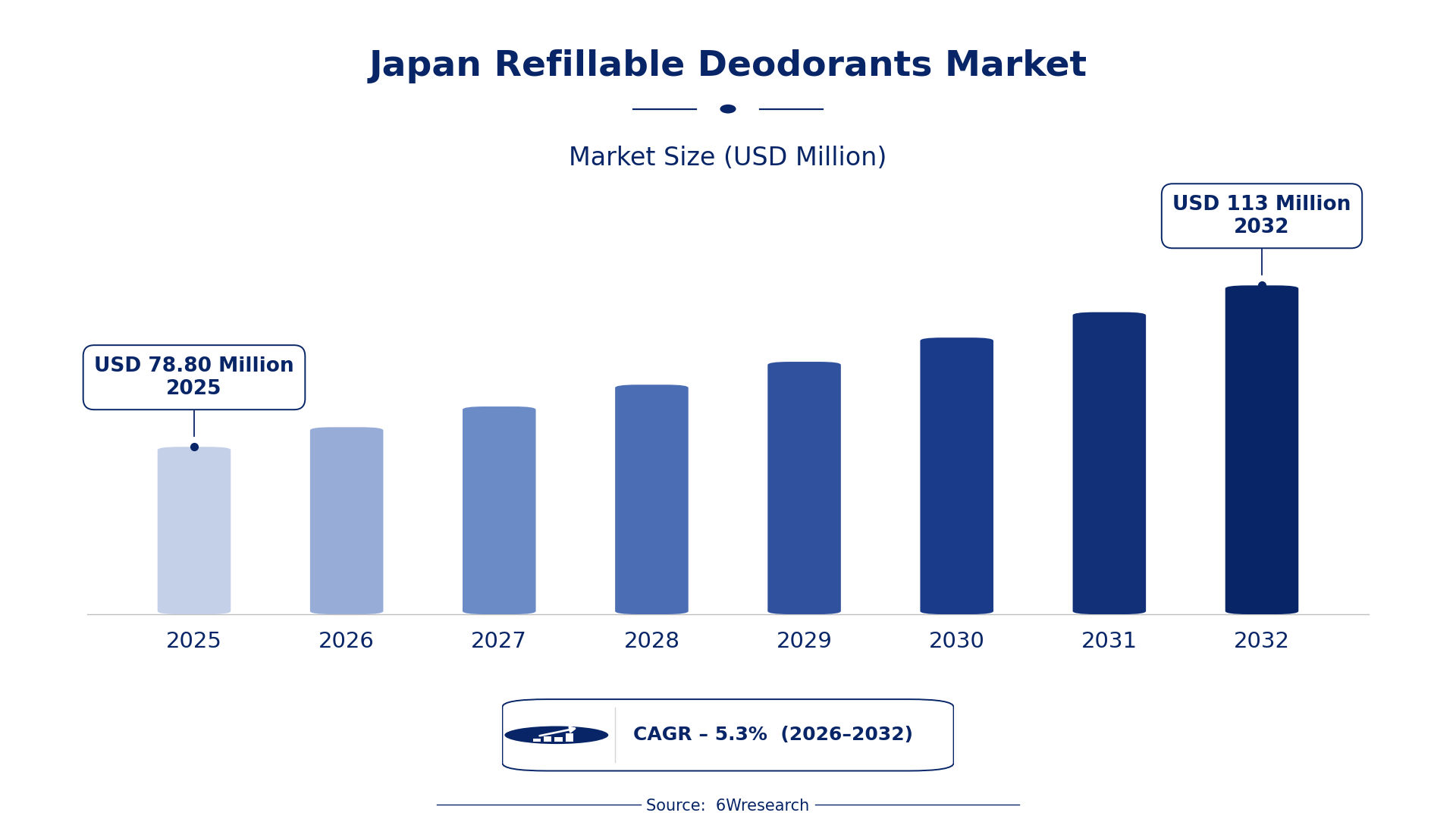
According to 6Wresearch internal database and industry insights, the Japan Refillable Deodorants Market was valued at USD 78.80 Million in 2025 and is projected to reach USD 113 Million by 2032, growing at a CAGR of approximately 5.3% during 2026–2032.
Japan Refillable Deodorants Market Highlights
| Report Metric | Details |
| Report Name | Japan Refillable Deodorants Market (2026-2032) |
| Market Size 2025 | USD 78.80 Million |
| Market Size 2032 | USD 113 Million |
| Absolute Growth 2025–2032 | USD 34.20 Million |
| CAGR 2026–2032 | 5.3% |
| Peak Annual Growth | 6.0% in 2028 |
| Forecast Period | 2026–2032 |
| Historical Data | 2022–2025 |
| Base Year | 2025 |
| Leading Type, 2025 | Refillable Spray Deodorant (59% share) |
| Leading Packaging, 2025 | Metal (53% share) |
| Fastest-Growing Type | Refillable Stick Deodorant (7.1% CAGR) |
| Fastest-Growing Packaging | Glass (6.8% CAGR) |
| Growing Sector | Personal Care Products |
| Key End Users | Eco-conscious consumers, retail chains, personal care brands |
Japan Refillable Deodorants Market Year-wise Growth Rate and Key Drivers (2022–2032)
This graph illustrates the annual growth rates of the market from 2022 to 2032, highlighting a steady upward trajectory and projected market expansion over the forecast period.
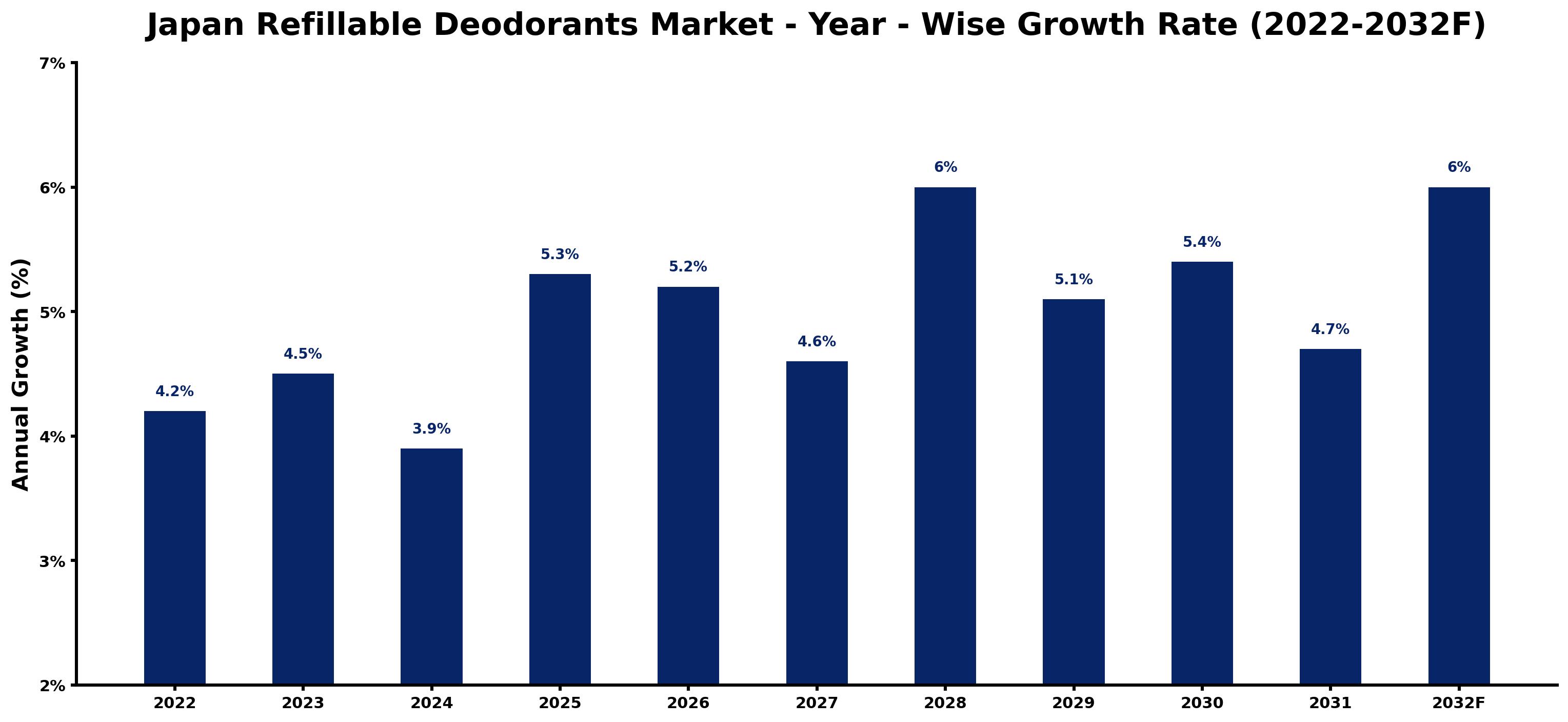
The yearly estimates that follow link every growth rate to its principal driver, so readers can see why the pace changed in each period.
| Year | Estimated Annual Growth (%) | Market Rationale |
| 2022 | 4.2 | Consumer awareness of environmental issues was increasing, driving demand for sustainable products. |
| 2023 | 4.5 | The trend towards eco-friendly products continued, leading to higher consumer engagement. |
| 2024 | 3.9 | Growth slowed as market saturation began to affect new purchases. |
| 2025 | 5.3 | The introduction of new eco-friendly personal care products boosted consumer interest. |
| 2026 | 5.2 | Demand growth is expected to slow as consumers become more selective about their purchases. |
| 2027 | 4.6 | Market growth will continue to slow as competition intensifies among brands. |
| 2028 | 6.0 | A surge in eco-conscious consumer behaviour is projected to lead to a peak in demand for refillable options. |
| 2029 | 5.1 | Growth is expected to moderate as the market adjusts to new consumer preferences and choices. |
| 2030 | 5.4 | Increased awareness of sustainability initiatives will revitalise interest in refillable deodorants. |
| 2031 | 4.7 | Consumer interest will remain steady, but growth rates are expected to normalise. |
| 2032 | 6.0 | Demand is projected to surge again as new sustainable initiatives gain traction among consumers. |
Note: Market size estimations and growth projections presented in this report are based on 6Wresearch's proprietary forecasting methodology, utilizing the latest available industry data, government publications, and primary research inputs.
Japan Refillable Deodorants Market Synopsis
Refillable deodorants reduce plastic waste by allowing users to refill sustainable containers. Available in sprays and sticks, they serve personal hygiene and odour control needs. The Japan Refillable Deodorants Market is expanding, driven by a 45% preference for refillable options among consumers in 2023 and increasing awareness of environmental issues. The Tokyo metropolitan area is a major hub for sales, with 30% of consumers using eco-friendly personal care products, further propelling market growth.
Market Dynamics Impact Analysis (2026–2032)
| Factor | Type | Impact | Primary Segment Affected |
| Increasing consumer preference for sustainable products | Driver | High | Refillable Spray Deodorant |
| Growth in eco-conscious consumer behaviour | Driver | High | Refillable Stick Deodorant |
| Expansion of retail channels for refillable products | Opportunity | High | Refillable Spray Deodorant |
| Rising demand for eco-friendly packaging solutions | Opportunity | High | Refillable Stick Deodorant |
| Competition from traditional deodorant brands | Restraint | Medium | Refillable Spray Deodorant |
| Consumer hesitation towards new product adoption | Restraint | Medium | Refillable Stick Deodorant |
| Supply chain challenges affecting availability | Challenge | High | Refillable Spray Deodorant |
| Regulatory compliance costs for sustainable products | Challenge | Medium | Refillable Stick Deodorant |
Evaluation of Drivers in Japan Refillable Deodorants Market (2026–2032)
The table below links each growth driver to the segment it affects and the evidence for it.
| Drivers | Primary Segment Affected | Why It Matters (Evidence) |
| Rising consumer awareness of sustainability | Refillable Spray Deodorant | In 2023, 45% of consumers preferred refillable options, driving purchases in major retail chains. |
| Increased availability of refillable products | Refillable Stick Deodorant | Retail chains expanded their eco-friendly product lines, resulting in a 30% increase in sales. |
| Support from government initiatives promoting sustainability | Refillable Spray Deodorant | The 'Plastics Smart' initiative encourages consumers to choose refillable options, boosting market demand. |
| Growing trend of eco-conscious consumerism | Refillable Stick Deodorant | In 2022, 30% of consumers reported using eco-friendly personal care products, influencing purchasing decisions. |
| Adoption of ISO 14021 standards | Refillable Spray Deodorant | These standards build consumer trust in environmental claims, increasing demand for refillable deodorants. |
Buyers are adding capacity as consumer awareness of sustainability rises, with 45% preferring refillable options in 2023. The Tokyo metropolitan area has seen a notable increase in sales of eco-friendly products, supported by expanding retail channels. The rise of eco-conscious consumerism is clear, with 30% of consumers using eco-friendly personal care products in 2022. Consequently, the refillable deodorant market is experiencing growth, particularly among environmentally aware buyers.
Evaluation of Restraints in Japan Refillable Deodorants Market
Below are the constraints most often cited by buyers and suppliers, with the segment each affects.
| Market Restraint | Primary Segment Affected | Why It Matters (Evidence) |
| Intense competition from traditional deodorant brands | Refillable Spray Deodorant | In 2023, established brands held a 70% share of the deodorant market, making it challenging for refillable options to gain traction. |
| Consumer reluctance to switch from familiar products | Refillable Stick Deodorant | Brand loyalty prevents many consumers from adopting new refillable products, with 60% preferring established brands. |
| Supply chain disruptions affecting product availability | Refillable Spray Deodorant | In 2022, 20% of retailers reported logistical challenges impacting the distribution of refillable deodorants. |
| High costs associated with compliance to sustainability regulations | Refillable Stick Deodorant | Producers face increased expenses to meet environmental standards, with compliance costs rising by 15% in recent years. |
| Limited consumer education on refillable benefits | Refillable Spray Deodorant | In 2023, 35% of consumers lacked awareness of the advantages of refillable products, hindering market growth. |
Japan Refillable Deodorants Market Challenges
Buyers of refillable deodorants face intense competition from traditional products, which often have lower prices due to established brand loyalty. This price disparity exists because traditional items benefit from extensive marketing, causing eco-conscious consumers to pay 800 to 1500 yen more for sustainable alternatives. Availability issues arise as major retail chains may not consistently stock refillable options, delaying access for buyers. Regulatory pressures from the government to comply with sustainable packaging initiatives require producers to allocate more resources, which can increase production costs and ultimately raise prices for consumers.
Trends in the Japan Refillable Deodorants Market
Four trends stand out in the Japan Refillable Deodorants Market.
- Shift from Traditional to Refillable Packaging: A noticeable shift from traditional packaging to refillable options is occurring, with 20% of personal care launches in 2023 featuring refillable designs. This trend reflects consumer demand for sustainability, especially in urban areas like Tokyo.
- Emergence of Eco-Conscious Consumer Groups: Eco-conscious consumers are becoming a prominent demographic, influencing product choices. In 2023, 45% of consumers preferred refillable deodorants, reflecting a broader societal shift towards sustainability.
- Adoption of Sustainable Packaging Guidelines: The Japanese Cosmetic Industry Association has introduced guidelines promoting sustainable practices in cosmetic products. This initiative is expected to increase the appeal of refillable deodorants, aligning with consumer preferences for eco-friendly options.
- Growth of Retail Channels for Refillable Products: Retail chains across Japan are increasingly stocking refillable deodorants, responding to consumer demand. This expansion is evident in the Tokyo metropolitan area, where sales of eco-friendly products have surged.
Investment Opportunities in the Japan Refillable Deodorants Market
The openings below show where demand in the Japan Refillable Deodorants Market is visible and how suppliers can enter.
- Refillable Deodorants: Investing in refillable deodorants is timely, as 45% of consumers prefer these options. Collaborating with major retail chains can facilitate market entry and increase visibility.
- Sustainable Packaging Solutions: With 20% of personal care launches featuring refillable options, suppliers can focus on sustainable packaging. Partnering with eco-conscious brands will strengthen market presence.
- Development of Eco-Friendly Formulations: The current trend towards sustainability presents opportunities for creating new refillable deodorant formulations. Engaging with urban consumers in areas like Tokyo will drive adoption.
- Expansion of Retail Partnerships: The market gap for refillable deodorants is substantial, with increasing consumer demand. Forming joint ventures with local retailers can streamline distribution and improve market reach.
Government Initiatives in the Japan Refillable Deodorants Market
The Chemical Substances Control Law of 1973 requires manufacturers to evaluate and control new chemical substances in production, ensuring safety and compliance in refillable deodorants. This law supports sustainable practices by promoting the use of eco-friendly materials. Additionally, the Economic Security Promotion Act of 2022 encourages supply-chain resilience for critical products, including sustainable personal care items, prompting manufacturers to invest in eco-friendly production methods.
In 2023, the Ministry of the Environment allocated 500 million yen to support initiatives aimed at reducing single-use plastics in personal care products. This funding is part of a broader strategy to promote sustainable practices, encouraging manufacturers to develop refillable options and comply with environmental standards.
Future Insight of the Japan Refillable Deodorants Market
The investment pipeline in sustainable packaging will expand through 2032, driven by government support and consumer demand for eco-friendly products. This increase will create a wider range of refillable deodorants available in convenience stores and supermarkets. Technological advancements in production processes will improve efficiency, reducing costs for suppliers. With 45% of consumers preferring refillable options, brands will focus on developing innovative refill systems to meet this growing demand, shaping the future of the market.
Market Segmentation Analysis
Japan Refillable Deodorants Market report covers a detailed analysis of the following market segments:
By Type – Refillable Spray Deodorant Leads, Refillable Stick Deodorant Expected to Grow Fastest
According to Summon Dutta, Assistant Manager at 6Wresearch, Refillable Spray Deodorant took 59% of type revenue in 2025, more than any other category. Refillable Spray Deodorant holds the largest share due to its widespread acceptance among consumers, particularly in urban areas like Tokyo where convenience is paramount. This form appeals to those prioritising personal hygiene and ease of use, contributing to its strong installed base. The quickest growth will come from Refillable Stick Deodorant, forecast to expand at a CAGR of 7.1% between 2026 and 2032. Refillable Stick Deodorant is experiencing rapid growth as consumers increasingly seek sustainable alternatives that align with their eco-conscious values, with 45% of consumers preferring refillable options in 2023. This trend suggests that the stick format will continue to gain traction, further expanding its market presence. Suppliers should focus on promoting refillable stick options to capitalise on the growing consumer preference for sustainable products.
By Packaging – Metal Leads, Glass Expected to Grow Fastest
In 2025, Metal led the packaging split with a 53% share. Metal packaging dominates the market due to its strong recyclability and durability, which resonate well with consumers focused on sustainability. This trend is particularly visible in major retail chains across Japan where metal-packaged refillable deodorants are widely available. Glass is projected to grow fastest, at a CAGR of 6.8% during 2026–2032. Glass packaging is experiencing rapid growth as consumers gravitate towards its premium image and environmental advantages, reflected in the rising number of product launches featuring glass options. This shift suggests a growing preference for sustainable packaging among eco-conscious buyers. Suppliers should consider expanding their product lines to include more glass packaging options in response to changing consumer preferences.
Key Attractiveness of the Report
- 10 Years of Market Numbers
- Historical Data Starting from 2022 to 2025
- Base Year 2025
- Forecast Data until 2032
- Key Performance Indicators Impacting the Market
- Major Upcoming Developments and Projects
Key Highlights of the Report:
- Japan Refillable Deodorants Market Outlook
- Market Size of Japan Refillable Deodorants Market, 2025
- Forecast of Japan Refillable Deodorants Market, 2032
- Historical Data and Forecast of Japan Refillable Deodorants Revenues & Volume for the Period 2022-2032
- Japan Refillable Deodorants Market Trend Evolution
- Japan Refillable Deodorants Market Drivers and Challenges
- Japan Refillable Deodorants Price Trends
- Japan Refillable Deodorants Porter's Five Forces
- Japan Refillable Deodorants Industry Life Cycle
- Historical Data and Forecast of Japan Refillable Deodorants Market Revenues & Volume By Type for the Period 2022-2032
- Historical Data and Forecast of Japan Refillable Deodorants Market Revenues & Volume By Refillable Spray Deodorant for the Period 2022-2032
- Historical Data and Forecast of Japan Refillable Deodorants Market Revenues & Volume By Refillable Stick Deodorant for the Period 2022-2032
- Historical Data and Forecast of Japan Refillable Deodorants Market Revenues & Volume By Packaging for the Period 2022-2032
- Historical Data and Forecast of Japan Refillable Deodorants Market Revenues & Volume By Metal for the Period 2022-2032
- Historical Data and Forecast of Japan Refillable Deodorants Market Revenues & Volume By Glass for the Period 2022-2032
- Historical Data and Forecast of Japan Refillable Deodorants Market Revenues & Volume By Plastic for the Period 2022-2032
- Historical Data and Forecast of Japan Refillable Deodorants Market Revenues & Volume By Paper for the Period 2022-2032
- Japan Refillable Deodorants Import Export Trade Statistics
- Market Opportunity Assessment By Type
- Market Opportunity Assessment By Packaging
- Japan Refillable Deodorants Top Companies Market Share
- Japan Refillable Deodorants Competitive Benchmarking By Technical and Operational Parameters
- Japan Refillable Deodorants Company Profiles
- Japan Refillable Deodorants Key Strategic Recommendations
Market Covered
Coverage by segment is as follows.
By Type
- Refillable Spray Deodorant
- Refillable Stick Deodorant
By Packaging
- Metal
- Glass
- Plastic
- Paper































