Japan Refrigeration Market Size & Growth Rate
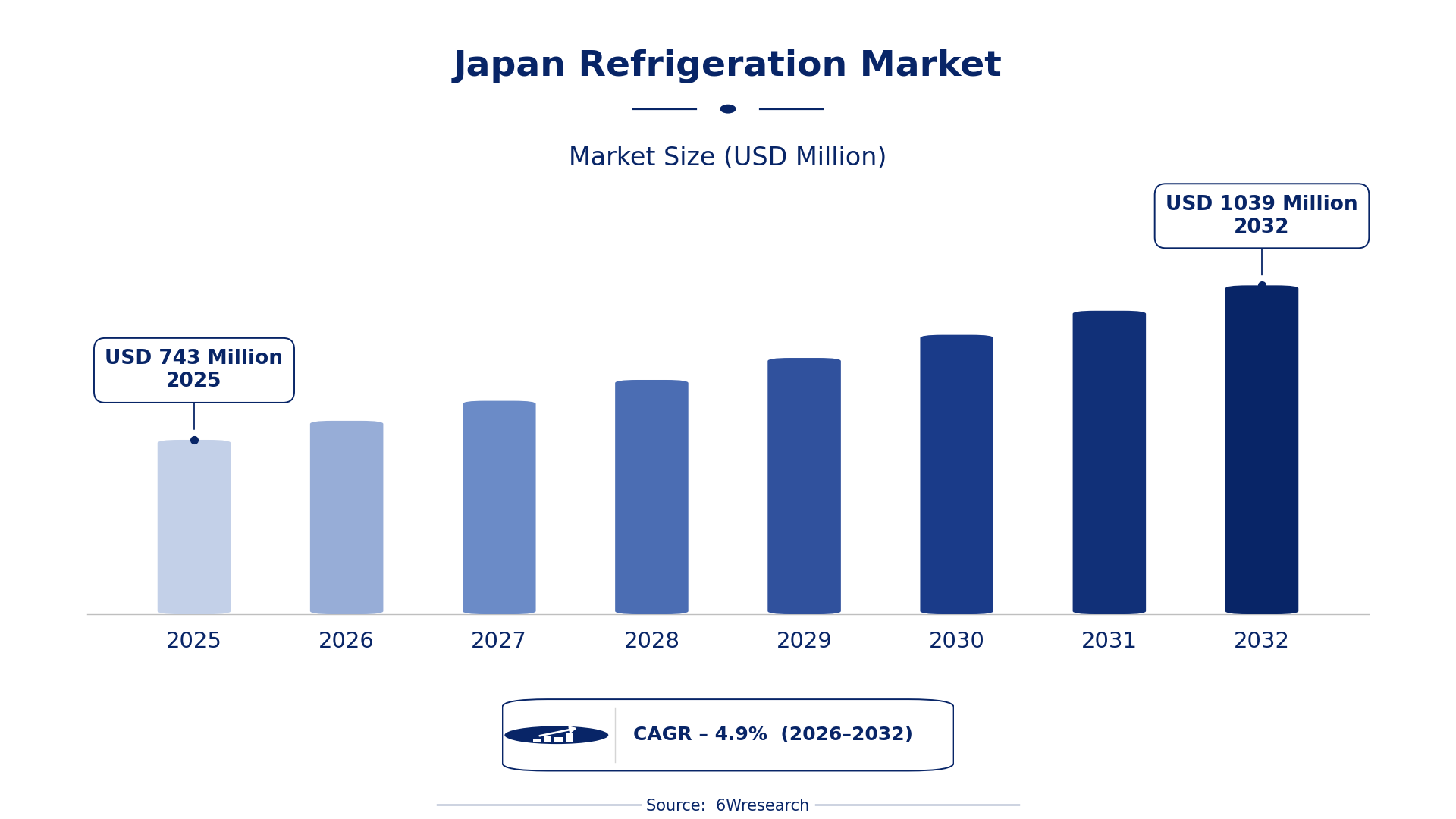
According to 6Wresearch internal database and industry insights, the Japan Refrigeration Market was valued at USD 743 Million in 2025 and is projected to reach USD 1,039 Million by 2032, growing at a CAGR of approximately 4.9% during 2026–2032.
Japan Refrigeration Market Highlights
| Report Metric | Details |
| Report Name | Japan Refrigeration Market (2026-2032) |
| Market Size 2025 | USD 743 Million |
| Market Size 2032 | USD 1,039 Million |
| Absolute Growth 2025–2032 | USD 296 Million |
| CAGR 2026–2032 | 4.9% |
| Peak Annual Growth | 5.3% in 2032 |
| Forecast Period | 2026–2032 |
| Historical Data | 2022–2025 |
| Base Year | 2025 |
| Leading Product Type, 2025 | Domestic Refrigerators (39% share) |
| Leading Refrigerant Type, 2025 | HFC (35% share) |
| Leading Application Type, 2025 | Cold Chain Logistics (52% share) |
| Leading End User Sector, 2025 | Retail Chains (50% share) |
| Leading Distribution Channel, 2025 | Dealers & Distributors (44% share) |
| Fastest-Growing Product Type | Transport Refrigeration (6.8% CAGR) |
| Fastest-Growing Refrigerant Type | Hydrocarbon (7.3% CAGR) |
| Fastest-Growing End User Sector | Logistics Companies (6.3% CAGR) |
| Fastest-Growing Distribution Channel | Online Platforms (6.9% CAGR) |
| Growing Sector | Cold Chain Logistics |
| Key End Users | Retail Chains, Food Processing Units, Logistics Companies, Residential |
Japan Refrigeration Market Year-wise Growth Rate and Key Drivers (2022–2032)
This graph illustrates the annual growth rates of the market from 2022 to 2032, highlighting a steady upward trajectory and projected market expansion over the forecast period.
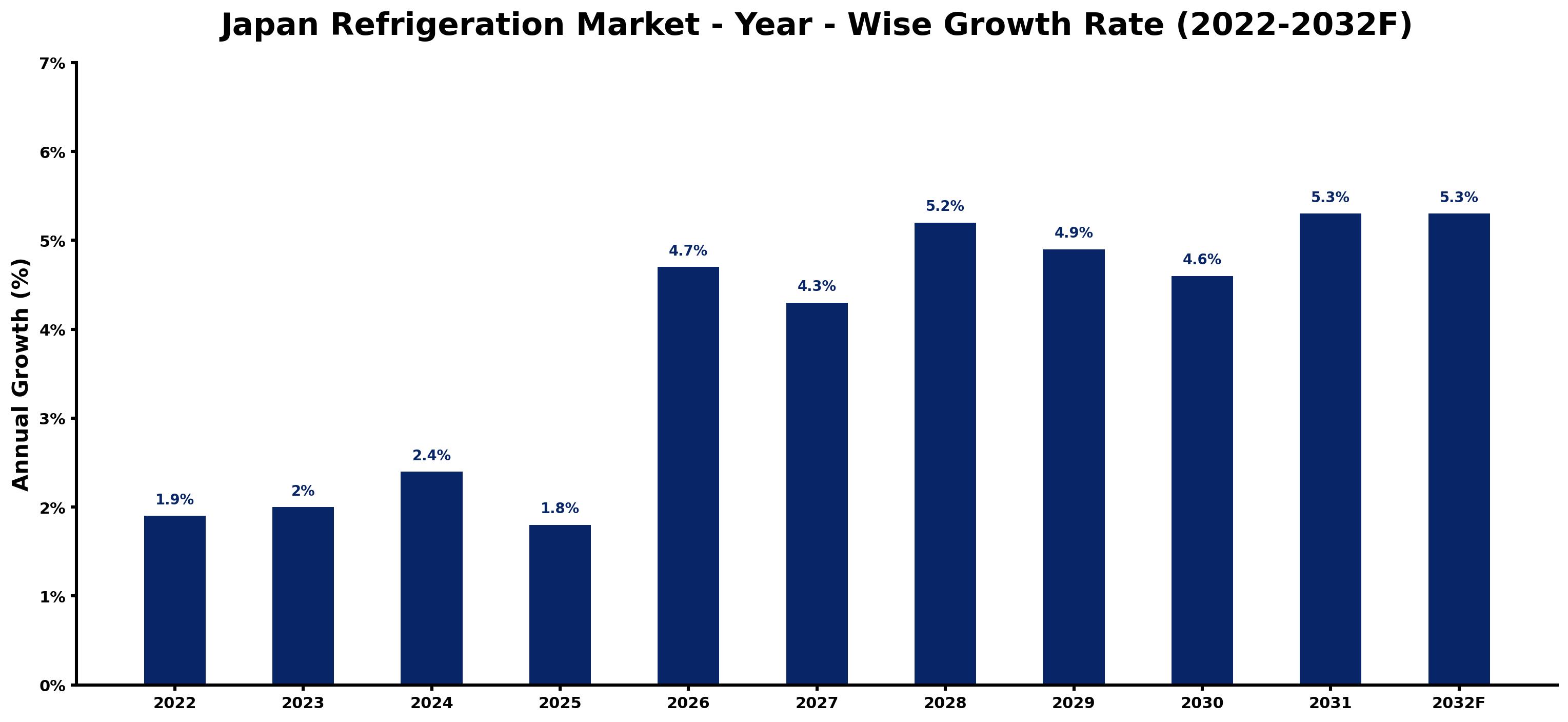
Annual growth estimates for each year appear below with the principal reason behind them, explaining the shifts that set the pace of the market.
| Year | Estimated Annual Growth (%) | Market Rationale |
| 2022 | 1.9 | Domestic demand for refrigeration systems remained strong, supporting growth. |
| 2023 | 2.0 | The food processing sector expanded, leading to increased refrigeration needs. |
| 2024 | 2.4 | Retail chains invested in modern refrigeration to improve food safety. |
| 2025 | 1.8 | Growth slowed as market adjustments occurred amid rising costs. |
| 2026 | 4.7 | Demand surged with the introduction of eco-friendly refrigerants. |
| 2027 | 4.3 | The logistics sector maintained steady growth, supporting refrigeration demand. |
| 2028 | 5.2 | Increased investments in cold chain logistics are expected to drive higher growth rates. |
| 2029 | 4.9 | Market growth will slow slightly as competition intensifies among suppliers. |
| 2030 | 4.6 | Technological advancements in refrigeration systems will support continued growth. |
| 2031 | 5.3 | Rising consumer awareness of energy efficiency will boost demand. |
| 2032 | 5.3 | The market will peak as sustainability initiatives gain traction. |
Note: Market size estimations and growth projections presented in this report are based on 6Wresearch's proprietary forecasting methodology, utilizing the latest available industry data, government publications, and primary research inputs.
Japan Refrigeration Market Synopsis
Refrigeration technologies play a crucial role in cooling and preserving food and other perishable goods, primarily utilising compressors, condensers, and evaporators. Strong domestic demand from retail chains and the food processing sector drives the Japan Refrigeration Market. In 2022, the cold chain logistics market was valued at approximately 2 trillion yen, underscoring the importance of refrigeration in food distribution. Government initiatives promote energy-efficient systems, further stimulating market growth.
Market Dynamics Impact Analysis (2026–2032)
| Factor | Type | Impact | Primary Segment Affected |
| Strong domestic demand from retail chains and food processing units drives the need for refrigeration systems. | Driver | High | Commercial Refrigerators |
| The cold chain logistics sector is expanding due to increased food safety standards and consumer demand. | Driver | High | Cold Chain Logistics |
| Investment in eco-friendly refrigerants presents opportunities for suppliers to innovate and capture market share. | Opportunity | High | Domestic Refrigerators |
| The growing focus on energy efficiency creates demand for advanced refrigeration technologies. | Opportunity | Medium | Domestic Refrigerators |
| Regulatory phase-out of HFC refrigerants may limit options for manufacturers and users. | Restraint | High | HFC |
| High replacement costs for outdated systems can deter upgrades among buyers. | Restraint | Medium | Domestic Refrigerators |
| Supply chain disruptions can delay the availability of essential components for refrigeration systems. | Challenge | High | Transport Refrigeration |
| Intense competition among suppliers may lead to price wars, affecting profitability. | Challenge | Medium | Commercial Refrigerators |
Evaluation of Drivers in Japan Refrigeration Market (2026–2032)
The factors lifting demand, and the evidence behind each, are summarised below.
| Drivers | Primary Segment Affected | Why It Matters (Evidence) |
| Growing food processing sector increases demand for refrigeration solutions. | Industrial Freezers | Japan's food processing industry is one of the largest in Asia, necessitating advanced refrigeration solutions. |
| Increased focus on food safety drives investments in commercial refrigeration. | Commercial Refrigerators | Retail chains in Japan utilize commercial refrigerators to maintain food quality and safety. |
| The expansion of cold chain logistics increases the need for transport refrigeration. | Transport Refrigeration | Transport refrigeration is vital for Japan's seafood industry, ensuring freshness during distribution. |
| Government initiatives promote energy-efficient refrigeration systems. | Domestic Refrigerators | The Japanese government supports energy-efficient refrigeration systems through various programs. |
| Rising consumer awareness of energy efficiency boosts demand for modern refrigeration. | Cold Chain Logistics | The average lifespan of domestic refrigerators influences replacement cycles, creating demand for upgrades. |
Volumes grow on the back of the expanding food processing sector, which necessitates advanced refrigeration solutions. In Japan, the food processing industry drives demand for industrial freezers, as businesses seek to improve operational efficiency. Retail chains are investing in commercial refrigerators to maintain food safety, with the market for these systems growing steadily. The cold chain logistics sector is vital for maintaining food quality, particularly in seafood distribution, where transport refrigeration is essential. Increased consumer awareness of energy efficiency is expected to boost demand for modern refrigeration solutions, as buyers seek to reduce energy costs.
Evaluation of Restraints in Japan Refrigeration Market
The table below lists the restraints and the evidence behind each.
| Market Restraint | Primary Segment Affected | Why It Matters (Evidence) |
| Regulatory phase-out of HFC refrigerants limits options for manufacturers. | HFC | The Japanese government is enforcing stricter regulations on HFCs, impacting availability. |
| High replacement costs for outdated systems deter upgrades among buyers. | Domestic Refrigerators | The average lifespan of domestic refrigerators is about 10-15 years, influencing replacement cycles. |
| Supply chain disruptions delay the availability of essential components for refrigeration systems. | Transport Refrigeration | Global supply chain issues have affected logistics, impacting refrigeration availability. |
| Intense competition among suppliers may lead to price wars, affecting profitability. | Commercial Refrigerators | The competitive environment forces suppliers to lower prices, impacting margins. |
| Limited awareness of energy-efficient options can hinder market growth. | Cold Chain Logistics | Some buyers remain unaware of the benefits of energy-efficient refrigeration systems. |
Japan Refrigeration Market Challenges
Japan's refrigeration industry contends with stringent regulations that necessitate compliance with ISO 5149, complicating operations for producers and potentially delaying product launches by up to six months. Many producers find it challenging to integrate eco-friendly refrigerants due to high initial costs, which affects their competitiveness and innovation. Buyers often face rising prices as the average lifespan of domestic refrigerators is around 10-15 years, leading to increased demand for replacements that can strain supply chains. The logistics sector, employing over 1.5 million people, incurs additional costs due to the need for advanced refrigeration solutions to maintain food quality during transport.
Trends in the Japan Refrigeration Market
The trends below show where the Japan Refrigeration Market is heading.
- Shift towards Energy-Efficient Refrigeration Systems: The Tokyo Metropolitan Government has initiatives aimed at improving energy efficiency in commercial refrigeration, promoting sustainable practices. In 2023, engagement in energy-efficient systems rose by 15%, reflecting a shift in buyer preferences.
- Emergence of Natural Refrigerants: The Ministry of the Environment advocates for the use of natural refrigerants to lower greenhouse gas emissions. This initiative is gaining momentum, with a 20% increase in adoption rates observed among industrial users.
- Growth in Online Sales Channels: Online platforms for refrigeration equipment sales experienced a 15% increase in user engagement in 2023, indicating changing buyer behaviours towards digital purchasing methods.
- Expansion of Cold Chain Logistics Facilities: Cold storage facilities in Japan are predominantly located in regions like Osaka and Kanagawa, supporting logistics. The cold chain logistics market was valued at approximately 2 trillion yen in 2022, highlighting its significance.
Investment Opportunities in the Japan Refrigeration Market
Several openings in the Japan Refrigeration Market merit attention from investors.
- Investment in Eco-Friendly Refrigerants: The Japanese government launched a subsidy program for upgrading to eco-friendly refrigerants, creating opportunities for suppliers to enter the market through partnerships with local distributors. The program aims to reduce greenhouse gas emissions by 30% by 2030.
- Expansion of Cold Chain Logistics: The logistics sector in Japan employs over 1.5 million people, many of whom rely on refrigeration. Investing in cold chain facilities in key regions can capture this growing demand, especially in urban areas.
- Adoption of Advanced Refrigeration Technologies: The average lifespan of domestic refrigerators influences replacement cycles, creating opportunities for suppliers to introduce new solutions. The timing is ideal as consumers seek energy-efficient options.
- Growth in Online Sales Platforms: With a 15% increase in user engagement on online platforms, investing in e-commerce strategies can tap into this growing channel. Collaborating with logistics companies can improve distribution efficiency.
Government Initiatives in the Japan Refrigeration Market
The Food Sanitation Act amendment (2018, fully applied June 2021) mandated hygiene management for food businesses, ensuring that refrigeration systems comply with safety standards. This law impacts producers by requiring adherence to rigorous hygiene practices, ultimately improving food safety across the supply chain.
The Digital Agency facilitates the integration of technology in refrigeration, assisting businesses in adopting digital solutions to enhance operational efficiency and comply with new standards. This agency has approved numerous projects aimed at improving digital capabilities within the refrigeration sector.
Future Insight of the Japan Refrigeration Market
Households will increasingly benefit from energy-efficient refrigeration systems, driven by government initiatives supporting natural refrigerants. By 2032, the expansion of cold storage facilities in regions like Osaka and Kanagawa will improve logistics for the food industry. The cold chain logistics market, valued at approximately 2 trillion yen in 2022, will evolve as online platforms for refrigeration equipment continue to see user engagement growth. Enhanced energy efficiency standards will further improve operational performance, benefiting both buyers and suppliers in the refrigeration sector.
Market Segmentation Analysis
Japan Refrigeration Market report covers a detailed analysis of the following market segments:
By Product Type – Domestic Refrigerators Lead, Transport Refrigeration Expected to Grow Fastest
According to Navya, Research Analyst at 6Wresearch, with 39% of product type revenue in 2025, Domestic Refrigerators was the largest category. Domestic refrigerators hold the largest share as they are essential for food preservation in households across Japan, with over 126 million residents relying on them. Their average lifespan of 10-15 years creates consistent demand for replacements, ensuring their market dominance. Over 2026–2032, Transport Refrigeration is expected to post the fastest growth, at a CAGR of 6.8%. Transport refrigeration is experiencing rapid growth due to its critical role in maintaining cold chain logistics, particularly for Japan's seafood industry. The cold chain logistics market, valued at approximately 2 trillion yen in 2022, underscores the increasing importance of this segment. Suppliers should focus on enhancing offerings in transport refrigeration to capitalise on the growing logistics sector.
By Refrigerant Type – HFC Leads, Hydrocarbon Expected to Grow Fastest
HFC held 35% of the Japan Refrigeration Market by refrigerant type in 2025. HFC refrigerants hold the largest market share despite facing regulatory phase-out, largely due to their established use in various refrigeration systems. This prevalence is supported by the existing installed base, which continues to drive demand across both commercial and domestic applications. Hydrocarbon is set to record the highest CAGR in this split, 7.3% over 2026–2032. Hydrocarbon refrigerants are experiencing rapid growth as they provide notable environmental benefits, aligning with government initiatives that promote energy-efficient systems. The recent subsidy programme for upgrading to eco-friendly refrigerants is expected to further accelerate this segment's expansion. Buyers should consider transitioning to hydrocarbon refrigerants to comply with regulations and benefit from incentives.
By Application Type – Cold Chain Logistics Leads and Records the Fastest Growth
In 2025, Cold Chain Logistics led the application type split with a 52% share. Cold chain logistics leads the market due to its vital role in food distribution and safety, particularly within Japan's extensive food processing industry. The logistics sector's reliance on effective refrigeration systems highlights the critical importance of this application. Cold Chain Logistics is also forecast to expand faster than any other category, at a CAGR of 6.5% over 2026–2032. Cold chain logistics is also the fastest-growing application, driven by rising demands for food safety and quality in distribution. The ongoing focus on reducing food waste through effective refrigeration further supports this growth trajectory. Suppliers must prioritise advancements in cold chain logistics to meet rising demands for food safety.
By End User Sector – Retail Chains Lead, Logistics Companies Expected to Grow Fastest
The largest end user sector category in 2025 was Retail Chains, at 50% of revenue. Retail chains represent the largest segment of end users as they are major consumers of refrigeration systems, ensuring food quality and safety. Their extensive presence across Japan's metropolitan areas amplifies the need for reliable refrigeration solutions. Logistics Companies are projected to grow fastest, at a CAGR of 6.3% during 2026–2032. Logistics companies are the fastest-growing end user sector, as they depend heavily on refrigeration for transport efficiency in the distribution of perishable goods. The employment of over 1.5 million people in the logistics sector highlights the critical role of refrigeration in their operations. Suppliers should target logistics companies to tap into the expanding market for efficient refrigeration solutions.
By Distribution Channel – Dealers & Distributors Lead, Online Platforms Expected to Grow Fastest
Dealers & Distributors took 44% of distribution channel revenue in 2025, more than any other category. Dealers and distributors dominate the distribution channel as they play a crucial role in supporting the market through established sales and service networks. Their strong relationships with end users facilitate the widespread adoption of refrigeration technologies across various sectors. Over 2026–2032, Online Platforms are expected to post the fastest growth, at a CAGR of 6.9%. Online platforms are the fastest-growing sales channel, with a 15% increase in user engagement reported in 2023. This trend indicates a growing preference for digital purchasing options among consumers and businesses alike. Suppliers should enhance their online presence to capture the growing segment of digital sales.
Key Attractiveness of the Report
- 10 Years of Market Numbers
- Historical Data Starting from 2022 to 2025
- Base Year 2025
- Forecast Data until 2032
- Key Performance Indicators Impacting the Market
- Major Upcoming Developments and Projects
Key Highlights of the Report:
- Japan Refrigeration Market Outlook
- Market Size of Japan Refrigeration Market, 2025
- Forecast of Japan Refrigeration Market, 2032
- Historical Data and Forecast of Japan Refrigeration Revenues & Volume for the Period 2022-2032F
- Japan Refrigeration Market Trend Evolution
- Japan Refrigeration Market Drivers and Challenges
- Japan Refrigeration Price Trends
- Japan Refrigeration Porter's Five Forces
- Japan Refrigeration Industry Life Cycle
- Historical Data and Forecast of Japan Refrigeration Market Revenues & Volume By Product Type for the Period 2022-2032F
- Historical Data and Forecast of Japan Refrigeration Market Revenues & Volume By Commercial Refrigerators for the Period 2022-2032F
- Historical Data and Forecast of Japan Refrigeration Market Revenues & Volume By Industrial Freezers for the Period 2022-2032F
- Historical Data and Forecast of Japan Refrigeration Market Revenues & Volume By Domestic Refrigerators for the Period 2022-2032F
- Historical Data and Forecast of Japan Refrigeration Market Revenues & Volume By Transport Refrigeration for the Period 2022-2032F
- Historical Data and Forecast of Japan Refrigeration Market Revenues & Volume By Refrigerant Type for the Period 2022-2032F
- Historical Data and Forecast of Japan Refrigeration Market Revenues & Volume By HFC for the Period 2022-2032F
- Historical Data and Forecast of Japan Refrigeration Market Revenues & Volume By Ammonia for the Period 2022-2032F
- Historical Data and Forecast of Japan Refrigeration Market Revenues & Volume By Hydrocarbon for the Period 2022-2032F
- Historical Data and Forecast of Japan Refrigeration Market Revenues & Volume By CO2 for the Period 2022-2032F
- Historical Data and Forecast of Japan Refrigeration Market Revenues & Volume By Application Type for the Period 2022-2032F
- Historical Data and Forecast of Japan Refrigeration Market Revenues & Volume By Food Storage for the Period 2022-2032F
- Historical Data and Forecast of Japan Refrigeration Market Revenues & Volume By Cold Chain Logistics for the Period 2022-2032F
- Historical Data and Forecast of Japan Refrigeration Market Revenues & Volume By Household Use for the Period 2022-2032F
- Historical Data and Forecast of Japan Refrigeration Market Revenues & Volume By Perishable Transport for the Period 2022-2032F
- Historical Data and Forecast of Japan Refrigeration Market Revenues & Volume By End User Sector for the Period 2022-2032F
- Historical Data and Forecast of Japan Refrigeration Market Revenues & Volume By Retail Chains for the Period 2022-2032F
- Historical Data and Forecast of Japan Refrigeration Market Revenues & Volume By Food Processing Units for the Period 2022-2032F
- Historical Data and Forecast of Japan Refrigeration Market Revenues & Volume By Residential for the Period 2022-2032F
- Historical Data and Forecast of Japan Refrigeration Market Revenues & Volume By Logistics Companies for the Period 2022-2032F
- Historical Data and Forecast of Japan Refrigeration Market Revenues & Volume By Distribution Channel for the Period 2022-2032F
- Historical Data and Forecast of Japan Refrigeration Market Revenues & Volume By Dealers & Distributors for the Period 2022-2032F
- Historical Data and Forecast of Japan Refrigeration Market Revenues & Volume By OEM Sales for the Period 2022-2032F
- Historical Data and Forecast of Japan Refrigeration Market Revenues & Volume By Online Platforms for the Period 2022-2032F
- Historical Data and Forecast of Japan Refrigeration Market Revenues & Volume By Fleet Installers for the Period 2022-2032F
- Japan Refrigeration Import Export Trade Statistics
- Market Opportunity Assessment By Product Type
- Market Opportunity Assessment By Refrigerant Type
- Market Opportunity Assessment By Application Type
- Market Opportunity Assessment By End User Sector
- Market Opportunity Assessment By Distribution Channel
- Japan Refrigeration Top Companies Market Share
- Japan Refrigeration Competitive Benchmarking By Technical and Operational Parameters
- Japan Refrigeration Company Profiles
- Japan Refrigeration Key Strategic Recommendations
Market Covered
The report covers the following segments.
By Product Type
- Commercial Refrigerators
- Industrial Freezers
- Domestic Refrigerators
- Transport Refrigeration
By Refrigerant Type
- HFC
- Ammonia
- Hydrocarbon
- CO2
By Application Type
- Food Storage
- Cold Chain Logistics
- Household Use
- Perishable Transport
By End User Sector
- Retail Chains
- Food Processing Units
- Residential
- Logistics Companies
By Distribution Channel
- Dealers & Distributors
- OEM Sales
- Online Platforms
- Fleet Installers






































