Japan Regional Airline Market Size & Growth Rate
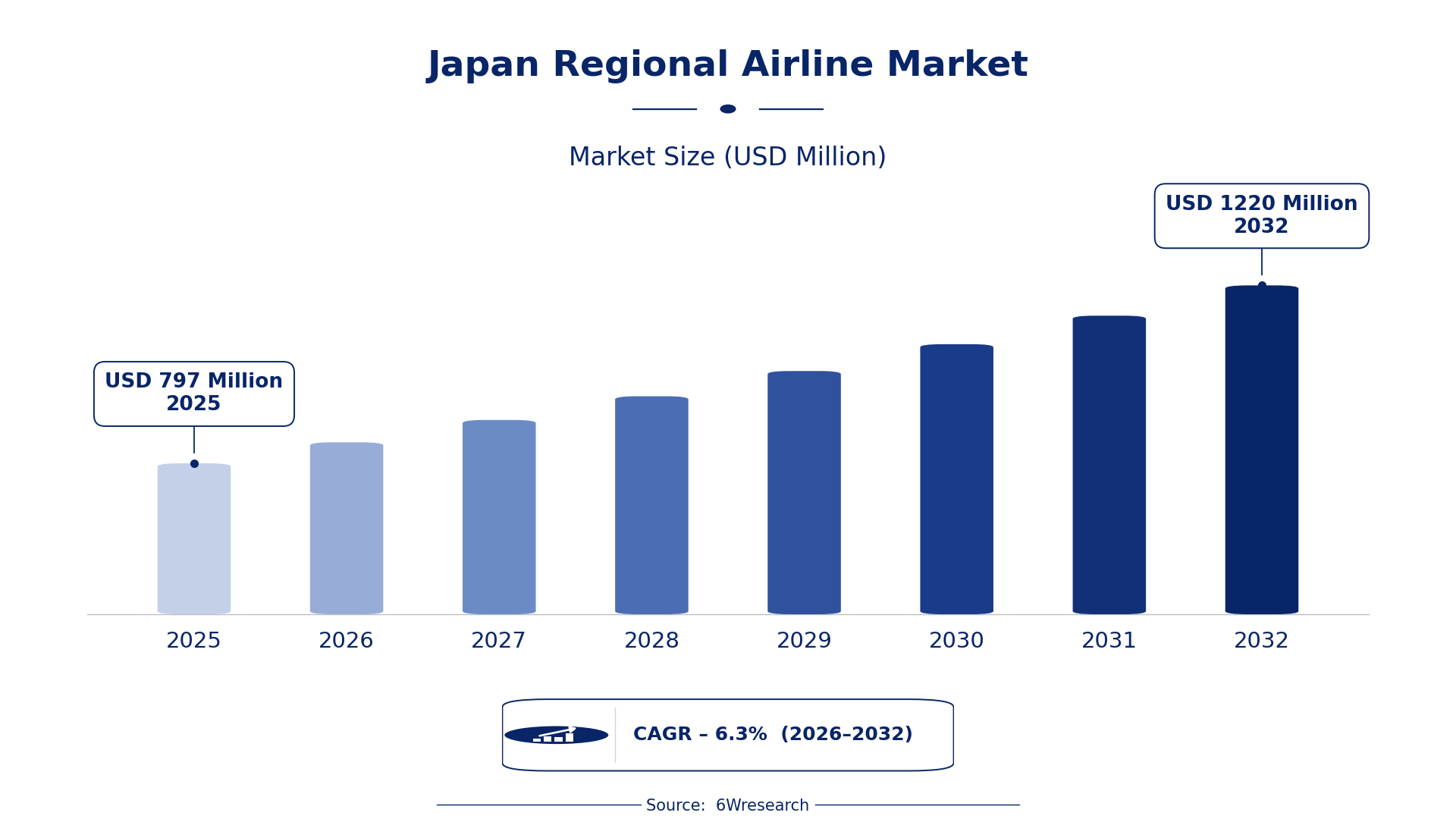
According to 6Wresearch internal database and industry insights, the Japan Regional Airline Market was valued at USD 797 Million in 2025 and is projected to reach USD 1,220 Million by 2032, growing at a CAGR of approximately 6.3% during 2026–2032.
Japan Regional Airline Market Highlights
| Report Metric | Details |
| Report Name | Japan Regional Airline Market (2026-2032) |
| Market Size 2025 | USD 797 Million |
| Market Size 2032 | USD 1,220 Million |
| Absolute Growth 2025–2032 | USD 423 Million |
| CAGR 2026–2032 | 6.3% |
| Peak Annual Growth | 7.4% in 2032 |
| Forecast Period | 2026–2032 |
| Historical Data | 2022–2025 |
| Base Year | 2025 |
| Leading Service Type, 2025 | Commuter Airlines (39% share) |
| Leading Route Type, 2025 | Point-to-Point (42% share) |
| Leading Fleet Type, 2025 | Turboprop / Small Jets (41% share) |
| Leading End User, 2025 | Business/Leisure Travelers (50% share) |
| Fastest-Growing Service Type | Feeder Airlines (8.6% CAGR) |
| Fastest-Growing Route Type | Hub Feeding (8.8% CAGR) |
| Fastest-Growing Fleet Type | Regional Jets (8.9% CAGR) |
| Fastest-Growing End User | Major Airline Partners (8.5% CAGR) |
| Growing Sector | regional air travel |
| Key End Users | business travelers, leisure travelers, government agencies |
Japan Regional Airline Market Year-wise Growth Rate and Key Drivers (2022–2032)
This graph illustrates the annual growth rates of the market from 2022 to 2032, highlighting a steady upward trajectory and projected market expansion over the forecast period.
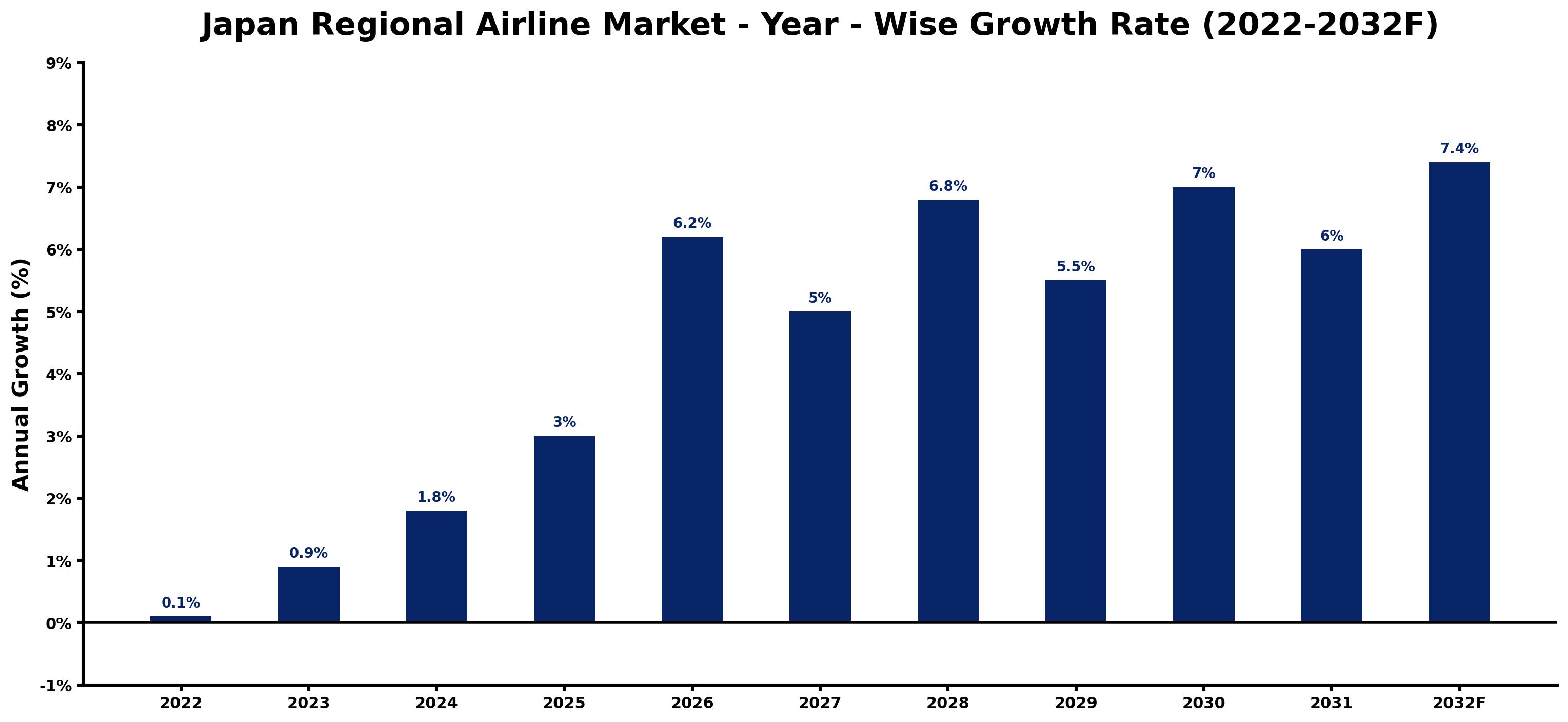
Below, each year's estimated growth is shown next to the factor that most influenced it.
| Year | Estimated Annual Growth (%) | Market Rationale |
| 2022 | 0.1 | The market showed minimal growth, reflecting stable demand from domestic travelers. |
| 2023 | 0.9 | Growth accelerated due to increased regional connectivity and government support. |
| 2024 | 1.8 | Demand continued to rise as more routes were added to underserved areas. |
| 2025 | 3.0 | Growth peaked as regional airlines expanded services to rural destinations. |
| 2026 | 6.2 | Investment in fleet modernisation and infrastructure is expected to drive demand higher. |
| 2027 | 5.0 | Growth will slow slightly as market adjustments take place after rapid expansion. |
| 2028 | 6.8 | Demand is projected to surge again, fueled by a rise in corporate travel and tourism. |
| 2029 | 5.5 | Growth will slow as market saturation begins to affect new route development. |
| 2030 | 7.0 | Demand is expected to increase again, supported by new regional jets entering service. |
| 2031 | 6.0 | Growth will slow as operational challenges begin to limit capacity expansion. |
| 2032 | 7.4 | The market is projected to peak with strong demand for regional connectivity. |
Note: Market size estimations and growth projections presented in this report are based on 6Wresearch's proprietary forecasting methodology, utilizing the latest available industry data, government publications, and primary research inputs.
Japan Regional Airline Market Synopsis
Regional airlines in Japan operate short-haul flights using smaller aircraft, providing connectivity to rural areas. The Japan Regional Airline Market is expanding due to increased domestic travel, government subsidies, and a focus on public service aviation. In 2023, the government allocated ¥10 billion for regional airline subsidies, reflecting its commitment to maintaining service levels. Demand from business travellers, accounting for 20% of regional flights, further drives market expansion, highlighting the importance of these airlines in supporting local economies and tourism.
Market Dynamics Impact Analysis (2026–2032)
| Factor | Type | Impact | Primary Segment Affected |
| Government subsidies for regional airlines enhance operational viability and route expansion. | Driver | High | Public Service Aviation |
| Growing demand for corporate travel boosts the need for efficient regional connectivity. | Driver | High | Feeder Airlines |
| Investment in airport infrastructure supports increased flight operations and capacity. | Opportunity | High | Commuter Airlines |
| The rise in tourism creates new routes and increases passenger volumes. | Opportunity | Medium | Point-to-Point |
| Operational costs for airlines are rising due to fuel price fluctuations. | Restraint | High | Regional Jets |
| Regulatory compliance can delay new route approvals and expansions. | Restraint | Medium | Hub Feeding |
| Limited capacity at regional airports restricts growth potential. | Challenge | High | Turboprop / Small Jets |
| Intense competition among airlines can lead to price wars and reduced margins. | Challenge | Medium | Charter/On-Demand |
Evaluation of Drivers in Japan Regional Airline Market (2026–2032)
Demand rests on the following drivers, each shown with the segment it touches most.
| Drivers | Primary Segment Affected | Why It Matters (Evidence) |
| Government subsidies for regional airlines support operational costs and route viability. | Public Service Aviation | In 2023, ¥10 billion was allocated for subsidies, enabling airlines to maintain service levels. |
| Rising corporate travel demand necessitates more efficient regional flight options. | Feeder Airlines | Corporate travel accounts for 20% of regional flights, driving airlines to improve services. |
| Investment in fleet modernisation improves operational efficiency and service quality. | Turboprop / Small Jets | The average passenger load factor for regional airlines is around 70%, prompting upgrades. |
| Increased tourism drives demand for direct flights to rural destinations. | Point-to-Point | Regional airlines are vital for tourism, especially in rural areas of Japan. |
| The expansion of regional airports facilitates new flight routes and increased capacity. | Hub Feeding | Japan has over 30 regional airports, enhancing connectivity and operational potential. |
This funding allows airlines to maintain essential services, particularly in rural areas, where demand for connectivity is high. The growing corporate travel sector, accounting for 20% of regional flights, drives airlines to improve their offerings. The average passenger load factor of around 70% indicates strong demand, prompting airlines to modernise their fleets. Furthermore, the expansion of regional airports supports new routes, unlocking additional capacity and improving service quality.
Evaluation of Restraints in Japan Regional Airline Market
The following restraints limit how fast demand can grow.
| Market Restraint | Primary Segment Affected | Why It Matters (Evidence) |
| Rising fuel costs impact operational expenses for airlines, limiting profitability. | Regional Jets | Fuel price fluctuations can increase operational costs, affecting fare pricing strategies. |
| Regulatory compliance can delay the launch of new routes and services. | Hub Feeding | Approval processes by the Ministry of Land, Infrastructure, Transport and Tourism can slow expansion. |
| Limited capacity at regional airports restricts the number of flights that can be accommodated. | Turboprop / Small Jets | Overcrowding at airports can lead to delays and cancellations, affecting service reliability. |
| Intense competition may lead to price wars, reducing profit margins for airlines. | Charter/On-Demand | Airlines may lower fares to attract customers, impacting overall financial health. |
| Operational inefficiencies can arise from outdated fleet technology, affecting service delivery. | Commuter Airlines | Older aircraft may require more maintenance, leading to increased downtime and costs. |
Japan Regional Airline Market Challenges
In 2023, regional airlines served approximately 15 million passengers, but competition from larger carriers limits market opportunities for producers. Many regional airlines struggle to secure aircraft parts, leading to maintenance delays that can extend downtime for operators by up to 20%. Rising fuel costs have increased operational expenses by 10% last year, tightening margins for producers. Buyers face limited flight options in rural areas, where routes often serve populations under 50,000, resulting in higher ticket prices and reduced access to essential services.
Trends in the Japan Regional Airline Market
These developments are changing demand patterns in the Japan Regional Airline Market.
- Increase in Direct Routes: In 2023, the government initiated a programme promoting direct flights to underserved areas. This initiative aims to boost tourism and connectivity, targeting a 10% increase in regional flight numbers.
- Growth of Corporate Travel: In 2023, corporate travel accounted for 20% of regional flights, reflecting a growing trend. This shift encourages airlines to tailor service offerings to business travellers, increasing overall demand.
- Expansion of Airport Infrastructure: Japan's regional airports, numbering over 30, are undergoing upgrades to accommodate more flights. This expansion is expected to improve connectivity and support the increasing volume of regional air travel.
- Shift Towards Sustainable Aviation: The GX Basic Policy, adopted in 2023, aims for JPY 150 trillion in decarbonisation investments over 10 years. This shift encourages regional airlines to adopt greener technologies, impacting operational practices.
Investment Opportunities in the Japan Regional Airline Market
The following areas offer the clearest openings for investors and suppliers in the Japan Regional Airline Market.
- Expansion of Regional Routes: With 15 million passengers in 2023, airlines can explore new routes to underserved areas. Collaborating with local governments can facilitate approvals and improve service offerings.
- Development of Tourism Packages: Tourism in rural areas is on the rise, creating demand for tailored travel packages. Airlines can partner with local tourism boards to create attractive offers for travellers.
- Investment in New Aircraft: With a projected gap in capacity, investment in modern turboprop aircraft is essential. The growing demand for regional connectivity presents opportunities for manufacturers to supply new fleets.
- Upgrading Airport Facilities: With over 30 regional airports, there is a need for modernisation. Investing in airport infrastructure can improve capacity and enhance passenger experience, benefiting airlines and travellers alike.
Government Initiatives in the Japan Regional Airline Market
The Act against Unjustifiable Premiums and Misleading Representations ensures transparency for buyers by prohibiting misleading advertising. This law protects consumers from false claims about regional airline services, promoting fair competition and trust in the market.
The Japan Civil Aviation Bureau oversees compliance with operational standards and safety regulations for regional airlines. It approves new routes and monitors service quality, ensuring that airlines meet safety requirements and maintain operational efficiency.
Future Insight of the Japan Regional Airline Market
New regional airports will emerge by 2032, improving connectivity for rural areas and supporting government initiatives. The introduction of advanced turboprop aircraft will improve fuel efficiency and lower operational costs. By 2032, the average passenger load factor is projected to reach 75%, indicating better capacity utilisation. Enhanced digital booking platforms will simplify the travel experience, allowing buyers to access services more easily while enabling suppliers to optimise operations.
Market Segmentation Analysis
Japan Regional Airline Market report covers a detailed analysis of the following market segments:
By Service Type – Commuter Airlines Lead, Feeder Airlines Expected to Grow Fastest
According to Saurav Kr Singh, Senior Research Analyst at 6Wresearch, Commuter Airlines held 39% of the Japan Regional Airline Market by service type in 2025. Commuter Airlines dominate the market as they provide essential transport for short distances, connecting rural areas effectively. The support from government subsidies ensures their operations remain viable and accessible for local populations. The quickest growth will come from Feeder Airlines, forecast to expand at a CAGR of 8.6% between 2026 and 2032. Feeder Airlines are experiencing rapid growth due to their importance in linking smaller airports to major hubs, with a notable 5% increase in regional flights in 2023. This trend will likely continue as demand for efficient connections rises. Suppliers should focus on developing services tailored to feeder routes to capitalise on this expanding market.
By Route Type – Point-to-Point Leads, Hub Feeding Expected to Grow Fastest
With 42% of route type revenue in 2025, Point-to-Point was the largest category. Point-to-Point routes hold the largest market share because they facilitate direct travel between destinations, which is highly preferred by passengers. The existence of over 30 regional airports enhances the feasibility of this route type throughout Japan. Hub Feeding is set to record the highest CAGR in this split, 8.8% over 2026–2032. Hub Feeding routes are growing quickly as they are vital for connecting regional flights with major airlines, reflecting the increasing demand for seamless travel connections. Government initiatives aimed at improving regional connectivity further bolster this trend. Buyers can anticipate improved travel options as hub feeding routes become more common.
By Fleet Type – Turboprop / Small Jets Lead, Regional Jets Expected to Grow Fastest
The largest fleet type category in 2025 was Turboprop / Small Jets, at 41% of revenue. Turboprop / Small Jets are the most widely used in the regional airline market, primarily due to their efficiency for short regional flights. The fleet includes over 200 aircraft, highlighting their prevalence in servicing various routes. Over 2026–2032, Regional Jets are expected to post the fastest growth, at a CAGR of 8.9%. Regional Jets are gaining traction as they are increasingly used for slightly longer regional routes, catering to the demand for more versatile travel options. This shift indicates a growing preference for comfort and speed among passengers. Suppliers should consider investing in regional jet capabilities to meet evolving customer preferences.
By End User – Business/Leisure Travelers Lead, Major Airline Partners Expected to Grow Fastest
In 2025, Business/Leisure Travelers led the end user split with a 50% share. Business/Leisure Travelers represent the largest segment of regional airline users, catering to the varied needs of both professional and leisure travel. This focus ensures a steady demand for regional flights, especially in urban and rural areas. Major Airline Partners are projected to grow fastest, at a CAGR of 8.5% during 2026–2032. Major Airline Partners are seeing significant growth as they collaborate with regional airlines to offer seamless travel options, indicating a shift towards more integrated travel experiences. This partnership is essential for enhancing overall passenger convenience and connectivity. Suppliers should strengthen partnerships with major airlines to enhance service offerings and meet customer expectations.
Key Attractiveness of the Report
- 10 Years of Market Numbers
- Historical Data Starting from 2022 to 2025
- Base Year 2025
- Forecast Data until 2032
- Key Performance Indicators Impacting the Market
- Major Upcoming Developments and Projects
Key Highlights of the Report:
- Japan Regional Airline Market Outlook
- Market Size of Japan Regional Airline Market, 2025
- Forecast of Japan Regional Airline Market, 2032
- Historical Data and Forecast of Japan Regional Airline Revenues & Volume for the Period 2022-2032F
- Japan Regional Airline Market Trend Evolution
- Japan Regional Airline Market Drivers and Challenges
- Japan Regional Airline Price Trends
- Japan Regional Airline Porter's Five Forces
- Japan Regional Airline Industry Life Cycle
- Historical Data and Forecast of Japan Regional Airline Market Revenues & Volume By Service Type for the Period 2022-2032F
- Historical Data and Forecast of Japan Regional Airline Market Revenues & Volume By Commuter Airlines for the Period 2022-2032F
- Historical Data and Forecast of Japan Regional Airline Market Revenues & Volume By Feeder Airlines for the Period 2022-2032F
- Historical Data and Forecast of Japan Regional Airline Market Revenues & Volume By Charter/On-Demand for the Period 2022-2032F
- Historical Data and Forecast of Japan Regional Airline Market Revenues & Volume By Public Service Aviation for the Period 2022-2032F
- Historical Data and Forecast of Japan Regional Airline Market Revenues & Volume By Route Type for the Period 2022-2032F
- Historical Data and Forecast of Japan Regional Airline Market Revenues & Volume By Point-to-Point for the Period 2022-2032F
- Historical Data and Forecast of Japan Regional Airline Market Revenues & Volume By Hub Feeding for the Period 2022-2032F
- Historical Data and Forecast of Japan Regional Airline Market Revenues & Volume By Ad-Hoc Routes for the Period 2022-2032F
- Historical Data and Forecast of Japan Regional Airline Market Revenues & Volume By Subsidized Routes for the Period 2022-2032F
- Historical Data and Forecast of Japan Regional Airline Market Revenues & Volume By Fleet Type for the Period 2022-2032F
- Historical Data and Forecast of Japan Regional Airline Market Revenues & Volume By Turboprop / Small Jets for the Period 2022-2032F
- Historical Data and Forecast of Japan Regional Airline Market Revenues & Volume By Regional Jets for the Period 2022-2032F
- Historical Data and Forecast of Japan Regional Airline Market Revenues & Volume By Mixed Fleet for the Period 2022-2032F
- Historical Data and Forecast of Japan Regional Airline Market Revenues & Volume By STOL Aircraft for the Period 2022-2032F
- Historical Data and Forecast of Japan Regional Airline Market Revenues & Volume By End User for the Period 2022-2032F
- Historical Data and Forecast of Japan Regional Airline Market Revenues & Volume By Business/Leisure Travelers for the Period 2022-2032F
- Historical Data and Forecast of Japan Regional Airline Market Revenues & Volume By Major Airline Partners for the Period 2022-2032F
- Historical Data and Forecast of Japan Regional Airline Market Revenues & Volume By Corporate & VIP Travel for the Period 2022-2032F
- Historical Data and Forecast of Japan Regional Airline Market Revenues & Volume By Governments & Authorities for the Period 2022-2032F
- Japan Regional Airline Import Export Trade Statistics
- Market Opportunity Assessment By Service Type
- Market Opportunity Assessment By Route Type
- Market Opportunity Assessment By Fleet Type
- Market Opportunity Assessment By End User
- Japan Regional Airline Top Companies Market Share
- Japan Regional Airline Competitive Benchmarking By Technical and Operational Parameters
- Japan Regional Airline Company Profiles
- Japan Regional Airline Key Strategic Recommendations
Market Covered
Coverage by segment is as follows.
By Service Type
- Commuter Airlines
- Feeder Airlines
- Charter/On-Demand
- Public Service Aviation
By Route Type
- Point-to-Point
- Hub Feeding
- Ad-Hoc Routes
- Subsidized Routes
By Fleet Type
- Turboprop / Small Jets
- Regional Jets
- Mixed Fleet
- STOL Aircraft
By End User
- Business/Leisure Travelers
- Major Airline Partners
- Corporate & VIP Travel
- Governments & Authorities































