Japan Regional Jet Nacelle Market Size & Growth Rate
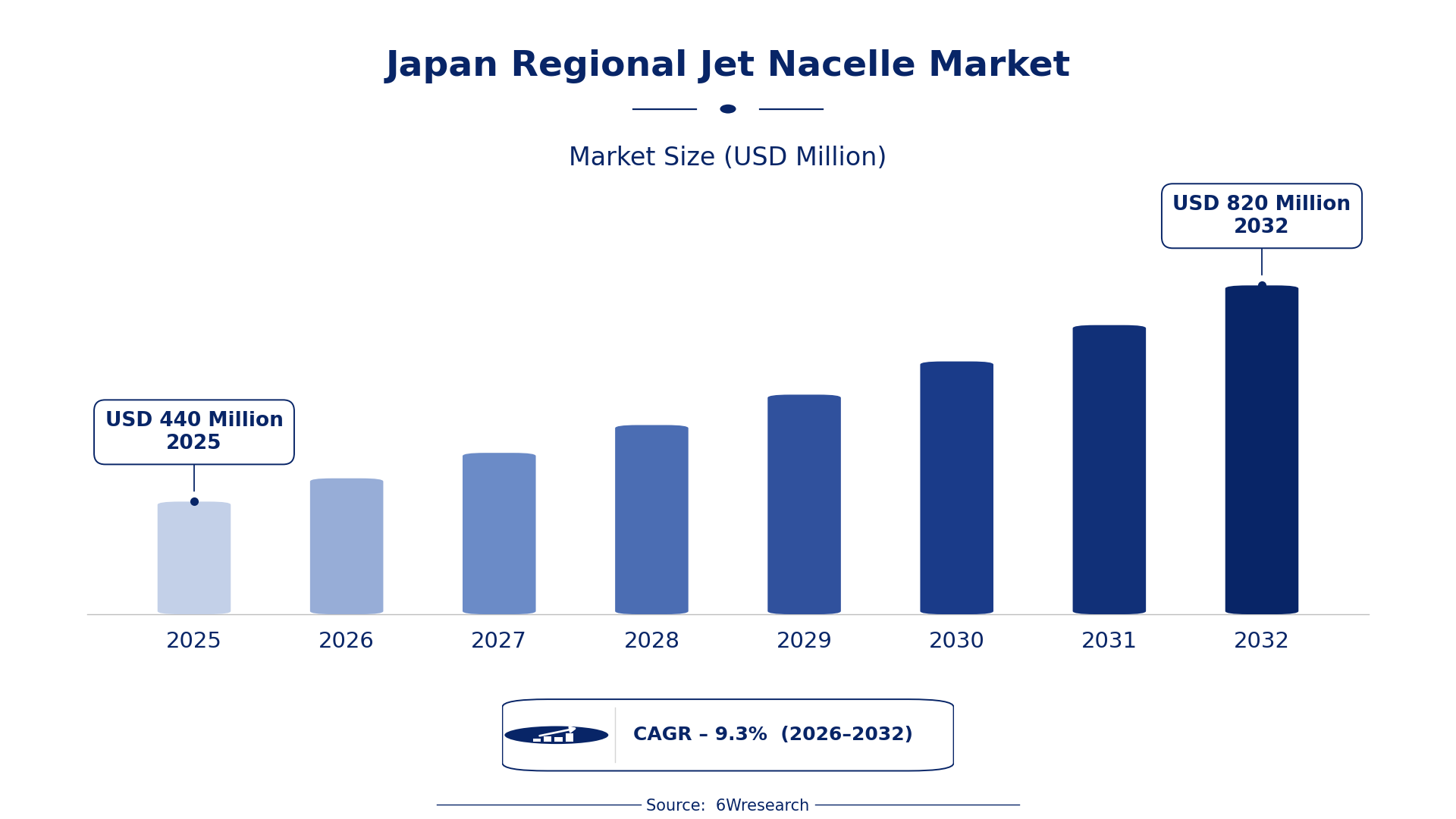
According to 6Wresearch internal database and industry insights, the Japan Regional Jet Nacelle Market was valued at USD 440 Million in 2025 and is projected to reach USD 820 Million by 2032, growing at a CAGR of approximately 9.3% during 2026–2032.
Japan Regional Jet Nacelle Market Highlights
| Report Metric | Details |
| Report Name | Japan Regional Jet Nacelle Market (2026-2032) |
| Market Size 2025 | USD 440 Million |
| Market Size 2032 | USD 820 Million |
| Absolute Growth 2025–2032 | USD 380 Million |
| CAGR 2026–2032 | 9.3% |
| Peak Annual Growth | 11.3% in 2026 |
| Forecast Period | 2026–2032 |
| Historical Data | 2022–2025 |
| Base Year | 2025 |
| Leading Nacelle Type, 2025 | Turbofan Nacelle (51% share) |
| Leading Engine Compatibility, 2025 | Regional Jet Engines (42% share) |
| Leading Material, 2025 | Composite/Aluminum (43% share) |
| Leading End User, 2025 | Aircraft OEMs (42% share) |
| Fastest-Growing Nacelle Type | Reverse-Thrust Nacelle (12.5% CAGR) |
| Fastest-Growing Engine Compatibility | Noise-Abatement Models (11.5% CAGR) |
| Fastest-Growing Material | Titanium/Stainless Steel (13.5% CAGR) |
| Fastest-Growing End User | MRO Providers (12.1% CAGR) |
| Growing Sector | Regional aviation |
| Key End Users | Aircraft OEMs, MRO Providers, Regional Jet Manufacturers |
Japan Regional Jet Nacelle Market Year-wise Growth Rate and Key Drivers (2022–2032)
This graph illustrates the annual growth rates of the market from 2022 to 2032, highlighting a steady upward trajectory and projected market expansion over the forecast period.
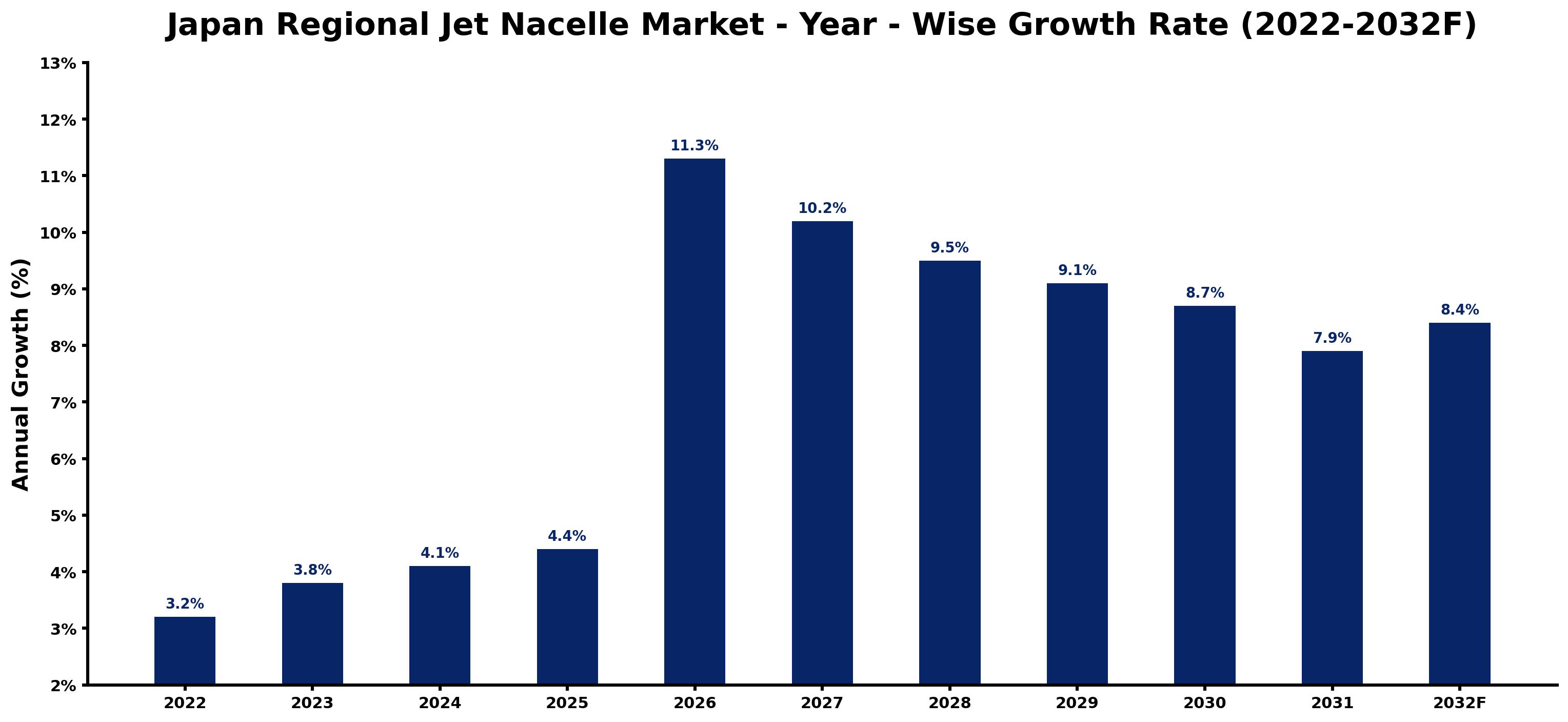
The following figures match every annual growth estimate with the main market development of that year, giving the reasoning behind each rise or slowdown.
| Year | Estimated Annual Growth (%) | Market Rationale |
| 2022 | 3.2 | The market experienced steady activity with over 100 regional jets in operation. |
| 2023 | 3.8 | Growth accelerated as regional jet manufacturers focused on noise abatement technologies. |
| 2024 | 4.1 | Demand increased further due to rising environmental compliance requirements. |
| 2025 | 4.4 | Market growth peaked as the Tokyo region saw heightened regional jet operations. |
| 2026 | 11.3 | Investment in advanced nacelle technologies is expected to drive growth. |
| 2027 | 10.2 | Growth slows slightly as manufacturers adjust to new environmental standards. |
| 2028 | 9.5 | The market continues to grow, supported by ongoing regional connectivity initiatives. |
| 2029 | 9.1 | Demand stabilises as manufacturers optimise production processes for efficiency. |
| 2030 | 8.7 | Growth remains steady with increasing adoption of composite materials in nacelles. |
| 2031 | 7.9 | The market sees a slowdown as manufacturers face capacity constraints. |
| 2032 | 8.4 | Growth picks up again as new regional connectivity strategies are implemented. |
Note: Market size estimations and growth projections presented in this report are based on 6Wresearch's proprietary forecasting methodology, utilizing the latest available industry data, government publications, and primary research inputs.
Japan Regional Jet Nacelle Market Synopsis
Regional Jet Nacelles are essential aerodynamic structures that house jet engines on regional aircraft, primarily made from composite materials and aluminum. The Japan Regional Jet Nacelle Market is projected to grow, driven by over 100 regional jets in operation and increasing demand for noise-abatement technologies. Factors such as a government strategy to improve regional air connectivity and compliance with environmental regulations are propelling market growth.
Market Dynamics Impact Analysis (2026–2032)
| Factor | Type | Impact | Primary Segment Affected |
| Increased investment in advanced nacelle technologies | Driver | High | Turbofan Nacelle |
| Growing demand for noise-abatement technologies | Driver | High | Environmental Nacelles |
| Rising demand for regional air connectivity | Opportunity | High | Regional Jet Manufacturers |
| Expansion of regional jet operations in the Tokyo region | Opportunity | Medium | Aircraft OEMs |
| Compliance with stringent environmental regulations | Restraint | High | Environmental Nacelles |
| Capacity constraints in manufacturing facilities | Restraint | Medium | Turbofan Nacelle |
| Cost pressures from raw material prices | Challenge | High | Composite/Aluminum |
| Challenges in meeting evolving emission standards | Challenge | Medium | Noise-Abatement Models |
Evaluation of Drivers in Japan Regional Jet Nacelle Market (2026–2032)
Key forces behind demand, with the segment each one moves most, are listed below.
| Drivers | Primary Segment Affected | Why It Matters (Evidence) |
| Investment in advanced nacelle technologies | Turbofan Nacelle | This investment improves performance and efficiency, encouraging purchases from Aircraft OEMs. |
| Growing focus on noise-abatement technologies | Environmental Nacelles | This focus aligns with compliance needs, prompting increased orders from regional jet manufacturers. |
| Expansion of regional air connectivity initiatives | Regional Jet Manufacturers | Such initiatives boost operational jets, driving higher nacelle demand. |
| Rising passenger traffic in the Tokyo region | Aircraft OEMs | Increased traffic necessitates more regional jets, thereby increasing nacelle production. |
| Adoption of composite materials for nacelle production | Composite/Aluminum | This adoption improves fuel efficiency, leading to higher demand from MRO Providers. |
Volumes increase due to heightened investment in advanced nacelle technologies, which boost performance and efficiency for regional jets. The emphasis on noise-abatement technologies aligns with compliance requirements, prompting regional jet manufacturers to raise their orders. Ongoing efforts to improve regional connectivity elevate the number of operational jets, resulting in increased nacelle demand. Rising passenger traffic calls for more regional jets, further stimulating nacelle production. The use of composite materials improves fuel efficiency, driving demand from maintenance and repair organisations.
Evaluation of Restraints in Japan Regional Jet Nacelle Market
The main factors holding the market back are set out below.
| Market Restraint | Primary Segment Affected | Why It Matters (Evidence) |
| Compliance with stringent environmental regulations | Environmental Nacelles | Manufacturers face challenges in meeting evolving standards, increasing costs for Aircraft OEMs. |
| Capacity constraints in manufacturing facilities | Turbofan Nacelle | Limited production capabilities slow down supply, affecting timely deliveries to MRO Providers. |
| Cost pressures from raw material prices | Composite/Aluminum | Rising prices of composites impact overall production costs for manufacturers. |
| Challenges in meeting evolving emission standards | Noise-Abatement Models | Stricter regulations require additional investments in technology, affecting profitability for manufacturers. |
| Limited availability of skilled workforce | Regional Jet Manufacturers | A shortage of skilled labour can delay production timelines and increase operational costs. |
Japan Regional Jet Nacelle Market Challenges
Limited availability of advanced composite materials raises costs for buyers, as these materials account for 60% of nacelle production. This scarcity arises from Japan's focus on domestic manufacturing, causing delays that can extend project timelines by three months. Skills shortages within the workforce hinder producers' capacity to meet the rising demand for nacelle designs, potentially leading to project delays and lost contracts for suppliers. Intense competition from international manufacturers forces local producers to reduce prices, which may compromise quality and increase lead times for buyers.
Trends in the Japan Regional Jet Nacelle Market
The shifts below are changing how Japan Regional Jet Nacelle Market products are bought and supplied.
- Shift towards Environmental Nacelles: The adoption of Environmental Nacelles has increased as regional jet manufacturers comply with Japanese emission standards. In 2023, demand for these nacelles rose, reflecting a commitment to sustainability.
- Focus on Noise-Abatement Technologies: Regional jet manufacturers in the Tokyo region have prioritised noise-abatement technologies, resulting in a substantial increase in orders for Environmental Nacelles. This shift is essential for compliance with local regulations.
- Increase in Composite Material Usage: The use of composite materials in nacelle production has surged, accounting for 60% of production in Japan. This trend began in 2022, driven by the need for lightweight structures that improve fuel efficiency.
- Expansion of Regional Air Connectivity Initiatives: The government's strategy to enhance regional air connectivity, announced in 2023, aims to improve access to remote areas. This initiative is expected to increase regional jet operations significantly by 2025.
Investment Opportunities in the Japan Regional Jet Nacelle Market
Several openings in the Japan Regional Jet Nacelle Market merit attention from investors.
- Aircraft OEMs seeking advanced nacelles: Aircraft OEMs are increasingly pursuing advanced nacelles to boost performance. The anticipated market growth offers suppliers an opportunity to enter this sector.
- Tokyo region's demand for regional jets: The Tokyo region's commitment to enhancing regional air connectivity presents a promising opportunity for nacelle suppliers. The expected rise in regional jet operations will substantially drive demand.
- Investment in noise-abatement technologies: With noise regulations becoming stricter, there is an urgent need for suppliers to invest in noise-abatement technologies. The growing focus on compliance among regional jet manufacturers will fuel this demand.
- Emerging markets for sustainable aviation: The movement towards sustainable aviation creates opportunities for suppliers of Environmental Nacelles. The government's strategy to achieve carbon neutrality by 2050 will further invigorate this market.
Government Initiatives in the Japan Regional Jet Nacelle Market
The Economic Security Promotion Act of 2022 supports supply-chain resilience for critical products and materials. This act ensures that manufacturers can maintain production levels and meet market demand, particularly for advanced nacelle technologies. The act also encourages investment in research and development, benefiting the entire sector.
The Ministry of Land, Infrastructure, Transport and Tourism oversees aviation regulations and approves new technologies for regional jets. This agency's funding for research into advanced nacelle technologies is essential for compliance with environmental standards, benefiting both manufacturers and buyers.
Future Insight of the Japan Regional Jet Nacelle Market
Buyers will see advancements in nacelle technology by 2032, driven by collaboration with the Japan Aerospace Exploration Agency on innovative designs. The government's strategy to improve regional air connectivity will support an increase in operational regional jets to over 120. ISO 9001 standards will ensure consistent quality in nacelle manufacturing, building trust among buyers. Noise abatement technologies will become standard, enhancing passenger experience and ensuring compliance with emission regulations.
Market Segmentation Analysis
Japan Regional Jet Nacelle Market report covers a detailed analysis of the following market segments:
By Nacelle Type – Turbofan Nacelle Leads, Reverse-Thrust Nacelle Expected to Grow Fastest
According to Saurav Kr Singh, Senior Research Analyst at 6Wresearch, Turbofan Nacelle accounted for 51% of the market by nacelle type in 2025. Turbofan Nacelles hold the largest share as they are essential for housing jet engines in Japan's regional jets, which number over 100 in operation. Their widespread use across the regional aviation sector, particularly in the Tokyo region, reinforces their leading position in the market. The quickest growth will come from Reverse-Thrust Nacelle, forecast to expand at a CAGR of 12.5% between 2026 and 2032. The Reverse-Thrust Nacelle segment is experiencing rapid growth due to the implementation of stricter safety regulations for landing procedures. This segment's expansion is further encouraged by the government's recent strategy to enhance regional air connectivity, which prioritises safety improvements. Suppliers should focus on developing advanced nacelle technologies to meet the increasing demand for safety and operational efficiency.
By Engine Compatibility – Regional Jet Engines Lead, Noise-Abatement Models Expected to Grow Fastest
Regional Jet Engines took 42% of engine compatibility revenue in 2025, more than any other category. Regional Jet Engines are the market leader as they serve as the core component for propulsion in Japan's regional jets. Their critical importance in ensuring operational efficiency guarantees a consistent demand from aircraft manufacturers. Noise-Abatement Models are set to record the highest CAGR in this split, 11.5% over 2026–2032. Noise-Abatement Models are experiencing swift growth driven by an increased regulatory focus on environmental compliance, especially regarding noise pollution. This trend is propelled by the need for regional aircraft to meet stricter emission standards imposed by authorities. Buyers should consider investing in noise-abatement technologies to comply with evolving regulations and maintain a competitive edge in the market.
By Material – Composite/Aluminum Leads, Titanium/Stainless Steel Expected to Grow Fastest
With 43% of material revenue in 2025, Composite/Aluminum was the largest category. Composite/Aluminum materials dominate the market as they are the primary materials used in nacelle production, constituting 60% of total production. Their lightweight and durable characteristics make them particularly suitable for regional jet applications, especially in high-demand areas like the Tokyo Metropolitan Area. Over 2026–2032, Titanium/Stainless Steel is expected to post the fastest growth, at a CAGR of 13.5%. Titanium/Stainless Steel materials are gaining traction due to their specific application in components that require enhanced strength and corrosion resistance. This trend aligns with the regional aviation industry's focus on improving performance and longevity of nacelles. Suppliers must concentrate on developing titanium and stainless steel solutions to address the rising demand for specialised nacelle components.
By End User – Aircraft OEMs Lead, MRO Providers Expected to Grow Fastest
In 2025, Aircraft OEMs led the end user split with a 42% share. Aircraft OEMs represent the largest share as they are the primary customers for nacelles, directly influencing production volumes. Their ongoing projects in the regional aviation sector ensure sustained demand for nacelle components. MRO Providers are projected to grow fastest, at a CAGR of 12.1% during 2026–2032. MRO Providers are experiencing the fastest growth as the need for maintenance and repair services increases with the expanding fleet of regional jets. This trend is supported by the growing operational hours of existing aircraft, necessitating regular upkeep. Suppliers should consider partnerships with MRO providers to capitalise on the rising demand for maintenance services in the regional jet market.
Key Attractiveness of the Report
- 10 Years of Market Numbers
- Historical Data Starting from 2022 to 2025
- Base Year 2025
- Forecast Data until 2032
- Key Performance Indicators Impacting the Market
- Major Upcoming Developments and Projects
Key Highlights of the Report:
- Japan Regional Jet Nacelle Market Outlook
- Market Size of Japan Regional Jet Nacelle Market, 2025
- Forecast of Japan Regional Jet Nacelle Market, 2032
- Historical Data and Forecast of Japan Regional Jet Nacelle Revenues & Volume for the Period 2022-2032F
- Japan Regional Jet Nacelle Market Trend Evolution
- Japan Regional Jet Nacelle Market Drivers and Challenges
- Japan Regional Jet Nacelle Price Trends
- Japan Regional Jet Nacelle Porter's Five Forces
- Japan Regional Jet Nacelle Industry Life Cycle
- Historical Data and Forecast of Japan Regional Jet Nacelle Market Revenues & Volume By Nacelle Type for the Period 2022-2032F
- Historical Data and Forecast of Japan Regional Jet Nacelle Market Revenues & Volume By Turbofan Nacelle for the Period 2022-2032F
- Historical Data and Forecast of Japan Regional Jet Nacelle Market Revenues & Volume By Reverse-Thrust Nacelle for the Period 2022-2032F
- Historical Data and Forecast of Japan Regional Jet Nacelle Market Revenues & Volume By Integrated Cowlings for the Period 2022-2032F
- Historical Data and Forecast of Japan Regional Jet Nacelle Market Revenues & Volume By Environmental Nacelles for the Period 2022-2032F
- Historical Data and Forecast of Japan Regional Jet Nacelle Market Revenues & Volume By Engine Compatibility for the Period 2022-2032F
- Historical Data and Forecast of Japan Regional Jet Nacelle Market Revenues & Volume By Regional Jet Engines for the Period 2022-2032F
- Historical Data and Forecast of Japan Regional Jet Nacelle Market Revenues & Volume By Noise-Abatement Models for the Period 2022-2032F
- Historical Data and Forecast of Japan Regional Jet Nacelle Market Revenues & Volume By High-Bypass Engines for the Period 2022-2032F
- Historical Data and Forecast of Japan Regional Jet Nacelle Market Revenues & Volume By Reduced Emission Specs for the Period 2022-2032F
- Historical Data and Forecast of Japan Regional Jet Nacelle Market Revenues & Volume By Material for the Period 2022-2032F
- Historical Data and Forecast of Japan Regional Jet Nacelle Market Revenues & Volume By Composite/Aluminum for the Period 2022-2032F
- Historical Data and Forecast of Japan Regional Jet Nacelle Market Revenues & Volume By Titanium/Stainless Steel for the Period 2022-2032F
- Historical Data and Forecast of Japan Regional Jet Nacelle Market Revenues & Volume By Advanced Composites for the Period 2022-2032F
- Historical Data and Forecast of Japan Regional Jet Nacelle Market Revenues & Volume By Carbon-Fiber for the Period 2022-2032F
- Historical Data and Forecast of Japan Regional Jet Nacelle Market Revenues & Volume By End User for the Period 2022-2032F
- Historical Data and Forecast of Japan Regional Jet Nacelle Market Revenues & Volume By Aircraft OEMs for the Period 2022-2032F
- Historical Data and Forecast of Japan Regional Jet Nacelle Market Revenues & Volume By MRO Providers for the Period 2022-2032F
- Historical Data and Forecast of Japan Regional Jet Nacelle Market Revenues & Volume By Regional Jet Manufacturers for the Period 2022-2032F
- Historical Data and Forecast of Japan Regional Jet Nacelle Market Revenues & Volume By Sustainable HVAC Units for the Period 2022-2032F
- Japan Regional Jet Nacelle Import Export Trade Statistics
- Market Opportunity Assessment By Nacelle Type
- Market Opportunity Assessment By Engine Compatibility
- Market Opportunity Assessment By Material
- Market Opportunity Assessment By End User
- Japan Regional Jet Nacelle Top Companies Market Share
- Japan Regional Jet Nacelle Competitive Benchmarking By Technical and Operational Parameters
- Japan Regional Jet Nacelle Company Profiles
- Japan Regional Jet Nacelle Key Strategic Recommendations
Market Covered
Segments analysed in this report are listed below.
By Nacelle Type
- Turbofan Nacelle
- Reverse-Thrust Nacelle
- Integrated Cowlings
- Environmental Nacelles
By Engine Compatibility
- Regional Jet Engines
- Noise-Abatement Models
- High-Bypass Engines
- Reduced Emission Specs
By Material
- Composite/Aluminum
- Titanium/Stainless Steel
- Advanced Composites
- Carbon-Fiber
By End User
- Aircraft OEMs
- MRO Providers
- Regional Jet Manufacturers
- Sustainable HVAC Units






































