Japan Reliability Centered Maintenance Market Size & Growth Rate
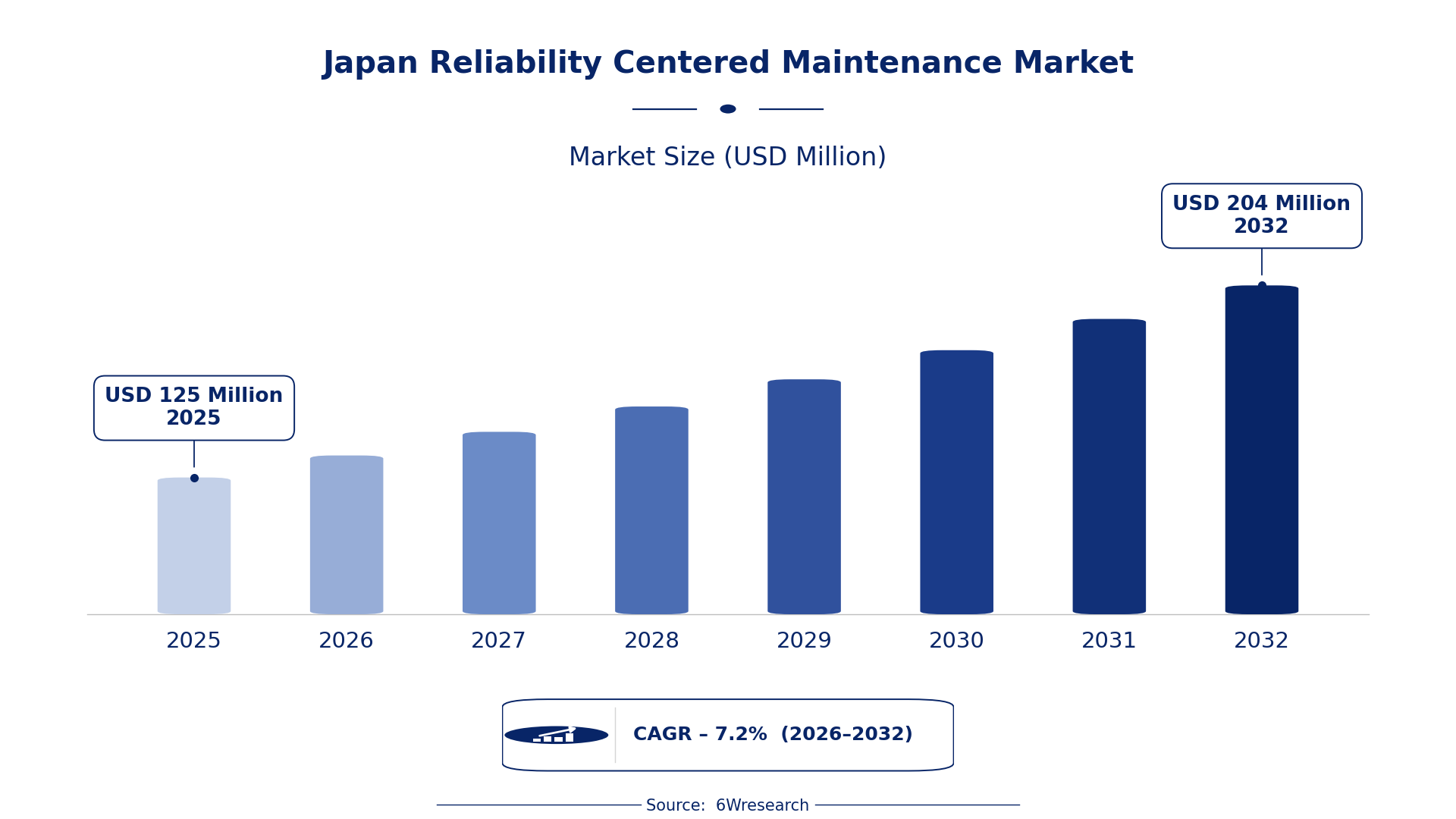
According to 6Wresearch internal database and industry insights, the Japan Reliability Centered Maintenance Market was valued at USD 125 Million in 2025 and is projected to reach USD 204 Million by 2032, growing at a CAGR of approximately 7.2% during 2026–2032.
Japan Reliability Centered Maintenance Market Highlights
| Report Metric | Details |
| Report Name | Japan Reliability Centered Maintenance Market (2026-2032) |
| Market Size 2025 | USD 125 Million |
| Market Size 2032 | USD 204 Million |
| Absolute Growth 2025–2032 | USD 79 Million |
| CAGR 2026–2032 | 7.2% |
| Peak Annual Growth | 8.4% in 2032 |
| Forecast Period | 2026–2032 |
| Historical Data | 2022–2025 |
| Base Year | 2025 |
| Leading Analysis Type, 2025 | Predictive (36% share) |
| Leading Maintenance Strategy, 2025 | Condition-Based (35% share) |
| Leading Tool Type, 2025 | Vibration/Temp Sensors (42% share) |
| Leading End User, 2025 | Power Plants & Mills (42% share) |
| Fastest-Growing Analysis Type | Preventive (10.2% CAGR) |
| Fastest-Growing Maintenance Strategy | Time-Based (9.5% CAGR) |
| Fastest-Growing Tool Type | CMMS Software (10.7% CAGR) |
| Fastest-Growing End User | Oil & Gas Infrastructure (9.9% CAGR) |
| Growing Sector | Oil & Gas Infrastructure |
| Key End Users | Power Plants & Mills, Oil & Gas Infrastructure, Maintenance Engineering Teams, Mine & Utility Operators |
Japan Reliability Centered Maintenance Market Year-wise Growth Rate and Key Drivers (2022–2032)
This graph illustrates the annual growth rates of the market from 2022 to 2032, highlighting a steady upward trajectory and projected market expansion over the forecast period.
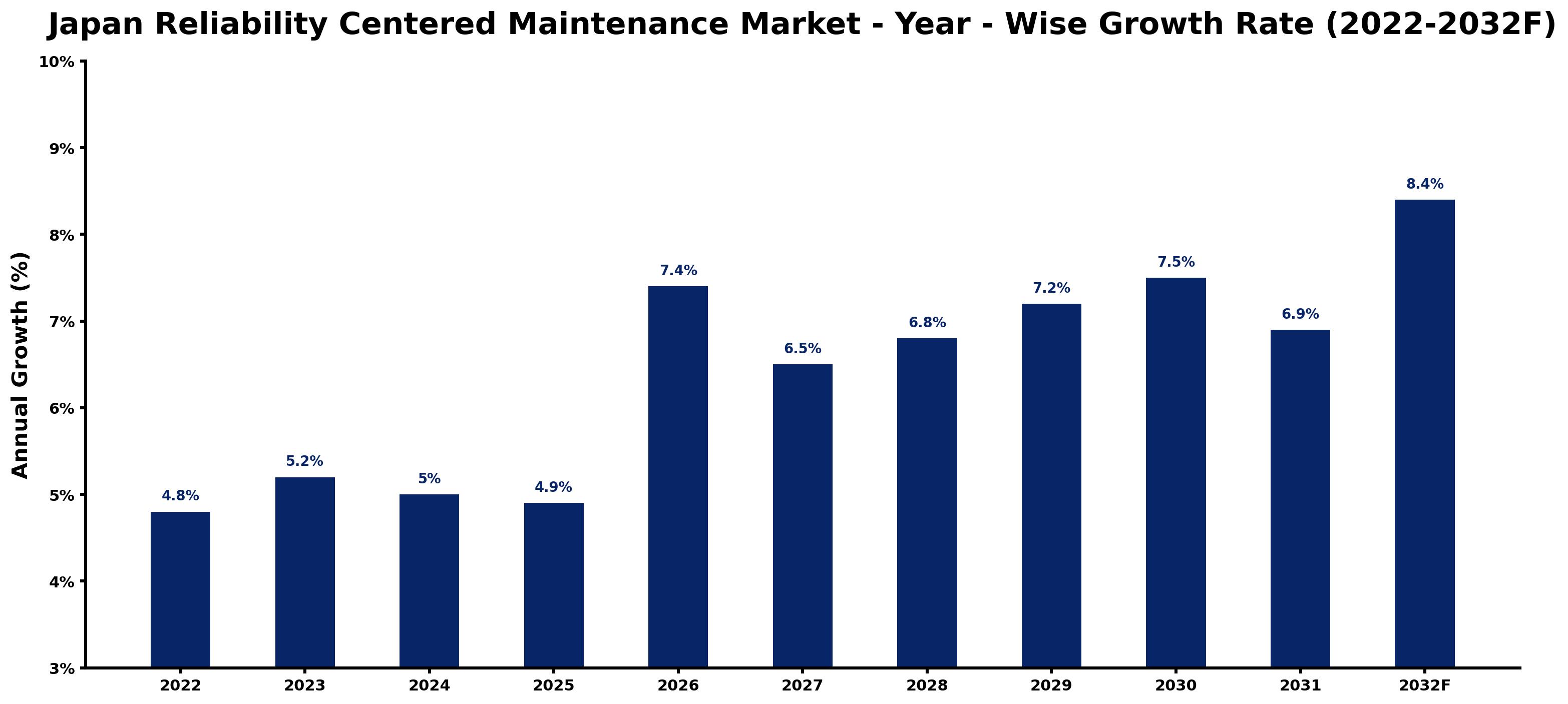
The following figures match every annual growth estimate with the main market development of that year, giving the reasoning behind each rise or slowdown.
| Year | Estimated Annual Growth (%) | Market Rationale |
| 2022 | 4.8 | The market showed steady growth due to ongoing investments in maintenance strategies. |
| 2023 | 5.2 | Growth was driven by increased adoption of RCM in power generation sectors. |
| 2024 | 5.0 | The market experienced a slowdown as companies adjusted their maintenance budgets. |
| 2025 | 4.9 | Demand continued to grow, albeit at a slower pace, reflecting market maturity. |
| 2026 | 7.4 | Growth is expected to accelerate as industries adopt more advanced predictive maintenance tools. |
| 2027 | 6.5 | A slight slowdown is projected as firms focus on optimizing existing resources. |
| 2028 | 6.8 | Demand is expected to rise again, driven by heightened awareness of maintenance efficiency. |
| 2029 | 7.2 | The market is projected to experience strong growth as new technologies gain traction. |
| 2030 | 7.5 | Growth is expected to continue as firms invest in reliability improvement initiatives. |
| 2031 | 6.9 | A slowdown is projected as the market begins to stabilise after rapid growth. |
| 2032 | 8.4 | The market is expected to peak, driven by substantial investments in RCM. |
Note: Market size estimations and growth projections presented in this report are based on 6Wresearch's proprietary forecasting methodology, utilizing the latest available industry data, government publications, and primary research inputs.
Japan Reliability Centered Maintenance Market Synopsis
Reliability Centered Maintenance (RCM) is a systematic approach ensuring systems perform their intended functions, primarily used in critical industries like power generation and oil and gas. In Japan, over 1,000 power plants employ RCM strategies, reflecting a strong demand for reliability. Factors driving market growth include increased adoption of ISO 55000 standards and a government initiative that invested ¥5 billion in 2023 to improve industrial reliability through RCM, indicating a positive investment environment. The Japan Reliability Centered Maintenance Market is expected to expand significantly as industries prioritise reliability and efficiency in their operations.
Market Dynamics Impact Analysis (2026–2032)
| Factor | Type | Impact | Primary Segment Affected |
| Growing adoption of RCM methodologies | Driver | High | Predictive |
| Increased investment in maintenance technologies | Driver | High | Condition-Based |
| Rising demand for reliability in energy sectors | Opportunity | High | Power Plants & Mills |
| Need for improved operational efficiency in oil and gas | Opportunity | High | Oil & Gas Infrastructure |
| Limited awareness of RCM benefits among smaller firms | Restraint | Medium | Preventive |
| High initial investment costs for RCM implementation | Restraint | Medium | Reliability Analysis |
| Difficulty in integrating new technologies into existing systems | Challenge | High | Optimization |
| Shortage of skilled personnel in maintenance engineering | Challenge | High | Maintenance Engineering Teams |
Evaluation of Drivers in Japan Reliability Centered Maintenance Market (2026–2032)
The main growth drivers and the segments they affect most are set out below.
| Drivers | Primary Segment Affected | Why It Matters (Evidence) |
| Increased adoption of predictive maintenance tools | Predictive | Approximately 80% of maintenance engineering teams in Japan use RCM methodologies, leading to higher demand for predictive tools. |
| Rising investment in reliability improvement | Condition-Based | In 2023, Japan's energy sector invested ¥5 billion in reliability improvement programs, boosting demand for condition-based maintenance. |
| Implementation of ISO 55000 standards | Reliability Analysis | Many Japanese firms have adopted ISO 55000 standards for asset management, driving demand for reliability analysis tools. |
| Growing focus on operational efficiency | Optimization | The oil and gas sector employs RCM to improve safety and efficiency, increasing demand for optimization strategies. |
| Expansion of CMMS software usage | CMMS Software | CMMS software adoption in Japan's utilities sector has increased by 25% since 2020, reflecting a shift towards digital maintenance management. |
The strongest pull on demand comes from the increased adoption of predictive maintenance tools, with a large number of maintenance engineering teams in Japan using RCM methodologies. The implementation of ISO 55000 standards for asset management drives the need for reliability analysis tools. The oil and gas sector employs RCM to improve safety and efficiency, which further increases demand for optimization strategies. CMMS software adoption in Japan's utilities sector has risen by 25% since 2020, reflecting a broader shift towards digital maintenance management.
Evaluation of Restraints in Japan Reliability Centered Maintenance Market
The table below lists the restraints and the evidence behind each.
| Market Restraint | Primary Segment Affected | Why It Matters (Evidence) |
| Limited awareness of RCM benefits among smaller firms | Preventive | Many smaller firms lack understanding of RCM advantages, resulting in lower adoption rates and missed opportunities for efficiency. |
| High initial investment costs for RCM implementation | Reliability Analysis | The upfront costs associated with RCM can deter smaller companies from adopting these methodologies, limiting market growth. |
| Difficulty in integrating new technologies into existing systems | Optimization | Many firms struggle to integrate RCM technologies with legacy systems, slowing down the adoption process. |
| Shortage of skilled personnel in maintenance engineering | Maintenance Engineering Teams | A lack of qualified professionals in RCM strategies hinders effective implementation and utilization across industries. |
| Resistance to change from traditional maintenance practices | Condition-Based | Some companies are hesitant to shift from established practices, impacting the overall adoption of RCM methodologies. |
Japan Reliability Centered Maintenance Market Challenges
Japan's power plants frequently contend with outdated maintenance practices, resulting in intense competition among operators to modernise strategies. This competition stems from stringent safety regulations, causing maintenance costs to rise by 30% for producers. Skills gaps remain, as only 80% of maintenance engineering teams are proficient in RCM methodologies, delaying project timelines for buyers requiring reliable services. Supply chain disruptions arise from reliance on imported RCM tools, potentially leading to project delays of up to six months for utilities implementing new systems.
Trends in the Japan Reliability Centered Maintenance Market
Four trends stand out in the Japan Reliability Centered Maintenance Market.
- Launch of the RCM Training Initiative: In 2023, the Japan Maintenance Management Association introduced a nationwide RCM training initiative, aiming to improve skills among maintenance teams. This initiative is expected to increase RCM adoption across various sectors, addressing the skills gap.
- Shift towards Digital Maintenance Management: The adoption of CMMS software has surged, with a 25% increase since 2020 in Japan's utilities sector. This shift indicates a growing preference for digital solutions to manage maintenance activities efficiently.
- Increased Focus on Predictive Maintenance: The oil and gas sector is increasingly adopting predictive maintenance strategies, driven by the need for operational efficiency. This trend is clear as RCM practices are implemented to prevent failures before they occur.
- Expansion of ISO 55000 Adoption: Since 2021, many Japanese firms have adopted ISO 55000 standards for asset management. This shift is improving reliability practices across industries, leading to better maintenance outcomes.
Investment Opportunities in the Japan Reliability Centered Maintenance Market
The following opportunities in the Japan Reliability Centered Maintenance Market pair current demand with a clear way in.
- Investment in Training Programs: With a gap in skilled personnel, investing in training programs for maintenance engineering teams can improve RCM adoption. The Japan Maintenance Management Association's initiatives support this need, indicating a strong opportunity for training providers.
- Growth in Digital Solutions: The increasing adoption of CMMS software presents an opportunity to supply digital solutions for maintenance management. Utilities in Japan are actively seeking these tools to improve operational efficiency.
- Focus on Reliability Improvement: The ¥5 billion investment in reliability improvement programs in 2023 highlights the need for innovative solutions in the energy sector. Suppliers can target this investment by offering advanced RCM technologies.
- Expansion in Oil and Gas Sector: The oil and gas sector's focus on predictive maintenance creates opportunities for suppliers of advanced monitoring tools. This sector's growth indicates a demand for reliable maintenance solutions.
Government Initiatives in the Japan Reliability Centered Maintenance Market
The Hydrogen Society Promotion Act, enacted in 2024, supports low-carbon hydrogen and ammonia supply chains with price-gap support, benefiting producers in the energy sector by facilitating the integration of RCM practices. Additionally, the AI Promotion Act of 2025 encourages the adoption of AI technologies in maintenance processes, establishing a framework for research and development that can improve operational efficiency.
Energy sector buyers can access funding through the Economic Security Promotion Act, which supports supply-chain resilience for critical products. This act, along with the Semiconductor and Digital Industry Strategy launched in June 2021, aims to strengthen domestic capabilities, allowing firms to invest in RCM technologies more effectively.
Future Insight of the Japan Reliability Centered Maintenance Market
The government initiative launched in 2023 will drive a policy shift towards improved reliability practices, prompting suppliers to invest in advanced RCM technologies. By 2032, the adoption of new reliability standards will encourage buyers to seek certified asset management solutions. Increased investment, such as the ¥5 billion allocated to reliability improvement programs, will enable firms to upgrade their maintenance protocols. The integration of predictive maintenance technologies will further optimise operational efficiency across industries, particularly in energy and utilities.
Market Segmentation Analysis
Japan Reliability Centered Maintenance Market report covers a detailed analysis of the following market segments:
By Analysis Type – Predictive Leads, Preventive Expected to Grow Fastest
According to Saurav Kr Singh, Senior Research Analyst at 6Wresearch, with 36% of analysis type revenue in 2025, Predictive was the largest category. Predictive analysis commands a substantial market share in Japan, particularly due to its application in over 1,000 power plants that rely on this method for ensuring reliable operations. This approach is essential for industries where anticipating failures is critical to maintaining continuous performance. Over 2026–2032, Preventive is expected to post the fastest growth, at a CAGR of 10.2%. Preventive analysis is experiencing rapid growth as industries increasingly recognise the importance of scheduled maintenance to prevent unexpected downtimes. The recent government initiative aimed at improving industrial reliability through RCM practices has further accelerated the adoption of preventive strategies. This suggests that suppliers should focus on enhancing predictive tools while buyers must invest in preventive maintenance to ensure system reliability.
By Maintenance Strategy – Condition-Based Leads, Time-Based Expected to Grow Fastest
In 2025, Condition-Based led the maintenance strategy split with a 35% share. Condition-based maintenance strategies dominate the market as they allow for maintenance actions based on the actual condition of equipment, which is crucial in sectors such as energy. This method is widely implemented in power plants and mills, ensuring optimal operational efficiency and reliability. Time-Based is set to record the highest CAGR in this split, 9.5% over 2026–2032. Time-based maintenance is witnessing swift growth as companies increasingly implement regular maintenance schedules to prevent failures. The energy sector's increased investment in reliability improvement programmes is a key factor driving this trend. This indicates that suppliers need to develop solutions that support condition-based approaches while buyers should consider integrating time-based strategies for enhanced reliability.
By Tool Type – Vibration/Temp Sensors Lead, CMMS Software Expected to Grow Fastest
The largest tool type category in 2025 was Vibration/Temp Sensors, at 42% of revenue. Vibration and temperature sensors are the leading tools in Japan, essential for monitoring equipment health across various industries, especially in manufacturing. Their widespread application in predictive maintenance underscores their critical role in ensuring operational reliability and performance. The quickest growth will come from CMMS Software, forecast to expand at a CAGR of 10.7% between 2026 and 2032. CMMS software is rapidly gaining traction as utilities seek to streamline their maintenance management processes. A 25% increase in software adoption since 2020 highlights the growing demand for digital solutions in maintenance management. This means that suppliers should prioritise the development of CMMS solutions, while buyers must leverage these tools to optimise their maintenance activities.
By End User – Power Plants & Mills Lead, Oil & Gas Infrastructure Expected to Grow Fastest
Power Plants & Mills held 42% of the Japan Reliability Centered Maintenance Market by end user in 2025. Power plants and mills are the primary users of reliability centered maintenance, employing these strategies to ensure continuous operation and safety. Their substantial investment in RCM practices underscores the critical importance of reliability in energy production and management. Oil & Gas Infrastructure is projected to grow fastest, at a CAGR of 9.9% during 2026–2032. The oil and gas infrastructure sector is experiencing the fastest growth as it prioritises maintaining operational efficiency through RCM strategies. This sector's strong focus on safety and efficiency drives the rapid adoption of RCM practices. This suggests that suppliers should tailor their offerings to meet the specific needs of power plants and oil and gas infrastructure, while buyers must align their RCM strategies with industry best practices.
Key Attractiveness of the Report
- 10 Years of Market Numbers
- Historical Data Starting from 2022 to 2025
- Base Year 2025
- Forecast Data until 2032
- Key Performance Indicators Impacting the Market
- Major Upcoming Developments and Projects
Key Highlights of the Report:
- Japan Reliability Centered Maintenance Market Outlook
- Market Size of Japan Reliability Centered Maintenance Market, 2025
- Forecast of Japan Reliability Centered Maintenance Market, 2032
- Historical Data and Forecast of Japan Reliability Centered Maintenance Revenues & Volume for the Period 2022-2032F
- Japan Reliability Centered Maintenance Market Trend Evolution
- Japan Reliability Centered Maintenance Market Drivers and Challenges
- Japan Reliability Centered Maintenance Price Trends
- Japan Reliability Centered Maintenance Porter's Five Forces
- Japan Reliability Centered Maintenance Industry Life Cycle
- Historical Data and Forecast of Japan Reliability Centered Maintenance Market Revenues & Volume By Analysis Type for the Period 2022-2032F
- Historical Data and Forecast of Japan Reliability Centered Maintenance Market Revenues & Volume By Predictive for the Period 2022-2032F
- Historical Data and Forecast of Japan Reliability Centered Maintenance Market Revenues & Volume By Preventive for the Period 2022-2032F
- Historical Data and Forecast of Japan Reliability Centered Maintenance Market Revenues & Volume By Reliability Analysis for the Period 2022-2032F
- Historical Data and Forecast of Japan Reliability Centered Maintenance Market Revenues & Volume By Optimization for the Period 2022-2032F
- Historical Data and Forecast of Japan Reliability Centered Maintenance Market Revenues & Volume By Maintenance Strategy for the Period 2022-2032F
- Historical Data and Forecast of Japan Reliability Centered Maintenance Market Revenues & Volume By Condition-Based for the Period 2022-2032F
- Historical Data and Forecast of Japan Reliability Centered Maintenance Market Revenues & Volume By Time-Based for the Period 2022-2032F
- Historical Data and Forecast of Japan Reliability Centered Maintenance Market Revenues & Volume By Critical System Review for the Period 2022-2032F
- Historical Data and Forecast of Japan Reliability Centered Maintenance Market Revenues & Volume By KPI-Based for the Period 2022-2032F
- Historical Data and Forecast of Japan Reliability Centered Maintenance Market Revenues & Volume By Tool Type for the Period 2022-2032F
- Historical Data and Forecast of Japan Reliability Centered Maintenance Market Revenues & Volume By Vibration/Temp Sensors for the Period 2022-2032F
- Historical Data and Forecast of Japan Reliability Centered Maintenance Market Revenues & Volume By CMMS Software for the Period 2022-2032F
- Historical Data and Forecast of Japan Reliability Centered Maintenance Market Revenues & Volume By FMEA/FMECA Tools for the Period 2022-2032F
- Historical Data and Forecast of Japan Reliability Centered Maintenance Market Revenues & Volume By Reporting Dashboards for the Period 2022-2032F
- Historical Data and Forecast of Japan Reliability Centered Maintenance Market Revenues & Volume By End User for the Period 2022-2032F
- Historical Data and Forecast of Japan Reliability Centered Maintenance Market Revenues & Volume By Power Plants & Mills for the Period 2022-2032F
- Historical Data and Forecast of Japan Reliability Centered Maintenance Market Revenues & Volume By Oil & Gas Infrastructure for the Period 2022-2032F
- Historical Data and Forecast of Japan Reliability Centered Maintenance Market Revenues & Volume By Maintenance Engineering Teams for the Period 2022-2032F
- Historical Data and Forecast of Japan Reliability Centered Maintenance Market Revenues & Volume By Mine & Utility Operators for the Period 2022-2032F
- Japan Reliability Centered Maintenance Import Export Trade Statistics
- Market Opportunity Assessment By Analysis Type
- Market Opportunity Assessment By Maintenance Strategy
- Market Opportunity Assessment By Tool Type
- Market Opportunity Assessment By End User
- Japan Reliability Centered Maintenance Top Companies Market Share
- Japan Reliability Centered Maintenance Competitive Benchmarking By Technical and Operational Parameters
- Japan Reliability Centered Maintenance Company Profiles
- Japan Reliability Centered Maintenance Key Strategic Recommendations
Market Covered
The following segment groups are covered in the report.
By Analysis Type
- Predictive
- Preventive
- Reliability Analysis
- Optimization
By Maintenance Strategy
- Condition-Based
- Time-Based
- Critical System Review
- KPI-Based
By Tool Type
- Vibration/Temp Sensors
- CMMS Software
- FMEA/FMECA Tools
- Reporting Dashboards
By End User
- Power Plants & Mills
- Oil & Gas Infrastructure
- Maintenance Engineering Teams
- Mine & Utility Operators































