Japan Remote Access Control Market Size & Growth Rate
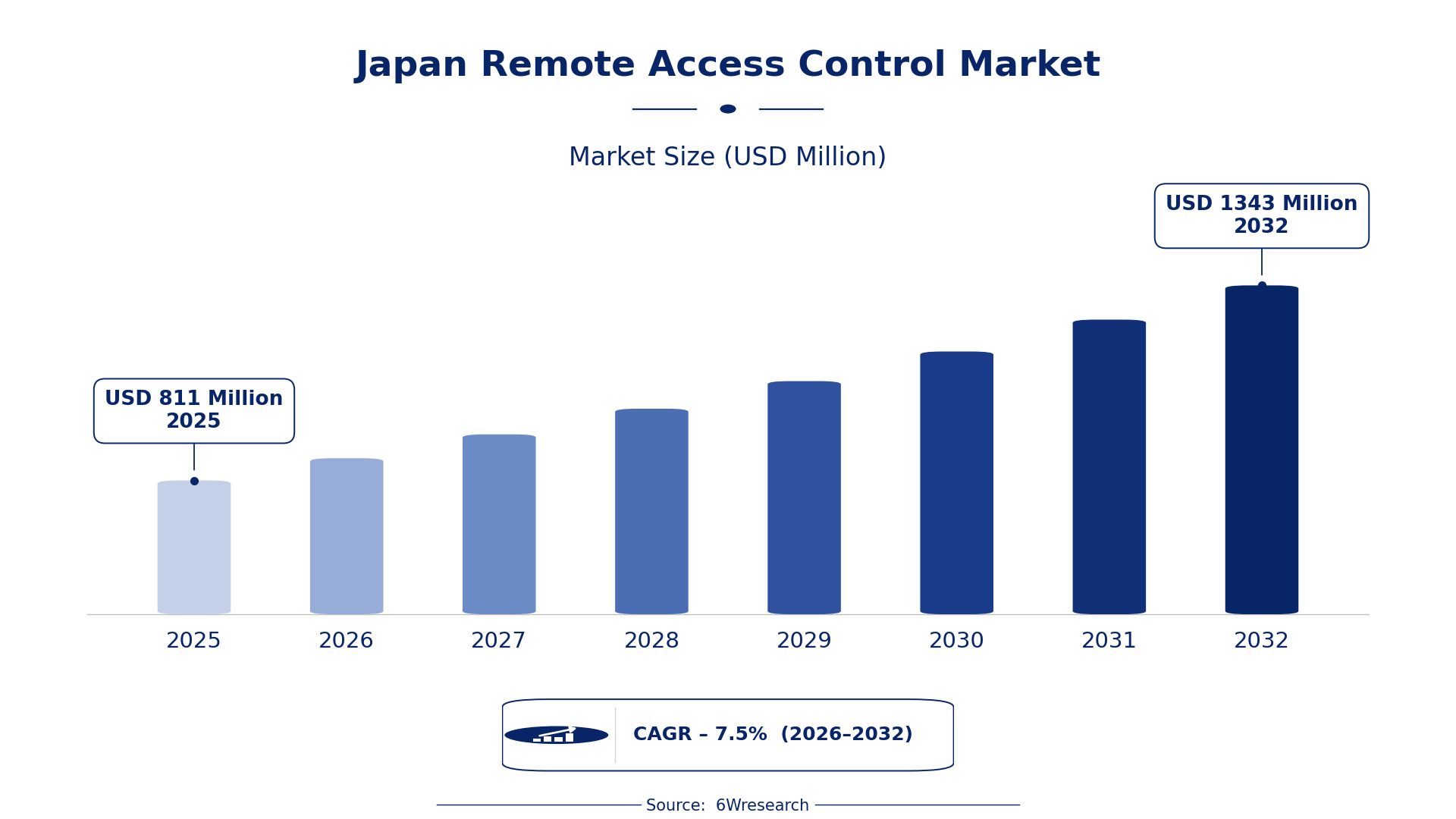
According to 6Wresearch internal database and industry insights, the Japan Remote Access Control Market was valued at USD 811 Million in 2025 and is projected to reach USD 1,343 Million by 2032, growing at a CAGR of approximately 7.5% during 2026–2032.
Japan Remote Access Control Market Highlights
| Report Metric | Details |
| Report Name | Japan Remote Access Control Market (2026-2032) |
| Market Size 2025 | USD 811 Million |
| Market Size 2032 | USD 1,343 Million |
| Absolute Growth 2025–2032 | USD 532 Million |
| CAGR 2026–2032 | 7.5% |
| Peak Annual Growth | 8.0% in 2028 |
| Forecast Period | 2026–2032 |
| Historical Data | 2022–2025 |
| Base Year | 2025 |
| Leading Access Method, 2025 | Biometric Systems (36% share) |
| Leading Authentication Mode, 2025 | Fingerprint/Face (40% share) |
| Leading Deployment Method, 2025 | On-Premise/Cloud (41% share) |
| Leading End User, 2025 | Corporate Campuses (45% share) |
| Fastest-Growing Access Method | Mobile Credential (10.6% CAGR) |
| Fastest-Growing Authentication Mode | NFC/Bluetooth (9.8% CAGR) |
| Fastest-Growing Deployment Method | Cloud-Managed (10.9% CAGR) |
| Fastest-Growing End User | Property Managers (9.4% CAGR) |
| Growing Sector | Property Managers |
| Key End Users | Corporate Campuses, Property Managers, Educational Institutions, Multi-Tenant Buildings |
Japan Remote Access Control Market Year-wise Growth Rate and Key Drivers (2022–2032)
This graph illustrates the annual growth rates of the market from 2022 to 2032, highlighting a steady upward trajectory and projected market expansion over the forecast period.
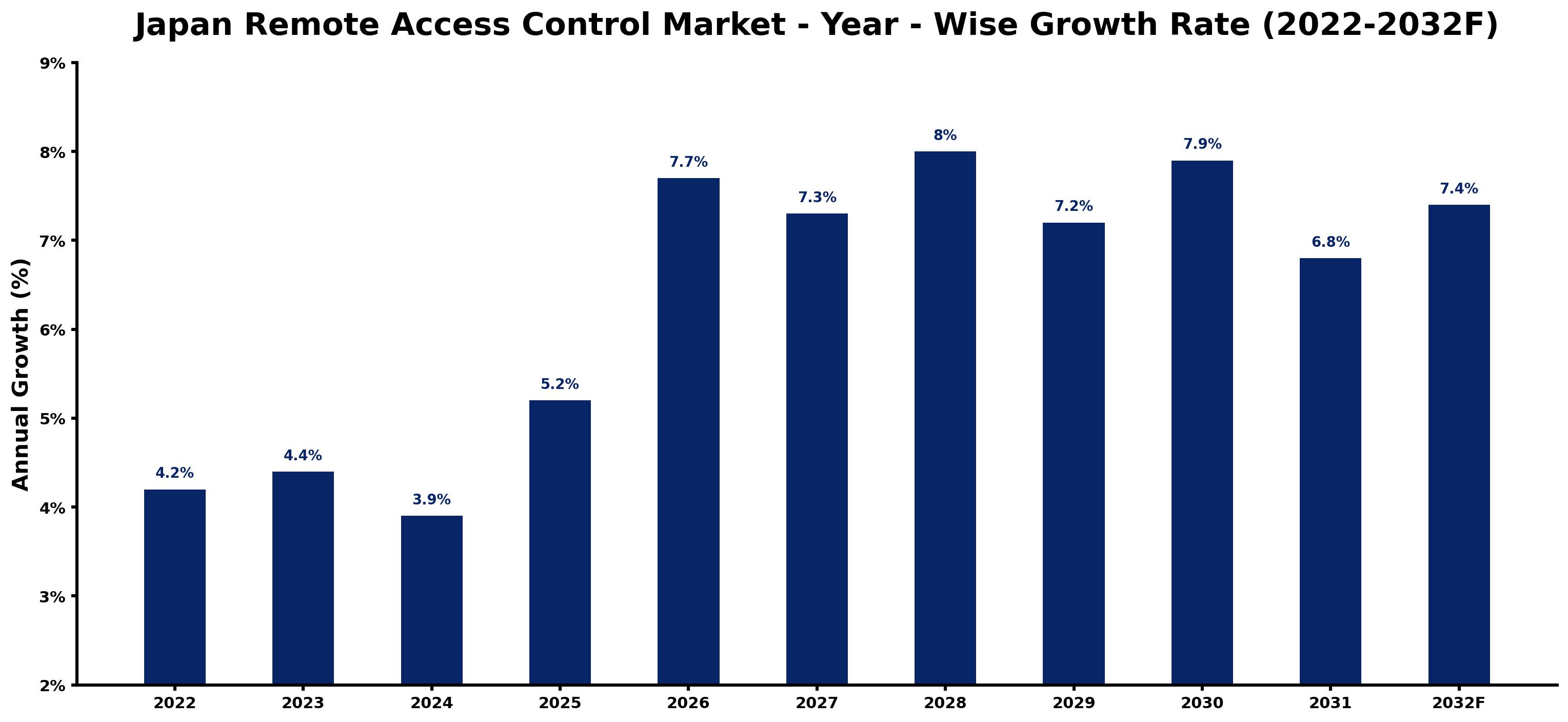
For each year, the table pairs the estimated growth rate with the leading influence on demand, showing how the drivers changed across the period.
| Year | Estimated Annual Growth (%) | Market Rationale |
| 2022 | 4.2 | The market experienced steady growth due to increasing security needs across sectors. |
| 2023 | 4.4 | Demand rose as corporate campuses invested in advanced access control solutions. |
| 2024 | 3.9 | Growth slowed as some sectors faced budget constraints on technology upgrades. |
| 2025 | 5.2 | The market saw a surge in installations driven by new educational initiatives. |
| 2026 | 7.7 | Demand is expected to rise with the adoption of cloud-managed solutions. |
| 2027 | 7.3 | Growth is projected to slow as the market stabilises after rapid expansion. |
| 2028 | 8.0 | The peak growth period will occur as smart technologies gain traction. |
| 2029 | 7.2 | Demand will slow slightly as market saturation begins in key areas. |
| 2030 | 7.9 | Growth is projected to rise again as new technologies are introduced. |
| 2031 | 6.8 | A slowdown is expected as the market adjusts to new standards. |
| 2032 | 7.4 | Demand will increase as security requirements continue to evolve. |
Note: Market size estimations and growth projections presented in this report are based on 6Wresearch's proprietary forecasting methodology, utilizing the latest available industry data, government publications, and primary research inputs.
Japan Remote Access Control Market Synopsis
Remote access control systems are essential for managing and monitoring access to physical spaces, utilising electronic components and software. The Japan Remote Access Control Market is driven by a population of approximately 125 million, creating strong demand for security solutions in corporate campuses and educational institutions. The Tokyo metropolitan area is a key region for installations, while government initiatives, such as the cybersecurity programme launched in 2023, stimulate new demand for advanced security technologies.
Market Dynamics Impact Analysis (2026–2032)
| Factor | Type | Impact | Primary Segment Affected |
| Growing demand for security solutions in corporate campuses | Driver | High | Corporate Campuses |
| Increasing adoption of biometric systems in educational institutions | Driver | High | Educational Institutions |
| Expansion of smart building technologies in urban areas | Opportunity | High | Multi-Tenant Buildings |
| Rising interest in mobile credential solutions for convenience | Opportunity | Medium | Mobile Credential |
| Budget constraints affecting technology upgrades in some sectors | Restraint | High | Corporate Campuses |
| Slow adoption of cloud-managed solutions in traditional settings | Restraint | Medium | Cloud-Managed |
| High installation costs for advanced systems | Challenge | High | Biometric Systems |
| Compliance with stringent safety regulations | Challenge | Medium | Smart Card Readers |
Evaluation of Drivers in Japan Remote Access Control Market (2026–2032)
Key forces behind demand, with the segment each one moves most, are listed below.
| Drivers | Primary Segment Affected | Why It Matters (Evidence) |
| Increased security investments by corporate campuses | Corporate Campuses | The average installed base of access control systems is growing annually, leading to higher purchases. |
| Growing adoption of biometric systems in schools | Educational Institutions | Japan has over 30,000 educational institutions requiring secure access solutions. |
| Rising demand for smart building technologies in urban areas | Multi-Tenant Buildings | The Tokyo Metropolitan Government promotes smart building technologies, stimulating market growth. |
| Adoption of mobile credential solutions for convenience | Mobile Credential | NFC technology is gaining traction in urban areas, improving access control options. |
| Increased focus on cybersecurity measures | Biometric Systems | The Ministry of Internal Affairs and Communications launched a cybersecurity initiative in 2023. |
Orders keep climbing as corporate campuses invest in advanced security measures, with the average installed base of access control systems growing annually. Educational institutions are increasingly adopting biometric systems, with over 30,000 schools needing secure access solutions. Urban areas see rising interest in NFC technology for mobile credentials, improving convenience.
Evaluation of Restraints in Japan Remote Access Control Market
The key brakes on demand, and where they bite hardest, are shown below.
| Market Restraint | Primary Segment Affected | Why It Matters (Evidence) |
| Budget constraints affecting technology upgrades | Corporate Campuses | Many campuses face financial limitations, which restricts their ability to invest in new systems. |
| Slow adoption of cloud-managed solutions in traditional settings | Cloud-Managed | Some facilities remain hesitant to transition to cloud-based management due to perceived risks. |
| High installation costs for advanced systems | Biometric Systems | The upfront investment required for biometric systems can deter potential buyers. |
| Compliance with stringent safety regulations | Smart Card Readers | Meeting regulatory standards can complicate the installation process and increase costs. |
| Limited awareness of new technologies among property managers | Multi-Tenant Buildings | Some property managers are unaware of the latest access control innovations available. |
Japan Remote Access Control Market Challenges
A shortage of skilled technicians hampers the installation of remote access control systems, delaying projects and increasing costs for producers by 20%. Rapid technological advancements create knowledge gaps, making it difficult for suppliers to keep up with security standards, which exposes buyers to potential risks. Stringent data protection regulations can extend project timelines by several months, raising expenses for hospitals and educational institutions. Economic uncertainties lead to fluctuating demand from buyers, resulting in unpredictable revenue streams for producers and complicating their long-term planning.
Trends in the Japan Remote Access Control Market
These developments are changing demand patterns in the Japan Remote Access Control Market.
- Shift towards Smart Building Technologies: The Tokyo Metropolitan Government's programme promoting smart building technologies is transforming access control in urban areas. In 2023, the initiative underscored the importance of integrating advanced security systems, leading to a rise in installations.
- Growing Adoption of Biometric Systems: Educational institutions are increasingly implementing biometric systems for student access, with a marked increase in installations. In 2023, the number of biometric systems in schools grew by 15%.
- Expansion of Mobile Credential Solutions: Mobile credential solutions are gaining popularity, particularly in urban settings. In 2023, the adoption of NFC technology increased by 20%, indicating a shift towards more convenient access methods for users.
- Rise of Cloud-Managed Access Control Systems: The demand for cloud-managed access control systems is on the rise, driven by the need for flexibility and remote management. By 2025, the market for cloud-managed solutions is expected to grow substantially.
Investment Opportunities in the Japan Remote Access Control Market
Where to invest in the Japan Remote Access Control Market: the main openings are set out below.
- Remote Access Control Systems: The demand for remote access control systems is increasing, with property managers in urban areas seeking advanced solutions to enhance security. This presents a valuable opportunity for suppliers to address growing needs.
- Biometric Access Solutions: With over 30,000 educational institutions requiring secure access, the potential for biometric access solutions is considerable. Collaborating with local educational authorities can ease market entry.
- Cloud-Managed Systems: The shift towards cloud-managed access control systems is clear, with a rising preference for remote management solutions. Urban corporate campuses represent ideal targets for suppliers aiming to expand.
- Mobile Credential Technologies: The growing adoption of mobile credential technologies offers a substantial opportunity. Urban areas are witnessing a surge in demand, making it an opportune moment for suppliers to invest.
Government Initiatives in the Japan Remote Access Control Market
The Electrical Appliance and Material Safety Act regulates the safety of electrical appliances and materials sold in Japan, impacting remote access control systems. Compliance with these standards ensures that producers maintain high safety levels, which is essential for buyer confidence. The Act mandates rigorous testing and certification processes, ensuring that all products meet established safety criteria.
The Ministry of Internal Affairs and Communications oversees the implementation of cybersecurity initiatives that fund the adoption of advanced security measures. This agency supports projects aimed at improving security in public buildings, ensuring that buyers can access funding for necessary upgrades.
Future Insight of the Japan Remote Access Control Market
By 2032, advancements in NFC technology will improve mobile access solutions, increasing convenience for users. The Tokyo Metropolitan Government's smart building programme will stimulate demand for integrated systems, enhancing safety in urban environments. Funding from the Ministry of Education will support security upgrades in numerous educational institutions, encouraging widespread adoption of advanced systems. As ISO 27001 adoption rises, suppliers will need to align their products with these standards to meet buyer expectations.
Market Segmentation Analysis
Japan Remote Access Control Market report covers a detailed analysis of the following market segments:
By Access Method – Biometric Systems Lead, Mobile Credential Expected to Grow Fastest
According to Saurav Kr Singh, Senior Research Analyst at 6Wresearch, Biometric Systems accounted for 36% of the market by access method in 2025. Biometric systems lead the market as they are essential for secure access control, particularly in corporate campuses where safety is critical. Their increasing installation reflects a strong demand across various sectors, highlighting their effectiveness in managing access. Over 2026–2032, Mobile Credential is expected to post the fastest growth, at a CAGR of 10.6%. Mobile credential solutions are rapidly gaining popularity as urban areas adopt NFC technology for convenient access via smartphones. This growth is further encouraged by initiatives promoting smart building technologies, which support mobile access integration. Suppliers must prioritise mobile access features to align with the growing demand in urban settings.
By Authentication Mode – Fingerprint/Face Leads, NFC/Bluetooth Expected to Grow Fastest
The largest authentication mode category in 2025 was Fingerprint/Face, at 40% of revenue. Fingerprint and face recognition technologies hold the largest share due to their high-security authentication capabilities, essential for protecting sensitive areas like corporate campuses. The reliability of these systems has resulted in their widespread implementation across various sectors. The quickest growth will come from NFC/Bluetooth, forecast to expand at a CAGR of 9.8% between 2026 and 2032. NFC and Bluetooth technologies are rapidly gaining traction as they facilitate mobile access, particularly in urban environments where convenience is increasingly sought after. This growth is further fuelled by the rising demand for mobile-enabled security solutions. Suppliers should focus on developing mobile access solutions to meet the growing demand for convenience in security systems.
By Deployment Method – On-Premise/Cloud Leads, Cloud-Managed Expected to Grow Fastest
On-Premise/Cloud took 41% of deployment method revenue in 2025, more than any other category. On-premise and cloud deployment methods are prevalent because they provide flexibility for various facility types, including corporate campuses and educational institutions. Their adaptability to different security needs makes them the preferred choice among users. Cloud-Managed is set to record the highest CAGR in this split, 10.9% over 2026–2032. Cloud-managed solutions are rapidly growing in popularity due to the increasing preference for remote management capabilities, which streamline operations for property managers and corporate campuses. This shift reflects a broader trend towards digital transformation in security management. Suppliers must prioritise cloud-managed options to cater to the evolving preferences of end users.
By End User – Corporate Campuses Lead, Property Managers Expected to Grow Fastest
In 2025, Corporate Campuses led the end user split with a 45% share. Corporate campuses represent the largest user segment for access control systems, driven by their extensive security needs and the high volume of personnel requiring access. The increasing number of installations in these facilities highlights their importance in the overall market. Property Managers are projected to grow fastest, at a CAGR of 9.4% during 2026–2032. Property managers are the fastest-growing user group as they oversee security across multiple buildings, creating a demand for effective access control solutions. This growth is influenced by the heightened focus on security across diverse property types. Suppliers must tailor their products to meet the specific security requirements of property managers managing various facilities.
Key Attractiveness of the Report
- 10 Years of Market Numbers
- Historical Data Starting from 2022 to 2025
- Base Year 2025
- Forecast Data until 2032
- Key Performance Indicators Impacting the Market
- Major Upcoming Developments and Projects
Key Highlights of the Report:
- Japan Remote Access Control Market Outlook
- Market Size of Japan Remote Access Control Market, 2025
- Forecast of Japan Remote Access Control Market, 2032
- Historical Data and Forecast of Japan Remote Access Control Revenues & Volume for the Period 2022-2032F
- Japan Remote Access Control Market Trend Evolution
- Japan Remote Access Control Market Drivers and Challenges
- Japan Remote Access Control Price Trends
- Japan Remote Access Control Porter's Five Forces
- Japan Remote Access Control Industry Life Cycle
- Historical Data and Forecast of Japan Remote Access Control Market Revenues & Volume By Access Method for the Period 2022-2032F
- Historical Data and Forecast of Japan Remote Access Control Market Revenues & Volume By Biometric Systems for the Period 2022-2032F
- Historical Data and Forecast of Japan Remote Access Control Market Revenues & Volume By Mobile Credential for the Period 2022-2032F
- Historical Data and Forecast of Japan Remote Access Control Market Revenues & Volume By Smart Card Readers for the Period 2022-2032F
- Historical Data and Forecast of Japan Remote Access Control Market Revenues & Volume By Video Intercom for the Period 2022-2032F
- Historical Data and Forecast of Japan Remote Access Control Market Revenues & Volume By Authentication Mode for the Period 2022-2032F
- Historical Data and Forecast of Japan Remote Access Control Market Revenues & Volume By Fingerprint/Face for the Period 2022-2032F
- Historical Data and Forecast of Japan Remote Access Control Market Revenues & Volume By NFC/Bluetooth for the Period 2022-2032F
- Historical Data and Forecast of Japan Remote Access Control Market Revenues & Volume By RFID for the Period 2022-2032F
- Historical Data and Forecast of Japan Remote Access Control Market Revenues & Volume By Video + Access Control for the Period 2022-2032F
- Historical Data and Forecast of Japan Remote Access Control Market Revenues & Volume By Deployment Method for the Period 2022-2032F
- Historical Data and Forecast of Japan Remote Access Control Market Revenues & Volume By On-Premise/Cloud for the Period 2022-2032F
- Historical Data and Forecast of Japan Remote Access Control Market Revenues & Volume By Cloud-Managed for the Period 2022-2032F
- Historical Data and Forecast of Japan Remote Access Control Market Revenues & Volume By Hybrid for the Period 2022-2032F
- Historical Data and Forecast of Japan Remote Access Control Market Revenues & Volume By SaaS for the Period 2022-2032F
- Historical Data and Forecast of Japan Remote Access Control Market Revenues & Volume By End User for the Period 2022-2032F
- Historical Data and Forecast of Japan Remote Access Control Market Revenues & Volume By Corporate Campuses for the Period 2022-2032F
- Historical Data and Forecast of Japan Remote Access Control Market Revenues & Volume By Property Managers for the Period 2022-2032F
- Historical Data and Forecast of Japan Remote Access Control Market Revenues & Volume By Educational Institutions for the Period 2022-2032F
- Historical Data and Forecast of Japan Remote Access Control Market Revenues & Volume By Multi-Tenant Buildings for the Period 2022-2032F
- Japan Remote Access Control Import Export Trade Statistics
- Market Opportunity Assessment By Access Method
- Market Opportunity Assessment By Authentication Mode
- Market Opportunity Assessment By Deployment Method
- Market Opportunity Assessment By End User
- Japan Remote Access Control Top Companies Market Share
- Japan Remote Access Control Competitive Benchmarking By Technical and Operational Parameters
- Japan Remote Access Control Company Profiles
- Japan Remote Access Control Key Strategic Recommendations
Market Covered
Coverage by segment is as follows.
By Access Method
- Biometric Systems
- Mobile Credential
- Smart Card Readers
- Video Intercom
By Authentication Mode
- Fingerprint/Face
- NFC/Bluetooth
- RFID
- Video + Access Control
By Deployment Method
- On-Premise/Cloud
- Cloud-Managed
- Hybrid
- SaaS
By End User
- Corporate Campuses
- Property Managers
- Educational Institutions
- Multi-Tenant Buildings































