Japan Remote Operation Services Market Size & Growth Rate
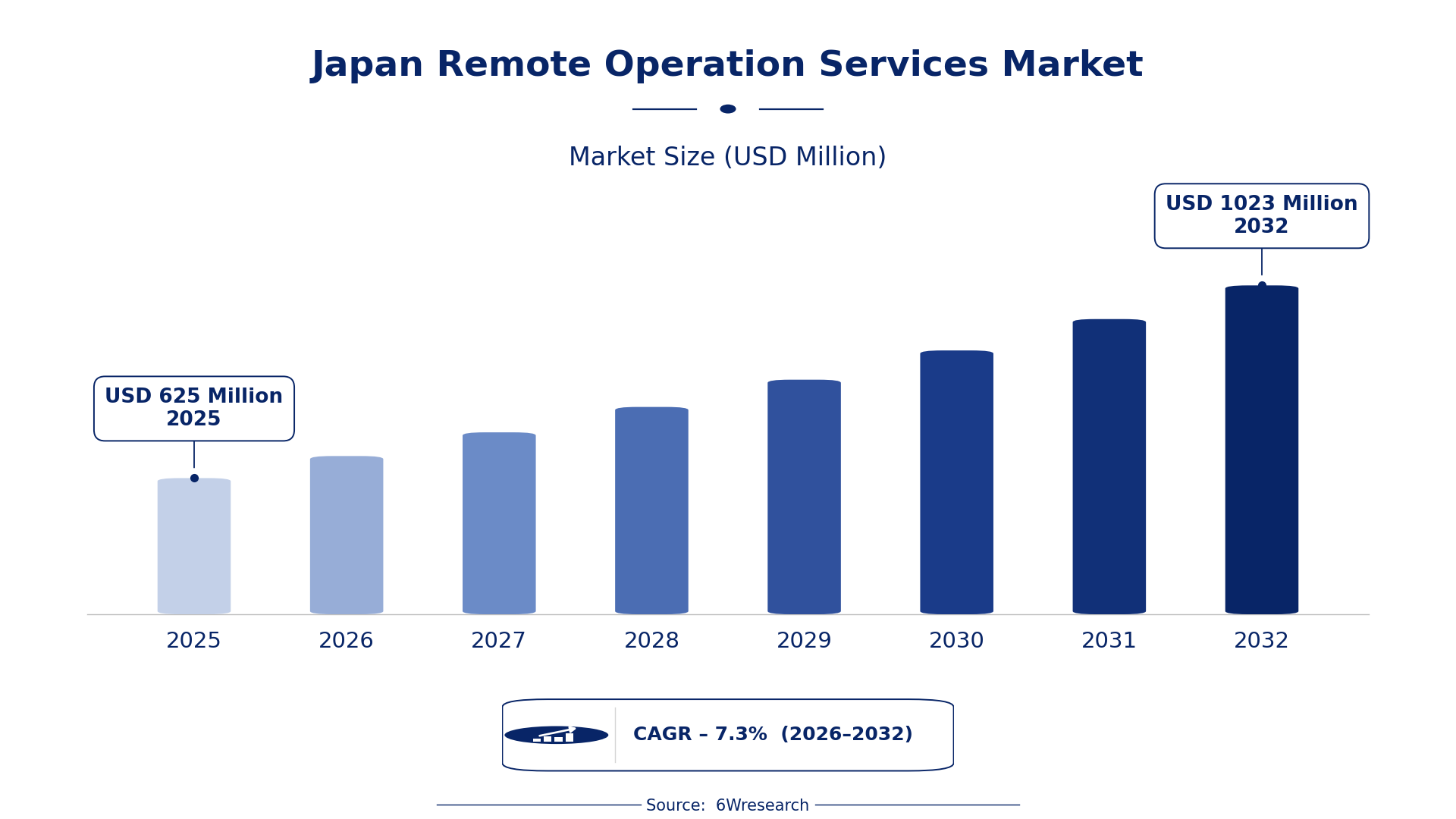
According to 6Wresearch internal database and industry insights, the Japan Remote Operation Services Market was valued at USD 625 Million in 2025 and is projected to reach USD 1,023 Million by 2032, growing at a CAGR of approximately 7.3% during 2026–2032.
Japan Remote Operation Services Market Highlights
| Report Metric | Details |
| Report Name | Japan Remote Operation Services Market (2026-2032) |
| Market Size 2025 | USD 625 Million |
| Market Size 2032 | USD 1,023 Million |
| Absolute Growth 2025–2032 | USD 398 Million |
| CAGR 2026–2032 | 7.3% |
| Peak Annual Growth | 8.2% in 2032 |
| Forecast Period | 2026–2032 |
| Historical Data | 2022–2025 |
| Base Year | 2025 |
| Leading Service Type, 2025 | Remote Equipment Control (36% share) |
| Leading Operational Platform, 2025 | Robotic/Tele-OP (44% share) |
| Leading Control Interface, 2025 | Haptic Controls (41% share) |
| Leading End User, 2025 | Construction & Mining Firms (37% share) |
| Fastest-Growing Service Type | Drone Inspection (9.9% CAGR) |
| Fastest-Growing Operational Platform | UAV Datalinks (10.7% CAGR) |
| Fastest-Growing Control Interface | VR-Based Control (9.5% CAGR) |
| Fastest-Growing End User | Asset Management Companies (9.6% CAGR) |
| Growing Sector | Construction and Energy |
| Key End Users | Construction Firms, Energy Production Firms, Shipping Companies, Asset Management Companies |
Japan Remote Operation Services Market Year-wise Growth Rate and Key Drivers (2022–2032)
This graph illustrates the annual growth rates of the market from 2022 to 2032, highlighting a steady upward trajectory and projected market expansion over the forecast period.
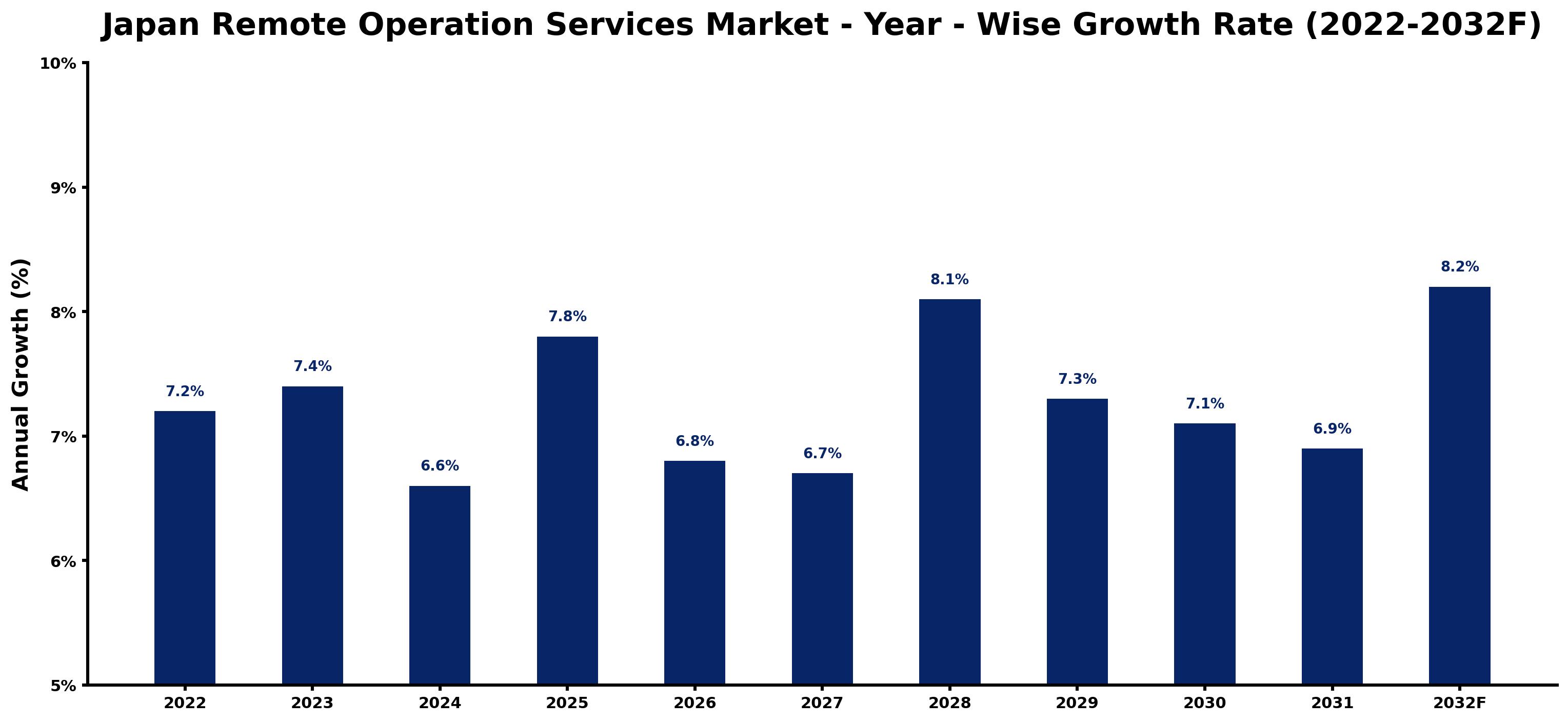
The table below sets out the estimated growth rate for each year and the main factor behind it.
| Year | Estimated Annual Growth (%) | Market Rationale |
| 2022 | 7.2 | The market experienced steady growth as demand for operational efficiency increased. |
| 2023 | 7.4 | Growth accelerated due to rising investments in remote operation technologies across sectors. |
| 2024 | 6.6 | A slowdown occurred as firms adjusted to previous year's rapid expansion. |
| 2025 | 7.8 | Demand surged as construction firms adopted advanced remote monitoring solutions. |
| 2026 | 6.8 | Growth is expected to slow as market saturation begins to affect new investments. |
| 2027 | 6.7 | Continued demand from energy production firms is expected to maintain positive growth. |
| 2028 | 8.1 | An increase in remote piloting services will boost market performance. |
| 2029 | 7.3 | Growth is projected to slow as competition intensifies among service providers. |
| 2030 | 7.1 | Demand will remain steady as firms continue to invest in operational technologies. |
| 2031 | 6.9 | A slight slowdown is anticipated as the market stabilises after previous peaks. |
| 2032 | 8.2 | Growth will peak as the adoption of remote operation technologies surges. |
Note: Market size estimations and growth projections presented in this report are based on 6Wresearch's proprietary forecasting methodology, utilizing the latest available industry data, government publications, and primary research inputs.
Japan Remote Operation Services Market Synopsis
Remote Operation Services enable the remote control and monitoring of equipment through advanced communication systems and robotics. The Japan Remote Operation Services Market is increasingly adopted in sectors like construction and energy, driven by a population exceeding 126 million and substantial investments in technology development. The Tokyo metropolitan area serves as a hub for innovation, while government measures promote further development, improving operational efficiency and safety across industries.
Market Dynamics Impact Analysis (2026–2032)
| Factor | Type | Impact | Primary Segment Affected |
| Growing demand for operational efficiency in construction and energy sectors | Driver | High | Remote Equipment Control |
| Increased adoption of UAV datalinks for construction inspections | Driver | High | Drone Inspection |
| Rising investments in offshore wind farms creating demand for remote operations | Opportunity | High | Oil & Gas Remote Ops |
| Expansion of maritime remote control applications in Tokyo Bay | Opportunity | Medium | Maritime Remote Control |
| Market saturation affecting new investments in remote operation technologies | Restraint | High | Remote Equipment Control |
| Challenges in integrating new technologies with existing systems | Restraint | Medium | Drone Inspection |
| High competition among service providers leading to price pressures | Challenge | High | Oil & Gas Remote Ops |
| Regulatory compliance costs affecting operational budgets | Challenge | Medium | Maritime Remote Control |
Evaluation of Drivers in Japan Remote Operation Services Market (2026–2032)
Demand rests on the following drivers, each shown with the segment it touches most.
| Drivers | Primary Segment Affected | Why It Matters (Evidence) |
| Increased demand for operational efficiency in construction | Remote Equipment Control | This demand drives firms to adopt remote equipment control solutions, improving site management. |
| Growing use of UAV datalinks for site inspections | Drone Inspection | Construction firms are increasingly adopting UAV datalinks, resulting in a 30% rise in usage for inspections. |
| Investment in offshore wind farms boosting remote operations | Oil & Gas Remote Ops | Energy production firms are investing heavily in remote operation services to improve efficiency. |
| Rising maritime operations in Tokyo Bay | Maritime Remote Control | Shipping companies are adopting remote control technologies to optimise logistics and fleet management. |
| Integration of haptic controls in training programs | Haptic Controls | Training programs are increasingly incorporating haptic controls, improving operator performance in remote tasks. |
Purchasing is picking up as construction firms increasingly demand remote operation services for site management, driving efficiency. The energy sector is investing heavily in offshore wind farms, propelling the adoption of remote operations. The use of UAV datalinks has surged by 30% among construction firms for inspections, reflecting a growing reliance on advanced technologies.
Evaluation of Restraints in Japan Remote Operation Services Market
Several factors work against faster growth; the main ones are summarised below.
| Market Restraint | Primary Segment Affected | Why It Matters (Evidence) |
| Market saturation affecting new investments in remote technologies | Remote Equipment Control | As the market matures, firms face challenges in attracting new investments for remote technologies. |
| Integration issues with existing systems causing delays | Drone Inspection | Firms struggle to integrate new UAV technologies with legacy systems, slowing adoption. |
| High competition affecting pricing strategies | Oil & Gas Remote Ops | Intense competition among service providers drives down prices, impacting profitability. |
| Regulatory compliance costs impacting operational budgets | Maritime Remote Control | Compliance with safety regulations increases operational costs for shipping companies. |
| Limited awareness of remote operation benefits among potential users | Haptic Controls | Many firms remain unaware of the advantages of haptic controls, hindering market growth. |
Japan Remote Operation Services Market Challenges
Producers in Japan encounter high costs due to intense competition in the remote operation services market, which squeezes profit margins and restricts investment in new technologies. Many producers face difficulties integrating advanced communication systems, resulting in project delays that can extend timelines by 20%. Supply chain disruptions stem from reliance on specific technology providers, causing service delivery delays that particularly impact the construction and energy sectors. Buyers face rising operational costs from pursuing ISO 9001 certification, compelling them to allocate additional budgets that affect project feasibility by 15%.
Trends in the Japan Remote Operation Services Market
Below are the shifts with the largest effect on the Japan Remote Operation Services Market.
- Shift from Traditional to Remote Operation Technologies: The Tokyo metropolitan area is undergoing a transformation towards remote operation technologies, with adoption rates rising. In 2023, the government initiated measures to promote these technologies across various sectors.
- Transition from Manual to Automated Inspections: Since 2021, construction firms have increasingly adopted UAV datalinks for inspections, improving operational efficiency. The use of UAV datalinks has increased by 30% in the last two years, indicating a trend towards automation.
- Emergence of Haptic Controls in Training: Training programs across various industries are integrating haptic controls, improving user experience in remote operations. This trend is supported by the Japan Society for Precision Engineering, which promotes standardisation in remote operation technologies.
- Prioritisation of Remote Operations in Disaster Response: Japan's disaster response efforts are prioritising remote operation services, especially in earthquake-prone regions. Remote operation services are increasingly utilised in disaster response, ensuring safety and efficiency.
Investment Opportunities in the Japan Remote Operation Services Market
The opportunities below stand out in the Japan Remote Operation Services Market for new entrants and existing suppliers.
- Timing for Investment in Remote Equipment Control: With a growing population exceeding 126 million, there is strong demand for remote equipment control solutions. Construction firms are seeking advanced technologies to improve operational efficiency, presenting a significant investment opportunity.
- Supply of UAV Datalinks for Inspections: The increasing adoption of UAV datalinks for inspections creates a timely opportunity for suppliers. Construction firms are actively seeking these technologies to enhance site management and monitoring.
- Maritime Remote Control Applications in Tokyo Bay: The Tokyo Bay area is a key region for maritime remote control applications, with shipping companies looking to improve logistics. Suppliers can enter this market through partnerships with local firms.
- Entry into Remote Control Training Solutions: The integration of haptic controls in training programs presents an opportunity for suppliers. Training institutions are seeking innovative solutions to improve operator performance, creating demand for advanced training technologies.
Government Initiatives in the Japan Remote Operation Services Market
The Building Energy Efficiency Act (2015, amended 2022) promotes the adoption of remote operation technologies in construction by requiring all new buildings to comply with energy standards starting April 2025. This measure compels firms to implement advanced technologies and comply with new standards, impacting Remote Operation Services.
In 2024, the Ministry of Economy, Trade and Industry (METI) has allocated ¥5 billion for technology development in remote operations. This funding supports projects aimed at improving remote operation capabilities across various sectors, ensuring compliance with industry standards.
Future Insight of the Japan Remote Operation Services Market
By 2032, the Japanese government will promote a shift towards remote operation technologies through initiatives like the 'Smart Infrastructure Initiative' and the 'Green Growth Strategy'. This will lead to increased investments in advanced communication systems, allowing suppliers to improve operational efficiency. The focus on offshore wind farms will create new opportunities for buyers in the energy sector. With a ¥5 billion budget allocated for technology development in 2024, the market will see substantial advancements in remote operation capabilities.
Market Segmentation Analysis
Japan Remote Operation Services Market report covers a detailed analysis of the following market segments:
By Service Type – Remote Equipment Control Leads, Drone Inspection Expected to Grow Fastest
According to Saurav Kr Singh, Senior Research Analyst at 6Wresearch, Remote Equipment Control held 36% of the Japan Remote Operation Services Market by service type in 2025. Remote Equipment Control holds the largest share due to its essential role in enabling real-time operation of machinery, particularly in construction and mining sectors. The significant demand for efficient site management and operational safety has solidified its position among users throughout Japan. Drone Inspection is projected to grow fastest, at a CAGR of 9.9% during 2026–2032. Drone Inspection is experiencing rapid growth as its application for monitoring infrastructure and environmental assessments has surged, especially following government initiatives promoting such technologies. This trend is likely to continue as various sectors increasingly recognise the benefits of drone technology. Suppliers should focus on enhancing remote equipment control capabilities to meet the growing demand across various sectors.
By Operational Platform – Robotic/Tele-OP Leads, UAV Datalinks Expected to Grow Fastest
In 2025, Robotic/Tele-OP led the operational platform split with a 44% share. Robotic/Tele-OP leads the market by facilitating remote handling of tasks across diverse industries, including construction and energy. Its efficiency in managing complex operations has made it a preferred choice among users. Over 2026–2032, UAV Datalinks are expected to post the fastest growth, at a CAGR of 10.7%. UAV Datalinks are expanding quickly due to their critical role in ensuring effective communication between drones and operators, particularly in construction and environmental monitoring. As reliance on drone technology increases, the demand for reliable communication platforms will also rise. Buyers will benefit from investing in advanced operational platforms that improve efficiency and safety in remote operations.
By Control Interface – Haptic Controls Lead, VR-Based Control Expected to Grow Fastest
The largest control interface category in 2025 was Haptic Controls, at 41% of revenue. Haptic Controls dominate the market as they significantly enhance user experience in remote operations, allowing operators to interact more intuitively with remote systems. This technology is particularly valued in training programs where precision and feedback are crucial. VR-Based Control is set to record the highest CAGR in this split, 9.5% over 2026–2032. VR-Based Control is rapidly gaining traction, primarily for its application in training and simulation, which are vital for preparing operators for real-world scenarios. As training requirements evolve, the demand for VR solutions is expected to increase. Suppliers should consider integrating advanced control interfaces to improve training outcomes and operational effectiveness.
By End User – Construction & Mining Firms Lead, Asset Management Companies Expected to Grow Fastest
With 37% of end user revenue in 2025, Construction & Mining Firms was the largest category. Construction & Mining Firms represent the largest user group, utilising remote operation services for effective site management and monitoring, particularly in challenging environments. Their ongoing projects and investments in technology ensure a strong demand for these services. The quickest growth will come from Asset Management Companies, forecast to expand at a CAGR of 9.6% between 2026 and 2032. Asset Management Companies are experiencing the fastest growth as they increasingly rely on data from remote operations for effective asset oversight. This trend reflects a broader shift towards data-driven decision-making in various sectors. Suppliers must tailor their offerings to meet the specific needs of diverse end users, especially in construction and asset management.
Key Attractiveness of the Report
- 10 Years of Market Numbers
- Historical Data Starting from 2022 to 2025
- Base Year 2025
- Forecast Data until 2032
- Key Performance Indicators Impacting the Market
- Major Upcoming Developments and Projects
Key Highlights of the Report:
- Japan Remote Operation Services Market Outlook
- Market Size of Japan Remote Operation Services Market, 2025
- Forecast of Japan Remote Operation Services Market, 2032
- Historical Data and Forecast of Japan Remote Operation Services Revenues & Volume for the Period 2022-2032F
- Japan Remote Operation Services Market Trend Evolution
- Japan Remote Operation Services Market Drivers and Challenges
- Japan Remote Operation Services Price Trends
- Japan Remote Operation Services Porter's Five Forces
- Japan Remote Operation Services Industry Life Cycle
- Historical Data and Forecast of Japan Remote Operation Services Market Revenues & Volume By Service Type for the Period 2022-2032F
- Historical Data and Forecast of Japan Remote Operation Services Market Revenues & Volume By Remote Equipment Control for the Period 2022-2032F
- Historical Data and Forecast of Japan Remote Operation Services Market Revenues & Volume By Drone Inspection for the Period 2022-2032F
- Historical Data and Forecast of Japan Remote Operation Services Market Revenues & Volume By Oil & Gas Remote Ops for the Period 2022-2032F
- Historical Data and Forecast of Japan Remote Operation Services Market Revenues & Volume By Maritime Remote Control for the Period 2022-2032F
- Historical Data and Forecast of Japan Remote Operation Services Market Revenues & Volume By Operational Platform for the Period 2022-2032F
- Historical Data and Forecast of Japan Remote Operation Services Market Revenues & Volume By Robotic/Tele-OP for the Period 2022-2032F
- Historical Data and Forecast of Japan Remote Operation Services Market Revenues & Volume By UAV Datalinks for the Period 2022-2032F
- Historical Data and Forecast of Japan Remote Operation Services Market Revenues & Volume By SCADA/TSO for the Period 2022-2032F
- Historical Data and Forecast of Japan Remote Operation Services Market Revenues & Volume By Remote Piloting for the Period 2022-2032F
- Historical Data and Forecast of Japan Remote Operation Services Market Revenues & Volume By Control Interface for the Period 2022-2032F
- Historical Data and Forecast of Japan Remote Operation Services Market Revenues & Volume By Haptic Controls for the Period 2022-2032F
- Historical Data and Forecast of Japan Remote Operation Services Market Revenues & Volume By VR-Based Control for the Period 2022-2032F
- Historical Data and Forecast of Japan Remote Operation Services Market Revenues & Volume By Redundant Links for the Period 2022-2032F
- Historical Data and Forecast of Japan Remote Operation Services Market Revenues & Volume By Satellite Systems for the Period 2022-2032F
- Historical Data and Forecast of Japan Remote Operation Services Market Revenues & Volume By End User for the Period 2022-2032F
- Historical Data and Forecast of Japan Remote Operation Services Market Revenues & Volume By Construction & Mining Firms for the Period 2022-2032F
- Historical Data and Forecast of Japan Remote Operation Services Market Revenues & Volume By Asset Management Companies for the Period 2022-2032F
- Historical Data and Forecast of Japan Remote Operation Services Market Revenues & Volume By Energy Production Firms for the Period 2022-2032F
- Historical Data and Forecast of Japan Remote Operation Services Market Revenues & Volume By Shipping Companies for the Period 2022-2032F
- Japan Remote Operation Services Import Export Trade Statistics
- Market Opportunity Assessment By Service Type
- Market Opportunity Assessment By Operational Platform
- Market Opportunity Assessment By Control Interface
- Market Opportunity Assessment By End User
- Japan Remote Operation Services Top Companies Market Share
- Japan Remote Operation Services Competitive Benchmarking By Technical and Operational Parameters
- Japan Remote Operation Services Company Profiles
- Japan Remote Operation Services Key Strategic Recommendations
Market Covered
The study includes the following segmentation.
By Service Type
- Remote Equipment Control
- Drone Inspection
- Oil & Gas Remote Ops
- Maritime Remote Control
By Operational Platform
- Robotic/Tele-OP
- UAV Datalinks
- SCADA/TSO
- Remote Piloting
By Control Interface
- Haptic Controls
- VR-Based Control
- Redundant Links
- Satellite Systems
By End User
- Construction & Mining Firms
- Asset Management Companies
- Energy Production Firms
- Shipping Companies































