Japan Remote Power Engine Market Size & Growth Rate
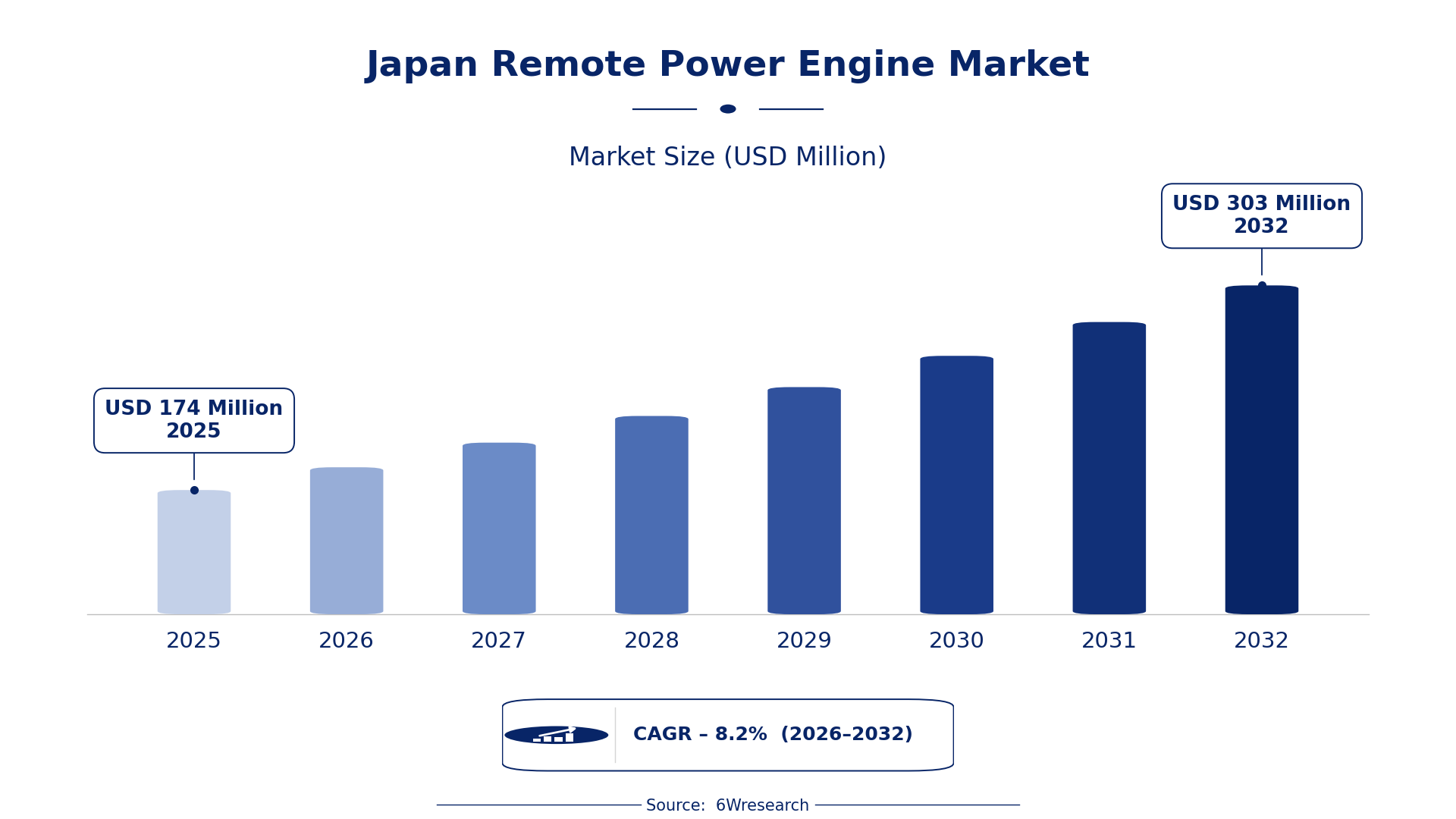
According to 6Wresearch internal database and industry insights, the Japan Remote Power Engine Market was valued at USD 174 Million in 2025 and is projected to reach USD 303 Million by 2032, growing at a CAGR of approximately 8.2% during 2026–2032.
Japan Remote Power Engine Market Highlights
| Report Metric | Details |
| Report Name | Japan Remote Power Engine Market (2026-2032) |
| Market Size 2025 | USD 174 Million |
| Market Size 2032 | USD 303 Million |
| Absolute Growth 2025–2032 | USD 129 Million |
| CAGR 2026–2032 | 8.2% |
| Peak Annual Growth | 9.1% in 2028 |
| Forecast Period | 2026–2032 |
| Historical Data | 2022–2025 |
| Base Year | 2025 |
| Leading Engine Type, 2025 | Diesel Gen Sets (42% share) |
| Leading Fuel Type, 2025 | Diesel/Fuel Mix (35% share) |
| Leading Delivery Model, 2025 | Remote Containerized (51% share) |
| Leading End User, 2025 | Mining & Construction Sites (38% share) |
| Fastest-Growing Engine Type | Solar-Hybrid Engines (12.1% CAGR) |
| Fastest-Growing Fuel Type | Solar + Battery (11.7% CAGR) |
| Fastest-Growing Delivery Model | Renewable Remote Power (10.7% CAGR) |
| Fastest-Growing End User | Telecom Towers (10.6% CAGR) |
| Growing Sector | Construction and Telecommunications |
| Key End Users | Construction companies, telecom providers, emergency services, renewable energy developers |
Japan Remote Power Engine Market Year-wise Growth Rate and Key Drivers (2022–2032)
This graph illustrates the annual growth rates of the market from 2022 to 2032, highlighting a steady upward trajectory and projected market expansion over the forecast period.
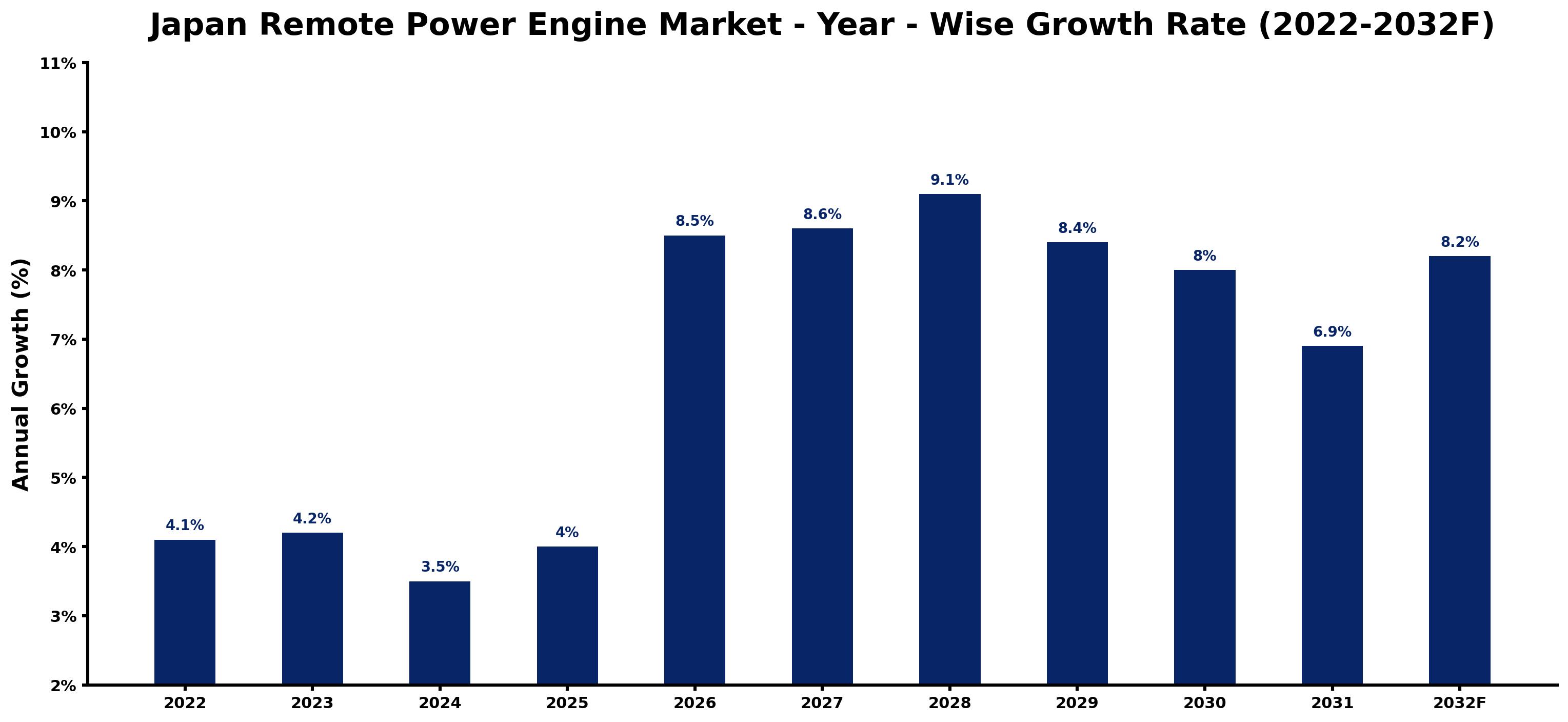
The following figures match every annual growth estimate with the main market development of that year, giving the reasoning behind each rise or slowdown.
| Year | Estimated Annual Growth (%) | Market Rationale |
| 2022 | 4.1 | The market exhibited steady demand for remote power solutions in various sectors. |
| 2023 | 4.2 | Growth was driven by increased investments in renewable energy projects across Japan. |
| 2024 | 3.5 | A slowdown occurred as some projects faced delays in implementation and funding. |
| 2025 | 4.0 | Demand rose again due to heightened construction activities and telecom infrastructure needs. |
| 2026 | 8.5 | Growth will accelerate as the adoption of solar-hybrid systems gains traction among users. |
| 2027 | 8.6 | Continued investments in off-grid solutions will contribute to a further rise in demand. |
| 2028 | 9.1 | The market is projected to peak as technological advancements in renewable energy systems emerge. |
| 2029 | 8.4 | Growth will slow slightly as market saturation begins to affect new installations. |
| 2030 | 8.0 | Demand is expected to stabilise as users become more selective in their energy solutions. |
| 2031 | 6.9 | A further slowdown is projected as competition intensifies among power solution providers. |
| 2032 | 8.2 | Growth will resume as new technologies and applications for remote power engines emerge. |
Note: Market size estimations and growth projections presented in this report are based on 6Wresearch's proprietary forecasting methodology, utilizing the latest available industry data, government publications, and primary research inputs.
Japan Remote Power Engine Market Synopsis
Remote Power Engines provide off-grid solutions, using diesel generators and solar-hybrid systems for various applications. This market is growing due to increased demand from the construction and telecommunications sectors, along with substantial government investments in renewable initiatives. The GX Basic Policy aims for a 36% share of renewable energy by 2030, further driving market growth and advancements in power technologies.
Market Dynamics Impact Analysis (2026–2032)
| Factor | Type | Impact | Primary Segment Affected |
| Increased demand for renewable energy solutions | Driver | High | Solar-Hybrid Engines |
| Growing construction activities in remote areas | Driver | High | Portable Power Units |
| Investment in renewable energy projects | Opportunity | High | Renewable Remote Power |
| Expansion of telecom infrastructure requiring reliable power | Opportunity | Medium | Telecom Towers |
| High initial costs of solar-hybrid systems | Restraint | High | Solar-Hybrid Engines |
| Limited infrastructure for natural gas engines | Restraint | Medium | Natural Gas |
| Competition from alternative energy sources | Challenge | High | Diesel Gen Sets |
| Regulatory hurdles for new technologies | Challenge | Medium | Gas Engines |
Evaluation of Drivers in Japan Remote Power Engine Market (2026–2032)
Demand rests on the following drivers, each shown with the segment it touches most.
| Drivers | Primary Segment Affected | Why It Matters (Evidence) |
| Rising investments in renewable energy projects | Solar-Hybrid Engines | Japan's GX Basic Policy targets JPY 150 trillion in decarbonisation investment over 10 years. |
| Increased construction activities in remote areas | Portable Power Units | The construction industry is projected to invest significantly in portable power units in the coming years. |
| Growing demand for reliable power in telecom sectors | Telecom Towers | The Tokyo metropolitan area requires dependable power sources for telecom infrastructure. |
| Government support for renewable energy projects | Renewable Remote Power | The government allocated ¥500 million for renewable energy projects in remote areas in 2023. |
| High demand for emergency power solutions | Emergency Power Providers | The Tohoku region has a high demand for emergency power due to geographical vulnerabilities. |
A broader customer base accounts for much of the growth, as rising investments in renewable energy projects increase demand for off-grid solutions. The construction industry is expected to invest heavily in portable power units, especially in remote areas, leading to higher purchases. The telecommunications sector requires dependable power sources, which further elevates demand for Remote Power Engines. Funding allocated for renewable energy projects supports this trend. Additionally, the need for emergency power solutions in areas prone to natural disasters boosts sales of portable power units.
Evaluation of Restraints in Japan Remote Power Engine Market
The table below lists the restraints and the evidence behind each.
| Market Restraint | Primary Segment Affected | Why It Matters (Evidence) |
| High initial costs of solar-hybrid systems | Solar-Hybrid Engines | The upfront investment for solar-hybrid systems can deter potential buyers, limiting market growth. |
| Limited infrastructure for natural gas engines | Natural Gas | The lack of widespread infrastructure restricts the adoption of natural gas engines in remote areas. |
| Competition from alternative energy sources | Diesel Gen Sets | Emerging technologies and solutions may divert demand away from traditional diesel generators. |
| Regulatory hurdles for new technologies | Gas Engines | Strict regulations can delay the introduction of new gas engine solutions to the market. |
| Market saturation in certain segments | Portable Power Units | As the market matures, new installations may slow due to existing competition. |
Japan Remote Power Engine Market Challenges
Frequent natural disasters in the Tohoku region create immediate demand for emergency power solutions, prompting buyers in construction and telecommunications to seek quick alternatives. This pressure challenges producers, who struggle to source materials rapidly, resulting in order fulfillment delays. Rising raw material costs, driven by regulatory changes, can increase prices for buyers, potentially raising project budgets by up to 15%. Compliance with the JIS B 8001 standard requires costly upgrades for producers, which can prolong production timelines and ultimately raise costs for end-users.
Trends in the Japan Remote Power Engine Market
These developments are changing demand patterns in the Japan Remote Power Engine Market.
- GX Basic Policy Promoting Renewable Energy Adoption: Japan's GX Basic Policy, adopted in 2023, promotes renewable energy, targeting a 36% share by 2030. This shift encourages investment in solar-hybrid systems, increasing demand for sustainable power solutions.
- Transition from Diesel to Solar-Hybrid Systems: The market is shifting from traditional diesel generators to solar-hybrid systems, driven by sustainability goals. In 2022, Japan's installed capacity for diesel generators was reported at 10 GW, indicating a need for cleaner alternatives.
- Rise of Remote Containerized Solutions: Remote Containerized power solutions are becoming increasingly popular for deployment in harsh environments. This model accounted for 51% of the delivery model market share in 2025, showcasing its effectiveness.
- Increased Focus on Disaster Recovery Solutions: Portable power units are gaining traction for disaster recovery operations across Japan. The construction industry is expected to invest heavily in these units, increasing their role in emergency scenarios.
Investment Opportunities in the Japan Remote Power Engine Market
The following opportunities in the Japan Remote Power Engine Market pair current demand with a clear way in.
- Solar-Hybrid Systems: Investing in solar-hybrid systems is timely as Japan aims for a 36% renewable energy share by 2030. Construction sites and telecom sectors are prime buyers, offering opportunities for local partnerships.
- Portable Power Units: The growing need for portable power units in disaster recovery presents a strong opportunity. With the construction industry expected to invest heavily, suppliers can enter through local collaborations.
- Renewable Remote Power Solutions: The demand for renewable remote power solutions is increasing due to government support. The Tohoku region, with its geographical vulnerabilities, is a key area for investment.
- Telecom Infrastructure Solutions: Investing in solutions for telecom infrastructure aligns with the growing need for reliable power. The Tokyo metropolitan area is a prime location for suppliers to establish partnerships.
Government Initiatives in the Japan Remote Power Engine Market
The GX Promotion Act, enacted in 2023, supports the GX strategy and strengthens the legal framework for renewable energy projects. This law complements regulations requiring large energy users to improve efficiency, ensuring a thorough approach to energy management. The government's commitment includes a target of JPY 150 trillion in decarbonisation investment over ten years, promoting growth in renewable energy technologies.
The Ministry of Economy, Trade and Industry oversees regulations for off-grid energy systems, approving projects that align with national energy goals. The ministry's initiatives include funding for renewable energy projects, ensuring that remote areas receive necessary power solutions. In 2023, the government allocated ¥500 million specifically for renewable energy projects in remote regions, facilitating access to clean energy.
Future Insight of the Japan Remote Power Engine Market
Advancements in solar-hybrid systems will reshape demand for off-grid power solutions by 2032, as Japan aims for a 36% renewable energy share. The government’s allocation of ¥500 million for renewable energy projects in remote areas will drive innovation in remote power technologies. Stricter regulations from the Ministry of Economy, Trade and Industry will encourage suppliers to implement cleaner energy practices. As portable power units become essential in disaster recovery, buyers will gain access to more dependable and efficient energy solutions.
Market Segmentation Analysis
Japan Remote Power Engine Market report covers a detailed analysis of the following market segments:
By Engine Type – Diesel Gen Sets Lead, Solar-Hybrid Engines Expected to Grow Fastest
According to Saurav Kr Singh, Senior Research Analyst at 6Wresearch, Diesel Gen Sets took 42% of engine type revenue in 2025, more than any other category. Diesel Gen Sets dominate the market because they provide reliable power to remote locations, particularly in construction and telecommunications. Their established presence, with an installed capacity of 10 GW, ensures they meet the demands of various industries in Japan. Solar-Hybrid Engines are projected to grow fastest, at a CAGR of 12.1% during 2026–2032. Solar-Hybrid Engines are experiencing rapid growth as they align with Japan's energy policy, which aims for a 36% share of renewable energy by 2030. This trend is further propelled by substantial government investments in renewable energy projects. Suppliers should focus on expanding solar-hybrid offerings to align with the growing demand for sustainable power solutions.
By Fuel Type – Diesel/Fuel Mix Leads, Solar + Battery Expected to Grow Fastest
Diesel/Fuel Mix accounted for 35% of the market by fuel type in 2025. The Diesel/Fuel Mix leads the market due to its efficiency and established presence in remote areas, making it the preferred choice for many users. Its compatibility with existing diesel generators ensures a strong market position. Solar + Battery is set to record the highest CAGR in this split, 11.7% over 2026–2032. Solar + Battery solutions are gaining popularity as they provide a cleaner alternative, particularly in remote areas where renewable energy is increasingly sought after. The emphasis on decarbonisation investments is driving their adoption. Buyers are likely to benefit from a broader range of renewable fuel options as market demand shifts towards sustainability.
By Delivery Model – Remote Containerized Leads, Renewable Remote Power Expected to Grow Fastest
The largest delivery model category in 2025 was Remote Containerized, at 51% of revenue. The Remote Containerized model leads the market as it is specifically designed for deployment in harsh environments, making it ideal for remote power applications. This model's versatility and ease of transport contribute to its popularity among users. Over 2026–2032, Renewable Remote Power is expected to post the fastest growth, at a CAGR of 10.7%. Renewable Remote Power is growing rapidly as it supports Japan's ambitious energy transition goals, appealing to users looking for sustainable solutions. The government's focus on renewable energy initiatives is a key driver for this segment's growth. Suppliers should consider expanding their renewable remote power offerings to align with Japan's energy transition objectives.
By End User – Mining & Construction Sites Lead, Telecom Towers Expected to Grow Fastest
In 2025, Mining & Construction Sites led the end user split with a 38% share. Mining & Construction Sites represent the largest end-user segment, as these industries rely on dependable power solutions for operations in remote areas. The expected heavy investments in portable power units for construction reinforce this segment's leading position. The quickest growth will come from Telecom Towers, forecast to expand at a CAGR of 10.6% between 2026 and 2032. Telecom Towers are witnessing the fastest growth due to their essential need for uninterrupted power supply, especially in urban centres like Tokyo. The increasing dependence on telecom infrastructure significantly boosts the demand for reliable power solutions. Suppliers should prioritise the telecom sector to leverage the growing need for dependable power sources in communication services.
Key Attractiveness of the Report
- 10 Years of Market Numbers
- Historical Data Starting from 2022 to 2025
- Base Year 2025
- Forecast Data until 2032
- Key Performance Indicators Impacting the Market
- Major Upcoming Developments and Projects
Key Highlights of the Report:
- Japan Remote Power Engine Market Outlook
- Market Size of Japan Remote Power Engine Market, 2025
- Forecast of Japan Remote Power Engine Market, 2032
- Historical Data and Forecast of Japan Remote Power Engine Revenues & Volume for the Period 2022-2032F
- Japan Remote Power Engine Market Trend Evolution
- Japan Remote Power Engine Market Drivers and Challenges
- Japan Remote Power Engine Price Trends
- Japan Remote Power Engine Porter's Five Forces
- Japan Remote Power Engine Industry Life Cycle
- Historical Data and Forecast of Japan Remote Power Engine Market Revenues & Volume By Engine Type for the Period 2022-2032F
- Historical Data and Forecast of Japan Remote Power Engine Market Revenues & Volume By Diesel Gen Sets for the Period 2022-2032F
- Historical Data and Forecast of Japan Remote Power Engine Market Revenues & Volume By Solar-Hybrid Engines for the Period 2022-2032F
- Historical Data and Forecast of Japan Remote Power Engine Market Revenues & Volume By Gas Engines for the Period 2022-2032F
- Historical Data and Forecast of Japan Remote Power Engine Market Revenues & Volume By Portable Power Units for the Period 2022-2032F
- Historical Data and Forecast of Japan Remote Power Engine Market Revenues & Volume By Fuel Type for the Period 2022-2032F
- Historical Data and Forecast of Japan Remote Power Engine Market Revenues & Volume By Diesel/Fuel Mix for the Period 2022-2032F
- Historical Data and Forecast of Japan Remote Power Engine Market Revenues & Volume By Solar + Battery for the Period 2022-2032F
- Historical Data and Forecast of Japan Remote Power Engine Market Revenues & Volume By Natural Gas for the Period 2022-2032F
- Historical Data and Forecast of Japan Remote Power Engine Market Revenues & Volume By Multi-Fuel for the Period 2022-2032F
- Historical Data and Forecast of Japan Remote Power Engine Market Revenues & Volume By Delivery Model for the Period 2022-2032F
- Historical Data and Forecast of Japan Remote Power Engine Market Revenues & Volume By Remote Containerized for the Period 2022-2032F
- Historical Data and Forecast of Japan Remote Power Engine Market Revenues & Volume By Renewable Remote Power for the Period 2022-2032F
- Historical Data and Forecast of Japan Remote Power Engine Market Revenues & Volume By Off-Grid Field Engines for the Period 2022-2032F
- Historical Data and Forecast of Japan Remote Power Engine Market Revenues & Volume By Plug-and-Play for the Period 2022-2032F
- Historical Data and Forecast of Japan Remote Power Engine Market Revenues & Volume By End User for the Period 2022-2032F
- Historical Data and Forecast of Japan Remote Power Engine Market Revenues & Volume By Mining & Construction Sites for the Period 2022-2032F
- Historical Data and Forecast of Japan Remote Power Engine Market Revenues & Volume By Telecom Towers for the Period 2022-2032F
- Historical Data and Forecast of Japan Remote Power Engine Market Revenues & Volume By Oil & Gas Exploration Units for the Period 2022-2032F
- Historical Data and Forecast of Japan Remote Power Engine Market Revenues & Volume By Emergency Power Providers for the Period 2022-2032F
- Japan Remote Power Engine Import Export Trade Statistics
- Market Opportunity Assessment By Engine Type
- Market Opportunity Assessment By Fuel Type
- Market Opportunity Assessment By Delivery Model
- Market Opportunity Assessment By End User
- Japan Remote Power Engine Top Companies Market Share
- Japan Remote Power Engine Competitive Benchmarking By Technical and Operational Parameters
- Japan Remote Power Engine Company Profiles
- Japan Remote Power Engine Key Strategic Recommendations
Market Covered
Coverage by segment is as follows.
By Engine Type
- Diesel Gen Sets
- Solar-Hybrid Engines
- Gas Engines
- Portable Power Units
By Fuel Type
- Diesel/Fuel Mix
- Solar + Battery
- Natural Gas
- Multi-Fuel
By Delivery Model
- Remote Containerized
- Renewable Remote Power
- Off-Grid Field Engines
- Plug-and-Play
By End User
- Mining & Construction Sites
- Telecom Towers
- Oil & Gas Exploration Units
- Emergency Power Providers































