Japan Remote Sensing Equipment Market Size & Growth Rate
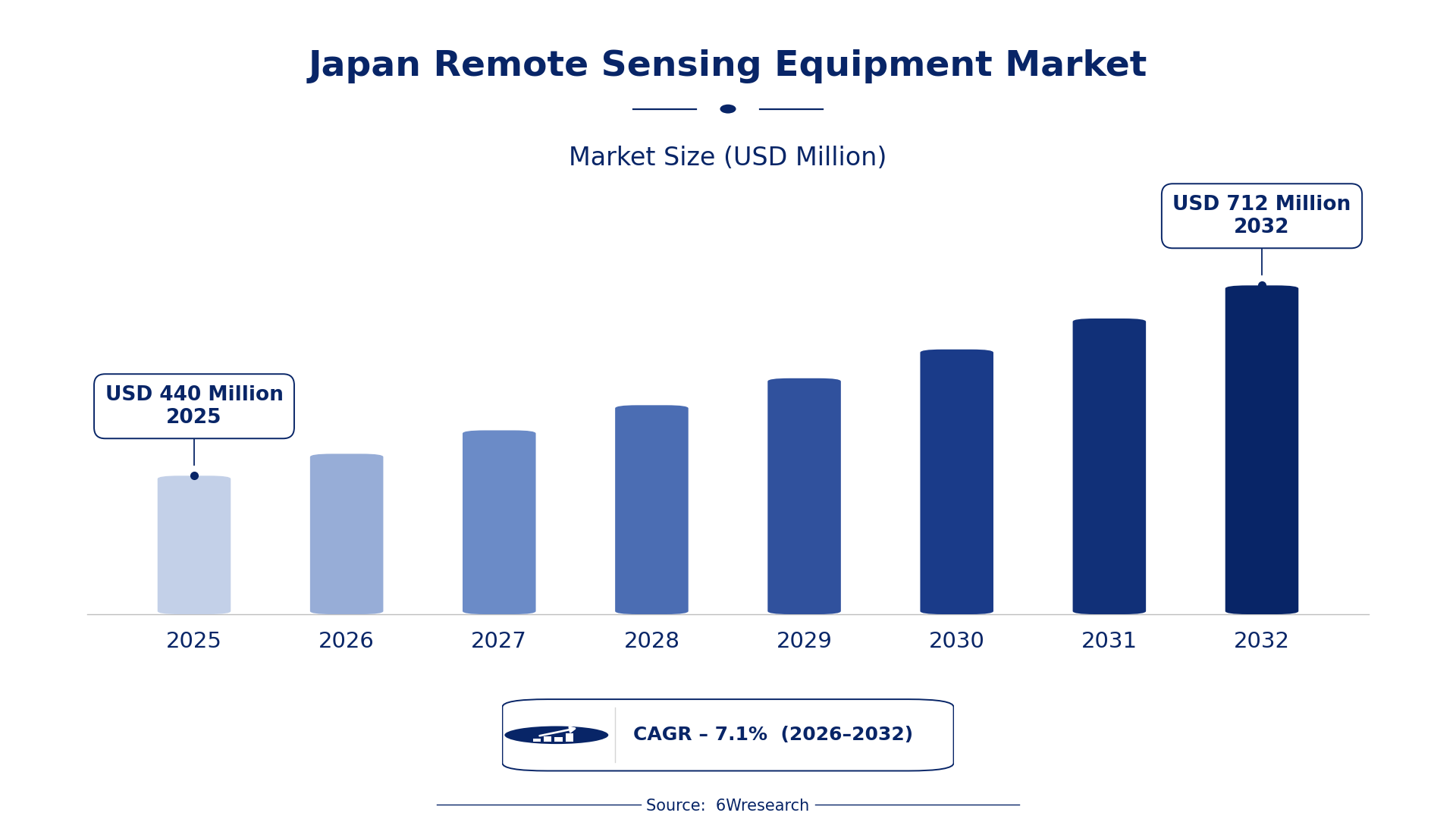
According to 6Wresearch internal database and industry insights, the Japan Remote Sensing Equipment Market was valued at USD 440 Million in 2025 and is projected to reach USD 712 Million by 2032, growing at a CAGR of approximately 7.1% during 2026–2032.
Japan Remote Sensing Equipment Market Highlights
| Report Metric | Details |
| Report Name | Japan Remote Sensing Equipment Market (2026-2032) |
| Market Size 2025 | USD 440 Million |
| Market Size 2032 | USD 712 Million |
| Absolute Growth 2025–2032 | USD 272 Million |
| CAGR 2026–2032 | 7.1% |
| Peak Annual Growth | 8.0% in 2028 |
| Forecast Period | 2026–2032 |
| Historical Data | 2022–2025 |
| Base Year | 2025 |
| Leading Equipment Type, 2025 | Satellite Ground Station (40% share) |
| Leading Sensor Technology, 2025 | Thermal/Multispectral (46% share) |
| Leading Mobility, 2025 | Fixed / Mobile (48% share) |
| Leading End User, 2025 | Environmental Survey Teams (42% share) |
| Fastest-Growing Equipment Type | UAV Sensors (10.5% CAGR) |
| Fastest-Growing Mobility | Drone-Carried (9.4% CAGR) |
| Fastest-Growing End User | Oil & Gas Data Centers (9.2% CAGR) |
| Growing Sector | Oil & Gas Data Centers |
| Key End Users | Environmental Survey Teams, Oil & Gas Data Centers, Exploration Geophysics Firms, Utility Network Providers |
Japan Remote Sensing Equipment Market Year-wise Growth Rate and Key Drivers (2022–2032)
This graph illustrates the annual growth rates of the market from 2022 to 2032, highlighting a steady upward trajectory and projected market expansion over the forecast period.
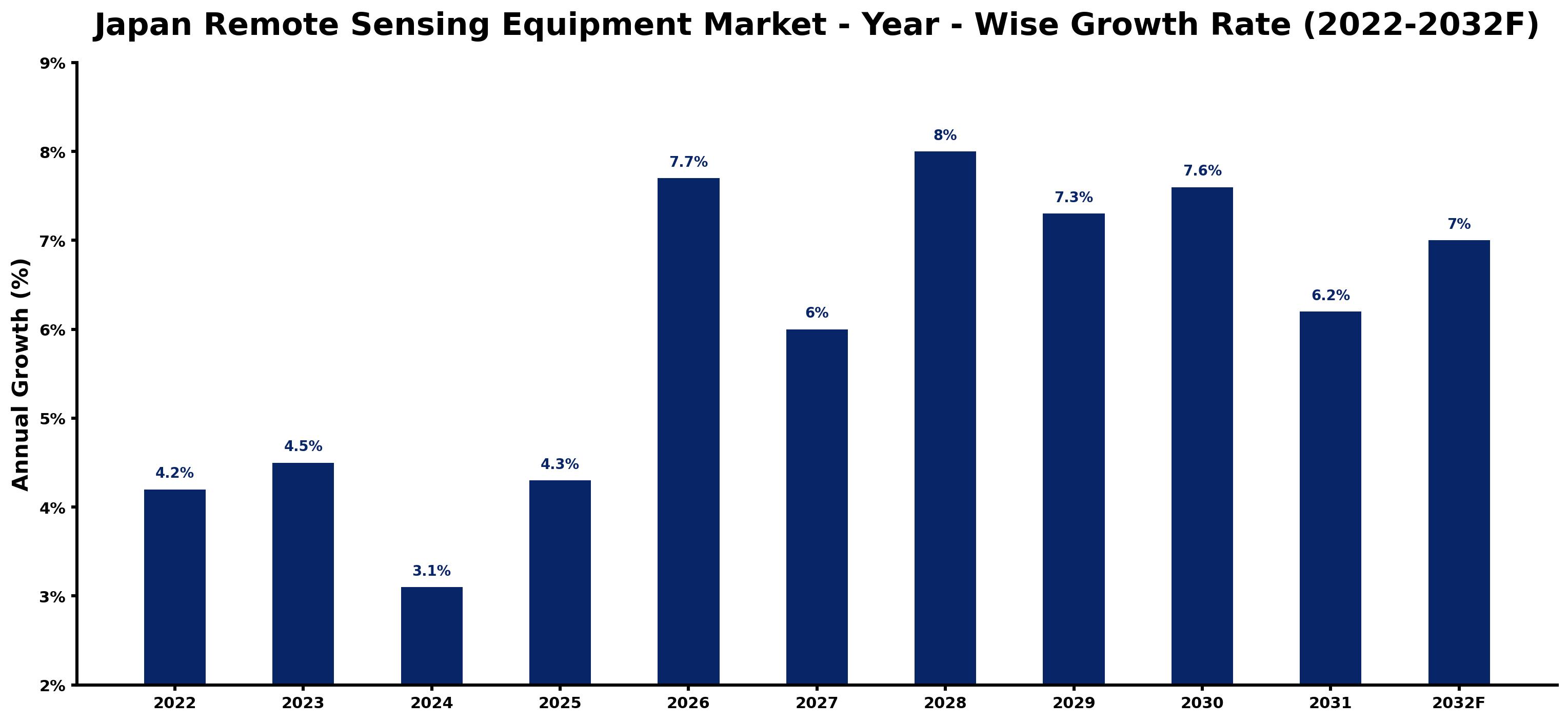
Year by year, the estimates below pair each growth rate with the development that shaped it.
| Year | Estimated Annual Growth (%) | Market Rationale |
| 2022 | 4.2 | The market was characterised by steady demand from environmental survey teams and government agencies. |
| 2023 | 4.5 | Growth accelerated due to increased investments in thermal/multispectral sensors for environmental monitoring. |
| 2024 | 3.1 | Demand growth slowed as some projects faced delays in funding and implementation timelines. |
| 2025 | 4.3 | Investment in UAV sensor technology surged, boosting growth rates in the market. |
| 2026 | 7.7 | The introduction of new technologies is expected to drive higher demand across various sectors. |
| 2027 | 6.0 | Market growth is projected to slow as the effects of previous investments begin to stabilise. |
| 2028 | 8.0 | The peak growth rate is anticipated as major projects come online and new technologies are adopted. |
| 2029 | 7.3 | Growth is expected to moderate as market saturation begins to affect demand levels. |
| 2030 | 7.6 | Continued investments in remote sensing technology will support steady growth in the market. |
| 2031 | 6.2 | A slight slowdown is expected as the market adjusts to new technological advancements and applications. |
| 2032 | 7.0 | Demand is projected to rise as the focus on disaster response and environmental monitoring intensifies. |
Note: Market size estimations and growth projections presented in this report are based on 6Wresearch's proprietary forecasting methodology, utilizing the latest available industry data, government publications, and primary research inputs.
Japan Remote Sensing Equipment Market Synopsis
Remote sensing equipment includes technologies for collecting data about the Earth's surface and atmosphere, made through advanced manufacturing processes. In Japan, demand comes primarily from government agencies and private firms focusing on environmental monitoring, resource management, and disaster response.
Market Dynamics Impact Analysis (2026–2032)
| Factor | Type | Impact | Primary Segment Affected |
| Increased government investment in disaster management technology | Driver | High | UAV Sensors |
| Growing environmental concerns leading to enhanced monitoring efforts | Driver | High | Thermal/Multispectral |
| Rising demand for real-time data collection in urban planning | Opportunity | High | UAV Sensors |
| Expansion of remote sensing applications in oil and gas exploration | Opportunity | High | Oil & Gas Data Centers |
| High costs associated with advanced sensor technology | Restraint | Medium | UAV Sensors |
| Limited awareness among smaller firms about remote sensing benefits | Restraint | Medium | Environmental Survey Teams |
| Challenges in integrating new technologies into existing systems | Challenge | High | Thermal/Multispectral |
| Regulatory hurdles in deploying remote sensing equipment | Challenge | Medium | Satellite Ground Station |
Evaluation of Drivers in Japan Remote Sensing Equipment Market (2026–2032)
The main growth drivers and the segments they affect most are set out below.
| Drivers | Primary Segment Affected | Why It Matters (Evidence) |
| Government investment in disaster management technologies | UAV Sensors | The Ministry of the Environment promotes UAV sensors for real-time data collection, increasing purchases by environmental agencies. |
| Environmental monitoring initiatives | Thermal/Multispectral | In 2023, Japan launched new thermal/multispectral sensors, driving demand from environmental survey teams. |
| Urban planning requirements | UAV Sensors | The Tokyo Metropolitan Government invests in UAV sensor technology, leading to increased demand from urban planners. |
| Oil and gas sector expansion | Oil & Gas Data Centers | Remote sensing technology is essential for resource management in Hokkaido, driving purchases by oil and gas firms. |
| Seismic monitoring needs | Seismic Sensor Arrays | Seismic sensor arrays are deployed across 47 prefectures, increasing demand from disaster response agencies. |
Purchasing is picking up as demand for remote sensing technologies rises, supported by increased investments in urban planning initiatives. In 2023, new thermal/multispectral sensors were launched, boosting data collection capabilities for environmental survey teams. The oil and gas sector in Hokkaido is increasingly adopting remote sensing technologies for resource management, prompting higher purchases. Seismic sensor arrays play a critical role in monitoring earthquakes, leading disaster response agencies to invest more in these systems. Overall, the market is benefiting from a combination of private sector initiatives and targeted investments in advanced technologies.
Evaluation of Restraints in Japan Remote Sensing Equipment Market
These restraints slow adoption and weigh on supplier margins.
| Market Restraint | Primary Segment Affected | Why It Matters (Evidence) |
| High costs of advanced sensor technologies | UAV Sensors | The initial investment required for UAV sensors can deter smaller firms from entering the market. |
| Limited awareness of remote sensing benefits | Environmental Survey Teams | Many smaller environmental firms lack knowledge about the advantages of remote sensing, hindering market growth. |
| Integration challenges with existing systems | Thermal/Multispectral | Existing infrastructure may not support new thermal/multispectral technologies, slowing adoption rates. |
| Regulatory hurdles for equipment deployment | Satellite Ground Station | Strict regulations can delay the installation and operation of satellite ground stations. |
| Market saturation in certain segments | Oil & Gas Data Centers | As more firms adopt remote sensing, competition increases, potentially limiting growth for new entrants. |
Japan Remote Sensing Equipment Market Challenges
In 2023, buyers of remote sensing equipment faced a 15% rise in operational costs due to intense competition among suppliers. Many producers grapple with the rapid pace of technological change, which can delay project timelines by six months for government agencies reliant on timely information. A shortage of skilled analysts hinders suppliers' capacity to meet demand, potentially leading to a 20% decline in revenue potential. Buyers frequently encounter challenges in integrating remote sensing insights with existing systems, resulting in inefficiencies that can inflate project costs by 10%.
Trends in the Japan Remote Sensing Equipment Market
Several trends are reshaping the Japan Remote Sensing Equipment Market; the most important are set out below.
- Launch of New Thermal/Multispectral Sensors: In 2023, Japan unveiled new thermal/multispectral sensors for environmental monitoring, enhancing data collection capabilities for agencies. This advancement is expected to boost the market's attractiveness, with a projected growth of 9.2% in this segment.
- Shift Towards UAV Sensor Technology: The trend towards UAV sensor technology is gaining momentum as urban planners in Tokyo increasingly depend on drones for real-time data collection. This shift is reflected in a 10.5% CAGR in UAV sensors, highlighting rising demand.
- Expansion of Seismic Monitoring Systems: Seismic sensor arrays are being deployed across 47 prefectures, improving earthquake monitoring capabilities. This expansion is crucial for disaster response, with local governments making substantial investments to enhance readiness.
- Increased Focus on Environmental Surveying: Environmental survey teams are prioritising remote sensing technologies to boost data accuracy and efficiency. With around 500 teams employing these technologies, demand is anticipated to grow significantly.
Investment Opportunities in the Japan Remote Sensing Equipment Market
Investors looking at the Japan Remote Sensing Equipment Market should consider the following areas.
- UAV Sensors for Urban Planning: The increasing need for UAV sensors in urban planning presents an opportunity, with a projected market gap of 10.5%. Urban planners in Tokyo can collaborate with local firms to enhance data collection capabilities.
- Thermal/Multispectral Sensors for Environmental Monitoring: With a projected growth of 9.2%, there exists a substantial opportunity to supply thermal/multispectral sensors. Environmental agencies are actively pursuing advanced technologies to improve monitoring efforts and outcomes.
- Seismic Sensor Arrays for Disaster Management: The demand for seismic sensor arrays is on the rise, with investments expected to increase. Disaster response agencies throughout Japan can benefit from partnerships to enhance monitoring capabilities and responsiveness.
- Oil & Gas Data Centers for Resource Management: The expansion of the oil and gas sector creates a demand for advanced remote sensing technologies. Suppliers can penetrate this market by collaborating with firms in Hokkaido to deliver tailored solutions.
Government Initiatives in the Japan Remote Sensing Equipment Market
The Industrial Safety and Health Act (1972) establishes safety standards for hazardous substances and machinery, impacting producers of remote sensing equipment. Compliance requires manufacturers to implement stringent safety measures, which may involve additional testing and certification processes to ensure product reliability and safety.
The Ministry of the Environment promotes remote sensing technologies through various funding initiatives, enabling environmental survey teams to access advanced equipment. These funds support the acquisition of UAV sensors and seismic monitoring systems, improving their operational capabilities and effectiveness.
Future Insight of the Japan Remote Sensing Equipment Market
A shift towards improved remote sensing capabilities will prompt suppliers to invest in cutting-edge technologies. The adoption of standards such as ISO 19130 will streamline data integration, enabling buyers to obtain more accurate information. As urban planning initiatives grow, investments in UAV sensor technology will create new opportunities for suppliers. By 2032, total investment in remote sensing technology will support approximately 500 environmental survey teams in their data collection activities.
Market Segmentation Analysis
Japan Remote Sensing Equipment Market report covers a detailed analysis of the following market segments:
By Equipment Type – Satellite Ground Station Leads, UAV Sensors Expected to Grow Fastest
According to Saurav Kr Singh, Senior Research Analyst at 6Wresearch, in 2025, Satellite Ground Station led the equipment type split with a 40% share. Satellite ground stations are essential for receiving data from satellites, which supports various applications across Japan. With over 100 stations primarily located in the Kanto region, they cater to a large user base reliant on precise data. Over 2026–2032, UAV Sensors are expected to post the fastest growth, at a CAGR of 10.5%. The rapid growth of UAV sensors stems from their integration into drones, which are increasingly favoured for real-time aerial surveys. This trend is bolstered by the recent launch of new thermal/multispectral sensors that improve UAV capabilities. Suppliers should focus on advancing UAV sensor technology to meet the rising demand from environmental survey teams.
By Sensor Technology – Thermal/Multispectral Leads and Records the Fastest Growth
The largest sensor technology category in 2025 was Thermal/Multispectral, at 46% of revenue. Thermal/multispectral sensors dominate the market due to their critical role in environmental analysis, making them indispensable for monitoring tasks. Their extensive application aligns with Japan's focus on environmental sustainability and resource management. Thermal/Multispectral is also forecast to expand faster than any other category, at a CAGR of 9.2% over 2026–2032. The thermal/multispectral segment is witnessing rapid growth as it becomes more integrated into emerging technologies for environmental monitoring. This trend will likely strengthen the dominance of thermal/multispectral sensors in the market. Buyers should prioritise investments in thermal/multispectral technology to enhance their environmental monitoring capabilities.
By Mobility – Fixed / Mobile Leads, Drone-Carried Expected to Grow Fastest
Fixed / Mobile took 48% of mobility revenue in 2025, more than any other category. Fixed/mobile systems are extensively used across various applications, offering flexibility and reliability in data collection. Their established presence in the market ensures a strong installed base that caters to diverse user requirements. Drone-Carried is set to record the highest CAGR in this split, 9.4% over 2026–2032. The drone-carried segment is rapidly growing due to its critical role in aerial data collection, which is becoming increasingly vital for numerous industries. As technology progresses, demand for drone-carried solutions is expected to escalate. Suppliers must adjust their offerings to include drone-carried solutions to capitalise on expanding market opportunities.
By End User – Environmental Survey Teams Lead, Oil & Gas Data Centers Expected to Grow Fastest
Environmental Survey Teams held 42% of the Japan Remote Sensing Equipment Market by end user in 2025. Environmental survey teams constitute the largest user group for remote sensing equipment, relying on accurate data collection for their operations. With an estimated 500 teams across Japan, their demand significantly influences market trends. The quickest growth will come from Oil & Gas Data Centers, forecast to expand at a CAGR of 9.2% between 2026 and 2032. Oil and gas data centers are quickly increasing their use of remote sensing technology for resource management, highlighting the sector's growing reliance on data-driven insights. This shift indicates a trend towards more sophisticated applications in resource management. Buyers in the oil and gas sector should invest in advanced remote sensing technologies to improve their resource management strategies.
Key Attractiveness of the Report
- 10 Years of Market Numbers
- Historical Data Starting from 2022 to 2025
- Base Year 2025
- Forecast Data until 2032
- Key Performance Indicators Impacting the Market
- Major Upcoming Developments and Projects
Key Highlights of the Report:
- Japan Remote Sensing Equipment Market Outlook
- Market Size of Japan Remote Sensing Equipment Market, 2025
- Forecast of Japan Remote Sensing Equipment Market, 2032
- Historical Data and Forecast of Japan Remote Sensing Equipment Revenues & Volume for the Period 2022-2032F
- Japan Remote Sensing Equipment Market Trend Evolution
- Japan Remote Sensing Equipment Market Drivers and Challenges
- Japan Remote Sensing Equipment Price Trends
- Japan Remote Sensing Equipment Porter's Five Forces
- Japan Remote Sensing Equipment Industry Life Cycle
- Historical Data and Forecast of Japan Remote Sensing Equipment Market Revenues & Volume By Equipment Type for the Period 2022-2032F
- Historical Data and Forecast of Japan Remote Sensing Equipment Market Revenues & Volume By Satellite Ground Station for the Period 2022-2032F
- Historical Data and Forecast of Japan Remote Sensing Equipment Market Revenues & Volume By UAV Sensors for the Period 2022-2032F
- Historical Data and Forecast of Japan Remote Sensing Equipment Market Revenues & Volume By IoT Ground Sensors for the Period 2022-2032F
- Historical Data and Forecast of Japan Remote Sensing Equipment Market Revenues & Volume By Seismic Sensor Arrays for the Period 2022-2032F
- Historical Data and Forecast of Japan Remote Sensing Equipment Market Revenues & Volume By Sensor Technology for the Period 2022-2032F
- Historical Data and Forecast of Japan Remote Sensing Equipment Market Revenues & Volume By Dish Antennas for the Period 2022-2032F
- Historical Data and Forecast of Japan Remote Sensing Equipment Market Revenues & Volume By Thermal/Multispectral for the Period 2022-2032F
- Historical Data and Forecast of Japan Remote Sensing Equipment Market Revenues & Volume By Pressure/Flow Sensors for the Period 2022-2032F
- Historical Data and Forecast of Japan Remote Sensing Equipment Market Revenues & Volume By Geophones for the Period 2022-2032F
- Historical Data and Forecast of Japan Remote Sensing Equipment Market Revenues & Volume By Mobility for the Period 2022-2032F
- Historical Data and Forecast of Japan Remote Sensing Equipment Market Revenues & Volume By Fixed / Mobile for the Period 2022-2032F
- Historical Data and Forecast of Japan Remote Sensing Equipment Market Revenues & Volume By Drone-Carried for the Period 2022-2032F
- Historical Data and Forecast of Japan Remote Sensing Equipment Market Revenues & Volume By Buryable / Surface Mount for the Period 2022-2032F
- Historical Data and Forecast of Japan Remote Sensing Equipment Market Revenues & Volume By Land/Marine for the Period 2022-2032F
- Historical Data and Forecast of Japan Remote Sensing Equipment Market Revenues & Volume By End User for the Period 2022-2032F
- Historical Data and Forecast of Japan Remote Sensing Equipment Market Revenues & Volume By Oil & Gas Data Centers for the Period 2022-2032F
- Historical Data and Forecast of Japan Remote Sensing Equipment Market Revenues & Volume By Environmental Survey Teams for the Period 2022-2032F
- Historical Data and Forecast of Japan Remote Sensing Equipment Market Revenues & Volume By Utility Network Providers for the Period 2022-2032F
- Historical Data and Forecast of Japan Remote Sensing Equipment Market Revenues & Volume By Exploration Geophysics Firms for the Period 2022-2032F
- Japan Remote Sensing Equipment Import Export Trade Statistics
- Market Opportunity Assessment By Equipment Type
- Market Opportunity Assessment By Sensor Technology
- Market Opportunity Assessment By Mobility
- Market Opportunity Assessment By End User
- Japan Remote Sensing Equipment Top Companies Market Share
- Japan Remote Sensing Equipment Competitive Benchmarking By Technical and Operational Parameters
- Japan Remote Sensing Equipment Company Profiles
- Japan Remote Sensing Equipment Key Strategic Recommendations
Market Covered
Coverage by segment is as follows.
By Equipment Type
- Satellite Ground Station
- UAV Sensors
- IoT Ground Sensors
- Seismic Sensor Arrays
By Sensor Technology
- Dish Antennas
- Thermal/Multispectral
- Pressure/Flow Sensors
- Geophones
By Mobility
- Fixed / Mobile
- Drone-Carried
- Buryable / Surface Mount
- Land/Marine
By End User
- Oil & Gas Data Centers
- Environmental Survey Teams
- Utility Network Providers
- Exploration Geophysics Firms































