Japan Rendering Market Size & Growth Rate
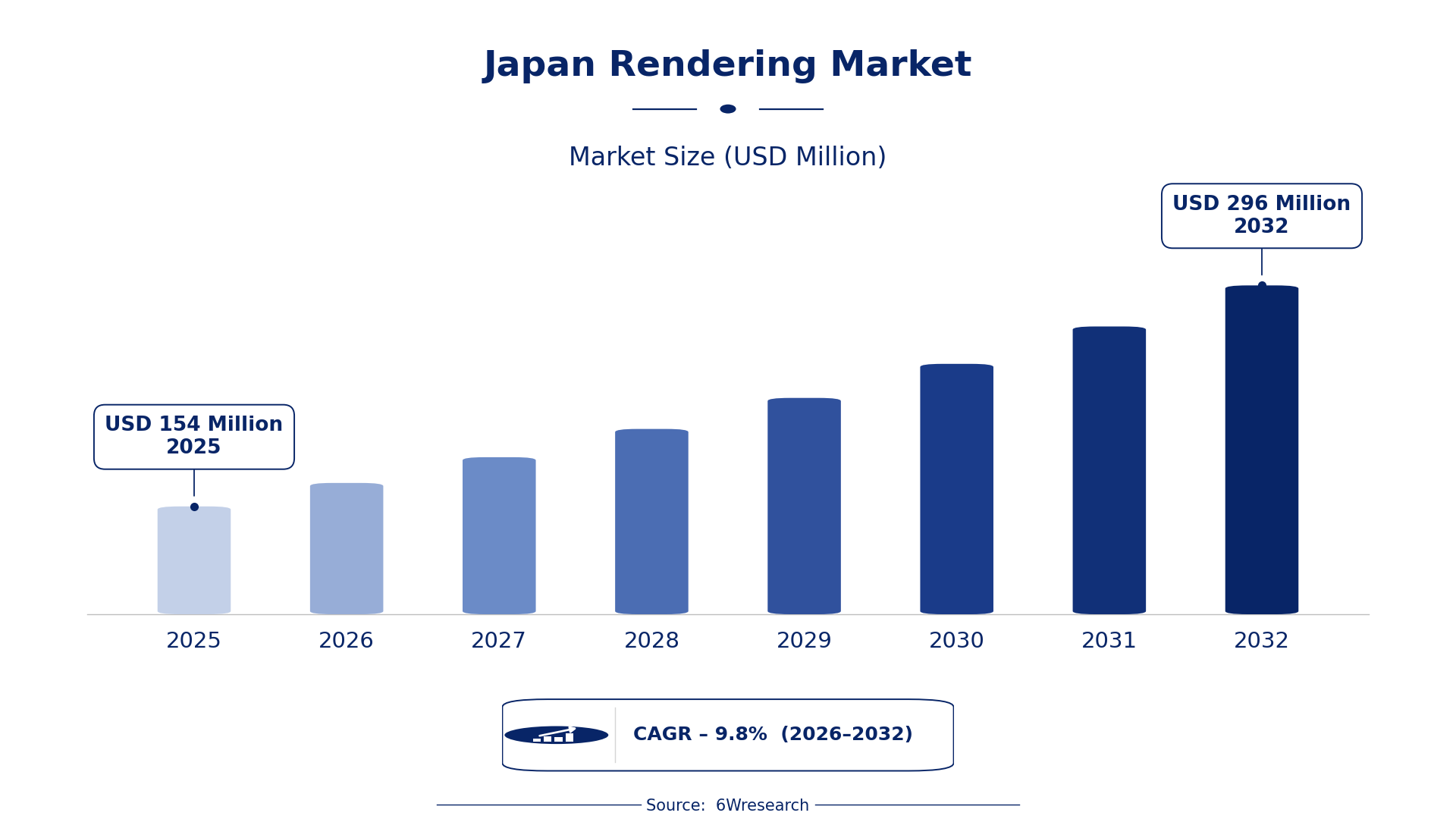
According to 6Wresearch internal database and industry insights, the Japan Rendering Market was valued at USD 154 Million in 2025 and is projected to reach USD 296 Million by 2032, growing at a CAGR of approximately 9.8% during 2026–2032.
Japan Rendering Market Highlights
| Report Metric | Details |
| Report Name | Japan Rendering Market (2026-2032) |
| Market Size 2025 | USD 154 Million |
| Market Size 2032 | USD 296 Million |
| Absolute Growth 2025–2032 | USD 142 Million |
| CAGR 2026–2032 | 9.8% |
| Peak Annual Growth | 10.7% in 2032 |
| Forecast Period | 2026–2032 |
| Historical Data | 2022–2025 |
| Base Year | 2025 |
| Leading Rendering Type, 2025 | Real-Time Rendering (43% share) |
| Leading Engine/Tool, 2025 | Unreal Engine (44% share) |
| Leading Delivery Mode, 2025 | Game Engines (38% share) |
| Leading End User, 2025 | Video Game Developers (45% share) |
| Fastest-Growing Rendering Type | AR/VR Visualization (13.9% CAGR) |
| Fastest-Growing Engine/Tool | Unity/Unreal (13.2% CAGR) |
| Fastest-Growing Delivery Mode | In-App / Webstream (13.6% CAGR) |
| Fastest-Growing End User | Architecture Firms (12.9% CAGR) |
| Growing Sector | Architecture Firms |
| Key End Users | Video Game Developers, Animated Film Studios, Architecture Firms, Marketing & Design Agencies |
Japan Rendering Market Year-wise Growth Rate and Key Drivers (2022–2032)
This graph illustrates the annual growth rates of the market from 2022 to 2032, highlighting a steady upward trajectory and projected market expansion over the forecast period.
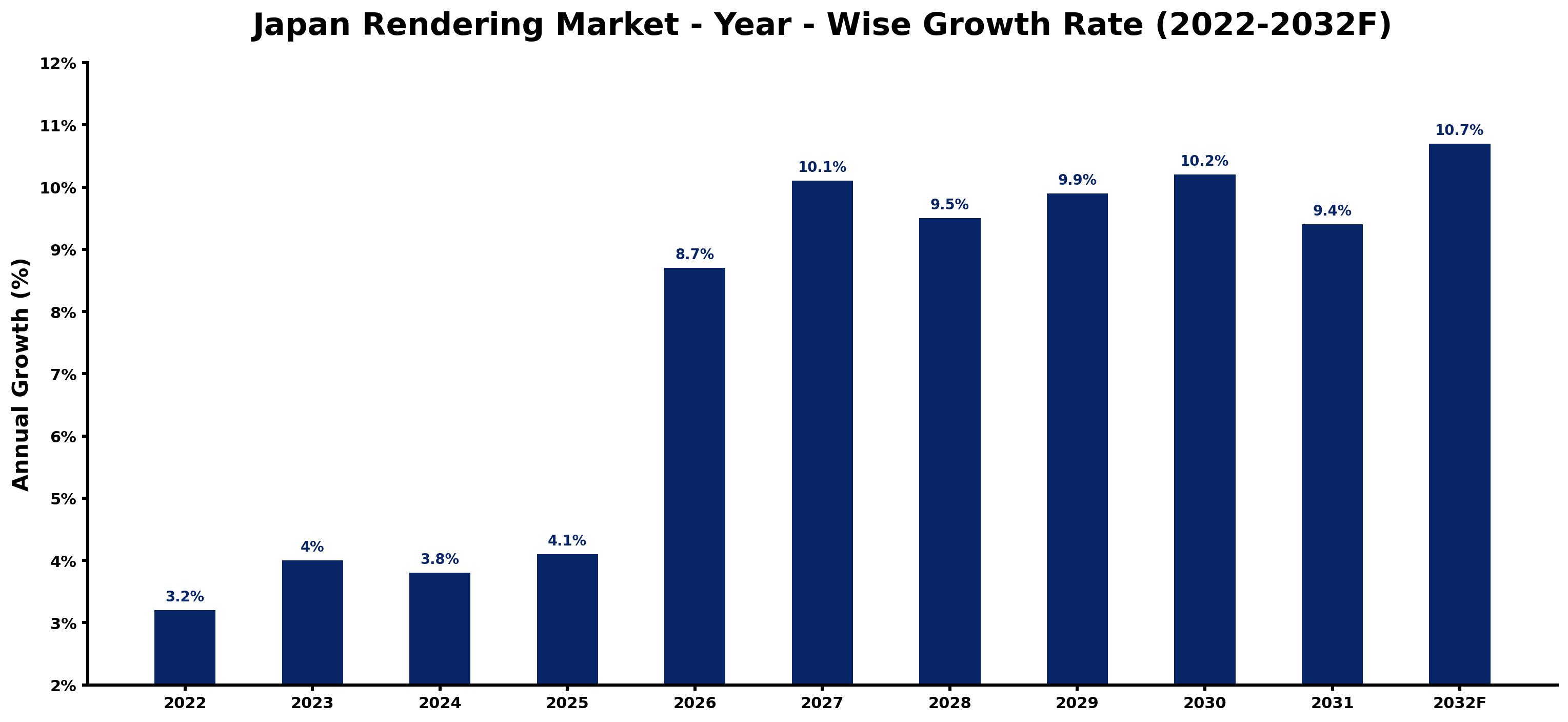
Each row of the following table gives one year's estimated growth and the event or demand shift that explains it.
| Year | Estimated Annual Growth (%) | Market Rationale |
| 2022 | 3.2 | The market saw steady demand from the animation industry and architectural firms. |
| 2023 | 4.0 | Growth accelerated due to increased production of animated films and video games. |
| 2024 | 3.8 | The pace slowed as competition intensified among rendering software providers. |
| 2025 | 4.1 | Demand surged with the recognition of over 50 games at the Japan Game Awards. |
| 2026 | 8.7 | Investments in digital transformation are expected to drive growth across sectors. |
| 2027 | 10.1 | The market will benefit from the increasing adoption of AR/VR technologies. |
| 2028 | 9.5 | The growth rate is projected to normalise as the market matures and competition stabilises. |
| 2029 | 9.9 | Demand is expected to rise with the expansion of architectural visualization in urban areas. |
| 2030 | 10.2 | Investment in rendering technologies will continue to support market growth. |
| 2031 | 9.4 | The growth rate is projected to slow as the market approaches saturation in key segments. |
| 2032 | 10.7 | The market is expected to peak as new rendering solutions gain traction across industries. |
Note: Market size estimations and growth projections presented in this report are based on 6Wresearch's proprietary forecasting methodology, utilizing the latest available industry data, government publications, and primary research inputs.
Japan Rendering Market Synopsis
Rendering generates images from 2D or 3D models using computer algorithms, crucial for animated films, video games, and architectural visualizations. The Japan Rendering Market is experiencing growth driven by increased investments in video game development and architectural visualization. The animation industry produced over 80 feature films in 2022, reflecting strong demand for rendering services. In 2023, the Japan Institute of Architects launched a new rendering standard, further increasing the need for high-quality rendering solutions.
Market Dynamics Impact Analysis (2026–2032)
| Factor | Type | Impact | Primary Segment Affected |
| Growing demand for animated films and video games | Driver | High | Real-Time Rendering |
| Increasing architectural projects in urban areas | Driver | High | Architectural Rendering |
| Expansion of AR/VR applications in various sectors | Opportunity | High | AR/VR Visualization |
| Emergence of new rendering standards promoting quality | Opportunity | Medium | Real-Time Rendering |
| Intense competition among rendering software providers | Restraint | High | Real-Time Rendering |
| High initial investment costs for advanced rendering technologies | Restraint | Medium | Real-Time Rendering |
| Talent shortages in the rendering industry | Challenge | High | Real-Time Rendering |
| Rapid technological advancements creating obsolescence | Challenge | Medium | Real-Time Rendering |
Evaluation of Drivers in Japan Rendering Market (2026–2032)
These are the developments adding the most demand over the forecast period.
| Drivers | Primary Segment Affected | Why It Matters (Evidence) |
| Increased production of animated films | Real-Time Rendering | Japan's animation industry produced over 80 feature films in 2022, driving demand for services. |
| Rising architectural projects in Tokyo | Architectural Rendering | Tokyo's population exceeds 14 million, increasing the need for visualization services. |
| Growing investments in AR/VR technologies | AR/VR Visualization | The Japan Virtual Reality Association promotes applications, stimulating market demand. |
| Launch of new rendering standards | Real-Time Rendering | A new standard introduced in 2023 raised quality expectations across the industry. |
| Expansion of educational institutions offering rendering courses | Real-Time Rendering | Rendering technologies are integrated into over 1,000 educational institutions, boosting workforce availability. |
Behind the steady rise in orders sits the thriving animation industry, which produced over 80 feature films in 2022, driving demand for services. Architectural projects in Tokyo are increasing the need for visualization. Investments in AR/VR technologies are growing, supported by the Japan Virtual Reality Association promoting applications in various sectors. The introduction of new standards in 2023 raises quality expectations, further stimulating the market. Rendering technologies are integrated into numerous educational institutions, ensuring a steady supply of skilled professionals to meet industry demands.
Evaluation of Restraints in Japan Rendering Market
These are the pressures that could keep growth below its potential.
| Market Restraint | Primary Segment Affected | Why It Matters (Evidence) |
| Intense competition among rendering software providers | Real-Time Rendering | Numerous providers have emerged, increasing price pressure and limiting profit margins. |
| High initial investment costs for advanced rendering technologies | Real-Time Rendering | Many studios struggle to adopt advanced solutions due to substantial upfront costs. |
| Talent shortages in the rendering industry | Real-Time Rendering | The demand for skilled professionals exceeds supply, impacting project timelines and quality. |
| Rapid technological advancements creating obsolescence | Real-Time Rendering | Frequent updates in software can render existing tools obsolete, complicating long-term investments. |
| Complexity of integrating new rendering standards | Architectural Rendering | New standards require firms to adapt their processes, potentially delaying project timelines. |
Japan Rendering Market Challenges
In 2023, architectural firms face rising costs due to intense competition in the rendering market, which can inflate project budgets by up to 20%. A lack of skilled professionals in advanced rendering techniques prevents producers from fulfilling client demands, causing project delays of several months. Buyers encounter challenges as over 70% of architectural firms depend on rendering software for presentations, risking client dissatisfaction if deadlines are missed. Gaps in technology standards, highlighted by the recent launch from the Japan Institute of Architects, compel firms to invest approximately 5 billion yen annually in training and software updates.
Trends in the Japan Rendering Market
These developments are changing demand patterns in the Japan Rendering Market.
- Shift from Traditional to Real-Time Rendering: Japan's rendering market is shifting towards real-time technologies, driven by the need for interactive experiences. The Tokyo Game Show in 2023 showcased advancements in this area, reflecting a growing trend in video game development.
- Emergence of AR/VR Applications in Rendering: Architecture firms are increasingly adopting AR/VR visualization techniques, improving client presentations. The Japan Virtual Reality Association reported a rise in AR/VR applications, indicating a shift in industry practices.
- Adoption of New Rendering Standards: The introduction of new standards by the Japan Institute of Architects in 2023 is changing industry practices. Over 70% of architectural firms are now aligning their processes with these standards, improving quality and consistency.
- Expansion of Educational Programs in Rendering: Rendering education is expanding in Japan, with numerous institutions integrating technologies into their curricula. This trend supports the industry's growth by ensuring a skilled workforce for future demands.
Investment Opportunities in the Japan Rendering Market
The openings below show where demand in the Japan Rendering Market is visible and how suppliers can enter.
- Joint Ventures with Local Firms: With the architectural rendering market valued at approximately 50 billion yen, entering through joint ventures with local firms can strengthen market presence. This approach is timely due to the increasing demand for high-quality services.
- Investment in AR/VR Technologies: The rise in AR/VR applications presents an opportunity to invest in specialized rendering tools. Architecture firms are actively seeking advanced solutions to improve client presentations, making this a promising market segment.
- Supply of Educational Programs: The expansion of rendering education offers a chance to supply training programs tailored to industry needs. Collaborating with educational institutions can help bridge the skills gap in the rendering workforce.
- Development of Cloud-Based Rendering Solutions: The growing demand for scalable solutions creates an opportunity to develop cloud-based services. This is particularly relevant as studios seek cost-effective and efficient rendering options.
Government Initiatives in the Japan Rendering Market
The Water Supply Act (1957) sets standards for drinking-water quality and supply, while the Sewerage Act (1958) governs sewerage systems and wastewater treatment. These laws establish frameworks that influence rendering practices, ensuring compliance with environmental standards.
The Digital Agency, established in September 2021, supports initiatives that promote the adoption of advanced rendering technologies. This agency benefits producers and buyers in the industry by encouraging digital transformation and common system standards.
Future Insight of the Japan Rendering Market
By 2032, architectural visualization will evolve as advancements in rendering technologies reshape the industry. Buyers will see improved quality and efficiency as over 90% of projects incorporate new standards. The Tokyo Metropolitan Government's smart city initiative will integrate rendering into urban planning, boosting public engagement. Educational institutions will increasingly emphasise rendering techniques, ensuring a skilled workforce aligns with industry needs.
Market Segmentation Analysis
Japan Rendering Market report covers a detailed analysis of the following market segments:
By Rendering Type – Real-Time Rendering Leads, AR/VR Visualization Expected to Grow Fastest
According to Saurav Kr Singh, Senior Research Analyst at 6Wresearch, in 2025, Real-Time Rendering led the rendering type split with a 43% share. Real-Time Rendering holds the largest share due to its essential role in interactive applications, particularly in the thriving video game sector. For instance, Tokyo's numerous game studios rely heavily on this technology to create engaging experiences. AR/VR Visualization is set to record the highest CAGR in this split, 13.9% over 2026–2032. AR/VR Visualization is experiencing rapid growth as it becomes crucial for immersive experiences across various sectors, including entertainment and education. The Tokyo Metropolitan Government's smart city initiative in 2023 highlights the increasing integration of AR/VR technologies. Suppliers should focus on enhancing real-time capabilities while buyers must invest in AR/VR technologies to stay competitive.
By Engine/Tool – Unreal Engine Leads, Unity/Unreal Expected to Grow Fastest
With 44% of engine/tool revenue in 2025, Unreal Engine was the largest category. Unreal Engine dominates the market as it is widely used for real-time rendering in games, appealing to a vast number of developers in Japan's gaming industry. Its integration into many successful titles showcases its effectiveness and popularity. Over 2026–2032, Unity/Unreal is expected to post the fastest growth, at a CAGR of 13.2%. Unity/Unreal is growing quickly as these tools are key for game development and interactive media, with a surge in projects leveraging both engines. The recognition of over 50 games at the Japan Game Awards in 2023 underscores their importance in the sector. Suppliers need to ensure compatibility with popular engines while buyers should consider these tools for their projects to maximise rendering efficiency.
By Delivery Mode – Game Engines Lead, In-App / Webstream Expected to Grow Fastest
Game Engines held 38% of the Japan Rendering Market by delivery mode in 2025. Game Engines lead the market as they are integral for creating interactive video games, which are a major part of Japan's entertainment industry. The extensive use of these engines in game development reflects their importance in delivering high-quality experiences. The quickest growth will come from In-App / Webstream, forecast to expand at a CAGR of 13.6% between 2026 and 2032. In-App / Webstream is the fastest-growing mode, driven by the rising demand for streaming rendered content in applications. This trend is evident as more developers seek to provide seamless experiences to users through mobile and web platforms. Suppliers should explore opportunities in streaming technologies while buyers must adapt to in-app solutions for broader audience reach.
By End User – Video Game Developers Lead, Architecture Firms Expected to Grow Fastest
Video Game Developers took 45% of end user revenue in 2025, more than any other category. Video Game Developers are the largest end user group, significantly utilising rendering tools to create visually captivating games that resonate with audiences. The production of over 80 feature films in Japan's animation industry in 2022 further illustrates the demand for rendering technologies. Architecture Firms are projected to grow fastest, at a CAGR of 12.9% during 2026–2032. Architecture Firms are experiencing the fastest growth as they increasingly utilise rendering for client presentations, reflecting the industry's shift towards visual communication. The architectural rendering market's valuation at approximately 50 billion yen indicates a robust demand for these services. Suppliers should tailor offerings to meet the specific needs of architecture firms while buyers must leverage rendering tools to enhance client engagement.
Key Attractiveness of the Report
- 10 Years of Market Numbers
- Historical Data Starting from 2022 to 2025
- Base Year 2025
- Forecast Data until 2032
- Key Performance Indicators Impacting the Market
- Major Upcoming Developments and Projects
Key Highlights of the Report:
- Japan Rendering Market Outlook
- Market Size of Japan Rendering Market, 2025
- Forecast of Japan Rendering Market, 2032
- Historical Data and Forecast of Japan Rendering Revenues & Volume for the Period 2022-2032F
- Japan Rendering Market Trend Evolution
- Japan Rendering Market Drivers and Challenges
- Japan Rendering Price Trends
- Japan Rendering Porter's Five Forces
- Japan Rendering Industry Life Cycle
- Historical Data and Forecast of Japan Rendering Market Revenues & Volume By Rendering Type for the Period 2022-2032F
- Historical Data and Forecast of Japan Rendering Market Revenues & Volume By Offline Ray-Tracing for the Period 2022-2032F
- Historical Data and Forecast of Japan Rendering Market Revenues & Volume By Real-Time Rendering for the Period 2022-2032F
- Historical Data and Forecast of Japan Rendering Market Revenues & Volume By Architectural Rendering for the Period 2022-2032F
- Historical Data and Forecast of Japan Rendering Market Revenues & Volume By AR/VR Visualization for the Period 2022-2032F
- Historical Data and Forecast of Japan Rendering Market Revenues & Volume By Engine/Tool for the Period 2022-2032F
- Historical Data and Forecast of Japan Rendering Market Revenues & Volume By V-Ray, Arnold for the Period 2022-2032F
- Historical Data and Forecast of Japan Rendering Market Revenues & Volume By Unreal Engine for the Period 2022-2032F
- Historical Data and Forecast of Japan Rendering Market Revenues & Volume By CAD-Based Tools for the Period 2022-2032F
- Historical Data and Forecast of Japan Rendering Market Revenues & Volume By Unity/Unreal for the Period 2022-2032F
- Historical Data and Forecast of Japan Rendering Market Revenues & Volume By Delivery Mode for the Period 2022-2032F
- Historical Data and Forecast of Japan Rendering Market Revenues & Volume By Workstation/Cloud for the Period 2022-2032F
- Historical Data and Forecast of Japan Rendering Market Revenues & Volume By Game Engines for the Period 2022-2032F
- Historical Data and Forecast of Japan Rendering Market Revenues & Volume By Cloud Pipelines for the Period 2022-2032F
- Historical Data and Forecast of Japan Rendering Market Revenues & Volume By In-App / Webstream for the Period 2022-2032F
- Historical Data and Forecast of Japan Rendering Market Revenues & Volume By End User for the Period 2022-2032F
- Historical Data and Forecast of Japan Rendering Market Revenues & Volume By Animated Film Studios for the Period 2022-2032F
- Historical Data and Forecast of Japan Rendering Market Revenues & Volume By Video Game Developers for the Period 2022-2032F
- Historical Data and Forecast of Japan Rendering Market Revenues & Volume By Architecture Firms for the Period 2022-2032F
- Historical Data and Forecast of Japan Rendering Market Revenues & Volume By Marketing & Design Agencies for the Period 2022-2032F
- Japan Rendering Import Export Trade Statistics
- Market Opportunity Assessment By Rendering Type
- Market Opportunity Assessment By Engine/Tool
- Market Opportunity Assessment By Delivery Mode
- Market Opportunity Assessment By End User
- Japan Rendering Top Companies Market Share
- Japan Rendering Competitive Benchmarking By Technical and Operational Parameters
- Japan Rendering Company Profiles
- Japan Rendering Key Strategic Recommendations
Market Covered
This report examines the market across the segments below.
By Rendering Type
- Offline Ray-Tracing
- Real-Time Rendering
- Architectural Rendering
- AR/VR Visualization
By Engine/Tool
- V-Ray
- Arnold
- Unreal Engine
- CAD-Based Tools
- Unity/Unreal
By Delivery Mode
- Workstation/Cloud
- Game Engines
- Cloud Pipelines
- In-App / Webstream
By End User
- Animated Film Studios
- Video Game Developers
- Architecture Firms
- Marketing & Design Agencies































