Japan Renewable Airborne Power Market Size & Growth Rate
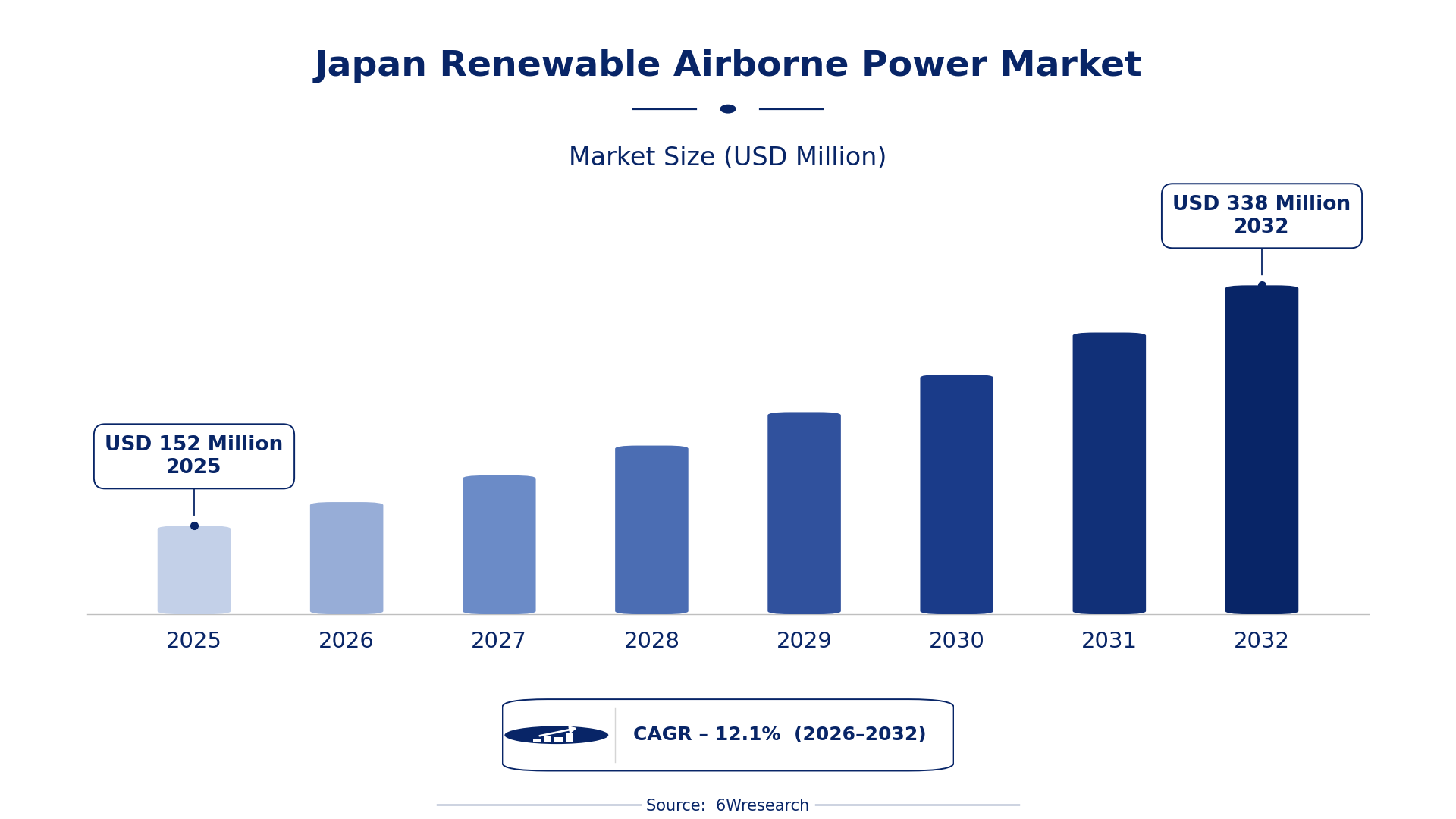
According to 6Wresearch internal database and industry insights, the Japan Renewable Airborne Power Market was valued at USD 152 Million in 2025 and is projected to reach USD 338 Million by 2032, growing at a CAGR of approximately 12.1% during 2026–2032.
Japan Renewable Airborne Power Market Highlights
| Report Metric | Details |
| Report Name | Japan Renewable Airborne Power Market (2026-2032) |
| Market Size 2025 | USD 152 Million |
| Market Size 2032 | USD 338 Million |
| Absolute Growth 2025–2032 | USD 186 Million |
| CAGR 2026–2032 | 12.1% |
| Peak Annual Growth | 15.3% in 2027 |
| Forecast Period | 2026–2032 |
| Historical Data | 2022–2025 |
| Base Year | 2025 |
| Leading Platform, 2025 | Drone-Based Solar UAVs (47% share) |
| Leading Energy Type, 2025 | Wind (49% share) |
| Leading Application Mode, 2025 | Ground Tethered (45% share) |
| Leading End User, 2025 | Utility-Scale Pilot Projects (58% share) |
| Fastest-Growing Platform | Kite Power Systems (17.5% CAGR) |
| Fastest-Growing Energy Type | High-Altitude Wind (17.8% CAGR) |
| Fastest-Growing Application Mode | Solar Survey/Power (16.8% CAGR) |
| Growing Sector | Utility-Scale Pilot Projects |
| Key End Users | Remote Site Operators, Utility-Scale Projects, Off-Grid Research Stations |
Japan Renewable Airborne Power Market Year-wise Growth Rate and Key Drivers (2022–2032)
This graph illustrates the annual growth rates of the market from 2022 to 2032, highlighting a steady upward trajectory and projected market expansion over the forecast period.
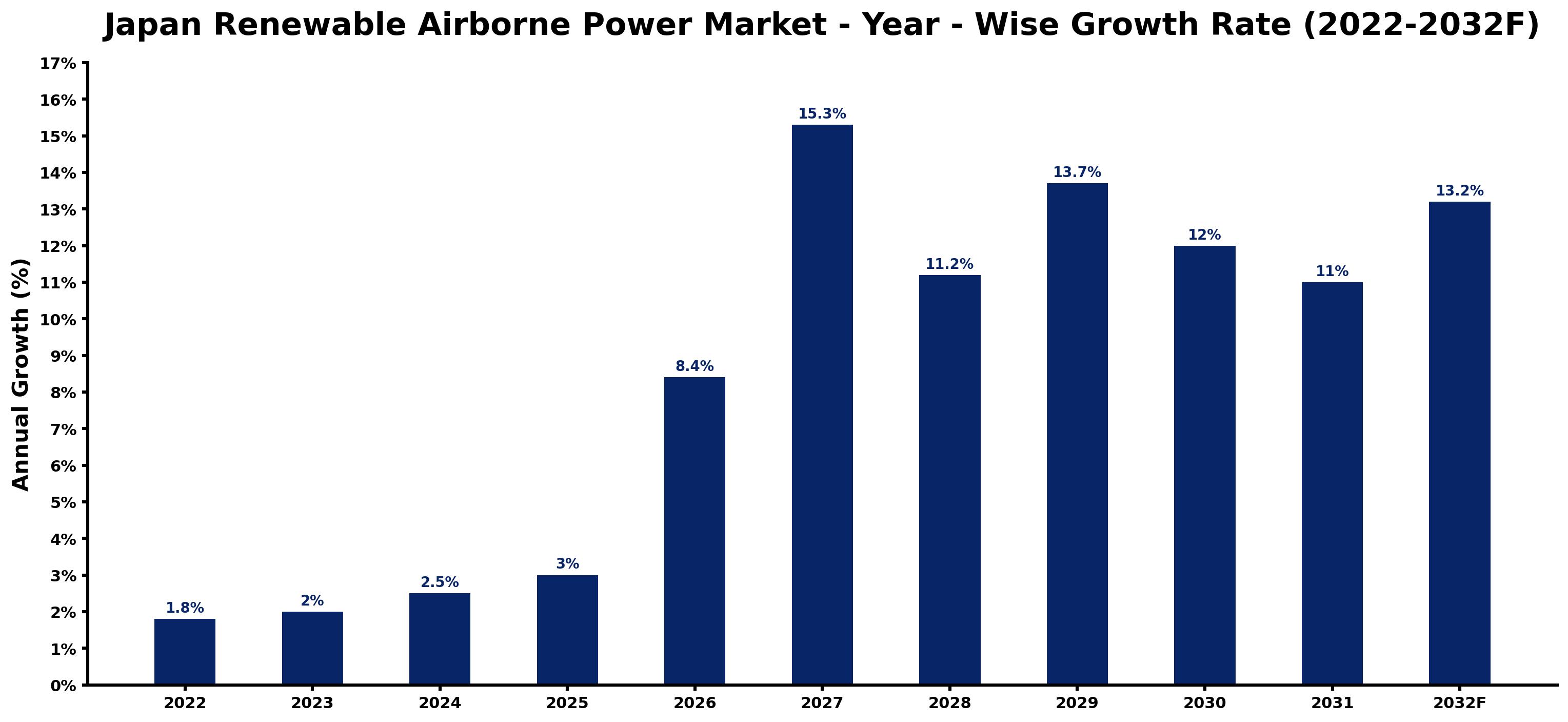
The yearly estimates that follow link every growth rate to its principal driver, so readers can see why the pace changed in each period.
| Year | Estimated Annual Growth (%) | Market Rationale |
| 2022 | 1.8 | The market showed initial growth, reflecting ongoing interest in renewable technologies. |
| 2023 | 2.0 | Demand increased due to rising investments in renewable energy infrastructure. |
| 2024 | 2.5 | Growth continued as utility-scale projects expanded across Japan. |
| 2025 | 3.0 | The market reached a peak growth rate, driven by government incentives. |
| 2026 | 8.4 | Demand is expected to surge as airborne technologies gain traction. |
| 2027 | 15.3 | The market is projected to peak with substantial investments in high-altitude systems. |
| 2028 | 11.2 | Growth is expected to slow slightly as market conditions stabilise after the peak. |
| 2029 | 13.7 | Demand will accelerate again with renewed interest in sustainable energy solutions. |
| 2030 | 12.0 | Growth is projected to moderate as the market adjusts to previous rapid expansions. |
| 2031 | 11.0 | The market will continue to grow, supported by ongoing utility projects. |
| 2032 | 13.2 | Demand is expected to rise as more projects come online. |
Note: Market size estimations and growth projections presented in this report are based on 6Wresearch's proprietary forecasting methodology, utilizing the latest available industry data, government publications, and primary research inputs.
Japan Renewable Airborne Power Market Synopsis
Renewable Airborne Power encompasses technologies that capture wind and solar energy using airborne platforms such as kites and drones. Japan aims for a renewable energy target of 36-38% by 2030, which is driving the demand for advanced solutions. Public and private investments, along with government initiatives like the GX Basic Policy, are propelling market growth, which is projected to reach USD 338 million by 2032. The increasing emphasis on utility-scale projects and off-grid applications further fuels this upward trend.
Market Dynamics Impact Analysis (2026–2032)
| Factor | Type | Impact | Primary Segment Affected |
| Rising investments in utility-scale projects drive demand for airborne power technologies. | Driver | High | Utility-Scale Pilot Projects |
| Government incentives for renewable energy adoption stimulate market growth. | Driver | High | Utility-Scale Pilot Projects |
| The increasing need for off-grid energy solutions presents opportunities for airborne systems. | Opportunity | High | Remote Site Operators |
| Growing interest in high-altitude wind energy creates new market avenues. | Opportunity | Medium | High-Altitude Wind |
| High initial costs of airborne power systems can deter investment. | Restraint | High | Drone-Based Solar UAVs |
| Limited public awareness of airborne technologies may hinder adoption. | Restraint | Medium | Kite Power Systems |
| Compliance with environmental standards can complicate project approvals. | Challenge | High | Utility-Scale Pilot Projects |
| Capacity constraints in manufacturing may delay project timelines. | Challenge | Medium | Atmospheric Turbines |
Evaluation of Drivers in Japan Renewable Airborne Power Market (2026–2032)
Below are the drivers that matter most for revenue growth, with supporting evidence.
| Drivers | Primary Segment Affected | Why It Matters (Evidence) |
| Increased investment in utility-scale projects boosts demand for airborne power systems. | Utility-Scale Pilot Projects | Japan's renewable energy target of 36-38% by 2030 necessitates advanced solutions. |
| Government incentives for renewable energy adoption accelerate market growth. | Utility-Scale Pilot Projects | The GX Basic Policy aims for JPY 150 trillion in decarbonisation investment over ten years. |
| Growing off-grid energy needs drive demand for airborne power solutions. | Remote Site Operators | Japan's population of approximately 125 million creates substantial energy demand. |
| Technological advancements in high-altitude wind energy systems increase market interest. | High-Altitude Wind | The Japan Wind Power Association promotes high-altitude technologies for efficiency. |
| Rising awareness of environmental sustainability fuels demand for renewable energy. | Drone-Based Solar UAVs | The GX Promotion Act encourages the development of renewable technologies. |
The strongest pull on demand comes from utility-scale pilot projects, essential for achieving Japan's renewable energy target of 36-38% by 2030. Investment in these projects is supported by JPY 150 trillion allocated for decarbonisation over the next decade. Off-grid energy needs are also rising, driven by Japan's population of approximately 125 million, leading remote site operators to adopt airborne power solutions. Technological advancements in high-altitude wind energy systems are generating interest, with the Japan Wind Power Association actively promoting these innovations. Growing awareness of sustainability is increasing demand for airborne power systems, aligning with national objectives.
Evaluation of Restraints in Japan Renewable Airborne Power Market
These are the pressures that could keep growth below its potential.
| Market Restraint | Primary Segment Affected | Why It Matters (Evidence) |
| High initial costs of airborne power systems can deter investment. | Drone-Based Solar UAVs | The upfront investment required may limit adoption among potential buyers. |
| Limited public awareness of airborne technologies may hinder adoption. | Kite Power Systems | Many potential users are unfamiliar with the benefits and applications of these systems. |
| Compliance with environmental standards can complicate project approvals. | Utility-Scale Pilot Projects | Producers must navigate complex regulations, which may delay project timelines. |
| Capacity constraints in manufacturing may delay project timelines. | Atmospheric Turbines | Manufacturers may struggle to meet the growing demand for airborne power systems. |
| Market volatility can affect investment stability in renewable technologies. | High-Altitude Wind | Fluctuations in market conditions may deter long-term investments in this sector. |
Japan Renewable Airborne Power Market Challenges
Producers are grappling with escalating costs due to Japan's ambitious decarbonisation targets, necessitating substantial investments in advanced technologies. This scenario arises from the GX Basic Policy, resulting in delays in project timelines for energy suppliers and increased expenses for buyers. Many producers find it challenging to adopt airborne technology, as expertise in these systems is scarce, leading to slower project rollouts that diminish energy availability for buyers. Heightened competition from new entrants is driving prices down, squeezing producers' margins and potentially compromising quality, which can lead to unreliable energy supply for buyers.
Trends in the Japan Renewable Airborne Power Market
The shifts below are changing how Japan Renewable Airborne Power Market products are bought and supplied.
- Launch of GX Promotion Act: The GX Promotion Act, enacted in 2023, strengthens the legal framework for renewable energy projects. This act aims to facilitate investments in advanced technologies, contributing to Japan's decarbonisation goals and supporting energy solutions.
- Shift Towards High-Altitude Wind Energy: There is an increasing emphasis on high-altitude wind energy technologies, spurred by advancements in atmospheric turbine designs. The Japan Wind Power Association's promotion of these systems is expected to improve energy capture efficiency, raising overall market interest.
- Increased Adoption of Off-Grid Solutions: Remote site operators are progressively adopting airborne power solutions to address energy demands in isolated areas. With over 200 utility-scale solar projects in Japan, the necessity for reliable off-grid energy sources is becoming more pressing.
- Expansion of Utility-Scale Pilot Projects: Utility-scale pilot projects are rapidly expanding, reflecting a growing commitment to renewable energy technologies. This growth is bolstered by substantial investments and government initiatives aimed at improving energy generation capabilities.
Investment Opportunities in the Japan Renewable Airborne Power Market
Where to invest in the Japan Renewable Airborne Power Market: the main openings are set out below.
- Growing Demand for Off-Grid Solutions: With Japan's population generating substantial energy demand, there is an urgent need for off-grid energy solutions. Remote site operators are seeking airborne power systems to fulfil these needs, presenting a notable market opportunity.
- Investment in High-Altitude Wind Technologies: The rising interest in high-altitude wind energy offers an opportunity for investment in new technologies. The Japan Wind Power Association's initiatives support the development of these systems, fostering partnerships with local firms.
- Expansion of Utility-Scale Projects: The current drive for utility-scale projects creates an opportunity for suppliers of airborne power solutions. With over 200 solar projects in Japan, there is a clear demand for advanced energy generation technologies.
- Collaboration with Government Initiatives: The timing is ideal for collaboration with government initiatives like the GX Promotion Act. Engaging with local authorities can streamline approvals and facilitate market entry for airborne power systems.
Government Initiatives in the Japan Renewable Airborne Power Market
The GX Promotion Act, enacted in 2023, establishes a legal framework for promoting renewable energy technologies, including airborne power systems. This act builds on previous laws that mandate large energy users to improve efficiency. Together, these laws encourage investment in advanced energy solutions, supporting Japan's ambitious decarbonisation targets with a target of JPY 150 trillion in investments over ten years.
The Ministry of Economy, Trade and Industry oversees the implementation of the GX Promotion Act, providing funding for renewable energy projects. Local governments, such as the Tokyo Metropolitan Government, are also involved in promoting sustainable energy practices, ensuring that projects align with national goals and receive necessary approvals.
Future Insight of the Japan Renewable Airborne Power Market
By 2032, utility-scale projects will increasingly adopt airborne power solutions, driven by government subsidies and support for advanced technologies. The Ministry of Economy, Trade and Industry will allocate funding to boost research and development, paving the way for more efficient energy solutions. Japan's renewable energy target aims for a 36-38% share by 2030, enabling buyers to access a more diverse energy mix. The JIS Q 14001 standard will promote effective environmental management, building consumer trust and ensuring market stability.
Market Segmentation Analysis
Japan Renewable Airborne Power Market report covers a detailed analysis of the following market segments:
By Platform – Drone-Based Solar UAVs Lead, Kite Power Systems Expected to Grow Fastest
According to Saurav Kr Singh, Senior Research Analyst at 6Wresearch, with 47% of platform revenue in 2025, Drone-Based Solar UAVs was the largest category. Drone-Based Solar UAVs hold a significant position in the market due to their effectiveness in solar energy generation and surveying, particularly in utility-scale projects. The presence of over 200 utility-scale solar projects in Japan underscores the strong demand for these advanced systems. The quickest growth will come from Kite Power Systems, forecast to expand at a CAGR of 17.5% between 2026 and 2032. Kite Power Systems are gaining momentum as they efficiently harness wind energy from higher altitudes, which is increasingly recognised for its advantages. The recent government subsidy programme for renewable airborne power systems is likely to further accelerate this segment's growth. Suppliers should focus on kite power systems to capitalise on emerging market opportunities.
By Energy Type – Wind Leads, High-Altitude Wind Expected to Grow Fastest
The largest energy type category in 2025 was Wind, at 49% of revenue. Wind energy retains its dominant position as it remains a cornerstone of Japan's renewable energy initiatives, with a total installed capacity of 4,000 MW in 2022. This established infrastructure reflects strong investment and commitment to traditional wind generation. Over 2026–2032, High-Altitude Wind is expected to post the fastest growth, at a CAGR of 17.8%. High-Altitude Wind is witnessing rapid growth as it captures wind energy from elevated locations, offering improved efficiency. The Japan Wind Power Association's promotion of high-altitude technologies is expected to drive this segment's further expansion. Buyers should consider high-altitude wind technologies to optimise energy capture.
By Application Mode – Ground Tethered Leads, Solar Survey/Power Expected to Grow Fastest
Ground Tethered accounted for 45% of the market by application mode in 2025. Ground Tethered systems lead the market as they ensure stable energy generation from tethered setups, which is crucial for utility-scale applications. Their reliability is essential for supporting Japan's renewable energy objectives. Solar Survey/Power is set to record the highest CAGR in this split, 16.8% over 2026–2032. Solar Survey/Power applications are expanding rapidly as they cater to both energy generation and site assessment needs, responding to the demand for efficient project planning. The integration of solar panels into these systems enhances their market potential. Suppliers must develop advanced solar survey technologies to meet the rising demand for effective energy assessment solutions.
By End User – Utility-Scale Pilot Projects Lead and Record the Fastest Growth
In 2025, Utility-Scale Pilot Projects led the end user split with a 58% share. Utility-Scale Pilot Projects dominate the market as they are essential for testing and deploying large-scale renewable energy solutions. This focus aligns with Japan's ambitious renewable energy targets, driving significant investments in the sector. The same category are also set to grow fastest, at a CAGR of 13.4% during 2026–2032. Utility-Scale Pilot Projects are also the fastest-growing segment, as they play a crucial role in advancing large-scale renewable technologies. Continued government support for decarbonisation investments is expected to further propel this segment's growth. Both suppliers and buyers should prioritise utility-scale pilot projects to align with national energy goals and maximise investment returns.
Key Attractiveness of the Report
- 10 Years of Market Numbers
- Historical Data Starting from 2022 to 2025
- Base Year 2025
- Forecast Data until 2032
- Key Performance Indicators Impacting the Market
- Major Upcoming Developments and Projects
Key Highlights of the Report:
- Japan Renewable Airborne Power Market Outlook
- Market Size of Japan Renewable Airborne Power Market, 2025
- Forecast of Japan Renewable Airborne Power Market, 2032
- Historical Data and Forecast of Japan Renewable Airborne Power Revenues & Volume for the Period 2022-2032F
- Japan Renewable Airborne Power Market Trend Evolution
- Japan Renewable Airborne Power Market Drivers and Challenges
- Japan Renewable Airborne Power Price Trends
- Japan Renewable Airborne Power Porter's Five Forces
- Japan Renewable Airborne Power Industry Life Cycle
- Historical Data and Forecast of Japan Renewable Airborne Power Market Revenues & Volume By Platform for the Period 2022-2032F
- Historical Data and Forecast of Japan Renewable Airborne Power Market Revenues & Volume By Kite Power Systems for the Period 2022-2032F
- Historical Data and Forecast of Japan Renewable Airborne Power Market Revenues & Volume By Drone-Based Solar UAVs for the Period 2022-2032F
- Historical Data and Forecast of Japan Renewable Airborne Power Market Revenues & Volume By Atmospheric Turbines for the Period 2022-2032F
- Historical Data and Forecast of Japan Renewable Airborne Power Market Revenues & Volume By Energy Type for the Period 2022-2032F
- Historical Data and Forecast of Japan Renewable Airborne Power Market Revenues & Volume By Wind for the Period 2022-2032F
- Historical Data and Forecast of Japan Renewable Airborne Power Market Revenues & Volume By Solar Panels for the Period 2022-2032F
- Historical Data and Forecast of Japan Renewable Airborne Power Market Revenues & Volume By High-Altitude Wind for the Period 2022-2032F
- Historical Data and Forecast of Japan Renewable Airborne Power Market Revenues & Volume By Application Mode for the Period 2022-2032F
- Historical Data and Forecast of Japan Renewable Airborne Power Market Revenues & Volume By Ground Tethered for the Period 2022-2032F
- Historical Data and Forecast of Japan Renewable Airborne Power Market Revenues & Volume By Solar Survey/Power for the Period 2022-2032F
- Historical Data and Forecast of Japan Renewable Airborne Power Market Revenues & Volume By Tethered Aerostats for the Period 2022-2032F
- Historical Data and Forecast of Japan Renewable Airborne Power Market Revenues & Volume By End User for the Period 2022-2032F
- Historical Data and Forecast of Japan Renewable Airborne Power Market Revenues & Volume By Utility-Scale Pilot Projects for the Period 2022-2032F
- Historical Data and Forecast of Japan Renewable Airborne Power Market Revenues & Volume By Remote Site Operators for the Period 2022-2032F
- Historical Data and Forecast of Japan Renewable Airborne Power Market Revenues & Volume By Off-Grid Research Stations for the Period 2022-2032F
- Japan Renewable Airborne Power Import Export Trade Statistics
- Market Opportunity Assessment By Platform
- Market Opportunity Assessment By Energy Type
- Market Opportunity Assessment By Application Mode
- Market Opportunity Assessment By End User
- Japan Renewable Airborne Power Top Companies Market Share
- Japan Renewable Airborne Power Competitive Benchmarking By Technical and Operational Parameters
- Japan Renewable Airborne Power Company Profiles
- Japan Renewable Airborne Power Key Strategic Recommendations
Market Covered
Coverage by segment is as follows.
By Platform
- Kite Power Systems
- Drone-Based Solar UAVs
- Atmospheric Turbines
By Energy Type
- Wind
- Solar Panels
- High-Altitude Wind
By Application Mode
- Ground Tethered
- Solar Survey/Power
- Tethered Aerostats
By End User
- Utility-Scale Pilot Projects
- Remote Site Operators
- Off-Grid Research Stations































