Japan Renewable Aviation Energy Market Size & Growth Rate
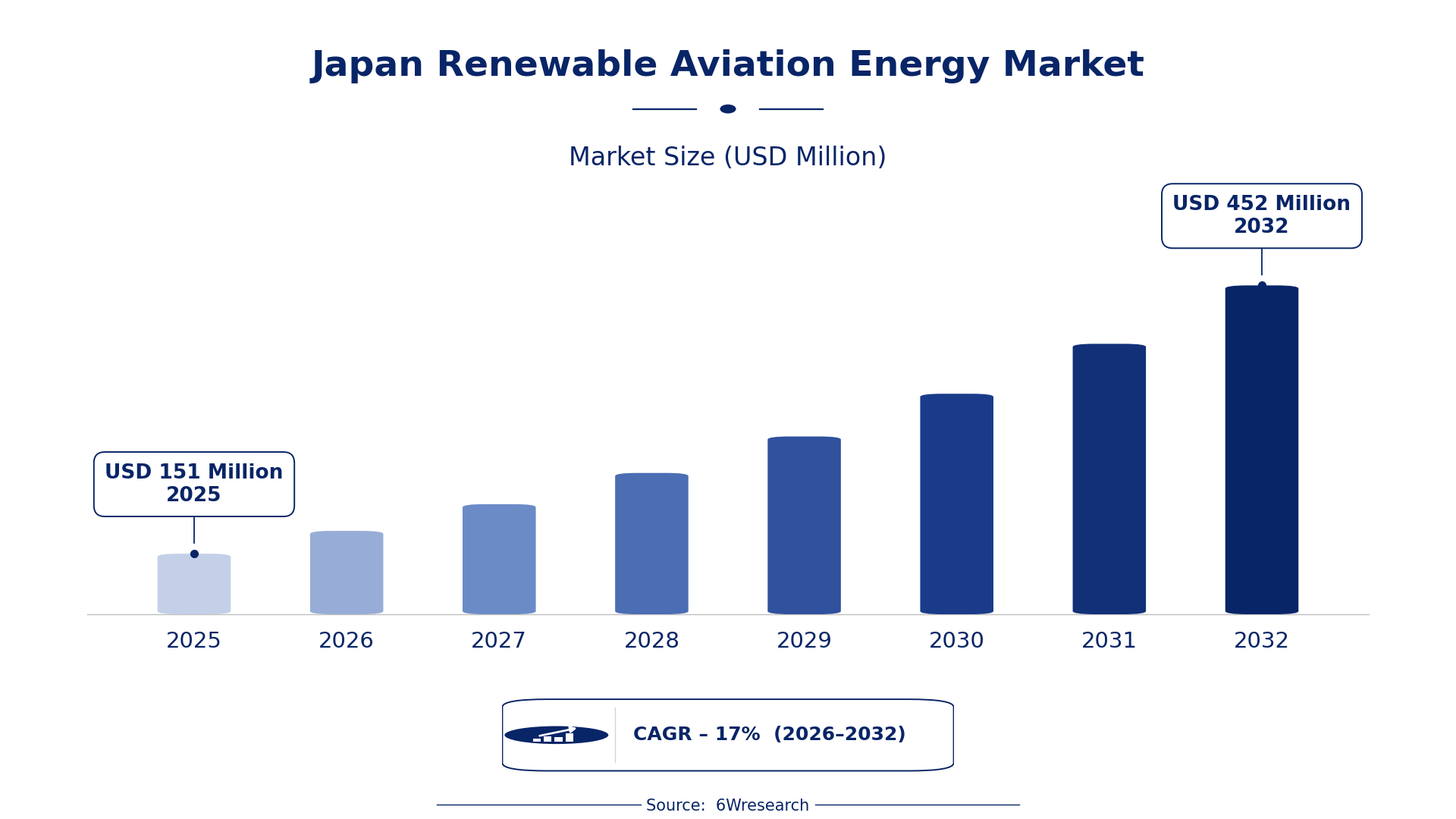
According to 6Wresearch internal database and industry insights, the Japan Renewable Aviation Energy Market was valued at USD 151 Million in 2025 and is projected to reach USD 452 Million by 2032, growing at a CAGR of approximately 17% during 2026–2032.
Japan Renewable Aviation Energy Market Highlights
| Report Metric | Details |
| Report Name | Japan Renewable Aviation Energy Market (2026-2032) |
| Market Size 2025 | USD 151 Million |
| Market Size 2032 | USD 452 Million |
| Absolute Growth 2025–2032 | USD 301 Million |
| CAGR 2026–2032 | 17% |
| Peak Annual Growth | 19.4% in 2032 |
| Forecast Period | 2026–2032 |
| Historical Data | 2022–2025 |
| Base Year | 2025 |
| Leading Energy Strategy, 2025 | Hydrotreated Vegetable Oil (HVO) (54% share) |
| Leading Fuel Type, 2025 | Biofuel (46% share) |
| Leading Application Mode, 2025 | Commercial Flights (48% share) |
| Leading End User, 2025 | Airlines & Aircraft OEMs (49% share) |
| Fastest-Growing Energy Strategy | Sustainable Aviation Fuel (SAF) (23.2% CAGR) |
| Fastest-Growing Fuel Type | SAF Blends (18.7% CAGR) |
| Fastest-Growing Application Mode | Airport Fueling (22.6% CAGR) |
| Fastest-Growing End User | Airports & Fuel Companies (22.5% CAGR) |
| Growing Sector | Airport Fueling |
| Key End Users | Commercial Flights, Airport Fueling, Experimental Aircraft |
Japan Renewable Aviation Energy Market Year-wise Growth Rate and Key Drivers (2022–2032)
This graph illustrates the annual growth rates of the market from 2022 to 2032, highlighting a steady upward trajectory and projected market expansion over the forecast period.
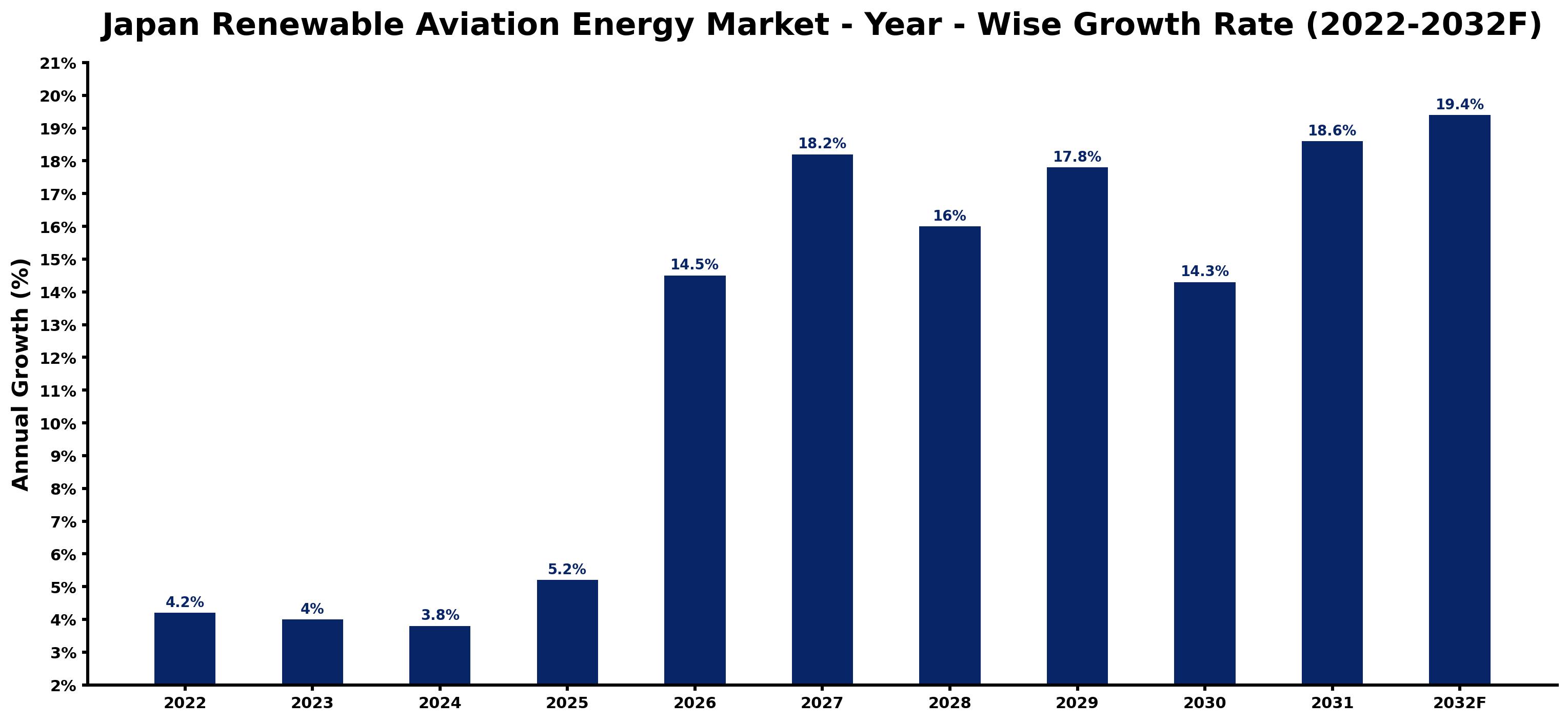
For each year, the table pairs the estimated growth rate with the leading influence on demand, showing how the drivers changed across the period.
| Year | Estimated Annual Growth (%) | Market Rationale |
| 2022 | 4.2 | The market showed moderate growth, reflecting ongoing interest in renewable energy solutions. |
| 2023 | 4.0 | Growth slowed slightly as stakeholders adjusted to evolving market conditions and regulations. |
| 2024 | 3.8 | The market continued to grow, albeit at a slower pace, as production capabilities expanded. |
| 2025 | 5.2 | Demand surged as production targets were met, leading to increased adoption of renewable fuels. |
| 2026 | 14.5 | Growth is expected to accelerate due to rising investments in sustainable aviation technologies. |
| 2027 | 18.2 | Demand will continue to rise sharply as more stakeholders enter the renewable aviation sector. |
| 2028 | 16.0 | Growth is projected to slow as the market begins to stabilise after rapid expansion in previous years. |
| 2029 | 17.8 | The market is expected to rebound with renewed interest in sustainable aviation initiatives and technologies. |
| 2030 | 14.3 | Growth will decelerate as the market adjusts to regulatory frameworks and production realities. |
| 2031 | 18.6 | Demand is projected to surge again as new technologies and investments revitalise the sector. |
| 2032 | 19.4 | The market will peak with advancements in production and widespread adoption of renewable fuels. |
Note: Market size estimations and growth projections presented in this report are based on 6Wresearch's proprietary forecasting methodology, utilizing the latest available industry data, government publications, and primary research inputs.
Japan Renewable Aviation Energy Market Synopsis
Renewable Aviation Energy includes Sustainable Aviation Fuel (SAF), Hydrotreated Vegetable Oil (HVO), and hydrogen-based fuels, produced through advanced processing methods. The aviation sector is increasingly adopting these fuels to meet emissions reduction targets. The Japan Renewable Aviation Energy Market is expanding due to ambitious national decarbonisation goals, aiming for 10% renewable aviation fuel by 2030, alongside investments in infrastructure and technology, such as the ¥2 billion allocated for hydrogen fuel research in 2023. This growth is driven by commitments from airlines and advancements in airport fueling capabilities.
Market Dynamics Impact Analysis (2026–2032)
| Factor | Type | Impact | Primary Segment Affected |
| Growing demand for Sustainable Aviation Fuel (SAF) from airlines | Driver | High | Sustainable Aviation Fuel (SAF) |
| Investment in airport fueling infrastructure to support renewable energy | Driver | High | Airport Fueling |
| Emerging opportunities in hydrogen fuel technology for aviation | Opportunity | Medium | Hydrogen/E-fuels |
| Increasing need for biofuels in ground transportation creates synergies | Opportunity | Medium | Biofuel |
| Limited production capacity for SAF and HVO in the short term | Restraint | High | Hydrotreated Vegetable Oil (HVO) |
| High initial investment costs for renewable energy infrastructure | Restraint | Medium | Airport Fueling |
| Technological challenges in scaling hydrogen fuel applications | Challenge | High | Hydrogen/E-fuels |
| Regulatory compliance costs for SAF production and distribution | Challenge | Medium | Sustainable Aviation Fuel (SAF) |
Evaluation of Drivers in Japan Renewable Aviation Energy Market (2026–2032)
Below are the drivers that matter most for revenue growth, with supporting evidence.
| Drivers | Primary Segment Affected | Why It Matters (Evidence) |
| Increased airline commitments to SAF usage by 2025 | Sustainable Aviation Fuel (SAF) | With Japan Airlines pledging to use SAF, demand is projected to reach 1 million liters by 2025. |
| Investment in airport infrastructure to support renewable fuels | Airport Fueling | Tokyo International Airport's role as a distribution hub is vital, with investments improving fuel availability. |
| Targets for emissions reduction driving innovation | Hydrotreated Vegetable Oil (HVO) | Japan aims for a 50% reduction in aviation emissions by 2030, spurring demand for renewable fuels. |
| Public and private investment in decarbonisation | Sustainable Aviation Fuel (SAF) | The GX Basic Policy targets JPY 150 trillion in investments, boosting renewable energy projects. |
| Research initiatives advancing hydrogen fuel technology | Hydrogen/E-fuels | The ¥2 billion allocated in 2023 for hydrogen research supports future aviation fuel developments. |
Several shifts outside the market lift sales. Airlines are committed to adopting Sustainable Aviation Fuel (SAF), with Japan Airlines targeting 1 million liters by 2025. Investment in airport fueling infrastructure, particularly at Tokyo International Airport, improves fuel availability, supporting the growing demand. Japan's goal for a 50% reduction in aviation emissions by 2030 drives innovation in renewable fuel production. These factors enhance the market's growth potential.
Evaluation of Restraints in Japan Renewable Aviation Energy Market
Several factors work against faster growth; the main ones are summarised below.
| Market Restraint | Primary Segment Affected | Why It Matters (Evidence) |
| Stringent regulations complicating compliance for producers | Sustainable Aviation Fuel (SAF) | Producers face high costs and delays due to strict regulations, impacting revenue potential by ¥10 million per project. |
| High transition costs for buyers switching to SAF | Airlines & Aircraft OEMs | Transitioning to Sustainable Aviation Fuel can increase operational expenses by 20%, affecting profitability. |
| Skills shortages hindering sector development | Airports & Fuel Companies | A lack of skilled workers delays project implementation, potentially extending timelines by 15%. |
| Supply chain disruptions affecting hydrogen fuel research | Hydrogen/E-fuels | Disruptions can delay innovation, impacting producers' ability to meet market demands. |
| Limited availability of renewable aviation fuels | Hydrotreated Vegetable Oil (HVO) | Supply constraints can restrict access for airlines, limiting operational capacity. |
Japan Renewable Aviation Energy Market Challenges
Producers face stringent regulations on renewable aviation fuels, complicating compliance and increasing production timelines, which can cost them potential revenue losses estimated at ¥10 million per project. Buyers incur higher costs when switching to Sustainable Aviation Fuel, raising operational expenses by 20% compared to conventional fuels, directly impacting their profitability. A shortage of skilled professionals in the renewable energy sector hampers the development of expertise, delaying project implementation for importers and distributors, which can extend timelines by 15%. Supply chain disruptions related to hydrogen fuel technology research can hinder innovation, affecting producers' ability to meet market demands.
Trends in the Japan Renewable Aviation Energy Market
The following changes are redrawing the Japan Renewable Aviation Energy Market.
- Shift towards Sustainable Aviation Fuel Adoption: Japan's aviation sector is increasingly adopting Sustainable Aviation Fuel to meet emissions targets, with a goal of 10% renewable fuel by 2030. This shift is supported by investments in infrastructure, including those at Tokyo International Airport.
- Emergence of Hydrogen Fuel Technology: Research initiatives on hydrogen-powered aircraft are gaining traction, with the Japan Aerospace Exploration Agency leading efforts. The ¥2 billion allocated for hydrogen research in 2023 underscores this trend.
- Investment in Airport Fueling Infrastructure: Tokyo International Airport is enhancing its fueling infrastructure to accommodate renewable aviation fuels. This investment is vital for supporting the demand for sustainable aviation energy.
- Growing Airline Commitments to Decarbonisation: Airlines are committing to decarbonisation, with Japan Airlines targeting 1 million liters of SAF by 2025. This commitment reflects a broader trend towards sustainable aviation practices.
Investment Opportunities in the Japan Renewable Aviation Energy Market
The following areas offer the clearest openings for investors and suppliers in the Japan Renewable Aviation Energy Market.
- Joint Ventures for Renewable Fuel Production: Establishing joint ventures with local producers can facilitate entry into the renewable aviation fuel market. The target of 10% renewable aviation fuel by 2030 presents a strong opportunity.
- Investment in Airport Infrastructure: With a projected ¥2 billion allocated for hydrogen fuel research, investing in airport fueling infrastructure is timely. Airports and fuel companies are key players in this growth.
- Research Collaborations on Hydrogen Technologies: Collaborating with research institutions on hydrogen technologies can advance innovation. The Japan Aerospace Exploration Agency's initiatives provide a platform for such partnerships.
- Focus on Sustainable Aviation Fuel Blends: Investing in the development of SAF blends can meet the increasing demand from airlines. The commitment of airlines to adopt SAF creates a strong market opportunity.
Government Initiatives in the Japan Renewable Aviation Energy Market
The Hydrogen Society Promotion Act, enacted in 2024, supports low-carbon hydrogen and ammonia supply chains, providing price-gap support for producers. This legislation aims to facilitate the growth of renewable aviation fuels by ensuring a stable supply of hydrogen. The Green Growth Strategy Through Achieving Carbon Neutrality in 2050 identifies growth sectors, with a focus on aviation fuel, and aims for substantial investments in renewable energy.
The Ministry of the Environment oversees funding for initiatives that promote Sustainable Aviation Fuel, including the 2023 initiative aimed at achieving carbon neutrality. This support is vital for producers and buyers seeking to transition to renewable aviation energy.
Future Insight of the Japan Renewable Aviation Energy Market
The policy-driven shift towards reducing greenhouse gas emissions will reshape the market by 2032, with a target of 10% of aviation fuel sourced from renewables. Research initiatives by the Aerospace Research and Development Agency will likely yield advancements in Sustainable Aviation Fuel technologies. Investments in airport fueling infrastructure will enhance distribution networks, facilitating wider adoption of renewable fuels. The allocation of ¥2 billion for hydrogen fuel technology research will support the transition, benefiting both buyers and suppliers by creating a more sustainable aviation environment.
Market Segmentation Analysis
Japan Renewable Aviation Energy Market report covers a detailed analysis of the following market segments:
By Energy Strategy – Hydrotreated Vegetable Oil (HVO) Leads, Sustainable Aviation Fuel (SAF) Expected to Grow Fastest
According to Saurav Kr Singh, Senior Research Analyst at 6Wresearch, the largest energy strategy category in 2025 was Hydrotreated Vegetable Oil (HVO), at 54% of revenue. Hydrotreated Vegetable Oil (HVO) holds the largest share due to its established use as a drop-in fuel for aviation applications, particularly at major hubs like Tokyo International Airport. This widespread acceptance and integration into existing fuel systems solidify its leading position in the market. The quickest growth will come from Sustainable Aviation Fuel (SAF), forecast to expand at a CAGR of 23.2% between 2026 and 2032. Sustainable Aviation Fuel (SAF) is experiencing rapid growth as Japan targets 1 million liters of SAF production by 2025, driven by government initiatives for carbon neutrality. This focus on reducing emissions in aviation will further accelerate SAF adoption, widening its market lead. Suppliers should prioritise investments in SAF production capabilities to align with national emission reduction goals.
By Fuel Type – Biofuel Leads, SAF Blends Expected to Grow Fastest
Biofuel took 46% of fuel type revenue in 2025, more than any other category. Biofuel currently leads the market as it has been integrated into some ground transportation sectors, creating a foundational demand. Its established presence allows for gradual acceptance in aviation, particularly as regulations evolve towards greener alternatives. Over 2026–2032, SAF Blends are expected to post the fastest growth, at a CAGR of 18.7%. SAF Blends are growing quickly as they can be seamlessly integrated with conventional fuels, making them an attractive option for airlines looking to reduce their carbon footprint. The increasing regulatory push for renewable sources in aviation fuels will further drive this segment's growth. Buyers should explore SAF Blends as a viable option to meet sustainability targets while ensuring fuel compatibility.
By Application Mode – Commercial Flights Lead, Airport Fueling Expected to Grow Fastest
In 2025, Commercial Flights led the application mode split with a 48% share. Commercial Flights dominate the market as they represent the primary application of renewable aviation energy, with airlines focusing on eco-friendly solutions to comply with regulatory targets. The strong demand from domestic airlines for sustainable fuel options solidifies this segment's leading position. Airport Fueling is set to record the highest CAGR in this split, 22.6% over 2026–2032. Airport Fueling is experiencing rapid growth driven by significant investments in infrastructure to integrate renewable energy sources at airports. The Tokyo Metropolitan Government's commitment to enhancing airport fueling capabilities highlights the urgency for this transition. This trend indicates that suppliers must focus on developing strategic partnerships with airport authorities to meet the increasing infrastructure demands for renewable aviation fuels.
By End User – Airlines & Aircraft OEMs Lead, Airports & Fuel Companies Expected to Grow Fastest
With 49% of end user revenue in 2025, Airlines & Aircraft OEMs was the largest category. Airlines & Aircraft OEMs account for the largest segment of renewable aviation energy consumers, as they are directly involved in utilising these fuels for their operations. Their active pursuit of sustainability initiatives solidifies their dominant market position. Airports & Fuel Companies are projected to grow fastest, at a CAGR of 22.5% during 2026–2032. Airports & Fuel Companies are quickly expanding their influence in the market, driven by the increasing need for infrastructure to distribute renewable aviation fuels effectively. This trend indicates a shift towards more integrated fuel supply chains in the aviation sector. Engagement with airports and fuel companies is essential for suppliers to establish effective distribution networks for renewable aviation energy.
Key Attractiveness of the Report
- 10 Years of Market Numbers
- Historical Data Starting from 2022 to 2025
- Base Year 2025
- Forecast Data until 2032
- Key Performance Indicators Impacting the Market
- Major Upcoming Developments and Projects
Key Highlights of the Report:
- Japan Renewable Aviation Energy Market Outlook
- Market Size of Japan Renewable Aviation Energy Market, 2025
- Forecast of Japan Renewable Aviation Energy Market, 2032
- Historical Data and Forecast of Japan Renewable Aviation Energy Revenues & Volume for the Period 2022-2032F
- Japan Renewable Aviation Energy Market Trend Evolution
- Japan Renewable Aviation Energy Market Drivers and Challenges
- Japan Renewable Aviation Energy Price Trends
- Japan Renewable Aviation Energy Porter's Five Forces
- Japan Renewable Aviation Energy Industry Life Cycle
- Historical Data and Forecast of Japan Renewable Aviation Energy Market Revenues & Volume By Energy Strategy for the Period 2022-2032F
- Historical Data and Forecast of Japan Renewable Aviation Energy Market Revenues & Volume By Hydrotreated Vegetable Oil (HVO) for the Period 2022-2032F
- Historical Data and Forecast of Japan Renewable Aviation Energy Market Revenues & Volume By Sustainable Aviation Fuel (SAF) for the Period 2022-2032F
- Historical Data and Forecast of Japan Renewable Aviation Energy Market Revenues & Volume By Hydrogen/E-fuels for the Period 2022-2032F
- Historical Data and Forecast of Japan Renewable Aviation Energy Market Revenues & Volume By Fuel Type for the Period 2022-2032F
- Historical Data and Forecast of Japan Renewable Aviation Energy Market Revenues & Volume By Biofuel for the Period 2022-2032F
- Historical Data and Forecast of Japan Renewable Aviation Energy Market Revenues & Volume By SAF Blends for the Period 2022-2032F
- Historical Data and Forecast of Japan Renewable Aviation Energy Market Revenues & Volume By Synthetic Fuels for the Period 2022-2032F
- Historical Data and Forecast of Japan Renewable Aviation Energy Market Revenues & Volume By Application Mode for the Period 2022-2032F
- Historical Data and Forecast of Japan Renewable Aviation Energy Market Revenues & Volume By Commercial Flights for the Period 2022-2032F
- Historical Data and Forecast of Japan Renewable Aviation Energy Market Revenues & Volume By Airport Fueling for the Period 2022-2032F
- Historical Data and Forecast of Japan Renewable Aviation Energy Market Revenues & Volume By Experimental Aircraft for the Period 2022-2032F
- Historical Data and Forecast of Japan Renewable Aviation Energy Market Revenues & Volume By End User for the Period 2022-2032F
- Historical Data and Forecast of Japan Renewable Aviation Energy Market Revenues & Volume By Airlines & Aircraft OEMs for the Period 2022-2032F
- Historical Data and Forecast of Japan Renewable Aviation Energy Market Revenues & Volume By Airports & Fuel Companies for the Period 2022-2032F
- Historical Data and Forecast of Japan Renewable Aviation Energy Market Revenues & Volume By Aerospace R&D for the Period 2022-2032F
- Japan Renewable Aviation Energy Import Export Trade Statistics
- Market Opportunity Assessment By Energy Strategy
- Market Opportunity Assessment By Fuel Type
- Market Opportunity Assessment By Application Mode
- Market Opportunity Assessment By End User
- Japan Renewable Aviation Energy Top Companies Market Share
- Japan Renewable Aviation Energy Competitive Benchmarking By Technical and Operational Parameters
- Japan Renewable Aviation Energy Company Profiles
- Japan Renewable Aviation Energy Key Strategic Recommendations
Market Covered
The following segment groups are covered in the report.
By Energy Strategy
- Hydrotreated Vegetable Oil (HVO)
- Sustainable Aviation Fuel (SAF)
- Hydrogen/E-fuels
By Fuel Type
- Biofuel
- SAF Blends
- Synthetic Fuels
By Application Mode
- Commercial Flights
- Airport Fueling
- Experimental Aircraft
By End User
- Airlines & Aircraft OEMs
- Airports & Fuel Companies
- Aerospace R&D































