Japan Renewable Energy From Crops Market Size & Growth Rate
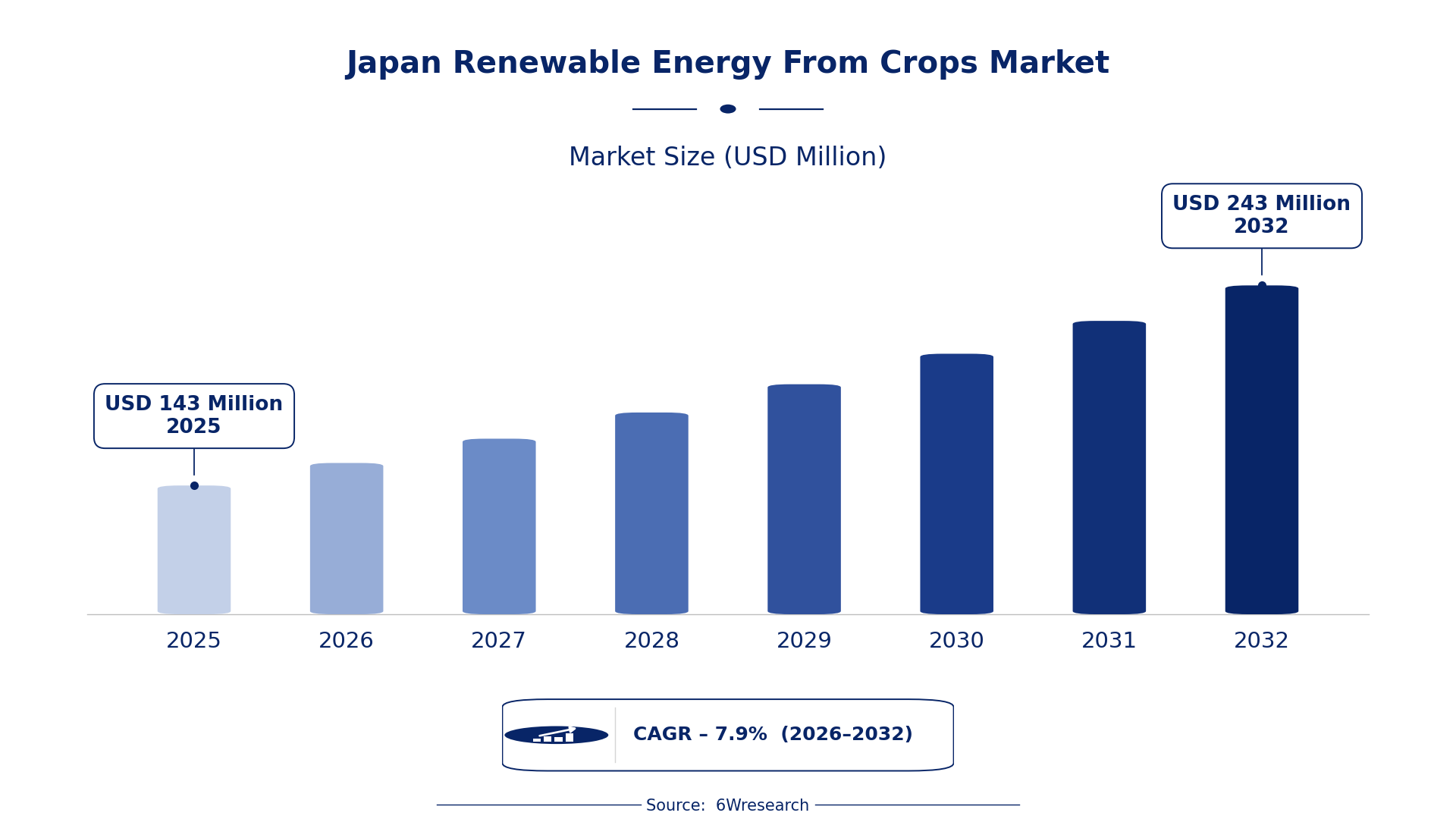
According to 6Wresearch internal database and industry insights, the Japan Renewable Energy From Crops Market was valued at USD 143 Million in 2025 and is projected to reach USD 243 Million by 2032, growing at a CAGR of approximately 7.9% during 2026–2032.
Japan Renewable Energy From Crops Market Highlights
| Report Metric | Details |
| Report Name | Japan Renewable Energy From Crops Market (2026-2032) |
| Market Size 2025 | USD 143 Million |
| Market Size 2032 | USD 243 Million |
| Absolute Growth 2025–2032 | USD 100 Million |
| CAGR 2026–2032 | 7.9% |
| Peak Annual Growth | 10.1% in 2031 |
| Forecast Period | 2026–2032 |
| Historical Data | 2022–2025 |
| Base Year | 2025 |
| Leading Crop Source, 2025 | Corn/Maize (48% share) |
| Leading Energy Form, 2025 | Ethanol (37% share) |
| Leading Conversion Method, 2025 | Fermentation (45% share) |
| Leading End User, 2025 | Biofuel Refineries (49% share) |
| Fastest-Growing Crop Source | Sugarcane (11.5% CAGR) |
| Fastest-Growing Energy Form | Bioethanol (11.7% CAGR) |
| Fastest-Growing Conversion Method | Distillation (11.2% CAGR) |
| Fastest-Growing End User | Fuel Blenders (10.5% CAGR) |
| Growing Sector | Transportation Sector |
| Key End Users | Biofuel Refineries, Fuel Blenders, Transportation Sector, Rural Electrification Programs |
Japan Renewable Energy From Crops Market Year-wise Growth Rate and Key Drivers (2022–2032)
This graph illustrates the annual growth rates of the market from 2022 to 2032, highlighting a steady upward trajectory and projected market expansion over the forecast period.
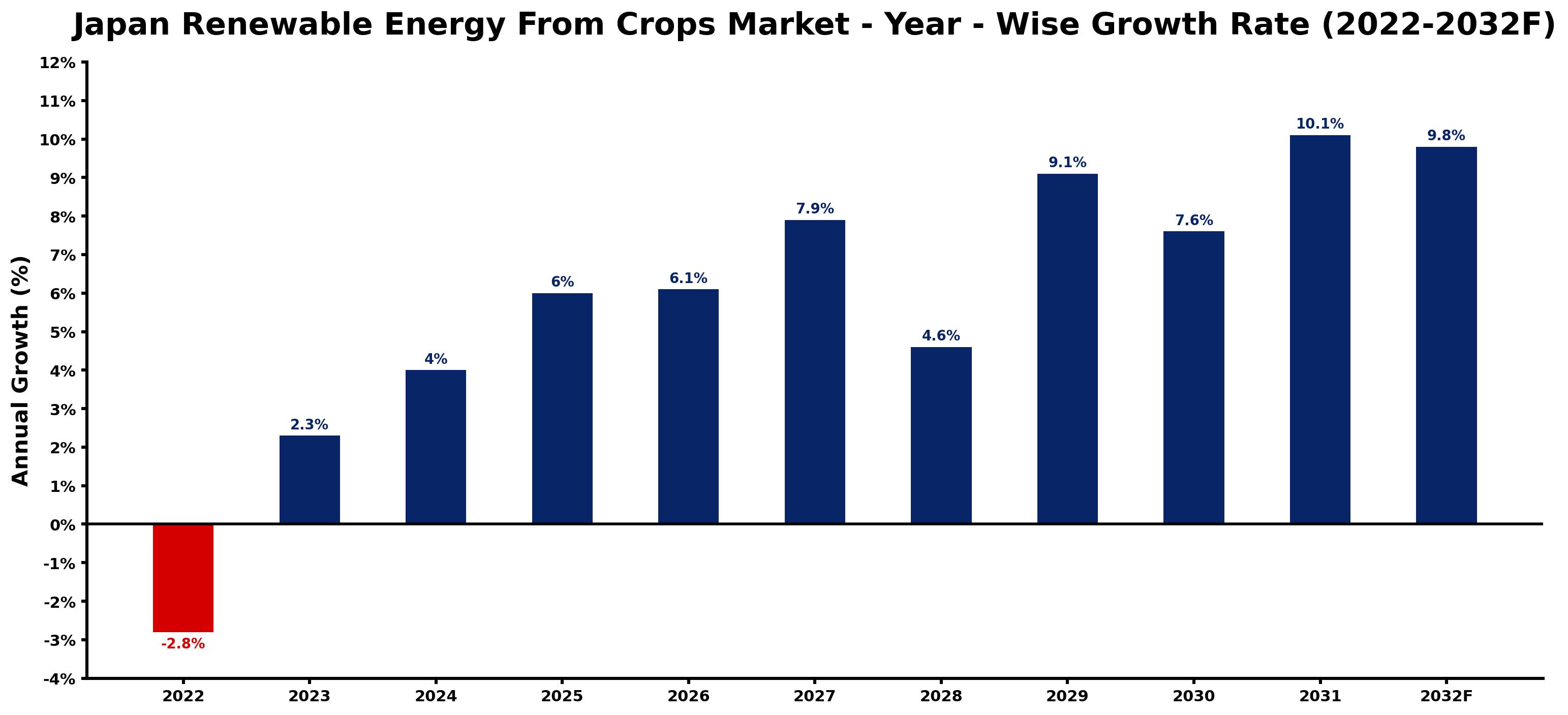
Below, each year's estimated growth is shown next to the factor that most influenced it.
| Year | Estimated Annual Growth (%) | Market Rationale |
| 2022 | -2.8 | The market faced challenges due to reduced biofuel adoption amidst economic uncertainty. |
| 2023 | 2.3 | Growth resumed as biofuel consumption increased following supportive government initiatives. |
| 2024 | 4.0 | Demand strengthened with rising awareness of renewable energy benefits among consumers. |
| 2025 | 6.0 | The market peaked as bioethanol production reached high levels in response to policy support. |
| 2026 | 6.1 | Growth is expected to continue as investments in biofuel infrastructure expand production capabilities. |
| 2027 | 7.9 | Demand is projected to surge due to heightened focus on energy security and sustainability efforts. |
| 2028 | 4.6 | Growth is anticipated to slow as market saturation begins to impact new investments and production. |
| 2029 | 9.1 | Renewed interest in biofuels is expected to lead to faster growth driven by technological advancements. |
| 2030 | 7.6 | Growth will moderate as the market stabilises with established production capacities. |
| 2031 | 10.1 | The market is projected to peak again as biofuel blending targets prompt increased consumption. |
| 2032 | 9.8 | Growth will decelerate slightly as the market adjusts to new regulatory frameworks. |
Note: Market size estimations and growth projections presented in this report are based on 6Wresearch's proprietary forecasting methodology, utilizing the latest available industry data, government publications, and primary research inputs.
Japan Renewable Energy From Crops Market Synopsis
The Japan Renewable Energy From Crops Market encompasses the conversion of agricultural products into biofuels such as ethanol and biodiesel, primarily through fermentation, distillation, and transesterification. Approximately 1.5 billion litres of bioethanol were produced in 2022, reflecting a growing emphasis on energy security and sustainability. The market is expanding due to increased consumption in the transportation sector and government initiatives targeting a 10% biofuel blend in transportation fuels by 2030, alongside substantial investments in decarbonisation.
Market Dynamics Impact Analysis (2026–2032)
| Factor | Type | Impact | Primary Segment Affected |
| Growing demand for biofuels in the transportation sector | Driver | High | Bioethanol |
| Government support for renewable energy initiatives | Driver | High | Biodiesel |
| Increased investment in biofuel infrastructure | Opportunity | High | Biofuel Refineries |
| Rising consumer awareness of sustainable energy sources | Opportunity | Medium | Transportation Sector |
| High production costs associated with biofuel production | Restraint | High | Ethanol |
| Limited availability of feedstock for biofuel production | Restraint | Medium | Biodiesel |
| Competition from fossil fuels affecting pricing | Challenge | High | Bioethanol |
| Technological barriers in biofuel production processes | Challenge | Medium | Biodiesel |
Evaluation of Drivers in Japan Renewable Energy From Crops Market (2026–2032)
These are the developments adding the most demand over the forecast period.
| Drivers | Primary Segment Affected | Why It Matters (Evidence) |
| Increased bioethanol production | Ethanol | Japan's bioethanol production reached approximately 1.5 billion liters in 2022, reflecting the transportation fuel needs. |
| Government initiatives promoting biofuel use | Biodiesel | The government aims for a 10% biofuel blend in transportation fuels by 2030, boosting biodiesel demand. |
| Expansion of biofuel refineries | Biofuel Refineries | With 20 biofuel refineries in Japan, production capacity is increasing to meet rising demand. |
| Growing transportation sector consumption | Transportation Sector | In 2023, the transportation sector consumed about 2 million tons of biodiesel, indicating increased biofuel adoption. |
| Technological advancements in biofuel production | Ethanol | Innovations in fermentation and distillation processes improve efficiency and lower production costs. |
What keeps demand rising is the increasing bioethanol production, which reached approximately 1.5 billion litres in 2022, reflecting the transportation sector's fuel needs. In 2023, the transportation sector consumed about 2 million tons of biodiesel, indicating a shift towards renewable energy sources. Technological improvements in production processes increase efficiency, enabling producers to meet rising demand effectively.
Evaluation of Restraints in Japan Renewable Energy From Crops Market
Below are the constraints most often cited by buyers and suppliers, with the segment each affects.
| Market Restraint | Primary Segment Affected | Why It Matters (Evidence) |
| High production costs associated with biofuels | Ethanol | Production costs remain elevated, impacting profit margins for bioethanol producers, particularly in a competitive market. |
| Limited availability of feedstock for biofuel production | Biodiesel | The reliance on specific crops for biodiesel limits supply, affecting production levels and pricing. |
| Competition from fossil fuels affecting pricing | Bioethanol | Fossil fuel prices remain competitive, challenging the market share of bioethanol in the transportation sector. |
| Regulatory compliance costs for biofuel standards | Biodiesel | Compliance with JIS K 2204 standards incurs additional costs for biodiesel producers, impacting profitability. |
| Market saturation limiting new investments | Biofuel Refineries | As the market matures, new investments in biofuel refineries may slow due to existing capacity. |
Japan Renewable Energy From Crops Market Challenges
Japan produced approximately 1.5 billion litres of bioethanol in 2022, yet skills shortages in the agricultural sector hinder efficient crop conversion into biofuels, causing delays in production timelines for producers. Local producers face intense competition from international markets, forcing them to lower prices, which can shrink their profit margins and limit growth potential. Regulatory compliance with JIS K 2204 standards for biodiesel incurs additional costs for producers, raising operational expenses that may deter investment in new technologies. Supply chain disruptions in sourcing raw materials can delay the government's 10% biofuel blend target by 2030, impacting buyers reliant on timely fuel availability.
Trends in the Japan Renewable Energy From Crops Market
Several trends are reshaping the Japan Renewable Energy From Crops Market; the most important are set out below.
- Expansion of Biofuel Production Capacity: The number of biofuel refineries in Japan has increased, supporting a production capacity of around 500 million liters annually. This expansion is vital for meeting growing energy demands.
- Growing Adoption of Bioethanol in Transportation: Bioethanol is becoming a preferred choice in Japan's transportation sector, with consumption reaching approximately 2 million tons in 2023. This trend reflects a broader shift towards renewable energy sources.
- Increased Investment in Decarbonisation Initiatives: Japan's GX Basic Policy (2023) aims for JPY 150 trillion in decarbonisation investments over the next decade. This commitment is driving growth in the renewable energy sector, including biofuels.
- Shift towards Sustainable Biofuel Standards: Japan is increasingly adopting stringent biofuel standards, such as JIS K 2204 for biodiesel, to ensure quality and sustainability. This shift began in 2022, aiming to build consumer confidence and promote biofuel adoption.
Investment Opportunities in the Japan Renewable Energy From Crops Market
Several openings in the Japan Renewable Energy From Crops Market merit attention from investors.
- Rural Electrification Programs Need Biofuels: Rural electrification programs are increasingly looking for sustainable energy solutions, presenting an opportunity for biofuel suppliers to provide renewable energy options to these initiatives.
- Market Gap for Advanced Biofuels: The market is facing a gap in advanced biofuels that meet new sustainability standards, creating opportunities for suppliers to innovate and cater to this demand, particularly among fuel blenders.
- Investment in Biogas Production: As the agricultural residue utilisation rate for biogas production is expected to reach 30% by 2025, there is an opportunity for investments in biogas facilities to support this growth.
- Timing for Increased Biofuel Adoption: With Japan targeting a 10% biofuel blend in transportation fuels by 2030, there is an opportunity for investment in biofuel production facilities, especially in the Kanto region, to meet this demand.
Government Initiatives in the Japan Renewable Energy From Crops Market
The Hydrogen Society Promotion Act (2024) impacts biofuel producers by supporting low-carbon hydrogen and ammonia supply chains, providing price-gap support that encourages biofuel adoption. This initiative aligns with Japan's broader decarbonisation goals, aiming for a 46% reduction in greenhouse gas emissions by 2030.
The Ministry of Agriculture, Forestry and Fisheries oversees the implementation of various programs promoting biofuel use, including funding for rural electrification initiatives. These programs are designed to support biofuel adoption, ensuring that producers can meet the growing demand for renewable energy.
Future Insight of the Japan Renewable Energy From Crops Market
Japan's GX Basic Policy aims for JPY 150 trillion in decarbonisation investments over the next decade, driving a shift towards renewable energy sources. By 2032, advancements in biofuel production technology will improve efficiency and reduce costs for suppliers, enhancing market viability. The government's 2023 initiative to promote biofuel use in rural areas will open new avenues for producers and boost consumer adoption. As the agricultural residue utilisation rate for biogas production is expected to reach 30% by 2025, buyers will benefit from a broader and more sustainable energy supply.
Market Segmentation Analysis
Japan Renewable Energy From Crops Market report covers a detailed analysis of the following market segments:
By Crop Source – Corn/Maize Leads, Sugarcane Expected to Grow Fastest
According to Saurav Kr Singh, Senior Research Analyst at 6Wresearch, Corn/Maize took 48% of crop source revenue in 2025, more than any other category. Corn/Maize holds the largest share in Japan's renewable energy market due to its extensive use in bioethanol production. The established agricultural infrastructure and processing capabilities make corn a reliable primary biofuel source. The quickest growth will come from Sugarcane, forecast to expand at a CAGR of 11.5% between 2026 and 2032. Sugarcane is experiencing rapid growth as a primary source for ethanol, propelled by government incentives and increasing domestic biofuel production. The rising demand for bioethanol in transportation fuels is significantly driving this segment's expansion. Suppliers should optimise their supply chains for corn and sugarcane to meet the increasing biofuel demands.
By Energy Form – Ethanol Leads, Bioethanol Expected to Grow Fastest
In 2025, Ethanol led the energy form split with a 37% share. Ethanol leads the market as it is widely used in transportation fuels, aligning with Japan's decarbonisation goals. The robust infrastructure for ethanol production further solidifies its dominant position in the renewable energy sector. Over 2026–2032, Bioethanol is expected to post the fastest growth, at a CAGR of 11.7%. Bioethanol is growing quickly due to its significant role as a renewable fuel, with government initiatives promoting a 10% biofuel blend in transportation fuels by 2030. This push is expected to accelerate bioethanol adoption in the coming years. Buyers should consider sourcing more bioethanol to comply with upcoming blending mandates and sustainability targets.
By Conversion Method – Fermentation Leads, Distillation Expected to Grow Fastest
The largest conversion method category in 2025 was Fermentation, at 45% of revenue. Fermentation is the leading conversion method as it is essential for converting sugars to ethanol, which is crucial for biofuel production. The established processes in Japan ensure a steady supply of ethanol through fermentation methods. Distillation is projected to grow fastest, at a CAGR of 11.2% during 2026–2032. Distillation is the fastest-growing method, critical for purifying ethanol and ensuring compliance with quality standards for fuel. The increasing production of bioethanol necessitates improvements in distillation processes to enhance efficiency and output. Suppliers must invest in advanced distillation technologies to keep pace with the growing demand for high-quality biofuels.
By End User – Biofuel Refineries Lead, Fuel Blenders Expected to Grow Fastest
With 49% of end user revenue in 2025, Biofuel Refineries was the largest category. Biofuel Refineries dominate the market as they are dedicated facilities for processing biofuels, ensuring a steady supply for the growing demand. Their established presence in regions like Kanto supports the renewable energy infrastructure. Fuel Blenders are set to record the highest CAGR in this split, 10.5% over 2026–2032. Fuel Blenders are rapidly expanding as they mix biofuels with fossil fuels to meet regulatory requirements and consumer demand. The push for higher biofuel blends in transportation fuels is driving this segment's growth. Buyers should engage with fuel blenders to secure a consistent supply of blended fuels that meet regulatory standards.
Key Attractiveness of the Report
- 10 Years of Market Numbers
- Historical Data Starting from 2022 to 2025
- Base Year 2025
- Forecast Data until 2032
- Key Performance Indicators Impacting the Market
- Major Upcoming Developments and Projects
Key Highlights of the Report:
- Japan Renewable Energy From Crops Market Outlook
- Market Size of Japan Renewable Energy From Crops Market, 2025
- Forecast of Japan Renewable Energy From Crops Market, 2032
- Historical Data and Forecast of Japan Renewable Energy From Crops Revenues & Volume for the Period 2022-2032F
- Japan Renewable Energy From Crops Market Trend Evolution
- Japan Renewable Energy From Crops Market Drivers and Challenges
- Japan Renewable Energy From Crops Price Trends
- Japan Renewable Energy From Crops Porter's Five Forces
- Japan Renewable Energy From Crops Industry Life Cycle
- Historical Data and Forecast of Japan Renewable Energy From Crops Market Revenues & Volume By Crop Source for the Period 2022-2032F
- Historical Data and Forecast of Japan Renewable Energy From Crops Market Revenues & Volume By Corn/Maize for the Period 2022-2032F
- Historical Data and Forecast of Japan Renewable Energy From Crops Market Revenues & Volume By Sugarcane for the Period 2022-2032F
- Historical Data and Forecast of Japan Renewable Energy From Crops Market Revenues & Volume By Oilseeds (Soy, Canola) for the Period 2022-2032F
- Historical Data and Forecast of Japan Renewable Energy From Crops Market Revenues & Volume By Agricultural Residue for the Period 2022-2032F
- Historical Data and Forecast of Japan Renewable Energy From Crops Market Revenues & Volume By Energy Form for the Period 2022-2032F
- Historical Data and Forecast of Japan Renewable Energy From Crops Market Revenues & Volume By Ethanol for the Period 2022-2032F
- Historical Data and Forecast of Japan Renewable Energy From Crops Market Revenues & Volume By Bioethanol for the Period 2022-2032F
- Historical Data and Forecast of Japan Renewable Energy From Crops Market Revenues & Volume By Biodiesel for the Period 2022-2032F
- Historical Data and Forecast of Japan Renewable Energy From Crops Market Revenues & Volume By Biogas for the Period 2022-2032F
- Historical Data and Forecast of Japan Renewable Energy From Crops Market Revenues & Volume By Conversion Method for the Period 2022-2032F
- Historical Data and Forecast of Japan Renewable Energy From Crops Market Revenues & Volume By Fermentation for the Period 2022-2032F
- Historical Data and Forecast of Japan Renewable Energy From Crops Market Revenues & Volume By Distillation for the Period 2022-2032F
- Historical Data and Forecast of Japan Renewable Energy From Crops Market Revenues & Volume By Transesterification for the Period 2022-2032F
- Historical Data and Forecast of Japan Renewable Energy From Crops Market Revenues & Volume By Anaerobic Digestion for the Period 2022-2032F
- Historical Data and Forecast of Japan Renewable Energy From Crops Market Revenues & Volume By End User for the Period 2022-2032F
- Historical Data and Forecast of Japan Renewable Energy From Crops Market Revenues & Volume By Biofuel Refineries for the Period 2022-2032F
- Historical Data and Forecast of Japan Renewable Energy From Crops Market Revenues & Volume By Fuel Blenders for the Period 2022-2032F
- Historical Data and Forecast of Japan Renewable Energy From Crops Market Revenues & Volume By Transportation Sector for the Period 2022-2032F
- Historical Data and Forecast of Japan Renewable Energy From Crops Market Revenues & Volume By Rural Electrification Programs for the Period 2022-2032F
- Japan Renewable Energy From Crops Import Export Trade Statistics
- Market Opportunity Assessment By Crop Source
- Market Opportunity Assessment By Energy Form
- Market Opportunity Assessment By Conversion Method
- Market Opportunity Assessment By End User
- Japan Renewable Energy From Crops Top Companies Market Share
- Japan Renewable Energy From Crops Competitive Benchmarking By Technical and Operational Parameters
- Japan Renewable Energy From Crops Company Profiles
- Japan Renewable Energy From Crops Key Strategic Recommendations
Market Covered
The following segment groups are covered in the report.
By Crop Source
- Corn/Maize
- Sugarcane
- Oilseeds (Soy, Canola)
- Agricultural Residue
By Energy Form
- Ethanol
- Bioethanol
- Biodiesel
- Biogas
By Conversion Method
- Fermentation
- Distillation
- Transesterification
- Anaerobic Digestion
By End User
- Biofuel Refineries
- Fuel Blenders
- Transportation Sector
- Rural Electrification Programs































