Japan Renewable Energy From Waste Market Size & Growth Rate
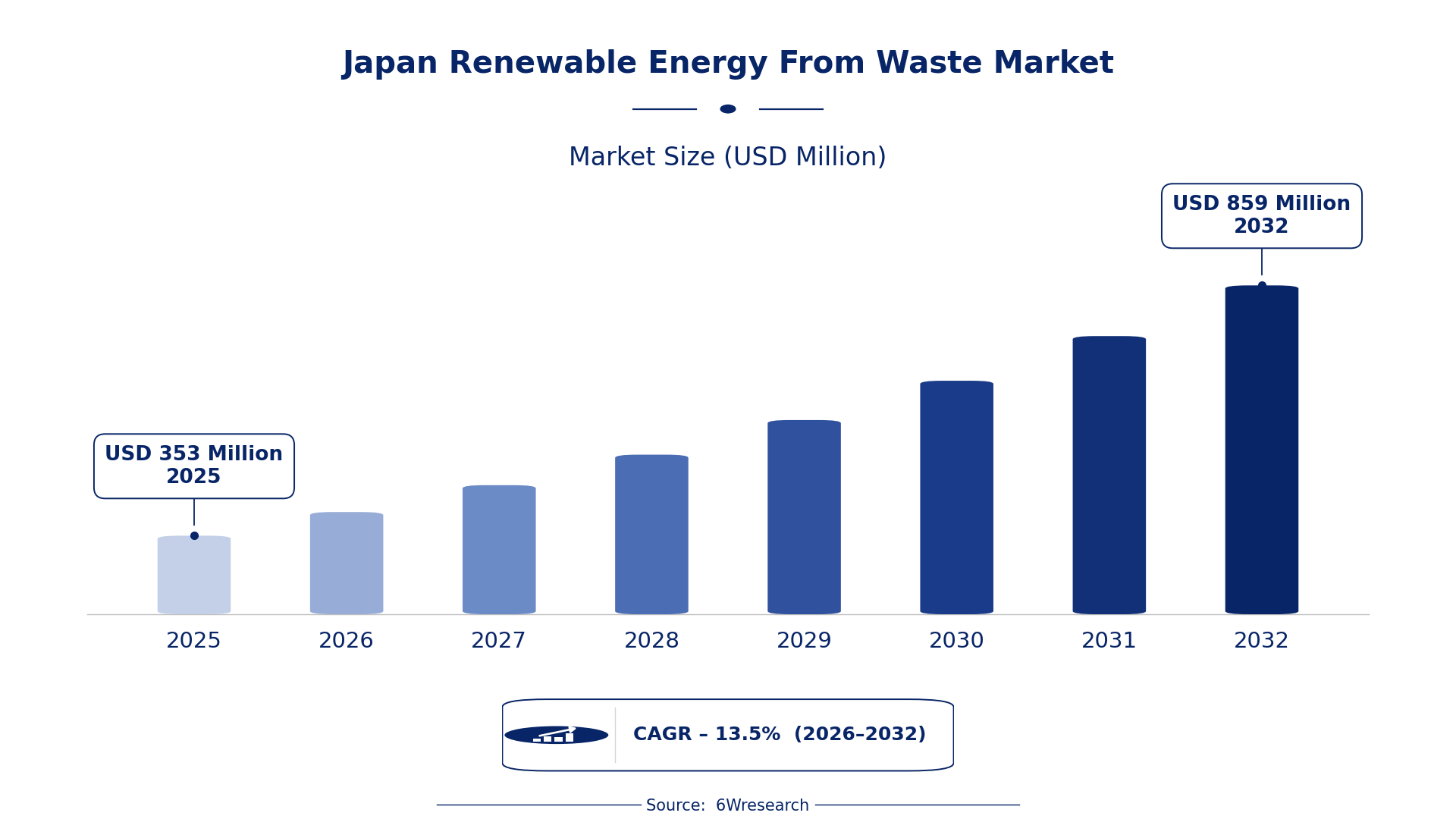
According to 6Wresearch internal database and industry insights, the Japan Renewable Energy From Waste Market was valued at USD 353 Million in 2025 and is projected to reach USD 859 Million by 2032, growing at a CAGR of approximately 13.5% during 2026–2032.
Japan Renewable Energy From Waste Market Highlights
| Report Metric | Details |
| Report Name | Japan Renewable Energy From Waste Market (2026-2032) |
| Market Size 2025 | USD 353 Million |
| Market Size 2032 | USD 859 Million |
| Absolute Growth 2025–2032 | USD 506 Million |
| CAGR 2026–2032 | 13.5% |
| Peak Annual Growth | 16.5% in 2030 |
| Forecast Period | 2026–2032 |
| Historical Data | 2022–2025 |
| Base Year | 2025 |
| Leading Waste Type, 2025 | Municipal Solid Waste (42% share) |
| Leading Energy Output, 2025 | Electricity (44% share) |
| Leading Technology Used, 2025 | Incineration/CHP (38% share) |
| Leading End User, 2025 | Urban Utilities (48% share) |
| Fastest-Growing Waste Type | Food & Organic Waste (19.6% CAGR) |
| Fastest-Growing Energy Output | Biogas (18.6% CAGR) |
| Fastest-Growing Technology Used | Anaerobic Digestion (19.1% CAGR) |
| Fastest-Growing End User | Industrial Biogas Plants (17.9% CAGR) |
| Growing Sector | Urban Utilities |
| Key End Users | Urban Utilities, Industrial Biogas Plants, Cement & Process Industries |
Japan Renewable Energy From Waste Market Year-wise Growth Rate and Key Drivers (2022–2032)
This graph illustrates the annual growth rates of the market from 2022 to 2032, highlighting a steady upward trajectory and projected market expansion over the forecast period.
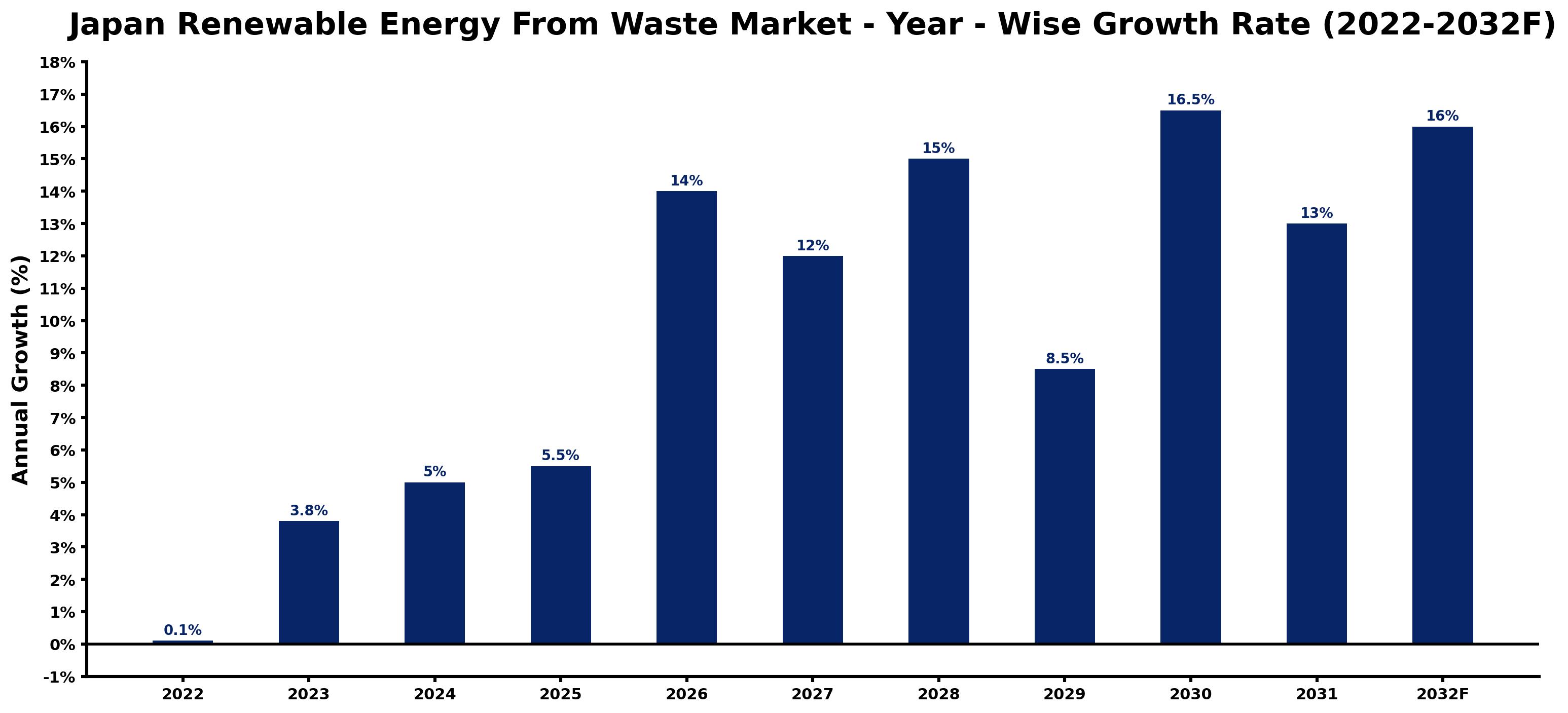
The table below sets out the estimated growth rate for each year and the main factor behind it.
| Year | Estimated Annual Growth (%) | Market Rationale |
| 2022 | 0.1 | The market exhibited minimal growth, reflecting early recovery from impacts of previous disruptions. |
| 2023 | 3.8 | Growth accelerated as urban utilities increased investments in renewable energy projects. |
| 2024 | 5.0 | Demand rose further due to heightened awareness of sustainability among consumers. |
| 2025 | 5.5 | The market reached its historical peak, driven by government initiatives and urban utility investments. |
| 2026 | 14.0 | Growth surged as new technologies in waste-to-energy are expected to gain traction. |
| 2027 | 12.0 | A slowdown is expected as market maturation begins to set in. |
| 2028 | 15.0 | Renewed interest in biogas production is projected to spur growth once again. |
| 2029 | 8.5 | Growth is expected to slow as market conditions stabilise after rapid expansion. |
| 2030 | 16.5 | The market is projected to peak again, propelled by ambitious decarbonisation targets. |
| 2031 | 13.0 | Growth is expected to moderate as the market adjusts to increased supply capacity. |
| 2032 | 16.0 | Continued investment in renewable technologies is projected to sustain growth. |
Note: Market size estimations and growth projections presented in this report are based on 6Wresearch's proprietary forecasting methodology, utilizing the latest available industry data, government publications, and primary research inputs.
Japan Renewable Energy From Waste Market Synopsis
Renewable Energy From Waste involves converting various types of waste into usable energy forms such as electricity and biogas, primarily through technologies like incineration and anaerobic digestion. The Japan Renewable Energy From Waste Market is growing due to rising investments in sustainable energy solutions, supported by a target of JPY 150 trillion in decarbonisation investment over ten years. Urban utilities are the main consumers of this energy, driving demand for advanced waste-to-energy technologies and practices.
Market Dynamics Impact Analysis (2026–2032)
| Factor | Type | Impact | Primary Segment Affected |
| Growing urbanisation and waste generation drive demand for renewable energy from waste. | Driver | High | Municipal Solid Waste |
| Technological advancements in waste-to-energy processes create new opportunities for efficiency. | Driver | High | Anaerobic Digestion |
| Increasing biogas production from food waste presents significant investment opportunities. | Opportunity | High | Food & Organic Waste |
| The push for sustainable energy solutions opens avenues for new market entrants. | Opportunity | Medium | Electricity |
| Limited public awareness of waste-to-energy benefits may hinder market growth. | Restraint | Medium | Municipal Solid Waste |
| High initial investment costs for waste-to-energy facilities restrict expansion. | Restraint | High | Anaerobic Digestion |
| Supply chain disruptions can impact the availability of waste feedstock. | Challenge | Medium | Industrial Waste |
| Competition from other renewable energy sources may limit market share. | Challenge | High | Electricity |
Evaluation of Drivers in Japan Renewable Energy From Waste Market (2026–2032)
The following drivers explain most of the expected growth.
| Drivers | Primary Segment Affected | Why It Matters (Evidence) |
| Increased urban waste generation fuels demand for waste-to-energy solutions. | Municipal Solid Waste | Japan generated approximately 45 million tons of municipal solid waste in 2022, prompting urban utilities to invest in energy recovery. |
| Technological advancements in anaerobic digestion improve biogas production efficiency. | Anaerobic Digestion | Biogas production from food waste reached 1.5 million tons in 2022, encouraging more facilities to adopt this technology. |
| Government initiatives support investments in renewable energy projects. | Electricity | The government allocated ¥30 billion for renewable energy projects from waste in 2023, stimulating sector growth. |
| Rising consumer demand for sustainable energy solutions drives market expansion. | Food & Organic Waste | The government aims to improve waste-to-energy technologies by 2030, aligning with consumer preferences. |
| ISO 14001 certification boosts operational standards for waste management facilities. | Municipal Solid Waste | Many facilities in Japan adopt ISO 14001, improving their environmental management and attracting investments. |
Orders keep climbing as urban utilities increasingly invest in renewable energy from waste, reflecting the generation of approximately 45 million tons of municipal solid waste in 2022. Facilities are adopting anaerobic digestion technologies due to rising biogas production from food waste, which reached 1.5 million tons. The allocation of ¥30 billion for renewable energy projects from waste in 2023 stimulates this growth. Consumer demand for sustainable energy solutions is rising, aligning with targets to improve waste-to-energy technologies by 2030. The adoption of ISO 14001 certification among waste management facilities also raises operational standards, attracting further investments in the sector.
Evaluation of Restraints in Japan Renewable Energy From Waste Market
The following restraints limit how fast demand can grow.
| Market Restraint | Primary Segment Affected | Why It Matters (Evidence) |
| Public awareness of waste-to-energy benefits remains limited, hindering growth. | Municipal Solid Waste | Despite large waste generation, many consumers are unaware of the advantages of waste-to-energy solutions. |
| High initial investment costs for waste-to-energy facilities restrict expansion opportunities. | Anaerobic Digestion | The capital required to establish anaerobic digestion facilities can deter potential investors. |
| Supply chain disruptions may affect the availability of waste feedstock for energy production. | Industrial Waste | Inconsistent waste collection and processing can impact the reliability of feedstock supply. |
| Competition from other renewable energy sources may limit market share for waste-to-energy. | Electricity | As solar and wind energy become more prevalent, waste-to-energy may face increased competition. |
| Regulatory hurdles can complicate the development of new waste-to-energy facilities. | Food & Organic Waste | Stringent environmental regulations may delay project approvals and increase compliance costs. |
Japan Renewable Energy From Waste Market Challenges
Japan's waste-to-energy sector faces supply chain issues, as over 1,200 incineration facilities require a steady waste supply, causing potential delays in energy generation for urban utilities. Regulatory hurdles exist due to strict environmental standards, which can extend project approval times, costing suppliers up to six months in lost revenue. High operational costs persist, with the recent ¥30 billion government funding insufficient to cover rising waste processing expenses for producers. Technology adoption lags, as outdated systems limit efficiency, forcing clinics to explore alternative energy sources while awaiting necessary upgrades.
Trends in the Japan Renewable Energy From Waste Market
The trends below show where the Japan Renewable Energy From Waste Market is heading.
- Shift from Landfill to Waste-to-Energy: Since 2023, urban utilities have increasingly favoured waste-to-energy solutions over landfilling. The Ministry of the Environment's 'Sound Material-Cycle Society' program promotes this shift, resulting in a 10% increase in waste-to-energy facilities in urban areas.
- Transition to Biogas Production: The focus on biogas production has intensified since 2022, with urban utilities leading the charge. Biogas production from food waste reached 1.5 million tons, reflecting a growing preference for renewable energy sources.
- Emergence of Advanced Anaerobic Digestion Technologies: In 2024, advanced anaerobic digestion technologies began gaining traction among urban utilities. This shift is clear as facilities adopt new methods, increasing biogas output by 18.6% over the next five years.
- Increased Investment in Decarbonisation: The government allocated ¥30 billion for renewable energy projects from waste in 2023, signalling a shift in investment priorities. This funding is expected to improve waste-to-energy technologies and infrastructure.
Investment Opportunities in the Japan Renewable Energy From Waste Market
The following opportunities in the Japan Renewable Energy From Waste Market pair current demand with a clear way in.
- Urban Utilities Seeking Sustainable Solutions: Urban utilities are increasingly looking for sustainable energy solutions, with a projected demand for renewable energy from waste expected to rise significantly. Collaborating with local partners can help suppliers tap into this growing market.
- Investment in Biogas Facilities: With biogas production from food waste reaching 1.5 million tons in 2022, there is a clear opportunity for investment in biogas facilities. Urban utilities in metropolitan regions are actively seeking partnerships to expand their biogas production capabilities.
- Supply Chain Development for Waste Management: The market gap for efficient waste management solutions is apparent, with urban utilities needing improved logistics. Establishing joint ventures with local waste management companies can facilitate entry into this sector.
- Renewable Energy Projects from Waste: The government's allocation of ¥30 billion for renewable energy projects from waste in 2023 highlights an investment opportunity. Suppliers can engage with urban utilities to provide technology and infrastructure support.
Government Initiatives in the Japan Renewable Energy From Waste Market
The Hydrogen Society Promotion Act, enacted in 2024, complements the Waste Management and Public Cleansing Act of 1970 by promoting low-carbon hydrogen and ammonia supply chains. This newer measure encourages waste-to-energy producers to explore hydrogen production from waste, improving their operational capabilities and contributing to decarbonisation goals.
In 2023, the government allocated ¥30 billion for renewable energy projects from waste, administered by the Ministry of the Environment. This funding supports the development of waste-to-energy facilities and encourages urban utilities to adopt innovative technologies.
Future Insight of the Japan Renewable Energy From Waste Market
Urban utilities will experience transformative changes by 2032, driven by advancements in waste-to-energy technologies that will enhance efficiency and output. Biogas production from food waste is expected to reach 2 million tons, providing more sustainable energy alternatives. The government's JPY 150 trillion decarbonisation investment will facilitate infrastructure upgrades and innovation. Adoption of ISO 14001 standards will help suppliers comply with environmental regulations, ensuring they meet the expectations of both buyers and regulatory authorities.
Market Segmentation Analysis
Japan Renewable Energy From Waste Market report covers a detailed analysis of the following market segments:
By Waste Type – Municipal Solid Waste Leads, Food & Organic Waste Expected to Grow Fastest
According to Saurav Kr Singh, Senior Research Analyst at 6Wresearch, Municipal Solid Waste held 42% of the Japan Renewable Energy From Waste Market by waste type in 2025. Municipal solid waste accounts for the largest share due to its extensive collection and processing for energy generation, with Japan generating approximately 45 million tons in 2022. The established infrastructure and high urban demand for sustainable energy solutions further solidify its dominance in the market. Food & Organic Waste is projected to grow fastest, at a CAGR of 19.6% during 2026–2032. Food and organic waste is experiencing rapid growth as a biogas source, with production reaching 1.5 million tons in 2022. This surge is driven by urban areas focusing on improving waste management practices and promoting renewable energy projects. This indicates that suppliers must invest in advanced technologies for processing food and organic waste to capitalise on the expanding market.
By Energy Output – Electricity Leads, Biogas Expected to Grow Fastest
Electricity accounted for 44% of the market by energy output in 2025. Electricity represents the largest share as the primary output from waste-to-energy plants, generating approximately 10,000 GWh in 2022. This output is essential for fulfilling the energy needs of urban utilities and aligning with Japan's renewable energy objectives. The quickest growth will come from Biogas, forecast to expand at a CAGR of 18.6% between 2026 and 2032. Biogas is the fastest-growing segment, largely due to its critical role in anaerobic digestion processes that transform organic waste into usable energy. The heightened emphasis on sustainable energy practices is driving biogas production. Buyers should explore biogas solutions to diversify energy sources and align with sustainability goals.
By Technology Used – Incineration/CHP Leads, Anaerobic Digestion Expected to Grow Fastest
In 2025, Incineration/CHP led the technology used split with a 38% share. Incineration and combined heat and power (CHP) technology dominate the market as the most commonly used methods for waste-to-energy conversion. This technology is well-established, with over 1,200 operational facilities across Japan, ensuring a reliable energy supply. Anaerobic Digestion is set to record the highest CAGR in this split, 19.1% over 2026–2032. Anaerobic digestion is rapidly gaining traction as an important method for processing organic waste, driven by the need for cleaner energy solutions and efficient waste management practices. This technology aligns well with Japan's environmental goals. Suppliers must invest in anaerobic digestion technologies to meet the growing demand for renewable energy from organic waste.
By End User – Urban Utilities Lead, Industrial Biogas Plants Expected to Grow Fastest
With 48% of end user revenue in 2025, Urban Utilities was the largest category. Urban utilities represent the largest consumer group of generated energy, utilising electricity from waste-to-energy plants to power city infrastructure. This demand is essential for supporting Japan's urban energy needs and sustainability initiatives. Over 2026–2032, Industrial Biogas Plants are expected to post the fastest growth, at a CAGR of 17.9%. Industrial biogas plants are the fastest-growing end user, as they increasingly utilise biogas to meet their energy requirements. The rise in biogas production aligns with the industrial sector's shift towards renewable energy sources. Buyers in the industrial sector should explore partnerships with biogas producers to secure sustainable energy supplies.
Key Attractiveness of the Report
- 10 Years of Market Numbers
- Historical Data Starting from 2022 to 2025
- Base Year 2025
- Forecast Data until 2032
- Key Performance Indicators Impacting the Market
- Major Upcoming Developments and Projects
Key Highlights of the Report:
- Japan Renewable Energy From Waste Market Outlook
- Market Size of Japan Renewable Energy From Waste Market, 2025
- Forecast of Japan Renewable Energy From Waste Market, 2032
- Historical Data and Forecast of Japan Renewable Energy From Waste Revenues & Volume for the Period 2022-2032F
- Japan Renewable Energy From Waste Market Trend Evolution
- Japan Renewable Energy From Waste Market Drivers and Challenges
- Japan Renewable Energy From Waste Price Trends
- Japan Renewable Energy From Waste Porter's Five Forces
- Japan Renewable Energy From Waste Industry Life Cycle
- Historical Data and Forecast of Japan Renewable Energy From Waste Market Revenues & Volume By Waste Type for the Period 2022-2032F
- Historical Data and Forecast of Japan Renewable Energy From Waste Market Revenues & Volume By Municipal Solid Waste for the Period 2022-2032F
- Historical Data and Forecast of Japan Renewable Energy From Waste Market Revenues & Volume By Food & Organic Waste for the Period 2022-2032F
- Historical Data and Forecast of Japan Renewable Energy From Waste Market Revenues & Volume By Industrial Waste for the Period 2022-2032F
- Historical Data and Forecast of Japan Renewable Energy From Waste Market Revenues & Volume By Agricultural Waste for the Period 2022-2032F
- Historical Data and Forecast of Japan Renewable Energy From Waste Market Revenues & Volume By Energy Output for the Period 2022-2032F
- Historical Data and Forecast of Japan Renewable Energy From Waste Market Revenues & Volume By Electricity for the Period 2022-2032F
- Historical Data and Forecast of Japan Renewable Energy From Waste Market Revenues & Volume By Biogas for the Period 2022-2032F
- Historical Data and Forecast of Japan Renewable Energy From Waste Market Revenues & Volume By Bio-oil/Gas for the Period 2022-2032F
- Historical Data and Forecast of Japan Renewable Energy From Waste Market Revenues & Volume By Biomass for the Period 2022-2032F
- Historical Data and Forecast of Japan Renewable Energy From Waste Market Revenues & Volume By Technology Used for the Period 2022-2032F
- Historical Data and Forecast of Japan Renewable Energy From Waste Market Revenues & Volume By Incineration/CHP for the Period 2022-2032F
- Historical Data and Forecast of Japan Renewable Energy From Waste Market Revenues & Volume By Anaerobic Digestion for the Period 2022-2032F
- Historical Data and Forecast of Japan Renewable Energy From Waste Market Revenues & Volume By Pyrolysis for the Period 2022-2032F
- Historical Data and Forecast of Japan Renewable Energy From Waste Market Revenues & Volume By Gasification for the Period 2022-2032F
- Historical Data and Forecast of Japan Renewable Energy From Waste Market Revenues & Volume By End User for the Period 2022-2032F
- Historical Data and Forecast of Japan Renewable Energy From Waste Market Revenues & Volume By Urban Utilities for the Period 2022-2032F
- Historical Data and Forecast of Japan Renewable Energy From Waste Market Revenues & Volume By Industrial Biogas Plants for the Period 2022-2032F
- Historical Data and Forecast of Japan Renewable Energy From Waste Market Revenues & Volume By Cement & Process Industries for the Period 2022-2032F
- Historical Data and Forecast of Japan Renewable Energy From Waste Market Revenues & Volume By Rural Energy Projects for the Period 2022-2032F
- Japan Renewable Energy From Waste Import Export Trade Statistics
- Market Opportunity Assessment By Waste Type
- Market Opportunity Assessment By Energy Output
- Market Opportunity Assessment By Technology Used
- Market Opportunity Assessment By End User
- Japan Renewable Energy From Waste Top Companies Market Share
- Japan Renewable Energy From Waste Competitive Benchmarking By Technical and Operational Parameters
- Japan Renewable Energy From Waste Company Profiles
- Japan Renewable Energy From Waste Key Strategic Recommendations
Market Covered
Coverage by segment is as follows.
By Waste Type
- Municipal Solid Waste
- Food & Organic Waste
- Industrial Waste
- Agricultural Waste
By Energy Output
- Electricity
- Biogas
- Bio-oil/Gas
- Biomass
By Technology Used
- Incineration/CHP
- Anaerobic Digestion
- Pyrolysis
- Gasification
By End User
- Urban Utilities
- Industrial Biogas Plants
- Cement & Process Industries
- Rural Energy Projects































