Japan Renewable Energy Generation Market Size & Growth Rate
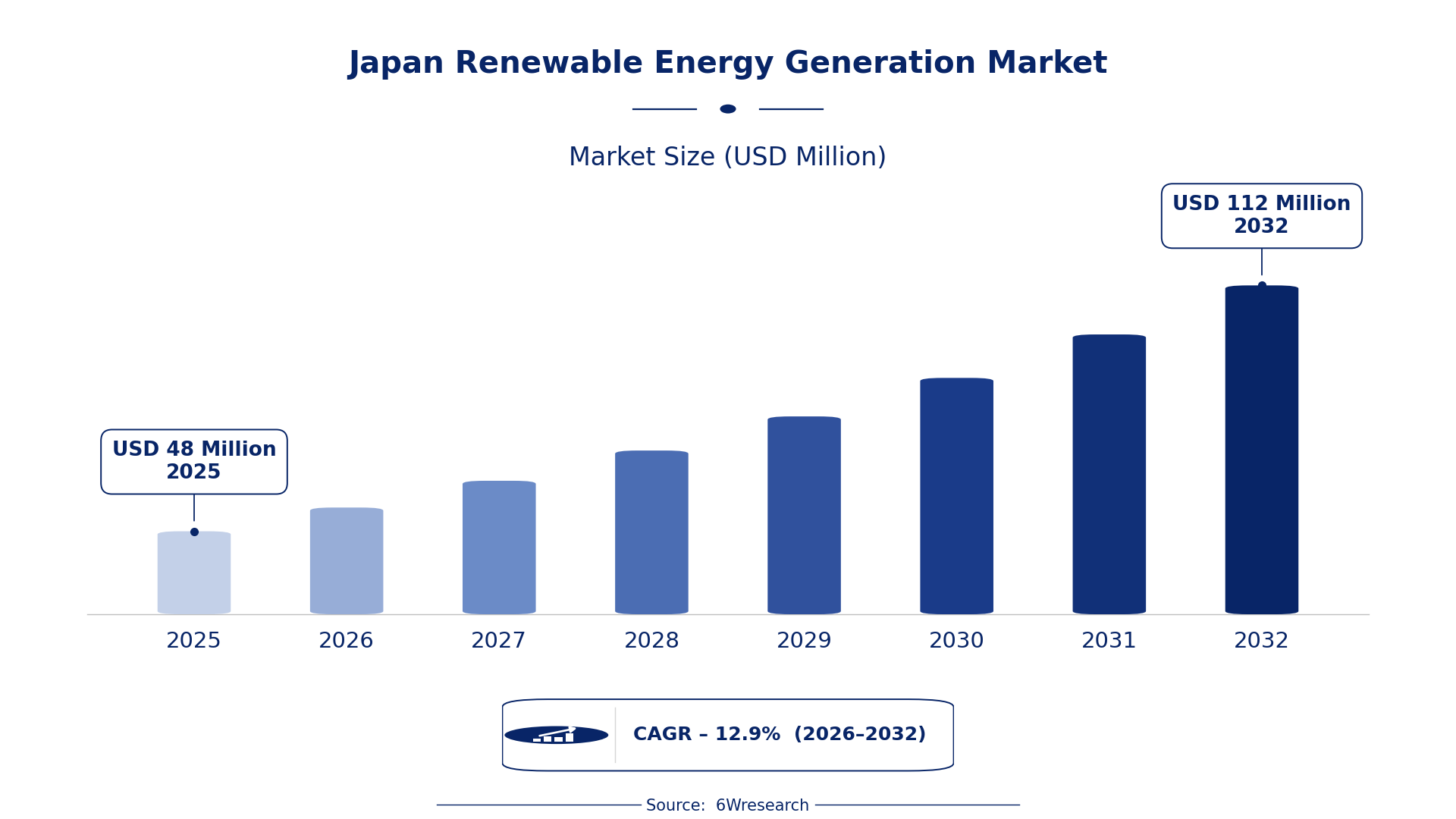
According to 6Wresearch internal database and industry insights, the Japan Renewable Energy Generation Market was valued at USD 48 Million in 2025 and is projected to reach USD 112 Million by 2032, growing at a CAGR of approximately 12.9% during 2026–2032.
Japan Renewable Energy Generation Market Highlights
| Report Metric | Details |
| Report Name | Japan Renewable Energy Generation Market (2026-2032) |
| Market Size 2025 | USD 48 Million |
| Market Size 2032 | USD 112 Million |
| Absolute Growth 2025–2032 | USD 64 Million |
| CAGR 2026–2032 | 12.9% |
| Peak Annual Growth | 14.9% in 2029 |
| Forecast Period | 2026–2032 |
| Historical Data | 2022–2025 |
| Base Year | 2025 |
| Leading Source Type, 2025 | Solar (41% share) |
| Leading Generation Technology, 2025 | Photovoltaic (PV) (43% share) |
| Leading Scale, 2025 | Residential to Utility (42% share) |
| Leading End User, 2025 | Solar Energy Providers (41% share) |
| Fastest-Growing Source Type | Wind (14.1% CAGR) |
| Fastest-Growing Generation Technology | Onshore/Offshore (14.6% CAGR) |
| Fastest-Growing Scale | Utility-Scale (17.2% CAGR) |
| Fastest-Growing End User | Wind Farm Operators (17.7% CAGR) |
| Growing Sector | Renewable Energy Generation |
| Key End Users | Solar Energy Providers, Wind Farm Operators, Renewable Utilities |
Japan Renewable Energy Generation Market Year-wise Growth Rate and Key Drivers (2022–2032)
This graph illustrates the annual growth rates of the market from 2022 to 2032, highlighting a steady upward trajectory and projected market expansion over the forecast period.
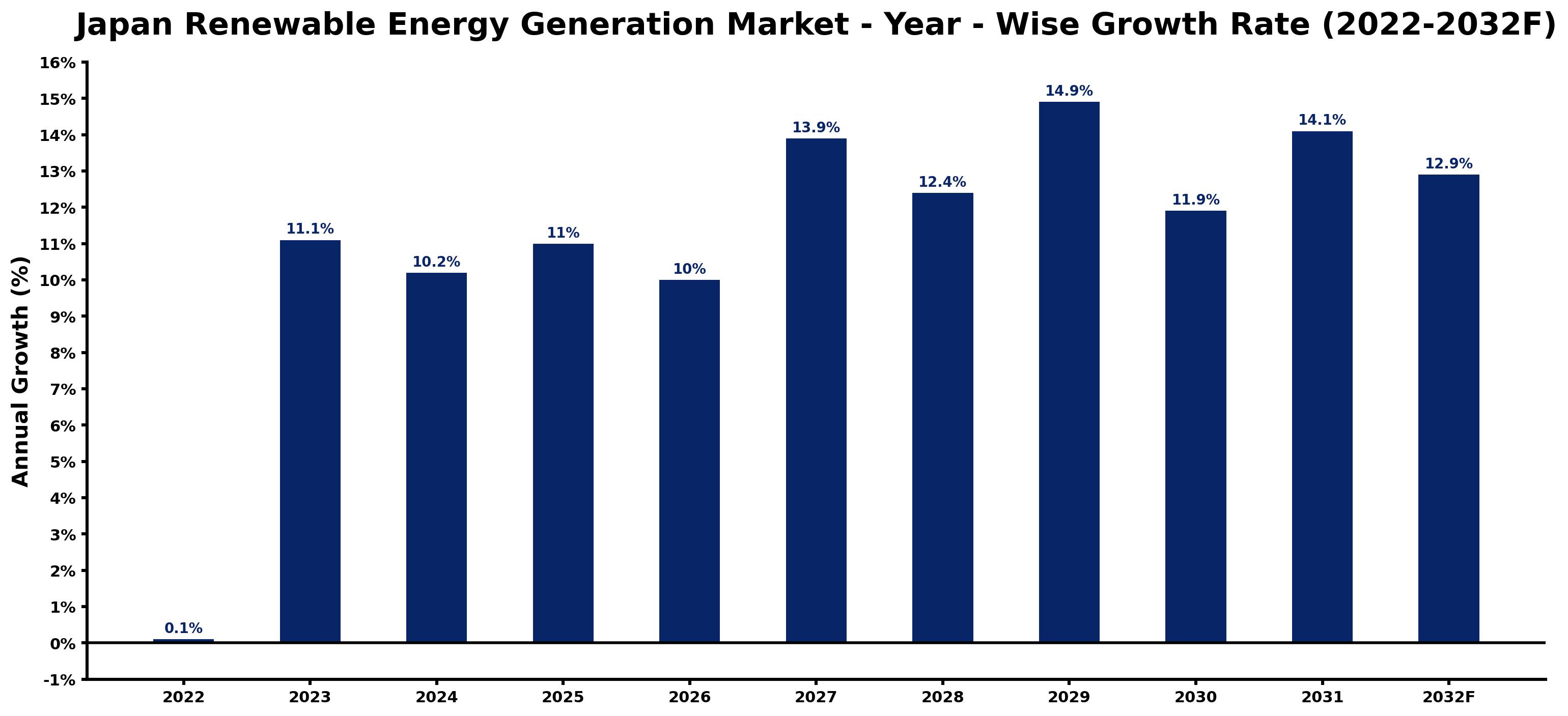
Year by year, the estimates below pair each growth rate with the development that shaped it.
| Year | Estimated Annual Growth (%) | Market Rationale |
| 2022 | 0.1 | The market maintained steady activity with ongoing investments in renewable energy projects. |
| 2023 | 11.1 | Growth accelerated due to increased installations and government support for renewable energy. |
| 2024 | 10.2 | Growth slowed slightly as the market adjusted to previous rapid expansions. |
| 2025 | 11.0 | Demand rose again as more renewable energy projects were commissioned across the country. |
| 2026 | 10.0 | Growth is expected to moderate as the market stabilises after a period of rapid expansion. |
| 2027 | 13.9 | The market is projected to rebound with heightened interest in renewable energy technologies. |
| 2028 | 12.4 | Growth is anticipated to decelerate as the market begins to normalise after gains. |
| 2029 | 14.9 | A surge in demand is expected as new projects come online and investments increase. |
| 2030 | 11.9 | Growth will slow as the market adjusts to the previous year's rapid expansion. |
| 2031 | 14.1 | Demand is projected to increase again as renewable energy projects continue to expand. |
| 2032 | 12.9 | Growth is expected to moderate as the market stabilises following a period of development. |
Note: Market size estimations and growth projections presented in this report are based on 6Wresearch's proprietary forecasting methodology, utilizing the latest available industry data, government publications, and primary research inputs.
Japan Renewable Energy Generation Market Synopsis
Renewable Energy Generation in Japan harnesses natural resources such as sunlight, wind, water, and biomass, employing technologies like photovoltaic systems and wind turbines. The Japan Renewable Energy Generation Market is expanding due to substantial investments, with the government aiming for 36-38% of electricity from renewables by 2030. In 2023, the government allocated ¥1 trillion for renewable energy development, attracting solar energy providers and wind farm operators to expand operations, thereby increasing capacity and contributing to energy security.
Market Dynamics Impact Analysis (2026–2032)
| Factor | Type | Impact | Primary Segment Affected |
| Increased installations of solar and wind technologies | Driver | High | Solar |
| Government incentives for renewable energy projects | Driver | High | Wind |
| Rising demand for clean energy solutions | Opportunity | High | Hydro |
| Growing investments in renewable energy infrastructure | Opportunity | High | Bioenergy |
| High initial investment costs for renewable projects | Restraint | Medium | Solar |
| Limited grid capacity for integrating renewable sources | Restraint | Medium | Wind |
| Regulatory compliance costs for new projects | Challenge | High | Hydro |
| Competition from established fossil fuel sources | Challenge | Medium | Bioenergy |
Evaluation of Drivers in Japan Renewable Energy Generation Market (2026–2032)
Demand rests on the following drivers, each shown with the segment it touches most.
| Drivers | Primary Segment Affected | Why It Matters (Evidence) |
| Growing installations of photovoltaic systems | Solar | Japan's solar capacity reached over 100 GW in 2022, driving demand for solar solutions. |
| Expansion of offshore wind farms | Wind | Japan has over 1,000 operational wind farms as of 2023, increasing offshore capacity to meet demands. |
| Government funding for renewable energy projects | Hydro | The government allocated ¥1 trillion for renewable energy development in 2023, boosting hydroelectric projects. |
| Rising consumer preference for sustainable energy | Bioenergy | Local industries are increasingly adopting biomass energy, promoting sustainable practices in various sectors. |
| Increased energy demand from a growing population | Photovoltaic (PV) | Japan's population of approximately 125 million drives the need for more renewable solutions. |
Purchasing is picking up as Japan's renewable energy capacity reached 100 GW in 2022, with solar installations exceeding 2 million in 2023. Local industries are increasingly adopting biomass energy, while the population of 125 million fuels the need for sustainable solutions. With over 1,000 operational wind farms, the demand for wind energy continues to rise, further driving investments in infrastructure.
Evaluation of Restraints in Japan Renewable Energy Generation Market
These restraints slow adoption and weigh on supplier margins.
| Market Restraint | Primary Segment Affected | Why It Matters (Evidence) |
| High initial capital investment for renewable energy projects | Solar | The cost of setting up solar installations can deter smaller investors, limiting market growth. |
| Limited grid capacity for integrating renewable energy sources | Wind | Existing grid infrastructure struggles to accommodate the increasing volume of renewable energy, hindering project implementation. |
| Regulatory compliance costs for new renewable projects | Hydro | The need to meet stringent regulations increases project costs, discouraging new investments. |
| Competition from established fossil fuel sources | Bioenergy | Fossil fuels remain cheaper in many cases, making it challenging for bioenergy to compete effectively in the market. |
| Market volatility due to fluctuating energy prices | Photovoltaic (PV) | Price fluctuations can impact investment decisions in solar energy projects, causing uncertainty for developers. |
Japan Renewable Energy Generation Market Challenges
Producers struggle with high costs due to Japan's target of JPY 150 trillion in decarbonisation investments over the next decade, which limits their ability to launch new projects. Importers face intense competition as local initiatives receive government backing, making it difficult to maintain profit margins and secure market presence. Buyers encounter skills shortages; despite over 200,000 jobs in the sector, the lack of trained personnel delays project timelines and increases costs. Technology adoption remains slow; while Japan's renewable capacity reached 100 GW in 2022, outdated systems hinder efficiency and raise operational expenses for producers.
Trends in the Japan Renewable Energy Generation Market
Four trends stand out in the Japan Renewable Energy Generation Market.
- Shift from Traditional to Renewable Energy Providers: Solar energy providers are increasingly dominating the market, with over 2 million installations reported in 2023, reflecting a shift towards renewable sources.
- Transition from Fossil Fuels to Wind Energy: Japan's wind energy sector is expanding rapidly, with over 1,200 operational wind farms as of 2023, showcasing a transition towards more sustainable energy solutions.
- Emergence of Biomass Energy as a Viable Option: The Biomass Utilization Promotion Law aims for 20% of energy from biomass by 2030, indicating a growing interest in diverse renewable sources.
- Prioritisation of Utility-Scale Renewable Projects: Utility-scale renewable projects are gaining traction, with a projected CAGR of 17.2% from 2026 to 2032, reflecting a shift in focus towards large-scale generation.
Investment Opportunities in the Japan Renewable Energy Generation Market
Where to invest in the Japan Renewable Energy Generation Market: the main openings are set out below.
- Solar Energy Providers Expanding Capacity: Solar energy providers are looking to expand their operations, with over 2 million installations in 2023, indicating strong demand for solar technology.
- Investment in Offshore Wind Farms: Investment in offshore wind farms is critical, particularly in regions like Hokkaido, where wind resources are abundant, targeting a capacity increase of 10 GW by 2030.
- Biomass Energy Utilisation in Local Industries: Local industries are encouraged to adopt biomass energy, with a target of 20% of energy from biomass by 2030, presenting an opportunity for suppliers.
- Development of Hydro Projects in Rural Areas: Rural areas are focusing on developing hydro projects, with a total installed hydro capacity of approximately 50 GW, creating opportunities for investment.
Government Initiatives in the Japan Renewable Energy Generation Market
The GX Promotion Act (2023) establishes a legal framework for Japan's green transformation, building on previous measures like the Green Growth Strategy (2020). This act aims to streamline regulatory processes and support renewable energy projects, facilitating investment and development in the sector. The act is expected to improve the efficiency of project approvals, encouraging more investments in renewable generation.
The Ministry of Economy, Trade and Industry oversees the implementation of the GX Promotion Act, ensuring that renewable energy projects receive necessary approvals and funding. The agency actively supports initiatives aimed at achieving Japan's decarbonisation targets, including public-private partnerships that strengthen renewable energy infrastructure and promote sustainable practices.
Future Insight of the Japan Renewable Energy Generation Market
Advancements in photovoltaic technology will transform demand for solar energy solutions, leading to more efficient electricity generation. By 2032, the Renewable Energy Standard will enhance project quality and reliability, benefiting both suppliers and buyers. The government's aim for 20% of energy from biomass by 2030 will open new avenues for energy producers. With a projected increase of 15% in renewable generation by 2025, buyers will enjoy a wider selection of sustainable energy sources, enhancing energy security and decreasing reliance on fossil fuels.
Market Segmentation Analysis
Japan Renewable Energy Generation Market report covers a detailed analysis of the following market segments:
By Source Type – Solar Leads, Wind Expected to Grow Fastest
According to Saurav Kr Singh, Senior Research Analyst at 6Wresearch, in 2025, Solar led the source type split with a 41% share. Solar holds the largest share because it is extensively utilised for residential and commercial electricity generation, with over 2 million solar installations reported in 2023. The Feed-in Tariff scheme has effectively incentivised solar projects, creating a robust market presence. Wind is set to record the highest CAGR in this split, 14.1% over 2026–2032. Wind is experiencing rapid growth, driven by substantial installations of both onshore and offshore wind farms, with backing from the Japan Wind Power Association. This segment's expansion is likely to continue as the government aims for a larger share of renewables by 2030. Suppliers should focus on enhancing their wind energy offerings to capitalise on this growth opportunity.
By Generation Technology – Photovoltaic (PV) Leads, Onshore/Offshore Expected to Grow Fastest
The largest generation technology category in 2025 was Photovoltaic (PV), at 43% of revenue. Photovoltaic (PV) technology is the leading method for solar energy generation, reflecting its established infrastructure and consumer acceptance. The total installed capacity of solar energy in Japan reached 100 GW in 2022, highlighting its critical role in the energy mix. Onshore/Offshore is projected to grow fastest, at a CAGR of 14.6% during 2026–2032. Onshore and offshore technologies are advancing rapidly, driven by increased investments and government support for large-scale projects. The focus on utility-scale developments is likely to improve the overall capacity and reliability of renewable energy generation. Buyers should invest in onshore and offshore technologies to align with market trends and government targets.
By Scale – Residential to Utility Leads, Utility-Scale Expected to Grow Fastest
Residential to Utility held 42% of the Japan Renewable Energy Generation Market by scale in 2025. The Residential to Utility scale segment commands the largest share as it encompasses all levels of energy generation, from small residential systems to extensive utility projects. This wide applicability attracts a diverse range of buyers, facilitating broad adoption across various sectors. The quickest growth will come from Utility-Scale, forecast to expand at a CAGR of 17.2% between 2026 and 2032. Utility-Scale projects are rapidly expanding, making significant contributions to the energy grid and meeting the increasing demand for renewable sources. The government's commitment to large-scale investments will further bolster this segment's growth. Suppliers must prioritise utility-scale solutions to align with rising energy demands and government targets.
By End User – Solar Energy Providers Lead, Wind Farm Operators Expected to Grow Fastest
Solar Energy Providers accounted for 41% of the market by end user in 2025. Solar Energy Providers lead the market, being key players in the solar energy sector and responsible for the majority of installations. Their established networks and expertise enable them to effectively respond to the growing demand for renewable energy. Over 2026–2032, Wind Farm Operators are expected to post the fastest growth, at a CAGR of 17.7%. Wind Farm Operators are experiencing accelerated growth as the number of operational wind farms increases, driven by supportive policies and investments in wind energy. This trend is expected to persist as the government promotes a higher share of renewables. Buyers should engage with wind farm operators to explore collaborative opportunities in the expanding wind energy sector.
Key Attractiveness of the Report
- 10 Years of Market Numbers
- Historical Data Starting from 2022 to 2025
- Base Year 2025
- Forecast Data until 2032
- Key Performance Indicators Impacting the Market
- Major Upcoming Developments and Projects
Key Highlights of the Report:
- Japan Renewable Energy Generation Market Outlook
- Market Size of Japan Renewable Energy Generation Market, 2025
- Forecast of Japan Renewable Energy Generation Market, 2032
- Historical Data and Forecast of Japan Renewable Energy Generation Revenues & Volume for the Period 2022-2032F
- Japan Renewable Energy Generation Market Trend Evolution
- Japan Renewable Energy Generation Market Drivers and Challenges
- Japan Renewable Energy Generation Price Trends
- Japan Renewable Energy Generation Porter's Five Forces
- Japan Renewable Energy Generation Industry Life Cycle
- Historical Data and Forecast of Japan Renewable Energy Generation Market Revenues & Volume By Source Type for the Period 2022-2032F
- Historical Data and Forecast of Japan Renewable Energy Generation Market Revenues & Volume By Solar for the Period 2022-2032F
- Historical Data and Forecast of Japan Renewable Energy Generation Market Revenues & Volume By Wind for the Period 2022-2032F
- Historical Data and Forecast of Japan Renewable Energy Generation Market Revenues & Volume By Hydro for the Period 2022-2032F
- Historical Data and Forecast of Japan Renewable Energy Generation Market Revenues & Volume By Bioenergy for the Period 2022-2032F
- Historical Data and Forecast of Japan Renewable Energy Generation Market Revenues & Volume By Generation Technology for the Period 2022-2032F
- Historical Data and Forecast of Japan Renewable Energy Generation Market Revenues & Volume By Photovoltaic (PV) for the Period 2022-2032F
- Historical Data and Forecast of Japan Renewable Energy Generation Market Revenues & Volume By Onshore/Offshore for the Period 2022-2032F
- Historical Data and Forecast of Japan Renewable Energy Generation Market Revenues & Volume By Micro/Run-of-River for the Period 2022-2032F
- Historical Data and Forecast of Japan Renewable Energy Generation Market Revenues & Volume By CHP/Biomass for the Period 2022-2032F
- Historical Data and Forecast of Japan Renewable Energy Generation Market Revenues & Volume By Scale for the Period 2022-2032F
- Historical Data and Forecast of Japan Renewable Energy Generation Market Revenues & Volume By Residential to Utility for the Period 2022-2032F
- Historical Data and Forecast of Japan Renewable Energy Generation Market Revenues & Volume By Utility-Scale for the Period 2022-2032F
- Historical Data and Forecast of Japan Renewable Energy Generation Market Revenues & Volume By Community/Industrial for the Period 2022-2032F
- Historical Data and Forecast of Japan Renewable Energy Generation Market Revenues & Volume By Industrial for the Period 2022-2032F
- Historical Data and Forecast of Japan Renewable Energy Generation Market Revenues & Volume By End User for the Period 2022-2032F
- Historical Data and Forecast of Japan Renewable Energy Generation Market Revenues & Volume By Solar Energy Providers for the Period 2022-2032F
- Historical Data and Forecast of Japan Renewable Energy Generation Market Revenues & Volume By Wind Farm Operators for the Period 2022-2032F
- Historical Data and Forecast of Japan Renewable Energy Generation Market Revenues & Volume By Small Hydro Operators for the Period 2022-2032F
- Historical Data and Forecast of Japan Renewable Energy Generation Market Revenues & Volume By Renewable Utilities for the Period 2022-2032F
- Japan Renewable Energy Generation Import Export Trade Statistics
- Market Opportunity Assessment By Source Type
- Market Opportunity Assessment By Generation Technology
- Market Opportunity Assessment By Scale
- Market Opportunity Assessment By End User
- Japan Renewable Energy Generation Top Companies Market Share
- Japan Renewable Energy Generation Competitive Benchmarking By Technical and Operational Parameters
- Japan Renewable Energy Generation Company Profiles
- Japan Renewable Energy Generation Key Strategic Recommendations
Market Covered
The study includes the following segmentation.
By Source Type
- Solar
- Wind
- Hydro
- Bioenergy
By Generation Technology
- Photovoltaic (PV)
- Onshore/Offshore
- Micro/Run-of-River
- CHP/Biomass
By Scale
- Residential to Utility
- Utility-Scale
- Community/Industrial
- Industrial
By End User
- Solar Energy Providers
- Wind Farm Operators
- Small Hydro Operators
- Renewable Utilities































