Japan Renewable Energy Technologies Market Size & Growth Rate
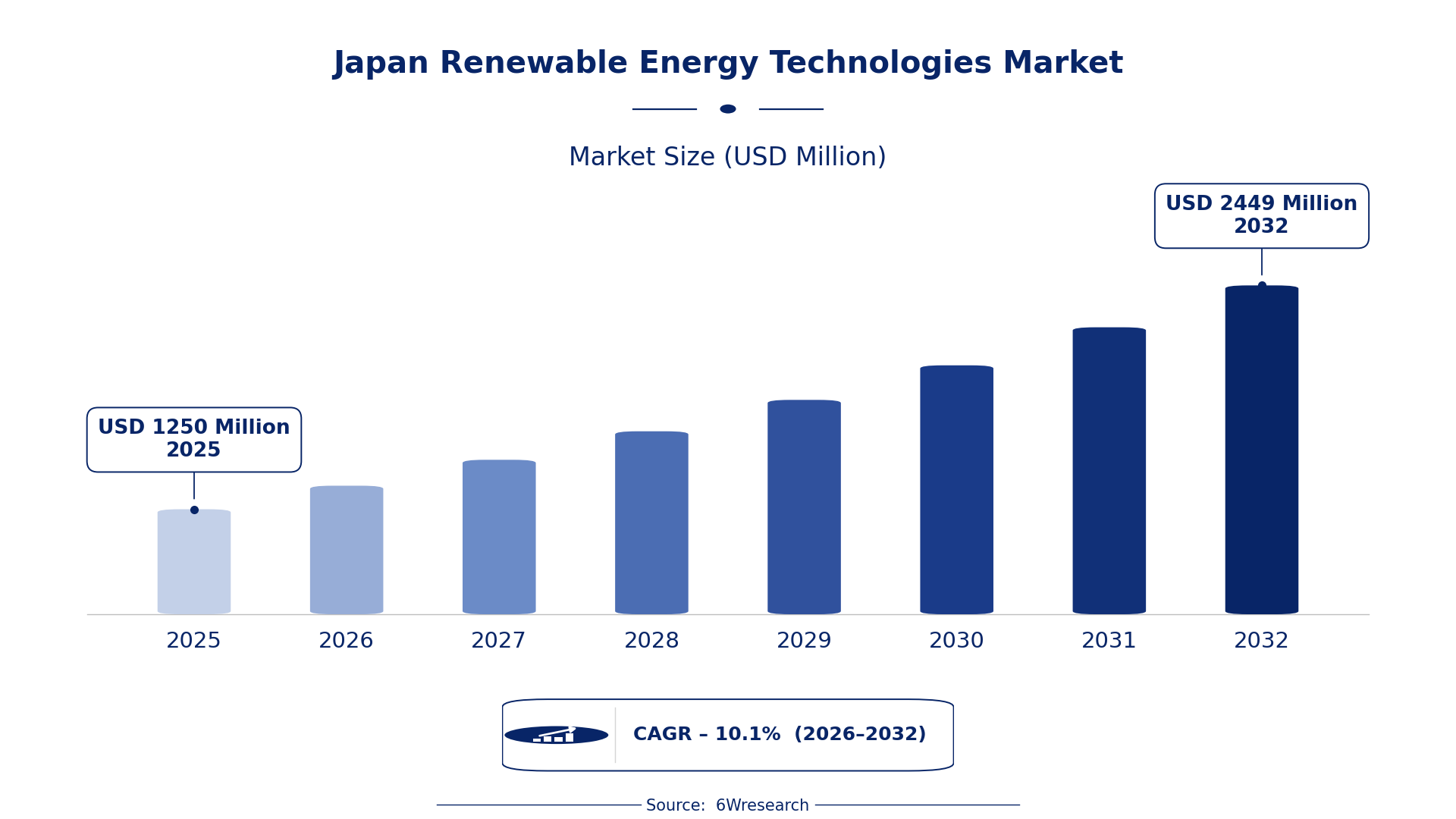
According to 6Wresearch internal database and industry insights, the Japan Renewable Energy Technologies Market was valued at USD 1,250 Million in 2025 and is projected to reach USD 2,449 Million by 2032, growing at a CAGR of approximately 10.1% during 2026–2032.
Japan Renewable Energy Technologies Market Highlights
| Report Metric | Details |
| Report Name | Japan Renewable Energy Technologies Market (2026-2032) |
| Market Size 2025 | USD 1,250 Million |
| Market Size 2032 | USD 2,449 Million |
| Absolute Growth 2025–2032 | USD 1,199 Million |
| CAGR 2026–2032 | 10.1% |
| Peak Annual Growth | 11.0% in 2028 |
| Forecast Period | 2026–2032 |
| Historical Data | 2022–2025 |
| Base Year | 2025 |
| Leading Technology Segment, 2025 | PV Systems (40% share) |
| Leading Energy Source, 2025 | Solar (47% share) |
| Leading Integration Mode, 2025 | Rooftop & Utility (46% share) |
| Leading End User, 2025 | EPC Contractors (40% share) |
| Fastest-Growing Technology Segment | Wind Turbine Tech (15.3% CAGR) |
| Fastest-Growing Energy Source | Wind (15.6% CAGR) |
| Fastest-Growing Integration Mode | Onshore & Offshore (13.9% CAGR) |
| Fastest-Growing End User | Wind Farm Operators (13.5% CAGR) |
| Growing Sector | Renewable energy generation |
| Key End Users | EPC Contractors, Wind Farm Operators, Green H2 Developers |
Japan Renewable Energy Technologies Market Year-wise Growth Rate and Key Drivers (2022–2032)
This graph illustrates the annual growth rates of the market from 2022 to 2032, highlighting a steady upward trajectory and projected market expansion over the forecast period.
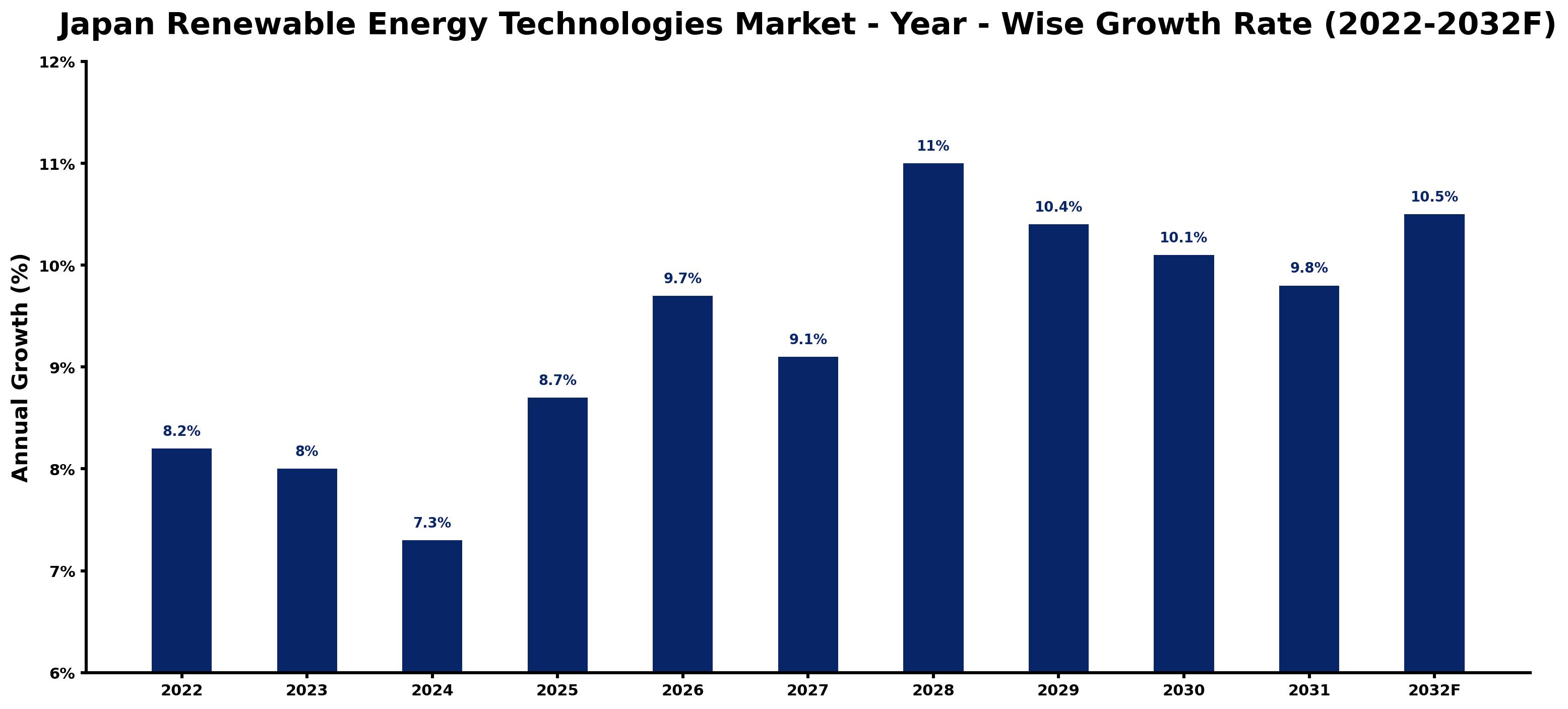
The following figures match every annual growth estimate with the main market development of that year, giving the reasoning behind each rise or slowdown.
| Year | Estimated Annual Growth (%) | Market Rationale |
| 2022 | 8.2 | The market showed solid growth, driven by increased investments in renewable energy projects. |
| 2023 | 8.0 | Growth slowed slightly due to market adjustments and project delays in renewable installations. |
| 2024 | 7.3 | The market continued to grow, albeit at a slower pace, as new projects were initiated. |
| 2025 | 8.7 | A surge in solar energy projects led to faster growth compared to the previous year. |
| 2026 | 9.7 | Investment in wind energy technologies is expected to accelerate, contributing to increased market growth. |
| 2027 | 9.1 | Growth is projected to slow as competition intensifies among renewable energy providers. |
| 2028 | 11.0 | The market is expected to peak with strong demand for renewable technologies, particularly in hydrogen. |
| 2029 | 10.4 | Market growth is anticipated to slow as supply chain issues impact project timelines. |
| 2030 | 10.1 | Growth will continue to slow, but demand for renewable energy remains strong. |
| 2031 | 9.8 | The market is projected to experience a slowdown as investment patterns begin to stabilise. |
| 2032 | 10.5 | Growth is expected to accelerate again, driven by new hydrogen initiatives and public investments. |
Note: Market size estimations and growth projections presented in this report are based on 6Wresearch's proprietary forecasting methodology, utilizing the latest available industry data, government publications, and primary research inputs.
Japan Renewable Energy Technologies Market Synopsis
Renewable Energy Technologies encompass various systems for generating energy from sources such as solar, wind, and hydrogen. These technologies are essential for electricity generation, heating, and transportation fuel. The Japan Renewable Energy Technologies Market is expanding due to government initiatives aimed at reducing carbon emissions and increasing renewable energy adoption. The target of 36-38% of electricity from renewables by 2030 and a JPY 150 trillion investment over ten years are key drivers of this growth, alongside rising domestic energy demand.
Market Dynamics Impact Analysis (2026–2032)
| Factor | Type | Impact | Primary Segment Affected |
| Government initiatives to support renewable energy adoption | Driver | High | PV Systems |
| Increased investment in hydrogen technologies | Driver | High | Hydrogen Generation |
| Growing demand for sustainable energy solutions | Opportunity | High | Wind Turbine Tech |
| Potential for biomass energy utilization in agriculture | Opportunity | Medium | Bioenergy Systems |
| High initial costs of renewable energy installations | Restraint | High | PV Systems |
| Limited availability of skilled workforce for renewable projects | Restraint | Medium | Wind Turbine Tech |
| Regulatory compliance costs for energy efficiency | Challenge | High | Hydrogen Generation |
| Capacity limitations in existing infrastructure | Challenge | Medium | Bioenergy Systems |
Evaluation of Drivers in Japan Renewable Energy Technologies Market (2026–2032)
Key forces behind demand, with the segment each one moves most, are listed below.
| Drivers | Primary Segment Affected | Why It Matters (Evidence) |
| Government support for solar energy through the Feed-in Tariff program | PV Systems | This initiative has led to Japan's installed solar power capacity reaching 75 GW in 2022. |
| Investment in hydrogen infrastructure under the Hydrogen Roadmap | Hydrogen Generation | The target of 3 million hydrogen vehicles by 2030 drives demand for hydrogen technologies. |
| Rising electricity prices prompting businesses to seek renewable solutions | Wind Turbine Tech | As wind energy contributed about 10% of total electricity generation in 2022, demand for wind technologies is increasing. |
| Growing awareness of climate change among consumers and businesses | Bioenergy Systems | This awareness is pushing industries to adopt biomass energy solutions, utilising Japan's estimated 30 million tons of biomass potential annually. |
| Technological advancements in renewable energy systems | Rooftop & Utility | These advancements are making solar installations more efficient and cost-effective, increasing adoption rates. |
The target of 3 million hydrogen vehicles by 2030 drives demand for hydrogen generation technologies. Increasing electricity prices prompt businesses to seek renewable solutions, particularly in wind energy, which has made a notable contribution to total electricity generation. Growing awareness of climate change is pushing industries to adopt bioenergy solutions, utilising Japan's biomass potential annually. Technological advancements are making renewable systems more efficient, further boosting adoption rates.
Evaluation of Restraints in Japan Renewable Energy Technologies Market
These restraints slow adoption and weigh on supplier margins.
| Market Restraint | Primary Segment Affected | Why It Matters (Evidence) |
| High initial costs of solar energy installations | PV Systems | The upfront investment required can deter potential buyers, limiting market growth. |
| Limited availability of skilled workforce for wind energy projects | Wind Turbine Tech | The shortage of trained professionals affects project execution and operational efficiency. |
| Regulatory compliance costs for hydrogen production | Hydrogen Generation | Meeting compliance can increase operational costs for producers, affecting profitability. |
| Infrastructure limitations for biomass energy utilization | Bioenergy Systems | Insufficient infrastructure can hinder the effective deployment of biomass energy solutions. |
| Market competition leading to price wars | Rooftop & Utility | Intense competition can compress margins, impacting the financial viability of projects. |
Japan Renewable Energy Technologies Market Challenges
In Tokyo, renewable energy projects face intense competition for investment, which restricts funding for new technologies and delays project launches for developers. Many producers encounter challenges with outdated systems, as high integration costs hinder the adoption of advanced solutions, leading to inefficiencies that can reduce output by 15%. Buyers experience rising energy prices due to increased demand and limited supply, inflating costs by 20% for commercial users. Skills shortages are prevalent, with over 50% of companies struggling to find qualified technicians, which delays project timelines for contractors.
Trends in the Japan Renewable Energy Technologies Market
Several trends are reshaping the Japan Renewable Energy Technologies Market; the most important are set out below.
- Shift towards Hydrogen Fuel Adoption: Japan is increasingly focusing on hydrogen as a clean energy source, targeting 3 million hydrogen vehicles by 2030, highlighting the shift towards sustainable transportation solutions.
- Transition from Traditional to Renewable Energy Sources: The Green Growth Strategy aims to boost renewable energy production, targeting 36-38% of electricity from renewables by 2030, reflecting a shift in energy policy.
- Emergence of Offshore Wind Technologies: With over 300 operational wind farms, Japan is prioritising offshore wind technologies, which are expected to grow significantly, contributing to the overall energy mix.
- Increased Integration of Biomass in Energy Production: The Ministry of the Environment promotes biomass energy utilization, tapping into Japan's estimated biomass potential of 30 million tons annually, enhancing energy diversification.
Investment Opportunities in the Japan Renewable Energy Technologies Market
Below are the investment opportunities with the strongest case in the Japan Renewable Energy Technologies Market.
- Market gap in solar energy storage solutions: With increasing solar capacity, there is an opportunity for energy storage solutions to manage supply, particularly in regions like Tokyo, where demand is high.
- Investment in wind energy infrastructure: As wind energy contributes 10% of total electricity generation, investing in new wind farms presents an opportunity for developers in coastal regions.
- Supply of advanced hydrogen production technologies: The focus on hydrogen vehicles creates a demand for advanced hydrogen production technologies, particularly in industrial hubs like Aichi Prefecture.
- Expansion of biomass energy projects: With a biomass potential of 30 million tons annually, investing in biomass energy projects can meet rising energy demands, especially in agricultural sectors.
Government Initiatives in the Japan Renewable Energy Technologies Market
The Hydrogen Society Promotion Act, enacted in 2024, supports low-carbon hydrogen supply chains, providing price-gap support to producers. This measure encourages investment in hydrogen technologies, benefiting buyers seeking cleaner energy sources.
In 2023, the government allocated ¥2 trillion for renewable energy investments, administered by the Ministry of Economy, Trade and Industry (METI). This funding supports various renewable projects, improving the overall capacity and efficiency of the energy sector.
Future Insight of the Japan Renewable Energy Technologies Market
By 2032, buyers will benefit from advancements in renewable technologies as the government supports smart grids and energy storage systems. A planned investment of JPY 150 trillion will stimulate innovation, enabling access to more efficient solutions. The automotive sector will transform with a target of 3 million hydrogen vehicles, promoting a robust hydrogen infrastructure. As biomass energy utilization increases, suppliers will tap into an estimated potential of 30 million tons annually, creating new opportunities in the renewable sector.
Market Segmentation Analysis
Japan Renewable Energy Technologies Market report covers a detailed analysis of the following market segments:
By Technology Segment – PV Systems Lead, Wind Turbine Tech Expected to Grow Fastest
According to Saurav Kr Singh, Senior Research Analyst at 6Wresearch, in 2025, PV Systems led the technology segment split with a 40% share. PV Systems dominate the market due to their widespread adoption for solar energy generation, supported by government incentives like the Feed-in Tariff programme. With Japan's installed solar power capacity reaching 75 GW in 2022, this technology has a substantial installed base driving its leading share. Over 2026–2032, Wind Turbine Tech is expected to post the fastest growth, at a CAGR of 15.3%. Wind Turbine Tech is experiencing rapid growth as Japan increases its focus on diversifying energy sources, with wind energy contributing about 10% of total electricity generation in 2022. This shift towards wind technology is expected to continue, further widening the gap with other technologies. Suppliers should prioritise investments in wind technology to capitalise on its growth potential.
By Energy Source – Solar Leads, Wind Expected to Grow Fastest
The largest energy source category in 2025 was Solar, at 47% of revenue. Solar holds the largest share in Japan's renewable energy market due to its substantial contribution to the government's target of 36-38% electricity generation from renewables by 2030. The installed solar power capacity of 75 GW further underscores its dominance and widespread adoption across various sectors. Wind is set to record the highest CAGR in this split, 15.6% over 2026–2032. Wind is experiencing rapid growth, supported by Japan's commitment to decarbonisation and the establishment of over 300 operational wind farms as of 2023. This expansion indicates a strategic shift towards wind energy, which will likely increase its market presence over time. Suppliers should focus on developing solutions that cater to the increasing demand for wind energy technologies.
By Integration Mode – Rooftop & Utility Leads, Onshore & Offshore Expected to Grow Fastest
Rooftop & Utility held 46% of the Japan Renewable Energy Technologies Market by integration mode in 2025. Rooftop & Utility integration modes are prevalent in Japan, particularly for solar energy, as they facilitate deployment in both urban and rural environments. This approach aligns with national policies aimed at promoting renewable energy across diverse facilities. The quickest growth will come from Onshore & Offshore, forecast to expand at a CAGR of 13.9% between 2026 and 2032. Onshore & Offshore integration modes are gaining momentum as Japan enhances its wind energy capacity, supported by government initiatives for both types of installations. This trend reflects a strategic focus on utilising coastal and land resources for energy generation. Suppliers need to innovate their offerings to address the growing demand for onshore and offshore integration solutions.
By End User – EPC Contractors Lead, Wind Farm Operators Expected to Grow Fastest
EPC Contractors took 40% of end user revenue in 2025, more than any other category. EPC Contractors are essential in executing renewable energy projects, making them significant players in the market. Their involvement in large-scale installations, including solar and wind farms, reinforces their leading position among end users. Wind Farm Operators are projected to grow fastest, at a CAGR of 13.5% during 2026–2032. Wind Farm Operators are increasingly important as demand for wind energy escalates, with government targets indicating substantial growth in renewable energy capacity. This trend positions these operators for significant expansion in the coming years. Buyers should collaborate with EPC Contractors to ensure effective project execution in the rapidly changing energy sector.
Key Attractiveness of the Report
- 10 Years of Market Numbers
- Historical Data Starting from 2022 to 2025
- Base Year 2025
- Forecast Data until 2032
- Key Performance Indicators Impacting the Market
- Major Upcoming Developments and Projects
Key Highlights of the Report:
- Japan Renewable Energy Technologies Market Outlook
- Market Size of Japan Renewable Energy Technologies Market, 2025
- Forecast of Japan Renewable Energy Technologies Market, 2032
- Historical Data and Forecast of Japan Renewable Energy Technologies Revenues & Volume for the Period 2022-2032F
- Japan Renewable Energy Technologies Market Trend Evolution
- Japan Renewable Energy Technologies Market Drivers and Challenges
- Japan Renewable Energy Technologies Price Trends
- Japan Renewable Energy Technologies Porter's Five Forces
- Japan Renewable Energy Technologies Industry Life Cycle
- Historical Data and Forecast of Japan Renewable Energy Technologies Market Revenues & Volume By Technology Segment for the Period 2022-2032F
- Historical Data and Forecast of Japan Renewable Energy Technologies Market Revenues & Volume By PV Systems for the Period 2022-2032F
- Historical Data and Forecast of Japan Renewable Energy Technologies Market Revenues & Volume By Wind Turbine Tech for the Period 2022-2032F
- Historical Data and Forecast of Japan Renewable Energy Technologies Market Revenues & Volume By Bioenergy Systems for the Period 2022-2032F
- Historical Data and Forecast of Japan Renewable Energy Technologies Market Revenues & Volume By Hydrogen Generation for the Period 2022-2032F
- Historical Data and Forecast of Japan Renewable Energy Technologies Market Revenues & Volume By Energy Source for the Period 2022-2032F
- Historical Data and Forecast of Japan Renewable Energy Technologies Market Revenues & Volume By Solar for the Period 2022-2032F
- Historical Data and Forecast of Japan Renewable Energy Technologies Market Revenues & Volume By Wind for the Period 2022-2032F
- Historical Data and Forecast of Japan Renewable Energy Technologies Market Revenues & Volume By Biomass/Biogas for the Period 2022-2032F
- Historical Data and Forecast of Japan Renewable Energy Technologies Market Revenues & Volume By Renewable Hydrogen for the Period 2022-2032F
- Historical Data and Forecast of Japan Renewable Energy Technologies Market Revenues & Volume By Integration Mode for the Period 2022-2032F
- Historical Data and Forecast of Japan Renewable Energy Technologies Market Revenues & Volume By Rooftop & Utility for the Period 2022-2032F
- Historical Data and Forecast of Japan Renewable Energy Technologies Market Revenues & Volume By Onshore & Offshore for the Period 2022-2032F
- Historical Data and Forecast of Japan Renewable Energy Technologies Market Revenues & Volume By Cogeneration for the Period 2022-2032F
- Historical Data and Forecast of Japan Renewable Energy Technologies Market Revenues & Volume By Electrolysis for the Period 2022-2032F
- Historical Data and Forecast of Japan Renewable Energy Technologies Market Revenues & Volume By End User for the Period 2022-2032F
- Historical Data and Forecast of Japan Renewable Energy Technologies Market Revenues & Volume By EPC Contractors for the Period 2022-2032F
- Historical Data and Forecast of Japan Renewable Energy Technologies Market Revenues & Volume By Wind Farm Operators for the Period 2022-2032F
- Historical Data and Forecast of Japan Renewable Energy Technologies Market Revenues & Volume By Agro-Industrial Enterprises for the Period 2022-2032F
- Historical Data and Forecast of Japan Renewable Energy Technologies Market Revenues & Volume By Green H2 Developers for the Period 2022-2032F
- Japan Renewable Energy Technologies Import Export Trade Statistics
- Market Opportunity Assessment By Technology Segment
- Market Opportunity Assessment By Energy Source
- Market Opportunity Assessment By Integration Mode
- Market Opportunity Assessment By End User
- Japan Renewable Energy Technologies Top Companies Market Share
- Japan Renewable Energy Technologies Competitive Benchmarking By Technical and Operational Parameters
- Japan Renewable Energy Technologies Company Profiles
- Japan Renewable Energy Technologies Key Strategic Recommendations
Market Covered
Coverage by segment is as follows.
By Technology Segment
- PV Systems
- Wind Turbine Tech
- Bioenergy Systems
- Hydrogen Generation
By Energy Source
- Solar
- Wind
- Biomass/Biogas
- Renewable Hydrogen
By Integration Mode
- Rooftop & Utility
- Onshore & Offshore
- Cogeneration
- Electrolysis
By End User
- EPC Contractors
- Wind Farm Operators
- Agro-Industrial Enterprises
- Green H2 Developers































