Japan Renewable Heat Generation Market Size & Growth Rate
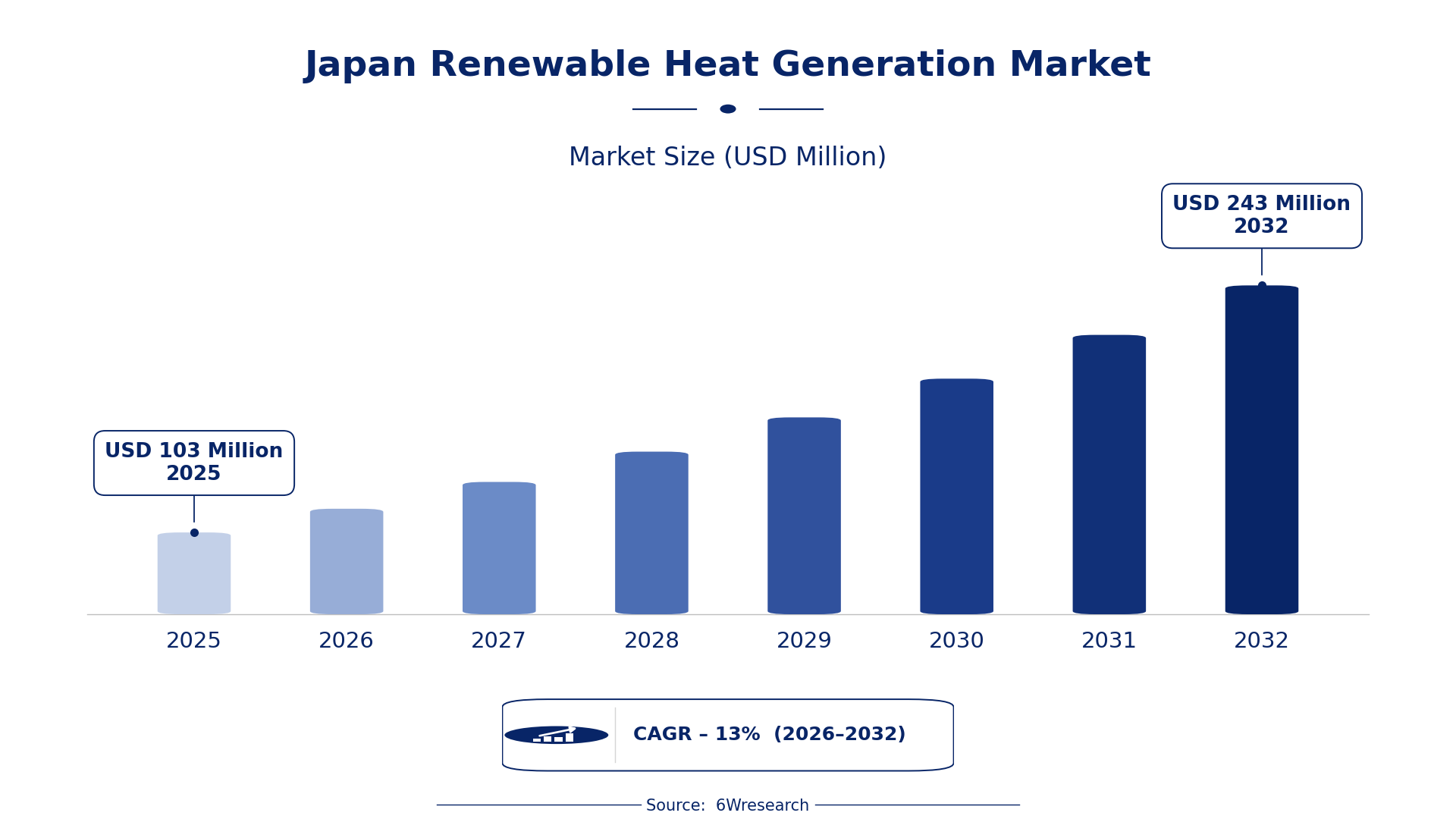
According to 6Wresearch internal database and industry insights, the Japan Renewable Heat Generation Market was valued at USD 103 Million in 2025 and is projected to reach USD 243 Million by 2032, growing at a CAGR of approximately 13% during 2026–2032.
Japan Renewable Heat Generation Market Highlights
| Report Metric | Details |
| Report Name | Japan Renewable Heat Generation Market (2026-2032) |
| Market Size 2025 | USD 103 Million |
| Market Size 2032 | USD 243 Million |
| Absolute Growth 2025–2032 | USD 140 Million |
| CAGR 2026–2032 | 13% |
| Peak Annual Growth | 14.1% in 2032 |
| Forecast Period | 2026–2032 |
| Historical Data | 2022–2025 |
| Base Year | 2025 |
| Leading Heat Source Type, 2025 | Biomass Boilers (42% share) |
| Leading Technology Type, 2025 | Pellet/Chips/Fuelwood (49% share) |
| Leading Application Sector, 2025 | Residential (31% share) |
| Leading End User, 2025 | Municipal District Heating (43% share) |
| Fastest-Growing Heat Source Type | Solar Thermal Panels (18.8% CAGR) |
| Fastest-Growing Technology Type | Flat Plate/ETC (19.1% CAGR) |
| Fastest-Growing Application Sector | Industrial (17.1% CAGR) |
| Fastest-Growing End User | Residential Builders (17.3% CAGR) |
| Growing Sector | Residential heating |
| Key End Users | Residential Builders, Municipal District Heating, Farms & Food Processors, Agricultural Sector |
Japan Renewable Heat Generation Market Year-wise Growth Rate and Key Drivers (2022–2032)
This graph illustrates the annual growth rates of the market from 2022 to 2032, highlighting a steady upward trajectory and projected market expansion over the forecast period.
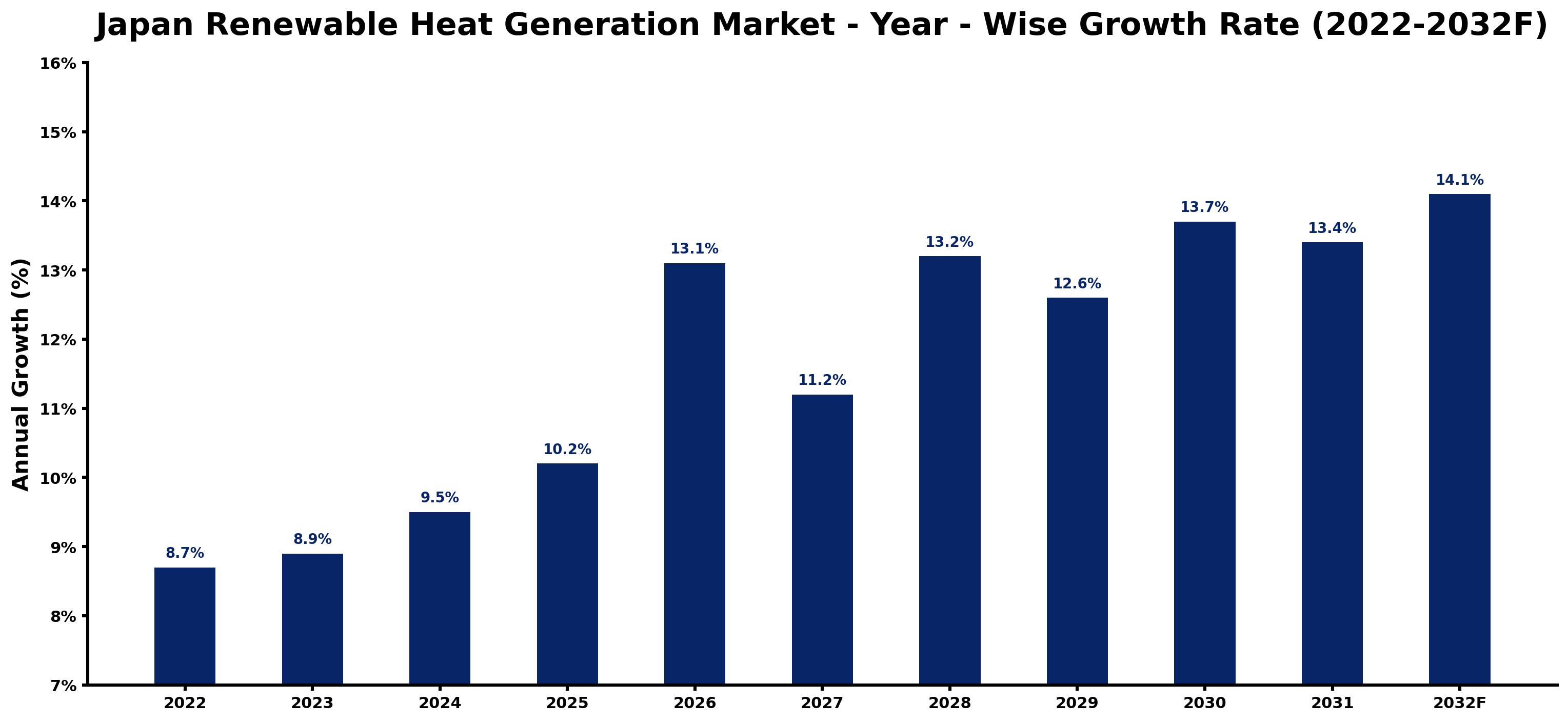
For each year, the table pairs the estimated growth rate with the leading influence on demand, showing how the drivers changed across the period.
| Year | Estimated Annual Growth (%) | Market Rationale |
| 2022 | 8.7 | The market was characterised by steady growth as renewable heat technologies gained traction. |
| 2023 | 8.9 | Demand for renewable heat solutions increased due to rising energy needs in urban areas. |
| 2024 | 9.5 | The introduction of new subsidies for renewable heat systems spurred further growth. |
| 2025 | 10.2 | The market experienced a peak as residential adoption of renewable heating solutions surged. |
| 2026 | 13.1 | Investment in renewable heat technologies is expected to accelerate, driven by government initiatives and private sector interest. |
| 2027 | 11.2 | Growth is projected to slow slightly as the market adjusts to increased capacity and competition. |
| 2028 | 13.2 | Renewable heat technologies are expected to gain popularity in industrial applications, boosting demand. |
| 2029 | 12.6 | Market growth is anticipated to slow as the sector matures and competition intensifies. |
| 2030 | 13.7 | Government targets for renewable energy adoption will stimulate renewed interest in heat generation. |
| 2031 | 13.4 | A slight slowdown is expected as the market stabilises after rapid growth in previous years. |
| 2032 | 14.1 | The market is projected to peak as new technologies and applications emerge. |
Note: Market size estimations and growth projections presented in this report are based on 6Wresearch's proprietary forecasting methodology, utilizing the latest available industry data, government publications, and primary research inputs.
Japan Renewable Heat Generation Market Synopsis
Renewable heat generation encompasses technologies that harness energy from biomass, solar, and geothermal sources to provide heating solutions. These systems cater to various applications, including residential heating, industrial processes, and agricultural needs. The Japan Renewable Heat Generation Market is expanding, driven by increasing energy demands and government targets for 30% of heating to come from renewables by 2030. With investment in renewable heat technologies reaching ¥100 billion in 2022, the market is well positioned for growth as more buyers seek sustainable heating solutions.
Market Dynamics Impact Analysis (2026–2032)
| Factor | Type | Impact | Primary Segment Affected |
| Growing investment in renewable heat technologies | Driver | High | Biomass Boilers |
| Rising energy demands in urban areas | Driver | High | Residential |
| Increased adoption of renewable heating solutions in new buildings | Opportunity | High | Residential Builders |
| Expansion of biogas plants supporting agricultural heating | Opportunity | High | Farms & Food Processors |
| High initial investment costs for renewable heat systems | Restraint | Medium | Geothermal Heat Pumps |
| Limited awareness of renewable heating options among consumers | Restraint | Medium | Solar Thermal Panels |
| Competition from traditional heating sources remains strong | Challenge | High | Municipal District Heating |
| Technological advancements require continuous investment | Challenge | Medium | Pellet/Chips/Fuelwood |
Evaluation of Drivers in Japan Renewable Heat Generation Market (2026–2032)
The following drivers explain most of the expected growth.
| Drivers | Primary Segment Affected | Why It Matters (Evidence) |
| Government subsidies for biomass energy | Biomass Boilers | The Agricultural and Forestry Agency supports biomass initiatives, increasing demand for biomass boilers in rural areas, particularly in Hokkaido. |
| Rising energy costs | Solar Thermal Panels | As energy prices rise, households are increasingly adopting solar thermal panels for water heating, with over 200,000 installations nationwide. |
| Growing focus on sustainability in construction | Geothermal Heat Pumps | The push for sustainable building practices drives demand for geothermal heat pumps, particularly in urban areas with increasing energy needs. |
| Increased agricultural waste utilisation | Residential | With a population of approximately 125 million, urban areas are seeing increased demand for residential renewable heating solutions. |
| Expansion of biogas facilities | Biogas Heaters | Japan has over 1,000 operational biogas plants as of 2023, indicating a trend towards utilising agricultural waste for energy. |
Purchasing is picking up as the residential sector accounts for 40% of renewable heat usage in Japan, influenced by rising energy costs and incentives for sustainable practices. Investment in renewable heat technologies reached ¥100 billion in 2022, encouraging households to adopt solar thermal panels for water heating. Urbanisation further fuels demand for residential heating solutions, creating a favourable environment for renewable technologies and driving market growth.
Evaluation of Restraints in Japan Renewable Heat Generation Market
These are the pressures that could keep growth below its potential.
| Market Restraint | Primary Segment Affected | Why It Matters (Evidence) |
| High initial costs for renewable heat systems | Geothermal Heat Pumps | The installation of geothermal heat pumps often involves substantial upfront costs, with average investments reaching ¥1 million, deterring potential buyers. |
| Limited consumer awareness of renewable heating options | Solar Thermal Panels | Many consumers remain unaware of the benefits and availability of solar thermal panels, with only 15% of new residential buildings incorporating these solutions in 2023. |
| Competition from traditional heating sources | Municipal District Heating | Established heating methods dominate the market, accounting for a significant share, making it challenging for renewable heat solutions to gain traction. |
| Technological advancements require ongoing investment | Pellet/Chips/Fuelwood | Suppliers must continually invest in new technologies to remain competitive, with funding needs estimated at ¥100 billion in 2022. |
| Regulatory hurdles for installation | Biogas Heaters | Complex regulations surrounding biogas installations can delay project approvals by up to six months, discouraging investment. |
Japan Renewable Heat Generation Market Challenges
Outdated technologies hinder the efficiency of renewable heat systems, as many producers rely on conventional methods that fail to meet rising energy demands, resulting in project delays of up to six months for residential users. Intense competition among suppliers drives down prices, forcing smaller producers to exit the market, which can lead to supply shortages for hospitals and clinics. High installation costs remain a barrier, with average initial investments reaching ¥1.2 million, slowing adoption among residential users. A skills gap persists, with only 15% of technicians trained in renewable technologies, limiting service options for producers.
Trends in the Japan Renewable Heat Generation Market
The following changes are redrawing the Japan Renewable Heat Generation Market.
- Shift towards Solar Thermal Integration: The integration of solar thermal panels in new developments is expanding, with over 200,000 households adopting this technology. This shift supports sustainable construction practices and increases demand for renewable heat solutions.
- Growing Adoption of Biomass Solutions: The Hokkaido region is leading in biomass energy utilisation, with a notable number of biomass boilers installed. This trend is expected to expand as more rural areas recognise the benefits of renewable heating.
- Increased Focus on Energy Efficiency: In 2023, 15% of new residential buildings incorporated renewable heating solutions, reflecting a growing trend towards energy-efficient construction. This shift will drive further demand for renewable heat technologies.
- Expansion of Biogas Facilities: Japan has over 1,000 operational biogas plants as of 2023, indicating a trend towards utilising agricultural waste for energy. This expansion supports the adoption of biogas heaters in farming operations.
Investment Opportunities in the Japan Renewable Heat Generation Market
Below are the investment opportunities with the strongest case in the Japan Renewable Heat Generation Market.
- Residential Builders Seeking Sustainable Solutions: Residential builders are increasingly looking for renewable heating options, with 15% of new buildings incorporating these technologies in 2023. This trend presents an opportunity for suppliers to partner with builders to meet growing demand.
- Hokkaido's Biomass Energy Market: Hokkaido's strong biomass energy utilisation creates investment opportunities for suppliers of biomass boilers and fuels. Local partnerships can facilitate entry into this expanding market.
- Approval Pathways for Renewable Heat Technologies: With support for renewable heat initiatives, suppliers can navigate approval pathways by collaborating with local authorities. This approach can streamline market entry and improve product visibility.
- Timing for Renewable Heat Investments: As Japan aims for 30% of heating to come from renewables by 2030, now is an ideal time for investment in renewable heat technologies to capture emerging market opportunities.
Government Initiatives in the Japan Renewable Heat Generation Market
The Industrial Safety and Health Act of 1972 mandates employer duties regarding hazardous substances, impacting producers of renewable heat technologies by requiring compliance with safety standards. This law ensures that manufacturers adhere to safety protocols during production, creating a safer environment for workers and consumers alike. Additionally, the Semiconductor and Digital Industry Strategy introduced in June 2021 aims to secure domestic manufacturing, indirectly supporting the renewable energy sector by promoting local production capabilities.
The Ministry of the Environment oversees the implementation of various initiatives, including funding for biomass energy projects. This agency approves subsidies that encourage the adoption of renewable heat technologies, such as biomass boilers and solar thermal systems. In 2023, the ministry allocated substantial funding to support the installation of renewable heating solutions in residential and industrial sectors, further driving market growth.
Future Insight of the Japan Renewable Heat Generation Market
New solar thermal panel installations will emerge by 2032, driven by the Green Building Program's incentives for renewable heat integration. The Ministry of the Environment's subsidies will stimulate investment in biomass initiatives, contributing to a projected ¥120 billion in funding by 2030. The expansion of biogas plants will enhance energy production capabilities in rural areas. Buyers will benefit from a wider range of efficient heating solutions, while suppliers will find increased demand for innovative technologies.
Market Segmentation Analysis
Japan Renewable Heat Generation Market report covers a detailed analysis of the following market segments:
By Heat Source Type – Biomass Boilers Lead, Solar Thermal Panels Expected to Grow Fastest
According to Saurav Kr Singh, Senior Research Analyst at 6Wresearch, Biomass Boilers accounted for 42% of the market by heat source type in 2025. Biomass boilers dominate the market due to their widespread use in rural areas, particularly in Hokkaido, where they are essential for residential and industrial heating. This established installed base and the support from the Agricultural and Forestry Agency further solidify their leading position. Solar Thermal Panels are projected to grow fastest, at a CAGR of 18.8% during 2026–2032. Solar thermal panels are experiencing rapid growth driven by the installation in over 200,000 households nationwide, reflecting a shift towards sustainable heating solutions. This trend is supported by government initiatives promoting renewable heat integration in new developments. Suppliers should focus on expanding their offerings in solar thermal technologies to capitalise on this growing market.
By Technology Type – Pellet/Chips/Fuelwood Leads, Flat Plate/ETC Expected to Grow Fastest
Pellet/Chips/Fuelwood took 49% of technology type revenue in 2025, more than any other category. Pellet, chips, and fuelwood serve as crucial biomass fuel sources for heating systems, particularly in rural areas like Hokkaido where they are extensively utilised. Their established supply chains and user familiarity solidify their position as the leading technology type in renewable heat generation. The quickest growth will come from Flat Plate/ETC, forecast to expand at a CAGR of 19.1% between 2026 and 2032. Flat plate and ETC technologies are witnessing rapid growth due to their effectiveness in solar thermal applications, particularly for heating water in residential settings. This surge is propelled by increasing awareness and government initiatives that advocate for renewable heating solutions. Suppliers should focus on enhancing their offerings in flat plate and ETC technologies to capitalise on the growing demand for efficient heating solutions.
By Application Sector – Residential Leads, Industrial Expected to Grow Fastest
Residential held 31% of the Japan Renewable Heat Generation Market by application sector in 2025. The residential sector dominates the market, accounting for 40% of renewable heat usage, largely due to the high demand for home heating solutions. Government policies that promote renewable energy adoption in households further reinforce this sector's leading position. Industrial is set to record the highest CAGR in this split, 17.1% over 2026–2032. The industrial sector is growing quickly as manufacturers increasingly adopt renewable heating solutions to improve sustainability in their processes. This trend is supported by regulatory pressures aimed at reducing carbon footprints across various industries. Suppliers must adapt their products to cater to the specific requirements of the industrial sector as it rapidly embraces renewable heating technologies.
By End User – Municipal District Heating Leads, Residential Builders Expected to Grow Fastest
The largest end user category in 2025 was Municipal District Heating, at 43% of revenue. Municipal district heating systems are essential for providing centralized heating to urban areas, establishing them as a key player in Japan's renewable heat generation market. Their well-established infrastructure and backing from local governments ensure a strong market presence. Over 2026–2032, Residential Builders are expected to post the fastest growth, at a CAGR of 17.3%. Residential builders are quickly incorporating renewable heating solutions into new homes, reflecting a growing commitment to sustainability in construction. This trend is anticipated to accelerate as more builders align with green building standards and practices. Suppliers should actively engage with residential builders to ensure their products meet the rising demand for renewable heating solutions in new developments.
Key Attractiveness of the Report
- 10 Years of Market Numbers
- Historical Data Starting from 2022 to 2025
- Base Year 2025
- Forecast Data until 2032
- Key Performance Indicators Impacting the Market
- Major Upcoming Developments and Projects
Key Highlights of the Report:
- Japan Renewable Heat Generation Market Outlook
- Market Size of Japan Renewable Heat Generation Market, 2025
- Forecast of Japan Renewable Heat Generation Market, 2032
- Historical Data and Forecast of Japan Renewable Heat Generation Revenues & Volume for the Period 2022-2032F
- Japan Renewable Heat Generation Market Trend Evolution
- Japan Renewable Heat Generation Market Drivers and Challenges
- Japan Renewable Heat Generation Price Trends
- Japan Renewable Heat Generation Porter's Five Forces
- Japan Renewable Heat Generation Industry Life Cycle
- Historical Data and Forecast of Japan Renewable Heat Generation Market Revenues & Volume By Heat Source Type for the Period 2022-2032F
- Historical Data and Forecast of Japan Renewable Heat Generation Market Revenues & Volume By Biomass Boilers for the Period 2022-2032F
- Historical Data and Forecast of Japan Renewable Heat Generation Market Revenues & Volume By Solar Thermal Panels for the Period 2022-2032F
- Historical Data and Forecast of Japan Renewable Heat Generation Market Revenues & Volume By Geothermal Heat Pumps for the Period 2022-2032F
- Historical Data and Forecast of Japan Renewable Heat Generation Market Revenues & Volume By Biogas Heaters for the Period 2022-2032F
- Historical Data and Forecast of Japan Renewable Heat Generation Market Revenues & Volume By Technology Type for the Period 2022-2032F
- Historical Data and Forecast of Japan Renewable Heat Generation Market Revenues & Volume By Pellet/Chips/Fuelwood for the Period 2022-2032F
- Historical Data and Forecast of Japan Renewable Heat Generation Market Revenues & Volume By Flat Plate/ETC for the Period 2022-2032F
- Historical Data and Forecast of Japan Renewable Heat Generation Market Revenues & Volume By Ground-Air for the Period 2022-2032F
- Historical Data and Forecast of Japan Renewable Heat Generation Market Revenues & Volume By Manure, Food Waste for the Period 2022-2032F
- Historical Data and Forecast of Japan Renewable Heat Generation Market Revenues & Volume By Application Sector for the Period 2022-2032F
- Historical Data and Forecast of Japan Renewable Heat Generation Market Revenues & Volume By Residential, Industrial for the Period 2022-2032F
- Historical Data and Forecast of Japan Renewable Heat Generation Market Revenues & Volume By Water Heating for the Period 2022-2032F
- Historical Data and Forecast of Japan Renewable Heat Generation Market Revenues & Volume By Space Heating for the Period 2022-2032F
- Historical Data and Forecast of Japan Renewable Heat Generation Market Revenues & Volume By Agricultural/Industrial for the Period 2022-2032F
- Historical Data and Forecast of Japan Renewable Heat Generation Market Revenues & Volume By End User for the Period 2022-2032F
- Historical Data and Forecast of Japan Renewable Heat Generation Market Revenues & Volume By Municipal District Heating for the Period 2022-2032F
- Historical Data and Forecast of Japan Renewable Heat Generation Market Revenues & Volume By Residential Builders for the Period 2022-2032F
- Historical Data and Forecast of Japan Renewable Heat Generation Market Revenues & Volume By Green Building Projects for the Period 2022-2032F
- Historical Data and Forecast of Japan Renewable Heat Generation Market Revenues & Volume By Farms & Food Processors for the Period 2022-2032F
- Japan Renewable Heat Generation Import Export Trade Statistics
- Market Opportunity Assessment By Heat Source Type
- Market Opportunity Assessment By Technology Type
- Market Opportunity Assessment By Application Sector
- Market Opportunity Assessment By End User
- Japan Renewable Heat Generation Top Companies Market Share
- Japan Renewable Heat Generation Competitive Benchmarking By Technical and Operational Parameters
- Japan Renewable Heat Generation Company Profiles
- Japan Renewable Heat Generation Key Strategic Recommendations
Market Covered
The study includes the following segmentation.
By Heat Source Type
- Biomass Boilers
- Solar Thermal Panels
- Geothermal Heat Pumps
- Biogas Heaters
By Technology Type
- Pellet/Chips/Fuelwood
- Flat Plate/ETC
- Ground-Air
- Manure
- Food Waste
By Application Sector
- Residential
- Industrial
- Water Heating
- Space Heating
- Agricultural/Industrial
By End User
- Municipal District Heating
- Residential Builders
- Green Building Projects
- Farms & Food Processors































