Japan Renewable Integration AI Market Size & Growth Rate
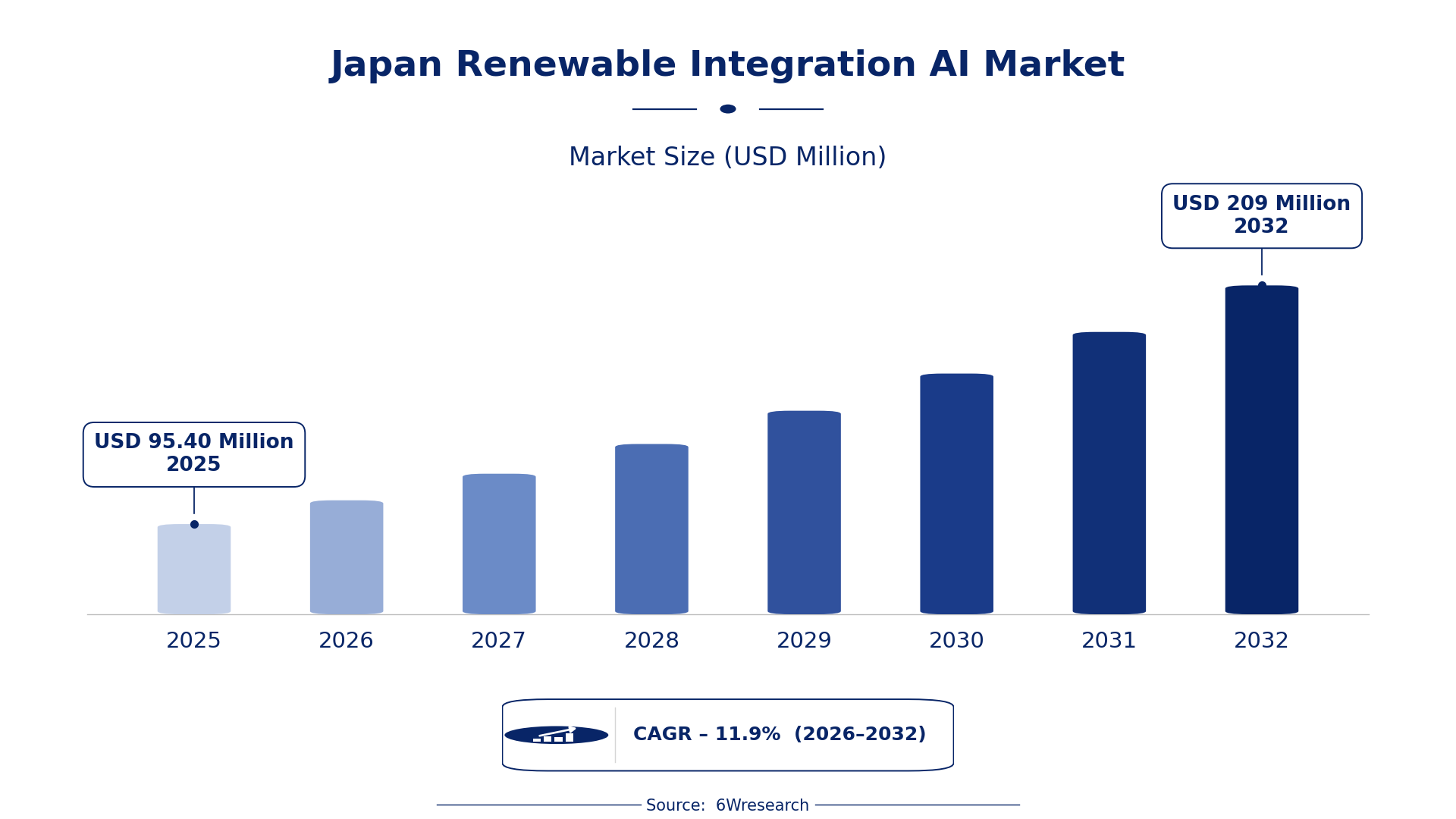
According to 6Wresearch internal database and industry insights, the Japan Renewable Integration AI Market was valued at USD 95.40 Million in 2025 and is projected to reach USD 209 Million by 2032, growing at a CAGR of approximately 11.9% during 2026–2032.
Japan Renewable Integration AI Market Highlights
| Report Metric | Details |
| Report Name | Japan Renewable Integration AI Market (2026-2032) |
| Market Size 2025 | USD 95.40 Million |
| Market Size 2032 | USD 209 Million |
| Absolute Growth 2025–2032 | USD 113.60 Million |
| CAGR 2026–2032 | 11.9% |
| Peak Annual Growth | 14.1% in 2032 |
| Forecast Period | 2026–2032 |
| Historical Data | 2022–2025 |
| Base Year | 2025 |
| Leading AI Application, 2025 | Load Forecasting AI (46% share) |
| Leading Use Case, 2025 | Demand Prediction (40% share) |
| Leading Deployment Mode, 2025 | Grid-Edge (36% share) |
| Leading End User, 2025 | Utility Operators (49% share) |
| Fastest-Growing AI Application | Grid Balancing AI (16.9% CAGR) |
| Fastest-Growing Use Case | Real-Time Dispatch (16.4% CAGR) |
| Fastest-Growing Deployment Mode | Cloud/Edge (17.7% CAGR) |
| Fastest-Growing End User | Smart Grid Managers (16.6% CAGR) |
| Growing Sector | Energy Management |
| Key End Users | Utility Operators, Smart Grid Managers, Energy Infrastructure Firms, Wind & Solar Aggregators |
Japan Renewable Integration AI Market Year-wise Growth Rate and Key Drivers (2022–2032)
This graph illustrates the annual growth rates of the market from 2022 to 2032, highlighting a steady upward trajectory and projected market expansion over the forecast period.
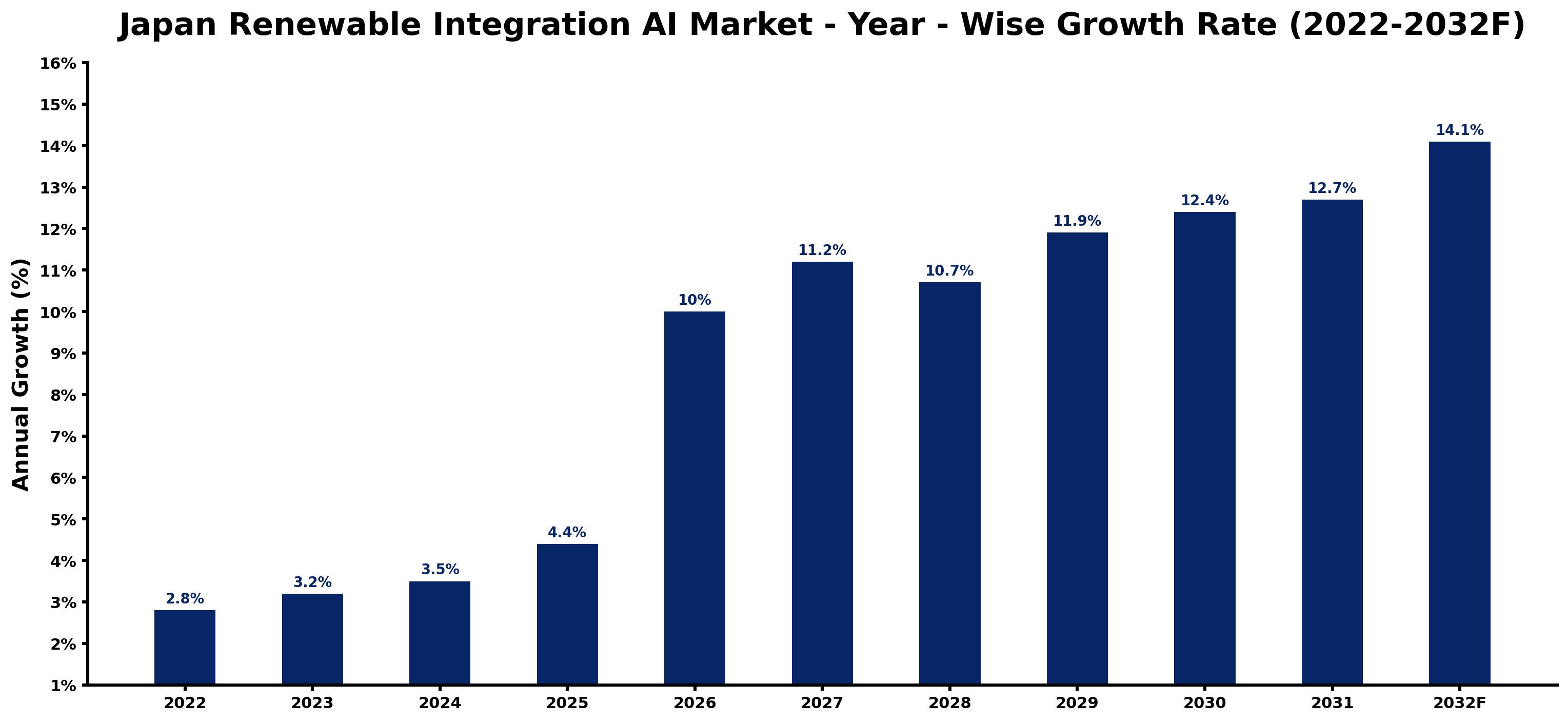
Each row of the following table gives one year's estimated growth and the event or demand shift that explains it.
| Year | Estimated Annual Growth (%) | Market Rationale |
| 2022 | 2.8 | The market experienced steady growth as demand for renewable energy solutions increased. |
| 2023 | 3.2 | Growth accelerated due to heightened investments in AI technologies for energy management. |
| 2024 | 3.5 | Continued investments in grid stability and efficiency drove further growth in the market. |
| 2025 | 4.4 | The introduction of new standards improved energy management systems, boosting growth. |
| 2026 | 10.0 | Demand surged as AI integration is expected to become essential for energy forecasting and management. |
| 2027 | 11.2 | The market will continue to expand, driven by advancements in grid balancing technologies. |
| 2028 | 10.7 | Growth is projected to slow slightly as the market matures, but demand will remain strong. |
| 2029 | 11.9 | The introduction of new AI applications is expected to lead to faster growth rates. |
| 2030 | 12.4 | Increased renewable energy targets will spur further investments in AI technologies. |
| 2031 | 12.7 | The market will maintain strong growth with ongoing technological advancements. |
| 2032 | 14.1 | Significant investments in AI for energy integration will push growth to its peak. |
Note: Market size estimations and growth projections presented in this report are based on 6Wresearch's proprietary forecasting methodology, utilizing the latest available industry data, government publications, and primary research inputs.
Japan Renewable Integration AI Market Synopsis
Renewable Integration AI optimises the integration of renewable energy into power grids through machine learning algorithms that improve grid reliability and energy efficiency. The Japan Renewable Integration AI Market is projected to grow, driven by the government's target of increasing renewable energy to 36-38% by 2030 and the Ministry of the Environment's 2023 programme promoting AI in energy management. With Japan's renewable energy capacity reaching 100 GW in 2022, demand for advanced AI solutions is rising as firms seek to enhance operational efficiency and sustainability.
Market Dynamics Impact Analysis (2026–2032)
| Factor | Type | Impact | Primary Segment Affected |
| Government initiatives promoting renewable energy integration are driving demand for AI solutions. | Driver | High | Load Forecasting AI |
| Investments in smart grid technologies are creating opportunities for AI applications. | Driver | High | Grid Balancing AI |
| The growing need for energy management solutions presents opportunities for AI integration. | Opportunity | High | Demand Prediction |
| The rise of localized energy management systems opens new avenues for AI deployment. | Opportunity | High | Grid-Edge |
| Limited awareness of AI benefits among energy firms restrains market growth. | Restraint | Medium | Renewable Forecasting |
| High initial investment costs for AI technologies can deter adoption in smaller firms. | Restraint | Medium | Predictive Maintenance |
| Competition from traditional energy management solutions can hinder AI adoption. | Challenge | High | Real-Time Dispatch |
| Technological integration challenges may delay implementation of AI solutions. | Challenge | Medium | Weather/Production |
Evaluation of Drivers in Japan Renewable Integration AI Market (2026–2032)
Key forces behind demand, with the segment each one moves most, are listed below.
| Drivers | Primary Segment Affected | Why It Matters (Evidence) |
| Government initiatives promoting renewable energy integration. | Load Forecasting AI | Japan's renewable energy capacity reached 100 GW in 2022, increasing demand for forecasting solutions. |
| Investments in smart grid technologies. | Grid Balancing AI | Approximately 1.5 billion USD was invested in AI solutions by the energy infrastructure sector in 2022. |
| The need for advanced energy management solutions. | Demand Prediction | The annual energy demand in Japan is approximately 900 TWh, necessitating effective planning. |
| The growth of localized energy management systems. | Grid-Edge | The Tokyo metropolitan area is a key region for deploying renewable integration AI technologies. |
| The adoption of ISO 50001 standards by energy firms. | Renewable Forecasting | These standards are being implemented to improve energy management systems across the sector. |
Several shifts outside the market lift sales. In 2022, Japan's renewable energy capacity reached 100 GW, driving demand for advanced forecasting solutions. The energy infrastructure sector invested approximately 1.5 billion USD in AI technologies, boosting applications for grid balancing. Utilities increasingly rely on predictive tools for effective planning, given the annual energy demand of around 900 TWh. The Tokyo metropolitan area is vital for localized energy management, facilitating grid-edge technologies. Adoption of ISO 50001 standards by energy firms further supports forecasting solutions, improving overall efficiency.
Evaluation of Restraints in Japan Renewable Integration AI Market
Below are the constraints most often cited by buyers and suppliers, with the segment each affects.
| Market Restraint | Primary Segment Affected | Why It Matters (Evidence) |
| Limited awareness of AI benefits among energy firms. | Renewable Forecasting | Many firms lack understanding of how AI can improve energy management systems, leading to missed opportunities. |
| High initial investment costs for AI technologies. | Predictive Maintenance | Smaller energy firms may struggle to afford advanced AI solutions, limiting adoption and growth. |
| Competition from traditional energy management solutions. | Real-Time Dispatch | Established methods may deter firms from transitioning to AI-driven approaches, slowing market penetration. |
| Technological integration challenges. | Weather/Production | Integrating AI with existing systems can be complex and time-consuming, hindering implementation. |
| Regulatory hurdles in adopting new technologies. | Grid-Edge | Compliance with existing regulations may slow down AI implementation, affecting market expansion. |
Japan Renewable Integration AI Market Challenges
Buyers in the Tokyo metropolitan area incur high costs due to slow AI integration, delaying grid optimisation by up to six months and increasing energy management expenses. Suppliers encounter fierce competition as numerous firms rush to adopt AI technologies, leading to price reductions that can shrink profit margins by 20%. Project delays arise from a shortage of skilled AI professionals, impacting energy firms' capacity to meet the growing demand for renewable solutions. Buyers face inefficiencies with outdated energy management systems, resulting in a 15% loss in potential efficiency gains when transitioning to cleaner energy sources.
Trends in the Japan Renewable Integration AI Market
These developments are changing demand patterns in the Japan Renewable Integration AI Market.
- Utility Operators Adopting AI Solutions: Utility operators are increasingly integrating AI solutions for grid management, with over 30 million smart meters installed as of 2023. This shift underscores the move towards more efficient energy management.
- Growing Demand for Real-Time Dispatch Technologies: The demand for Real-Time Dispatch technologies is rising, driven by the need for immediate responses to energy supply fluctuations. The Tokyo Electric Power Company is at the forefront of this shift with advanced AI integration.
- Focus on Renewable Forecasting: Renewable forecasting is gaining traction as firms aim to predict energy generation from renewable sources more accurately. The Renewable Energy Institute advocates for AI in this area, reflecting a broader industry trend.
- Expansion of Grid-Edge Solutions: Grid-Edge solutions are becoming more prevalent as localised energy management systems gain importance. The Japan Smart Community Alliance promotes these technologies to improve energy efficiency.
Investment Opportunities in the Japan Renewable Integration AI Market
The following opportunities in the Japan Renewable Integration AI Market pair current demand with a clear way in.
- Local Partnerships for AI Integration: Forming local partnerships is crucial for deploying AI solutions effectively. Utility operators in Japan are seeking advanced technologies to improve grid management, presenting a prime opportunity for collaboration.
- Investment in Smart Grid Technologies: The current push for smart grid technologies creates a prime opportunity for investment. Energy infrastructure firms are looking to integrate AI solutions to improve efficiency and reliability.
- Timing for AI Adoption: With the government aiming for 36-38% renewable energy by 2030, the timing is ideal for AI investments. Utility operators are eager to adopt advanced forecasting and management solutions.
- Focus on Tokyo Metropolitan Area: The Tokyo metropolitan area is a key location for deploying renewable integration AI technologies. Investments in this region can yield strong returns as demand for energy management solutions rises.
Government Initiatives in the Japan Renewable Integration AI Market
The Hydrogen Society Promotion Act, enacted in 2024, builds on previous laws by providing price-gap support for low-carbon hydrogen and ammonia supply chains. This measure strengthens the framework for integrating renewable energy sources into existing systems, encouraging producers to adopt advanced technologies. The act aims to support the transition to a more sustainable energy system by promoting innovation in the sector.
The Agency for Natural Resources and Energy plays a significant role in approving projects that support AI integration in energy systems. By funding initiatives that improve energy efficiency, the agency facilitates the adoption of advanced technologies across the sector, ensuring that energy firms can effectively implement AI solutions to meet growing demands.
Future Insight of the Japan Renewable Integration AI Market
The rollout of advanced smart grid facilities will revolutionise energy management by 2032, enabling seamless integration of diverse energy sources. The government's initiative to increase renewable energy to 36-38% by 2030 will drive substantial demand for AI technologies, improving grid reliability. With over 30 million smart meters deployed, real-time data analytics will enhance forecasting methods, facilitating better energy distribution. The Ministry of the Environment's support for AI integration will streamline operations, yielding considerable advantages for both buyers and suppliers in the energy sector.
Market Segmentation Analysis
Japan Renewable Integration AI Market report covers a detailed analysis of the following market segments:
By AI Application – Load Forecasting AI Leads, Grid Balancing AI Expected to Grow Fastest
According to Saurav Kr Singh, Senior Research Analyst at 6Wresearch, in 2025, Load Forecasting AI led the ai application split with a 46% share. Load Forecasting AI holds the largest market share as it is crucial for predicting energy demand, enabling utilities to allocate resources effectively. Its use by facilities in the Tokyo metropolitan area highlights its significance in managing energy consumption. Over 2026–2032, Grid Balancing AI is expected to post the fastest growth, at a CAGR of 16.9%. Grid Balancing AI is rapidly growing due to its necessity for maintaining energy supply and demand stability, especially with the increasing integration of renewable sources. The 2023 initiative from the Ministry of the Environment to promote AI in energy management illustrates the urgency for this technology. Suppliers should focus on enhancing Grid Balancing AI solutions to meet the rising demand in the market.
By Use Case – Demand Prediction Leads, Real-Time Dispatch Expected to Grow Fastest
Demand Prediction held 40% of the Japan Renewable Integration AI Market by use case in 2025. Demand Prediction is the leading use case as it is essential for utilities to plan energy needs effectively, particularly given Japan's annual energy demand of approximately 900 TWh. This capability allows for improved energy distribution and resource management. Real-Time Dispatch is projected to grow fastest, at a CAGR of 16.4% during 2026–2032. Real-Time Dispatch is experiencing rapid growth as it enables immediate responses to fluctuations in energy supply, which is vital for integrating renewable sources. The complexity of energy management in urban areas like Tokyo propels this demand forward. Buyers should invest in Real-Time Dispatch solutions to enhance operational responsiveness and efficiency.
By Deployment Mode – Grid-Edge Leads, Cloud/Edge Expected to Grow Fastest
Grid-Edge accounted for 36% of the market by deployment mode in 2025. Grid-Edge technology dominates the market as it supports localized energy management solutions, increasingly necessary in Japan's diverse energy landscape. The installed base of over 30 million smart meters exemplifies the demand for such localized approaches. Cloud/Edge is set to record the highest CAGR in this split, 17.7% over 2026–2032. Cloud/Edge deployment is gaining traction due to its ability to provide scalable solutions for energy management, aligning with government initiatives for improved renewable integration. Funding from the Agency for Natural Resources and Energy further encourages this trend. Suppliers must prioritise Cloud/Edge solutions to address the evolving requirements of energy management systems.
By End User – Utility Operators Lead, Smart Grid Managers Expected to Grow Fastest
The largest end user category in 2025 was Utility Operators, at 49% of revenue. Utility Operators represent the largest segment as they are the primary users of solutions for grid management, essential for ensuring reliable energy supply. Their substantial investments in advanced technologies underscore their critical role in the market. The quickest growth will come from Smart Grid Managers, forecast to expand at a CAGR of 16.6% between 2026 and 2032. Smart Grid Managers are experiencing the fastest growth as they implement technologies in smart grids, which are increasingly important for energy efficiency. The shift towards smart grid technologies reflects the broader trend towards sustainable energy systems. Buyers should collaborate with Smart Grid Managers to leverage technologies for improved grid performance.
Key Attractiveness of the Report
- 10 Years of Market Numbers
- Historical Data Starting from 2022 to 2025
- Base Year 2025
- Forecast Data until 2032
- Key Performance Indicators Impacting the Market
- Major Upcoming Developments and Projects
Key Highlights of the Report:
- Japan Renewable Integration AI Market Outlook
- Market Size of Japan Renewable Integration AI Market, 2025
- Forecast of Japan Renewable Integration AI Market, 2032
- Historical Data and Forecast of Japan Renewable Integration AI Revenues & Volume for the Period 2022-2032F
- Japan Renewable Integration AI Market Trend Evolution
- Japan Renewable Integration AI Market Drivers and Challenges
- Japan Renewable Integration AI Price Trends
- Japan Renewable Integration AI Porter's Five Forces
- Japan Renewable Integration AI Industry Life Cycle
- Historical Data and Forecast of Japan Renewable Integration AI Market Revenues & Volume By AI Application for the Period 2022-2032F
- Historical Data and Forecast of Japan Renewable Integration AI Market Revenues & Volume By Load Forecasting AI for the Period 2022-2032F
- Historical Data and Forecast of Japan Renewable Integration AI Market Revenues & Volume By Grid Balancing AI for the Period 2022-2032F
- Historical Data and Forecast of Japan Renewable Integration AI Market Revenues & Volume By Fault Detection for the Period 2022-2032F
- Historical Data and Forecast of Japan Renewable Integration AI Market Revenues & Volume By Renewable Forecasting for the Period 2022-2032F
- Historical Data and Forecast of Japan Renewable Integration AI Market Revenues & Volume By Use Case for the Period 2022-2032F
- Historical Data and Forecast of Japan Renewable Integration AI Market Revenues & Volume By Demand Prediction for the Period 2022-2032F
- Historical Data and Forecast of Japan Renewable Integration AI Market Revenues & Volume By Real-Time Dispatch for the Period 2022-2032F
- Historical Data and Forecast of Japan Renewable Integration AI Market Revenues & Volume By Predictive Maintenance for the Period 2022-2032F
- Historical Data and Forecast of Japan Renewable Integration AI Market Revenues & Volume By Weather/Production for the Period 2022-2032F
- Historical Data and Forecast of Japan Renewable Integration AI Market Revenues & Volume By Deployment Mode for the Period 2022-2032F
- Historical Data and Forecast of Japan Renewable Integration AI Market Revenues & Volume By Grid-Edge for the Period 2022-2032F
- Historical Data and Forecast of Japan Renewable Integration AI Market Revenues & Volume By Cloud/Edge for the Period 2022-2032F
- Historical Data and Forecast of Japan Renewable Integration AI Market Revenues & Volume By AIoT + SCADA for the Period 2022-2032F
- Historical Data and Forecast of Japan Renewable Integration AI Market Revenues & Volume By ML Models for the Period 2022-2032F
- Historical Data and Forecast of Japan Renewable Integration AI Market Revenues & Volume By End User for the Period 2022-2032F
- Historical Data and Forecast of Japan Renewable Integration AI Market Revenues & Volume By Utility Operators for the Period 2022-2032F
- Historical Data and Forecast of Japan Renewable Integration AI Market Revenues & Volume By Smart Grid Managers for the Period 2022-2032F
- Historical Data and Forecast of Japan Renewable Integration AI Market Revenues & Volume By Energy Infrastructure Firms for the Period 2022-2032F
- Historical Data and Forecast of Japan Renewable Integration AI Market Revenues & Volume By Wind & Solar Aggregators for the Period 2022-2032F
- Japan Renewable Integration AI Import Export Trade Statistics
- Market Opportunity Assessment By AI Application
- Market Opportunity Assessment By Use Case
- Market Opportunity Assessment By Deployment Mode
- Market Opportunity Assessment By End User
- Japan Renewable Integration AI Top Companies Market Share
- Japan Renewable Integration AI Competitive Benchmarking By Technical and Operational Parameters
- Japan Renewable Integration AI Company Profiles
- Japan Renewable Integration AI Key Strategic Recommendations
Market Covered
The study includes the following segmentation.
By AI Application
- Load Forecasting AI
- Grid Balancing AI
- Fault Detection
- Renewable Forecasting
By Use Case
- Demand Prediction
- Real-Time Dispatch
- Predictive Maintenance
- Weather/Production
By Deployment Mode
- Grid-Edge
- Cloud/Edge
- AIoT + SCADA
- ML Models
By End User
- Utility Operators
- Smart Grid Managers
- Energy Infrastructure Firms
- Wind & Solar Aggregators































