Japan Renewable Integration Storage Market Size & Growth Rate
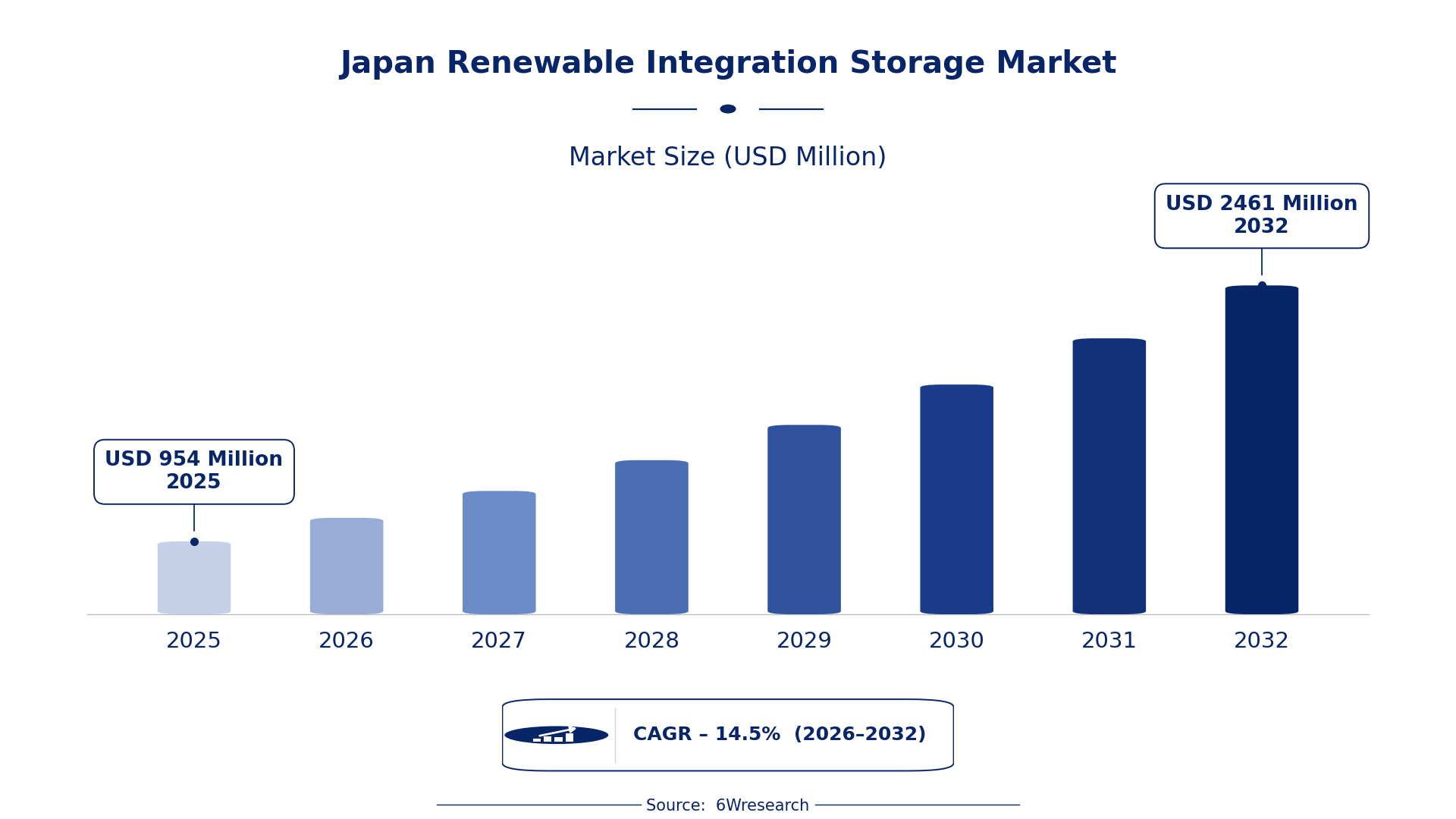
According to 6Wresearch internal database and industry insights, the Japan Renewable Integration Storage Market was valued at USD 954 Million in 2025 and is projected to reach USD 2,461 Million by 2032, growing at a CAGR of approximately 14.5% during 2026–2032.
Japan Renewable Integration Storage Market Highlights
| Report Metric | Details |
| Report Name | Japan Renewable Integration Storage Market (2026-2032) |
| Market Size 2025 | USD 954 Million |
| Market Size 2032 | USD 2,461 Million |
| Absolute Growth 2025–2032 | USD 1,507 Million |
| CAGR 2026–2032 | 14.5% |
| Peak Annual Growth | 15.5% in 2032 |
| Forecast Period | 2026–2032 |
| Historical Data | 2022–2025 |
| Base Year | 2025 |
| Leading Storage Type, 2025 | Battery Energy Storage (47% share) |
| Leading Application, 2025 | PV/Wind + BESS (36% share) |
| Leading Integration Mode, 2025 | Grid-Tied (38% share) |
| Leading End User, 2025 | Grid Operators (38% share) |
| Fastest-Growing Storage Type | Hydrogen Storage (20.9% CAGR) |
| Fastest-Growing Application | H2 from Surplus RE (20.5% CAGR) |
| Fastest-Growing Integration Mode | Smart Grid (19.3% CAGR) |
| Fastest-Growing End User | Distributed Energy Resources (19.4% CAGR) |
| Growing Sector | Energy Storage |
| Key End Users | Grid Operators, Energy Managers, Renewable Energy Producers, Urban Planners |
Japan Renewable Integration Storage Market Year-wise Growth Rate and Key Drivers (2022–2032)
This graph illustrates the annual growth rates of the market from 2022 to 2032, highlighting a steady upward trajectory and projected market expansion over the forecast period.
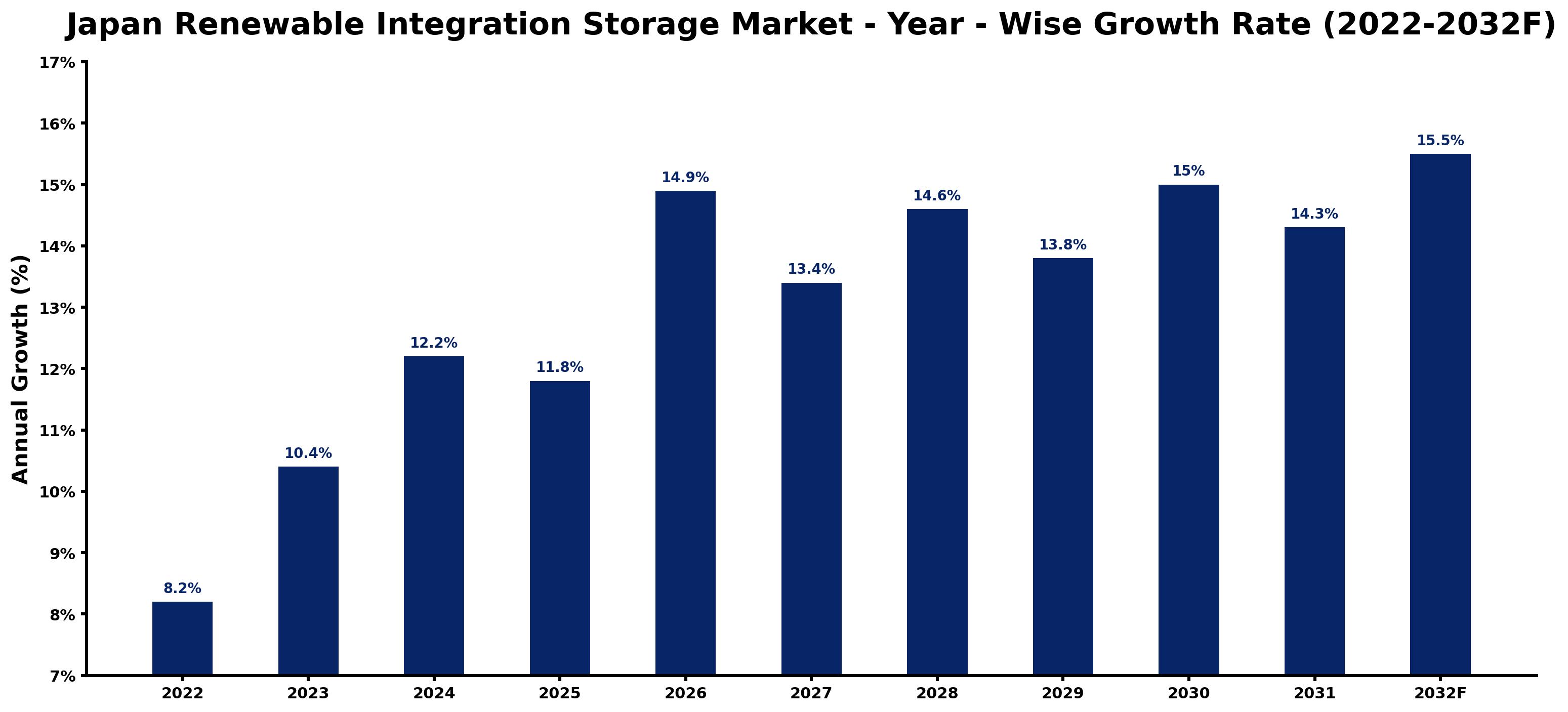
Below, each year's estimated growth is shown next to the factor that most influenced it.
| Year | Estimated Annual Growth (%) | Market Rationale |
| 2022 | 8.2 | The market experienced growth due to rising energy demands and initial investments in renewable technologies. |
| 2023 | 10.4 | Increased adoption of battery storage systems contributed to growth compared to the previous year. |
| 2024 | 12.2 | The introduction of new standards and technologies further accelerated market expansion. |
| 2025 | 11.8 | Growth slowed slightly as the market adjusted to increased competition and supply chain challenges. |
| 2026 | 14.9 | Investment in hydrogen initiatives and smart grid projects will drive a resurgence in growth. |
| 2027 | 13.4 | The market will continue to grow, albeit at a slower rate as it stabilises after rapid expansion. |
| 2028 | 14.6 | Renewable energy projects will gain momentum, leading to a faster growth rate once again. |
| 2029 | 13.8 | Growth will decelerate slightly as market saturation begins to affect new installations. |
| 2030 | 15.0 | The push for hydrogen vehicles and infrastructure will spur renewed interest and demand. |
| 2031 | 14.3 | Growth will slow as the market matures and competition intensifies among suppliers. |
| 2032 | 15.5 | A surge in investments in smart grid technologies will result in the highest growth rate of the decade. |
Note: Market size estimations and growth projections presented in this report are based on 6Wresearch's proprietary forecasting methodology, utilizing the latest available industry data, government publications, and primary research inputs.
Japan Renewable Integration Storage Market Synopsis
Renewable Integration Storage includes battery energy storage, thermal storage, and hydrogen storage technologies that facilitate the integration of renewable energy into the grid. These systems stabilise the grid, store surplus energy, and provide backup power. The Japan Renewable Integration Storage Market is growing due to rising energy demands, government initiatives promoting renewable energy, and substantial investments in infrastructure, aiming for 30% of electricity from renewables by 2030. A strong base of domestic users and ongoing investments in renewable energy infrastructure further support this market's expansion.
Market Dynamics Impact Analysis (2026–2032)
| Factor | Type | Impact | Primary Segment Affected |
| Growing investments in battery storage technologies | Driver | High | Battery Energy Storage |
| Increased demand for hydrogen storage solutions | Driver | High | Hydrogen Storage |
| Expansion of smart grid projects across Japan | Opportunity | High | Smart Grid |
| Rising need for energy management systems in urban areas | Opportunity | Medium | Distributed Energy Resources |
| High initial costs of storage systems | Restraint | High | Battery Energy Storage |
| Limited awareness of thermal storage benefits | Restraint | Medium | Thermal Storage |
| Technological challenges in integrating diverse storage systems | Challenge | High | Hybrid Systems |
| Competition from alternative energy solutions | Challenge | Medium | Hydrogen Storage |
Evaluation of Drivers in Japan Renewable Integration Storage Market (2026–2032)
The table below links each growth driver to the segment it affects and the evidence for it.
| Drivers | Primary Segment Affected | Why It Matters (Evidence) |
| Investment in battery storage capacity | Battery Energy Storage | Japan's installed battery storage capacity reached 1,000 MW in 2022, prompting increased purchases from grid operators. |
| Government support for hydrogen initiatives | Hydrogen Storage | The Ministry of the Environment allocated ¥200 billion to hydrogen projects, encouraging investments in storage solutions. |
| Growing renewable energy installations | PV/Wind + BESS | Tokyo leads with over 300 MW of solar capacity, driving demand for integrated storage solutions. |
| Adoption of ISO 50001 energy management standards | Smart Grid | Compliance with ISO 50001 promotes efficiency, leading to increased investments in smart grid technologies. |
| Rising energy demand from a population of 125 million | Distributed Energy Resources | The large population drives the need for efficient energy management and storage solutions. |
Most of the extra volume comes from investments in battery storage, which reached 1,000 MW in 2022, prompting grid operators to purchase more systems for stability. Tokyo's solar capacity of over 300 MW is increasing the need for integrated storage systems. Compliance with ISO 50001 is encouraging investments in smart grid technologies, while the total population of 125 million creates a demand for efficient energy management solutions.
Evaluation of Restraints in Japan Renewable Integration Storage Market
Several factors work against faster growth; the main ones are summarised below.
| Market Restraint | Primary Segment Affected | Why It Matters (Evidence) |
| High initial costs of battery storage systems | Battery Energy Storage | The average installation cost can exceed ¥100 million, deterring some potential buyers from investing. |
| Limited awareness of thermal storage benefits | Thermal Storage | Many potential users lack understanding of how thermal storage can enhance energy efficiency, resulting in underutilisation. |
| Technological challenges in integrating diverse storage systems | Hybrid Systems | The complexity of combining different storage technologies can delay projects and increase overall costs. |
| Competition from alternative energy solutions | Hydrogen Storage | Emerging technologies may divert investments from hydrogen storage, impacting overall market growth. |
| Regulatory hurdles for new installations | Smart Grid | Navigating multiple regulations can slow down the deployment of smart grid technologies. |
Japan Renewable Integration Storage Market Challenges
Japan's limited domestic production capacity for renewable integration storage systems creates procurement delays, extending lead times for buyers by up to six months. Skills shortages in renewable technologies hinder producers' ability to scale operations, resulting in project delays that can cost buyers approximately ¥50 million in lost revenue. Supply chain disruptions in sourcing advanced materials inflate costs for buyers by as much as 15%, jeopardising project feasibility. Rising production costs linked to regulatory compliance further strain budgets, compelling buyers to allocate additional funds for implementation and impacting overall project timelines.
Trends in the Japan Renewable Integration Storage Market
The shifts below are changing how Japan Renewable Integration Storage Market products are bought and supplied.
- Shift towards Hydrogen Storage Solutions: The government initiated the Hydrogen Society Promotion Act in 2024 to support hydrogen supply chains. This initiative aims to significantly increase hydrogen storage capacity by 2030, boosting the market for energy storage.
- Transition to Smart Grid Technologies: In 2023, the Ministry of Economy, Trade and Industry launched a smart grid project to improve energy management. This shift will enhance efficiency and demand for smart grid solutions across urban areas.
- Emergence of Co-Located Installations: The trend towards co-located installations began in 2022, integrating various renewable sources with storage systems. This approach is set to optimise energy use, particularly in regions like Tohoku, known for wind energy.
- Growing Adoption of Energy Management Standards: The adoption of ISO 50001 standards has been increasing since 2022, promoting energy efficiency in storage systems. This trend will drive demand for compliant technologies among energy producers.
Investment Opportunities in the Japan Renewable Integration Storage Market
The openings below show where demand in the Japan Renewable Integration Storage Market is visible and how suppliers can enter.
- Gap in Battery Storage Capacity: With Japan's total installed capacity of renewable energy reaching 100 GW in 2022, there is a significant gap for battery storage solutions. Grid operators in urban areas are seeking reliable systems to manage this demand effectively.
- Investment in Hydrogen Infrastructure: The government aims for 10 million hydrogen vehicles by 2030, creating a need for hydrogen storage solutions. Local municipalities are looking for partners to develop infrastructure that supports this transition.
- Expansion of Smart Grid Projects: The smart grid project launched in 2023 presents opportunities for technology suppliers. Urban energy managers are actively seeking innovative solutions to enhance grid efficiency and reliability.
- Rising Demand for Thermal Storage Systems: With increasing solar installations, the thermal storage market is projected to grow. Solar thermal plants in regions like Tokyo are looking for efficient storage options to maximise energy use.
Government Initiatives in the Japan Renewable Integration Storage Market
The Hydrogen Society Promotion Act, enacted in 2024, significantly impacts hydrogen storage producers by providing price-gap support for low-carbon hydrogen supply chains. This measure encourages investment in hydrogen storage technologies, ensuring compliance with national energy goals.
The Agency for Natural Resources and Energy oversees the implementation of the Battery Industry Strategy, which aims for 150 GWh of domestic battery manufacturing capacity by 2030. This initiative supports battery storage producers by facilitating funding and approvals for new projects.
Future Insight of the Japan Renewable Integration Storage Market
Battery energy storage technology will reshape demand by 2032, driven by the government's target of 10 million hydrogen vehicles. Smart grid projects will improve energy management, enabling suppliers to better integrate renewable sources. The growth of thermal storage systems will accommodate increased solar installations, stabilising the grid. By 2032, Japan's total installed capacity of renewable energy will exceed 100 GW, prompting changes in procurement strategies for buyers and suppliers.
Market Segmentation Analysis
Japan Renewable Integration Storage Market report covers a detailed analysis of the following market segments:
By Storage Type – Battery Energy Storage Leads, Hydrogen Storage Expected to Grow Fastest
According to Saurav Kr Singh, Senior Research Analyst at 6Wresearch, Battery Energy Storage held 47% of the Japan Renewable Integration Storage Market by storage type in 2025. Battery energy storage commands the largest share due to its extensive use in stabilising the grid and managing energy effectively. In 2022, Japan's installed battery storage capacity reached 1,000 MW, showcasing its critical role in energy infrastructure. Hydrogen Storage is projected to grow fastest, at a CAGR of 20.9% during 2026–2032. Hydrogen storage is rapidly expanding as it provides a viable solution for storing excess renewable energy, with the government aiming for 3 million tons of hydrogen production by 2030. This growth is likely to strengthen the position of battery energy storage as well. Suppliers should focus on hydrogen technologies to meet the increasing demand for renewable energy storage solutions.
By Application – PV/Wind + BESS Leads, H2 from Surplus RE Expected to Grow Fastest
PV/Wind + BESS accounted for 36% of the market by application in 2025. The PV/Wind + BESS application holds the largest share as it effectively integrates solar and wind energy with battery storage, which is crucial for stabilising the grid. This integration is vital for meeting Japan's ambitious goal of 30% renewable electricity by 2030. H2 from Surplus RE is set to record the highest CAGR in this split, 20.5% over 2026–2032. The H2 from Surplus RE application is experiencing rapid growth due to its ability to convert excess renewable energy into hydrogen, supporting the government's aim of 10 million hydrogen vehicles by 2030. This growth will likely strengthen the position of PV/Wind + BESS applications in the market. Investing in hydrogen technologies will be essential for buyers to meet future energy demands and comply with government initiatives.
By Integration Mode – Grid-Tied Leads, Smart Grid Expected to Grow Fastest
With 38% of integration mode revenue in 2025, Grid-Tied was the largest category. Grid-tied systems lead the market as they integrate effectively with the existing power grid, facilitating efficient energy distribution. This integration is essential for managing Japan's substantial renewable energy capacity, which reached 100 GW in 2022. The quickest growth will come from Smart Grid, forecast to expand at a CAGR of 19.3% between 2026 and 2032. Smart grid technology is rapidly advancing, enhancing grid management and efficiency, which is critical for accommodating the growing share of renewable energy sources. The launch of a smart grid project in 2023 underscores this important development. Suppliers should focus on smart grid advancements to stay competitive in the evolving energy sector.
By End User – Grid Operators Lead, Distributed Energy Resources Expected to Grow Fastest
The largest end user category in 2025 was Grid Operators, at 38% of revenue. Grid operators hold the largest share as they are essential for managing and operating the energy grid, which is critical for integrating renewable sources. Their importance is amplified by the complexities of energy management in Japan's grid system. Over 2026–2032, Distributed Energy Resources are expected to post the fastest growth, at a CAGR of 19.4%. The segment of distributed energy resources is experiencing rapid growth, driven by the increasing prevalence of localized energy generation and storage solutions. This shift indicates a broader movement towards decentralised energy systems in Japan. Buyers should seek partnerships with distributed energy resource providers to improve energy resilience.
Key Attractiveness of the Report
- 10 Years of Market Numbers
- Historical Data Starting from 2022 to 2025
- Base Year 2025
- Forecast Data until 2032
- Key Performance Indicators Impacting the Market
- Major Upcoming Developments and Projects
Key Highlights of the Report:
- Japan Renewable Integration Storage Market Outlook
- Market Size of Japan Renewable Integration Storage Market, 2025
- Forecast of Japan Renewable Integration Storage Market, 2032
- Historical Data and Forecast of Japan Renewable Integration Storage Revenues & Volume for the Period 2022-2032F
- Japan Renewable Integration Storage Market Trend Evolution
- Japan Renewable Integration Storage Market Drivers and Challenges
- Japan Renewable Integration Storage Price Trends
- Japan Renewable Integration Storage Porter's Five Forces
- Japan Renewable Integration Storage Industry Life Cycle
- Historical Data and Forecast of Japan Renewable Integration Storage Market Revenues & Volume By Storage Type for the Period 2022-2032F
- Historical Data and Forecast of Japan Renewable Integration Storage Market Revenues & Volume By Battery Energy Storage for the Period 2022-2032F
- Historical Data and Forecast of Japan Renewable Integration Storage Market Revenues & Volume By Thermal Storage for the Period 2022-2032F
- Historical Data and Forecast of Japan Renewable Integration Storage Market Revenues & Volume By Hybrid Systems for the Period 2022-2032F
- Historical Data and Forecast of Japan Renewable Integration Storage Market Revenues & Volume By Hydrogen Storage for the Period 2022-2032F
- Historical Data and Forecast of Japan Renewable Integration Storage Market Revenues & Volume By Application for the Period 2022-2032F
- Historical Data and Forecast of Japan Renewable Integration Storage Market Revenues & Volume By PV/Wind + BESS for the Period 2022-2032F
- Historical Data and Forecast of Japan Renewable Integration Storage Market Revenues & Volume By CSP & Microgrids for the Period 2022-2032F
- Historical Data and Forecast of Japan Renewable Integration Storage Market Revenues & Volume By Solar-Wind-Battery for the Period 2022-2032F
- Historical Data and Forecast of Japan Renewable Integration Storage Market Revenues & Volume By H2 from Surplus RE for the Period 2022-2032F
- Historical Data and Forecast of Japan Renewable Integration Storage Market Revenues & Volume By Integration Mode for the Period 2022-2032F
- Historical Data and Forecast of Japan Renewable Integration Storage Market Revenues & Volume By Co-Located Installations for the Period 2022-2032F
- Historical Data and Forecast of Japan Renewable Integration Storage Market Revenues & Volume By Grid-Tied for the Period 2022-2032F
- Historical Data and Forecast of Japan Renewable Integration Storage Market Revenues & Volume By Smart Grid for the Period 2022-2032F
- Historical Data and Forecast of Japan Renewable Integration Storage Market Revenues & Volume By Power-to-Gas for the Period 2022-2032F
- Historical Data and Forecast of Japan Renewable Integration Storage Market Revenues & Volume By End User for the Period 2022-2032F
- Historical Data and Forecast of Japan Renewable Integration Storage Market Revenues & Volume By Grid Operators for the Period 2022-2032F
- Historical Data and Forecast of Japan Renewable Integration Storage Market Revenues & Volume By Solar Thermal Plants for the Period 2022-2032F
- Historical Data and Forecast of Japan Renewable Integration Storage Market Revenues & Volume By Distributed Energy Resources for the Period 2022-2032F
- Historical Data and Forecast of Japan Renewable Integration Storage Market Revenues & Volume By Renewable Gas Utilities for the Period 2022-2032F
- Japan Renewable Integration Storage Import Export Trade Statistics
- Market Opportunity Assessment By Storage Type
- Market Opportunity Assessment By Application
- Market Opportunity Assessment By Integration Mode
- Market Opportunity Assessment By End User
- Japan Renewable Integration Storage Top Companies Market Share
- Japan Renewable Integration Storage Competitive Benchmarking By Technical and Operational Parameters
- Japan Renewable Integration Storage Company Profiles
- Japan Renewable Integration Storage Key Strategic Recommendations
Market Covered
The report covers the following segments.
By Storage Type
- Battery Energy Storage
- Thermal Storage
- Hybrid Systems
- Hydrogen Storage
By Application
- PV/Wind + BESS
- CSP & Microgrids
- Solar-Wind-Battery
- H2 from Surplus RE
By Integration Mode
- Co-Located Installations
- Grid-Tied
- Smart Grid
- Power-to-Gas
By End User
- Grid Operators
- Solar Thermal Plants
- Distributed Energy Resources
- Renewable Gas Utilities































