Japan Reservoir Modeling AI Market Size & Growth Rate
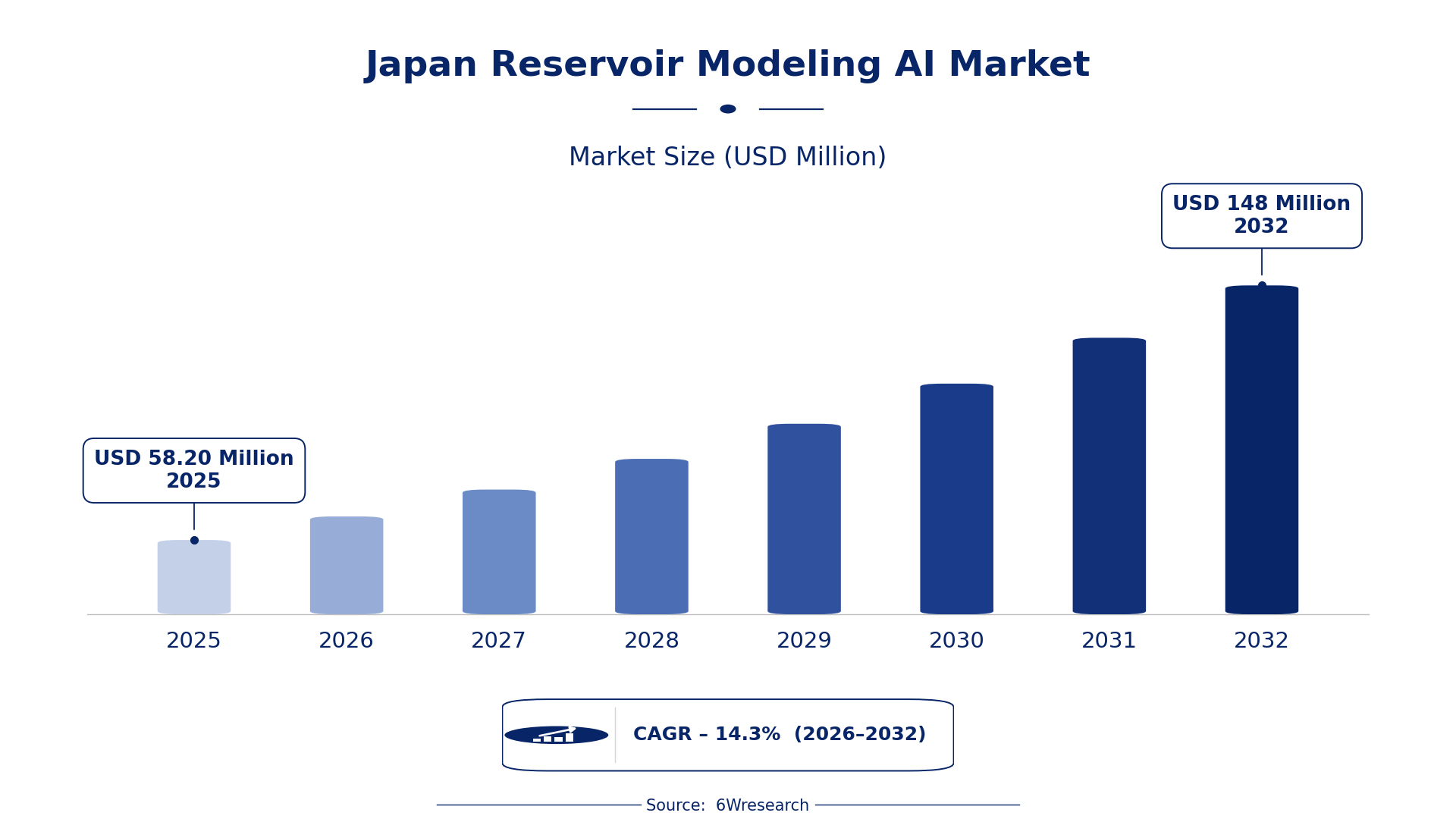
According to 6Wresearch internal database and industry insights, the Japan Reservoir Modeling AI Market was valued at USD 58.20 Million in 2025 and is projected to reach USD 148 Million by 2032, growing at a CAGR of approximately 14.3% during 2026–2032.
Japan Reservoir Modeling AI Market Highlights
| Report Metric | Details |
| Report Name | Japan Reservoir Modeling AI Market (2026-2032) |
| Market Size 2025 | USD 58.20 Million |
| Market Size 2032 | USD 148 Million |
| Absolute Growth 2025–2032 | USD 89.80 Million |
| CAGR 2026–2032 | 14.3% |
| Peak Annual Growth | 15.3% in 2031 |
| Forecast Period | 2026–2032 |
| Historical Data | 2022–2025 |
| Base Year | 2025 |
| Leading AI Model Function, 2025 | Flood Forecasting (61% share) |
| Leading Data Input, 2025 | Rainfall & Flow Data (62% share) |
| Leading Deployment Mode, 2025 | Cloud-Based (55% share) |
| Leading End User, 2025 | Water Management Agencies (68% share) |
| Fastest-Growing AI Model Function | Reservoir Optimization (18.0% CAGR) |
| Fastest-Growing Data Input | Level + Usage Metrics (19.0% CAGR) |
| Fastest-Growing End User | Utility Operators (17.8% CAGR) |
| Growing Sector | Utility Operators |
| Key End Users | Water Management Agencies, Utility Operators |
Japan Reservoir Modeling AI Market Year-wise Growth Rate and Key Drivers (2022–2032)
This graph illustrates the annual growth rates of the market from 2022 to 2032, highlighting a steady upward trajectory and projected market expansion over the forecast period.
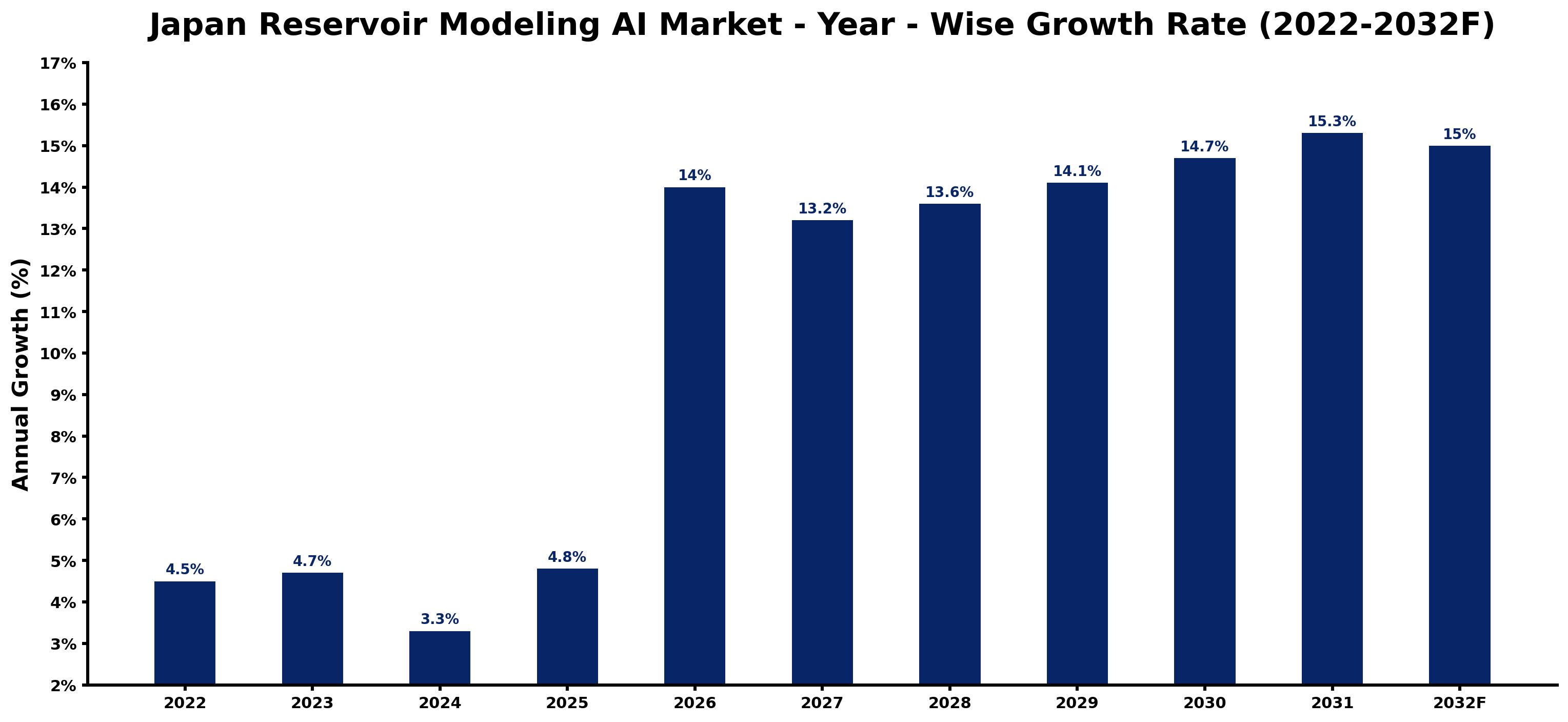
Annual growth estimates for each year appear below with the principal reason behind them, explaining the shifts that set the pace of the market.
| Year | Estimated Annual Growth (%) | Market Rationale |
| 2022 | 4.5 | The market experienced steady growth due to increasing awareness of AI applications in water management. |
| 2023 | 4.7 | Demand rose as water management agencies adopted AI for flood forecasting in major reservoirs. |
| 2024 | 3.3 | Growth slowed as agencies faced challenges integrating new technologies into existing systems. |
| 2025 | 4.8 | The market saw renewed growth as utility operators expanded AI usage for operational efficiency. |
| 2026 | 14.0 | Demand is expected to surge with the implementation of advanced AI technologies across water management sectors. |
| 2027 | 13.2 | Growth is projected to slow slightly as the market begins to stabilise following rapid expansion. |
| 2028 | 13.6 | Demand will increase as more agencies adopt cloud-based solutions for reservoir modeling. |
| 2029 | 14.1 | Growth is anticipated to accelerate as utility operators improve their AI capabilities for service delivery. |
| 2030 | 14.7 | Demand will rise further with the integration of AI technologies in flood prediction models. |
| 2031 | 15.3 | The market is expected to peak as agencies fully embrace AI for effective water resource management. |
| 2032 | 15.0 | Growth is projected to slow as the market reaches maturity, but demand for AI solutions remains strong. |
Note: Market size estimations and growth projections presented in this report are based on 6Wresearch's proprietary forecasting methodology, utilizing the latest available industry data, government publications, and primary research inputs.
Japan Reservoir Modeling AI Market Synopsis
Reservoir Modeling AI employs artificial intelligence to simulate and predict water reservoir behaviours, optimising resource management and forecasting flood events. The Japan Reservoir Modeling AI Market is primarily driven by water management agencies and utility operators, who are increasingly adopting AI technologies. The integration of AI into operations is expected to improve efficiency, with a shift towards advanced water management solutions as 80% of major utility operators are projected to implement these technologies by 2025.
Market Dynamics Impact Analysis (2026–2032)
| Factor | Type | Impact | Primary Segment Affected |
| Increasing adoption of AI technologies for flood forecasting and reservoir optimisation drives demand. | Driver | High | Flood Forecasting |
| Growing need for efficient water resource management encourages investment in AI solutions. | Driver | High | Reservoir Optimization |
| The ongoing integration of AI in utility operations presents opportunities for new technology providers. | Opportunity | High | Utility Operators |
| The shift towards cloud-based solutions creates demand for scalable AI applications. | Opportunity | High | Cloud-Based |
| Challenges in integrating AI with existing systems may hinder adoption rates. | Restraint | Medium | Flood Forecasting |
| Limited access to high-quality data can restrict the effectiveness of AI models. | Restraint | Medium | Reservoir Optimization |
| The complexity of AI technologies can deter smaller agencies from adoption. | Challenge | Medium | Utility Operators |
| High implementation costs may delay the adoption of advanced AI solutions. | Challenge | Medium | Cloud-Based |
Evaluation of Drivers in Japan Reservoir Modeling AI Market (2026–2032)
These are the developments adding the most demand over the forecast period.
| Drivers | Primary Segment Affected | Why It Matters (Evidence) |
| Adoption of AI for flood forecasting | Flood Forecasting | In 2023, Japan's water management agencies utilised AI for flood forecasting in over 50 major reservoirs, improving predictive capabilities. |
| Need for efficient water resource management | Reservoir Optimization | The Water Supply Act mandates efficient management, driving agencies to adopt AI for better resource allocation. |
| Integration of AI technologies in utility operations | Utility Operators | AI technologies are projected to be integrated into 80% of major utility operators by 2025, improving service delivery. |
| Cloud-based solutions for scalability | Cloud-Based | By 2025, cloud-based solutions are expected to be used by 60% of water management agencies, providing flexible deployment options. |
| Real-time data processing capabilities | AI Edge Platforms | AI Edge Platforms are increasingly adopted for localized data processing, improving operational efficiency in remote areas. |
Utility operators are projected to implement AI technologies in 80% of their operations by 2025, improving service delivery. The rise of AI Edge Platforms for real-time data processing is also notable, catering to remote operational needs.
Evaluation of Restraints in Japan Reservoir Modeling AI Market
Below are the constraints most often cited by buyers and suppliers, with the segment each affects.
| Market Restraint | Primary Segment Affected | Why It Matters (Evidence) |
| Outdated modeling techniques | Flood Forecasting | In Japan, water management agencies face rising costs due to outdated modeling techniques, inflating operational expenses by up to 30%. |
| Supply chain disruptions | Utility Operators | Utility operators experience supply chain disruptions as they rely heavily on historical data, leading to delays in implementing AI solutions. |
| Regulatory compliance delays | Reservoir Optimization | Regulatory pressures from the Ministry of Land, Infrastructure, Transport and Tourism require compliance with the Water Supply Act, slowing project timelines. |
| Limited AI adoption | Water Management Agencies | Technology adoption lags as only 20% of agencies currently use AI, hindering their ability to improve flood prediction capabilities. |
| Integration challenges | Cloud-Based | Agencies face difficulties integrating new AI technologies into existing systems, affecting overall operational efficiency. |
Japan Reservoir Modeling AI Market Challenges
In Japan, water management agencies encounter inflated operational costs due to outdated modeling techniques, which increase expenses by 30%. Utility operators face supply delays as they depend on historical data, resulting in a year-long wait for AI solution implementation. Compliance with the Water Supply Act, overseen by the Ministry of Land, Infrastructure, Transport and Tourism, can extend project timelines for agencies needing system upgrades. Technology adoption is sluggish, with only 20% of agencies currently utilising AI, which hampers their ability to predict floods effectively.
Trends in the Japan Reservoir Modeling AI Market
The trends below show where the Japan Reservoir Modeling AI Market is heading.
- Shift Towards Cloud-Based Solutions: The Tokyo metropolitan area is experiencing a shift towards cloud-based reservoir modeling solutions, with 60% of water management agencies expected to adopt these technologies by 2025, improving operational flexibility.
- Increased Use of AI for Flood Prediction: Since 2023, water management agencies have increasingly utilised AI for flood prediction, with over 50 major reservoirs adopting these technologies, significantly improving response times during flood events.
- Adoption of ISO 14001 Standards: The integration of ISO 14001 standards among water management agencies began in 2022, promoting environmental management practices that align with AI technologies, leading to better resource management.
- Real-Time Data Processing in Remote Areas: AI Edge Platforms have gained traction in remote areas since 2023, with agencies adopting these solutions for real-time data processing, improving operational efficiency in challenging environments.
Investment Opportunities in the Japan Reservoir Modeling AI Market
The following opportunities in the Japan Reservoir Modeling AI Market pair current demand with a clear way in.
- Partnerships for AI Integration: Now is the time for partnerships in AI integration, as utility operators seek to improve operational efficiency. Collaborating with local technology firms can facilitate entry into the market.
- Supply of Cloud-Based Solutions: With 60% of agencies expected to adopt cloud-based solutions by 2025, supplying these technologies presents a significant opportunity for growth in the market.
- Investment in AI Training Programs: Investment in training programs for AI implementation is essential now, as water management agencies require skilled personnel to manage new technologies effectively.
- Expansion of Real-Time Data Solutions: There is a growing need for real-time data solutions, particularly in remote areas, providing opportunities for firms to supply AI Edge Platforms that meet these demands.
Government Initiatives in the Japan Reservoir Modeling AI Market
The Water Supply Act (1957) sets standards for drinking-water quality and supply, ensuring that water management agencies adhere to efficient resource management practices. This law mandates agencies to implement AI for better monitoring and forecasting, directly impacting their operational strategies.
The Digital Agency, established in September 2021, leads government digital transformation efforts. It approves funding for projects aimed at integrating AI technologies in water management, supporting agencies in their transition to advanced operational frameworks.
Future Insight of the Japan Reservoir Modeling AI Market
Investment in reservoir modeling AI is projected to exceed 500 million dollars by 2032, driving demand for cutting-edge technologies. By 2024, the Japan Water Agency's program will improve flood prediction capabilities, enhancing community resilience. Utility operators will increasingly implement advanced AI algorithms for more accurate forecasting. By 2025, 60% of agencies are expected to adopt cloud-based solutions, facilitating efficient real-time data processing and informed decision-making.
Market Segmentation Analysis
Japan Reservoir Modeling AI Market report covers a detailed analysis of the following market segments:
By AI Model Function – Flood Forecasting Leads, Reservoir Optimization Expected to Grow Fastest
According to Saurav Kr Singh, Senior Research Analyst at 6Wresearch, with 61% of ai model function revenue in 2025, Flood Forecasting was the largest category. Flood forecasting holds the largest share as it is essential for predicting water levels and managing flood risks. In Japan, this technology is actively used by water management agencies across over 50 major reservoirs, highlighting its critical importance. Reservoir Optimization is set to record the highest CAGR in this split, 18.0% over 2026–2032. Reservoir optimization is growing rapidly due to its importance in efficient water resource allocation and usage. The ongoing integration of advanced technologies into utility operations is expected to further drive this segment's growth. Suppliers should focus on developing solutions that enhance reservoir optimization to meet rising market demands.
By Data Input – Rainfall & Flow Data Leads, Level + Usage Metrics Expected to Grow Fastest
Rainfall & Flow Data took 62% of data input revenue in 2025, more than any other category. Rainfall and flow data leads the segment as it is crucial for accurate modeling and predictions. The Japan Meteorological Agency's provision of this data underscores its vital role in effective reservoir management. Over 2026–2032, Level + Usage Metrics are expected to post the fastest growth, at a CAGR of 19.0%. Level and usage metrics are experiencing swift growth as they are key for assessing reservoir performance. The increasing emphasis on operational efficiency among utility operators is propelling this segment forward. Buyers will benefit from solutions that incorporate level and usage metrics for improved performance evaluation.
By Deployment Mode – Cloud-Based Leads and Records the Fastest Growth
In 2025, Cloud-Based led the deployment mode split with a 55% share. Cloud-based deployment is the leading mode as it provides scalable and flexible options for water management agencies. This approach facilitates real-time data processing, which is essential for effective reservoir management. Cloud-Based is also forecast to expand faster than any other category, at a CAGR of 15.3% over 2026–2032. Cloud-based solutions are also the fastest-growing segment, with 60% of water management agencies expected to adopt them by 2025. This trend indicates a broader shift towards more efficient and accessible technological solutions. Suppliers must prioritise cloud-based offerings to align with the market's transition towards scalable technologies.
By End User – Water Management Agencies Lead, Utility Operators Expected to Grow Fastest
Water Management Agencies accounted for 68% of the market by end user in 2025. Water management agencies represent the largest user group as they are responsible for the effective management of water resources. Their proactive role in adopting new technologies highlights their significance in the market. Utility Operators are projected to grow fastest, at a CAGR of 17.8% during 2026–2032. Utility operators are the fastest-growing segment, driven by their pursuit of operational efficiency and improved service delivery. The integration of new technologies into their operations is expected to lead to substantial advancements. Suppliers should customise their products to meet the specific needs of utility operators for enhanced operational efficiency.
Key Attractiveness of the Report
- 10 Years of Market Numbers
- Historical Data Starting from 2022 to 2025
- Base Year 2025
- Forecast Data until 2032
- Key Performance Indicators Impacting the Market
- Major Upcoming Developments and Projects
Key Highlights of the Report:
- Japan Reservoir Modeling AI Market Outlook
- Market Size of Japan Reservoir Modeling AI Market, 2025
- Forecast of Japan Reservoir Modeling AI Market, 2032
- Historical Data and Forecast of Japan Reservoir Modeling AI Revenues & Volume for the Period 2022-2032F
- Japan Reservoir Modeling AI Market Trend Evolution
- Japan Reservoir Modeling AI Market Drivers and Challenges
- Japan Reservoir Modeling AI Price Trends
- Japan Reservoir Modeling AI Porter's Five Forces
- Japan Reservoir Modeling AI Industry Life Cycle
- Historical Data and Forecast of Japan Reservoir Modeling AI Market Revenues & Volume By AI Model Function for the Period 2022-2032F
- Historical Data and Forecast of Japan Reservoir Modeling AI Market Revenues & Volume By Flood Forecasting for the Period 2022-2032F
- Historical Data and Forecast of Japan Reservoir Modeling AI Market Revenues & Volume By Reservoir Optimization for the Period 2022-2032F
- Historical Data and Forecast of Japan Reservoir Modeling AI Market Revenues & Volume By Data Input for the Period 2022-2032F
- Historical Data and Forecast of Japan Reservoir Modeling AI Market Revenues & Volume By Rainfall & Flow Data for the Period 2022-2032F
- Historical Data and Forecast of Japan Reservoir Modeling AI Market Revenues & Volume By Level + Usage Metrics for the Period 2022-2032F
- Historical Data and Forecast of Japan Reservoir Modeling AI Market Revenues & Volume By Deployment Mode for the Period 2022-2032F
- Historical Data and Forecast of Japan Reservoir Modeling AI Market Revenues & Volume By Cloud-Based for the Period 2022-2032F
- Historical Data and Forecast of Japan Reservoir Modeling AI Market Revenues & Volume By AI Edge Platforms for the Period 2022-2032F
- Historical Data and Forecast of Japan Reservoir Modeling AI Market Revenues & Volume By End User for the Period 2022-2032F
- Historical Data and Forecast of Japan Reservoir Modeling AI Market Revenues & Volume By Water Management Agencies for the Period 2022-2032F
- Historical Data and Forecast of Japan Reservoir Modeling AI Market Revenues & Volume By Utility Operators for the Period 2022-2032F
- Japan Reservoir Modeling AI Import Export Trade Statistics
- Market Opportunity Assessment By AI Model Function
- Market Opportunity Assessment By Data Input
- Market Opportunity Assessment By Deployment Mode
- Market Opportunity Assessment By End User
- Japan Reservoir Modeling AI Top Companies Market Share
- Japan Reservoir Modeling AI Competitive Benchmarking By Technical and Operational Parameters
- Japan Reservoir Modeling AI Company Profiles
- Japan Reservoir Modeling AI Key Strategic Recommendations
Market Covered
This report examines the market across the segments below.
By AI Model Function
- Flood Forecasting
- Reservoir Optimization
By Data Input
- Rainfall & Flow Data
- Level + Usage Metrics
By Deployment Mode
- Cloud-Based
- AI Edge Platforms
By End User
- Water Management Agencies
- Utility Operators































