Japan Reservoir Simulation Software Market Size & Growth Rate
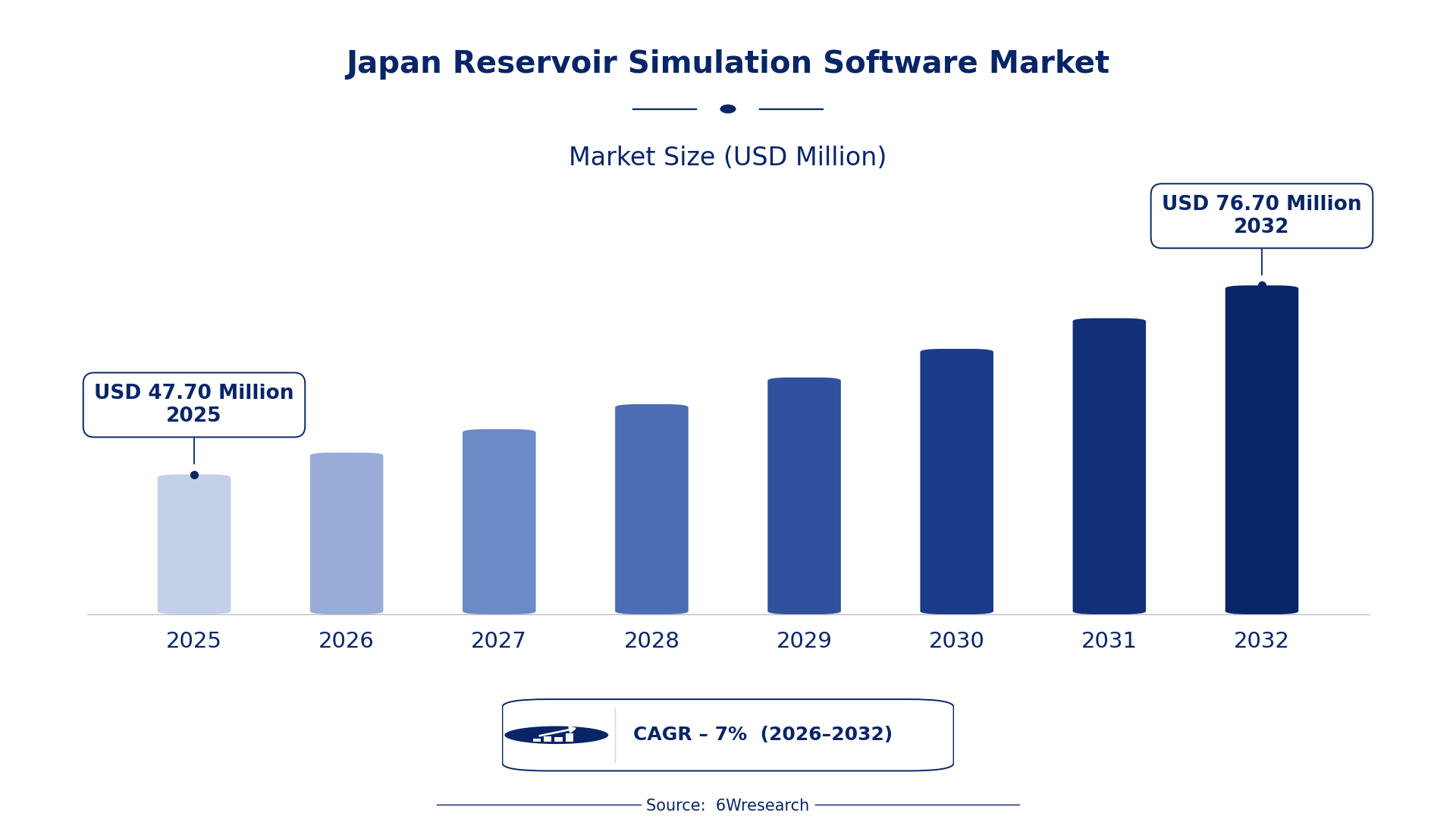
According to 6Wresearch internal database and industry insights, the Japan Reservoir Simulation Software Market was valued at USD 47.70 Million in 2025 and is projected to reach USD 76.70 Million by 2032, growing at a CAGR of approximately 7% during 2026–2032.
Japan Reservoir Simulation Software Market Highlights
| Report Metric | Details |
| Report Name | Japan Reservoir Simulation Software Market (2026-2032) |
| Market Size 2025 | USD 47.70 Million |
| Market Size 2032 | USD 76.70 Million |
| Absolute Growth 2025–2032 | USD 29 Million |
| CAGR 2026–2032 | 7% |
| Peak Annual Growth | 7.8% in 2026 |
| Forecast Period | 2026–2032 |
| Historical Data | 2022–2025 |
| Base Year | 2025 |
| Leading Simulation Type, 2025 | Hydrologic Modeling (45% share) |
| Leading Fluid Type, 2025 | Water (52% share) |
| Leading User Interface, 2025 | 2D/3D Visualization (41% share) |
| Leading End User, 2025 | Environmental Engineers (48% share) |
| Fastest-Growing Simulation Type | Sediment Transport (9.5% CAGR) |
| Fastest-Growing Fluid Type | Water & Particulate (9.7% CAGR) |
| Fastest-Growing User Interface | GUI & APIs (10.2% CAGR) |
| Fastest-Growing End User | Civil Infrastructure Firms (8.8% CAGR) |
| Growing Sector | Environmental Engineering |
| Key End Users | Environmental Engineers, Civil Infrastructure Firms, Hydropower Plants |
Japan Reservoir Simulation Software Market Year-wise Growth Rate and Key Drivers (2022–2032)
This graph illustrates the annual growth rates of the market from 2022 to 2032, highlighting a steady upward trajectory and projected market expansion over the forecast period.
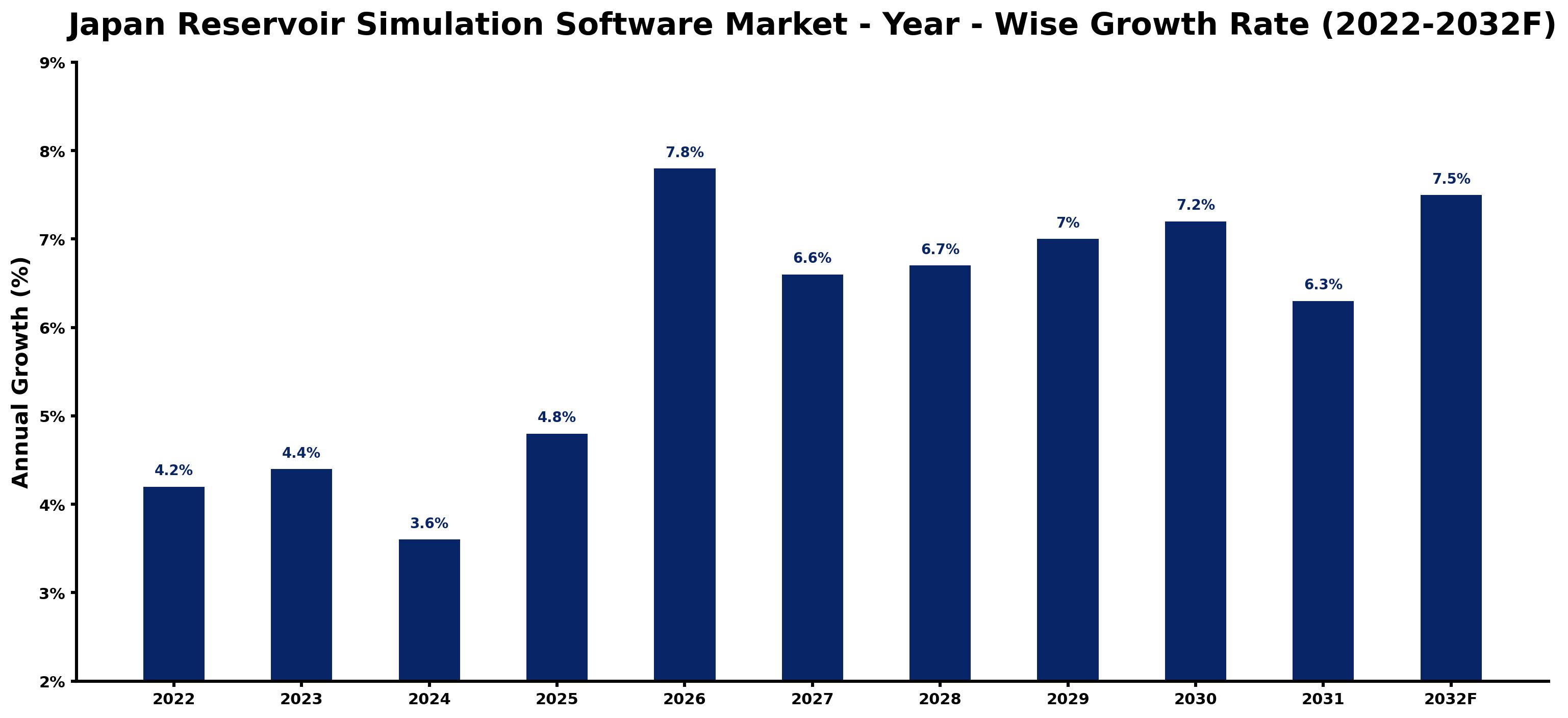
The following figures match every annual growth estimate with the main market development of that year, giving the reasoning behind each rise or slowdown.
| Year | Estimated Annual Growth (%) | Market Rationale |
| 2022 | 4.2 | The market showed steady growth as environmental engineering projects gained traction. |
| 2023 | 4.4 | Demand increased due to a rise in hydropower plant projects across the country. |
| 2024 | 3.6 | Growth slowed as some infrastructure projects faced delays in funding. |
| 2025 | 4.8 | The market rebounded with stronger demand from civil infrastructure firms. |
| 2026 | 7.8 | Rapid growth is anticipated as new simulation technologies are adopted widely. |
| 2027 | 6.6 | Growth is projected to slow slightly as the market stabilises after rapid expansion. |
| 2028 | 6.7 | Demand is expected to pick up again as more firms adopt cloud-based solutions. |
| 2029 | 7.0 | The market will continue to grow as environmental assessments become more critical. |
| 2030 | 7.2 | Growth is projected to remain strong due to ongoing investments in water resource management. |
| 2031 | 6.3 | A slight slowdown is expected as the market adjusts to new technologies. |
| 2032 | 7.5 | Demand is projected to surge again as more projects require advanced simulation capabilities. |
Note: Market size estimations and growth projections presented in this report are based on 6Wresearch's proprietary forecasting methodology, utilizing the latest available industry data, government publications, and primary research inputs.
Japan Reservoir Simulation Software Market Synopsis
Reservoir Simulation Software is a specialized tool used in hydrology and environmental engineering to model and analyze water resources. The Japan Reservoir Simulation Software Market is experiencing growth driven by increased demand from civil infrastructure firms and environmental engineers, with approximately 70% of the latter utilizing this software. The launch of a government programme in 2023 to improve water resource management using simulation technologies further fuels this demand, indicating a strong future for the market.
Market Dynamics Impact Analysis (2026–2032)
| Factor | Type | Impact | Primary Segment Affected |
| Growing demand from hydropower plants for water flow optimization | Driver | High | Hydrologic Modeling |
| Increased focus on environmental assessments by civil infrastructure firms | Driver | High | Sediment Transport |
| Rising need for advanced simulation tools in environmental engineering | Opportunity | High | Environmental Engineers |
| Expansion of cloud-based solutions for flexible deployment | Opportunity | Medium | Cloud/On-Premise |
| High costs associated with software licensing and maintenance | Restraint | High | Hydrologic Modeling |
| Limited awareness of simulation benefits among smaller firms | Restraint | Medium | Civil Infrastructure Firms |
| Budget constraints limiting investment in advanced technologies | Challenge | High | Environmental Engineers |
| Compliance with evolving environmental regulations can delay projects | Challenge | Medium | Civil Infrastructure Firms |
Evaluation of Drivers in Japan Reservoir Simulation Software Market (2026–2032)
The factors lifting demand, and the evidence behind each, are summarised below.
| Drivers | Primary Segment Affected | Why It Matters (Evidence) |
| Increased investment in hydropower projects | Hydrologic Modeling | Over 50 hydropower plants utilize this software, driving demand for optimization tools. |
| Focus on sustainable infrastructure development | Sediment Transport | The Japan Society of Civil Engineers promotes simulation tools, increasing usage among firms. |
| Growing environmental regulations requiring assessments | Environmental Engineers | Approximately 70% of environmental engineers use simulation software for compliance with regulations. |
| Adoption of cloud solutions for flexibility | Cloud/On-Premise | Cloud-based systems are gaining traction, allowing easier access to simulation tools for users. |
| Technological advancements in simulation algorithms | 2D/3D Visualization | Improved visualization capabilities support decision-making in civil projects, enhancing project outcomes. |
Several shifts outside the market lift sales. In the Kanto region, over 50 hydropower plants rely on reservoir simulation software, which drives demand for hydrologic modeling tools. The Japan Society of Civil Engineers actively promotes the use of simulation tools, facilitating their integration into civil infrastructure projects. Cloud-based solutions are gaining traction among firms, allowing flexible access to advanced simulation capabilities, while technological advancements in algorithms improve the accuracy of sediment transport modeling.
Evaluation of Restraints in Japan Reservoir Simulation Software Market
The main factors holding the market back are set out below.
| Market Restraint | Primary Segment Affected | Why It Matters (Evidence) |
| High software licensing and maintenance costs | Hydrologic Modeling | Costs can deter smaller firms from adopting essential simulation tools, limiting market participation. |
| Limited understanding of simulation benefits among engineers | Civil Infrastructure Firms | This knowledge gap restricts the adoption of advanced technologies, hindering project efficiency. |
| Budget constraints affecting project funding | Environmental Engineers | Many projects face delays due to insufficient financial resources for software, impacting timelines. |
| Evolving regulations requiring compliance adjustments | Sediment Transport | Frequent changes complicate the use of existing simulation tools, creating uncertainty for users. |
| Inadequate training for effective software use | Cloud/On-Premise | Lack of skilled personnel can hinder the effective implementation of solutions, affecting outcomes. |
Japan Reservoir Simulation Software Market Challenges
In Japan, 50 hydropower plants rely on reservoir simulation software, creating a demand for consistent inputs that can lead to supply chain delays for civil engineers. Regulatory standards, such as ISO 14046, require thorough water footprint assessments, complicating compliance and extending project approval times for firms. A skills gap exists, as only 70% of environmental engineers are proficient in using this software, raising training costs and prolonging project timelines for employers. Limited adoption of cloud-based solutions restricts technological advancements, impacting efficiency for users in the environmental sector.
Trends in the Japan Reservoir Simulation Software Market
Four trends stand out in the Japan Reservoir Simulation Software Market.
- Environmental Engineers Prioritising Simulation Tools: Environmental engineers are increasingly prioritising advanced simulation tools to meet regulatory demands, with approximately 70% using reservoir simulation software in their projects, reflecting a shift towards data-driven decision-making.
- Kanto Region Leading in Infrastructure Simulation: A high concentration of civil infrastructure firms in the Kanto region is adopting simulation software, with over 50 hydropower plants utilising these tools to improve project outcomes.
- Transition to Cloud-Based Solutions: The shift towards cloud-based solutions is transforming how firms access reservoir simulation software, with increasing adoption rates among users, facilitating more flexible and scalable deployment options.
- Rising Focus on Sediment Transport Modelling: Sediment transport modelling is gaining importance for maintaining river health, with many projects integrating these simulations to improve environmental assessments, reflecting a growing recognition of their significance.
Investment Opportunities in the Japan Reservoir Simulation Software Market
The openings below show where demand in the Japan Reservoir Simulation Software Market is visible and how suppliers can enter.
- Growing Market Gap for Advanced Simulation Tools: With a projected increase in demand for simulation software, firms can invest in developing advanced tools, particularly targeting environmental engineers who require compliance solutions.
- Investment in Cloud-Based Simulation Solutions: The rising trend towards cloud solutions presents an opportunity for developers to supply flexible software options, particularly for civil infrastructure firms needing scalable tools.
- Need for Training Programs in Simulation Software: As awareness of simulation benefits grows, there is an opportunity to provide training programs for engineers, particularly in regions with high infrastructure development.
- Improving Water Quality Monitoring Systems: The Japanese government's funding for water quality monitoring systems creates an opportunity for suppliers to develop simulation software that integrates with these initiatives.
Government Initiatives in the Japan Reservoir Simulation Software Market
The Industrial Standardization Act governs product and test standards for reservoir simulation software, ensuring compliance and quality in the industry. This law promotes the use of standardised tools across various projects, benefiting producers and users alike. The Ministry of Land, Infrastructure, Transport and Tourism supports initiatives that integrate simulation technologies into public works projects, approving funding for software development and implementation, which improves water resource management efforts.
The Digital Agency leads government efforts in digital transformation, approving funds for projects that integrate simulation technologies. This agency supports initiatives aimed at improving water resource management, providing essential funding for software development and implementation.
Future Insight of the Japan Reservoir Simulation Software Market
By 2032, advanced simulation technologies will reshape water resource management, driven by government initiatives and industry standards. The 2023 programme launched by Japan's Ministry of the Environment will improve monitoring systems, enhancing data accuracy for users. Integration of simulation software in public works projects will streamline operations, benefiting civil engineers. As cloud-based solutions become prevalent, collaboration among stakeholders will increase, driving progress in environmental engineering practices.
Market Segmentation Analysis
Japan Reservoir Simulation Software Market report covers a detailed analysis of the following market segments:
By Simulation Type – Hydrologic Modeling Leads, Sediment Transport Expected to Grow Fastest
According to Saurav Kr Singh, Senior Research Analyst at 6Wresearch, Hydrologic Modeling took 45% of simulation type revenue in 2025, more than any other category. Hydrologic Modeling holds the largest share as it is extensively used in over 50 hydropower plants across Japan, essential for simulating water flow and distribution. Its critical role in optimising water resource management ensures strong demand from environmental and civil engineering sectors. Sediment Transport is projected to grow fastest, at a CAGR of 9.5% during 2026–2032. Sediment Transport is experiencing rapid growth due to its importance in maintaining river and lake health, particularly in environmental assessments. The increasing focus on sustainable practices in the Kanto region is driving heightened demand for this sub-segment. Suppliers should prioritise features related to sediment transport to align with the growing emphasis on environmental sustainability.
By Fluid Type – Water Leads, Water & Particulate Expected to Grow Fastest
With 52% of fluid type revenue in 2025, Water was the largest category. Water holds the largest share as it is essential for all types of reservoir simulations, serving as the primary medium for modelling water resources. Its extensive use in over 50 hydropower plants across Japan ensures consistent demand from environmental engineers. Water & Particulate is set to record the highest CAGR in this split, 9.7% over 2026–2032. Water & Particulate is experiencing rapid growth due to its specific applications in environmental assessments, particularly in sediment transport studies. The increasing focus on maintaining river and lake health is driving this segment's expansion. Suppliers should consider developing solutions that incorporate both water and particulate modelling to meet diverse project needs.
By User Interface – 2D/3D Visualization Leads, GUI & APIs Expected to Grow Fastest
2D/3D Visualization accounted for 41% of the market by user interface in 2025. 2D/3D Visualization is the leading user interface as it provides essential visual representation of simulation results, helping users interpret complex data effectively. This capability is especially valued by civil engineers in the Tokyo metropolitan area for clear communication of findings. The quickest growth will come from GUI & APIs, forecast to expand at a CAGR of 10.2% between 2026 and 2032. GUI & APIs are gaining popularity as they enable seamless integration with other software tools, improving user experience and operational efficiency. The rising demand for more interactive interfaces in engineering projects is propelling this segment's growth. Developing user-friendly interfaces will be crucial for suppliers aiming to attract a wider range of users in the engineering sectors.
By End User – Environmental Engineers Lead, Civil Infrastructure Firms Expected to Grow Fastest
In 2025, Environmental Engineers led the end user split with a 48% share. Environmental Engineers represent the largest user group, utilising reservoir simulation software primarily for effective water resource management. Approximately 70% of these professionals rely on such tools to optimise their projects, ensuring a steady demand. Over 2026–2032, Civil Infrastructure Firms are expected to post the fastest growth, at a CAGR of 8.8%. Civil Infrastructure Firms are experiencing the fastest growth as they increasingly adopt simulation software for planning and designing infrastructure projects. The Japanese government's support for infrastructure development is driving this surge in demand. Suppliers should tailor their offerings to meet the specific needs of civil infrastructure firms to capitalise on this growing market.
Key Attractiveness of the Report
- 10 Years of Market Numbers
- Historical Data Starting from 2022 to 2025
- Base Year 2025
- Forecast Data until 2032
- Key Performance Indicators Impacting the Market
- Major Upcoming Developments and Projects
Key Highlights of the Report:
- Japan Reservoir Simulation Software Market Outlook
- Market Size of Japan Reservoir Simulation Software Market, 2025
- Forecast of Japan Reservoir Simulation Software Market, 2032
- Historical Data and Forecast of Japan Reservoir Simulation Software Revenues & Volume for the Period 2022-2032F
- Japan Reservoir Simulation Software Market Trend Evolution
- Japan Reservoir Simulation Software Market Drivers and Challenges
- Japan Reservoir Simulation Software Price Trends
- Japan Reservoir Simulation Software Porter's Five Forces
- Japan Reservoir Simulation Software Industry Life Cycle
- Historical Data and Forecast of Japan Reservoir Simulation Software Market Revenues & Volume By Simulation Type for the Period 2022-2032F
- Historical Data and Forecast of Japan Reservoir Simulation Software Market Revenues & Volume By Hydrologic Modeling for the Period 2022-2032F
- Historical Data and Forecast of Japan Reservoir Simulation Software Market Revenues & Volume By Sediment Transport for the Period 2022-2032F
- Historical Data and Forecast of Japan Reservoir Simulation Software Market Revenues & Volume By Thermal Stratification for the Period 2022-2032F
- Historical Data and Forecast of Japan Reservoir Simulation Software Market Revenues & Volume By Fluid Type for the Period 2022-2032F
- Historical Data and Forecast of Japan Reservoir Simulation Software Market Revenues & Volume By Water for the Period 2022-2032F
- Historical Data and Forecast of Japan Reservoir Simulation Software Market Revenues & Volume By Water & Particulate for the Period 2022-2032F
- Historical Data and Forecast of Japan Reservoir Simulation Software Market Revenues & Volume By Water Bodies for the Period 2022-2032F
- Historical Data and Forecast of Japan Reservoir Simulation Software Market Revenues & Volume By User Interface for the Period 2022-2032F
- Historical Data and Forecast of Japan Reservoir Simulation Software Market Revenues & Volume By 2D/3D Visualization for the Period 2022-2032F
- Historical Data and Forecast of Japan Reservoir Simulation Software Market Revenues & Volume By GUI & APIs for the Period 2022-2032F
- Historical Data and Forecast of Japan Reservoir Simulation Software Market Revenues & Volume By Cloud/On-Premise for the Period 2022-2032F
- Historical Data and Forecast of Japan Reservoir Simulation Software Market Revenues & Volume By End User for the Period 2022-2032F
- Historical Data and Forecast of Japan Reservoir Simulation Software Market Revenues & Volume By Environmental Engineers for the Period 2022-2032F
- Historical Data and Forecast of Japan Reservoir Simulation Software Market Revenues & Volume By Civil Infrastructure Firms for the Period 2022-2032F
- Historical Data and Forecast of Japan Reservoir Simulation Software Market Revenues & Volume By Hydropower Plants for the Period 2022-2032F
- Japan Reservoir Simulation Software Import Export Trade Statistics
- Market Opportunity Assessment By Simulation Type
- Market Opportunity Assessment By Fluid Type
- Market Opportunity Assessment By User Interface
- Market Opportunity Assessment By End User
- Japan Reservoir Simulation Software Top Companies Market Share
- Japan Reservoir Simulation Software Competitive Benchmarking By Technical and Operational Parameters
- Japan Reservoir Simulation Software Company Profiles
- Japan Reservoir Simulation Software Key Strategic Recommendations
Market Covered
The study includes the following segmentation.
By Simulation Type
- Hydrologic Modeling
- Sediment Transport
- Thermal Stratification
By Fluid Type
- Water
- Water & Particulate
- Water Bodies
By User Interface
- 2D/3D Visualization
- GUI & APIs
- Cloud/On-Premise
By End User
- Environmental Engineers
- Civil Infrastructure Firms
- Hydropower Plants































