Japan Residential Roofing Market Size & Growth Rate
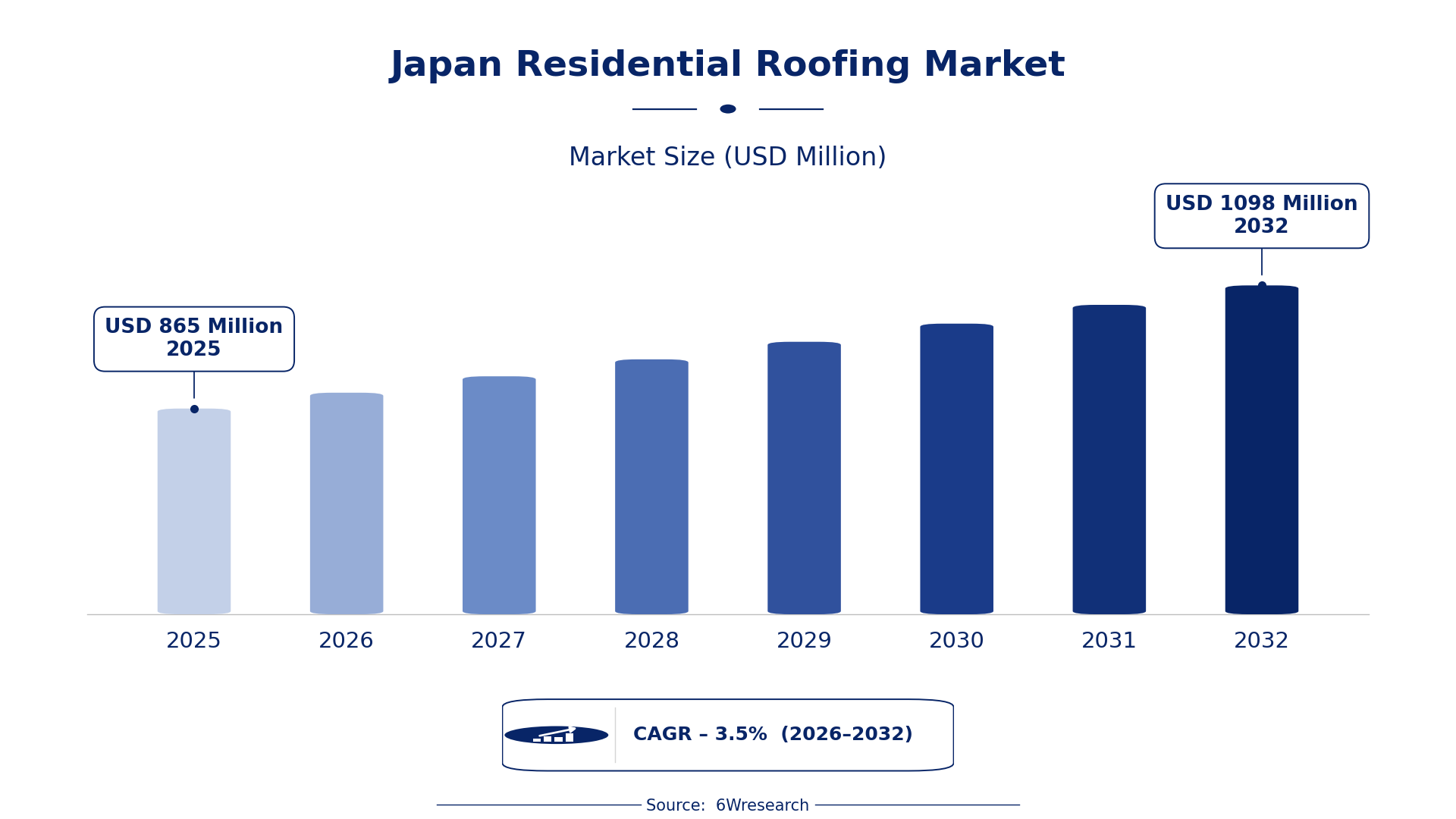
According to 6Wresearch internal database and industry insights, the Japan Residential Roofing Market was valued at USD 865 Million in 2025 and is projected to reach USD 1,098 Million by 2032, growing at a CAGR of approximately 3.5% during 2026–2032.
Japan Residential Roofing Market Highlights
| Report Metric | Details |
| Report Name | Japan Residential Roofing Market (2026-2032) |
| Market Size 2025 | USD 865 Million |
| Market Size 2032 | USD 1,098 Million |
| Absolute Growth 2025–2032 | USD 233 Million |
| CAGR 2026–2032 | 3.5% |
| Peak Annual Growth | 4.4% in 2028 |
| Forecast Period | 2026–2032 |
| Historical Data | 2022–2025 |
| Base Year | 2025 |
| Leading Roofing Type, 2025 | Asphalt Shingles (49% share) |
| Leading Material, 2025 | Bitumen/Fiberglass (38% share) |
| Leading Roof Design, 2025 | Pitched/Sloped Roofs (49% share) |
| Leading End User, 2025 | Urban Homes (35% share) |
| Fastest-Growing Roofing Type | Metal Roofing (5.1% CAGR) |
| Fastest-Growing Material | Steel/Aluminum (5.0% CAGR) |
| Fastest-Growing Roof Design | Low Slope/Flat Roofs (4.8% CAGR) |
| Fastest-Growing End User | Modern Villas (4.6% CAGR) |
| Growing Sector | Residential construction |
| Key End Users | Urban homeowners, eco-friendly builders, roofing contractors, property developers |
Japan Residential Roofing Market Year-wise Growth Rate and Key Drivers (2022–2032)
This graph illustrates the annual growth rates of the market from 2022 to 2032, highlighting a steady upward trajectory and projected market expansion over the forecast period.
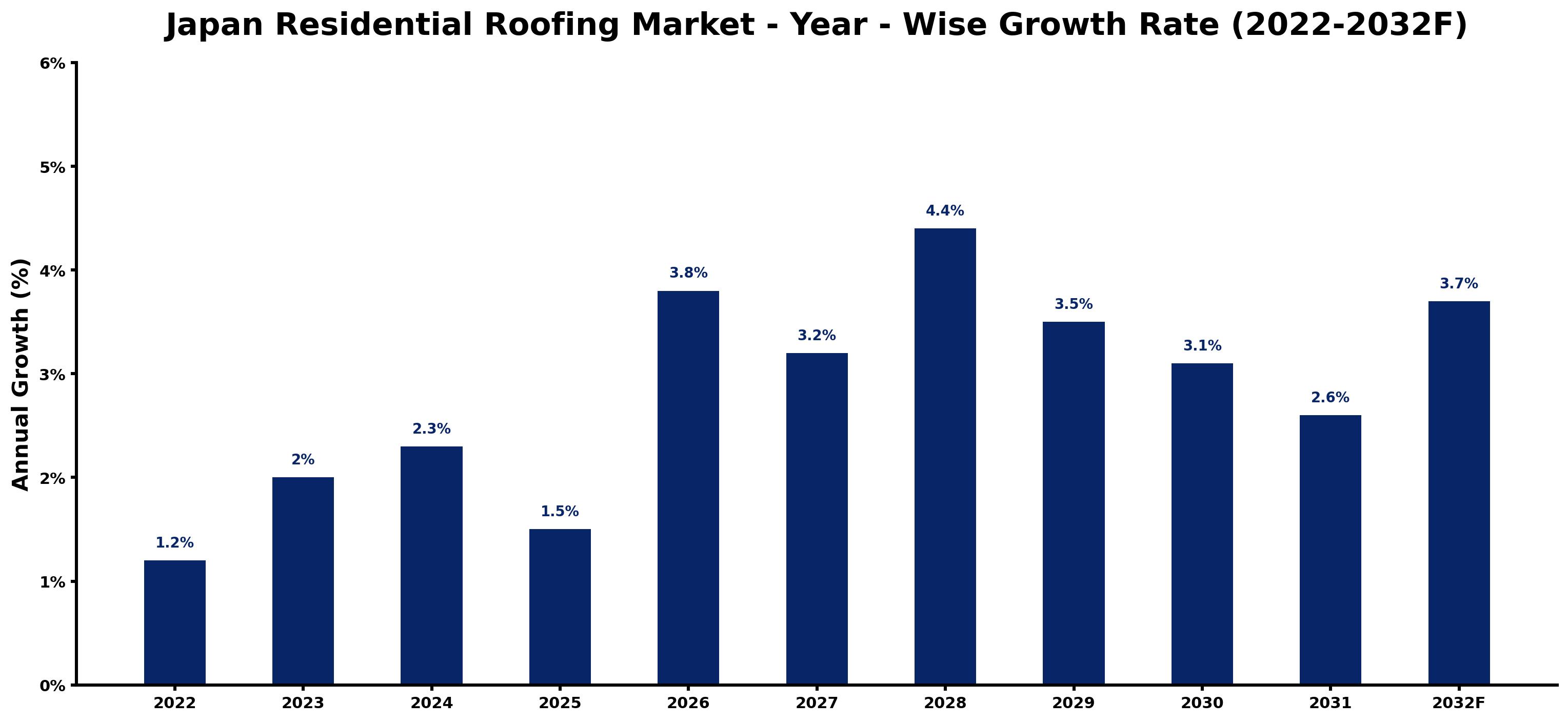
Each row of the following table gives one year's estimated growth and the event or demand shift that explains it.
| Year | Estimated Annual Growth (%) | Market Rationale |
| 2022 | 1.2 | The market showed steady growth as urban housing demand remained strong. |
| 2023 | 2.0 | Growth accelerated due to increased investments in residential construction. |
| 2024 | 2.3 | Demand continued to rise with the adoption of eco-friendly roofing solutions. |
| 2025 | 1.5 | Growth slowed as construction activities faced temporary constraints. |
| 2026 | 3.8 | The market is expected to rebound with heightened interest in sustainable materials. |
| 2027 | 3.2 | Growth is projected to decelerate slightly as supply chain issues affect availability. |
| 2028 | 4.4 | Demand is anticipated to peak as new roofing technologies gain traction. |
| 2029 | 3.5 | Growth will moderate as market saturation begins to set in. |
| 2030 | 3.1 | The market is expected to continue growing as eco-friendly initiatives expand. |
| 2031 | 2.6 | Growth is projected to slow with a focus on cost-effective roofing solutions. |
| 2032 | 3.7 | Demand is expected to rise as urban areas embrace solar roofing. |
Note: Market size estimations and growth projections presented in this report are based on 6Wresearch's proprietary forecasting methodology, utilizing the latest available industry data, government publications, and primary research inputs.
Japan Residential Roofing Market Synopsis
Residential roofing in Japan comprises materials such as asphalt shingles, metal roofing, and clay tiles, which protect homes from weather elements and increase property value. The Japan Residential Roofing Market is expanding due to urban housing developments and eco-friendly initiatives. For instance, the adoption of solar roofing has surged in new constructions, with an increase of 20% since 2022. Eco-friendly homes are projected to constitute 25% of new residential buildings by 2025, supported by initiatives like the solar roof subsidy program in Tokyo.
Market Dynamics Impact Analysis (2026–2032)
| Factor | Type | Impact | Primary Segment Affected |
| Urban housing developments are increasing demand for roofing materials. | Driver | High | Asphalt Shingles |
| The rise in eco-friendly initiatives drives interest in sustainable roofing. | Driver | High | Solar Roofing |
| The growing trend towards energy-efficient homes presents opportunities for suppliers. | Opportunity | High | Eco-Friendly Homes |
| The demand for modern villa designs is creating a niche for premium roofing materials. | Opportunity | Medium | Modern Villas |
| Supply chain disruptions are impacting material availability. | Restraint | High | Metal Roofing |
| The high cost of residential roof replacements is limiting buyer options. | Restraint | Medium | Clay/Concrete Tiles |
| Competition among roofing contractors is intensifying, affecting pricing. | Challenge | High | Bitumen/Fiberglass |
| Technological advancements require continuous investment from suppliers. | Challenge | Medium | Integrated Solar Tiles |
Evaluation of Drivers in Japan Residential Roofing Market (2026–2032)
The table below links each growth driver to the segment it affects and the evidence for it.
| Drivers | Primary Segment Affected | Why It Matters (Evidence) |
| Urban housing demand drives the use of asphalt shingles for cost-effective solutions. | Asphalt Shingles | Asphalt shingles account for 30% of residential roofing in urban areas. |
| The durability of metal roofing attracts buyers in coastal regions. | Metal Roofing | Metal roofing is preferred in coastal regions due to its resistance to corrosion. |
| The increasing popularity of solar roofing aligns with eco-friendly building trends. | Solar Roofing | The use of solar roofing has increased by 20% in new constructions since 2022. |
| Clay tiles are sought after for their long lifespan and aesthetic appeal. | Clay/Concrete Tiles | The average lifespan of clay tiles is over 50 years, making them a long-term investment. |
| Bitumen and fiberglass materials are essential for waterproofing solutions. | Bitumen/Fiberglass | These materials are widely used in asphalt shingle production for effective waterproofing. |
A wider customer base explains much of the growth, as urban housing developments continue to thrive in Tokyo, which has a population of over 14 million. The adoption of eco-friendly roofing materials is rising, with solar roofing usage increasing by 20% in new constructions since 2022. The average lifespan of clay tiles, over 50 years, attracts buyers seeking long-term investments. Metal roofing's durability in coastal regions further boosts its appeal, while the popularity of bitumen and fiberglass materials ensures effective waterproofing solutions in residential applications.
Evaluation of Restraints in Japan Residential Roofing Market
The table below lists the restraints and the evidence behind each.
| Market Restraint | Primary Segment Affected | Why It Matters (Evidence) |
| Supply chain disruptions are hindering the availability of roofing materials. | Metal Roofing | These disruptions have led to delays in project timelines and increased costs. |
| High replacement costs limit consumer options in roofing choices. | Clay/Concrete Tiles | The average cost of a residential roof replacement in Japan is approximately ¥1,500,000. |
| Intense competition among contractors is driving down profit margins. | Bitumen/Fiberglass | This competition affects the pricing strategies of roofing contractors. |
| Market saturation is slowing growth rates in established segments. | Asphalt Shingles | Asphalt shingles dominate but face challenges from emerging materials. |
| Technological advancements require continuous investment from suppliers. | Integrated Solar Tiles | Suppliers must adapt to new technologies to remain competitive. |
Japan Residential Roofing Market Challenges
In urban areas, asphalt shingles account for 30% of residential roofing, leading to fierce competition among contractors who struggle to differentiate themselves. Rising costs of raw materials, especially clay sourced from Kyushu and Shikoku, can elevate the average roof replacement price to ¥1,500,000, imposing financial burdens on homeowners. Supply chain disruptions from natural disasters can delay roofing projects, resulting in contractors missing deadlines and diminishing customer satisfaction. Limited adoption of advanced technologies, such as integrated solar tiles, hampers innovation, restricting buyers' access to modern energy-efficient solutions.
Trends in the Japan Residential Roofing Market
The shifts below are changing how Japan Residential Roofing Market products are bought and supplied.
- Shift from Traditional to Eco-Friendly Roofing: Since 2023, eco-friendly roofing solutions have gained traction, with a notable increase in solar roofing usage in new constructions. This trend is reflected in the Tokyo Metropolitan Government's initiatives promoting sustainable building practices.
- Rise of Integrated Solar Tiles: In 2023, integrated solar tiles have become popular in modern villa designs, reflecting a growing preference for aesthetics and energy efficiency. This trend aligns with projections that eco-friendly homes will constitute 25% of new residential buildings by 2025.
- Transition to Durable Metal Roofing: Since 2022, metal roofing has seen increased adoption in coastal regions due to its corrosion resistance. This shift is evident as more homeowners prioritise long-lasting materials in their roofing choices.
- Growing Demand for Pitched Roofs: In 2022, pitched roofs became the preferred design for effective water drainage in residential buildings. This trend is driven by urban homes, which account for 35% of the market.
Investment Opportunities in the Japan Residential Roofing Market
The opportunities below stand out in the Japan Residential Roofing Market for new entrants and existing suppliers.
- Increased Demand for Eco-Friendly Roofing: With eco-friendly homes projected to make up 25% of new residential buildings by 2025, suppliers should focus on sustainable roofing materials. Urban developers are actively seeking these solutions to meet consumer demand.
- Investment in Modern Villa Roofing Solutions: The modern villa segment is expanding, presenting opportunities for suppliers of premium roofing materials. Urban areas are ideal for partnerships with developers to meet this demand.
- Focus on Durable Roofing Materials: With rising interest in metal roofing, suppliers should invest in high-quality materials. Coastal regions are particularly promising due to their demand for corrosion-resistant options.
- Government Support for Sustainable Roofing: The Economic Security Promotion Act (2022) encourages investments in local production of roofing materials, creating opportunities for suppliers to meet the growing demand for sustainable solutions.
Government Initiatives in the Japan Residential Roofing Market
The Economic Security Promotion Act (2022) supports supply-chain resilience for critical roofing materials, ensuring that producers can maintain consistent quality and availability. This act encourages manufacturers to invest in local production capabilities, benefiting buyers by providing more reliable access to essential materials. Additionally, the Ministry of the Environment oversees the PRTR Law, which requires businesses to report on chemical substances used in roofing materials. This regulation ensures that producers adhere to safety standards, allowing buyers to trust the quality and safety of the products they purchase.
The Ministry of the Environment oversees the PRTR Law, which requires businesses to report on chemical substances used in roofing materials. This regulation ensures that producers adhere to safety standards, allowing buyers to trust the quality and safety of the products they purchase. Furthermore, the Chemical Substances Control Law mandates evaluation and control of new and existing chemical substances in manufacture and import, reinforcing safety and compliance in the industry.
Future Insight of the Japan Residential Roofing Market
By 2032, advancements in solar roofing technology will reshape residential roofing demand as government initiatives encourage the use of photovoltaic panels. Eco-friendly homes are projected to constitute 25% of new residential buildings by 2025, indicating a clear trend towards sustainable construction. The Tokyo Metropolitan Government's solar roof subsidy program will drive homeowners to invest in renewable energy solutions. With the average lifespan of clay tiles exceeding 50 years, suppliers must adapt their offerings to meet the growing preference for long-lasting, energy-efficient roofing materials.
Market Segmentation Analysis
Japan Residential Roofing Market report covers a detailed analysis of the following market segments:
By Roofing Type – Asphalt Shingles Lead, Metal Roofing Expected to Grow Fastest
According to Saurav Kr Singh, Senior Research Analyst at 6Wresearch, Asphalt Shingles held 49% of the Japan Residential Roofing Market by roofing type in 2025. Asphalt shingles dominate the residential roofing market because they are a cost-effective solution widely adopted in urban settings. Their popularity is especially pronounced in Tokyo, where the high demand for reliable roofing solutions drives their usage. Over 2026–2032, Metal Roofing is expected to post the fastest growth, at a CAGR of 5.1%. Metal roofing is experiencing rapid growth due to its durability and low maintenance, particularly in coastal regions where corrosion resistance is crucial. This segment's expansion is further supported by a rising preference for long-lasting materials in new residential developments. Suppliers should focus on enhancing their metal roofing offerings to meet the increasing demand from homeowners.
By Material – Bitumen/Fiberglass Leads, Steel/Aluminum Expected to Grow Fastest
With 38% of material revenue in 2025, Bitumen/Fiberglass was the largest category. Bitumen/fiberglass materials are the leading choice for residential roofing, primarily due to their effectiveness in waterproofing asphalt shingles. This widespread use is supported by the established manufacturing processes that ensure quality and reliability in urban housing. Steel/Aluminum is set to record the highest CAGR in this split, 5.0% over 2026–2032. Steel/aluminium materials are gaining traction rapidly, driven by their strength and lightweight properties, making them ideal for modern roofing applications. The increasing trend towards contemporary architectural designs is propelling their adoption in new constructions. Buyers should consider the advantages of steel and aluminium materials for their roofing needs to benefit from their durability and modern appeal.
By Roof Design – Pitched/Sloped Roofs Lead, Low Slope/Flat Roofs Expected to Grow Fastest
In 2025, Pitched/Sloped Roofs led the roof design split with a 49% share. Pitched/sloped roofs are the dominant design in residential properties, effectively managing water drainage and adapting well to various climatic conditions. This design is especially prevalent in urban areas, where traditional aesthetics are often preserved. Low Slope/Flat Roofs are projected to grow fastest, at a CAGR of 4.8% during 2026–2032. Low slope/flat roofs are gaining traction, particularly in urban environments where maximising space is vital. Their popularity is driven by modern architectural styles that encourage the use of rooftops for gardens and leisure activities. Suppliers need to expand their product lines to include low slope/flat roofing options to cater to the evolving needs of urban homeowners.
By End User – Urban Homes Lead, Modern Villas Expected to Grow Fastest
The largest end user category in 2025 was Urban Homes, at 35% of revenue. Urban homes represent the largest segment of the residential roofing market, reflecting the high population density and ongoing housing developments in cities. This segment drives demand for diverse roofing solutions tailored to urban living conditions. The quickest growth will come from Modern Villas, forecast to expand at a CAGR of 4.6% between 2026 and 2032. Modern villas are the fastest-growing end-user segment, as they often incorporate premium roofing materials and contemporary designs. The increasing affluence and demand for luxury housing are propelling this segment's growth. Suppliers should target the modern villa market with high-quality roofing materials to capture the increasing demand from affluent buyers.
Key Attractiveness of the Report
- 10 Years of Market Numbers
- Historical Data Starting from 2022 to 2025
- Base Year 2025
- Forecast Data until 2032
- Key Performance Indicators Impacting the Market
- Major Upcoming Developments and Projects
Key Highlights of the Report:
- Japan Residential Roofing Market Outlook
- Market Size of Japan Residential Roofing Market, 2025
- Forecast of Japan Residential Roofing Market, 2032
- Historical Data and Forecast of Japan Residential Roofing Revenues & Volume for the Period 2022-2032F
- Japan Residential Roofing Market Trend Evolution
- Japan Residential Roofing Market Drivers and Challenges
- Japan Residential Roofing Price Trends
- Japan Residential Roofing Porter's Five Forces
- Japan Residential Roofing Industry Life Cycle
- Historical Data and Forecast of Japan Residential Roofing Market Revenues & Volume By Roofing Type for the Period 2022-2032F
- Historical Data and Forecast of Japan Residential Roofing Market Revenues & Volume By Asphalt Shingles for the Period 2022-2032F
- Historical Data and Forecast of Japan Residential Roofing Market Revenues & Volume By Metal Roofing for the Period 2022-2032F
- Historical Data and Forecast of Japan Residential Roofing Market Revenues & Volume By Clay/Concrete Tiles for the Period 2022-2032F
- Historical Data and Forecast of Japan Residential Roofing Market Revenues & Volume By Solar Roofing for the Period 2022-2032F
- Historical Data and Forecast of Japan Residential Roofing Market Revenues & Volume By Material for the Period 2022-2032F
- Historical Data and Forecast of Japan Residential Roofing Market Revenues & Volume By Bitumen/Fiberglass for the Period 2022-2032F
- Historical Data and Forecast of Japan Residential Roofing Market Revenues & Volume By Steel/Aluminum for the Period 2022-2032F
- Historical Data and Forecast of Japan Residential Roofing Market Revenues & Volume By Natural Clay/Stone for the Period 2022-2032F
- Historical Data and Forecast of Japan Residential Roofing Market Revenues & Volume By Photovoltaic Panels for the Period 2022-2032F
- Historical Data and Forecast of Japan Residential Roofing Market Revenues & Volume By Roof Design for the Period 2022-2032F
- Historical Data and Forecast of Japan Residential Roofing Market Revenues & Volume By Pitched/Sloped Roofs for the Period 2022-2032F
- Historical Data and Forecast of Japan Residential Roofing Market Revenues & Volume By Low Slope/Flat Roofs for the Period 2022-2032F
- Historical Data and Forecast of Japan Residential Roofing Market Revenues & Volume By Mediterranean Style for the Period 2022-2032F
- Historical Data and Forecast of Japan Residential Roofing Market Revenues & Volume By Integrated Solar Tiles for the Period 2022-2032F
- Historical Data and Forecast of Japan Residential Roofing Market Revenues & Volume By End User for the Period 2022-2032F
- Historical Data and Forecast of Japan Residential Roofing Market Revenues & Volume By Urban Homes for the Period 2022-2032F
- Historical Data and Forecast of Japan Residential Roofing Market Revenues & Volume By Modern Villas for the Period 2022-2032F
- Historical Data and Forecast of Japan Residential Roofing Market Revenues & Volume By Premium Residences for the Period 2022-2032F
- Historical Data and Forecast of Japan Residential Roofing Market Revenues & Volume By Eco-Friendly Homes for the Period 2022-2032F
- Japan Residential Roofing Import Export Trade Statistics
- Market Opportunity Assessment By Roofing Type
- Market Opportunity Assessment By Material
- Market Opportunity Assessment By Roof Design
- Market Opportunity Assessment By End User
- Japan Residential Roofing Top Companies Market Share
- Japan Residential Roofing Competitive Benchmarking By Technical and Operational Parameters
- Japan Residential Roofing Company Profiles
- Japan Residential Roofing Key Strategic Recommendations
Market Covered
This report examines the market across the segments below.
By Roofing Type
- Asphalt Shingles
- Metal Roofing
- Clay/Concrete Tiles
- Solar Roofing
By Material
- Bitumen/Fiberglass
- Steel/Aluminum
- Natural Clay/Stone
- Photovoltaic Panels
By Roof Design
- Pitched/Sloped Roofs
- Low Slope/Flat Roofs
- Mediterranean Style
- Integrated Solar Tiles
By End User
- Urban Homes
- Modern Villas
- Premium Residences
- Eco-Friendly Homes































