Japan Residential Water Filters Market Size & Growth Rate
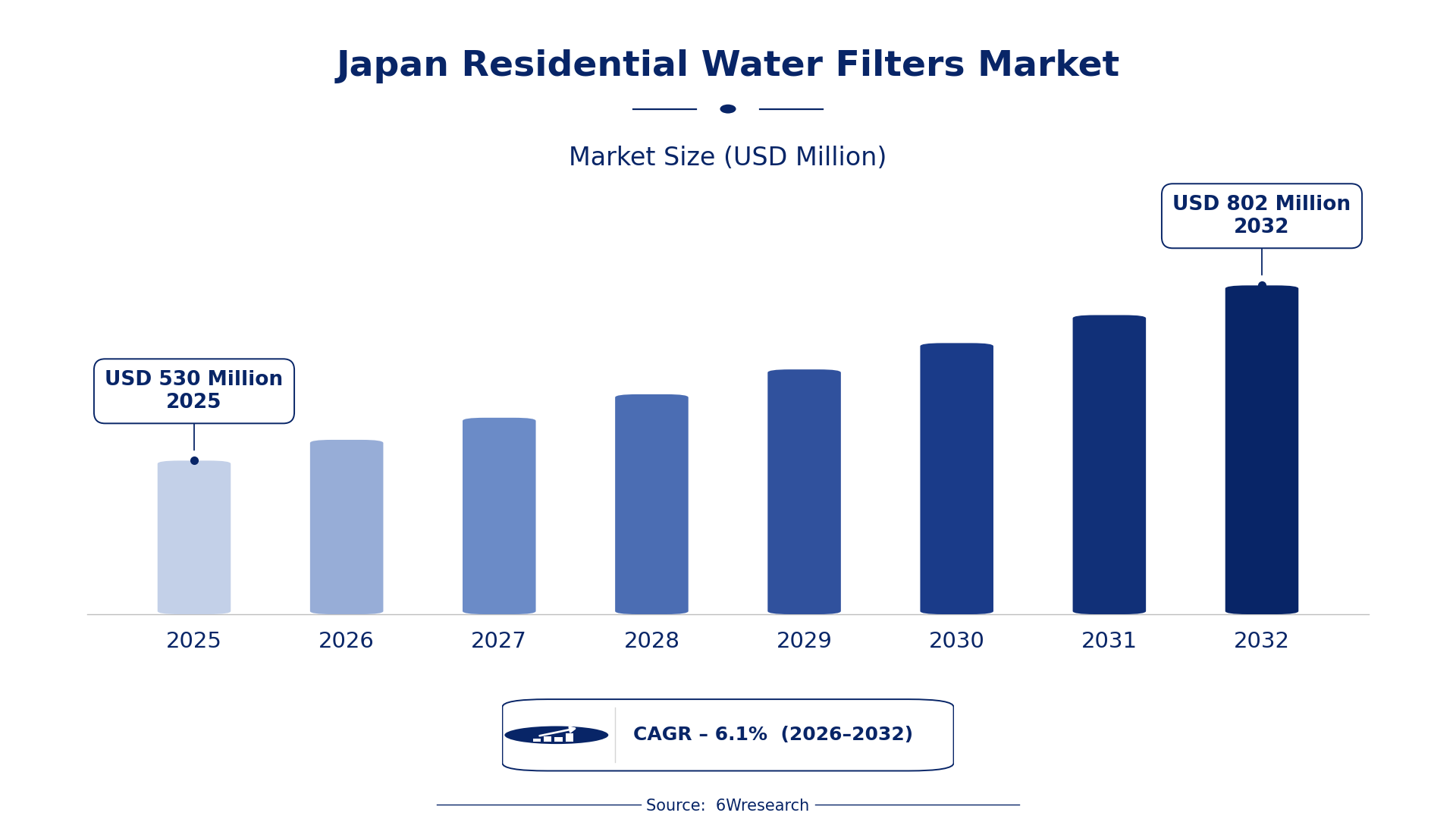
According to 6Wresearch internal database and industry insights, the Japan Residential Water Filters Market was valued at USD 530 Million in 2025 and is projected to reach USD 802 Million by 2032, growing at a CAGR of approximately 6.1% during 2026–2032.
Japan Residential Water Filters Market Highlights
| Report Metric | Details |
| Report Name | Japan Residential Water Filters Market (2026-2032) |
| Market Size 2025 | USD 530 Million |
| Market Size 2032 | USD 802 Million |
| Absolute Growth 2025–2032 | USD 272 Million |
| CAGR 2026–2032 | 6.1% |
| Peak Annual Growth | 7.6% in 2032 |
| Forecast Period | 2026–2032 |
| Historical Data | 2022–2025 |
| Base Year | 2025 |
| Leading Filter Type, 2025 | RO Systems (50% share) |
| Leading Filtration Technology, 2025 | Reverse Osmosis (38% share) |
| Leading Installation Mode, 2025 | Under-the-Sink (44% share) |
| Leading End User, 2025 | Individual Households (37% share) |
| Fastest-Growing Filter Type | UV Filters (8.6% CAGR) |
| Fastest-Growing Filtration Technology | Ultraviolet Sterilization (8.9% CAGR) |
| Fastest-Growing Installation Mode | Point-of-Entry (8.0% CAGR) |
| Fastest-Growing End User | Villas/Independent Homes (8.1% CAGR) |
| Growing Sector | residential water filtration |
| Key End Users | individual households, apartments, villas, independent homes |
Japan Residential Water Filters Market Year-wise Growth Rate and Key Drivers (2022–2032)
This graph illustrates the annual growth rates of the market from 2022 to 2032, highlighting a steady upward trajectory and projected market expansion over the forecast period.
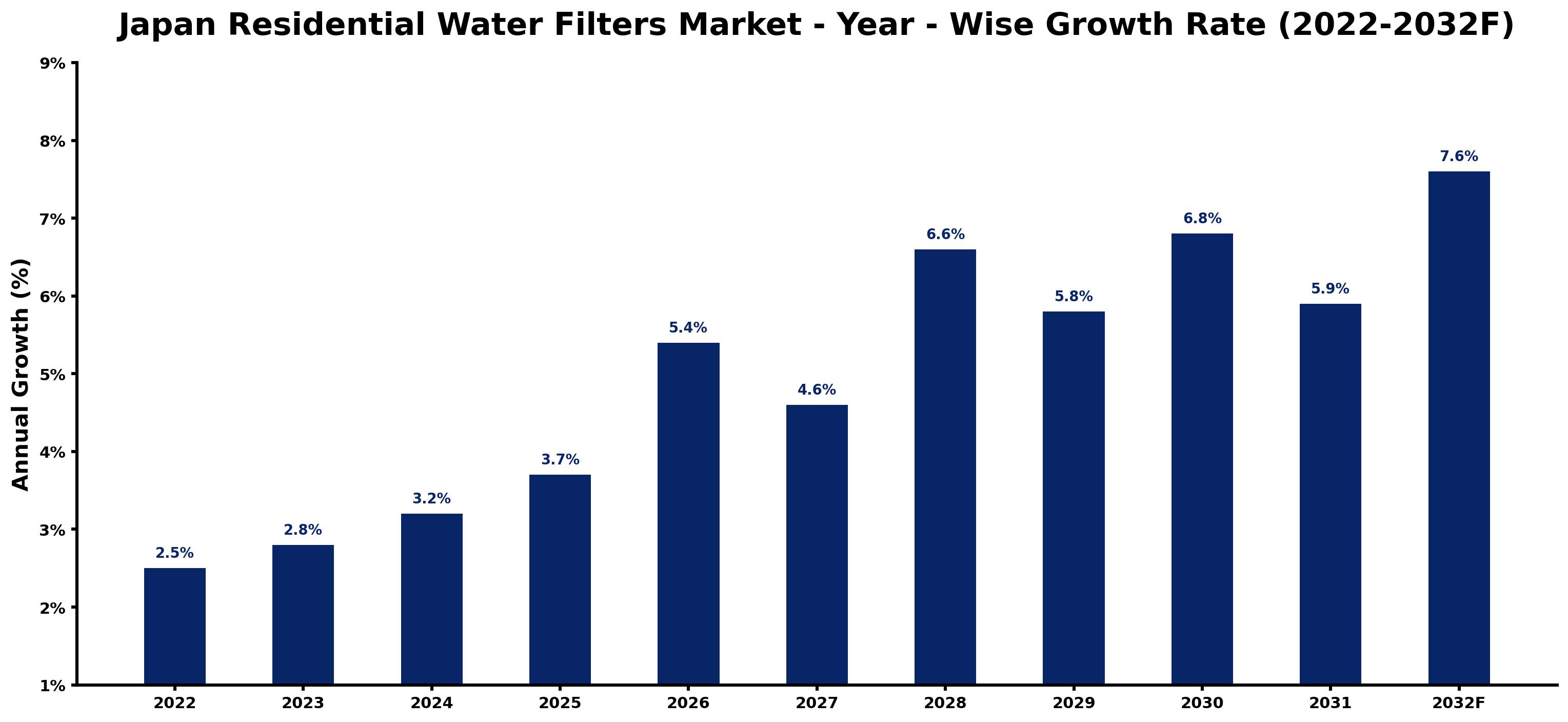
The table below sets out the estimated growth rate for each year and the main factor behind it.
| Year | Estimated Annual Growth (%) | Market Rationale |
| 2022 | 2.5 | Households focused on improving water quality, leading to steady demand for filters. |
| 2023 | 2.8 | Increased awareness of water safety standards boosted filter purchases across urban areas. |
| 2024 | 3.2 | Growing urbanisation in Tokyo and Osaka drove higher demand for residential water filters. |
| 2025 | 3.7 | The rise in hard water issues prompted more households to adopt reverse osmosis systems. |
| 2026 | 5.4 | Heightened public interest in health and safety standards spurred filter adoption. |
| 2027 | 4.6 | Demand stabilised as households adjusted to new filtration technologies and options. |
| 2028 | 6.6 | Consumers increasingly sought advanced filtration solutions, driving overall market growth. |
| 2029 | 5.8 | Market growth moderated as competition intensified among different filtration technologies. |
| 2030 | 6.8 | Technological advancements in filtration systems attracted more buyers seeking efficiency. |
| 2031 | 5.9 | Consumer preferences shifted towards thorough water treatment solutions, sustaining growth. |
| 2032 | 7.6 | The introduction of new safety regulations is expected to drive filter sales significantly. |
Note: Market size estimations and growth projections presented in this report are based on 6Wresearch's proprietary forecasting methodology, utilizing the latest available industry data, government publications, and primary research inputs.
Japan Residential Water Filters Market Synopsis
Residential water filters are essential devices that remove impurities from drinking water, ensuring safety and improving taste. The Japan Residential Water Filters Market is growing due to heightened awareness of water quality, particularly in urban areas like Tokyo and Osaka. Government initiatives, including campaigns promoting water safety and new regulations, are stimulating demand. With the average household spending around 15,000 JPY annually on filtration systems, the market is set to expand significantly in the coming years.
Market Dynamics Impact Analysis (2026–2032)
| Factor | Type | Impact | Primary Segment Affected |
| Growing awareness of water quality standards | Driver | High | Individual Households |
| Increased urbanisation leading to higher demand | Driver | High | Apartments |
| Rising interest in advanced filtration technologies | Opportunity | Medium | Whole-House Systems |
| Government subsidies for low-income households | Opportunity | Medium | Low-Income Homes |
| Limited awareness of filtration options | Restraint | High | Gravity-Based Filters |
| Budget constraints for low-income households | Restraint | High | Low-Income Homes |
| Competition among various filtration technologies | Challenge | Medium | Reverse Osmosis |
| Regulatory compliance costs for producers | Challenge | Medium | UV Filters |
Evaluation of Drivers in Japan Residential Water Filters Market (2026–2032)
The factors lifting demand, and the evidence behind each, are summarised below.
| Drivers | Primary Segment Affected | Why It Matters (Evidence) |
| Increased focus on health and safety | Individual Households | The Ministry of Health, Labour and Welfare promotes water safety standards, leading to more households purchasing filters. |
| Urbanisation in major cities | Apartments | Tokyo and Osaka's growing populations drive demand for residential water filters to ensure clean drinking water. |
| Rising hard water issues in regions | Reverse Osmosis | The prevalence of hard water in certain areas encourages households to invest in reverse osmosis systems for effective purification. |
| Government campaigns promoting water quality | UV Filters | The 2023 campaign raised awareness about water safety, increasing the adoption of UV filtration systems. |
| Consumer preference for thorough solutions | Whole-House Systems | Independent homes are increasingly adopting multi-stage filtration systems for effective water treatment. |
Most of the extra volume comes from the growing focus on health and safety standards, particularly in urban areas where the average household spends around 15,000 JPY annually on water filtration. The rising prevalence of hard water issues in certain regions has led to increased adoption of reverse osmosis systems, which effectively purify drinking water. Campaigns promoting water quality have heightened awareness, particularly for UV filters, which are gaining popularity due to their effectiveness. In independent homes, the preference for thorough solutions has resulted in a shift towards multi-stage filtration systems, improving overall water quality.
Evaluation of Restraints in Japan Residential Water Filters Market
These are the pressures that could keep growth below its potential.
| Market Restraint | Primary Segment Affected | Why It Matters (Evidence) |
| Limited consumer awareness regarding filtration options | Gravity-Based Filters | Many consumers lack knowledge of advanced filtration technologies, which restricts market growth. |
| Budget constraints affecting low-income households | Low-Income Homes | Low-income households often struggle to invest in water filtration systems, impacting overall market demand. |
| High competition among filtration technologies | Reverse Osmosis | Intense competition can lead to price wars, affecting profit margins for producers. |
| Regulatory compliance costs for producers | UV Filters | Producers face costs to comply with safety regulations, impacting pricing strategies. |
| Preference for traditional filtration methods | Gravity-Based Filters | Some consumers still prefer traditional methods, hindering the adoption of advanced filtration systems. |
Japan Residential Water Filters Market Challenges
Limited investment in filtration technology hampers the development of advanced residential water filters, potentially compromising safety for households. This issue arises from inadequate funding for research and development, resulting in outdated products that do not meet consumer expectations. A lack of skilled technicians hinders the installation and maintenance of these systems, causing service delays that elevate costs for buyers. Compliance with new safety regulations increases operational expenses, making quality filtration solutions less accessible for low-income households. Competition from alternative purification methods diverts attention from traditional filters, affecting sales for established manufacturers.
Trends in the Japan Residential Water Filters Market
The shifts below are changing how Japan Residential Water Filters Market products are bought and supplied.
- Shift from Traditional to Advanced Filtration: A noticeable shift from traditional filtration methods to advanced technologies like reverse osmosis is occurring. In 2023, the adoption of these systems increased, particularly in urban households, where the demand for effective purification is high.
- Growing Popularity of UV Filters: The introduction of new UV filtration systems has gained traction in Japan, especially in urban areas. In 2023, their adoption rose by 15%, reflecting a shift towards chemical-free disinfection methods.
- Increase in Whole-House Filtration Systems: The trend towards whole-house filtration systems is growing, particularly in villas and independent homes. In 2023, installations increased by 20%, driven by consumer demand for thorough water treatment solutions.
- Rise of Point-of-Entry Installations: Point-of-entry installations are gaining popularity, particularly in new residential developments. By 2023, this segment saw an 18% increase, highlighting the demand for efficient whole-house filtration.
Investment Opportunities in the Japan Residential Water Filters Market
Several openings in the Japan Residential Water Filters Market merit attention from investors.
- Individual Households Seeking Advanced Solutions: Individual households are increasingly pursuing advanced filtration solutions, with the market for these systems expected to grow. In 2023, the average household expenditure on water filtration was around 15,000 JPY.
- Urban Areas with High Water Quality Concerns: Urban areas like Tokyo present a significant opportunity for suppliers of water filtration systems. With a population of approximately 14 million, the demand for effective solutions is anticipated to rise.
- Villas and Independent Homes Focusing on Quality: Villas and independent homes are prioritising high-quality filtration solutions, creating opportunities for suppliers. The market for whole-house systems is projected to expand as consumers seek thorough treatment.
- Partnerships for Local Distribution: Establishing partnerships with local distributors can facilitate market entry for new filtration technologies. Collaborating with regional agencies can improve brand visibility and consumer trust.
Government Initiatives in the Japan Residential Water Filters Market
The 2023 campaign by the Ministry of Health, Labour and Welfare promotes water quality awareness, reinforcing existing laws like the Water Supply Act (1957) and the Sewerage Act (1958). This initiative ensures consumers have access to cleaner drinking water through improved safety standards for residential water filters.
The Japan Consumer Affairs Agency oversees compliance with regulations that prevent misleading advertising of filtration products. This oversight guarantees that residential water filters meet safety standards and that consumers receive accurate information about their effectiveness.
Future Insight of the Japan Residential Water Filters Market
By 2032, smart monitoring features will transform demand for residential water filters, offering real-time performance insights to users. Government initiatives to raise awareness about water quality will drive consumer interest in advanced filtration technologies. New safety standards set by the Japan Water Quality Association will improve product reliability, instilling greater confidence among buyers. Increased government subsidies will facilitate access to effective filtration solutions for low-income households, promoting widespread adoption across diverse communities.
Market Segmentation Analysis
Japan Residential Water Filters Market report covers a detailed analysis of the following market segments:
By Filter Type – RO Systems Lead, UV Filters Expected to Grow Fastest
According to Saurav Kr Singh, Senior Research Analyst at 6Wresearch, RO Systems held 50% of the Japan Residential Water Filters Market by filter type in 2025. Reverse osmosis systems hold the largest share due to their effectiveness in removing contaminants, making them the preferred choice for urban households in areas like Tokyo. This technology is widely endorsed by health authorities, ensuring a strong installed base among consumers prioritising water safety. UV Filters are projected to grow fastest, at a CAGR of 8.6% during 2026–2032. Ultraviolet filters are experiencing rapid growth as awareness increases about their ability to disinfect water without chemicals, particularly following the government's 2023 campaign on water quality. This trend indicates a shift towards more health-conscious choices among consumers. Suppliers should focus on promoting UV filters to capitalise on this growing demand.
By Filtration Technology – Reverse Osmosis Leads, Ultraviolet Sterilization Expected to Grow Fastest
Reverse Osmosis took 38% of filtration technology revenue in 2025, more than any other category. Reverse osmosis technology dominates the market because of its thorough purification capabilities, which are essential for households facing hard water issues. Its widespread adoption in urban settings illustrates the strong consumer preference for reliable water purification solutions. The quickest growth will come from Ultraviolet Sterilization, forecast to expand at a CAGR of 8.9% between 2026 and 2032. Ultraviolet sterilization is the fastest-growing technology, driven by its effectiveness in killing pathogens, especially as new regulations in 2023 highlight the importance of water safety. This growth suggests a shift in consumer priorities towards health and safety. Manufacturers should invest in UV sterilization technologies to meet the increasing consumer demand.
By Installation Mode – Under-the-Sink Leads, Point-of-Entry Expected to Grow Fastest
The largest installation mode category in 2025 was Under-the-Sink, at 44% of revenue. Under-the-sink installations hold the largest share due to their space-saving design and convenience, particularly appealing in urban areas like Tokyo where kitchen space is limited. This installation mode caters effectively to the needs of individual households seeking efficient water filtration solutions. Over 2026–2032, Point-of-Entry is expected to post the fastest growth, at a CAGR of 8.0%. Point-of-entry systems are growing rapidly as they provide comprehensive filtration for entire homes, meeting the increasing demand for improved water quality. The trend is driven by heightened consumer awareness regarding water safety and the benefits of whole-house filtration. Suppliers should prioritise the development of point-of-entry systems to align with the growing consumer preference for comprehensive water treatment solutions.
By End User – Individual Households Lead, Villas/Independent Homes Expected to Grow Fastest
In 2025, Individual Households led the end user split with a 37% share. Individual households represent the largest segment as they are the main users of residential water filters, motivated by the need for safe drinking water. The average annual spending of around 15,000 JPY underscores their commitment to ensuring high water quality at home. Villas/Independent Homes are set to record the highest CAGR in this split, 8.1% over 2026–2032. Villas and independent homes are experiencing the fastest growth, as owners increasingly seek premium filtration options to enhance their water quality. This trend suggests a willingness to invest in advanced filtration technologies for better health and safety. Suppliers should tailor their offerings to appeal to villa and independent home owners to take advantage of this rapidly expanding market segment.
Key Attractiveness of the Report
- 10 Years of Market Numbers
- Historical Data Starting from 2022 to 2025
- Base Year 2025
- Forecast Data until 2032
- Key Performance Indicators Impacting the Market
- Major Upcoming Developments and Projects
Key Highlights of the Report:
- Japan Residential Water Filters Market Outlook
- Market Size of Japan Residential Water Filters Market, 2025
- Forecast of Japan Residential Water Filters Market, 2032
- Historical Data and Forecast of Japan Residential Water Filters Revenues & Volume for the Period 2022-2032F
- Japan Residential Water Filters Market Trend Evolution
- Japan Residential Water Filters Market Drivers and Challenges
- Japan Residential Water Filters Price Trends
- Japan Residential Water Filters Porter's Five Forces
- Japan Residential Water Filters Industry Life Cycle
- Historical Data and Forecast of Japan Residential Water Filters Market Revenues & Volume By Filter Type for the Period 2022-2032F
- Historical Data and Forecast of Japan Residential Water Filters Market Revenues & Volume By RO Systems for the Period 2022-2032F
- Historical Data and Forecast of Japan Residential Water Filters Market Revenues & Volume By UV Filters for the Period 2022-2032F
- Historical Data and Forecast of Japan Residential Water Filters Market Revenues & Volume By Gravity-Based Filters for the Period 2022-2032F
- Historical Data and Forecast of Japan Residential Water Filters Market Revenues & Volume By Whole-House Systems for the Period 2022-2032F
- Historical Data and Forecast of Japan Residential Water Filters Market Revenues & Volume By Filtration Technology for the Period 2022-2032F
- Historical Data and Forecast of Japan Residential Water Filters Market Revenues & Volume By Reverse Osmosis for the Period 2022-2032F
- Historical Data and Forecast of Japan Residential Water Filters Market Revenues & Volume By Ultraviolet Sterilization for the Period 2022-2032F
- Historical Data and Forecast of Japan Residential Water Filters Market Revenues & Volume By Activated Carbon for the Period 2022-2032F
- Historical Data and Forecast of Japan Residential Water Filters Market Revenues & Volume By Multi-Stage Filtration for the Period 2022-2032F
- Historical Data and Forecast of Japan Residential Water Filters Market Revenues & Volume By Installation Mode for the Period 2022-2032F
- Historical Data and Forecast of Japan Residential Water Filters Market Revenues & Volume By Under-the-Sink for the Period 2022-2032F
- Historical Data and Forecast of Japan Residential Water Filters Market Revenues & Volume By Wall Mounted for the Period 2022-2032F
- Historical Data and Forecast of Japan Residential Water Filters Market Revenues & Volume By Countertop for the Period 2022-2032F
- Historical Data and Forecast of Japan Residential Water Filters Market Revenues & Volume By Point-of-Entry for the Period 2022-2032F
- Historical Data and Forecast of Japan Residential Water Filters Market Revenues & Volume By End User for the Period 2022-2032F
- Historical Data and Forecast of Japan Residential Water Filters Market Revenues & Volume By Individual Households for the Period 2022-2032F
- Historical Data and Forecast of Japan Residential Water Filters Market Revenues & Volume By Apartments for the Period 2022-2032F
- Historical Data and Forecast of Japan Residential Water Filters Market Revenues & Volume By Low-Income Homes for the Period 2022-2032F
- Historical Data and Forecast of Japan Residential Water Filters Market Revenues & Volume By Villas/Independent Homes for the Period 2022-2032F
- Japan Residential Water Filters Import Export Trade Statistics
- Market Opportunity Assessment By Filter Type
- Market Opportunity Assessment By Filtration Technology
- Market Opportunity Assessment By Installation Mode
- Market Opportunity Assessment By End User
- Japan Residential Water Filters Top Companies Market Share
- Japan Residential Water Filters Competitive Benchmarking By Technical and Operational Parameters
- Japan Residential Water Filters Company Profiles
- Japan Residential Water Filters Key Strategic Recommendations
Market Covered
This report examines the market across the segments below.
By Filter Type
- RO Systems
- UV Filters
- Gravity-Based Filters
- Whole-House Systems
By Filtration Technology
- Reverse Osmosis
- Ultraviolet Sterilization
- Activated Carbon
- Multi-Stage Filtration
By Installation Mode
- Under-the-Sink
- Wall Mounted
- Countertop
- Point-of-Entry
By End User
- Individual Households
- Apartments
- Low-Income Homes
- Villas/Independent Homes































