Japan Residential Wi-Fi Systems Market Size & Growth Rate
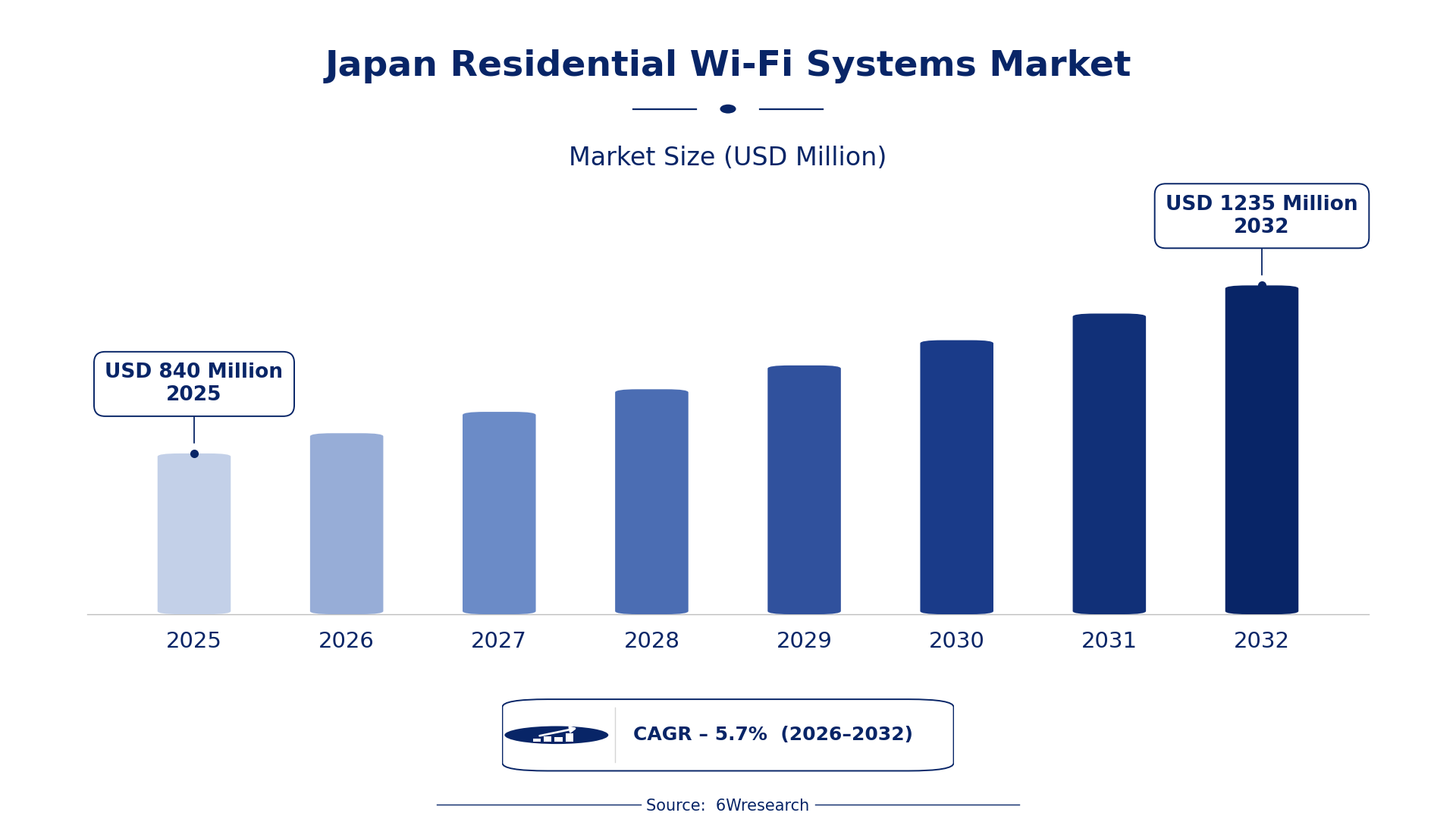
According to 6Wresearch internal database and industry insights, the Japan Residential Wi-Fi Systems Market was valued at USD 840 Million in 2025 and is projected to reach USD 1,235 Million by 2032, growing at a CAGR of approximately 5.7% during 2026–2032.
Japan Residential Wi-Fi Systems Market Highlights
| Report Metric | Details |
| Report Name | Japan Residential Wi-Fi Systems Market (2026-2032) |
| Market Size 2025 | USD 840 Million |
| Market Size 2032 | USD 1,235 Million |
| Absolute Growth 2025–2032 | USD 395 Million |
| CAGR 2026–2032 | 5.7% |
| Peak Annual Growth | 6.7% in 2026 |
| Forecast Period | 2026–2032 |
| Historical Data | 2022–2025 |
| Base Year | 2025 |
| Leading System Type, 2025 | Mesh Wi-Fi Systems (49% share) |
| Leading Frequency Band, 2025 | Dual/Triband (54% share) |
| Leading Network Mode, 2025 | Mesh/Seamless Roaming (43% share) |
| Leading End User, 2025 | Large Residences (39% share) |
| Fastest-Growing System Type | Wi-Fi 6 Routers (7.8% CAGR) |
| Fastest-Growing Network Mode | High-Speed Streaming (7.2% CAGR) |
| Fastest-Growing End User | Smart Home Users (7.3% CAGR) |
| Growing Sector | Residential Connectivity Solutions |
| Key End Users | Homeowners, Smart Home Users, Internet Service Providers |
Japan Residential Wi-Fi Systems Market Year-wise Growth Rate and Key Drivers (2022–2032)
This graph illustrates the annual growth rates of the market from 2022 to 2032, highlighting a steady upward trajectory and projected market expansion over the forecast period.
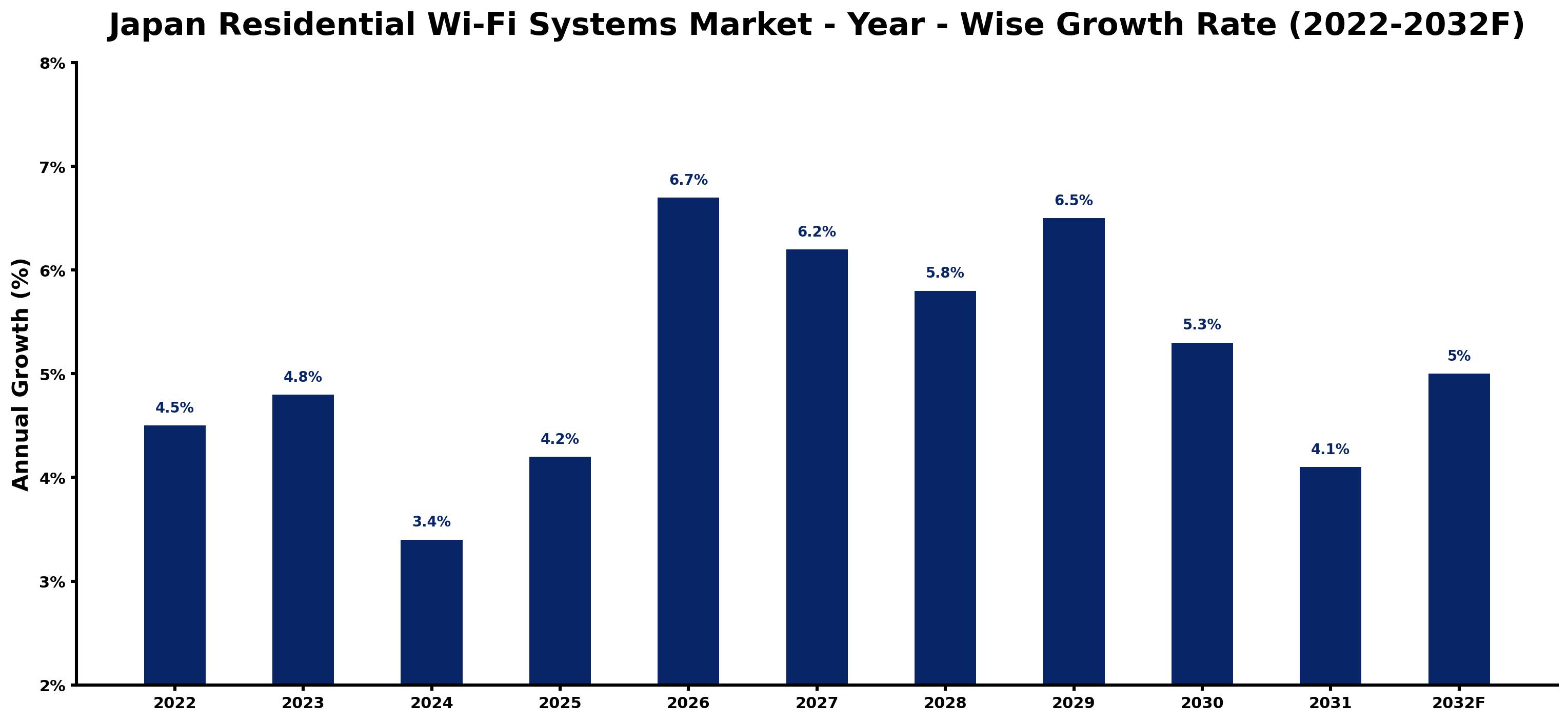
For each year, the table pairs the estimated growth rate with the leading influence on demand, showing how the drivers changed across the period.
| Year | Estimated Annual Growth (%) | Market Rationale |
| 2022 | 4.5 | The market exhibited steady growth, reflecting strong demand for home internet connectivity. |
| 2023 | 4.8 | Growth accelerated due to increased broadband subscriptions and smart home adoption. |
| 2024 | 3.4 | The market experienced a slowdown as competition intensified among providers. |
| 2025 | 4.2 | Demand rose again with the introduction of advanced Wi-Fi technologies. |
| 2026 | 6.7 | The peak growth year is expected to be driven by widespread adoption of Wi-Fi 6 routers. |
| 2027 | 6.2 | Growth will moderate slightly as market saturation begins to take effect. |
| 2028 | 5.8 | The market is projected to continue growing, supported by ongoing smart home integration. |
| 2029 | 6.5 | Demand will surge again, driven by urban areas requiring effective solutions. |
| 2030 | 5.3 | Growth is anticipated to slow as the market matures and competition intensifies further. |
| 2031 | 4.1 | A decrease in growth rate is expected as customer needs stabilise. |
| 2032 | 5.0 | The market is projected to grow steadily, driven by new technology adoption. |
Note: Market size estimations and growth projections presented in this report are based on 6Wresearch's proprietary forecasting methodology, utilizing the latest available industry data, government publications, and primary research inputs.
Japan Residential Wi-Fi Systems Market Synopsis
Residential Wi-Fi systems provide wireless internet connectivity in homes, utilising advanced networking components such as routers and access points. The Japan Residential Wi-Fi Systems Market is expanding, driven by over 40 million broadband subscriptions and a rise in smart home device sales projected to reach 15 million units by 2025. Urban areas, particularly Tokyo, are key demand sources, accounting for 30% of the market, while the adoption of Wi-Fi 6 technology is increasing at a rate of 20% annually.
Market Dynamics Impact Analysis (2026–2032)
| Factor | Type | Impact | Primary Segment Affected |
| Growing demand for smart home devices | Driver | High | Smart Home Users |
| Increase in broadband subscriptions | Driver | High | Large Residences |
| Emerging demand for seamless coverage in urban areas | Opportunity | High | Mesh Wi-Fi Systems |
| Rising need for high-speed internet access | Opportunity | Medium | Wi-Fi 6 Routers |
| Intense competition among providers | Restraint | High | Gateway Modem-Routers |
| Market saturation in urban regions | Restraint | Medium | Extenders/Boosters |
| High costs of advanced technology integration | Challenge | High | Wi-Fi 6 Routers |
| Regulatory compliance challenges for new products | Challenge | Medium | Mesh Wi-Fi Systems |
Evaluation of Drivers in Japan Residential Wi-Fi Systems Market (2026–2032)
The main growth drivers and the segments they affect most are set out below.
| Drivers | Primary Segment Affected | Why It Matters (Evidence) |
| Increase in smart home device adoption | Smart Home Users | The total number of smart home users in Japan is around 5 million, driving demand for compatible Wi-Fi systems. |
| Expansion of broadband subscriptions | Large Residences | In 2023, there are over 40 million broadband subscriptions, leading to higher demand for residential Wi-Fi. |
| Urbanisation driving demand for effective coverage | Mesh Wi-Fi Systems | Urban areas see a higher demand for mesh systems due to dense living conditions, improving connectivity. |
| Growing need for high-speed internet | Wi-Fi 6 Routers | The average internet speed in Japan is 100 Mbps, supporting high-speed streaming and multiple devices. |
| Technological advancements in networking | Gateway Modem-Routers | Wi-Fi 6 technology adoption in residential areas is increasing by 20% annually, improving user experience. |
The strongest pull on demand comes from the increasing adoption of smart home devices, with approximately 5 million users in Japan seeking compatible Wi-Fi systems. Over 40 million broadband subscriptions in 2023 have led to a surge in demand for residential Wi-Fi solutions, particularly in large residences. Urbanisation has heightened the need for effective coverage, driving interest in mesh Wi-Fi systems, especially in densely populated areas. The average internet speed of 100 Mbps supports high-speed streaming, creating a need for advanced routers, which are being adopted at a rate of 20% annually. Technological advancements in networking are further improving the user experience, resulting in a notable rise in gateway modem-routers.
Evaluation of Restraints in Japan Residential Wi-Fi Systems Market
The main factors holding the market back are set out below.
| Market Restraint | Primary Segment Affected | Why It Matters (Evidence) |
| Intense competition among providers | Gateway Modem-Routers | With numerous providers in the market, price wars are reducing profit margins for manufacturers. |
| Market saturation in urban regions | Extenders/Boosters | In urban areas, the availability of various Wi-Fi solutions limits growth potential for extenders. |
| High costs of advanced technology integration | Wi-Fi 6 Routers | The integration of advanced technologies raises production costs, impacting pricing strategies. |
| Regulatory compliance challenges for new products | Mesh Wi-Fi Systems | New regulations require extensive testing and certification, delaying product launches. |
| Consumer reluctance to upgrade existing systems | Dual/Triband | Many consumers are satisfied with their current systems, limiting the market for new dual/triband products. |
Japan Residential Wi-Fi Systems Market Challenges
In Japan, over 40 million broadband subscriptions highlight a technology gap, as many homes still use outdated equipment, causing delays in internet access for users. A skills shortage exists among service providers, with only 5 million smart home users, limiting their ability to install and optimise advanced Wi-Fi solutions and resulting in extended service delays. Regulatory challenges arise from compliance with the JIS X 5071 standard, increasing production costs for manufacturers, which are ultimately passed on to buyers. Urban areas experience supply chain disruptions, particularly for mesh systems, leading to product availability delays for consumers in densely populated regions.
Trends in the Japan Residential Wi-Fi Systems Market
The shifts below are changing how Japan Residential Wi-Fi Systems Market products are bought and supplied.
- Adoption of Mesh Wi-Fi Systems: Urban areas are increasingly adopting mesh Wi-Fi systems to ensure effective coverage across large spaces. In 2023, demand for these systems surged due to the need for reliable connectivity in densely populated regions.
- Growth of Wi-Fi 6 Technology: Since 2023, Wi-Fi 6 technology has gained traction in residential areas, with adoption increasing by 20% annually. This shift is driven by the need for faster internet speeds and improved capacity for multiple devices.
- Demand for High-Speed Streaming: The average household in Japan has 10 connected devices requiring Wi-Fi, leading to a growing need for high-speed streaming solutions. This trend reflects the increasing importance of uninterrupted video and gaming experiences.
- Integration of Smart Home Devices: Smart home device sales are projected to reach 15 million units by 2025, driving demand for compatible Wi-Fi systems. This integration improves user convenience and promotes the adoption of advanced networking technologies.
Investment Opportunities in the Japan Residential Wi-Fi Systems Market
Where to invest in the Japan Residential Wi-Fi Systems Market: the main openings are set out below.
- Collaborations with local ISPs: Now is the time to form partnerships with local ISPs to supply residential Wi-Fi systems, as broadband subscriptions exceed 40 million. Collaborating with ISPs can facilitate access to a broader customer base.
- Investment in urban mesh systems: With urban areas experiencing higher demand for effective coverage, investing in mesh Wi-Fi systems is timely. The Kanto region, accounting for 40% of sales, presents a prime opportunity for suppliers.
- Focus on high-speed internet solutions: The average internet speed of 100 Mbps indicates a gap in high-speed solutions. Suppliers should focus on providing advanced Wi-Fi routers to meet this growing demand.
- Expansion into smart home integrations: As smart home device sales are projected to reach 15 million units by 2025, suppliers should invest in systems that integrate effectively with these devices, improving user experience.
Government Initiatives in the Japan Residential Wi-Fi Systems Market
The Act against Unjustifiable Premiums and Misleading Representations, enacted in 1962, prohibits misleading labelling and advertising of goods, ensuring that residential Wi-Fi systems are accurately represented to consumers. The Industrial Standardization Act, originally established in 1949 and amended in 2019, governs Japanese Industrial Standards, including those applicable to wireless LAN devices, ensuring quality and safety in the market.
In 2023, the government initiated a program to subsidise broadband installation in rural areas, aiming to improve access to high-speed internet. The Ministry of Internal Affairs and Communications oversees this initiative, funding projects to enhance broadband infrastructure and support residential Wi-Fi system adoption.
Future Insight of the Japan Residential Wi-Fi Systems Market
Households will increasingly require Wi-Fi 6 technology, which supports connectivity for an average of 10 devices. By 2032, smart home device sales are projected to reach 15 million units, driving demand for advanced residential Wi-Fi solutions. The government's broadband installation subsidy programme will improve access in rural areas, providing buyers with more reliable internet options. Urban areas will see a rise in mesh system installations, enhancing connectivity in densely populated environments and meeting the needs of modern households.
Market Segmentation Analysis
Japan Residential Wi-Fi Systems Market report covers a detailed analysis of the following market segments:
By System Type – Mesh Wi-Fi Systems Lead, Wi-Fi 6 Routers Expected to Grow Fastest
According to Saurav Kr Singh, Senior Research Analyst at 6Wresearch, Mesh Wi-Fi Systems held 49% of the Japan Residential Wi-Fi Systems Market by system type in 2025. Mesh Wi-Fi Systems dominate the market as they provide seamless coverage across large areas, making them ideal for homes with multiple floors. This is particularly beneficial in urban areas like Tokyo, where reliable connectivity is essential for residents. Wi-Fi 6 Routers are set to record the highest CAGR in this split, 7.8% over 2026–2032. Wi-Fi 6 Routers are experiencing rapid growth due to their ability to offer improved speed and capacity for multiple devices, which is increasingly important as households connect more devices. The average home has around 10 devices, driving this demand. Suppliers should focus on enhancing Wi-Fi 6 offerings to meet the rising consumer demand.
By Frequency Band – Dual/Triband Leads and Records the Fastest Growth
Dual/Triband took 54% of frequency band revenue in 2025, more than any other category. Dual/Triband systems dominate the market as they support multiple devices with minimal interference, which is vital for households with many connected devices. This is especially important in densely populated urban settings where connectivity needs are high. Dual/Triband is also forecast to expand faster than any other category, at a CAGR of 7.4% over 2026–2032. The growth of Dual/Triband is fuelled by its capability to manage high traffic from various devices simultaneously, ensuring optimal performance in smart homes. As the number of connected devices continues to rise, this technology will remain essential. Buyers will gain from investing in Dual/Triband systems for reliable connectivity across numerous devices.
By Network Mode – Mesh/Seamless Roaming Leads, High-Speed Streaming Expected to Grow Fastest
In 2025, Mesh/Seamless Roaming led the network mode split with a 43% share. Mesh/Seamless Roaming leads the segment because it allows devices to switch between access points seamlessly, ensuring consistent connectivity throughout larger homes. This feature is particularly appealing to users who require uninterrupted internet access in various rooms. High-Speed Streaming is projected to grow fastest, at a CAGR of 7.2% during 2026–2032. High-Speed Streaming is gaining importance as it is crucial for uninterrupted video and gaming experiences, especially with the rise in online content consumption. The growing demand for high-definition streaming services propels this growth. Suppliers must prioritise features that enhance streaming capabilities to align with consumer expectations.
By End User – Large Residences Lead, Smart Home Users Expected to Grow Fastest
Large Residences accounted for 39% of the market by end user in 2025. Large Residences hold the largest segment as they require robust systems for extensive coverage, accommodating the high number of connected devices typically found in these homes. The trend towards larger living spaces in urban areas further supports this demand. The quickest growth will come from Smart Home Users, forecast to expand at a CAGR of 7.3% between 2026 and 2032. Smart Home Users are the fastest-growing segment due to the integration of Wi-Fi systems with smart devices for automation, reflecting the rising popularity of smart home technologies. With smart home device sales projected to reach 15 million units by 2025, this segment is set to expand further. Suppliers should tailor their products to cater to the specific needs of smart home users to capture this growing market.
Key Attractiveness of the Report
- 10 Years of Market Numbers
- Historical Data Starting from 2022 to 2025
- Base Year 2025
- Forecast Data until 2032
- Key Performance Indicators Impacting the Market
- Major Upcoming Developments and Projects
Key Highlights of the Report:
- Japan Residential Wi-Fi Systems Market Outlook
- Market Size of Japan Residential Wi-Fi Systems Market, 2025
- Forecast of Japan Residential Wi-Fi Systems Market, 2032
- Historical Data and Forecast of Japan Residential Wi-Fi Systems Revenues & Volume for the Period 2022-2032F
- Japan Residential Wi-Fi Systems Market Trend Evolution
- Japan Residential Wi-Fi Systems Market Drivers and Challenges
- Japan Residential Wi-Fi Systems Price Trends
- Japan Residential Wi-Fi Systems Porter's Five Forces
- Japan Residential Wi-Fi Systems Industry Life Cycle
- Historical Data and Forecast of Japan Residential Wi-Fi Systems Market Revenues & Volume By System Type for the Period 2022-2032F
- Historical Data and Forecast of Japan Residential Wi-Fi Systems Market Revenues & Volume By Mesh Wi-Fi Systems for the Period 2022-2032F
- Historical Data and Forecast of Japan Residential Wi-Fi Systems Market Revenues & Volume By Wi-Fi 6 Routers for the Period 2022-2032F
- Historical Data and Forecast of Japan Residential Wi-Fi Systems Market Revenues & Volume By Extenders/Boosters for the Period 2022-2032F
- Historical Data and Forecast of Japan Residential Wi-Fi Systems Market Revenues & Volume By Gateway Modem-Routers for the Period 2022-2032F
- Historical Data and Forecast of Japan Residential Wi-Fi Systems Market Revenues & Volume By Frequency Band for the Period 2022-2032F
- Historical Data and Forecast of Japan Residential Wi-Fi Systems Market Revenues & Volume By Dual/Triband for the Period 2022-2032F
- Historical Data and Forecast of Japan Residential Wi-Fi Systems Market Revenues & Volume By 2.4 GHz / 5 GHz / 6 GHz for the Period 2022-2032F
- Historical Data and Forecast of Japan Residential Wi-Fi Systems Market Revenues & Volume By 2.4 GHz for the Period 2022-2032F
- Historical Data and Forecast of Japan Residential Wi-Fi Systems Market Revenues & Volume By Broadband Integration for the Period 2022-2032F
- Historical Data and Forecast of Japan Residential Wi-Fi Systems Market Revenues & Volume By Network Mode for the Period 2022-2032F
- Historical Data and Forecast of Japan Residential Wi-Fi Systems Market Revenues & Volume By Mesh/Seamless Roaming for the Period 2022-2032F
- Historical Data and Forecast of Japan Residential Wi-Fi Systems Market Revenues & Volume By High-Speed Streaming for the Period 2022-2032F
- Historical Data and Forecast of Japan Residential Wi-Fi Systems Market Revenues & Volume By Repeater Mode for the Period 2022-2032F
- Historical Data and Forecast of Japan Residential Wi-Fi Systems Market Revenues & Volume By ISP Bundled for the Period 2022-2032F
- Historical Data and Forecast of Japan Residential Wi-Fi Systems Market Revenues & Volume By End User for the Period 2022-2032F
- Historical Data and Forecast of Japan Residential Wi-Fi Systems Market Revenues & Volume By Large Residences for the Period 2022-2032F
- Historical Data and Forecast of Japan Residential Wi-Fi Systems Market Revenues & Volume By Smart Home Users for the Period 2022-2032F
- Historical Data and Forecast of Japan Residential Wi-Fi Systems Market Revenues & Volume By Multi-Floor Houses for the Period 2022-2032F
- Historical Data and Forecast of Japan Residential Wi-Fi Systems Market Revenues & Volume By Urban Apartments for the Period 2022-2032F
- Japan Residential Wi-Fi Systems Import Export Trade Statistics
- Market Opportunity Assessment By System Type
- Market Opportunity Assessment By Frequency Band
- Market Opportunity Assessment By Network Mode
- Market Opportunity Assessment By End User
- Japan Residential Wi-Fi Systems Top Companies Market Share
- Japan Residential Wi-Fi Systems Competitive Benchmarking By Technical and Operational Parameters
- Japan Residential Wi-Fi Systems Company Profiles
- Japan Residential Wi-Fi Systems Key Strategic Recommendations
Market Covered
This report examines the market across the segments below.
By System Type
- Mesh Wi-Fi Systems
- Wi-Fi 6 Routers
- Extenders/Boosters
- Gateway Modem-Routers
By Frequency Band
- Dual/Triband
- 2.4 GHz / 5 GHz / 6 GHz
- 2.4 GHz
- Broadband Integration
By Network Mode
- Mesh/Seamless Roaming
- High-Speed Streaming
- Repeater Mode
- ISP Bundled
By End User
- Large Residences
- Smart Home Users
- Multi-Floor Houses
- Urban Apartments































