Japan Resource Allocation AI Market Size & Growth Rate
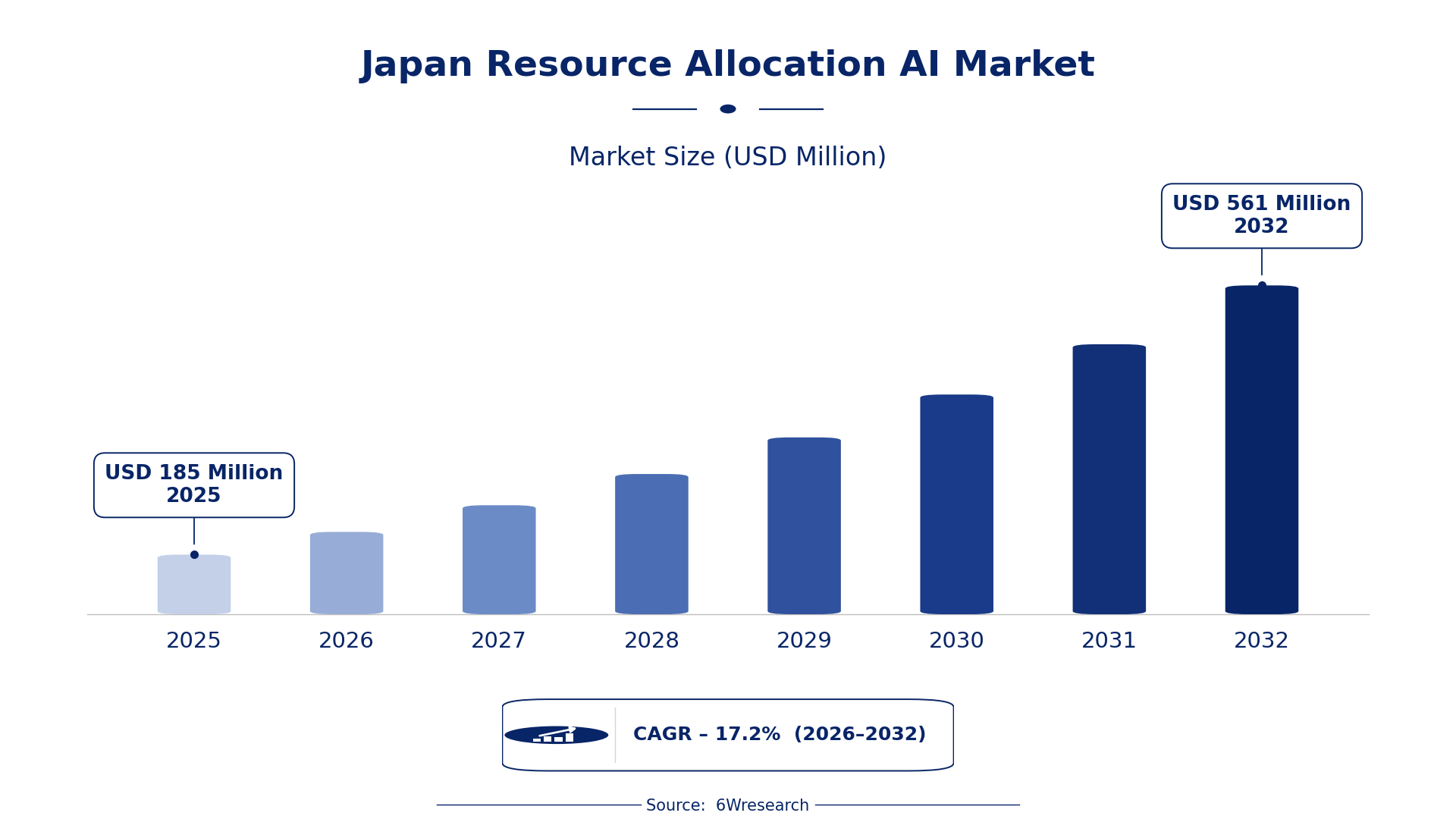
According to 6Wresearch internal database and industry insights, the Japan Resource Allocation AI Market was valued at USD 185 Million in 2025 and is projected to reach USD 561 Million by 2032, growing at a CAGR of approximately 17.2% during 2026–2032.
Japan Resource Allocation AI Market Highlights
| Report Metric | Details |
| Report Name | Japan Resource Allocation AI Market (2026-2032) |
| Market Size 2025 | USD 185 Million |
| Market Size 2032 | USD 561 Million |
| Absolute Growth 2025–2032 | USD 376 Million |
| CAGR 2026–2032 | 17.2% |
| Peak Annual Growth | 19.5% in 2032 |
| Forecast Period | 2026–2032 |
| Historical Data | 2022–2025 |
| Base Year | 2025 |
| Leading AI Application, 2025 | Healthcare Scheduling (39% share) |
| Leading Domain, 2025 | Doctor/Nurse Allocation (46% share) |
| Leading Optimization Method, 2025 | Predictive Analytics (39% share) |
| Leading End User, 2025 | Hospitals/Clinics (45% share) |
| Fastest-Growing AI Application | Cloud Resource Mgmt (19.3% CAGR) |
| Fastest-Growing Domain | Data Center Load Balancing (23.6% CAGR) |
| Fastest-Growing Optimization Method | Dynamic Scaling (18.2% CAGR) |
| Fastest-Growing End User | IT Companies (22.6% CAGR) |
| Growing Sector | Healthcare |
| Key End Users | Hospitals, IT Companies, Manufacturing Firms, Telecom Providers |
Japan Resource Allocation AI Market Year-wise Growth Rate and Key Drivers (2022–2032)
This graph illustrates the annual growth rates of the market from 2022 to 2032, highlighting a steady upward trajectory and projected market expansion over the forecast period.
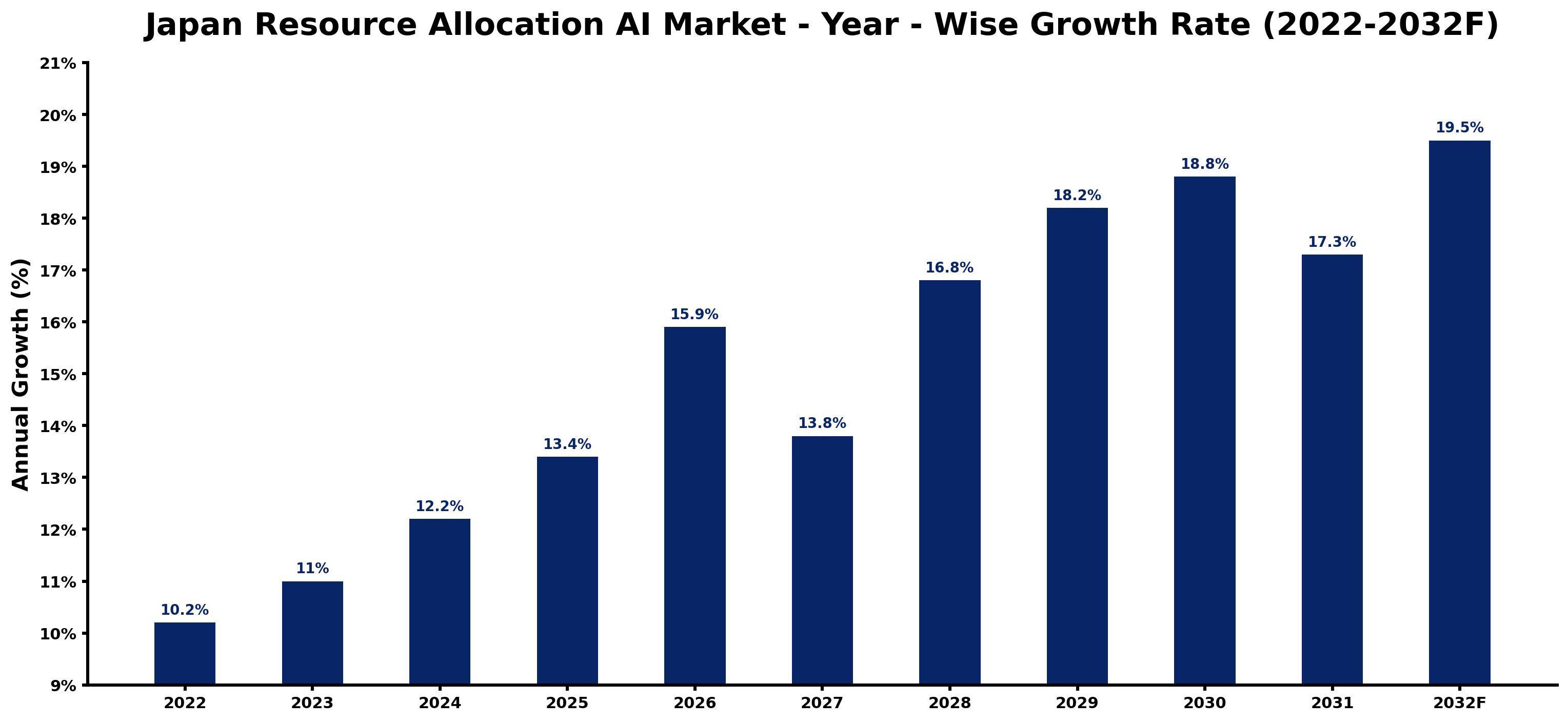
The following figures match every annual growth estimate with the main market development of that year, giving the reasoning behind each rise or slowdown.
| Year | Estimated Annual Growth (%) | Market Rationale |
| 2022 | 10.2 | The market experienced steady growth due to increasing adoption of AI technologies. |
| 2023 | 11.0 | Demand accelerated as more hospitals integrated AI for scheduling efficiency. |
| 2024 | 12.2 | The healthcare sector expanded its AI capabilities, driving further investments. |
| 2025 | 13.4 | Healthcare AI initiatives gained momentum, improving operational efficiency across facilities. |
| 2026 | 15.9 | Investment in AI technologies surged, particularly in healthcare and IT sectors. |
| 2027 | 13.8 | Growth slowed as the market matured, but demand for optimization remained strong. |
| 2028 | 16.8 | Healthcare and IT sectors continued to adopt AI, boosting market performance. |
| 2029 | 18.2 | Increased focus on resource allocation in manufacturing spurred demand for AI. |
| 2030 | 18.8 | Investment in AI technologies remained strong, particularly in cloud management. |
| 2031 | 17.3 | The market experienced a slowdown as growth stabilised in established sectors. |
| 2032 | 19.5 | Demand peaked as healthcare and IT sectors fully embraced AI solutions. |
Note: Market size estimations and growth projections presented in this report are based on 6Wresearch's proprietary forecasting methodology, utilizing the latest available industry data, government publications, and primary research inputs.
Japan Resource Allocation AI Market Synopsis
Resource Allocation AI optimises resource distribution across sectors using algorithms and data analytics. In Japan, over 8,000 hospitals are employing this technology to improve healthcare scheduling and efficiency. The growing demand for AI in healthcare, manufacturing, and IT sectors stems from the need for operational efficiency and resource management. With substantial investments anticipated in AI technologies, the Japan Resource Allocation AI Market is poised for considerable growth, particularly in healthcare and cloud resource management.
Market Dynamics Impact Analysis (2026–2032)
| Factor | Type | Impact | Primary Segment Affected |
| Increasing adoption of AI in healthcare scheduling | Driver | High | Healthcare Scheduling |
| Growing investments in AI technologies by the manufacturing sector | Driver | High | Manufacturing Planning |
| Expansion of AI applications in data centers | Opportunity | High | Cloud Resource Mgmt |
| Rising demand for optimized telecom networks | Opportunity | Medium | Telecom Network AI |
| Concerns over data privacy and security in AI applications | Restraint | High | Cloud Resource Mgmt |
| Limited awareness of AI benefits among smaller healthcare facilities | Restraint | Medium | Healthcare Scheduling |
| High initial investment costs for AI implementation | Challenge | High | Manufacturing Planning |
| Shortage of skilled personnel in AI and data analytics | Challenge | Medium | Telecom Network AI |
Evaluation of Drivers in Japan Resource Allocation AI Market (2026–2032)
Key forces behind demand, with the segment each one moves most, are listed below.
| Drivers | Primary Segment Affected | Why It Matters (Evidence) |
| Integration of AI in healthcare operations | Healthcare Scheduling | Over 8,000 hospitals in Japan are adopting AI, improving patient management and resource allocation. |
| Investment in AI technologies for production efficiency | Manufacturing Planning | The manufacturing sector is projected to invest 1 trillion yen in AI technologies by 2025. |
| Adoption of AI for cloud resource optimization | Cloud Resource Mgmt | Over 70% of data centers in Japan are expected to adopt AI for load balancing by 2025. |
| Demand for improved network performance in telecom | Telecom Network AI | Support for AI development in telecom sectors is increasing, driving further adoption. |
| Utilization of predictive analytics for patient management | Healthcare Scheduling | Predictive analytics is increasingly used in healthcare to support decision-making processes. |
A wider customer base explains much of the growth, as over 8,000 hospitals in Japan are integrating AI for scheduling, improving patient flow and resource management. The manufacturing sector is projected to invest 1 trillion yen in AI technologies by 2025, driving efficiency in production processes. More than 70% of data centers are expected to adopt AI for load balancing, enhancing performance and resource allocation. Demand for better network performance in telecom is rising, leading to increased AI adoption. The growing use of predictive analytics in healthcare facilitates improved patient management and operational efficiency.
Evaluation of Restraints in Japan Resource Allocation AI Market
The following restraints limit how fast demand can grow.
| Market Restraint | Primary Segment Affected | Why It Matters (Evidence) |
| Concerns regarding data privacy and security | Cloud Resource Mgmt | ISO/IEC 27001 compliance impacts implementation costs, increasing financial burden. |
| Limited awareness of AI benefits in smaller facilities | Healthcare Scheduling | Many smaller hospitals lack knowledge about AI's potential, hindering adoption and efficiency improvements. |
| High initial investment costs for AI technologies | Manufacturing Planning | The substantial upfront costs deter smaller manufacturers from adopting AI solutions, limiting market growth. |
| Shortage of skilled personnel in AI and analytics | Telecom Network AI | The lack of trained professionals affects the management of AI systems, delaying implementation. |
| Regulatory hurdles in AI deployment | Healthcare Scheduling | Clinical Trials Act regulations complicate the introduction of new AI technologies, slowing progress. |
Japan Resource Allocation AI Market Challenges
Japan's healthcare sector faces a 15% increase in patient wait times due to inefficient resource allocation across over 8,000 hospitals. Compliance with ISO/IEC 27001 regulations complicates AI integration, delaying implementation by six months for healthcare providers. Producers encounter outdated technology, resulting in a 20% drop in productivity and hindering their ability to adopt AI effectively. IT companies experience skills shortages in data analytics, limiting their capacity to fully utilise AI, which leads to project delays and rising costs for businesses.
Trends in the Japan Resource Allocation AI Market
Four trends stand out in the Japan Resource Allocation AI Market.
- Shift in Healthcare Scheduling Practices: Hospitals are increasingly adopting AI for scheduling, reflecting a trend towards efficiency. This shift improves patient flow and resource management, indicating a transformation in healthcare operations, with over 8,000 hospitals implementing AI solutions.
- Rise of AI in Cloud Resource Management: By 2025, over 70% of data centers in Japan will adopt AI for load balancing, showcasing a trend towards optimizing cloud resources and improving operational performance, enhancing efficiency in IT operations.
- Growing Use of Predictive Analytics in Healthcare: Predictive analytics is becoming a key tool in healthcare, with hospitals using it for patient management. This trend is evident as more facilities invest in AI capabilities to support decision-making processes, improving overall operational efficiency.
- Telecom Sector Embracing AI Optimization: The telecom industry is increasingly implementing AI for network optimization, supported by government initiatives. This trend is vital for improving service delivery and operational efficiency, enhancing customer satisfaction.
Investment Opportunities in the Japan Resource Allocation AI Market
Below are the investment opportunities with the strongest case in the Japan Resource Allocation AI Market.
- Timing for AI Adoption in Healthcare: With over 8,000 hospitals in Japan, the current environment presents an opportunity to invest in AI solutions for scheduling and resource management, improving operational efficiency and patient care, particularly in urban areas.
- Supply of AI Technologies for Data Centers: The increasing adoption of AI in over 70% of data centres by 2025 presents an opportunity to supply advanced AI solutions for load balancing and resource optimisation, improving performance across the IT sector.
- Investment in AI for Manufacturing Efficiency: The manufacturing sector's projected investment of 1 trillion yen in AI technologies by 2025 creates opportunities for suppliers of AI-driven solutions to improve production processes, particularly in robotics and automation.
- Support for Telecom Network Optimization: Government support for AI development in telecom offers opportunities for companies to provide solutions for network performance improvement, particularly in urban telecommunications infrastructure.
Government Initiatives in the Japan Resource Allocation AI Market
The Long-Term Care Insurance Act, in force since 2000, funds nursing care and support services, impacting resource allocation in healthcare facilities by encouraging the adoption of AI technologies for better management of resources. The Clinical Trials Act, effective from 2018, sets rules for clinical research, influencing how AI technologies are tested and implemented in medical settings, ensuring compliance and safety in healthcare applications.
The Japan Association of Medical Informatics promotes AI usage in healthcare, facilitating funding and support for hospitals adopting AI technologies. The PMDA reviews medical devices, ensuring compliance with regulations, which affects how healthcare facilities implement AI solutions, impacting their operational efficiency.
Future Insight of the Japan Resource Allocation AI Market
The Ministry of Health's programme to enhance AI in healthcare will streamline operations by 2032. By 2025, over 70% of data centres will adopt AI for load balancing, improving efficiency across the IT sector. Manufacturers are projected to invest 1 trillion yen in AI technologies, which will advance production processes. Initiatives from the Tokyo region will promote AI integration in public services, leading to better resource management and service delivery.
Market Segmentation Analysis
Japan Resource Allocation AI Market report covers a detailed analysis of the following market segments:
By AI Application – Healthcare Scheduling Leads, Cloud Resource Mgmt Expected to Grow Fastest
According to Saurav Kr Singh, Senior Research Analyst at 6Wresearch, in 2025, Healthcare Scheduling led the ai application split with a 39% share. Healthcare scheduling holds the largest market share as over 8,000 hospitals in Japan rely on this technology to enhance patient flow and resource management. The recent initiative by the Ministry of Health to improve AI in healthcare further solidifies its dominant position in this sector. Over 2026–2032, Cloud Resource Mgmt is expected to post the fastest growth, at a CAGR of 19.3%. Cloud resource management is experiencing rapid growth, with over 70% of data centres in Japan projected to adopt new technologies for load balancing by 2025, highlighting a strong focus on efficiency in IT operations. This suggests that as healthcare scheduling continues to thrive, cloud management will also see increased adoption due to its critical role in IT infrastructure. Suppliers should focus on developing tailored solutions for both healthcare and IT sectors to capitalise on this expanding market opportunity.
By Domain – Doctor/Nurse Allocation Leads, Data Center Load Balancing Expected to Grow Fastest
The largest domain category in 2025 was Doctor/Nurse Allocation, at 46% of revenue. Doctor and nurse allocation is the leading domain as it directly enhances staff distribution in healthcare settings, crucial for maintaining operational efficiency in hospitals and clinics. The support from the Japan Association of Medical Informatics underscores its importance within the healthcare ecosystem. Data Center Load Balancing is set to record the highest CAGR in this split, 23.6% over 2026–2032. Data centre load balancing is the fastest-growing domain, driven by the need for optimal performance in IT infrastructures, with many facilities planning to implement new technologies for resource management. The rising reliance on data centres for cloud services indicates a consistent demand for efficient resource allocation methods. Buyers in the healthcare sector should prioritise solutions that improve staff allocation to enhance service delivery.
By Optimization Method – Predictive Analytics Leads, Dynamic Scaling Expected to Grow Fastest
Predictive Analytics held 39% of the Japan Resource Allocation AI Market by optimization method in 2025. Predictive analytics is the leading optimization method as it supports decision-making processes across various applications, particularly in healthcare where it aids in patient management. Its relevance is underscored by the growing emphasis on data-driven strategies in resource allocation. The quickest growth will come from Dynamic Scaling, forecast to expand at a CAGR of 18.2% between 2026 and 2032. Dynamic scaling is the fastest-growing method, as it allows for real-time adjustments in resource allocation based on demand fluctuations, which is essential for maintaining efficiency in cloud environments. The increasing complexity of IT operations necessitates such adaptive solutions, driving rapid adoption. Suppliers should invest in developing dynamic scaling capabilities to meet the evolving needs of IT companies.
By End User – Hospitals/Clinics Lead, IT Companies Expected to Grow Fastest
Hospitals/Clinics took 45% of end user revenue in 2025, more than any other category. Hospitals and clinics represent the largest end user group, being primary adopters of resource allocation technologies for scheduling, which directly impacts patient care and operational efficiency. The extensive network of over 8,000 hospitals in Japan highlights the critical role of this sector in the market. IT Companies are projected to grow fastest, at a CAGR of 22.6% during 2026–2032. IT companies are the fastest-growing end user group, employing resource allocation technologies for cloud management and optimisation, essential for handling increasing data volumes. The expected investment in new technologies by these companies indicates a strong growth trajectory in this segment. Suppliers must tailor their offerings to meet the specific needs of hospitals and IT companies to seize emerging market opportunities.
Key Attractiveness of the Report
- 10 Years of Market Numbers
- Historical Data Starting from 2022 to 2025
- Base Year 2025
- Forecast Data until 2032
- Key Performance Indicators Impacting the Market
- Major Upcoming Developments and Projects
Key Highlights of the Report:
- Japan Resource Allocation AI Market Outlook
- Market Size of Japan Resource Allocation AI Market, 2025
- Forecast of Japan Resource Allocation AI Market, 2032
- Historical Data and Forecast of Japan Resource Allocation AI Revenues & Volume for the Period 2022-2032F
- Japan Resource Allocation AI Market Trend Evolution
- Japan Resource Allocation AI Market Drivers and Challenges
- Japan Resource Allocation AI Price Trends
- Japan Resource Allocation AI Porter's Five Forces
- Japan Resource Allocation AI Industry Life Cycle
- Historical Data and Forecast of Japan Resource Allocation AI Market Revenues & Volume By AI Application for the Period 2022-2032F
- Historical Data and Forecast of Japan Resource Allocation AI Market Revenues & Volume By Healthcare Scheduling for the Period 2022-2032F
- Historical Data and Forecast of Japan Resource Allocation AI Market Revenues & Volume By Cloud Resource Mgmt for the Period 2022-2032F
- Historical Data and Forecast of Japan Resource Allocation AI Market Revenues & Volume By Manufacturing Planning for the Period 2022-2032F
- Historical Data and Forecast of Japan Resource Allocation AI Market Revenues & Volume By Telecom Network AI for the Period 2022-2032F
- Historical Data and Forecast of Japan Resource Allocation AI Market Revenues & Volume By Domain for the Period 2022-2032F
- Historical Data and Forecast of Japan Resource Allocation AI Market Revenues & Volume By Doctor/Nurse Allocation for the Period 2022-2032F
- Historical Data and Forecast of Japan Resource Allocation AI Market Revenues & Volume By Data Center Load Balancing for the Period 2022-2032F
- Historical Data and Forecast of Japan Resource Allocation AI Market Revenues & Volume By Machine/Staff Utilization for the Period 2022-2032F
- Historical Data and Forecast of Japan Resource Allocation AI Market Revenues & Volume By Bandwidth Allocation for the Period 2022-2032F
- Historical Data and Forecast of Japan Resource Allocation AI Market Revenues & Volume By Optimization Method for the Period 2022-2032F
- Historical Data and Forecast of Japan Resource Allocation AI Market Revenues & Volume By Predictive Analytics for the Period 2022-2032F
- Historical Data and Forecast of Japan Resource Allocation AI Market Revenues & Volume By Dynamic Scaling for the Period 2022-2032F
- Historical Data and Forecast of Japan Resource Allocation AI Market Revenues & Volume By AI Scheduling Tools for the Period 2022-2032F
- Historical Data and Forecast of Japan Resource Allocation AI Market Revenues & Volume By Reinforcement Learning for the Period 2022-2032F
- Historical Data and Forecast of Japan Resource Allocation AI Market Revenues & Volume By End User for the Period 2022-2032F
- Historical Data and Forecast of Japan Resource Allocation AI Market Revenues & Volume By Hospitals/Clinics for the Period 2022-2032F
- Historical Data and Forecast of Japan Resource Allocation AI Market Revenues & Volume By IT Companies for the Period 2022-2032F
- Historical Data and Forecast of Japan Resource Allocation AI Market Revenues & Volume By Factory Operations for the Period 2022-2032F
- Historical Data and Forecast of Japan Resource Allocation AI Market Revenues & Volume By Network Providers for the Period 2022-2032F
- Japan Resource Allocation AI Import Export Trade Statistics
- Market Opportunity Assessment By AI Application
- Market Opportunity Assessment By Domain
- Market Opportunity Assessment By Optimization Method
- Market Opportunity Assessment By End User
- Japan Resource Allocation AI Top Companies Market Share
- Japan Resource Allocation AI Competitive Benchmarking By Technical and Operational Parameters
- Japan Resource Allocation AI Company Profiles
- Japan Resource Allocation AI Key Strategic Recommendations
Market Covered
Coverage by segment is as follows.
By AI Application
- Healthcare Scheduling
- Cloud Resource Mgmt
- Manufacturing Planning
- Telecom Network AI
By Domain
- Doctor/Nurse Allocation
- Data Center Load Balancing
- Machine/Staff Utilization
- Bandwidth Allocation
By Optimization Method
- Predictive Analytics
- Dynamic Scaling
- AI Scheduling Tools
- Reinforcement Learning
By End User
- Hospitals/Clinics
- IT Companies
- Factory Operations
- Network Providers































