Japan Retail Automation Systems Market Size & Growth Rate
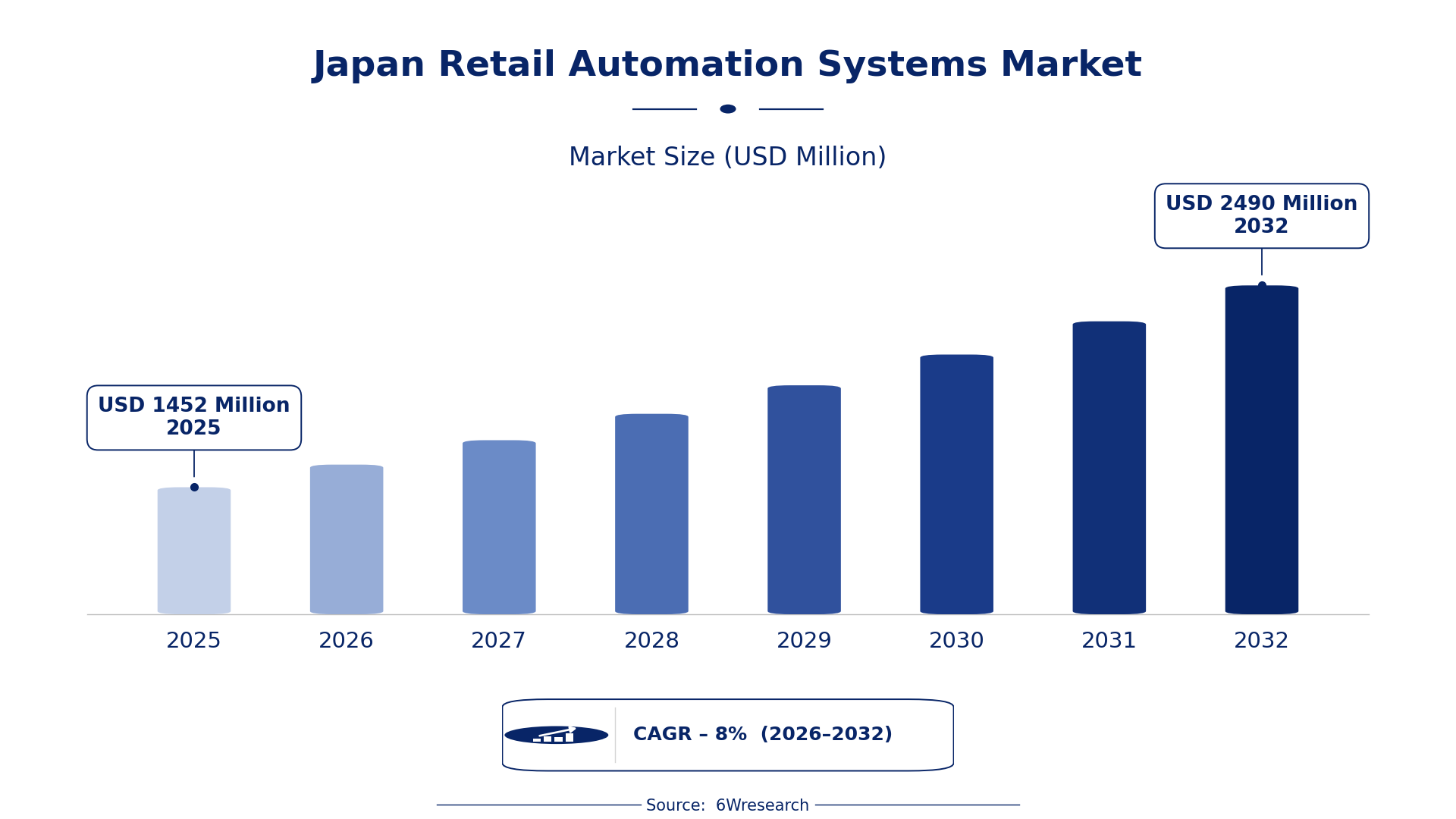
According to 6Wresearch internal database and industry insights, the Japan Retail Automation Systems Market was valued at USD 1,452 Million in 2025 and is projected to reach USD 2,490 Million by 2032, growing at a CAGR of approximately 8% during 2026–2032.
Japan Retail Automation Systems Market Highlights
| Report Metric | Details |
| Report Name | Japan Retail Automation Systems Market (2026-2032) |
| Market Size 2025 | USD 1,452 Million |
| Market Size 2032 | USD 2,490 Million |
| Absolute Growth 2025–2032 | USD 1,038 Million |
| CAGR 2026–2032 | 8% |
| Peak Annual Growth | 9.0% in 2029 |
| Forecast Period | 2026–2032 |
| Historical Data | 2022–2025 |
| Base Year | 2025 |
| Leading System Type, 2025 | Self-checkout Kiosks (42% share) |
| Leading Automation Focus, 2025 | Payment & Scanning (35% share) |
| Leading Integration Level, 2025 | RFID/Barcode + POS (47% share) |
| Leading End User, 2025 | Supermarkets & Retail Chains (45% share) |
| Fastest-Growing System Type | Robotic Shelf Replenishment (11.9% CAGR) |
| Fastest-Growing Automation Focus | Restocking Tasks (11.1% CAGR) |
| Fastest-Growing Integration Level | AI/Robotics (11.3% CAGR) |
| Fastest-Growing End User | Warehouses & Retail Stores (10.8% CAGR) |
| Growing Sector | Retail technology |
| Key End Users | Supermarkets, Retail Chains, Warehouses, Large Format Retailers |
Japan Retail Automation Systems Market Year-wise Growth Rate and Key Drivers (2022–2032)
This graph illustrates the annual growth rates of the market from 2022 to 2032, highlighting a steady upward trajectory and projected market expansion over the forecast period.
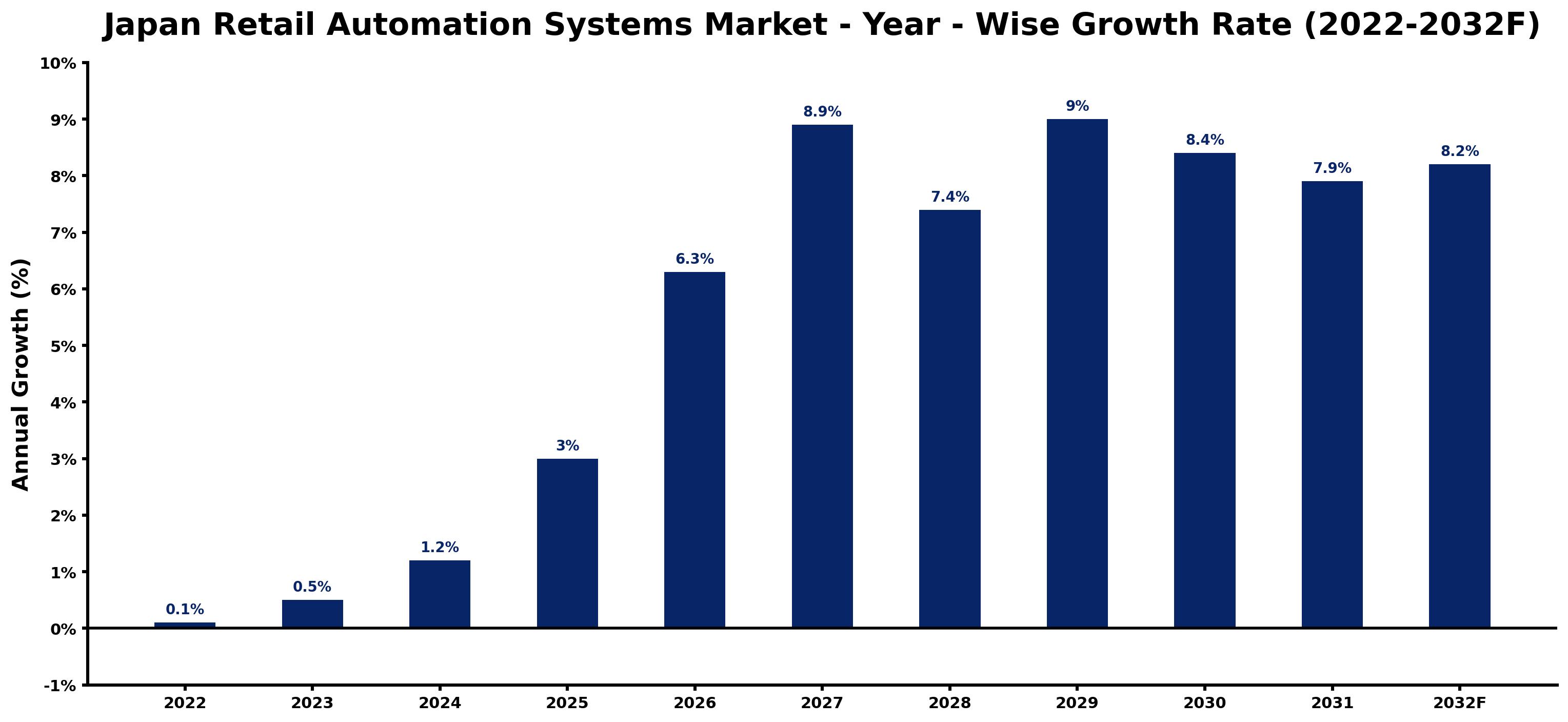
For each year, the table pairs the estimated growth rate with the leading influence on demand, showing how the drivers changed across the period.
| Year | Estimated Annual Growth (%) | Market Rationale |
| 2022 | 0.1 | The market exhibited minimal growth, reflecting initial adoption of automation technologies. |
| 2023 | 0.5 | Growth accelerated as more retailers began implementing self-checkout systems. |
| 2024 | 1.2 | Increased investment in digital price labels drove further market expansion. |
| 2025 | 3.0 | The market peaked historically as supermarkets widely adopted automation solutions. |
| 2026 | 6.3 | Growth surged as robotic shelf replenishment gained traction in urban areas. |
| 2027 | 8.9 | Demand rose sharply due to heightened consumer expectations for convenience. |
| 2028 | 7.4 | Growth slowed as the market matured and adoption levels stabilised. |
| 2029 | 9.0 | The market reached its peak annual growth as technology integration advanced. |
| 2030 | 8.4 | Growth decelerated slightly as the market adjusted to new standards. |
| 2031 | 7.9 | A further slowdown occurred as market saturation began to take effect. |
| 2032 | 8.2 | The market is projected to regain momentum as new innovations emerge. |
Note: Market size estimations and growth projections presented in this report are based on 6Wresearch's proprietary forecasting methodology, utilizing the latest available industry data, government publications, and primary research inputs.
Japan Retail Automation Systems Market Synopsis
Retail automation systems streamline operations in retail environments through integrated hardware and software solutions. These systems improve processes such as checkout and inventory management while optimising stock levels. The Japan Retail Automation Systems Market is growing, driven by over 100 million consumers and substantial investments in technology. Initiatives like the 2023 programme to advance smart retail technologies are stimulating demand, particularly in key regions like Tokyo and Osaka, where adoption rates are steadily rising.
Market Dynamics Impact Analysis (2026–2032)
| Factor | Type | Impact | Primary Segment Affected |
| Increasing consumer demand for convenience and efficiency | Driver | High | Self-checkout Kiosks |
| Growing investments in technology by retailers | Driver | High | Digital Price Labels |
| Rising need for efficient inventory management | Opportunity | High | Robotic Shelf Replenishment |
| Expansion of smart retail technologies | Opportunity | Medium | Payment & Scanning |
| High initial investment costs for automation systems | Restraint | High | Back-store Fulfillment Robots |
| Limited awareness among smaller retailers about automation benefits | Restraint | Medium | Robotic Shelf Replenishment |
| Supply chain disruptions affecting equipment availability | Challenge | High | Payment & Scanning |
| Competition from alternative technologies | Challenge | Medium | Self-checkout Kiosks |
Evaluation of Drivers in Japan Retail Automation Systems Market (2026–2032)
The following drivers explain most of the expected growth.
| Drivers | Primary Segment Affected | Why It Matters (Evidence) |
| Growing consumer preference for self-service options | Self-checkout Kiosks | Self-checkout kiosks accounted for 30% of all checkout transactions in urban areas, leading to increased installations. |
| Rising demand for accurate pricing | Digital Price Labels | The adoption of digital price labels is growing at 15% annually, prompting retailers to improve pricing accuracy. |
| Need for efficient inventory management | Robotic Shelf Replenishment | Robotic shelf replenishment systems are increasingly used in major cities, improving stock management. |
| Investment in AI-driven solutions | Payment & Scanning | Investment in AI for retail is projected to reach ¥20 billion by 2025, boosting automation adoption. |
| Government support for automation initiatives | Back-store Fulfillment Robots | The Ministry of Economy, Trade and Industry supports automation initiatives, encouraging retailers to adopt new technologies. |
Orders keep climbing as retailers increasingly adopt self-checkout kiosks, which accounted for 30% of all checkout transactions in urban areas. The demand for digital price labels is rising at 15% annually, improving pricing accuracy. Robotic shelf replenishment systems are becoming more prevalent in major cities, enhancing inventory management. Investment in AI for retail is set to reach ¥20 billion by 2025, driving automation adoption.
Evaluation of Restraints in Japan Retail Automation Systems Market
The following restraints limit how fast demand can grow.
| Market Restraint | Primary Segment Affected | Why It Matters (Evidence) |
| High initial investment costs for automation systems | Back-store Fulfillment Robots | The average supermarket serves around 1,000 customers daily, making initial costs a barrier for many retailers. |
| Limited awareness among smaller retailers about automation benefits | Self-checkout Kiosks | Many smaller retailers lack knowledge of the advantages of automation, hindering adoption rates. |
| Supply chain disruptions affecting equipment availability | Payment & Scanning | Ongoing supply chain issues have delayed the delivery of essential automation equipment. |
| Competition from alternative technologies | Robotic Shelf Replenishment | Emerging technologies may divert investment from traditional automation systems. |
| Regulatory compliance challenges for new technologies | Digital Price Labels | Retailers must navigate complex regulations, which can slow down implementation. |
Japan Retail Automation Systems Market Challenges
Japan's declining population results in a smaller consumer base for retail automation systems, limiting suppliers' growth potential. Regulatory pressures for sustainability compel producers to invest in compliance, causing delays of up to six months for product rollouts. A shortage of skilled workers in technology forces buyers to invest in training, which can take over a year to produce proficient staff. Rising operational costs, with the national minimum wage increasing to JPY 1,055 per hour, tighten profit margins for retailers, restricting their ability to invest in new automation technologies.
Trends in the Japan Retail Automation Systems Market
The trends below show where the Japan Retail Automation Systems Market is heading.
- Launch of Smart Retail Technologies Initiative: In 2023, Japan initiated a programme to improve smart retail technologies, aiming to boost operational efficiency. This initiative is expected to drive substantial investments in automation across the retail sector.
- Shift Towards Digital Price Labels: The adoption of digital price labels is rapidly increasing, with a growth rate of 15% annually. This trend is particularly prominent in urban areas, where retailers seek to improve pricing accuracy.
- Rise of Robotic Shelf Replenishment: Robotic shelf replenishment systems are gaining traction in major cities, improving inventory management. This shift reflects a growing demand for efficiency in retail operations.
- Increased Use of Self-Checkout Kiosks: Self-checkout kiosks are becoming more common, accounting for 30% of all checkout transactions in urban areas. This trend highlights consumer preference for convenience in shopping.
Investment Opportunities in the Japan Retail Automation Systems Market
Investors looking at the Japan Retail Automation Systems Market should consider the following areas.
- Supermarkets Seeking Automation Solutions: With over 50% of supermarkets implementing automation, there is a strong opportunity for suppliers. The average supermarket serves around 1,000 customers daily, indicating a high demand for efficiency.
- Investment in AI for Retail: Projected investment in AI for retail is set to reach ¥20 billion by 2025, creating opportunities for technology providers. Supermarkets and retail chains are key buyer groups looking for advanced solutions.
- Expansion of Payment & Scanning Technologies: The growing adoption of payment and scanning technologies presents an opportunity for suppliers. With a 35% market share, this segment is critical for improving retail transactions.
- Robotic Fulfillment in Warehouses: Robotic fulfillment is expected to be implemented in 25% of warehouses by 2024, indicating a need for automation solutions. Warehouses and retail stores are prime targets for investment.
Government Initiatives in the Japan Retail Automation Systems Market
The legal framework for retail automation in Japan is shaped by the New Robot Strategy (2015) and the AI Promotion Act (2025). These measures aim to expand the use of robots and AI in various sectors, including retail, improving operational efficiency and competitiveness for producers and buyers of retail automation systems.
The Ministry of Economy, Trade and Industry oversees the implementation of automation initiatives. With an annual budget of ¥10 billion for retail technology innovation, the agency funds projects that support the adoption of automation systems in retail environments, benefiting buyers through enhanced operational capabilities.
Future Insight of the Japan Retail Automation Systems Market
By 2032, a policy-driven shift will lead to widespread adoption of retail automation technologies. The JPY 150 trillion investment in decarbonisation will motivate suppliers to innovate sustainable solutions for eco-conscious consumers. Enhanced inventory management will emerge as AI investment reaches ¥20 billion, streamlining operations significantly. The anticipated implementation of robotic fulfillment in 25% of warehouses will improve logistics efficiency, enabling buyers to enjoy lower costs and quicker service.
Market Segmentation Analysis
Japan Retail Automation Systems Market report covers a detailed analysis of the following market segments:
By System Type – Self-checkout Kiosks Lead, Robotic Shelf Replenishment Expected to Grow Fastest
According to Saurav Kr Singh, Senior Research Analyst at 6Wresearch, with 42% of system type revenue in 2025, Self-checkout Kiosks was the largest category. Self-checkout kiosks hold the largest share as they are widely adopted for customer convenience, allowing shoppers to complete transactions quickly. Their presence in urban areas, where they account for 30% of all checkout transactions, illustrates their effectiveness in enhancing the shopping experience. Robotic Shelf Replenishment is projected to grow fastest, at a CAGR of 11.9% during 2026–2032. Robotic shelf replenishment is experiencing rapid growth as retailers focus on efficient inventory management solutions. The increasing use of these systems in major cities highlights a strong trend towards automating restocking processes, which is essential for operational efficiency. Suppliers should concentrate on developing advanced robotic solutions to cater to the rising demand for efficient inventory management.
By Automation Focus – Payment & Scanning Leads, Restocking Tasks Expected to Grow Fastest
The largest automation focus category in 2025 was Payment & Scanning, at 35% of revenue. Payment and scanning systems are the leading segment as they are core functionalities in retail transactions, ensuring smooth operations at checkout. Their integral role in facilitating sales drives widespread adoption across various retail environments. The quickest growth will come from Restocking Tasks, forecast to expand at a CAGR of 11.1% between 2026 and 2032. Restocking tasks are witnessing the fastest growth as retailers emphasise the importance of maintaining optimal inventory levels. This focus on product availability is leading to increased investments in automation technologies for efficient restocking. Buyers will gain from investing in automation technologies that streamline restocking processes, thereby enhancing operational efficiency.
By Integration Level – RFID/Barcode + POS Leads, AI/Robotics Expected to Grow Fastest
In 2025, RFID/Barcode + POS led the integration level split with a 47% share. RFID and barcode systems combined with POS technology dominate the market due to their essential role in accurate inventory tracking. This integration is critical for retailers to effectively monitor stock levels, which is vital for operational success. AI/Robotics are set to record the highest CAGR in this split, 11.3% over 2026–2032. AI and robotics are the fastest-growing segment as they significantly improve operational efficiency across various retail processes. The heightened focus on automation technologies is driving their increased adoption within the retail sector. Suppliers should prioritise AI and robotics solutions to capitalise on the growing demand for enhanced operational efficiency.
By End User – Supermarkets & Retail Chains Lead, Warehouses & Retail Stores Expected to Grow Fastest
Supermarkets & Retail Chains took 45% of end user revenue in 2025, more than any other category. Supermarkets and retail chains represent the largest user group of automation systems, necessitating efficient solutions to manage high customer volumes. Their substantial market presence drives the demand for advanced retail automation technologies. Over 2026–2032, Warehouses & Retail Stores are expected to post the fastest growth, at a CAGR of 10.8%. Warehouses and retail stores are rapidly expanding as they play a crucial role in supporting retail operations. The increasing complexity of supply chains is prompting these users to adopt more automation solutions to improve overall efficiency. Suppliers must tailor their offerings to meet the specific needs of warehouses and retail stores to capture this expanding market segment.
Key Attractiveness of the Report
- 10 Years of Market Numbers
- Historical Data Starting from 2022 to 2025
- Base Year 2025
- Forecast Data until 2032
- Key Performance Indicators Impacting the Market
- Major Upcoming Developments and Projects
Key Highlights of the Report:
- Japan Retail Automation Systems Market Outlook
- Market Size of Japan Retail Automation Systems Market, 2025
- Forecast of Japan Retail Automation Systems Market, 2032
- Historical Data and Forecast of Japan Retail Automation Systems Revenues & Volume for the Period 2022-2032F
- Japan Retail Automation Systems Market Trend Evolution
- Japan Retail Automation Systems Market Drivers and Challenges
- Japan Retail Automation Systems Price Trends
- Japan Retail Automation Systems Porter's Five Forces
- Japan Retail Automation Systems Industry Life Cycle
- Historical Data and Forecast of Japan Retail Automation Systems Market Revenues & Volume By System Type for the Period 2022-2032F
- Historical Data and Forecast of Japan Retail Automation Systems Market Revenues & Volume By Self-checkout Kiosks for the Period 2022-2032F
- Historical Data and Forecast of Japan Retail Automation Systems Market Revenues & Volume By Robotic Shelf Replenishment for the Period 2022-2032F
- Historical Data and Forecast of Japan Retail Automation Systems Market Revenues & Volume By Back-store Fulfillment Robots for the Period 2022-2032F
- Historical Data and Forecast of Japan Retail Automation Systems Market Revenues & Volume By Digital Price Labels for the Period 2022-2032F
- Historical Data and Forecast of Japan Retail Automation Systems Market Revenues & Volume By Automation Focus for the Period 2022-2032F
- Historical Data and Forecast of Japan Retail Automation Systems Market Revenues & Volume By Payment & Scanning for the Period 2022-2032F
- Historical Data and Forecast of Japan Retail Automation Systems Market Revenues & Volume By Restocking Tasks for the Period 2022-2032F
- Historical Data and Forecast of Japan Retail Automation Systems Market Revenues & Volume By Picking Automation for the Period 2022-2032F
- Historical Data and Forecast of Japan Retail Automation Systems Market Revenues & Volume By Dynamic Pricing for the Period 2022-2032F
- Historical Data and Forecast of Japan Retail Automation Systems Market Revenues & Volume By Integration Level for the Period 2022-2032F
- Historical Data and Forecast of Japan Retail Automation Systems Market Revenues & Volume By RFID/Barcode + POS for the Period 2022-2032F
- Historical Data and Forecast of Japan Retail Automation Systems Market Revenues & Volume By AI/Robotics for the Period 2022-2032F
- Historical Data and Forecast of Japan Retail Automation Systems Market Revenues & Volume By In-Store/Warehouse for the Period 2022-2032F
- Historical Data and Forecast of Japan Retail Automation Systems Market Revenues & Volume By Electronic Shelf Labels for the Period 2022-2032F
- Historical Data and Forecast of Japan Retail Automation Systems Market Revenues & Volume By End User for the Period 2022-2032F
- Historical Data and Forecast of Japan Retail Automation Systems Market Revenues & Volume By Supermarkets & Retail Chains for the Period 2022-2032F
- Historical Data and Forecast of Japan Retail Automation Systems Market Revenues & Volume By Warehouses & Retail Stores for the Period 2022-2032F
- Historical Data and Forecast of Japan Retail Automation Systems Market Revenues & Volume By Large Format Retailers for the Period 2022-2032F
- Historical Data and Forecast of Japan Retail Automation Systems Market Revenues & Volume By Supermarket Chains for the Period 2022-2032F
- Japan Retail Automation Systems Import Export Trade Statistics
- Market Opportunity Assessment By System Type
- Market Opportunity Assessment By Automation Focus
- Market Opportunity Assessment By Integration Level
- Market Opportunity Assessment By End User
- Japan Retail Automation Systems Top Companies Market Share
- Japan Retail Automation Systems Competitive Benchmarking By Technical and Operational Parameters
- Japan Retail Automation Systems Company Profiles
- Japan Retail Automation Systems Key Strategic Recommendations
Market Covered
The following segment groups are covered in the report.
By System Type
- Self-checkout Kiosks
- Robotic Shelf Replenishment
- Back-store Fulfillment Robots
- Digital Price Labels
By Automation Focus
- Payment & Scanning
- Restocking Tasks
- Picking Automation
- Dynamic Pricing
By Integration Level
- RFID/Barcode + POS
- AI/Robotics
- In-Store/Warehouse
- Electronic Shelf Labels
By End User
- Supermarkets & Retail Chains
- Warehouses & Retail Stores
- Large Format Retailers
- Supermarket Chains































