Japan Retail ERP Market Size & Growth Rate
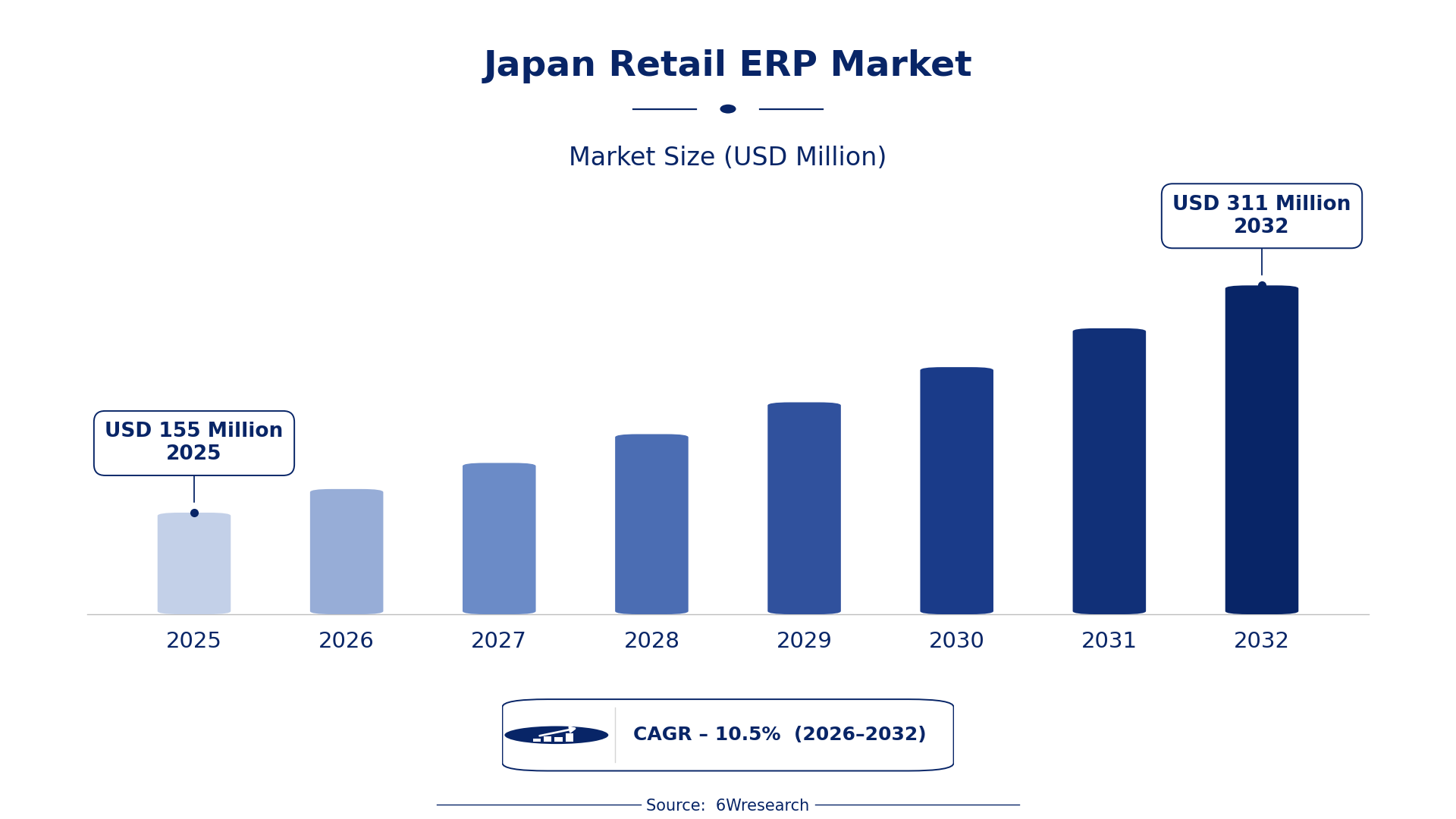
According to 6Wresearch internal database and industry insights, the Japan Retail ERP Market was valued at USD 155 Million in 2025 and is projected to reach USD 311 Million by 2032, growing at a CAGR of approximately 10.5% during 2026–2032.
Japan Retail ERP Market Highlights
| Report Metric | Details |
| Report Name | Japan Retail ERP Market (2026-2032) |
| Market Size 2025 | USD 155 Million |
| Market Size 2032 | USD 311 Million |
| Absolute Growth 2025–2032 | USD 156 Million |
| CAGR 2026–2032 | 10.5% |
| Peak Annual Growth | 11.2% in 2028 |
| Forecast Period | 2026–2032 |
| Historical Data | 2022–2025 |
| Base Year | 2025 |
| Leading Module, 2025 | Inventory Management (40% share) |
| Leading Platform Type, 2025 | SaaS/Cloud (48% share) |
| Leading Deployment Mode, 2025 | Cloud-Based (40% share) |
| Leading End User, 2025 | Retail Chains (44% share) |
| Fastest-Growing Module | CRM & Loyalty (13.9% CAGR) |
| Fastest-Growing Platform Type | Analytics Module (15.5% CAGR) |
| Fastest-Growing Deployment Mode | Hybrid (15.4% CAGR) |
| Fastest-Growing End User | Franchise Stores (13.3% CAGR) |
| Growing Sector | retail |
| Key End Users | retail chains, franchise stores, brand retailers, retail headquarters |
Japan Retail ERP Market Year-wise Growth Rate and Key Drivers (2022–2032)
This graph illustrates the annual growth rates of the market from 2022 to 2032, highlighting a steady upward trajectory and projected market expansion over the forecast period.
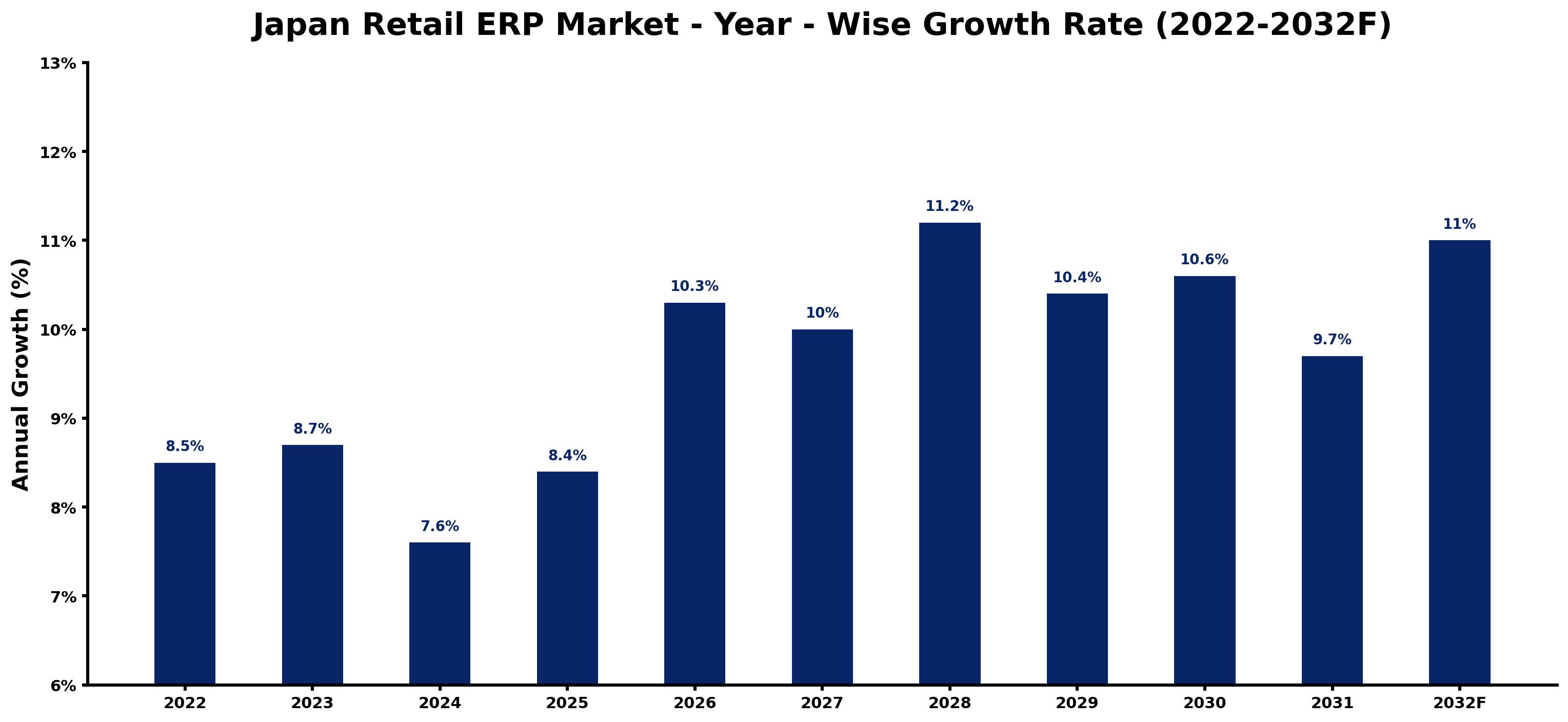
The table below sets out the estimated growth rate for each year and the main factor behind it.
| Year | Estimated Annual Growth (%) | Market Rationale |
| 2022 | 8.5 | Retailers increasingly adopted ERP systems to improve operational efficiency and competitiveness. |
| 2023 | 8.7 | The rise in retail sales and digital transformation efforts contributed to faster growth. |
| 2024 | 7.6 | Growth slowed as some retailers faced challenges in system integration and adaptation. |
| 2025 | 8.4 | The ongoing demand for better inventory management drove a resurgence in ERP adoption. |
| 2026 | 10.3 | Cloud-based solutions are projected to gain traction, leading to an increase in market growth. |
| 2027 | 10.0 | A slight slowdown is anticipated as the market adjusts to rapid technology changes. |
| 2028 | 11.2 | Increased investment in digital infrastructure will propel the market to its peak growth rate. |
| 2029 | 10.4 | The market is expected to continue growing, albeit at a slower pace as saturation begins to set in. |
| 2030 | 10.6 | Demand for advanced analytics in retail will drive further ERP system enhancements. |
| 2031 | 9.7 | Growth is projected to slow as competition intensifies among ERP providers, affecting pricing strategies. |
| 2032 | 11.0 | The ongoing shift towards hybrid solutions is expected to stimulate renewed interest in ERP systems. |
Note: Market size estimations and growth projections presented in this report are based on 6Wresearch's proprietary forecasting methodology, utilizing the latest available industry data, government publications, and primary research inputs.
Japan Retail ERP Market Synopsis
Retail ERP is a software solution designed to manage and integrate core business processes in the retail sector, including inventory management, sales tracking, and customer relationship management. The Japan Retail ERP Market is expanding as retailers increasingly adopt cloud-based solutions, with around 70% of them reporting ERP usage in 2022. Key regions such as Tokyo and Osaka are at the forefront of this trend, supported by initiatives from the Retail Industry Association of Japan to promote digital transformation in the sector.
Market Dynamics Impact Analysis (2026–2032)
| Factor | Type | Impact | Primary Segment Affected |
| Growing adoption of cloud-based ERP solutions | Driver | High | SaaS/Cloud |
| Increased focus on inventory management efficiency | Driver | High | Inventory Management |
| Rising demand for data-driven decision-making tools | Opportunity | Medium | Analytics Module |
| Expansion of retail chains and franchise operations | Opportunity | High | Retail Chains |
| Challenges in system integration for small retailers | Restraint | High | Cloud-Based |
| High competition among ERP providers leading to price wars | Restraint | Medium | SaaS/Cloud |
| Limited understanding of ERP benefits among smaller retailers | Challenge | High | Franchise Stores |
| Resistance to change from traditional retail practices | Challenge | Medium | Retail Headquarters |
Evaluation of Drivers in Japan Retail ERP Market (2026–2032)
Key forces behind demand, with the segment each one moves most, are listed below.
| Drivers | Primary Segment Affected | Why It Matters (Evidence) |
| Increased investment in digital infrastructure | SaaS/Cloud | Approximately 70% of retailers reported using ERP systems, driving demand for cloud solutions. |
| Focus on operational efficiency | Inventory Management | ERP systems help reduce operational costs by up to 30%, encouraging adoption among retailers. |
| Demand for real-time data access | Analytics Module | Retailers require advanced analytics for performance tracking, resulting in higher ERP system purchases. |
| Growth of e-commerce channels | CRM & Loyalty | Retailers are investing in ERP to improve customer relationships and loyalty programs. |
| Digital transformation initiatives | Finance & Reporting | Government support for digital tools is increasing ERP adoption among retailers. |
Purchasing is picking up as Tokyo and Osaka lead the way in digital infrastructure investment, with approximately 70% of retailers using ERP systems to enhance operational efficiency. The focus on inventory management has led to a reduction in operational costs for many retailers, driving further demand for these solutions. The growth of e-commerce channels has prompted retailers to adopt CRM modules within ERP systems to strengthen customer relationships. Increased interest in finance and reporting functionalities is making ERP systems essential for compliance and performance tracking. The combination of these factors is reshaping the retail landscape in Japan.
Evaluation of Restraints in Japan Retail ERP Market
The table below lists the restraints and the evidence behind each.
| Market Restraint | Primary Segment Affected | Why It Matters (Evidence) |
| Integration challenges for small retailers | Cloud-Based | Many small retailers struggle to integrate ERP systems, limiting their adoption despite potential benefits. |
| High competition leading to price wars | SaaS/Cloud | Intense competition among providers has resulted in aggressive pricing strategies, affecting profitability. |
| Limited understanding of ERP benefits | Franchise Stores | Some franchise operators are unaware of how ERP can streamline operations, hindering adoption. |
| Resistance to change from traditional practices | Retail Headquarters | Many retail headquarters prefer established methods, slowing the transition to modern ERP solutions. |
| Complexity of ERP systems | Analytics Module | The perceived complexity of ERP systems can deter retailers from making the switch. |
Japan Retail ERP Market Challenges
A primary obstacle in the retail ERP market is a shortage of skilled professionals, which limits effective implementation for buyers. This issue arises from Japan's declining population, resulting in fewer qualified candidates, costing retailers time and resources in training. Many small retailers find it challenging to adopt advanced ERP technology, delaying efficiency improvements and preventing them from realising operational savings of up to 30%. Compliance with standards such as JIS Q 15001 complicates operations, necessitating additional investment in training and processes, which can extend project timelines for clinics. Competition among over 20,000 retail chains compels retailers to innovate rapidly, often leading to hasty decisions that compromise system effectiveness for producers.
Trends in the Japan Retail ERP Market
These developments are changing demand patterns in the Japan Retail ERP Market.
- Shift towards Cloud-Based Solutions: In 2022, 70% of retailers reported using ERP systems, with cloud-based solutions gaining traction. This shift is driven by the need for scalability and lower upfront costs, particularly among small retailers.
- Increased Focus on Data Analytics: Tokyo is seeing a surge in demand for advanced analytics modules within ERP systems, with a projected growth rate of 15.5%. Retailers are leveraging data to enhance decision-making and operational efficiency.
- Rise of Modular ERP Systems: Retail chains are increasingly adopting modular ERP systems, allowing for tailored solutions that meet specific needs. This trend reflects retailers' desire for flexibility in their operations.
- Growing Adoption of Hybrid Solutions: Since 2025, demand for hybrid ERP solutions has been on the rise, with a growth rate of 15.4%. Retailers are seeking systems that combine cloud and on-premise capabilities.
Investment Opportunities in the Japan Retail ERP Market
Several openings in the Japan Retail ERP Market merit attention from investors.
- Partnerships with Local Providers: Now is an ideal time for investments in cloud-based ERP solutions, with 70% of retailers reporting usage. Collaborating with local partners can facilitate market entry and improve service delivery.
- Investment in Analytics Modules: With a projected growth rate of 15.5%, supplying advanced analytics modules presents a notable opportunity. Retail chains are particularly interested in these solutions to enhance decision-making.
- Focus on Franchise Operations: The growing number of franchise stores, exceeding 20,000, creates a demand for standardised ERP solutions. Entering this market through joint ventures can yield substantial returns.
- Expansion of Digital Transformation Initiatives: With the government promoting digital transformation, there is a gap in ERP adoption among small retailers. Offering tailored solutions can capture this emerging market.
Government Initiatives in the Japan Retail ERP Market
The Digital Agency, established in September 2021, is key in leading digital transformation efforts across sectors, including retail. It sets common system standards and promotes the adoption of digital tools. This initiative has resulted in increased funding for ERP implementation, benefiting retailers looking to modernise their operations, with substantial investments allocated for training and support.
The Ministry of Economy, Trade and Industry plays a crucial role in promoting digital transformation in retail. It supports initiatives that encourage the adoption of ERP systems, with funding allocated for training and implementation projects. This support is important for retailers aiming to improve their operational efficiency and competitiveness, with numerous projects approved to assist in this transition.
Future Insight of the Japan Retail ERP Market
Cloud technology will drive demand for retail ERP systems by 2032, as small retailers increasingly leverage these solutions for operational efficiency. The Ministry of Economy, Trade and Industry's initiatives will facilitate the digital transformation of the retail sector, enhancing competitiveness. Retail sales are projected to grow by 1.5% annually, prompting buyers to seek integrated solutions that improve operational capabilities. As the sector adopts new standards like JIS Q 15001, suppliers will need to refine their offerings to meet evolving customer requirements.
Market Segmentation Analysis
Japan Retail ERP Market report covers a detailed analysis of the following market segments:
By Module – Inventory Management Leads, CRM & Loyalty Expected to Grow Fastest
According to Saurav Kr Singh, Senior Research Analyst at 6Wresearch, Inventory Management took 40% of module revenue in 2025, more than any other category. Inventory Management maintains the largest share as it is vital for tracking stock levels and optimising turnover, essential for retailers' success. Given that Japan has over 20,000 retail chains, effective inventory management is crucial for sustaining competitiveness. CRM & Loyalty is set to record the highest CAGR in this split, 13.9% over 2026–2032. The CRM & Loyalty segment is expanding rapidly as retailers increasingly prioritise customer relationships and loyalty programmes. This growth is underscored by the 70% of retailers who reported using some form of ERP system, making CRM functionalities a key focus. Suppliers should enhance CRM features to align with the rising demand from retailers.
By Platform Type – SaaS/Cloud Leads, Analytics Module Expected to Grow Fastest
In 2025, SaaS/Cloud led the platform type split with a 48% share. SaaS/Cloud dominates the market due to its widespread adoption for scalability and accessibility, allowing retailers to streamline operations effectively. The ongoing digital transformation in retail has accelerated the shift towards cloud-based solutions. Analytics Module is projected to grow fastest, at a CAGR of 15.5% during 2026–2032. The Analytics Module is witnessing rapid growth as retailers demand data-driven tools for performance tracking. This trend is driven by the competitive nature of the Japanese retail market, where actionable insights are crucial for success. Buyers should invest in analytics capabilities to harness data for informed decision-making.
By Deployment Mode – Cloud-Based Leads, Hybrid Expected to Grow Fastest
Cloud-Based held 40% of the Japan Retail ERP Market by deployment mode in 2025. Cloud-Based deployment is favoured for its flexibility and lower initial costs, appealing to a diverse range of retailers. This preference aligns with the Ministry of Economy, Trade and Industry's initiatives promoting digital transformation in the retail sector. Over 2026–2032, Hybrid is expected to post the fastest growth, at a CAGR of 15.4%. Hybrid deployment is increasingly popular as some retailers seek a combination of cloud and on-premise solutions to meet their operational needs. This trend highlights the varied requirements of retailers in Japan's competitive environment. Suppliers should provide hybrid solutions to accommodate the diverse preferences of retailers.
By End User – Retail Chains Lead, Franchise Stores Expected to Grow Fastest
With 44% of end user revenue in 2025, Retail Chains was the largest category. Retail Chains are the largest users of ERP systems, relying on these tools for operational efficiency across numerous locations. Their substantial presence in the market drives the demand for tailored ERP solutions that meet their specific needs. The quickest growth will come from Franchise Stores, forecast to expand at a CAGR of 13.3% between 2026 and 2032. Franchise Stores are the fastest-growing segment as they leverage ERP systems for standardised operations and reporting across franchises. This growth reflects the increasing need for operational consistency within franchise networks. Suppliers should focus on creating solutions that specifically address the requirements of franchise operations.
Key Attractiveness of the Report
- 10 Years of Market Numbers
- Historical Data Starting from 2022 to 2025
- Base Year 2025
- Forecast Data until 2032
- Key Performance Indicators Impacting the Market
- Major Upcoming Developments and Projects
Key Highlights of the Report:
- Japan Retail ERP Market Outlook
- Market Size of Japan Retail ERP Market, 2025
- Forecast of Japan Retail ERP Market, 2032
- Historical Data and Forecast of Japan Retail ERP Revenues & Volume for the Period 2022-2032F
- Japan Retail ERP Market Trend Evolution
- Japan Retail ERP Market Drivers and Challenges
- Japan Retail ERP Price Trends
- Japan Retail ERP Porter's Five Forces
- Japan Retail ERP Industry Life Cycle
- Historical Data and Forecast of Japan Retail ERP Market Revenues & Volume By Module for the Period 2022-2032F
- Historical Data and Forecast of Japan Retail ERP Market Revenues & Volume By Inventory Management for the Period 2022-2032F
- Historical Data and Forecast of Japan Retail ERP Market Revenues & Volume By POS Integration for the Period 2022-2032F
- Historical Data and Forecast of Japan Retail ERP Market Revenues & Volume By CRM & Loyalty for the Period 2022-2032F
- Historical Data and Forecast of Japan Retail ERP Market Revenues & Volume By Finance & Reporting for the Period 2022-2032F
- Historical Data and Forecast of Japan Retail ERP Market Revenues & Volume By Platform Type for the Period 2022-2032F
- Historical Data and Forecast of Japan Retail ERP Market Revenues & Volume By SaaS/Cloud for the Period 2022-2032F
- Historical Data and Forecast of Japan Retail ERP Market Revenues & Volume By Mobile/Desktop for the Period 2022-2032F
- Historical Data and Forecast of Japan Retail ERP Market Revenues & Volume By Customer Data Mgmt for the Period 2022-2032F
- Historical Data and Forecast of Japan Retail ERP Market Revenues & Volume By Analytics Module for the Period 2022-2032F
- Historical Data and Forecast of Japan Retail ERP Market Revenues & Volume By Deployment Mode for the Period 2022-2032F
- Historical Data and Forecast of Japan Retail ERP Market Revenues & Volume By Modular/Suite for the Period 2022-2032F
- Historical Data and Forecast of Japan Retail ERP Market Revenues & Volume By On-Premise or Cloud for the Period 2022-2032F
- Historical Data and Forecast of Japan Retail ERP Market Revenues & Volume By Cloud-Based for the Period 2022-2032F
- Historical Data and Forecast of Japan Retail ERP Market Revenues & Volume By Hybrid for the Period 2022-2032F
- Historical Data and Forecast of Japan Retail ERP Market Revenues & Volume By End User for the Period 2022-2032F
- Historical Data and Forecast of Japan Retail ERP Market Revenues & Volume By Retail Chains for the Period 2022-2032F
- Historical Data and Forecast of Japan Retail ERP Market Revenues & Volume By Franchise Stores for the Period 2022-2032F
- Historical Data and Forecast of Japan Retail ERP Market Revenues & Volume By Brand Retailers for the Period 2022-2032F
- Historical Data and Forecast of Japan Retail ERP Market Revenues & Volume By Retail Headquarters for the Period 2022-2032F
- Japan Retail ERP Import Export Trade Statistics
- Market Opportunity Assessment By Module
- Market Opportunity Assessment By Platform Type
- Market Opportunity Assessment By Deployment Mode
- Market Opportunity Assessment By End User
- Japan Retail ERP Top Companies Market Share
- Japan Retail ERP Competitive Benchmarking By Technical and Operational Parameters
- Japan Retail ERP Company Profiles
- Japan Retail ERP Key Strategic Recommendations
Market Covered
This report examines the market across the segments below.
By Module
- Inventory Management
- POS Integration
- CRM & Loyalty
- Finance & Reporting
By Platform Type
- SaaS/Cloud
- Mobile/Desktop
- Customer Data Mgmt
- Analytics Module
By Deployment Mode
- Modular/Suite
- On-Premise or Cloud
- Cloud-Based
- Hybrid
By End User
- Retail Chains
- Franchise Stores
- Brand Retailers
- Retail Headquarters































