Japan Retail Footfall Analysis AI Market Size & Growth Rate
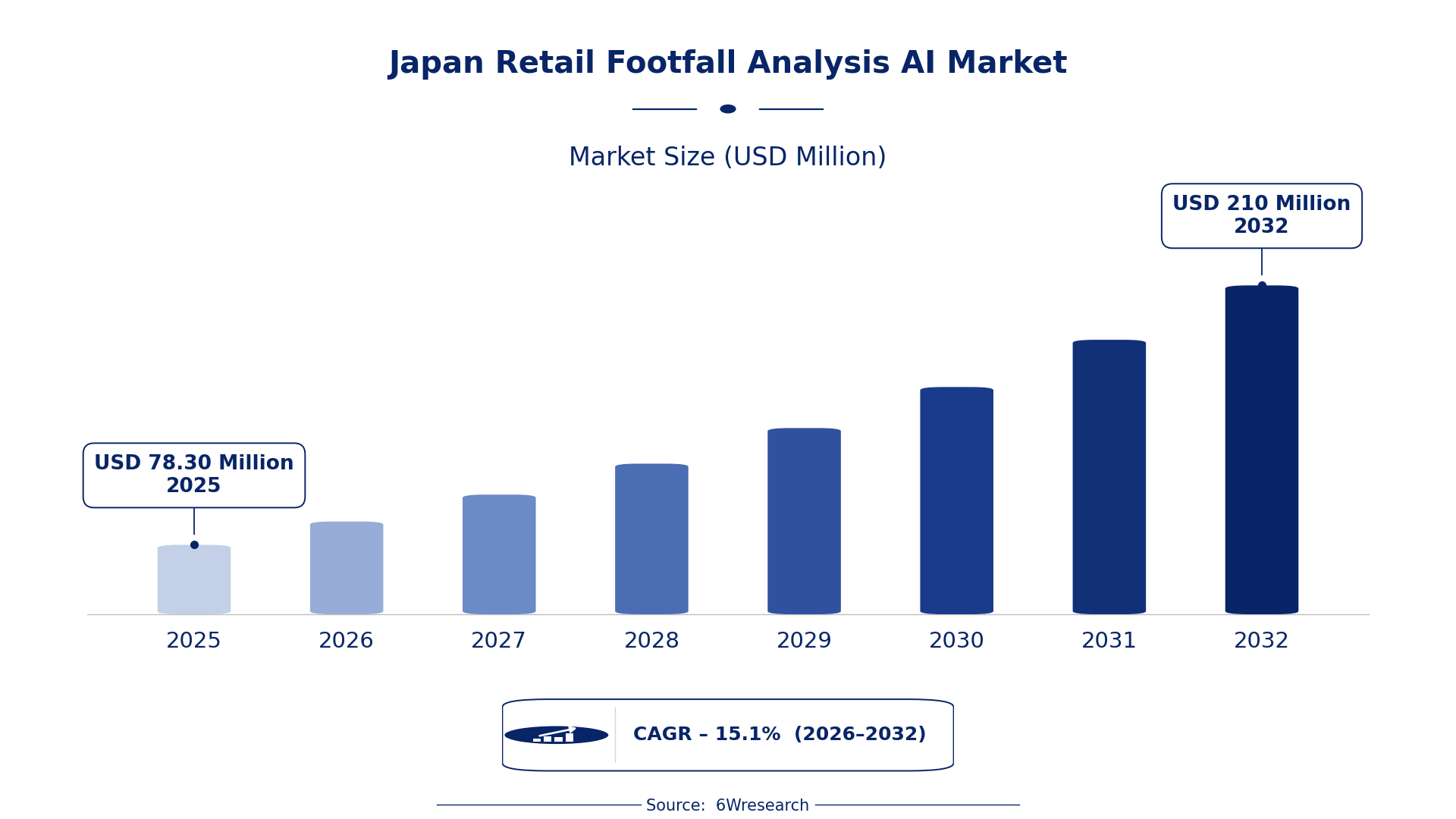
According to 6Wresearch internal database and industry insights, the Japan Retail Footfall Analysis AI Market was valued at USD 78.30 Million in 2025 and is projected to reach USD 210 Million by 2032, growing at a CAGR of approximately 15.1% during 2026–2032.
Japan Retail Footfall Analysis AI Market Highlights
| Report Metric | Details |
| Report Name | Japan Retail Footfall Analysis AI Market (2026-2032) |
| Market Size 2025 | USD 78.30 Million |
| Market Size 2032 | USD 210 Million |
| Absolute Growth 2025–2032 | USD 131.70 Million |
| CAGR 2026–2032 | 15.1% |
| Peak Annual Growth | 16.1% in 2032 |
| Forecast Period | 2026–2032 |
| Historical Data | 2022–2025 |
| Base Year | 2025 |
| Leading Analysis Type, 2025 | Store Entry Counters (38% share) |
| Leading Sensor Platform, 2025 | Stereo Camera/Infrared (36% share) |
| Leading Insight Model, 2025 | True Traffic Counts (44% share) |
| Leading End User, 2025 | Store Managers (39% share) |
| Fastest-Growing Analysis Type | Dwell-Time Analytics (21.1% CAGR) |
| Fastest-Growing Sensor Platform | Heat Mapping Cameras (16.8% CAGR) |
| Fastest-Growing Insight Model | AI Engagement Metrics (21.4% CAGR) |
| Fastest-Growing End User | Retail Operations Teams (19.4% CAGR) |
| Growing Sector | retail analytics |
| Key End Users | store managers, mall operators, retail operations teams |
Japan Retail Footfall Analysis AI Market Year-wise Growth Rate and Key Drivers (2022–2032)
This graph illustrates the annual growth rates of the market from 2022 to 2032, highlighting a steady upward trajectory and projected market expansion over the forecast period.
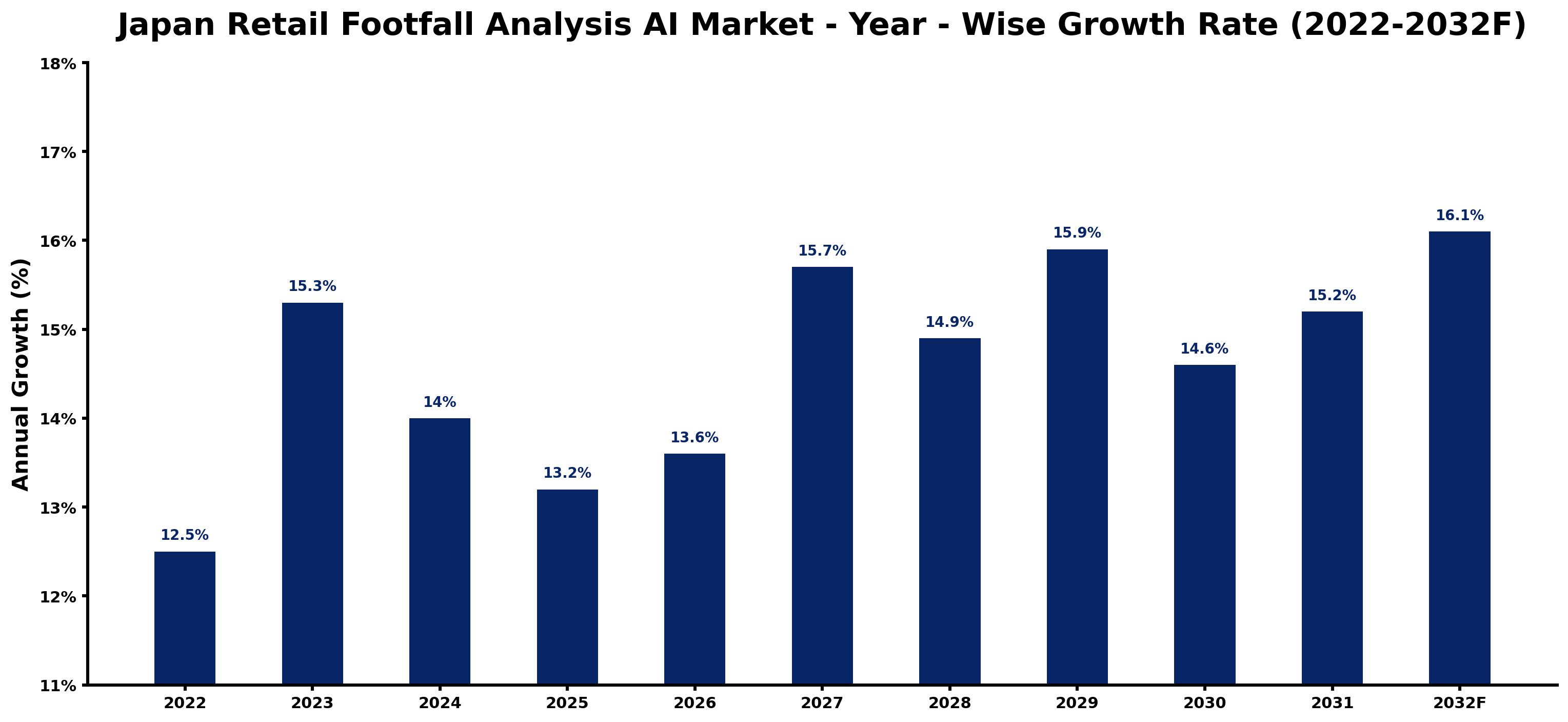
For each year, the table pairs the estimated growth rate with the leading influence on demand, showing how the drivers changed across the period.
| Year | Estimated Annual Growth (%) | Market Rationale |
| 2022 | 12.5 | The market showed steady growth as retailers began adopting AI technologies for footfall analysis. |
| 2023 | 15.3 | Growth accelerated due to increased investment in retail analytics technologies across urban areas. |
| 2024 | 14.0 | Growth slowed slightly as market saturation began to affect new technology adoption rates. |
| 2025 | 13.2 | The market continued to grow as businesses focused on improving customer experience through data insights. |
| 2026 | 13.6 | Growth is expected to rise again as AI adoption in retail analytics increases. |
| 2027 | 15.7 | Demand will rise further as more retailers implement advanced footfall analysis solutions. |
| 2028 | 14.9 | Growth will slow as the market stabilizes with widespread technology adoption. |
| 2029 | 15.9 | Demand is projected to rise again as new innovations in AI analytics emerge. |
| 2030 | 14.6 | Growth will moderate as the market matures and competition intensifies. |
| 2031 | 15.2 | Growth is expected to increase again as retailers seek to optimize operations further. |
| 2032 | 16.1 | Demand will peak as the market reaches full maturity with advanced AI technologies. |
Note: Market size estimations and growth projections presented in this report are based on 6Wresearch's proprietary forecasting methodology, utilizing the latest available industry data, government publications, and primary research inputs.
Japan Retail Footfall Analysis AI Market Synopsis
Retail Footfall Analysis AI involves technologies that utilize AI algorithms to analyze customer behavior in retail environments. This technology is essential for optimizing store layouts, improving customer experiences, and refining sales strategies. In Japan, the retail sector, valued at approximately 150 trillion yen in 2023, is experiencing growth driven by urban retailers adopting AI tools at a rate of 60%. The anticipated 25% increase in AI adoption by 2025 indicates strong future demand, particularly in metropolitan areas like Tokyo, which accounts for over 30% of retail sales.
Market Dynamics Impact Analysis (2026–2032)
| Factor | Type | Impact | Primary Segment Affected |
| Increased adoption of AI technologies in retail analytics | Driver | High | Dwell-Time Analytics |
| Growing focus on customer experience optimization | Driver | High | Shopper Path Tracking |
| Rising demand for data-driven insights among retail operations teams | Opportunity | High | Retail Operations Teams |
| Expansion of shopping malls in urban areas | Opportunity | Medium | Mall Operators |
| High initial investment costs for advanced AI systems | Restraint | High | Stereo Camera/Infrared |
| Limited awareness of AI benefits among smaller retailers | Restraint | Medium | Store Entry Counters |
| Competition from traditional retail analytics methods | Challenge | High | Conversion Rate Metrics |
| Slow integration of AI technologies in existing retail systems | Challenge | Medium | Heat Mapping Cameras |
Evaluation of Drivers in Japan Retail Footfall Analysis AI Market (2026–2032)
Below are the drivers that matter most for revenue growth, with supporting evidence.
| Drivers | Primary Segment Affected | Why It Matters (Evidence) |
| Increased urban retail analytics adoption | Dwell-Time Analytics | Urban retailers are adopting AI tools at a rate of 60%, boosting customer engagement. |
| Focus on optimizing store layouts | Shopper Path Tracking | Retailers are investing in layout optimization to improve customer experience, increasing demand for analytics. |
| Growing emphasis on data-driven decision-making | Retail Operations Teams | Retail operations teams are increasingly relying on analytics for strategic decisions, driving demand for AI solutions. |
| Expansion of shopping malls in urban areas | Mall Operators | The number of shopping malls reached 1,200, creating a need for advanced footfall analysis. |
| Rising consumer expectations for personalized experiences | AI Engagement Metrics | As 70% of store managers adopt AI engagement metrics, demand for personalized retail experiences grows. |
A wider customer base explains much of the growth, as urban retailers increasingly adopt AI technologies for footfall analysis. In 2023, Japan's retail sector was valued at approximately 150 trillion yen, with Tokyo contributing over 30% of sales. The average dwell time in stores is around 30 minutes, prompting retailers to invest in advanced analytics to improve customer engagement. AI adoption in retail analytics is expected to increase by 25% by 2025, further driving demand. Sixty percent of retail operations teams now utilize AI tools to make informed decisions, reflecting a shift towards data-driven strategies.
Evaluation of Restraints in Japan Retail Footfall Analysis AI Market
The key brakes on demand, and where they bite hardest, are shown below.
| Market Restraint | Primary Segment Affected | Why It Matters (Evidence) |
| High initial investment costs for advanced AI systems | Stereo Camera/Infrared | The costs associated with implementing AI systems can deter smaller retailers from adoption. |
| Limited awareness of AI benefits among smaller retailers | Store Entry Counters | Many smaller retailers lack understanding of how AI can improve their operations, hindering market growth. |
| Competition from traditional retail analytics methods | Conversion Rate Metrics | Traditional methods remain prevalent, making it challenging for AI solutions to penetrate the market. |
| Slow integration of AI technologies in existing retail systems | Heat Mapping Cameras | Existing systems may not easily accommodate new AI technologies, delaying implementation. |
| Concerns over data privacy and security | AI Engagement Metrics | Retailers are cautious about data handling, impacting the adoption of AI-driven analytics. |
Japan Retail Footfall Analysis AI Market Challenges
In 2023, compliance with JIS X 6911 standards raised operational costs for retailers, delaying technology adoption and hindering growth. Regulatory hurdles arise from the complexity of these standards, which can take months to navigate, preventing timely implementation for many retailers. Competition intensified as urban retail operations teams adopted AI tools at a rate of 60%, compelling smaller stores to invest heavily, straining their financial resources. Rising costs from the national minimum wage increase to JPY 1,055 per hour squeezed profit margins, prompting retailers to rethink staffing strategies and leading to potential layoffs. Buyers faced challenges as the average conversion rate in Japan's retail remained around 20%, resulting in many potential sales being lost, which affected overall revenue.
Trends in the Japan Retail Footfall Analysis AI Market
Several trends are reshaping the Japan Retail Footfall Analysis AI Market; the most important are set out below.
- Shift from Traditional to AI-Driven Analytics: Retailers are increasingly adopting AI-driven analytics for footfall analysis, with 60% of retail operations teams now using these technologies. This transition enhances understanding of customer behaviour and optimizes store layouts.
- Transition from Basic Foot Traffic Counting to Advanced Analytics: The introduction of advanced technologies like Heat Mapping Cameras is changing how retailers analyze customer movement. Over 40% of major retail chains are now utilizing this technology to improve store layouts and customer engagement.
- Emergence of AI Engagement Metrics in Retail: AI Engagement Metrics are becoming essential tools for store managers, with 70% now using them to measure customer interactions. This trend reflects a growing demand for data-driven insights to improve customer experiences.
- Increase in Mall Developments in Urban Areas: The number of shopping malls in Japan reached 1,200 in 2023, leading to increased demand for footfall analysis technologies. This growth is prompting mall operators to seek advanced analytics solutions to improve overall performance.
Investment Opportunities in the Japan Retail Footfall Analysis AI Market
Where to invest in the Japan Retail Footfall Analysis AI Market: the main openings are set out below.
- Retail Operations Teams Seeking Advanced Insights: Retail operations teams are increasingly pursuing AI solutions to enhance decision-making. With a 60% adoption rate of AI tools in urban areas, there is potential for investment in advanced analytics technologies.
- Expansion of Shopping Malls in Urban Areas: The growth of shopping malls in urban regions presents opportunities for suppliers of footfall analysis technologies. With 1,200 malls in Japan, partnerships with mall operators can facilitate entry into this expanding market.
- Collaborations with Technology Providers: Now is an opportune moment for companies to invest in partnerships with technology providers to develop AI solutions for retail analytics. Collaborating with local firms can ease market entry and improve product offerings.
- Increased Focus on Customer Experience: With the average dwell time in stores around 30 minutes, retailers are prioritising technologies that enhance customer experiences. Suppliers can capitalise on this trend by offering advanced footfall analysis solutions.
Government Initiatives in the Japan Retail Footfall Analysis AI Market
The Semiconductor and Digital Industry Strategy, established in June 2021, strengthens Japan's semiconductor manufacturing capabilities, benefiting producers of retail footfall analysis technologies by ensuring a stable supply of components. This strategy complements existing laws aimed at promoting digital transformation in retail. The Economic Security Promotion Act (2022) supports supply-chain resilience for critical products, which aids in the adoption of advanced technologies in the retail sector.
The Digital Agency oversees government digital transformation initiatives and approves funding for projects that improve retail analytics capabilities. This agency's support is vital for retailers looking to adopt advanced AI technologies, as it helps facilitate the integration of new systems into existing operations.
Future Insight of the Japan Retail Footfall Analysis AI Market
By 2032, suppliers will develop more advanced AI technologies, improving customer experiences in retail environments. Engagement metrics among retail staff will rise, enhancing operational efficiency and customer interaction. The number of shopping malls will continue to grow, reaching approximately 1,500, which will improve foot traffic analysis capabilities. New funding programmes from local governments will support retail innovation, enabling suppliers to provide more effective solutions.
Market Segmentation Analysis
Japan Retail Footfall Analysis AI Market report covers a detailed analysis of the following market segments:
By Analysis Type – Store Entry Counters Lead, Dwell-Time Analytics Expected to Grow Fastest
According to Saurav Kr Singh, Senior Research Analyst at 6Wresearch, with 38% of analysis type revenue in 2025, Store Entry Counters was the largest category. Store Entry Counters command the largest share as they are essential for measuring foot traffic, which directly impacts store performance evaluations. Retailers in urban environments rely heavily on these counters to inform their operational strategies based on visitor metrics. Dwell-Time Analytics is set to record the highest CAGR in this split, 21.1% over 2026–2032. Dwell-Time Analytics is experiencing rapid growth because retailers are increasingly prioritising insights into customer engagement, with over 70% of store managers adopting these metrics. This heightened focus on enhancing customer experiences will likely accelerate further adoption in the future. Suppliers should prioritise the development of tools that facilitate deeper customer engagement analysis to meet market demands.
By Sensor Platform – Stereo Camera/Infrared Leads, Heat Mapping Cameras Expected to Grow Fastest
In 2025, Stereo Camera/Infrared led the sensor platform split with a 36% share. Stereo Camera/Infrared technology leads the segment due to its capacity to provide accurate footfall data, which is critical for retailers seeking to optimise their operations. This technology is particularly favoured in urban retail contexts where precise data collection is vital for success. Over 2026–2032, Heat Mapping Cameras are expected to post the fastest growth, at a CAGR of 16.8%. Heat Mapping Cameras are rapidly gaining traction as they effectively visualise customer movement patterns, allowing retailers to refine store layouts. With over 40% of major retail chains utilising this technology, demand is projected to rise significantly. Buyers should consider integrating heat mapping solutions to enhance store layout and improve customer flow management.
By Insight Model – True Traffic Counts Lead, AI Engagement Metrics Expected to Grow Fastest
True Traffic Counts took 44% of insight model revenue in 2025, more than any other category. True Traffic Counts are the leading insight model as they provide precise visitor counts, vital for performance evaluation in retail environments. Retailers depend on this data to make informed decisions about inventory and staffing. AI Engagement Metrics are projected to grow fastest, at a CAGR of 21.4% during 2026–2032. AI Engagement Metrics are rapidly gaining traction as they measure customer interactions, which are increasingly important for improving sales strategies. With 70% of store managers adopting these metrics, their relevance is expected to grow. Suppliers must focus on delivering AI-driven engagement metrics to meet the evolving needs of retailers.
By End User – Store Managers Lead, Retail Operations Teams Expected to Grow Fastest
The largest end user category in 2025 was Store Managers, at 39% of revenue. Store Managers hold the largest share as they directly leverage insights from footfall analysis to enhance operational efficiency and boost sales. Their role is crucial in implementing strategies informed by customer behaviour data to improve overall performance. The quickest growth will come from Retail Operations Teams, forecast to expand at a CAGR of 19.4% between 2026 and 2032. Retail Operations Teams are growing swiftly as they increasingly rely on analytics for informed strategic decision-making, mirroring a shift towards data-centric management practices. This trend coincides with the rising adoption of advanced technologies within the retail sector. Retailers should empower operations teams with sophisticated analytics tools to optimise strategic outcomes.
Key Attractiveness of the Report
- 10 Years of Market Numbers
- Historical Data Starting from 2022 to 2025
- Base Year 2025
- Forecast Data until 2032
- Key Performance Indicators Impacting the Market
- Major Upcoming Developments and Projects
Key Highlights of the Report:
- Japan Retail Footfall Analysis AI Market Outlook
- Market Size of Japan Retail Footfall Analysis AI Market, 2025
- Forecast of Japan Retail Footfall Analysis AI Market, 2032
- Historical Data and Forecast of Japan Retail Footfall Analysis AI Revenues & Volume for the Period 2022-2032F
- Japan Retail Footfall Analysis AI Market Trend Evolution
- Japan Retail Footfall Analysis AI Market Drivers and Challenges
- Japan Retail Footfall Analysis AI Price Trends
- Japan Retail Footfall Analysis AI Porter's Five Forces
- Japan Retail Footfall Analysis AI Industry Life Cycle
- Historical Data and Forecast of Japan Retail Footfall Analysis AI Market Revenues & Volume By Analysis Type for the Period 2022-2032F
- Historical Data and Forecast of Japan Retail Footfall Analysis AI Market Revenues & Volume By Store Entry Counters for the Period 2022-2032F
- Historical Data and Forecast of Japan Retail Footfall Analysis AI Market Revenues & Volume By Dwell-Time Analytics for the Period 2022-2032F
- Historical Data and Forecast of Japan Retail Footfall Analysis AI Market Revenues & Volume By Conversion Rate Metrics for the Period 2022-2032F
- Historical Data and Forecast of Japan Retail Footfall Analysis AI Market Revenues & Volume By Shopper Path Tracking for the Period 2022-2032F
- Historical Data and Forecast of Japan Retail Footfall Analysis AI Market Revenues & Volume By Sensor Platform for the Period 2022-2032F
- Historical Data and Forecast of Japan Retail Footfall Analysis AI Market Revenues & Volume By Stereo Camera/Infrared for the Period 2022-2032F
- Historical Data and Forecast of Japan Retail Footfall Analysis AI Market Revenues & Volume By Heat Mapping Cameras for the Period 2022-2032F
- Historical Data and Forecast of Japan Retail Footfall Analysis AI Market Revenues & Volume By POS + Video Analytics for the Period 2022-2032F
- Historical Data and Forecast of Japan Retail Footfall Analysis AI Market Revenues & Volume By Ceiling-Mounted Sensors for the Period 2022-2032F
- Historical Data and Forecast of Japan Retail Footfall Analysis AI Market Revenues & Volume By Insight Model for the Period 2022-2032F
- Historical Data and Forecast of Japan Retail Footfall Analysis AI Market Revenues & Volume By True Traffic Counts for the Period 2022-2032F
- Historical Data and Forecast of Japan Retail Footfall Analysis AI Market Revenues & Volume By AI Engagement Metrics for the Period 2022-2032F
- Historical Data and Forecast of Japan Retail Footfall Analysis AI Market Revenues & Volume By Edge + Cloud AI for the Period 2022-2032F
- Historical Data and Forecast of Japan Retail Footfall Analysis AI Market Revenues & Volume By Path Visualization for the Period 2022-2032F
- Historical Data and Forecast of Japan Retail Footfall Analysis AI Market Revenues & Volume By End User for the Period 2022-2032F
- Historical Data and Forecast of Japan Retail Footfall Analysis AI Market Revenues & Volume By Store Managers for the Period 2022-2032F
- Historical Data and Forecast of Japan Retail Footfall Analysis AI Market Revenues & Volume By Mall Operators for the Period 2022-2032F
- Historical Data and Forecast of Japan Retail Footfall Analysis AI Market Revenues & Volume By Retail Operations Teams for the Period 2022-2032F
- Historical Data and Forecast of Japan Retail Footfall Analysis AI Market Revenues & Volume By Store Layout Planners for the Period 2022-2032F
- Japan Retail Footfall Analysis AI Import Export Trade Statistics
- Market Opportunity Assessment By Analysis Type
- Market Opportunity Assessment By Sensor Platform
- Market Opportunity Assessment By Insight Model
- Market Opportunity Assessment By End User
- Japan Retail Footfall Analysis AI Top Companies Market Share
- Japan Retail Footfall Analysis AI Competitive Benchmarking By Technical and Operational Parameters
- Japan Retail Footfall Analysis AI Company Profiles
- Japan Retail Footfall Analysis AI Key Strategic Recommendations
Market Covered
The following segment groups are covered in the report.
By Analysis Type
- Store Entry Counters
- Dwell-Time Analytics
- Conversion Rate Metrics
- Shopper Path Tracking
By Sensor Platform
- Stereo Camera/Infrared
- Heat Mapping Cameras
- POS + Video Analytics
- Ceiling-Mounted Sensors
By Insight Model
- True Traffic Counts
- AI Engagement Metrics
- Edge + Cloud AI
- Path Visualization
By End User
- Store Managers
- Mall Operators
- Retail Operations Teams
- Store Layout Planners































