Japan Retail Shelf Management Market Size & Growth Rate
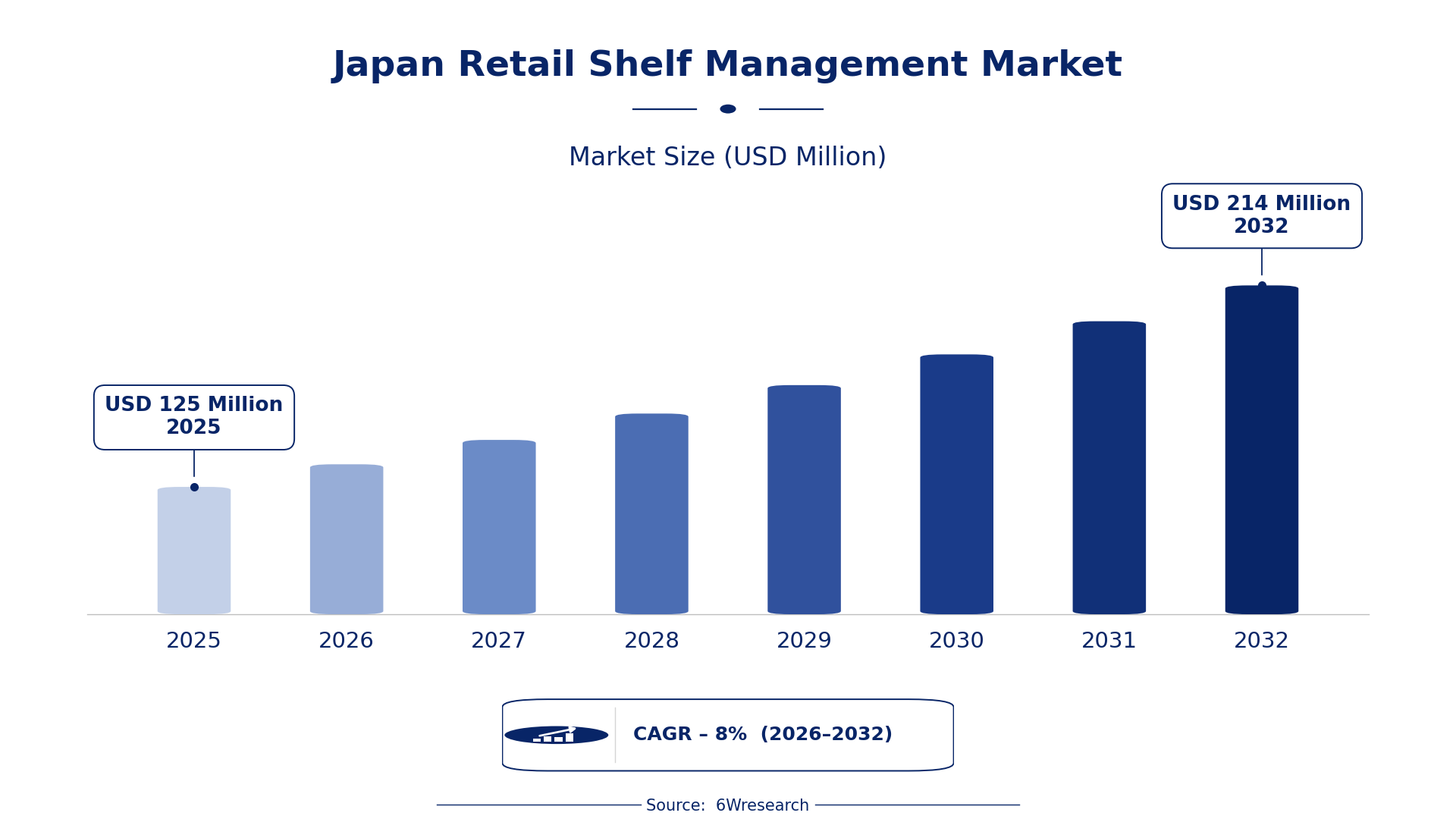
According to 6Wresearch internal database and industry insights, the Japan Retail Shelf Management Market was valued at USD 125 Million in 2025 and is projected to reach USD 214 Million by 2032, growing at a CAGR of approximately 8% during 2026–2032.
Japan Retail Shelf Management Market Highlights
| Report Metric | Details |
| Report Name | Japan Retail Shelf Management Market (2026-2032) |
| Market Size 2025 | USD 125 Million |
| Market Size 2032 | USD 214 Million |
| Absolute Growth 2025–2032 | USD 89 Million |
| CAGR 2026–2032 | 8% |
| Peak Annual Growth | 8.3% in 2030 |
| Forecast Period | 2026–2032 |
| Historical Data | 2022–2025 |
| Base Year | 2025 |
| Leading Technology, 2025 | Planogram Software (50% share) |
| Leading Functionality, 2025 | Shelf Layout Design (41% share) |
| Leading Integration Medium, 2025 | Cloud or On-Premise (55% share) |
| Leading End User, 2025 | Category Managers (43% share) |
| Fastest-Growing Technology | Electronic Shelf Labels (11.9% CAGR) |
| Fastest-Growing Functionality | Price + Promo Control (10.1% CAGR) |
| Fastest-Growing Integration Medium | Shelf-Edge Displays (11.1% CAGR) |
| Fastest-Growing End User | Supermarkets & Drug Stores (10.2% CAGR) |
| Growing Sector | Retail |
| Key End Users | Supermarkets, Drug Stores, Retail Inventory Teams, Category Managers |
Japan Retail Shelf Management Market Year-wise Growth Rate and Key Drivers (2022–2032)
This graph illustrates the annual growth rates of the market from 2022 to 2032, highlighting a steady upward trajectory and projected market expansion over the forecast period.
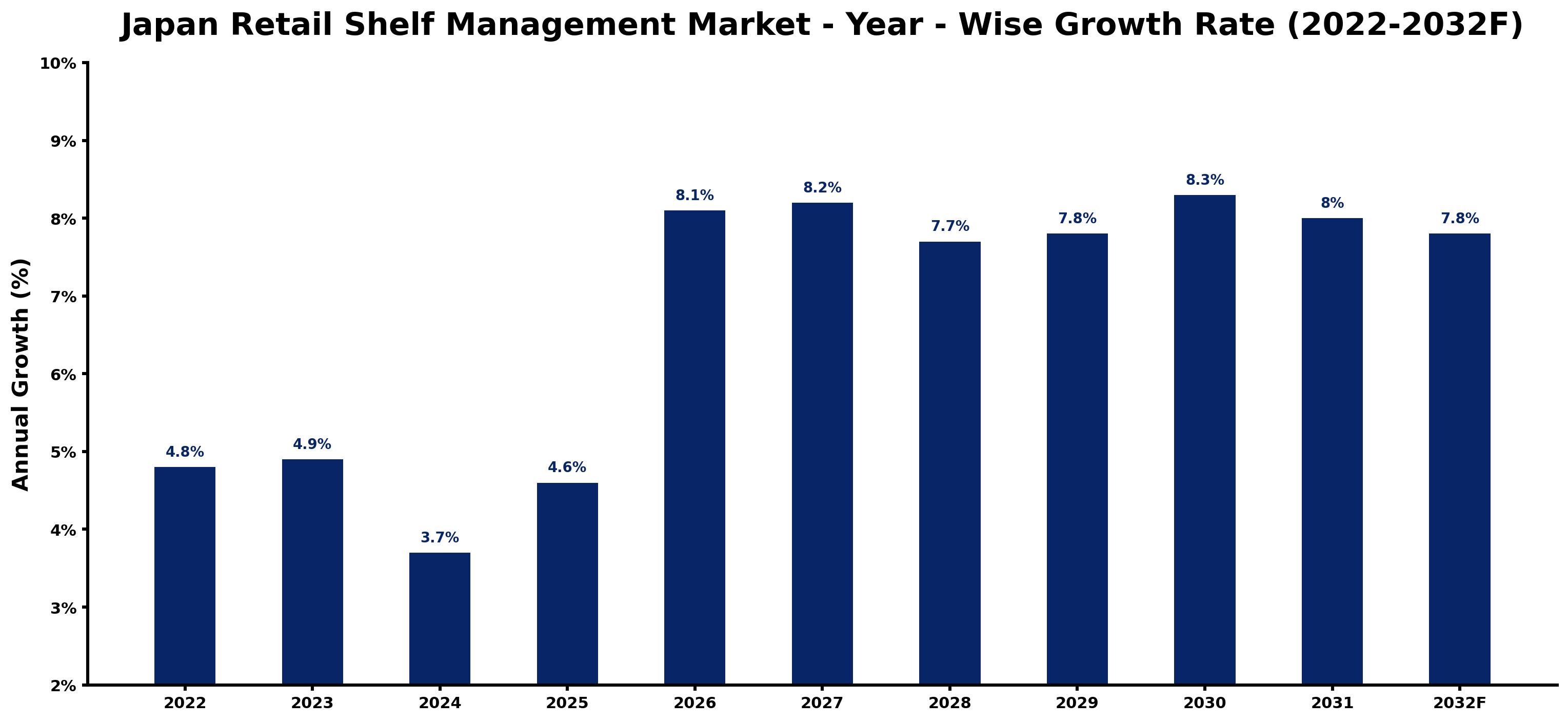
For each year, the table pairs the estimated growth rate with the leading influence on demand, showing how the drivers changed across the period.
| Year | Estimated Annual Growth (%) | Market Rationale |
| 2022 | 4.8 | The market experienced stable growth as retailers adopted shelf management technologies. |
| 2023 | 4.9 | Demand increased due to heightened competition among supermarkets and drug stores. |
| 2024 | 3.7 | Growth slowed as retailers adjusted to market saturation and refined strategies. |
| 2025 | 4.6 | Retailers invested more in technology upgrades to improve operational efficiency. |
| 2026 | 8.1 | The market is expected to accelerate as smart technologies gain traction. |
| 2027 | 8.2 | Investment in inventory management solutions is expected to drive growth further. |
| 2028 | 7.7 | Growth is projected to slow as market maturity begins to set in. |
| 2029 | 7.8 | Retailers are expected to adopt more innovative solutions, boosting demand. |
| 2030 | 8.3 | The market is forecasted to peak as advanced technologies become standard. |
| 2031 | 8.0 | Growth is anticipated to moderate as the market stabilises post-peak. |
| 2032 | 7.8 | Demand is expected to continue growing as retailers seek efficiency. |
Note: Market size estimations and growth projections presented in this report are based on 6Wresearch's proprietary forecasting methodology, utilizing the latest available industry data, government publications, and primary research inputs.
Japan Retail Shelf Management Market Synopsis
Retail Shelf Management encompasses technology and software solutions that optimise product placement and inventory management on retail shelves. In 2022, more than 50,000 supermarkets and drug stores in Japan employed these solutions, with the Tokyo metropolitan area representing the largest market. Growth in the Japan Retail Shelf Management Market is propelled by the rising adoption of planogram software, with over 70% of major retailers implementing it, alongside initiatives that promote smart retail technologies.
Market Dynamics Impact Analysis (2026–2032)
| Factor | Type | Impact | Primary Segment Affected |
| Increasing adoption of planogram software enhances product visibility and stock management. | Driver | High | Planogram Software |
| The rise of electronic shelf labels facilitates dynamic pricing and promotions. | Driver | High | Electronic Shelf Labels |
| Growing demand for real-time stock monitoring creates opportunities for smart sensors. | Opportunity | High | Smart Sensors |
| The need for efficient shelf management solutions in supermarkets and drug stores presents a market opportunity. | Opportunity | High | Supermarkets & Drug Stores |
| High initial investment costs can deter smaller retailers from adopting advanced technologies. | Restraint | High | Smart Sensors |
| Limited awareness of the benefits of retail shelf management solutions may restrict market growth. | Restraint | Medium | Planogram Software |
| Compliance with safety regulations can increase operational costs for retailers. | Challenge | High | Electronic Shelf Labels |
| Capacity constraints in technology integration may hinder the implementation of new solutions. | Challenge | Medium | Smart Sensors |
Evaluation of Drivers in Japan Retail Shelf Management Market (2026–2032)
The table below links each growth driver to the segment it affects and the evidence for it.
| Drivers | Primary Segment Affected | Why It Matters (Evidence) |
| Widespread use of planogram software improves shelf layout efficiency. | Planogram Software | Over 70% of major retailers in Japan use planogram software, leading to increased sales. |
| Adoption of electronic shelf labels improves pricing strategies. | Electronic Shelf Labels | The Japan Retail Association supports their use, boosting demand for dynamic pricing. |
| Smart sensors enable real-time stock monitoring, improving inventory accuracy. | Smart Sensors | Retail inventory teams are increasingly adopting smart sensors for effective stock management. |
| Vision-based gaps detection technology identifies empty shelf spaces automatically. | Vision-Based Gaps Detection | This technology is gaining traction as retailers seek to minimise out-of-stock situations. |
| Shelf layout design improves product placement strategies, driving sales. | Shelf Layout Design | Retailers are focusing on optimising product visibility to attract more customers. |
Spending increases as the Tokyo metropolitan area has experienced strong uptake of retail shelf management technologies, with over 50,000 supermarkets and drug stores employing these solutions. The average Japanese supermarket manages upwards of 10,000 SKUs, which demands effective inventory management. Consequently, retailers are investing more in smart sensors for real-time stock monitoring, and an increasing number of retail inventory teams are adopting these technologies. The allocation of ¥5 billion for technology upgrades in the retail sector supports the integration of advanced solutions, resulting in heightened demand for electronic shelf labels. This combination of elements fuels growth in the Japan Retail Shelf Management Market.
Evaluation of Restraints in Japan Retail Shelf Management Market
The following restraints limit how fast demand can grow.
| Market Restraint | Primary Segment Affected | Why It Matters (Evidence) |
| High initial investment costs deter smaller retailers from adopting technologies. | Smart Sensors | Many smaller retailers cannot afford the upfront costs associated with smart technologies. |
| Limited awareness of benefits restricts market growth for planogram software. | Planogram Software | Some retailers remain unaware of how these solutions can improve sales. |
| Compliance with safety regulations increases operational costs for retailers. | Electronic Shelf Labels | Retailers must ensure compliance with the Electrical Appliance and Material Safety Act, which raises costs. |
| Integration challenges may delay the adoption of new technologies. | Smart Sensors | Retailers face difficulties in integrating new systems with existing infrastructure, slowing down implementation. |
| Market saturation limits growth opportunities for new entrants. | Planogram Software | As major retailers dominate, smaller players struggle to gain market share. |
Japan Retail Shelf Management Market Challenges
Supermarkets encounter a shortage of skilled workers trained in advanced shelf management technologies, which delays implementation and raises training costs by approximately 15% for these retailers. Competition among supermarkets forces producers to reduce margins, affecting profitability and leading to a 10% revenue decline for some suppliers. Rising operational costs, driven by Japan's minimum wage increase to JPY 1,055 per hour, strain budgets and restrict investment in new technologies for over 50,000 supermarkets and drug stores. Many retailers struggle to integrate smart sensors due to outdated infrastructure, resulting in lost sales opportunities estimated at 20% during peak seasons.
Trends in the Japan Retail Shelf Management Market
Buyers and suppliers in the Japan Retail Shelf Management Market are adjusting to the following trends.
- Shift from Traditional to Smart Shelf Management: In 2023, over 70% of major retailers adopted planogram software, reflecting a shift towards smart shelf management solutions. This change improves product visibility and stock management, resulting in increased sales.
- Transition to Real-Time Inventory Monitoring: The adoption of smart sensors has increased among retail inventory teams, with real-time stock monitoring becoming essential. This trend supports better inventory accuracy and reduces out-of-stock situations.
- Emergence of Dynamic Pricing Strategies: The use of electronic shelf labels is on the rise, with the Japan Retail Association advocating for their adoption. This shift enables retailers to implement dynamic pricing, responding quickly to market changes.
- Increase in Smart Technology Adoption: The IoT in retail initiative aims to boost smart technology adoption by 30% by 2025. This initiative encourages retailers to invest in advanced solutions, improving operational efficiency.
Investment Opportunities in the Japan Retail Shelf Management Market
Where to invest in the Japan Retail Shelf Management Market: the main openings are set out below.
- Gap in Smart Sensor Adoption: With over 70% of major retailers using planogram software, there is a gap for smart sensor adoption. Retail inventory teams are increasingly looking for solutions to improve stock monitoring.
- Timing for Advanced Technology Investments: As the retail sector allocates ¥5 billion for technology upgrades, now is the time for suppliers to offer solutions. Supermarkets and drug stores are actively seeking improvements in shelf management.
- Demand from Supermarkets & Drug Stores: Supermarkets and drug stores are increasingly adopting retail shelf management solutions, creating a strong opportunity for suppliers. Partnerships with local firms can facilitate market entry.
- Entry through Joint Ventures: The growing demand for electronic shelf labels presents an opportunity for joint ventures with local technology providers. This collaboration can improve market presence and ensure compliance with local regulations.
Government Initiatives in the Japan Retail Shelf Management Market
The Electrical Appliance and Material Safety Act regulates the safety of electrical appliances and materials in Japan, impacting producers of retail shelf management technologies. Compliance with this law requires manufacturers to ensure their products meet safety standards, which can increase production costs. The AI Promotion Act, enacted in 2025, establishes a framework for the development and use of AI in various sectors, including retail, promoting innovation and efficiency in shelf management solutions.
In 2023, the government allocated ¥5 billion for technology upgrades in the retail sector, administered by the Ministry of Economy, Trade and Industry. This funding supports initiatives aimed at increasing the adoption of smart technologies, benefiting retailers seeking to improve their operational efficiency.
Future Insight of the Japan Retail Shelf Management Market
The Future Retail Strategy program will drive the adoption of smart technologies in retail operations. By 2032, government funding will facilitate technology upgrades, enabling better inventory management across the sector. Over 70% of major retailers will adopt advanced software solutions, supporting data-driven decision-making. The implementation of JIS Z 8801 will standardise electronic shelf labels, streamlining operations and improving customer experience.
Market Segmentation Analysis
Japan Retail Shelf Management Market report covers a detailed analysis of the following market segments:
By Technology – Planogram Software Leads, Electronic Shelf Labels Expected to Grow Fastest
According to Saurav Kr Singh, Senior Research Analyst at 6Wresearch, Planogram Software took 50% of technology revenue in 2025, more than any other category. Planogram software holds the largest share in the technology segment as it is extensively used for designing optimal shelf layouts in over 70% of major retailers in Japan. This widespread adoption underscores its critical role in enhancing product visibility and managing inventory effectively within the competitive retail landscape. Electronic Shelf Labels are projected to grow fastest, at a CAGR of 11.9% during 2026–2032. Electronic shelf labels are experiencing rapid growth, driven by government initiatives such as the ¥5 billion allocation for technology upgrades in the retail sector. This funding is expected to significantly boost the adoption of these labels, thereby improving pricing strategies across retailers. Suppliers should prioritise the development of advanced planogram software and electronic shelf labels to meet the increasing demands of retailers.
By Functionality – Shelf Layout Design Leads, Price + Promo Control Expected to Grow Fastest
The largest functionality category in 2025 was Shelf Layout Design, at 41% of revenue. Shelf layout design leads the functionality segment as it is essential for enhancing product placement strategies, which are vital for maximising sales in Japan's competitive retail market. This focus is particularly crucial for supermarkets managing an average of over 10,000 SKUs, necessitating effective shelf management. Price + Promo Control is set to record the highest CAGR in this split, 10.1% over 2026–2032. Price and promo control is the fastest-growing functionality, propelled by retailers' need to manage pricing strategies effectively in response to market conditions. The increasing emphasis on flexible pricing models to attract customers makes this functionality increasingly important. Buyers will gain a competitive advantage by integrating advanced pricing and promotional control solutions into their retail strategies.
By Integration Medium – Cloud or On-Premise Leads, Shelf-Edge Displays Expected to Grow Fastest
In 2025, Cloud or On-Premise led the integration medium split with a 55% share. Cloud or on-premise solutions dominate the integration medium segment as they provide flexibility in deployment options, catering to diverse retailer needs. This adaptability is essential for retailers aiming to optimise operations without incurring substantial upfront costs. The quickest growth will come from Shelf-Edge Displays, forecast to expand at a CAGR of 11.1% between 2026 and 2032. Shelf-edge displays are the fastest-growing integration medium, primarily used for promotional displays that enhance customer engagement. Their rapid adoption aligns with the increasing focus on in-store marketing strategies to drive sales. Suppliers should concentrate on creating versatile integration options that include both cloud solutions and innovative display technologies to attract a broader customer base.
By End User – Category Managers Lead, Supermarkets & Drug Stores Expected to Grow Fastest
Category Managers accounted for 43% of the market by end user in 2025. Category managers represent the largest end user group as they oversee product categories and are directly involved in shelf management strategies. Their role is critical in ensuring that products are optimally placed to drive sales in a market with over 50,000 supermarkets and drug stores. Over 2026–2032, Supermarkets & Drug Stores are expected to post the fastest growth, at a CAGR of 10.2%. Supermarkets and drug stores are the fastest-growing end user segment, driven by their need for efficient shelf management solutions to handle diverse product offerings. This sector's growth reflects the increasing complexity of retail inventory management. Suppliers should tailor their offerings to meet the specific needs of supermarkets and drug stores, ensuring solutions are scalable and user-friendly.
Key Attractiveness of the Report
- 10 Years of Market Numbers
- Historical Data Starting from 2022 to 2025
- Base Year 2025
- Forecast Data until 2032
- Key Performance Indicators Impacting the Market
- Major Upcoming Developments and Projects
Key Highlights of the Report:
- Japan Retail Shelf Management Market Outlook
- Market Size of Japan Retail Shelf Management Market, 2025
- Forecast of Japan Retail Shelf Management Market, 2032
- Historical Data and Forecast of Japan Retail Shelf Management Revenues & Volume for the Period 2022-2032F
- Japan Retail Shelf Management Market Trend Evolution
- Japan Retail Shelf Management Market Drivers and Challenges
- Japan Retail Shelf Management Price Trends
- Japan Retail Shelf Management Porter's Five Forces
- Japan Retail Shelf Management Industry Life Cycle
- Historical Data and Forecast of Japan Retail Shelf Management Market Revenues & Volume By Technology for the Period 2022-2032F
- Historical Data and Forecast of Japan Retail Shelf Management Market Revenues & Volume By Planogram Software for the Period 2022-2032F
- Historical Data and Forecast of Japan Retail Shelf Management Market Revenues & Volume By Electronic Shelf Labels for the Period 2022-2032F
- Historical Data and Forecast of Japan Retail Shelf Management Market Revenues & Volume By Smart Sensors for the Period 2022-2032F
- Historical Data and Forecast of Japan Retail Shelf Management Market Revenues & Volume By Vision-Based Gaps Detection for the Period 2022-2032F
- Historical Data and Forecast of Japan Retail Shelf Management Market Revenues & Volume By Functionality for the Period 2022-2032F
- Historical Data and Forecast of Japan Retail Shelf Management Market Revenues & Volume By Shelf Layout Design for the Period 2022-2032F
- Historical Data and Forecast of Japan Retail Shelf Management Market Revenues & Volume By Price + Promo Control for the Period 2022-2032F
- Historical Data and Forecast of Japan Retail Shelf Management Market Revenues & Volume By Stock Level Detection for the Period 2022-2032F
- Historical Data and Forecast of Japan Retail Shelf Management Market Revenues & Volume By Out-of-Stock Alerts for the Period 2022-2032F
- Historical Data and Forecast of Japan Retail Shelf Management Market Revenues & Volume By Integration Medium for the Period 2022-2032F
- Historical Data and Forecast of Japan Retail Shelf Management Market Revenues & Volume By Cloud or On-Premise for the Period 2022-2032F
- Historical Data and Forecast of Japan Retail Shelf Management Market Revenues & Volume By Shelf-Edge Displays for the Period 2022-2032F
- Historical Data and Forecast of Japan Retail Shelf Management Market Revenues & Volume By IoT-Connected for the Period 2022-2032F
- Historical Data and Forecast of Japan Retail Shelf Management Market Revenues & Volume By Shelf-Cameras for the Period 2022-2032F
- Historical Data and Forecast of Japan Retail Shelf Management Market Revenues & Volume By End User for the Period 2022-2032F
- Historical Data and Forecast of Japan Retail Shelf Management Market Revenues & Volume By Category Managers for the Period 2022-2032F
- Historical Data and Forecast of Japan Retail Shelf Management Market Revenues & Volume By Supermarkets & Drug Stores for the Period 2022-2032F
- Historical Data and Forecast of Japan Retail Shelf Management Market Revenues & Volume By Retail Inventory Teams for the Period 2022-2032F
- Historical Data and Forecast of Japan Retail Shelf Management Market Revenues & Volume By Retail Operations Staff for the Period 2022-2032F
- Japan Retail Shelf Management Import Export Trade Statistics
- Market Opportunity Assessment By Technology
- Market Opportunity Assessment By Functionality
- Market Opportunity Assessment By Integration Medium
- Market Opportunity Assessment By End User
- Japan Retail Shelf Management Top Companies Market Share
- Japan Retail Shelf Management Competitive Benchmarking By Technical and Operational Parameters
- Japan Retail Shelf Management Company Profiles
- Japan Retail Shelf Management Key Strategic Recommendations
Market Covered
Segments analysed in this report are listed below.
By Technology
- Planogram Software
- Electronic Shelf Labels
- Smart Sensors
- Vision-Based Gaps Detection
By Functionality
- Shelf Layout Design
- Price + Promo Control
- Stock Level Detection
- Out-of-Stock Alerts
By Integration Medium
- Cloud or On-Premise
- Shelf-Edge Displays
- IoT-Connected
- Shelf-Cameras
By End User
- Category Managers
- Supermarkets & Drug Stores
- Retail Inventory Teams
- Retail Operations Staff































