Japan Retail Supply Chain Market Size & Growth Rate
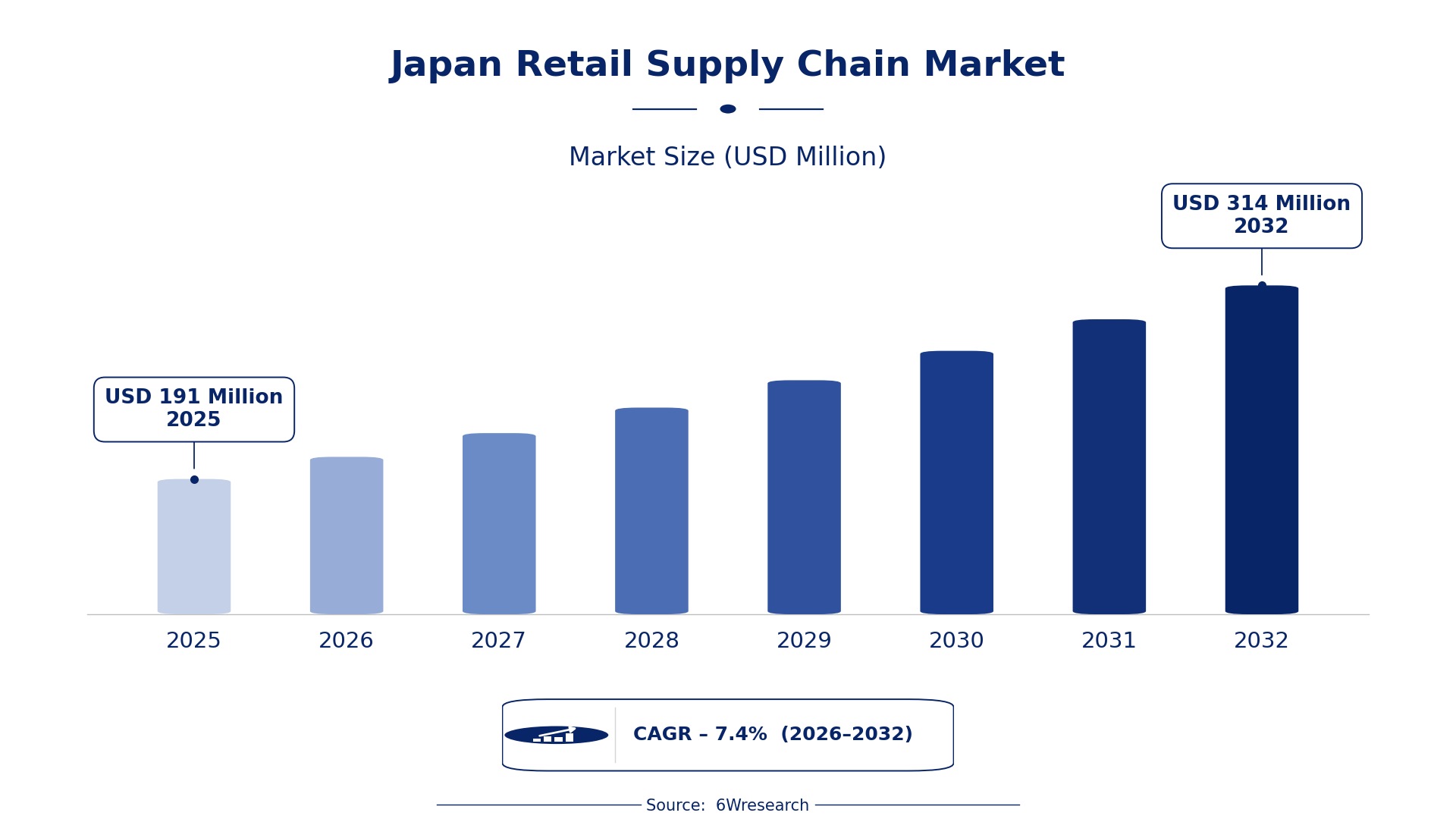
According to 6Wresearch internal database and industry insights, the Japan Retail Supply Chain Market was valued at USD 191 Million in 2025 and is projected to reach USD 314 Million by 2032, growing at a CAGR of approximately 7.4% during 2026–2032.
Japan Retail Supply Chain Market Highlights
| Report Metric | Details |
| Report Name | Japan Retail Supply Chain Market (2026-2032) |
| Market Size 2025 | USD 191 Million |
| Market Size 2032 | USD 314 Million |
| Absolute Growth 2025–2032 | USD 123 Million |
| CAGR 2026–2032 | 7.4% |
| Peak Annual Growth | 7.8% in 2026 |
| Forecast Period | 2026–2032 |
| Historical Data | 2022–2025 |
| Base Year | 2025 |
| Leading Supply Chain Component, 2025 | Last-Mile Delivery (41% share) |
| Leading Technology Platform, 2025 | WMS Software (43% share) |
| Leading Integration Format, 2025 | Cloud-Hosted (49% share) |
| Leading End User, 2025 | E-commerce Retailers (41% share) |
| Fastest-Growing Technology Platform | AI/ML Analytics (10.6% CAGR) |
| Fastest-Growing Integration Format | SaaS/On-Premise (11.1% CAGR) |
| Fastest-Growing End User | Retail Distribution Centers (9.6% CAGR) |
| Growing Sector | E-commerce |
| Key End Users | E-commerce Retailers, Retail Distribution Centers, Procurement Teams |
Japan Retail Supply Chain Market Year-wise Growth Rate and Key Drivers (2022–2032)
This graph illustrates the annual growth rates of the market from 2022 to 2032, highlighting a steady upward trajectory and projected market expansion over the forecast period.
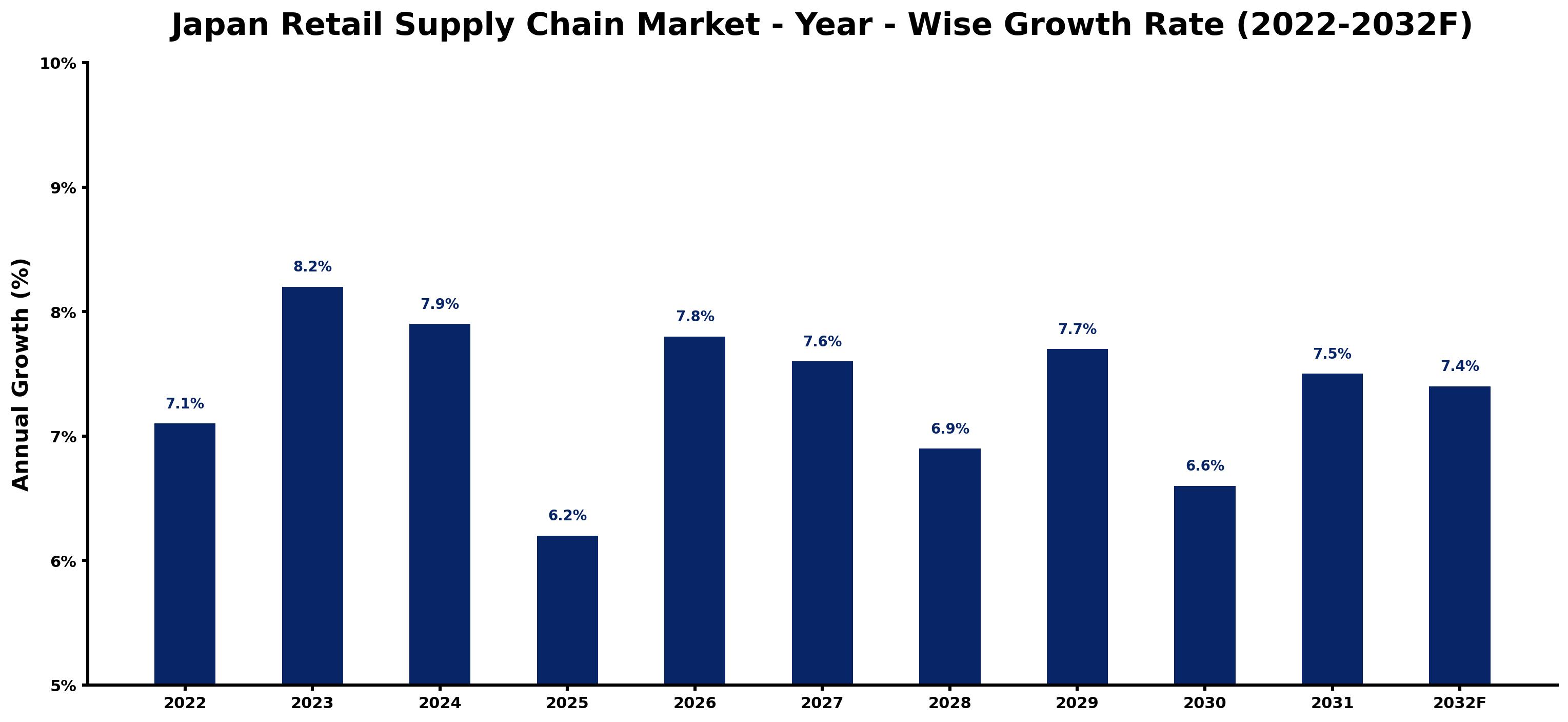
Each row of the following table gives one year's estimated growth and the event or demand shift that explains it.
| Year | Estimated Annual Growth (%) | Market Rationale |
| 2022 | 7.1 | The market experienced steady growth as e-commerce demand surged. |
| 2023 | 8.2 | Demand accelerated due to increased investments in supply chain technologies. |
| 2024 | 7.9 | Growth slowed as market adjustments to technology adoption occurred. |
| 2025 | 6.2 | The market continued to grow, albeit at a slower pace, reflecting saturation. |
| 2026 | 7.8 | Growth is expected to rebound with renewed interest in last-mile delivery solutions. |
| 2027 | 7.6 | Demand growth is projected to moderate as market conditions stabilise after the peak. |
| 2028 | 6.9 | The market is anticipated to grow at a slower pace due to increased competition. |
| 2029 | 7.7 | Demand is expected to pick up again, driven by innovations in supply chain management. |
| 2030 | 6.6 | Growth will slow as market maturity sets in, with fewer rapid changes. |
| 2031 | 7.5 | Demand is projected to increase again as businesses adapt to new technologies. |
| 2032 | 7.4 | The market will continue to grow, supported by ongoing digital transformation. |
Note: Market size estimations and growth projections presented in this report are based on 6Wresearch's proprietary forecasting methodology, utilizing the latest available industry data, government publications, and primary research inputs.
Japan Retail Supply Chain Market Synopsis
Retail supply chain solutions in Japan involve integrating logistics and technology to optimise efficiency from suppliers to consumers. The Japan Retail Supply Chain Market is propelled by a thriving e-commerce sector, which reached 19 trillion yen in 2022, alongside substantial investments in technology, with the logistics industry projected to invest 1 trillion yen by 2025. The increasing adoption of warehouse management systems and last-mile delivery solutions further drives demand, as businesses aim to improve inventory management and customer satisfaction.
Market Dynamics Impact Analysis (2026–2032)
| Factor | Type | Impact | Primary Segment Affected |
| Rising e-commerce sales are driving demand for efficient supply chain solutions. | Driver | High | Last-Mile Delivery |
| Increased investment in logistics technology enhances operational capabilities. | Driver | High | Warehouse Mgmt Systems |
| The shift towards automated systems in retail distribution centres presents growth opportunities. | Opportunity | High | Warehouse Mgmt Systems |
| The growing preference for cloud-hosted solutions among new retail businesses opens new avenues. | Opportunity | High | Cloud-Hosted |
| High operational costs associated with technology upgrades can limit market growth. | Restraint | High | Warehouse Mgmt Systems |
| Limited availability of skilled workforce in logistics can hinder operational efficiency. | Restraint | High | Last-Mile Delivery |
| Competition among logistics providers can lead to price wars, affecting profitability. | Challenge | High | Last-Mile Delivery |
| Regulatory compliance requirements can slow down technology adoption. | Challenge | High | Warehouse Mgmt Systems |
Evaluation of Drivers in Japan Retail Supply Chain Market (2026–2032)
Key forces behind demand, with the segment each one moves most, are listed below.
| Drivers | Primary Segment Affected | Why It Matters (Evidence) |
| The e-commerce sector is expanding rapidly, leading to increased demand for efficient logistics solutions. | Last-Mile Delivery | Japan's e-commerce market reached 19 trillion yen in 2022, prompting retailers to improve delivery capabilities. |
| Investment in technology upgrades is essential for maintaining competitive advantage. | Warehouse Mgmt Systems | The logistics industry plans to invest 1 trillion yen by 2025, boosting demand for advanced management systems. |
| Adoption of WMS software is critical for inventory management and order fulfilment. | WMS Software | 60% of large retailers in Japan have adopted WMS software, indicating strong demand. |
| The need for faster delivery times is pushing retailers to optimise last-mile logistics. | Last-Mile Delivery | Average delivery times in urban areas are 2-3 hours, necessitating efficient delivery solutions. |
| Growing automation in retail distribution centres improves operational efficiency. | Warehouse Mgmt Systems | Automated systems are increasingly used in retail distribution centres to streamline operations. |
What keeps demand rising is the rapid expansion of the e-commerce sector, which reached 19 trillion yen in 2022, pushing retailers to enhance last-mile delivery solutions. The logistics industry is projected to invest 1 trillion yen by 2025, prompting businesses to adopt warehouse management systems for better inventory control. Sixty percent of large retailers now utilise WMS software, reflecting a strong trend towards automation. The average delivery time for last-mile logistics in urban areas is 2-3 hours, increasing the need for optimisation. Retail distribution centres are increasingly adopting automated systems to improve efficiency, further driving demand for effective supply chain solutions.
Evaluation of Restraints in Japan Retail Supply Chain Market
The main factors holding the market back are set out below.
| Market Restraint | Primary Segment Affected | Why It Matters (Evidence) |
| High operational costs associated with technology upgrades can limit market growth. | Warehouse Mgmt Systems | The logistics industry faces rising costs, with Japan's national minimum wage reaching JPY 1,055 per hour in October 2024. |
| Limited availability of skilled workforce in logistics can hinder operational efficiency. | Last-Mile Delivery | Japan's declining population impacts the workforce, making it challenging to find skilled labour. |
| Intense competition among logistics providers can lead to price wars, affecting profitability. | Last-Mile Delivery | The growing number of logistics firms in Japan intensifies competition, driving down prices. |
| Regulatory compliance requirements can slow down technology adoption. | Warehouse Mgmt Systems | ISO 9001 standards for quality management require significant investment and time for compliance. |
| Resistance to change from traditional retail practices can impede innovation. | WMS Software | Many retailers are hesitant to adopt new technologies, preferring established methods. |
Japan Retail Supply Chain Market Challenges
Japan's retail supply chain faces technology adoption issues, as only 60% of large retailers use warehouse management systems, resulting in higher inventory costs for buyers. Limited supplier investment in technology upgrades, projected at 1 trillion yen by 2025, can lead to longer lead times and affect product availability for retailers. Buyers encounter intense competition from e-commerce, with the market reaching 19 trillion yen in 2022, forcing traditional retailers to enhance their supply chains or risk losing customers. Increased competition among logistics providers, spurred by subsidies for tech adoption, creates service quality disparities that disadvantage smaller firms and impact their pricing strategies.
Trends in the Japan Retail Supply Chain Market
The shifts below are changing how Japan Retail Supply Chain Market products are bought and supplied.
- Shift towards Automated Systems in Retail Distribution Centers: Tokyo and Osaka are experiencing a notable shift towards automation in retail distribution centres, with a reported 25% increase in automated systems in 2023. This trend improves operational efficiency and reduces labour costs.
- Transition from On-Premise to Cloud-Hosted Solutions: The adoption of cloud-hosted solutions is growing rapidly, with 70% of new retail businesses in Japan preferring this model for scalability. This shift allows for better resource management and flexibility in operations.
- Emergence of AI/ML Analytics for Demand Forecasting: AI/ML analytics are becoming increasingly popular among retailers, with a 40% adoption rate in 2023. This technology improves decision-making and inventory management, leading to better customer satisfaction.
- Focus on Last-Mile Delivery Efficiency: The Japanese government is implementing policies to improve last-mile delivery efficiency, with the average delivery time in urban areas currently at 2-3 hours. This focus is driving innovations in logistics solutions.
Investment Opportunities in the Japan Retail Supply Chain Market
Several openings in the Japan Retail Supply Chain Market merit attention from investors.
- Investment in Warehouse Management Systems: With the logistics industry projected to invest 1 trillion yen by 2025, there is an opportunity to supply advanced warehouse management systems. Retail distribution centres in Tokyo are prime targets for these solutions.
- Supply of Cloud-Hosted Solutions for New Retailers: As 70% of new retail businesses prefer cloud-hosted solutions, there is a gap in the market for scalable supply chain services. Partnering with local tech firms can facilitate entry into this segment.
- Development of Last-Mile Delivery Solutions: The growing demand for efficient last-mile delivery solutions presents an opportunity to invest in logistics technology. E-commerce retailers in Osaka are actively seeking effective delivery options.
- Expansion of AI/ML Analytics Services: The rising adoption of AI/ML analytics, currently at 40%, creates a demand for analytical services. Collaborating with retail chains can help penetrate this market effectively.
Government Initiatives in the Japan Retail Supply Chain Market
The Economic Security Promotion Act of 2022 supports supply-chain resilience for critical products, ensuring that producers must comply with new standards to maintain supply chain stability. Additionally, the AI Promotion Act of 2025 establishes a framework for AI research and development, encouraging businesses to integrate AI into their operations.
The Digital Agency, established in September 2021, leads the government's digital transformation efforts. It approves funding for projects aimed at improving supply chain efficiency, with an allocation of 500 million yen for logistics technology research and development in 2023.
Future Insight of the Japan Retail Supply Chain Market
A shift in Japan's retail supply chain by 2032 will emerge from the Ministry of Economy, Trade and Industry's 'Digital Supply Chain Strategy'. Logistics firms are expected to invest 1 trillion yen in technology upgrades, which will enhance operational efficiency for suppliers. The Smart Logistics initiative will improve last-mile delivery processes, while the adoption of ISO 9001 standards will ensure quality management across the sector. As these changes unfold, buyers will enjoy faster, more reliable services, and suppliers will gain improved operational capabilities, fostering a competitive market.
Market Segmentation Analysis
Japan Retail Supply Chain Market report covers a detailed analysis of the following market segments:
By Supply Chain Component – Last-Mile Delivery Leads and Records the Fastest Growth
According to Saurav Kr Singh, Senior Research Analyst at 6Wresearch, Last-Mile Delivery accounted for 41% of the market by supply chain component in 2025. Last-Mile Delivery holds the largest share due to its critical function in efficiently transporting goods directly to consumers. With urban areas experiencing an average delivery time of 2-3 hours, this segment is essential for meeting customer expectations and satisfaction. Its lead should widen, with a projected CAGR of 10.1% during 2026–2032, the highest in this split. The rapid growth of Last-Mile Delivery is propelled by the increasing demand for swift delivery services, particularly in urban centres. Government initiatives aimed at enhancing last-mile delivery efficiency further contribute to this upward trend. Suppliers must prioritise improvements in last-mile delivery solutions to align with rising consumer expectations.
By Technology Platform – WMS Software Leads, AI/ML Analytics Expected to Grow Fastest
In 2025, WMS Software led the technology platform split with a 43% share. WMS Software leads the market as it is crucial for effectively managing warehouse operations, with a 60% adoption rate among large retailers. This extensive use underscores the importance of efficient inventory management within the retail supply chain. The quickest growth will come from AI/ML Analytics, forecast to expand at a CAGR of 10.6% between 2026 and 2032. AI/ML Analytics is experiencing rapid growth due to its ability to enhance decision-making processes in supply chain management. The 40% adoption rate among retailers indicates its increasing relevance in improving operational efficiencies. Buyers should explore the integration of AI/ML Analytics to refine their supply chain decision-making processes.
By Integration Format – Cloud-Hosted Leads, SaaS/On-Premise Expected to Grow Fastest
Cloud-Hosted took 49% of integration format revenue in 2025, more than any other category. Cloud-Hosted solutions are predominant in the market, favoured by 70% of new retail businesses for their scalability and adaptability. This preference illustrates the industry's movement towards more flexible supply chain solutions that can accommodate growth. SaaS/On-Premise is projected to grow fastest, at a CAGR of 11.1% during 2026–2032. SaaS/On-Premise formats are rapidly gaining popularity as they offer versatile deployment options for a variety of supply chain solutions. Their rising adoption highlights a growing demand for customised software solutions among businesses. Suppliers should provide a range of integration formats to meet the diverse needs of their clients.
By End User – E-commerce Retailers Lead, Retail Distribution Centers Expected to Grow Fastest
E-commerce Retailers held 41% of the Japan Retail Supply Chain Market by end user in 2025. E-commerce Retailers constitute the largest user group for supply chain solutions, propelled by the booming e-commerce market that reached 19 trillion yen in 2022. Their reliance on efficient logistics highlights the necessity for robust supply chain management. Over 2026–2032, Retail Distribution Centers are expected to post the fastest growth, at a CAGR of 9.6%. Retail Distribution Centers are the fastest-growing segment as they play a crucial role in streamlining supply chain operations. Their significance as key facilities in the logistics network is increasingly vital as the demand for efficiency escalates. Suppliers must tailor their offerings to address the specific requirements of retail distribution centres to capture this expanding market.
Key Attractiveness of the Report
- 10 Years of Market Numbers
- Historical Data Starting from 2022 to 2025
- Base Year 2025
- Forecast Data until 2032
- Key Performance Indicators Impacting the Market
- Major Upcoming Developments and Projects
Key Highlights of the Report:
- Japan Retail Supply Chain Market Outlook
- Market Size of Japan Retail Supply Chain Market, 2025
- Forecast of Japan Retail Supply Chain Market, 2032
- Historical Data and Forecast of Japan Retail Supply Chain Revenues & Volume for the Period 2022-2032F
- Japan Retail Supply Chain Market Trend Evolution
- Japan Retail Supply Chain Market Drivers and Challenges
- Japan Retail Supply Chain Price Trends
- Japan Retail Supply Chain Porter's Five Forces
- Japan Retail Supply Chain Industry Life Cycle
- Historical Data and Forecast of Japan Retail Supply Chain Market Revenues & Volume By Supply Chain Component for the Period 2022-2032F
- Historical Data and Forecast of Japan Retail Supply Chain Market Revenues & Volume By Warehouse Mgmt Systems for the Period 2022-2032F
- Historical Data and Forecast of Japan Retail Supply Chain Market Revenues & Volume By Last-Mile Delivery for the Period 2022-2032F
- Historical Data and Forecast of Japan Retail Supply Chain Market Revenues & Volume By Supplier Collaboration for the Period 2022-2032F
- Historical Data and Forecast of Japan Retail Supply Chain Market Revenues & Volume By Demand Forecasting for the Period 2022-2032F
- Historical Data and Forecast of Japan Retail Supply Chain Market Revenues & Volume By Technology Platform for the Period 2022-2032F
- Historical Data and Forecast of Japan Retail Supply Chain Market Revenues & Volume By WMS Software for the Period 2022-2032F
- Historical Data and Forecast of Japan Retail Supply Chain Market Revenues & Volume By Route Optimization for the Period 2022-2032F
- Historical Data and Forecast of Japan Retail Supply Chain Market Revenues & Volume By Vendor Portal Systems for the Period 2022-2032F
- Historical Data and Forecast of Japan Retail Supply Chain Market Revenues & Volume By AI/ML Analytics for the Period 2022-2032F
- Historical Data and Forecast of Japan Retail Supply Chain Market Revenues & Volume By Integration Format for the Period 2022-2032F
- Historical Data and Forecast of Japan Retail Supply Chain Market Revenues & Volume By SaaS/On-Premise for the Period 2022-2032F
- Historical Data and Forecast of Japan Retail Supply Chain Market Revenues & Volume By Mobile Apps for the Period 2022-2032F
- Historical Data and Forecast of Japan Retail Supply Chain Market Revenues & Volume By Cloud-Hosted for the Period 2022-2032F
- Historical Data and Forecast of Japan Retail Supply Chain Market Revenues & Volume By Dashboard Platforms for the Period 2022-2032F
- Historical Data and Forecast of Japan Retail Supply Chain Market Revenues & Volume By End User for the Period 2022-2032F
- Historical Data and Forecast of Japan Retail Supply Chain Market Revenues & Volume By Retail Distribution Centers for the Period 2022-2032F
- Historical Data and Forecast of Japan Retail Supply Chain Market Revenues & Volume By E-commerce Retailers for the Period 2022-2032F
- Historical Data and Forecast of Japan Retail Supply Chain Market Revenues & Volume By Procurement Teams for the Period 2022-2032F
- Historical Data and Forecast of Japan Retail Supply Chain Market Revenues & Volume By Category/Product Managers for the Period 2022-2032F
- Japan Retail Supply Chain Import Export Trade Statistics
- Market Opportunity Assessment By Supply Chain Component
- Market Opportunity Assessment By Technology Platform
- Market Opportunity Assessment By Integration Format
- Market Opportunity Assessment By End User
- Japan Retail Supply Chain Top Companies Market Share
- Japan Retail Supply Chain Competitive Benchmarking By Technical and Operational Parameters
- Japan Retail Supply Chain Company Profiles
- Japan Retail Supply Chain Key Strategic Recommendations
Market Covered
The following segment groups are covered in the report.
By Supply Chain Component
- Warehouse Mgmt Systems
- Last-Mile Delivery
- Supplier Collaboration
- Demand Forecasting
By Technology Platform
- WMS Software
- Route Optimization
- Vendor Portal Systems
- AI/ML Analytics
By Integration Format
- SaaS/On-Premise
- Mobile Apps
- Cloud-Hosted
- Dashboard Platforms
By End User
- Retail Distribution Centers
- E-commerce Retailers
- Procurement Teams
- Category/Product Managers































