Japan Retail Tech Market Size & Growth Rate

According to 6Wresearch internal database and industry insights, the Japan Retail Tech Market was valued at USD 872 Million in 2025 and is projected to reach USD 1,544 Million by 2032, growing at a CAGR of approximately 8.5% during 2026–2032.
Japan Retail Tech Market Highlights
| Report Metric | Details |
| Report Name | Japan Retail Tech Market (2026-2032) |
| Market Size 2025 | USD 872 Million |
| Market Size 2032 | USD 1,544 Million |
| Absolute Growth 2025–2032 | USD 672 Million |
| CAGR 2026–2032 | 8.5% |
| Peak Annual Growth | 9.4% in 2028 |
| Forecast Period | 2026–2032 |
| Historical Data | 2022–2025 |
| Base Year | 2025 |
| Leading Segment, 2025 | POS & Payment Systems (45% share) |
| Leading Technology Type, 2025 | Contactless/Digital (52% share) |
| Leading Deployment Mode, 2025 | On-Premise/Cloud (40% share) |
| Leading End User, 2025 | Retail Chains (41% share) |
| Fastest-Growing Segment | Inventory Automation (11.3% CAGR) |
| Fastest-Growing Technology Type | RFID/IoT Sensors (13.1% CAGR) |
| Fastest-Growing Deployment Mode | Edge-Enabled (12.3% CAGR) |
| Fastest-Growing End User | Warehouse & Store Teams (11.1% CAGR) |
| Growing Sector | retail |
| Key End Users | retail chains, marketing teams, warehouse teams, omnichannel retailers |
Japan Retail Tech Market Year-wise Growth Rate and Key Drivers (2022–2032)
This graph illustrates the annual growth rates of the market from 2022 to 2032, highlighting a steady upward trajectory and projected market expansion over the forecast period.
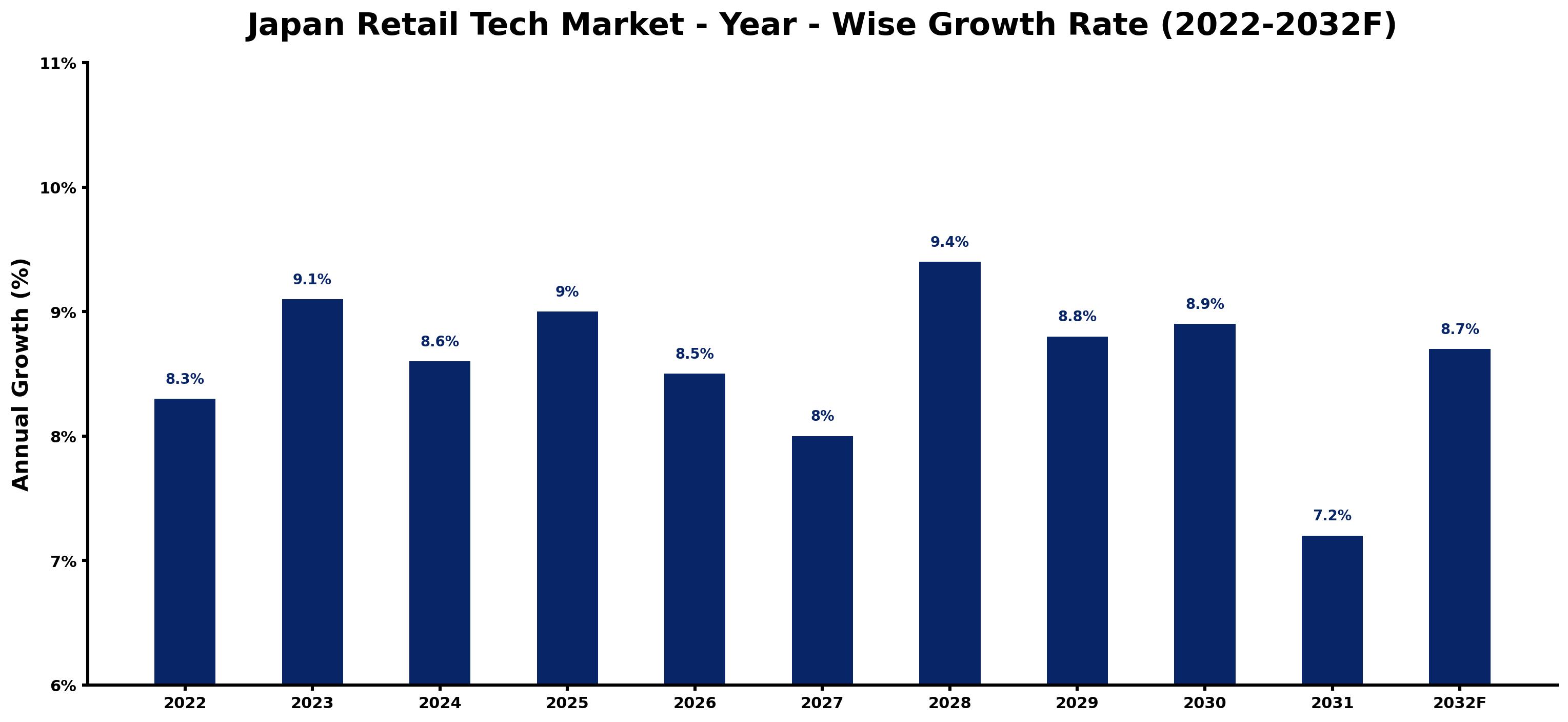
The yearly estimates that follow link every growth rate to its principal driver, so readers can see why the pace changed in each period.
| Year | Estimated Annual Growth (%) | Market Rationale |
| 2022 | 8.3 | The market showed steady growth due to existing demand from retail chains. |
| 2023 | 9.1 | Growth accelerated as retailers adopted advanced technology solutions. |
| 2024 | 8.6 | The growth rate slowed slightly as market saturation began to set in. |
| 2025 | 9.0 | Demand surged again as retailers sought to improve customer engagement. |
| 2026 | 8.5 | Growth is expected to decelerate as competition intensifies among technology providers. |
| 2027 | 8.0 | The market will continue to grow, but at a slower pace due to consolidation. |
| 2028 | 9.4 | A peak in growth is projected as contactless solutions gain widespread acceptance. |
| 2029 | 8.8 | Growth is expected to slow as the market matures and technology adoption stabilises. |
| 2030 | 8.9 | Demand will increase again as retailers invest in omnichannel strategies. |
| 2031 | 7.2 | The growth rate is projected to slow as the market approaches saturation levels. |
| 2032 | 8.7 | A resurgence in demand is expected as new technologies emerge. |
Note: Market size estimations and growth projections presented in this report are based on 6Wresearch's proprietary forecasting methodology, utilizing the latest available industry data, government publications, and primary research inputs.
Japan Retail Tech Market Synopsis
Retail Tech encompasses various technologies designed to improve the retail experience, including POS systems, inventory management, and customer analytics. Demand in the Japan Retail Tech Market is driven by urban retail chains seeking operational efficiency and improved customer engagement. The adoption of contactless payment systems reached 50% in 2023, while the Tokyo Metropolitan Government's smart retail initiative, which launched in 2023, stimulates further investment in digital transformation and innovation.
Market Dynamics Impact Analysis (2026–2032)
| Factor | Type | Impact | Primary Segment Affected |
| Increased adoption of contactless payment systems | Driver | High | POS & Payment Systems |
| Growing need for inventory management solutions | Driver | High | Inventory Automation |
| Expansion of smart retail initiatives in urban areas | Opportunity | High | Omnichannel Integration |
| Rising demand for analytics tools among marketing teams | Opportunity | Medium | Customer Analytics |
| High initial investment costs for technology implementation | Restraint | High | Inventory Automation |
| Limited availability of skilled workforce for tech integration | Restraint | Medium | POS & Payment Systems |
| Intense competition among technology providers | Challenge | High | Customer Analytics |
| Rapid technological advancements requiring constant updates | Challenge | Medium | Omnichannel Integration |
Evaluation of Drivers in Japan Retail Tech Market (2026–2032)
These are the developments adding the most demand over the forecast period.
| Drivers | Primary Segment Affected | Why It Matters (Evidence) |
| Urban retail chains are increasingly adopting advanced POS systems | POS & Payment Systems | This shift improves transaction efficiency, with 30% of demand originating from urban areas. |
| Retailers are investing in inventory automation to manage stock levels | Inventory Automation | The average store employs 5-10 solutions, which improves stock control and reduces waste. |
| The rise of customer analytics tools is driven by data-driven marketing | Customer Analytics | 35% of retailers use these tools to better understand consumer behaviour, leading to targeted campaigns. |
| Omnichannel strategies are being adopted to improve customer engagement | Omnichannel Integration | Retailers are integrating channels to provide a cohesive shopping experience, increasing customer satisfaction. |
| Contactless payment systems are gaining popularity for convenience | POS & Payment Systems | The adoption rate reached 50% in 2023, pushing demand for modern payment solutions. |
Buyers are adding capacity as the retail tech market evolves. In 2023, 50% of retailers adopted contactless payment systems, improving transaction efficiency. The average retail store employs 5-10 inventory automation solutions, which improves stock management. About 35% of retailers utilise AI-driven customer analytics to understand consumer behaviour, enabling more targeted marketing strategies. Urban retail chains are increasingly investing in omnichannel integration, creating a shopping experience that caters to modern consumer preferences.
Evaluation of Restraints in Japan Retail Tech Market
Several factors work against faster growth; the main ones are summarised below.
| Market Restraint | Primary Segment Affected | Why It Matters (Evidence) |
| High initial investment costs for advanced retail technologies | Inventory Automation | Many retailers face budget constraints, limiting their ability to implement new systems effectively, impacting 30% of small businesses. |
| Limited availability of skilled workforce for technology integration | POS & Payment Systems | A shortage of trained professionals hampers the effective deployment of new solutions, impacting 40% of retailers. |
| Technological complexity can deter smaller retailers from adoption | Customer Analytics | Smaller businesses may struggle to implement sophisticated analytics tools, affecting their competitive edge and limiting growth. |
| Market saturation in urban areas can limit growth potential | Omnichannel Integration | As most retailers adopt these technologies, competition intensifies and growth slows, particularly in Tokyo. |
| Rapid technological advancements require continuous updates | POS & Payment Systems | Retailers must frequently invest in upgrades to stay competitive, impacting their operational budgets. |
Japan Retail Tech Market Challenges
High operational costs burden buyers, as Japan's national minimum wage will rise to JPY 1,055 per hour in October 2024, increasing labour expenses. Many producers face technological challenges, with only 20% of major retail chains using RFID, which delays inventory processes and reduces profitability. Regulatory demands, such as ISO 27001 for data security, impose financial pressures on clinics, diverting resources from crucial technology enhancements. Skills shortages in the retail tech sector result in delays for suppliers, obstructing the timely rollout of modern solutions that could boost customer engagement.
Trends in the Japan Retail Tech Market
The trends below show where the Japan Retail Tech Market is heading.
- Retail Chains Adopting Omnichannel Strategies: Retail chains are increasingly adopting omnichannel strategies to improve customer engagement. By 2025, omnichannel retailers are projected to grow by 15% annually, reflecting a shift in consumer shopping preferences.
- Shift Towards Contactless Payment Solutions: The adoption of contactless payment systems is reshaping the retail sector. By 2023, the adoption rate reached 50%, driven by consumer demand for convenience and safety.
- Integration of AI in Customer Analytics: AI-driven customer analytics tools are becoming essential for retailers. In 2023, 35% of retailers employed these tools, enabling them to tailor marketing strategies based on consumer behaviour.
- Urban Areas Leading Retail Tech Adoption: Tokyo accounts for 30% of retail tech demand in Japan. This concentration drives innovation and investment in advanced retail technologies, enhancing the overall market.
Investment Opportunities in the Japan Retail Tech Market
The opportunities below stand out in the Japan Retail Tech Market for new entrants and existing suppliers.
- Retail Chains Seeking Advanced Solutions: Retail chains are looking for technologies to improve customer experiences. With the market valued at approximately 1 trillion JPY, there is potential for investment in AI-driven tools and solutions.
- Tokyo as a Hub for Retail Tech Innovation: Tokyo's smart retail initiatives create opportunities for technology providers. The government allocated 500 million JPY for retail tech innovation in 2023, encouraging local partnerships and investments.
- Partnerships for Technology Integration: Collaboration with local firms can facilitate market entry. Retailers are increasingly seeking joint ventures to implement advanced systems effectively and enhance their operational capabilities.
- Timing for Investment in Inventory Automation: With inventory automation expected to be implemented in 50% of stores by 2025, now is the time for suppliers to invest in this growing segment and meet rising demand.
Government Initiatives in the Japan Retail Tech Market
The Semiconductor and Digital Industry Strategy, established by METI in June 2021, aims to secure domestic semiconductor manufacturing. This law supports retail tech producers by ensuring access to critical components necessary for technology development. The Economic Security Promotion Act of 2022 supports supply-chain resilience for critical products, benefiting retailers reliant on consistent tech supply.
The Ministry of Economy, Trade and Industry approves funding for digital transformation initiatives. In 2023, the government allocated 500 million JPY for retail tech innovation, supporting projects that improve operational efficiency and customer engagement.
Future Insight of the Japan Retail Tech Market
Retailers will experience a shift as 70% of new entrants adopt cloud-based solutions to streamline their operations. By 2025, 50% of stores are expected to implement advanced technologies, improving overall efficiency. The Tokyo Metropolitan Government's smart retail initiative will drive innovation and transform urban shopping experiences. Omnichannel strategies are projected to grow by 15% annually through 2025, fostering integrated shopping experiences that will benefit both buyers and suppliers.
Market Segmentation Analysis
Japan Retail Tech Market report covers a detailed analysis of the following market segments:
By Segment – POS & Payment Systems Lead, Inventory Automation Expected to Grow Fastest
According to Saurav Kr Singh, Senior Research Analyst at 6Wresearch, POS & Payment Systems accounted for 45% of the market by segment in 2025. POS and payment systems dominate the market as they are essential for transaction processing in retail environments, particularly in high-traffic areas like Tokyo. Their widespread adoption across various retail formats solidifies their position as a fundamental component of retail operations. The quickest growth will come from Inventory Automation, forecast to expand at a CAGR of 11.3% between 2026 and 2032. Inventory automation is set to grow rapidly as retailers aim to enhance stock management efficiency, with projections indicating that 50% of stores will implement these solutions by 2025. This surge is driven by the need for more effective inventory control in a competitive retail landscape. Suppliers should focus on developing advanced inventory automation solutions to meet the increasing demand.
By Technology Type – Contactless/Digital Leads, RFID/IoT Sensors Expected to Grow Fastest
With 52% of technology type revenue in 2025, Contactless/Digital was the largest category. Contactless and digital payment methods are preferred by consumers for their convenience and safety, particularly in urban settings with high foot traffic. The adoption rate of contactless payment systems reached 50% in 2023, highlighting their significance in the retail tech market. RFID/IoT Sensors are projected to grow fastest, at a CAGR of 13.1% during 2026–2032. RFID and IoT sensors are rapidly being adopted as retailers look to improve inventory tracking, with implementation noted in over 20% of major retail chains. This growth reflects a broader recognition of the benefits associated with real-time inventory management. Buyers should consider integrating RFID and IoT technologies to enhance their inventory management capabilities.
By Deployment Mode – On-Premise/Cloud Leads, Edge-Enabled Expected to Grow Fastest
The largest deployment mode category in 2025 was On-Premise/Cloud, at 40% of revenue. On-premise and cloud solutions are widely adopted as they meet the diverse needs of retailers, providing flexibility and security in data management. Many retailers prefer these deployment modes to ensure optimal performance and reliability in their retail operations. Over 2026–2032, Edge-Enabled is expected to post the fastest growth, at a CAGR of 12.3%. Edge-enabled deployment is emerging as a key solution, driven by the demand for real-time data processing at the source. As technology continues to advance, this mode is expected to attract more retailers seeking efficiency gains. Suppliers must explore the development of edge-enabled solutions to remain competitive in the market.
By End User – Retail Chains Lead, Warehouse & Store Teams Expected to Grow Fastest
Retail Chains took 41% of end user revenue in 2025, more than any other category. Retail chains are the primary users of retail tech solutions, utilising these technologies to improve operational efficiency and customer engagement. Their extensive operations necessitate sophisticated tech solutions to manage the complexities of the retail environment effectively. Warehouse & Store Teams are set to record the highest CAGR in this split, 11.1% over 2026–2032. Warehouse and store teams are increasingly adopting automation and analytics tools to optimise their processes, indicating a shift towards enhanced efficiency in retail operations. This trend underscores the rising importance of data-driven strategies in the industry. Investing in tailored solutions for warehouse and store teams can yield significant advantages for suppliers.
Key Attractiveness of the Report
- 10 Years of Market Numbers
- Historical Data Starting from 2022 to 2025
- Base Year 2025
- Forecast Data until 2032
- Key Performance Indicators Impacting the Market
- Major Upcoming Developments and Projects
Key Highlights of the Report:
- Japan Retail Tech Market Outlook
- Market Size of Japan Retail Tech Market, 2025
- Forecast of Japan Retail Tech Market, 2032
- Historical Data and Forecast of Japan Retail Tech Revenues & Volume for the Period 2022-2032F
- Japan Retail Tech Market Trend Evolution
- Japan Retail Tech Market Drivers and Challenges
- Japan Retail Tech Price Trends
- Japan Retail Tech Porter's Five Forces
- Japan Retail Tech Industry Life Cycle
- Historical Data and Forecast of Japan Retail Tech Market Revenues & Volume By Segment for the Period 2022-2032F
- Historical Data and Forecast of Japan Retail Tech Market Revenues & Volume By POS & Payment Systems for the Period 2022-2032F
- Historical Data and Forecast of Japan Retail Tech Market Revenues & Volume By Inventory Automation for the Period 2022-2032F
- Historical Data and Forecast of Japan Retail Tech Market Revenues & Volume By Customer Analytics for the Period 2022-2032F
- Historical Data and Forecast of Japan Retail Tech Market Revenues & Volume By Omnichannel Integration for the Period 2022-2032F
- Historical Data and Forecast of Japan Retail Tech Market Revenues & Volume By Technology Type for the Period 2022-2032F
- Historical Data and Forecast of Japan Retail Tech Market Revenues & Volume By Contactless/Digital for the Period 2022-2032F
- Historical Data and Forecast of Japan Retail Tech Market Revenues & Volume By RFID/IoT Sensors for the Period 2022-2032F
- Historical Data and Forecast of Japan Retail Tech Market Revenues & Volume By AI/ML Engines for the Period 2022-2032F
- Historical Data and Forecast of Japan Retail Tech Market Revenues & Volume By ERP/WMS Integration for the Period 2022-2032F
- Historical Data and Forecast of Japan Retail Tech Market Revenues & Volume By Deployment Mode for the Period 2022-2032F
- Historical Data and Forecast of Japan Retail Tech Market Revenues & Volume By On-Premise/Cloud for the Period 2022-2032F
- Historical Data and Forecast of Japan Retail Tech Market Revenues & Volume By Edge-Enabled for the Period 2022-2032F
- Historical Data and Forecast of Japan Retail Tech Market Revenues & Volume By SaaS Platforms for the Period 2022-2032F
- Historical Data and Forecast of Japan Retail Tech Market Revenues & Volume By Integrated Suites for the Period 2022-2032F
- Historical Data and Forecast of Japan Retail Tech Market Revenues & Volume By End User for the Period 2022-2032F
- Historical Data and Forecast of Japan Retail Tech Market Revenues & Volume By Retail Chains for the Period 2022-2032F
- Historical Data and Forecast of Japan Retail Tech Market Revenues & Volume By Warehouse & Store Teams for the Period 2022-2032F
- Historical Data and Forecast of Japan Retail Tech Market Revenues & Volume By Marketing & CX Teams for the Period 2022-2032F
- Historical Data and Forecast of Japan Retail Tech Market Revenues & Volume By Omnichannel Retailers for the Period 2022-2032F
- Japan Retail Tech Import Export Trade Statistics
- Market Opportunity Assessment By Segment
- Market Opportunity Assessment By Technology Type
- Market Opportunity Assessment By Deployment Mode
- Market Opportunity Assessment By End User
- Japan Retail Tech Top Companies Market Share
- Japan Retail Tech Competitive Benchmarking By Technical and Operational Parameters
- Japan Retail Tech Company Profiles
- Japan Retail Tech Key Strategic Recommendations
Market Covered
The report covers the following segments.
By Segment
- POS & Payment Systems
- Inventory Automation
- Customer Analytics
- Omnichannel Integration
By Technology Type
- Contactless/Digital
- RFID/IoT Sensors
- AI/ML Engines
- ERP/WMS Integration
By Deployment Mode
- On-Premise/Cloud
- Edge-Enabled
- SaaS Platforms
- Integrated Suites
By End User
- Retail Chains
- Warehouse & Store Teams
- Marketing & CX Teams
- Omnichannel Retailers































