Japan Revenue Management Software Market Size & Growth Rate
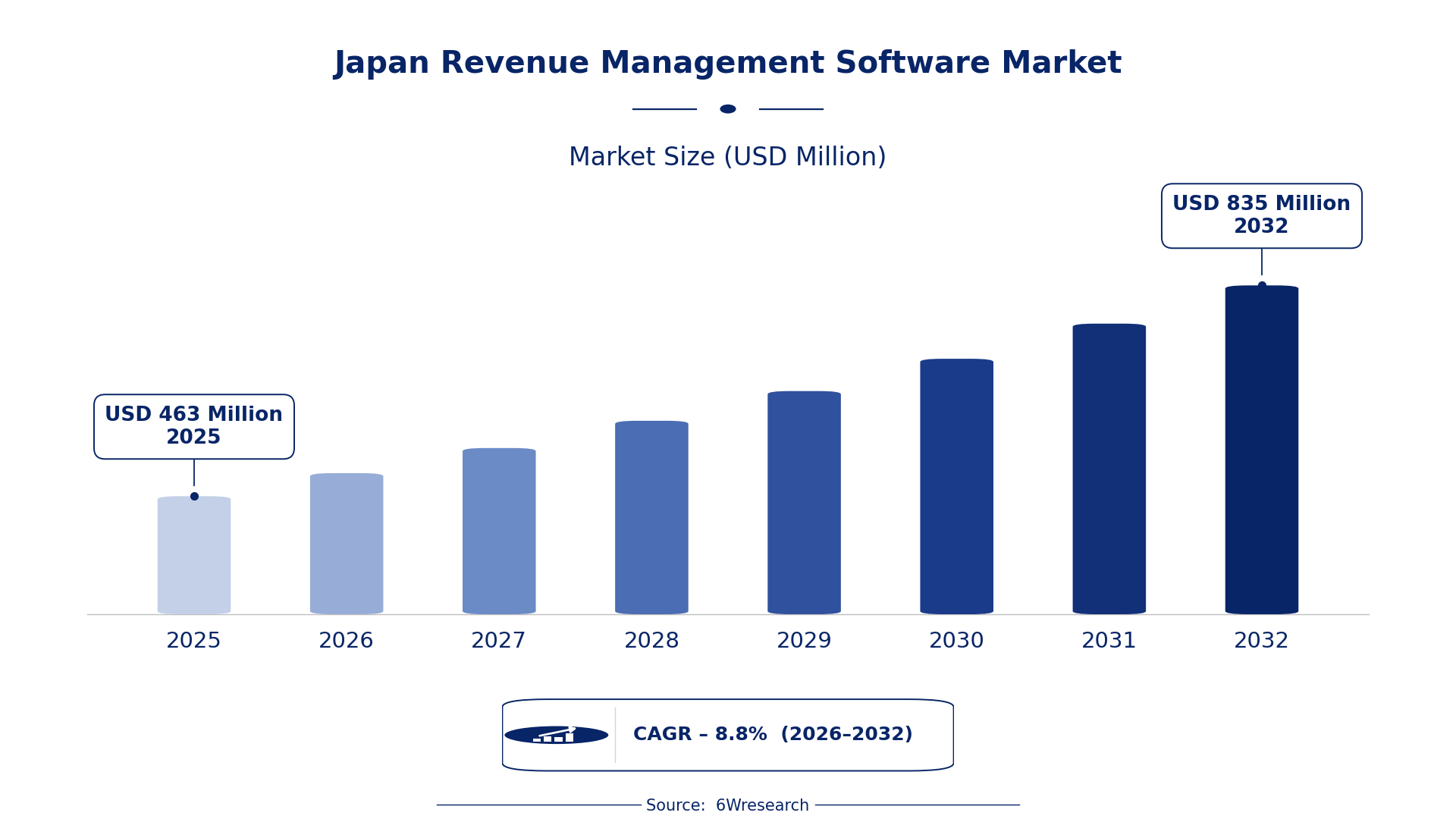
According to 6Wresearch internal database and industry insights, the Japan Revenue Management Software Market was valued at USD 463 Million in 2025 and is projected to reach USD 835 Million by 2032, growing at a CAGR of approximately 8.8% during 2026–2032.
Japan Revenue Management Software Market Highlights
| Report Metric | Details |
| Report Name | Japan Revenue Management Software Market (2026-2032) |
| Market Size 2025 | USD 463 Million |
| Market Size 2032 | USD 835 Million |
| Absolute Growth 2025–2032 | USD 372 Million |
| CAGR 2026–2032 | 8.8% |
| Peak Annual Growth | 10.6% in 2026 |
| Forecast Period | 2026–2032 |
| Historical Data | 2022–2025 |
| Base Year | 2025 |
| Leading Module Type, 2025 | Dynamic Pricing (47% share) |
| Leading Algorithm Type, 2025 | ML & Forecasting (51% share) |
| Leading Deployment Model, 2025 | Cloud-Based (40% share) |
| Leading End User, 2025 | E-commerce Retailers (54% share) |
| Fastest-Growing Module Type | Channel Management (12.0% CAGR) |
| Fastest-Growing Deployment Model | On-Premise SaaS (12.2% CAGR) |
| Fastest-Growing End User | Online Travel Agencies (11.4% CAGR) |
| Growing Sector | Online Travel Agencies |
| Key End Users | E-commerce Retailers, Online Travel Agencies, Hospitality Operators, Finance Teams |
Japan Revenue Management Software Market Year-wise Growth Rate and Key Drivers (2022–2032)
This graph illustrates the annual growth rates of the market from 2022 to 2032, highlighting a steady upward trajectory and projected market expansion over the forecast period.
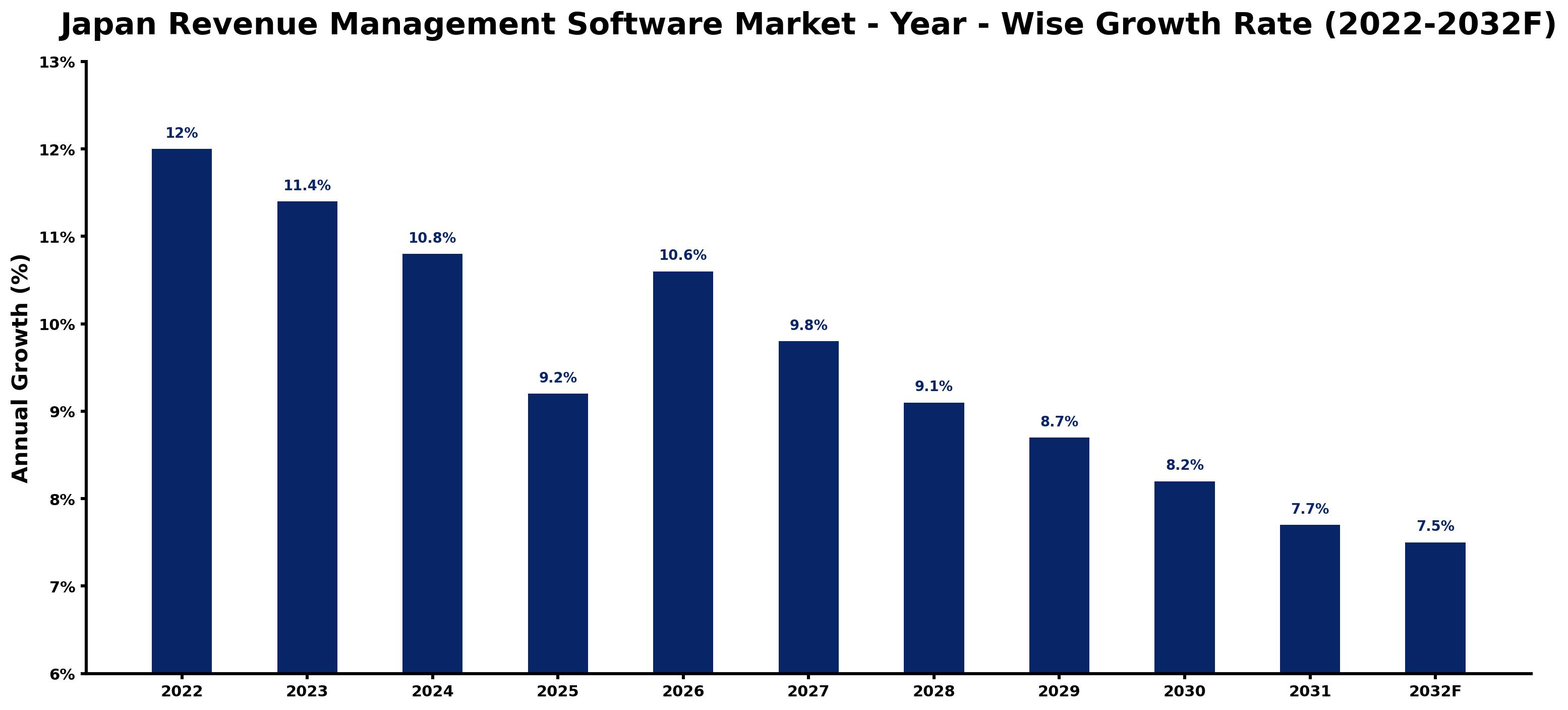
For each year, the table pairs the estimated growth rate with the leading influence on demand, showing how the drivers changed across the period.
| Year | Estimated Annual Growth (%) | Market Rationale |
| 2022 | 12.0 | The market experienced strong demand due to increased digital transformation efforts in various sectors. |
| 2023 | 11.4 | The hospitality sector's recovery contributed to a slight slowdown in growth compared to the previous year. |
| 2024 | 10.8 | Continued investment in e-commerce platforms led to further growth, albeit at a slower pace. |
| 2025 | 9.2 | Demand remained steady as businesses focused on optimizing revenue management strategies. |
| 2026 | 10.6 | Growth is anticipated to accelerate as more companies adopt advanced revenue management solutions to improve competitiveness. |
| 2027 | 9.8 | The market is projected to see a slowdown as saturation in some sectors begins to limit further expansion. |
| 2028 | 9.1 | Continued technology adoption is expected to keep growth steady, though at a reduced rate compared to previous years. |
| 2029 | 8.7 | Demand for software solutions is expected to remain consistent, but growth will begin to decelerate further. |
| 2030 | 8.2 | The market will continue to grow, driven by ongoing investments in digital infrastructure. |
| 2031 | 7.7 | Growth is projected to slow as market maturity sets in, leading to more cautious spending by businesses. |
| 2032 | 7.5 | The market is expected to maintain growth as companies increasingly recognize the value of data-driven pricing strategies. |
Note: Market size estimations and growth projections presented in this report are based on 6Wresearch's proprietary forecasting methodology, utilizing the latest available industry data, government publications, and primary research inputs.
Japan Revenue Management Software Market Synopsis
Revenue Management Software optimises pricing and inventory management through data analysis and forecasting. The Japan Revenue Management Software Market is growing, driven by the e-commerce sector, which reached ¥19 trillion in 2022. The recovery of the hospitality sector, with over 60 million domestic travellers in 2023, further fuels demand. Cloud-based solutions account for approximately 70% of deployments, and government initiatives for digital transformation are boosting investment in advanced revenue management technologies.
Market Dynamics Impact Analysis (2026–2032)
| Factor | Type | Impact | Primary Segment Affected |
| Increasing adoption of cloud-based solutions | Driver | High | Cloud-Based |
| Growing e-commerce sector | Driver | High | E-commerce Retailers |
| Expansion of the hospitality sector | Opportunity | High | Hospitality Operators |
| Rising number of online travel agencies | Opportunity | High | Online Travel Agencies |
| Market saturation in certain sectors | Restraint | Medium | E-commerce Retailers |
| High competition among software providers | Restraint | Medium | Cloud-Based |
| Limited awareness of advanced features | Challenge | Medium | Hospitality Operators |
| Dependence on technology infrastructure | Challenge | Medium | E-commerce Retailers |
Evaluation of Drivers in Japan Revenue Management Software Market (2026–2032)
These are the developments adding the most demand over the forecast period.
| Drivers | Primary Segment Affected | Why It Matters (Evidence) |
| Increased demand for dynamic pricing strategies | Dynamic Pricing | This approach is essential for maximizing revenue in competitive markets, particularly in e-commerce, valued at ¥19 trillion in 2022. |
| Adoption of budgeting and forecasting tools | Budgeting & Forecasting | These tools are critical for financial planning, with many finance teams utilizing them for resource allocation. |
| Growth in the hospitality sector | Hospitality Operators | The recovery of this sector, with over 60 million domestic travelers in 2023, boosts demand for revenue management software. |
| Shift towards cloud-based solutions | Cloud-Based | Approximately 70% of revenue management software deployments are cloud-based, providing scalability and accessibility for users. |
| Increased focus on compliance with accounting standards | Revenue Recognition | As businesses strive for compliance, the need for effective revenue recognition solutions becomes paramount. |
Purchasing is picking up as the e-commerce sector thrives, with a market size reaching ¥19 trillion in 2022. This growth encourages more retailers to adopt dynamic pricing strategies, essential for maximizing revenue. The hospitality sector's recovery, marked by over 60 million domestic travelers in 2023, drives demand for budgeting and forecasting tools. Cloud-based solutions, accounting for approximately 70% of deployments, are increasingly favoured for their scalability. The focus on compliance with accounting standards is pushing finance teams to invest in revenue recognition software, further driving market growth.
Evaluation of Restraints in Japan Revenue Management Software Market
The table below lists the restraints and the evidence behind each.
| Market Restraint | Primary Segment Affected | Why It Matters (Evidence) |
| Intense competition among providers | Cloud-Based | High competition leads to price pressures, making it difficult for providers to maintain margins. |
| Limited understanding of advanced software features | Hospitality Operators | Many operators lack awareness of the benefits of advanced revenue management tools, hindering adoption rates. |
| Dependence on technology infrastructure | E-commerce Retailers | The need for reliable technology can delay implementation, impacting revenue optimization efforts. |
| Challenges in integrating new systems | Budgeting & Forecasting | Integration issues can slow down the adoption of new software, limiting its effectiveness. |
| Skills shortages in data analysis | Finance Teams | The gap between academic training and industry application delays effective software deployment. |
Japan Revenue Management Software Market Challenges
Buyers in the hospitality sector face intense competition, with over 1,000 online travel agencies vying for market share, which drives down profit margins. This saturation exists due to Japan's thriving e-commerce market, valued at ¥19 trillion in 2022, forcing hotels to adopt aggressive pricing strategies. Many producers struggle with technology integration, as the average hotel employs at least three different revenue management software modules, complicating operations and increasing operational costs. A skills gap persists, as while statistical modelling techniques are taught in universities, the lack of practical application delays software implementation for end users.
Trends in the Japan Revenue Management Software Market
The trends below show where the Japan Revenue Management Software Market is heading.
- Shift towards Cloud-Based Solutions: Since 2022, the preference for cloud-based revenue management software has surged, particularly in Tokyo and Osaka. Approximately 70% of deployments are now cloud-based, allowing for greater scalability and accessibility for users.
- E-commerce Retailers Increasing Investment in Dynamic Pricing: Starting in 2023, e-commerce retailers have increased their investment in dynamic pricing strategies. This trend is driven by the need to remain competitive in a rapidly growing market, contributing to a market size of ¥19 trillion.
- Hospitality Sector Embracing Advanced Software: In 2023, the hospitality sector began adopting advanced revenue management software to optimise pricing. With over 60 million domestic travellers, hotels are increasingly implementing these solutions to improve revenue management.
- Online Travel Agencies Expanding Software Use: In 2023, online travel agencies have been rapidly expanding their use of revenue management software. With over 1,000 agencies in Japan, the competitive environment necessitates effective inventory and pricing management.
Investment Opportunities in the Japan Revenue Management Software Market
The following areas offer the clearest openings for investors and suppliers in the Japan Revenue Management Software Market.
- Timing for Investment: With the e-commerce market reaching ¥19 trillion in 2022, there is an opportunity for investment in revenue management software, particularly for e-commerce retailers looking to optimise pricing strategies.
- Expansion in Hospitality Sector: The recovery of the hospitality sector presents an opportunity for suppliers to offer advanced revenue management solutions, particularly in regions like Tokyo and Osaka, where demand is high.
- Entry through Partnerships: With the establishment of the Japan Revenue Management Association in 2021, there is a pathway for new entrants to partner with existing players to enhance software adoption and best practices.
- Growing Demand for Compliance Solutions: As businesses focus on compliance with accounting standards, there is an opportunity to supply effective revenue recognition software, particularly to finance teams.
Government Initiatives in the Japan Revenue Management Software Market
The AI Promotion Act, established in 2025, sets a national framework for AI research and development, impacting buyers by encouraging the adoption of AI-driven revenue management software. This measure aims to improve the capabilities of revenue management solutions across industries.
The Digital Agency, launched in September 2021, leads government digital transformation efforts, funding initiatives that promote the adoption of advanced technologies in sectors like hospitality. This agency supports projects that improve software integration and operational efficiency.
Future Insight of the Japan Revenue Management Software Market
Technology advancements will transform demand for revenue management software by 2032, with cloud solutions projected to account for 70% of deployments. The 'Digital Agency' launched in 2022 will accelerate technology adoption across industries, enhancing operational efficiency. Initiatives from the Ministry of Economy, Trade and Industry will streamline software integration in hospitality, improving overall service quality. The establishment of the Japan Revenue Management Association will promote best practices, ensuring that revenue management solutions are more effective and aligned with industry standards.
Market Segmentation Analysis
Japan Revenue Management Software Market report covers a detailed analysis of the following market segments:
By Module Type – Dynamic Pricing Leads, Channel Management Expected to Grow Fastest
According to Saurav Kr Singh, Senior Research Analyst at 6Wresearch, Dynamic Pricing took 47% of module type revenue in 2025, more than any other category. Dynamic Pricing holds the largest share because it is crucial for maximising revenue in competitive markets. For instance, numerous hotels in Tokyo and Osaka implement dynamic pricing strategies to adjust room rates based on real-time demand fluctuations. Over 2026–2032, Channel Management is expected to post the fastest growth, at a CAGR of 12.0%. Channel Management is experiencing rapid growth as businesses seek to optimise sales across multiple platforms, particularly in the expanding e-commerce sector. With Japan's e-commerce market reaching ¥19 trillion in 2022, the demand for effective channel management solutions is surging. This trend indicates that suppliers should focus on enhancing channel management features to meet growing market demands.
By Algorithm Type – ML & Forecasting Leads and Records the Fastest Growth
With 51% of algorithm type revenue in 2025, ML & Forecasting was the largest category. ML & Forecasting leads the market as it supports various functionalities within revenue management software, enabling informed decision-making across sectors. Its widespread application in industries such as hospitality reinforces its dominant position in the market. Its lead should widen, with a projected CAGR of 10.5% during 2026–2032, the highest in this split. The growth of ML & Forecasting continues as it enhances software capabilities while providing valuable insights, ensuring its ongoing relevance. As more companies adopt these algorithms, the demand for advanced forecasting tools will likely increase, further solidifying its leadership. Suppliers must invest in developing advanced ML algorithms to maintain competitiveness in the evolving market.
By Deployment Model – Cloud-Based Leads, On-Premise SaaS Expected to Grow Fastest
Cloud-Based held 40% of the Japan Revenue Management Software Market by deployment model in 2025. Cloud-Based solutions command the largest share due to their scalability and accessibility, making them the preferred choice for many businesses. Approximately 70% of revenue management software deployments in Japan are cloud-based, reflecting a strong preference for this model. On-Premise SaaS are projected to grow fastest, at a CAGR of 12.2% during 2026–2032. On-Premise SaaS is growing quickly as some companies prioritise data security, leading to a shift in deployment preferences. This trend is evident as organisations seek to balance security concerns with operational efficiency in their software solutions. Suppliers should consider offering flexible deployment options to cater to diverse customer preferences.
By End User – E-commerce Retailers Lead, Online Travel Agencies Expected to Grow Fastest
E-commerce Retailers accounted for 54% of the market by end user in 2025. E-commerce Retailers represent the largest segment as they rely heavily on pricing strategies to remain competitive in a fast-paced market. The substantial growth of Japan's e-commerce sector has driven the demand for tailored revenue management solutions among these retailers, ensuring their market leadership. Online Travel Agencies are set to record the highest CAGR in this split, 11.4% over 2026–2032. Online Travel Agencies are experiencing the fastest growth due to their need for effective inventory and pricing management across various platforms. The competitive landscape, with over 1,000 agencies, necessitates advanced software solutions for optimal performance and efficiency. This highlights the need for suppliers to tailor their offerings to meet the specific needs of online travel agencies.
Key Attractiveness of the Report
- 10 Years of Market Numbers
- Historical Data Starting from 2022 to 2025
- Base Year 2025
- Forecast Data until 2032
- Key Performance Indicators Impacting the Market
- Major Upcoming Developments and Projects
Key Highlights of the Report:
- Japan Revenue Management Software Market Outlook
- Market Size of Japan Revenue Management Software Market, 2025
- Forecast of Japan Revenue Management Software Market, 2032
- Historical Data and Forecast of Japan Revenue Management Software Revenues & Volume for the Period 2022-2032F
- Japan Revenue Management Software Market Trend Evolution
- Japan Revenue Management Software Market Drivers and Challenges
- Japan Revenue Management Software Price Trends
- Japan Revenue Management Software Porter's Five Forces
- Japan Revenue Management Software Industry Life Cycle
- Historical Data and Forecast of Japan Revenue Management Software Market Revenues & Volume By Module Type for the Period 2022-2032F
- Historical Data and Forecast of Japan Revenue Management Software Market Revenues & Volume By Dynamic Pricing for the Period 2022-2032F
- Historical Data and Forecast of Japan Revenue Management Software Market Revenues & Volume By Budgeting & Forecasting for the Period 2022-2032F
- Historical Data and Forecast of Japan Revenue Management Software Market Revenues & Volume By Revenue Recognition for the Period 2022-2032F
- Historical Data and Forecast of Japan Revenue Management Software Market Revenues & Volume By Channel Management for the Period 2022-2032F
- Historical Data and Forecast of Japan Revenue Management Software Market Revenues & Volume By Algorithm Type for the Period 2022-2032F
- Historical Data and Forecast of Japan Revenue Management Software Market Revenues & Volume By ML & Forecasting for the Period 2022-2032F
- Historical Data and Forecast of Japan Revenue Management Software Market Revenues & Volume By Statistical Modeling for the Period 2022-2032F
- Historical Data and Forecast of Japan Revenue Management Software Market Revenues & Volume By Accounting Compliance for the Period 2022-2032F
- Historical Data and Forecast of Japan Revenue Management Software Market Revenues & Volume By Multi-Channel Routing for the Period 2022-2032F
- Historical Data and Forecast of Japan Revenue Management Software Market Revenues & Volume By Deployment Model for the Period 2022-2032F
- Historical Data and Forecast of Japan Revenue Management Software Market Revenues & Volume By Cloud-Based for the Period 2022-2032F
- Historical Data and Forecast of Japan Revenue Management Software Market Revenues & Volume By On-Premise SaaS for the Period 2022-2032F
- Historical Data and Forecast of Japan Revenue Management Software Market Revenues & Volume By Hybrid Systems for the Period 2022-2032F
- Historical Data and Forecast of Japan Revenue Management Software Market Revenues & Volume By Integrated Platforms for the Period 2022-2032F
- Historical Data and Forecast of Japan Revenue Management Software Market Revenues & Volume By End User for the Period 2022-2032F
- Historical Data and Forecast of Japan Revenue Management Software Market Revenues & Volume By E-commerce Retailers for the Period 2022-2032F
- Historical Data and Forecast of Japan Revenue Management Software Market Revenues & Volume By Finance Teams for the Period 2022-2032F
- Historical Data and Forecast of Japan Revenue Management Software Market Revenues & Volume By Hospitality Operators for the Period 2022-2032F
- Historical Data and Forecast of Japan Revenue Management Software Market Revenues & Volume By Online Travel Agencies for the Period 2022-2032F
- Japan Revenue Management Software Import Export Trade Statistics
- Market Opportunity Assessment By Module Type
- Market Opportunity Assessment By Algorithm Type
- Market Opportunity Assessment By Deployment Model
- Market Opportunity Assessment By End User
- Japan Revenue Management Software Top Companies Market Share
- Japan Revenue Management Software Competitive Benchmarking By Technical and Operational Parameters
- Japan Revenue Management Software Company Profiles
- Japan Revenue Management Software Key Strategic Recommendations
Market Covered
Coverage by segment is as follows.
By Module Type
- Dynamic Pricing
- Budgeting & Forecasting
- Revenue Recognition
- Channel Management
By Algorithm Type
- ML & Forecasting
- Statistical Modeling
- Accounting Compliance
- Multi-Channel Routing
By Deployment Model
- Cloud-Based
- On-Premise SaaS
- Hybrid Systems
- Integrated Platforms
By End User
- E-commerce Retailers
- Finance Teams
- Hospitality Operators
- Online Travel Agencies































