Japan Reverse Osmosis Chemicals Market Size & Growth Rate
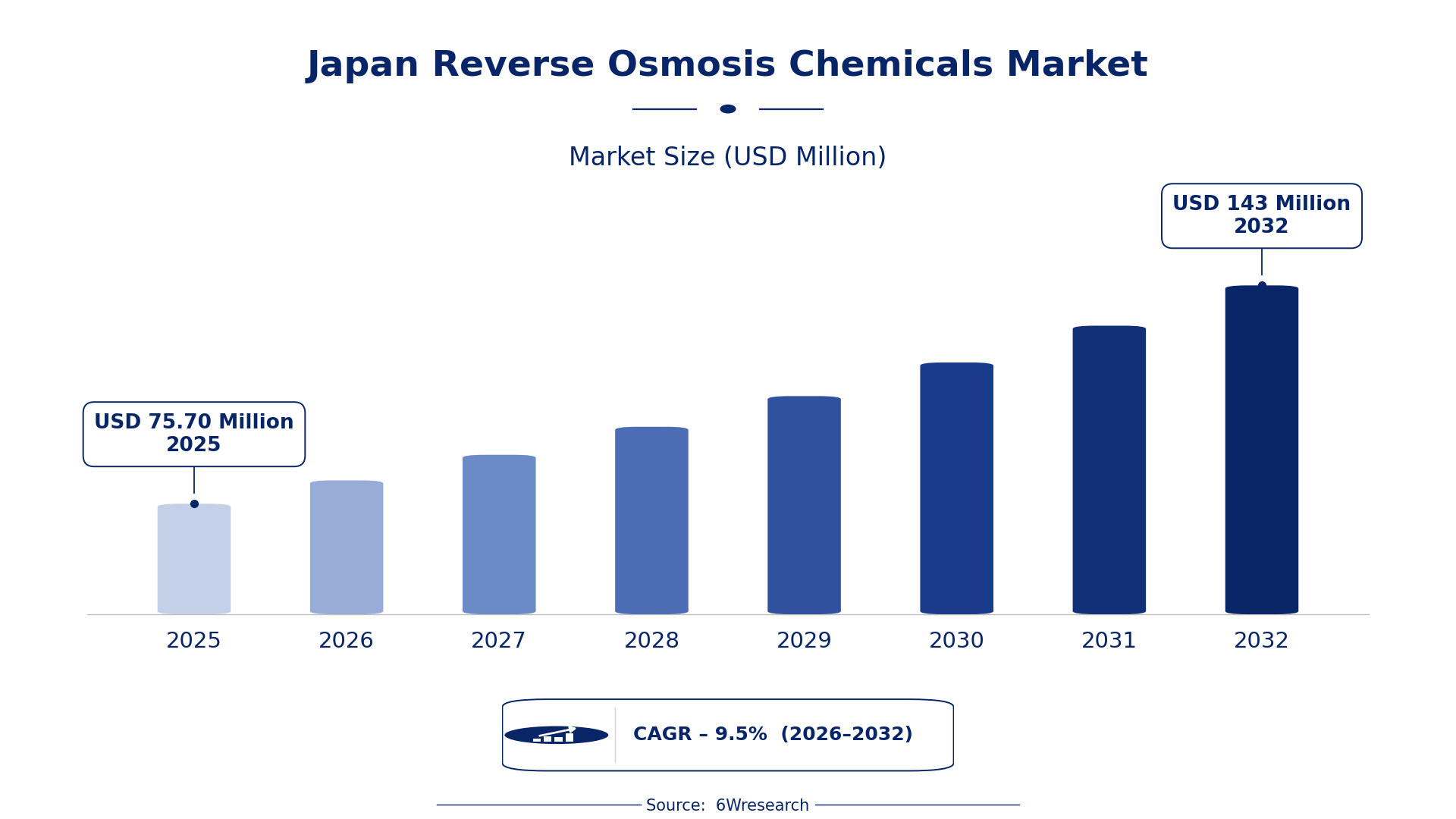
According to 6Wresearch internal database and industry insights, the Japan Reverse Osmosis Chemicals Market was valued at USD 75.70 Million in 2025 and is projected to reach USD 143 Million by 2032, growing at a CAGR of approximately 9.5% during 2026–2032.
Japan Reverse Osmosis Chemicals Market Highlights
| Report Metric | Details |
| Report Name | Japan Reverse Osmosis Chemicals Market (2026-2032) |
| Market Size 2025 | USD 75.70 Million |
| Market Size 2032 | USD 143 Million |
| Absolute Growth 2025–2032 | USD 67.30 Million |
| CAGR 2026–2032 | 9.5% |
| Peak Annual Growth | 10.4% in 2032 |
| Forecast Period | 2026–2032 |
| Historical Data | 2022–2025 |
| Base Year | 2025 |
| Leading Chemical Type, 2025 | Antiscalants (46% share) |
| Leading Application Use, 2025 | Scale Prevention (42% share) |
| Leading Purity Grade, 2025 | High Purity (36% share) |
| Leading End User, 2025 | Water Treatment Plants (35% share) |
| Fastest-Growing Chemical Type | Biocides and Disinfectants (13.7% CAGR) |
| Fastest-Growing Application Use | Biofilm Control (13.0% CAGR) |
| Fastest-Growing Purity Grade | Food Grade (13.2% CAGR) |
| Fastest-Growing End User | Pharmaceutical Water Systems (12.2% CAGR) |
| Growing Sector | Water Treatment |
| Key End Users | Municipal Water Utilities, Water Treatment Plants, Pharmaceutical Water Systems |
Japan Reverse Osmosis Chemicals Market Year-wise Growth Rate and Key Drivers (2022–2032)
This graph illustrates the annual growth rates of the market from 2022 to 2032, highlighting a steady upward trajectory and projected market expansion over the forecast period.
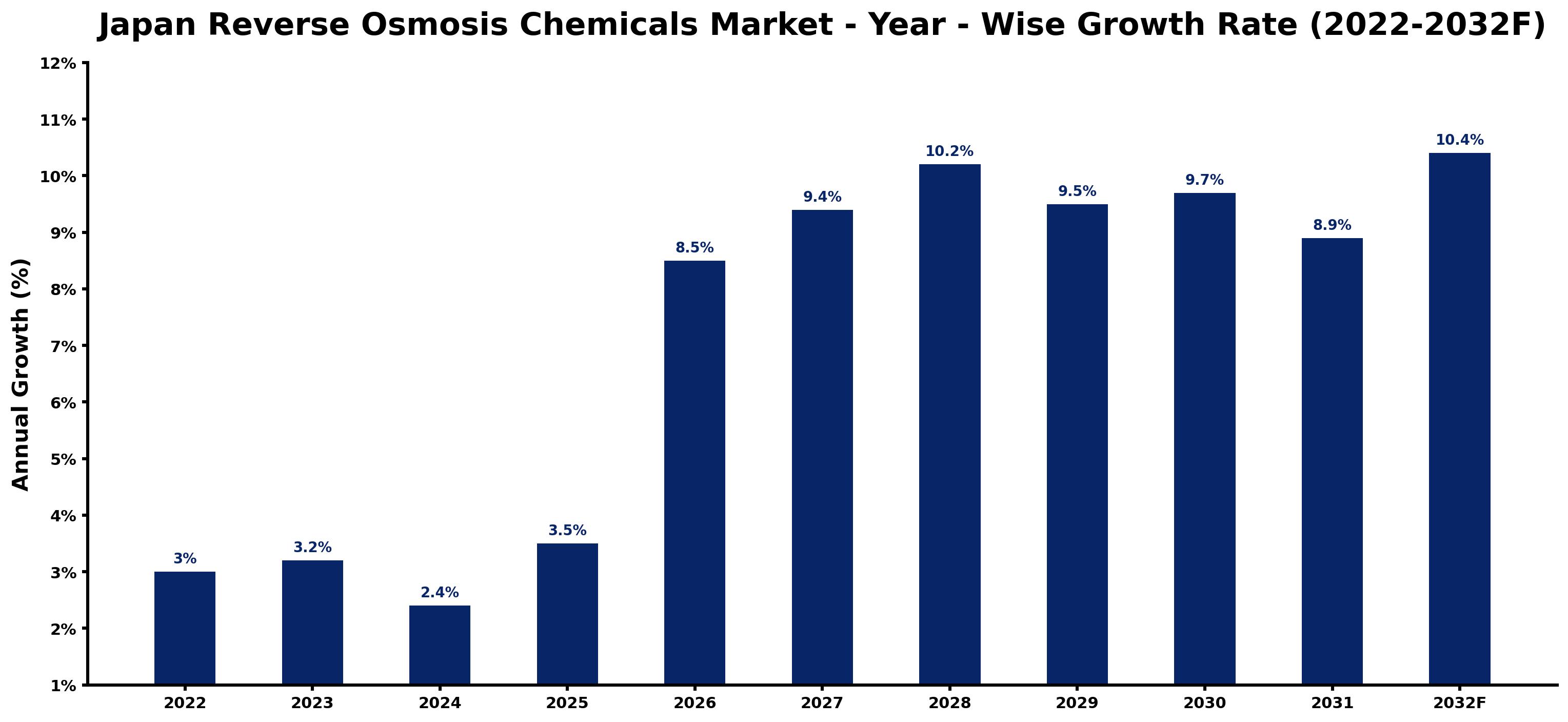
The table below sets out the estimated growth rate for each year and the main factor behind it.
| Year | Estimated Annual Growth (%) | Market Rationale |
| 2022 | 3.0 | The market experienced steady growth due to increasing demand for clean water. |
| 2023 | 3.2 | Growth accelerated as municipalities invested in advanced water treatment technologies. |
| 2024 | 2.4 | A slowdown occurred as some projects faced delays in implementation. |
| 2025 | 3.5 | Demand rose again as water treatment standards were updated by the Ministry of Health. |
| 2026 | 8.5 | Investment in decarbonisation initiatives is expected to create new opportunities in the sector. |
| 2027 | 9.4 | The market will continue to grow as urban areas focus on water recycling. |
| 2028 | 10.2 | Increased adoption of reverse osmosis systems in industrial applications will drive demand higher. |
| 2029 | 9.5 | A slight slowdown is projected as competition intensifies among suppliers. |
| 2030 | 9.7 | Growth will pick up as municipalities expand their infrastructure projects. |
| 2031 | 8.9 | Demand growth is expected to slow as market maturity begins to set in. |
| 2032 | 10.4 | The peak growth rate will be achieved as new technologies improve efficiency. |
Note: Market size estimations and growth projections presented in this report are based on 6Wresearch's proprietary forecasting methodology, utilizing the latest available industry data, government publications, and primary research inputs.
Japan Reverse Osmosis Chemicals Market Synopsis
Reverse Osmosis Chemicals are specialized formulations used in water purification processes, primarily for preventing scale formation, controlling biofilm, and cleaning membranes. The Japan Reverse Osmosis Chemicals Market is expanding due to investments in water treatment infrastructure, driven by the need for clean water in a densely populated country. With over 1,200 water treatment plants and a commitment to reducing greenhouse gas emissions, demand is projected to rise, particularly from municipal utilities and the pharmaceutical sector requiring high purity water.
Market Dynamics Impact Analysis (2026–2032)
| Factor | Type | Impact | Primary Segment Affected |
| Increasing investment in water treatment infrastructure | Driver | High | Water Treatment Plants |
| Growing demand for high purity chemicals in pharmaceuticals | Driver | High | High Purity |
| Expansion of reverse osmosis systems in industrial applications | Opportunity | High | Industrial Grade |
| Rising urbanisation leading to higher water consumption | Opportunity | Medium | Municipal Water Utilities |
| Regulatory compliance costs for chemical manufacturers | Restraint | High | Biocides and Disinfectants |
| Competition from alternative water treatment technologies | Restraint | Medium | Cleaning Chemicals |
| High costs associated with compliance to safety regulations | Challenge | High | Antiscalants |
| Limited availability of skilled workforce in chemical manufacturing | Challenge | Medium | RO System Maintainers |
Evaluation of Drivers in Japan Reverse Osmosis Chemicals Market (2026–2032)
Below are the drivers that matter most for revenue growth, with supporting evidence.
| Drivers | Primary Segment Affected | Why It Matters (Evidence) |
| Investment in advanced water treatment technologies | Water Treatment Plants | Municipal utilities are investing heavily in modernising facilities to meet water quality standards, resulting in increased purchases of reverse osmosis chemicals. |
| Rising pharmaceutical production requiring high purity water | High Purity | The pharmaceutical industry in Japan demands high purity reverse osmosis chemicals, driving manufacturers to increase their supply. |
| Government initiatives promoting water recycling | Municipal Water Utilities | The government's strategy to improve water recycling has led to increased demand for reverse osmosis technologies in urban areas. |
| Growing industrial applications for reverse osmosis | Industrial Grade | Industries, particularly electronics manufacturing, are increasingly adopting reverse osmosis systems, boosting the demand for related chemicals. |
| New water quality standards set by the Ministry of Health | Biocides and Disinfectants | Updated regulations necessitate the use of biocides to ensure compliance, increasing their demand in municipal utilities. |
Behind the steady rise in orders sits substantial investment in water treatment technologies, with municipal utilities investing heavily in modernisation, resulting in increased purchases of reverse osmosis chemicals. The pharmaceutical sector, one of the largest consumers of high purity water, drives demand for high purity chemicals. The electronics manufacturing sector is adopting reverse osmosis systems, further boosting the need for related chemicals. New water quality standards necessitate the use of biocides, ensuring compliance and driving their demand in municipal utilities.
Evaluation of Restraints in Japan Reverse Osmosis Chemicals Market
The table below lists the restraints and the evidence behind each.
| Market Restraint | Primary Segment Affected | Why It Matters (Evidence) |
| Compliance costs for safety and environmental regulations | Antiscalants | Manufacturers face high costs to meet regulations, impacting pricing and availability of antiscalants. |
| Market competition from alternative treatment solutions | Cleaning Chemicals | The emergence of alternative technologies can restrict growth of cleaning chemical sales in the market. |
| Supply chain disruptions affecting raw material availability | Biocides and Disinfectants | Disruptions in the supply chain can create shortages of key ingredients for biocides, affecting production. |
| Fluctuating demand due to economic conditions | Industrial Grade | Economic downturns can lead to reduced industrial activity, impacting the demand for reverse osmosis chemicals. |
| Technological advancements leading to obsolescence | High Purity | Rapid advancements in water treatment technologies may render some high purity chemicals less relevant. |
Japan Reverse Osmosis Chemicals Market Challenges
Over 70% of reverse osmosis systems in Japan rely on antiscalants, inflating operational costs by 30% for water treatment plants due to frequent chemical replenishment. New water quality standards set by Japan's Ministry of Health in 2023 impose regulatory burdens that can delay product approvals for suppliers, impacting their market entry timelines. Fierce competition emerges as municipal water utilities invest heavily in advanced technologies, leading to price wars that erode profit margins for producers. Rapid technological advancements require continuous investment, straining financial resources for smaller manufacturers who struggle to keep pace with larger competitors.
Trends in the Japan Reverse Osmosis Chemicals Market
Four trends stand out in the Japan Reverse Osmosis Chemicals Market.
- Shift towards Water Recycling Initiatives: The government is focusing on water recycling initiatives, particularly in urban areas, to address water scarcity. This strategy aims for improved infrastructure, with a projected investment of JPY 150 trillion over ten years, increasing demand for reverse osmosis chemicals.
- Transition from Conventional to Updated Water Treatment Standards: In 2023, new standards set by Japan's Ministry of Health for pharmaceutical water quality prompted water treatment facilities to upgrade their systems. This shift is expected to increase the demand for high purity reverse osmosis chemicals.
- Rising Adoption of Reverse Osmosis in Industrial Applications: The electronics manufacturing sector is increasingly adopting reverse osmosis systems, driven by the need for high-quality water. This trend is likely to boost demand for industrial-grade reverse osmosis chemicals, particularly in high-tech regions.
- Growing Emphasis on Environmental Sustainability: Japan's commitment to reducing greenhouse gas emissions by 46% by 2030 is driving investments in sustainable water treatment solutions. This focus on sustainability is likely to enhance the market for reverse osmosis chemicals.
Investment Opportunities in the Japan Reverse Osmosis Chemicals Market
Several openings in the Japan Reverse Osmosis Chemicals Market merit attention from investors.
- Expansion of Tokyo's Water Treatment Facilities: Tokyo is expanding its water treatment facilities to meet rising demand for clean water. With over 1,200 plants, this expansion presents a notable opportunity for suppliers of reverse osmosis chemicals, estimated at JPY 150 trillion.
- Push for Water Recycling Technologies: The urgent need for water recycling technologies in urban areas creates a supply gap. Suppliers can target municipal water utilities, which are investing heavily in advanced water treatment solutions.
- High Purity Chemicals for Pharmaceutical Applications: The pharmaceutical sector's demand for high purity chemicals is growing, driven by stringent quality standards. Suppliers can enter this market by ensuring compliance with JIS standards and obtaining necessary certifications.
- Investment in Desalination Projects Along the Coast: Desalination projects along Japan's coast are on the rise, creating demand for reverse osmosis chemicals. Suppliers can engage with municipal utilities to provide tailored solutions for these projects.
Government Initiatives in the Japan Reverse Osmosis Chemicals Market
The regulatory framework significantly impacts buyers of reverse osmosis chemicals in Japan. The PRTR Law mandates businesses to report the release of designated chemical substances, ensuring transparency in chemical handling. Compliance with the Chemical Substances Control Law requires manufacturers to evaluate and control chemical substances, which adds to production costs but enhances safety standards. These regulations shape the operational landscape, compelling producers to invest in compliance measures to maintain market access and protect public health.
Municipal water utilities in Japan leverage funding from the Act on the Rational Use of Energy to improve energy efficiency in their operations. This act obliges large energy users to report energy consumption and implement energy-saving measures, which often involve upgrading water treatment technologies. By adhering to these regulations, utilities can access financial support for modernisation projects, enhancing their capacity to provide clean water while ensuring compliance with environmental standards.
Future Insight of the Japan Reverse Osmosis Chemicals Market
The launch of new urban desalination projects will enhance the demand for reverse osmosis chemicals. By 2032, Japan's water treatment facilities will increasingly adopt smart monitoring systems to improve operational efficiency, benefiting both buyers and suppliers. The commitment to decarbonisation will stimulate JPY 150 trillion in public and private investments in water treatment innovations, fostering a more sustainable industry. As the electronics manufacturing sector grows, the need for reverse osmosis chemicals will expand, ensuring high-quality water supply across various applications.
Market Segmentation Analysis
Japan Reverse Osmosis Chemicals Market report covers a detailed analysis of the following market segments:
By Chemical Type – Antiscalants Lead, Biocides and Disinfectants Expected to Grow Fastest
According to Saurav Kr Singh, Senior Research Analyst at 6Wresearch, Antiscalants took 46% of chemical type revenue in 2025, more than any other category. Antiscalants dominate the market due to their vital role in preventing scale buildup on membranes, which is essential for the efficiency of reverse osmosis systems. With over 70% of these systems in Japan utilising antiscalants, their significance in maintaining water treatment efficacy is evident. Biocides and Disinfectants are projected to grow fastest, at a CAGR of 13.7% during 2026–2032. The demand for biocides and disinfectants is surging as they are critical for controlling microbial growth in water systems, particularly in urban municipalities. This growth is propelled by the government's recent initiatives to enhance water quality standards, leading to increased adoption of these chemicals. Suppliers need to focus on developing biocides to meet the growing demand driven by urban water treatment requirements.
By Application Use – Scale Prevention Leads, Biofilm Control Expected to Grow Fastest
The largest application use category in 2025 was Scale Prevention, at 42% of revenue. Scale prevention is the leading application as it is critical for maintaining system performance and longevity in reverse osmosis processes. The reliance on scale prevention techniques ensures that water treatment facilities can operate efficiently and effectively. Over 2026–2032, Biofilm Control is expected to post the fastest growth, at a CAGR of 13.0%. Biofilm control is the fastest-growing application due to its importance in ensuring water quality and system hygiene, especially in municipal utilities. The recent government initiatives to improve water treatment infrastructure have further accelerated the need for effective biofilm management. Buyers must prioritise biofilm control solutions to ensure compliance with emerging water quality standards.
By Purity Grade – High Purity Leads, Food Grade Expected to Grow Fastest
High Purity accounted for 36% of the market by purity grade in 2025. High purity chemicals dominate the market as they are necessary for applications that require stringent quality standards, particularly within the pharmaceutical industry. The substantial demand for high purity water from Japan's large pharmaceutical sector reinforces this segment's leading position. The quickest growth will come from Food Grade, forecast to expand at a CAGR of 13.2% between 2026 and 2032. Food grade chemicals are experiencing growth due to their rising use in food processing applications, although they are still less prevalent than high purity chemicals. Increasing consumer awareness regarding food safety is propelling this segment's expansion. Suppliers may benefit from diversifying their offerings to include food grade chemicals to capture this emerging market.
By End User – Water Treatment Plants Lead, Pharmaceutical Water Systems Expected to Grow Fastest
In 2025, Water Treatment Plants led the end user split with a 35% share. Water treatment plants are the primary users of reverse osmosis chemicals, utilising them extensively to ensure efficient water purification processes. The presence of over 1,200 water treatment plants in Japan highlights the substantial demand from this sector. Pharmaceutical Water Systems are set to record the highest CAGR in this split, 12.2% over 2026–2032. Pharmaceutical water systems are rapidly growing as they are critical for ensuring water quality in pharmaceutical applications, which are subject to strict regulations. The increasing investment in pharmaceutical infrastructure is propelling this segment's growth. Buyers in the pharmaceutical sector should ensure they are sourcing high-quality reverse osmosis chemicals to meet regulatory requirements.
Key Attractiveness of the Report
- 10 Years of Market Numbers
- Historical Data Starting from 2022 to 2025
- Base Year 2025
- Forecast Data until 2032
- Key Performance Indicators Impacting the Market
- Major Upcoming Developments and Projects
Key Highlights of the Report:
- Japan Reverse Osmosis Chemicals Market Outlook
- Market Size of Japan Reverse Osmosis Chemicals Market, 2025
- Forecast of Japan Reverse Osmosis Chemicals Market, 2032
- Historical Data and Forecast of Japan Reverse Osmosis Chemicals Revenues & Volume for the Period 2022-2032F
- Japan Reverse Osmosis Chemicals Market Trend Evolution
- Japan Reverse Osmosis Chemicals Market Drivers and Challenges
- Japan Reverse Osmosis Chemicals Price Trends
- Japan Reverse Osmosis Chemicals Porter's Five Forces
- Japan Reverse Osmosis Chemicals Industry Life Cycle
- Historical Data and Forecast of Japan Reverse Osmosis Chemicals Market Revenues & Volume By Chemical Type for the Period 2022-2032F
- Historical Data and Forecast of Japan Reverse Osmosis Chemicals Market Revenues & Volume By Antiscalants for the Period 2022-2032F
- Historical Data and Forecast of Japan Reverse Osmosis Chemicals Market Revenues & Volume By Biocides and Disinfectants for the Period 2022-2032F
- Historical Data and Forecast of Japan Reverse Osmosis Chemicals Market Revenues & Volume By pH Adjusters for the Period 2022-2032F
- Historical Data and Forecast of Japan Reverse Osmosis Chemicals Market Revenues & Volume By Cleaning Chemicals for the Period 2022-2032F
- Historical Data and Forecast of Japan Reverse Osmosis Chemicals Market Revenues & Volume By Application Use for the Period 2022-2032F
- Historical Data and Forecast of Japan Reverse Osmosis Chemicals Market Revenues & Volume By Scale Prevention for the Period 2022-2032F
- Historical Data and Forecast of Japan Reverse Osmosis Chemicals Market Revenues & Volume By Biofilm Control for the Period 2022-2032F
- Historical Data and Forecast of Japan Reverse Osmosis Chemicals Market Revenues & Volume By System Balancing for the Period 2022-2032F
- Historical Data and Forecast of Japan Reverse Osmosis Chemicals Market Revenues & Volume By Membrane Cleaning for the Period 2022-2032F
- Historical Data and Forecast of Japan Reverse Osmosis Chemicals Market Revenues & Volume By Purity Grade for the Period 2022-2032F
- Historical Data and Forecast of Japan Reverse Osmosis Chemicals Market Revenues & Volume By High Purity for the Period 2022-2032F
- Historical Data and Forecast of Japan Reverse Osmosis Chemicals Market Revenues & Volume By Food Grade for the Period 2022-2032F
- Historical Data and Forecast of Japan Reverse Osmosis Chemicals Market Revenues & Volume By Industrial Grade for the Period 2022-2032F
- Historical Data and Forecast of Japan Reverse Osmosis Chemicals Market Revenues & Volume By Technical Grade for the Period 2022-2032F
- Historical Data and Forecast of Japan Reverse Osmosis Chemicals Market Revenues & Volume By End User for the Period 2022-2032F
- Historical Data and Forecast of Japan Reverse Osmosis Chemicals Market Revenues & Volume By Water Treatment Plants for the Period 2022-2032F
- Historical Data and Forecast of Japan Reverse Osmosis Chemicals Market Revenues & Volume By Pharmaceutical Water Systems for the Period 2022-2032F
- Historical Data and Forecast of Japan Reverse Osmosis Chemicals Market Revenues & Volume By Municipal Water Utilities for the Period 2022-2032F
- Historical Data and Forecast of Japan Reverse Osmosis Chemicals Market Revenues & Volume By RO System Maintainers for the Period 2022-2032F
- Japan Reverse Osmosis Chemicals Import Export Trade Statistics
- Market Opportunity Assessment By Chemical Type
- Market Opportunity Assessment By Application Use
- Market Opportunity Assessment By Purity Grade
- Market Opportunity Assessment By End User
- Japan Reverse Osmosis Chemicals Top Companies Market Share
- Japan Reverse Osmosis Chemicals Competitive Benchmarking By Technical and Operational Parameters
- Japan Reverse Osmosis Chemicals Company Profiles
- Japan Reverse Osmosis Chemicals Key Strategic Recommendations
Market Covered
The study includes the following segmentation.
By Chemical Type
- Antiscalants
- Biocides and Disinfectants
- pH Adjusters
- Cleaning Chemicals
By Application Use
- Scale Prevention
- Biofilm Control
- System Balancing
- Membrane Cleaning
By Purity Grade
- High Purity
- Food Grade
- Industrial Grade
- Technical Grade
By End User
- Water Treatment Plants
- Pharmaceutical Water Systems
- Municipal Water Utilities
- RO System Maintainers































