Japan RF Substrate Market Size & Growth Rate
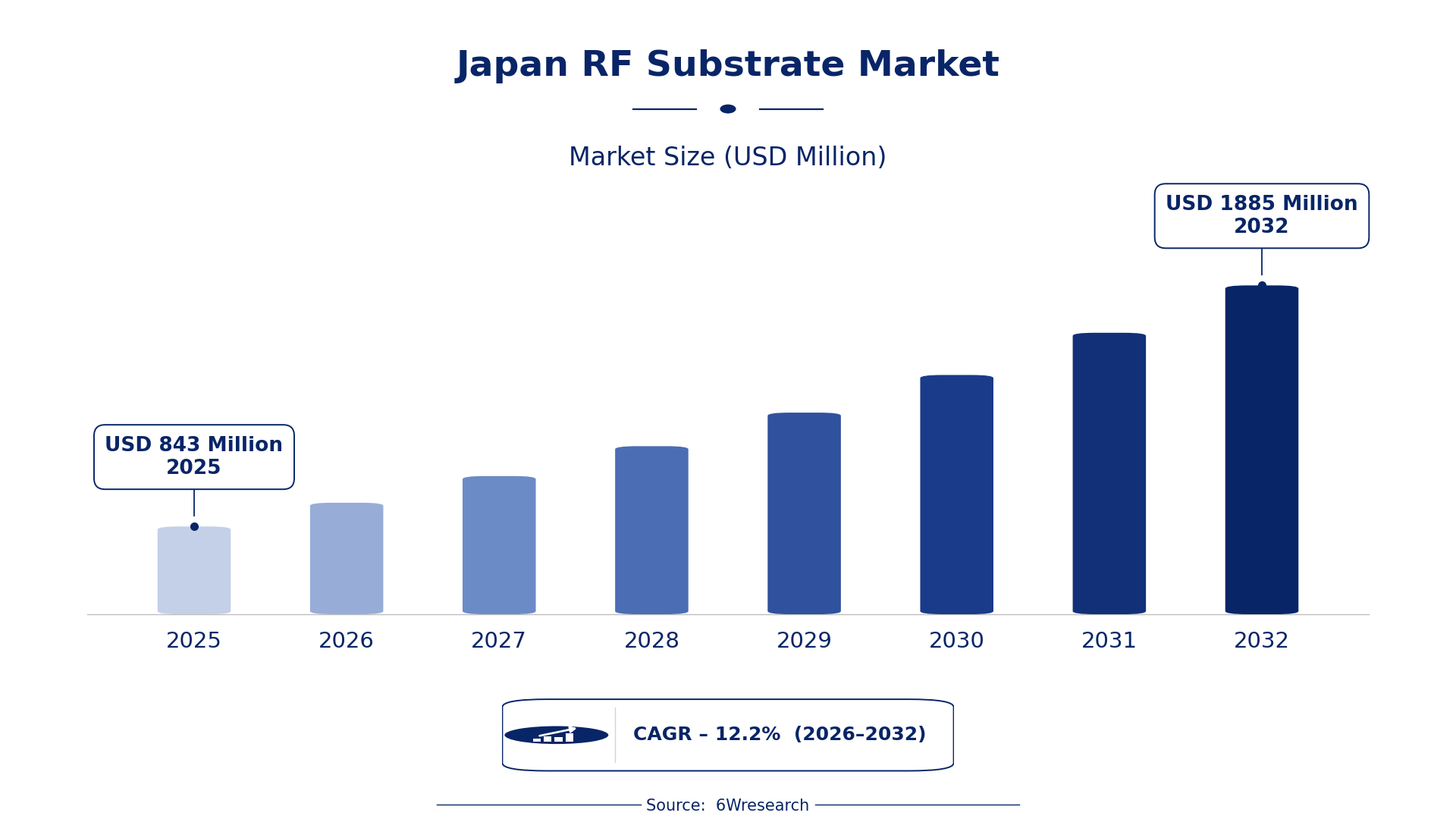
According to 6Wresearch internal database and industry insights, the Japan RF Substrate Market was valued at USD 843 Million in 2025 and is projected to reach USD 1,885 Million by 2032, growing at a CAGR of approximately 12.2% during 2026–2032.
Japan RF Substrate Market Highlights
| Report Metric | Details |
| Report Name | Japan RF Substrate Market (2026-2032) |
| Market Size 2025 | USD 843 Million |
| Market Size 2032 | USD 1,885 Million |
| Absolute Growth 2025–2032 | USD 1,042 Million |
| CAGR 2026–2032 | 12.2% |
| Peak Annual Growth | 13.9% in 2027 |
| Forecast Period | 2026–2032 |
| Historical Data | 2022–2025 |
| Base Year | 2025 |
| Leading Substrate Type, 2025 | FR-4 (38% share) |
| Leading Material, 2025 | PCB Standard (39% share) |
| Leading Application Area, 2025 | General RF Boards (38% share) |
| Leading End User, 2025 | PCB Fabricators (35% share) |
| Fastest-Growing Substrate Type | Flexible RF Substrates (16.9% CAGR) |
| Fastest-Growing Material | High-Frequency FR (17.4% CAGR) |
| Fastest-Growing Application Area | Wearables/IoT (15.3% CAGR) |
| Fastest-Growing End User | Wearable Device Makers (16.5% CAGR) |
| Growing Sector | telecommunications and electronics |
| Key End Users | PCB Fabricators, High-Speed Module Suppliers, Wearable Device Makers, Smart Sensor OEMs |
Japan RF Substrate Market Year-wise Growth Rate and Key Drivers (2022–2032)
This graph illustrates the annual growth rates of the market from 2022 to 2032, highlighting a steady upward trajectory and projected market expansion over the forecast period.
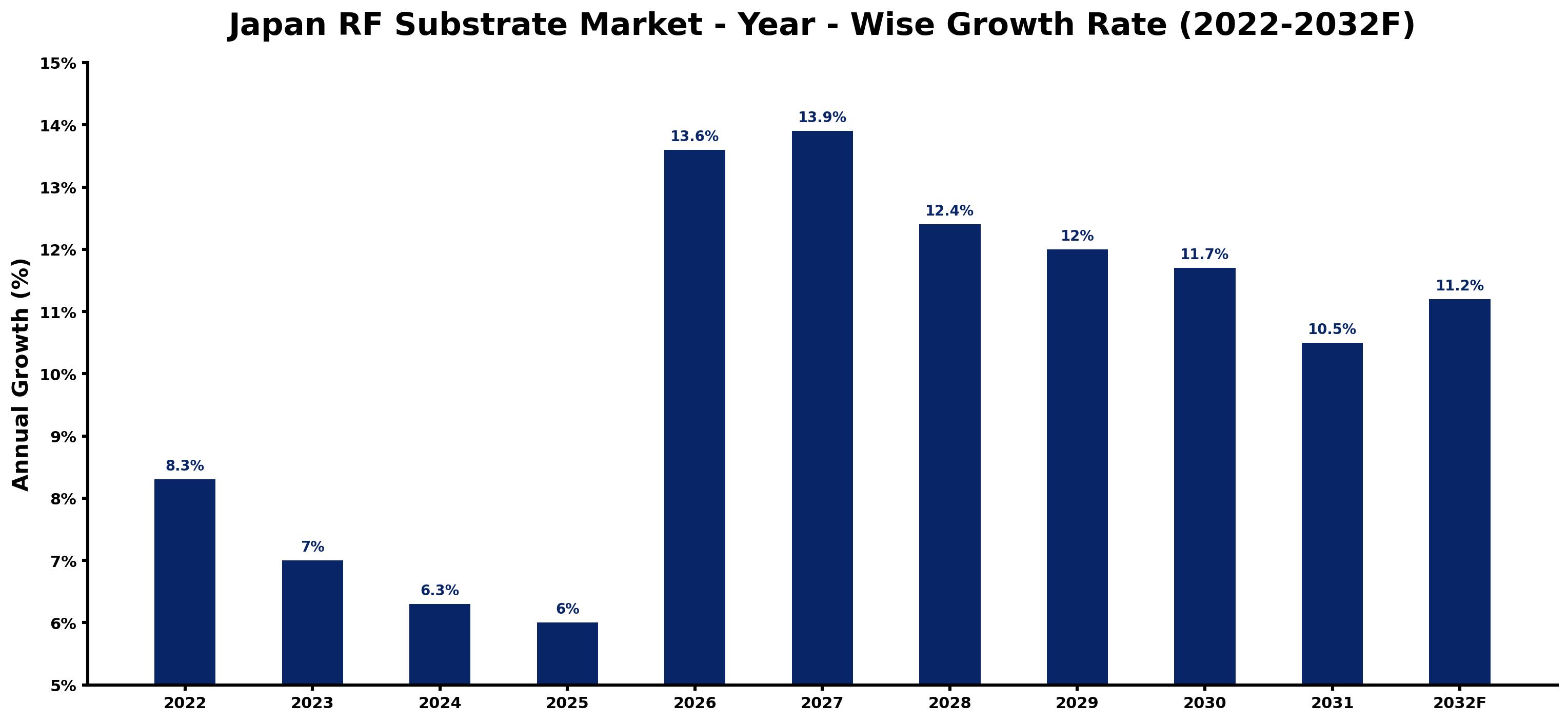
Annual growth estimates for each year appear below with the principal reason behind them, explaining the shifts that set the pace of the market.
| Year | Estimated Annual Growth (%) | Market Rationale |
| 2022 | 8.3 | The market experienced strong demand from the electronics sector, particularly in telecommunications. |
| 2023 | 7.0 | Growth slowed due to market adjustments and a temporary oversupply of certain substrates. |
| 2024 | 6.3 | Demand remained steady as manufacturers adapted to changing technology requirements. |
| 2025 | 6.0 | Growth continued to decelerate as the market stabilised after previous peaks. |
| 2026 | 13.6 | Demand is expected to surge as 5G technology rollout accelerates across urban areas. |
| 2027 | 13.9 | The market will see renewed growth driven by increased investments in high-frequency applications. |
| 2028 | 12.4 | Growth is projected to moderate as the market adjusts to new supply chain conditions. |
| 2029 | 12.0 | Demand will remain strong, supported by ongoing technological advancements in RF applications. |
| 2030 | 11.7 | Growth is expected to slow as competition intensifies among substrate manufacturers. |
| 2031 | 10.5 | The market will stabilise as manufacturers focus on quality improvements and certifications. |
| 2032 | 11.2 | Demand is projected to rise again as new applications in IoT gain traction. |
Note: Market size estimations and growth projections presented in this report are based on 6Wresearch's proprietary forecasting methodology, utilizing the latest available industry data, government publications, and primary research inputs.
Japan RF Substrate Market Synopsis
RF substrates are essential materials used in high-frequency electronic circuits, primarily made from PTFE or ceramic composites. Their main applications include telecommunications, particularly in 5G technology, and other high-frequency devices. The Japan RF Substrate Market is expanding due to a strong electronics sector valued at over 10 trillion yen annually. Factors such as urbanisation, technological advancements, and government support for 5G infrastructure development are driving this growth.
Market Dynamics Impact Analysis (2026–2032)
| Factor | Type | Impact | Primary Segment Affected |
| Increasing demand for 5G technology and its infrastructure. | Driver | High | 5G & Microwave Modules |
| Growth in the wearable devices market requiring advanced substrates. | Driver | High | Wearables/IoT |
| Expansion of the IoT sector creating new applications for RF substrates. | Opportunity | High | Wearables/IoT |
| Rising investments in smart sensor technologies enhancing substrate demand. | Opportunity | High | Sensor Modules |
| Market saturation in certain substrate types leading to price competition. | Restraint | Medium | FR-4 |
| Supply chain disruptions affecting the availability of raw materials. | Restraint | High | Ceramic Substrates |
| High competition among local manufacturers impacting margins. | Challenge | High | PCB Fabricators |
| Technological advancements requiring constant innovation from producers. | Challenge | Medium | High-Speed Module Suppliers |
Evaluation of Drivers in Japan RF Substrate Market (2026–2032)
Demand rests on the following drivers, each shown with the segment it touches most.
| Drivers | Primary Segment Affected | Why It Matters (Evidence) |
| Growing urbanisation leading to increased demand for telecommunications infrastructure. | 5G & Microwave Modules | The population density in urban areas drives the need for improved connectivity. |
| Rising adoption of smart wearable devices necessitating high-performance substrates. | Wearables/IoT | The total installed base of smart sensors in Japan is projected to exceed 50 million units by 2025. |
| Government initiatives promoting domestic production of electronic components. | General RF Boards | The government aims to increase domestic production by 2025, boosting local substrate manufacturing. |
| Technological advancements in automotive radar systems increasing substrate requirements. | High-Frequency FR | High-frequency FR materials are increasingly used in automotive radar systems, reflecting growing automotive technology. |
| Demand for reliable substrates in medical devices driving growth. | Ceramic Substrates | Ceramic substrates are preferred in medical device applications for their reliability and performance. |
Purchasing is picking up as urbanisation accelerates in regions like Tokyo, where the population density is around 6,000 people per square kilometer. This urban growth is driving demand for telecommunications infrastructure, particularly in 5G applications. The total installed base of smart sensors is projected to exceed 50 million units by 2025, increasing the need for high-performance substrates in wearable devices. Advancements in automotive technology are resulting in a rise in the use of high-frequency FR materials in radar systems, further stimulating the market.
Evaluation of Restraints in Japan RF Substrate Market
Several factors work against faster growth; the main ones are summarised below.
| Market Restraint | Primary Segment Affected | Why It Matters (Evidence) |
| Market saturation in the FR-4 segment leading to intense price competition. | FR-4 | The widespread use of FR-4 substrates has led to oversupply, affecting profit margins for manufacturers. |
| Supply chain disruptions impacting raw material availability for ceramic substrates. | Ceramic Substrates | Global supply chain issues have caused difficulties in sourcing essential materials for production. |
| High competition among local manufacturers affecting pricing strategies. | PCB Fabricators | Numerous manufacturers in Japan are competing for market share, putting pressure on prices. |
| Technological advancements requiring continuous innovation from producers. | High-Speed Module Suppliers | Rapid changes in technology compel manufacturers to frequently update their offerings. |
| Regulatory compliance costs for chemical substances affecting production expenses. | Flexible RF Substrates | Compliance with the Chemical Substances Control Law raises operational costs for producers. |
Japan RF Substrate Market Challenges
Japan's electronics sector, valued at over 10 trillion yen annually, faces rising costs due to limited domestic production of RF substrates, delaying product availability for manufacturers. A shortage of skilled workers in advanced material handling hampers production efficiency, causing suppliers to reduce output by approximately 20%. Slow technology adoption in integrating RF substrates with IoT applications results in missed opportunities for producers, which can lead to a 15% decline in potential revenue. Buyers experience longer lead times as demand for high-frequency materials in automotive radar systems surges, complicating supply chain management for manufacturers.
Trends in the Japan RF Substrate Market
The following changes are redrawing the Japan RF Substrate Market.
- Shift towards Advanced Materials in RF Substrates: The demand for high-frequency RF substrates is shifting towards advanced materials like ceramic composites, particularly in medical devices. This trend is reflected as ceramic substrates are preferred for their reliability, with a projected growth of 15% in this segment by 2025.
- Transition from Standard to Flexible RF Substrates: The market is transitioning from traditional substrates to flexible RF substrates, spurred by the rise of IoT devices. The Japanese market for flexible RF substrates is expanding, reflecting a 15% growth projection by 2025.
- Emergence of Wearables as a Key Application Area: Wearables are emerging as a critical application area for RF substrates, with demand driven by technological advancements. The wearable devices market is expected to grow by 16.5% annually, highlighting the increasing need for compact, efficient designs.
- Focus on 5G Infrastructure Development: The focus on 5G infrastructure development is reshaping the RF substrate market, with the rollout expected to reach 90% coverage by 2025. This initiative is driving demand for advanced RF substrates across various applications.
Investment Opportunities in the Japan RF Substrate Market
Investors looking at the Japan RF Substrate Market should consider the following areas.
- Rising Demand for IoT Devices: With the total installed base of smart sensors projected to exceed 50 million units by 2025, there is a notable opportunity for suppliers of RF substrates. Collaborating with IoT startups in urban areas can facilitate market entry.
- Expansion of Automotive Radar Systems: The increasing use of high-frequency FR materials in automotive radar systems presents a timely opportunity. Suppliers can target automotive manufacturers in regions like Tokyo to meet this growing demand.
- Government Support for Domestic Production: Government initiatives aimed at boosting domestic production of electronic components are creating opportunities for substrate manufacturers. Engaging with the Japan Electronics and Information Technology Industries Association can improve market entry.
- Growth in Medical Device Applications: The demand for reliable ceramic substrates in medical devices is rising, driven by technological advancements. Suppliers should focus on partnerships with medical device manufacturers to capitalise on this trend.
Government Initiatives in the Japan RF Substrate Market
The Economic Security Promotion Act (2022) impacts RF substrate producers by supporting supply-chain resilience for critical products. This legislation encourages manufacturers to invest in local production capabilities, ensuring a stable supply of essential materials for RF substrates.
Funding of 5 billion yen for research in advanced materials for electronics has been allocated for 2023, administered by the Ministry of Internal Affairs and Communications. This funding aims to support innovation and the development of new RF substrate technologies.
Future Insight of the Japan RF Substrate Market
By 2032, government initiatives will drive a substantial increase in domestic production of electronic components, prompting suppliers to invest in advanced manufacturing technologies. Support for IoT startups will stimulate innovation in RF substrate applications, giving buyers access to a broader range of product options. As the total installed base of smart sensors in Japan is projected to exceed 50 million units, demand for flexible RF substrates will rise significantly. New standards from the Japan Printed Circuit Association will enhance quality and reliability across the market.
Market Segmentation Analysis
Japan RF Substrate Market report covers a detailed analysis of the following market segments:
By Substrate Type – FR-4 Leads, Flexible RF Substrates Expected to Grow Fastest
According to Saurav Kr Singh, Senior Research Analyst at 6Wresearch, in 2025, FR-4 led the substrate type split with a 38% share. FR-4 holds the largest share due to its cost-effectiveness and widespread use in standard printed circuit boards, making it a preferred choice among manufacturers. This substrate type is particularly popular in the Tokyo region, which hosts numerous PCB fabrication facilities. Over 2026–2032, Flexible RF Substrates are expected to post the fastest growth, at a CAGR of 16.9%. The growth of flexible RF substrates is driven by the increasing demand for flexible electronics and wearable devices, with a projected growth of 15% by 2025. As more consumers adopt wearable technology, the need for these substrates will continue to rise. Suppliers should focus on developing flexible RF substrates to meet the growing demand in the wearable technology sector.
By Material – PCB Standard Leads, High-Frequency FR Expected to Grow Fastest
With 39% of material revenue in 2025, PCB Standard was the largest category. The PCB standard material maintains its leading position as it serves as the core for PCB manufacturing, ensuring compatibility across numerous applications. Its established role in Japan's electronics sector, valued at over 10 trillion yen annually, reinforces its dominance. High-Frequency FR is set to record the highest CAGR in this split, 17.4% over 2026–2032. High-frequency FR materials are experiencing significant growth due to their specific design for high-frequency applications, which are becoming increasingly vital in modern electronics. This demand surge is closely associated with the ongoing rollout of 5G technology in Japan, which is expected to reach 90% coverage by 2025. Suppliers should prioritise the development of high-frequency FR materials to address the increasing demand stemming from advanced electronic applications.
By Application Area – General RF Boards Lead, Wearables/IoT Expected to Grow Fastest
General RF Boards accounted for 38% of the market by application area in 2025. General RF boards lead the market as they are widely used across various RF applications, providing essential functionality in numerous electronic devices. Their versatility makes them a staple in the Japanese electronics sector, particularly in urban areas like Tokyo. Wearables/IoT is projected to grow fastest, at a CAGR of 15.3% during 2026–2032. The wearables and IoT application area is the fastest growing segment, driven by the rise of flexible and compact designs that cater to consumer preferences. As the total installed base of smart sensors in Japan is expected to exceed 50 million units by 2025, this growth will continue. Suppliers should prioritise the development of RF substrates tailored for wearables and IoT applications to capture this expanding market.
By End User – PCB Fabricators Lead, Wearable Device Makers Expected to Grow Fastest
The largest end user category in 2025 was PCB Fabricators, at 35% of revenue. PCB fabricators represent the largest end-user segment as they are the primary consumers of RF substrates in the manufacturing process. Their essential role in producing a diverse range of electronic devices in Japan guarantees a steady demand for RF substrates. The quickest growth will come from Wearable Device Makers, forecast to expand at a CAGR of 16.5% between 2026 and 2032. Wearable device makers are the fastest growing end-user segment, as they utilise RF substrates for compact and efficient designs that meet the needs of modern consumer electronics. This growth is closely linked to the rising adoption of wearable technology throughout Japan. Suppliers must customise their offerings to align with the specific demands of wearable device makers to take advantage of the growth in this segment.
Key Attractiveness of the Report
- 10 Years of Market Numbers
- Historical Data Starting from 2022 to 2025
- Base Year 2025
- Forecast Data until 2032
- Key Performance Indicators Impacting the Market
- Major Upcoming Developments and Projects
Key Highlights of the Report:
- Japan RF Substrate Market Outlook
- Market Size of Japan RF Substrate Market, 2025
- Forecast of Japan RF Substrate Market, 2032
- Historical Data and Forecast of Japan RF Substrate Revenues & Volume for the Period 2022-2032F
- Japan RF Substrate Market Trend Evolution
- Japan RF Substrate Market Drivers and Challenges
- Japan RF Substrate Price Trends
- Japan RF Substrate Porter's Five Forces
- Japan RF Substrate Industry Life Cycle
- Historical Data and Forecast of Japan RF Substrate Market Revenues & Volume By Substrate Type for the Period 2022-2032F
- Historical Data and Forecast of Japan RF Substrate Market Revenues & Volume By FR-4 for the Period 2022-2032F
- Historical Data and Forecast of Japan RF Substrate Market Revenues & Volume By Rogers, Duroid, Arlon for the Period 2022-2032F
- Historical Data and Forecast of Japan RF Substrate Market Revenues & Volume By Ceramic Substrates for the Period 2022-2032F
- Historical Data and Forecast of Japan RF Substrate Market Revenues & Volume By Flexible RF Substrates for the Period 2022-2032F
- Historical Data and Forecast of Japan RF Substrate Market Revenues & Volume By Material for the Period 2022-2032F
- Historical Data and Forecast of Japan RF Substrate Market Revenues & Volume By PCB Standard for the Period 2022-2032F
- Historical Data and Forecast of Japan RF Substrate Market Revenues & Volume By High-Frequency FR for the Period 2022-2032F
- Historical Data and Forecast of Japan RF Substrate Market Revenues & Volume By LTCC, Alumina for the Period 2022-2032F
- Historical Data and Forecast of Japan RF Substrate Market Revenues & Volume By PTFE, Polyimide for the Period 2022-2032F
- Historical Data and Forecast of Japan RF Substrate Market Revenues & Volume By Application Area for the Period 2022-2032F
- Historical Data and Forecast of Japan RF Substrate Market Revenues & Volume By General RF Boards for the Period 2022-2032F
- Historical Data and Forecast of Japan RF Substrate Market Revenues & Volume By 5G & Microwave Modules for the Period 2022-2032F
- Historical Data and Forecast of Japan RF Substrate Market Revenues & Volume By Sensor Modules for the Period 2022-2032F
- Historical Data and Forecast of Japan RF Substrate Market Revenues & Volume By Wearables/IoT for the Period 2022-2032F
- Historical Data and Forecast of Japan RF Substrate Market Revenues & Volume By End User for the Period 2022-2032F
- Historical Data and Forecast of Japan RF Substrate Market Revenues & Volume By PCB Fabricators for the Period 2022-2032F
- Historical Data and Forecast of Japan RF Substrate Market Revenues & Volume By High-Speed Module Suppliers for the Period 2022-2032F
- Historical Data and Forecast of Japan RF Substrate Market Revenues & Volume By Smart Sensor OEMs for the Period 2022-2032F
- Historical Data and Forecast of Japan RF Substrate Market Revenues & Volume By Wearable Device Makers for the Period 2022-2032F
- Japan RF Substrate Import Export Trade Statistics
- Market Opportunity Assessment By Substrate Type
- Market Opportunity Assessment By Material
- Market Opportunity Assessment By Application Area
- Market Opportunity Assessment By End User
- Japan RF Substrate Top Companies Market Share
- Japan RF Substrate Competitive Benchmarking By Technical and Operational Parameters
- Japan RF Substrate Company Profiles
- Japan RF Substrate Key Strategic Recommendations
Market Covered
This report examines the market across the segments below.
By Substrate Type
- FR-4
- Rogers
- Duroid
- Arlon
- Ceramic Substrates
- Flexible RF Substrates
By Material
- PCB Standard
- High-Frequency FR
- LTCC
- Alumina
- PTFE
- Polyimide
By Application Area
- General RF Boards
- 5G & Microwave Modules
- Sensor Modules
- Wearables/IoT
By End User
- PCB Fabricators
- High-Speed Module Suppliers
- Smart Sensor OEMs
- Wearable Device Makers































