Japan RFID Apparel Tags Market Size & Growth Rate
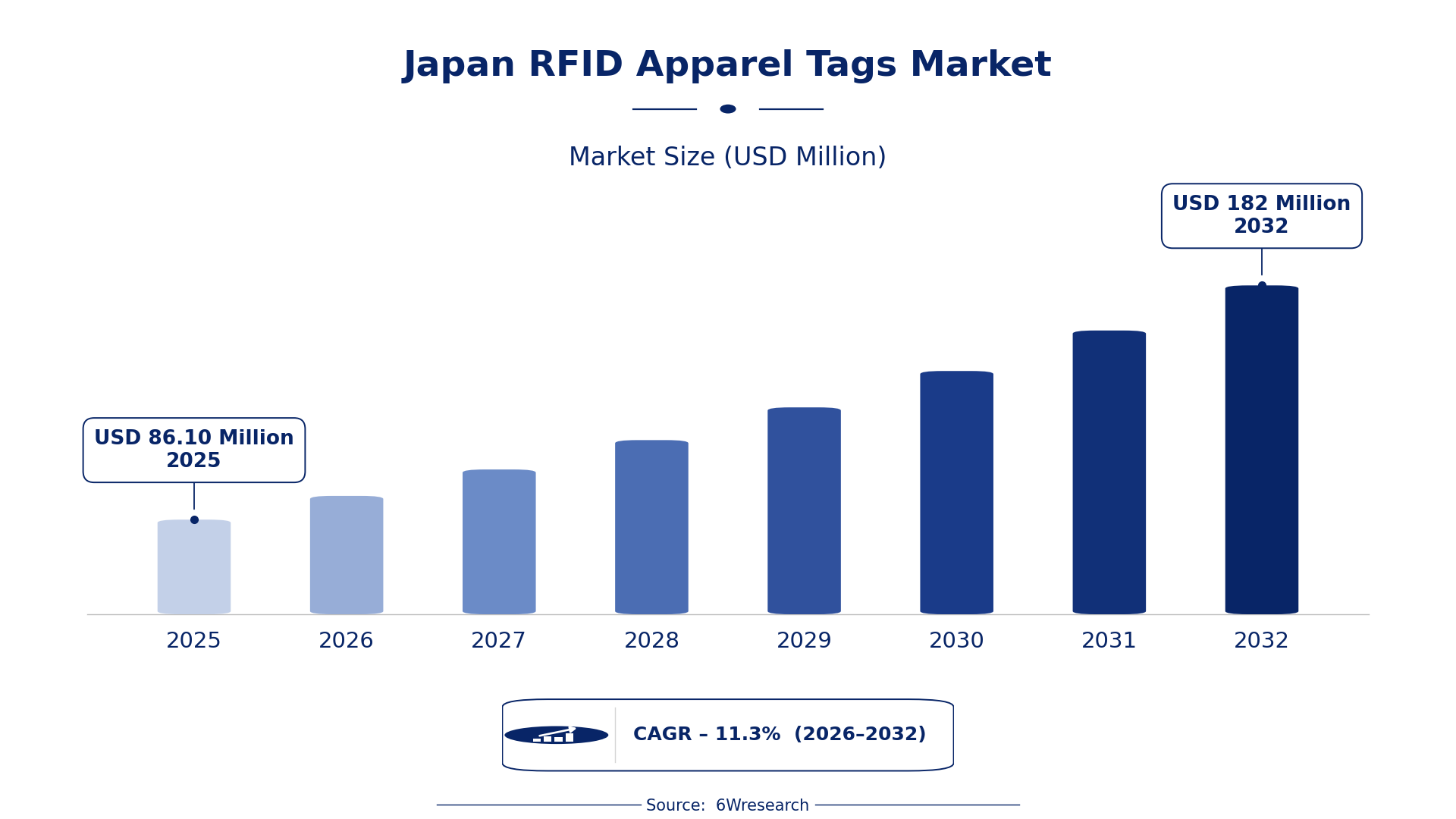
According to 6Wresearch internal database and industry insights, the Japan RFID Apparel Tags Market was valued at USD 86.10 Million in 2025 and is projected to reach USD 182 Million by 2032, growing at a CAGR of approximately 11.3% during 2026–2032.
Japan RFID Apparel Tags Market Highlights
| Report Metric | Details |
| Report Name | Japan RFID Apparel Tags Market (2026-2032) |
| Market Size 2025 | USD 86.10 Million |
| Market Size 2032 | USD 182 Million |
| Absolute Growth 2025–2032 | USD 95.90 Million |
| CAGR 2026–2032 | 11.3% |
| Peak Annual Growth | 12.1% in 2028 |
| Forecast Period | 2026–2032 |
| Historical Data | 2022–2025 |
| Base Year | 2025 |
| Leading Tag Type, 2025 | Roll Tell Tags (52% share) |
| Leading Frequency & Range, 2025 | UHF EPC Gen2 (47% share) |
| Leading Form Factor, 2025 | Sew-in Hang Tags (44% share) |
| Leading End User, 2025 | Retail Store Chains (47% share) |
| Fastest-Growing Tag Type | Laundry-Resistant Tags (15.7% CAGR) |
| Fastest-Growing Frequency & Range | NFC-Enabled (14.6% CAGR) |
| Fastest-Growing Form Factor | Embedded Textile Tags (15.5% CAGR) |
| Fastest-Growing End User | Uniform/Linen Manufacturers (14.3% CAGR) |
| Growing Sector | Uniform/Linen Manufacturers |
| Key End Users | Retail Store Chains, Apparel Manufacturers, Uniform/Linen Manufacturers |
Japan RFID Apparel Tags Market Year-wise Growth Rate and Key Drivers (2022–2032)
This graph illustrates the annual growth rates of the market from 2022 to 2032, highlighting a steady upward trajectory and projected market expansion over the forecast period.
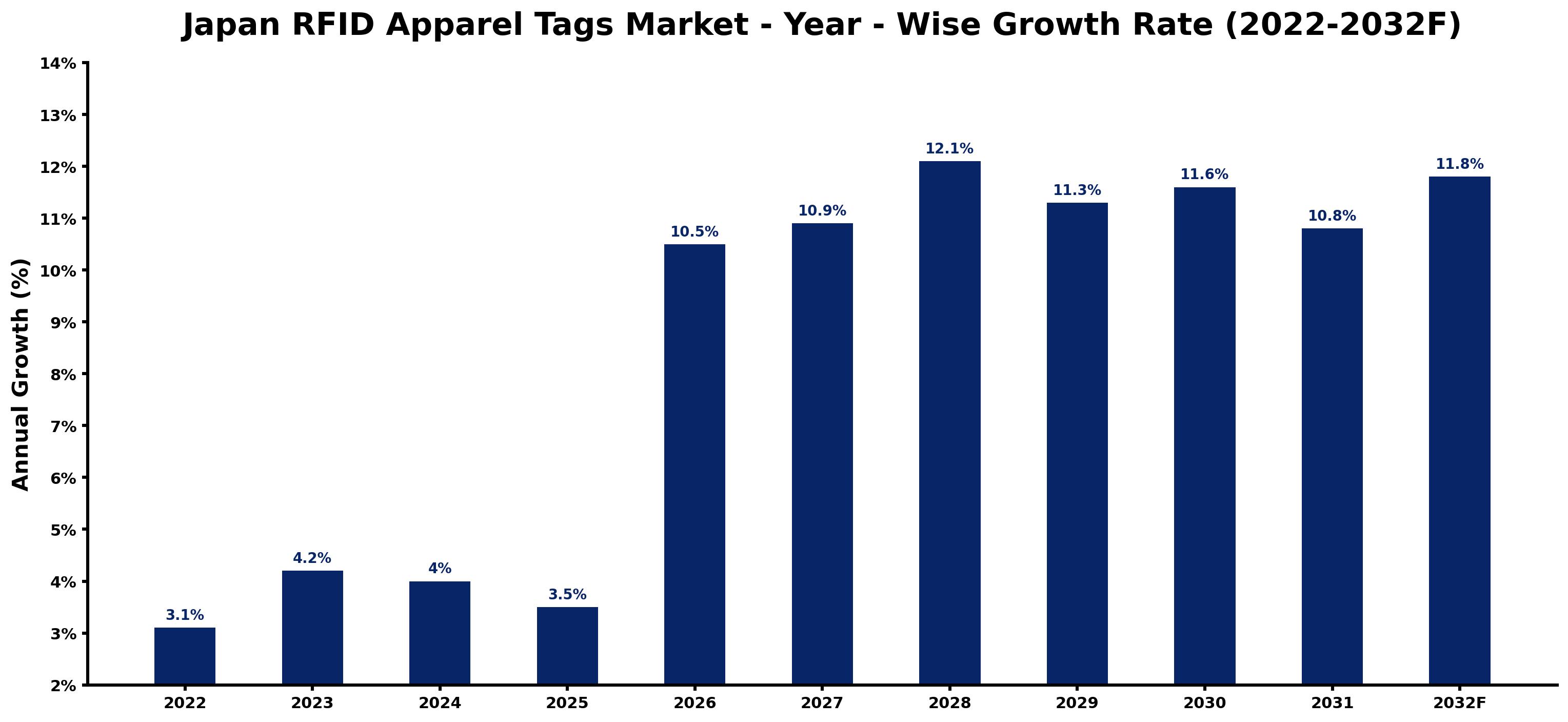
Annual growth estimates for each year appear below with the principal reason behind them, explaining the shifts that set the pace of the market.
| Year | Estimated Annual Growth (%) | Market Rationale |
| 2022 | 3.1 | The market showed steady growth due to ongoing adoption of RFID technology in retail. |
| 2023 | 4.2 | Growth accelerated as more retail chains integrated RFID for inventory management. |
| 2024 | 4.0 | The market experienced a slowdown as some retailers paused technology investments. |
| 2025 | 3.5 | Growth continued to slow as retailers focused on optimising existing RFID systems. |
| 2026 | 10.5 | Demand is expected to surge as new initiatives promote RFID adoption in the apparel sector. |
| 2027 | 10.9 | Growth will remain strong as retailers expand their RFID applications in stores. |
| 2028 | 12.1 | The peak growth year is driven by widespread technology acceptance in retail. |
| 2029 | 11.3 | Growth is projected to slow slightly as the market begins to stabilise after rapid expansion. |
| 2030 | 11.6 | Demand will rise again as retailers seek to improve operational efficiency. |
| 2031 | 10.8 | The market is expected to continue growing, supported by ongoing technology improvements. |
| 2032 | 11.8 | Growth will accelerate as new applications for RFID emerge in the apparel industry. |
Note: Market size estimations and growth projections presented in this report are based on 6Wresearch's proprietary forecasting methodology, utilizing the latest available industry data, government publications, and primary research inputs.
Japan RFID Apparel Tags Market Synopsis
RFID Apparel Tags are sophisticated items embedded with chips that track inventory in the apparel industry. They play a crucial role in inventory management, loss prevention, and improving customer experience in retail settings. The Japan RFID Apparel Tags Market is growing as retail chains increasingly adopt RFID technology, with over 60% already implementing it. The Tokyo region stands out as a key hub for apparel manufacturing, and initiatives from the Ministry of Economy, Trade and Industry are further driving adoption, leading to increased purchases and investments in this technology.
Market Dynamics Impact Analysis (2026–2032)
| Factor | Type | Impact | Primary Segment Affected |
| Increased adoption of RFID technology in retail chains | Driver | High | Retail Store Chains |
| Innovative applications of RFID in inventory management | Driver | High | Apparel Manufacturers |
| Growing demand for efficient inventory management solutions | Opportunity | High | Retail Store Chains |
| Expansion of RFID applications in the apparel sector | Opportunity | Medium | Uniform/Linen Manufacturers |
| High initial investment costs for RFID systems | Restraint | High | Apparel Manufacturers |
| Limited awareness of RFID benefits among smaller retailers | Restraint | Medium | Retail Store Chains |
| Challenges in integrating RFID with existing systems | Challenge | High | Apparel Manufacturers |
| Slow technology adoption in some traditional retail environments | Challenge | Medium | Uniform/Linen Manufacturers |
Evaluation of Drivers in Japan RFID Apparel Tags Market (2026–2032)
The main growth drivers and the segments they affect most are set out below.
| Drivers | Primary Segment Affected | Why It Matters (Evidence) |
| Increased retail chain adoption of RFID technology | Retail Store Chains | Over 60% of retail chains in Japan are adopting RFID technology, improving inventory management and loss prevention. |
| Applications for inventory tracking | Apparel Manufacturers | RFID tags are expected to reduce inventory discrepancies by up to 30% in retail settings, driving demand. |
| Government initiatives promoting technology adoption | Retail Store Chains | Support for RFID adoption through various initiatives is increasing purchases among retailers. |
| Improved customer experience through RFID | Retail Store Chains | Retail chains are implementing RFID solutions to provide better service and engagement. |
| Advancements in RFID systems | Apparel Manufacturers | New RFID technologies are making systems more efficient, prompting manufacturers to invest in upgrades. |
Most of the extra volume comes from the Tokyo region, where over 60% of retail chains are adopting RFID technology for inventory management. This shift stems from the need to minimise inventory discrepancies, which can reach 30% without RFID. Retailers are investing in RFID systems to tackle these issues, resulting in heightened demand. Technological advancements are enhancing the efficiency of RFID solutions, prompting manufacturers to upgrade their systems. Consequently, demand for RFID apparel tags is rising across the sector.
Evaluation of Restraints in Japan RFID Apparel Tags Market
Several factors work against faster growth; the main ones are summarised below.
| Market Restraint | Primary Segment Affected | Why It Matters (Evidence) |
| High initial investment costs for RFID systems | Apparel Manufacturers | The upfront costs can deter smaller manufacturers from adopting RFID technology, limiting market growth. |
| Limited awareness of RFID benefits among smaller retailers | Retail Store Chains | Many smaller retailers do not fully understand the advantages of RFID, which slows adoption rates. |
| Integration challenges with existing systems | Apparel Manufacturers | Integrating RFID with current inventory systems can be complex, causing delays in implementation. |
| Concerns over data privacy and security | Retail Store Chains | Retailers worry about potential data breaches, which can hinder RFID adoption. |
| Dependence on technology infrastructure | Uniform/Linen Manufacturers | A lack of adequate technology infrastructure can limit the effectiveness of RFID solutions. |
Japan RFID Apparel Tags Market Challenges
Apparel retailers in Japan encounter high initial costs for RFID adoption, with expenses exceeding 100 million yen per store, which delays improvements in inventory management. Many buyers face challenges with outdated systems, as over 40% of retailers still depend on manual inventory processes, leading to discrepancies that can amount to 30% annually. Regulatory challenges arise from compliance with ISO/IEC 18000-63, requiring suppliers to dedicate time and resources to meet these standards. Increased competition from international brands adopting RFID technology more rapidly pressures local producers to innovate or risk losing market share.
Trends in the Japan RFID Apparel Tags Market
Buyers and suppliers in the Japan RFID Apparel Tags Market are adjusting to the following trends.
- Shift towards RFID-Enabled Inventory Management: The Tokyo Fashion Week has showcased uses of RFID technology in apparel, highlighting its growing importance. In 2022, over 60% of retail chains began adopting RFID, reflecting a trend in the industry.
- Transition from Manual to Automated Inventory Tracking: Retailers are increasingly moving towards automated inventory management solutions, with RFID tags leading the way. This shift began in 2023 as retailers sought to improve efficiency and reduce discrepancies.
- Emergence of Smart Apparel with RFID Integration: Smart apparel featuring embedded RFID tags is gaining traction, allowing for effective tracking and customer engagement. The trend is expected to grow as technology becomes more accessible in the coming years.
- Growing Focus on Sustainability in RFID Applications: The GX Basic Policy adopted in 2023 aims for public-private investment in decarbonisation, influencing RFID applications in the apparel sector. This policy supports sustainable practices in inventory management.
Investment Opportunities in the Japan RFID Apparel Tags Market
The following areas offer the clearest openings for investors and suppliers in the Japan RFID Apparel Tags Market.
- Retail Store Chains: With over 60% of retail chains adopting RFID, there is an opportunity to supply advanced RFID solutions. Collaborating with local partners can facilitate market entry.
- Apparel Manufacturers: As manufacturers strive to improve inventory accuracy, there is a demand for durable RFID tags. Investing in high-quality RFID solutions can effectively meet this need.
- Uniform/Linen Manufacturers: The increasing demand for efficient tracking in uniform management presents an opportunity for RFID suppliers. Establishing joint ventures can strengthen market presence.
- Retail Technology Providers: The Japanese government has allocated 500 million yen for technology innovation in retail, creating an opportunity for suppliers to offer RFID solutions that align with this funding.
Government Initiatives in the Japan RFID Apparel Tags Market
The Industrial Standardization Act of 1949, amended in 2019, governs product and test standards for RFID technology in Japan. This legislation ensures that RFID products meet specific quality and safety standards, facilitating wider adoption across the apparel sector. The Act against Unjustifiable Premiums and Misleading Representations from 1962 prohibits misleading labelling and advertising, ensuring transparency in RFID applications, which is vital for consumer trust.
In 2023, the Japanese government allocated 500 million yen for technology innovation in the retail sector, administered by the Ministry of Economy, Trade and Industry. This funding supports initiatives that promote RFID adoption, helping retailers improve inventory management and operational efficiency.
Future Insight of the Japan RFID Apparel Tags Market
New retail innovation hubs will emerge by 2032, driven by government funding and industry initiatives. RFID adoption is expected to rise, with over 80% of retail chains implementing the technology, improving inventory accuracy and customer service. Tokyo Fashion Week will showcase advancements in RFID applications, promoting collaboration between designers and technology developers. As a result, buyers will benefit from enhanced stock management, while suppliers will need to adapt to evolving standards and consumer expectations.
Market Segmentation Analysis
Japan RFID Apparel Tags Market report covers a detailed analysis of the following market segments:
By Tag Type – Roll Tell Tags Lead, Laundry-Resistant Tags Expected to Grow Fastest
According to Saurav Kr Singh, Senior Research Analyst at 6Wresearch, Roll Tell Tags accounted for 52% of the market by tag type in 2025. Roll Tell Tags hold the largest share due to their widespread use in retail for inventory tracking, particularly in the Tokyo region where retail activity is high. Their effectiveness in reducing inventory discrepancies by up to 30% makes them indispensable for retail chains. Laundry-Resistant Tags are set to record the highest CAGR in this split, 15.7% over 2026–2032. Laundry-Resistant Tags are experiencing rapid growth driven by the increasing demand from retail chains for durable solutions that can withstand laundering processes. This trend is particularly evident in sectors requiring frequent cleaning of garments, ensuring reliability in inventory management. Suppliers should focus on developing Laundry-Resistant Tags to meet the rising demand for durable tracking solutions.
By Frequency & Range – UHF EPC Gen2 Leads, NFC-Enabled Expected to Grow Fastest
With 47% of frequency & range revenue in 2025, UHF EPC Gen2 was the largest category. UHF EPC Gen2 tags lead the market as they are preferred for long-range scanning in retail settings, facilitating efficient inventory management. Their compatibility with existing systems in major retail chains solidifies their dominant position in the sector. NFC-Enabled is projected to grow fastest, at a CAGR of 14.6% during 2026–2032. NFC-Enabled tags are growing quickly due to their ability to enhance consumer engagement and facilitate information sharing. The trend towards interactive retail experiences is driving their adoption among progressive retailers. Buyers should consider integrating NFC-Enabled tags to improve customer interaction and streamline information flow.
By Form Factor – Sew-in Hang Tags Lead, Embedded Textile Tags Expected to Grow Fastest
Sew-in Hang Tags held 44% of the Japan RFID Apparel Tags Market by form factor in 2025. Sew-in Hang Tags are the leading form factor as they are easily integrated into garments, allowing for efficient scanning and inventory management. Their practical application in retail chains ensures their continued market dominance. The quickest growth will come from Embedded Textile Tags, forecast to expand at a CAGR of 15.5% between 2026 and 2032. Embedded Textile Tags are gaining traction rapidly as they offer an efficient solution for tracking within fabrics, appealing to manufacturers focused on operational efficiency. Their use in modern apparel showcases their growth potential. Suppliers must prioritise the advancement of Embedded Textile Tags to satisfy the increasing demand for integrated tracking solutions.
By End User – Retail Store Chains Lead, Uniform/Linen Manufacturers Expected to Grow Fastest
Retail Store Chains took 47% of end user revenue in 2025, more than any other category. Retail Store Chains represent the largest segment as they are the primary users of RFID technology for inventory management and loss prevention. Their significant presence in urban areas like Tokyo drives the need for effective tracking solutions. Over 2026–2032, Uniform/Linen Manufacturers are expected to post the fastest growth, at a CAGR of 14.3%. Uniform/Linen Manufacturers are witnessing the fastest growth as they increasingly adopt RFID for tracking and managing uniforms, reflecting a shift towards more efficient inventory practices. Support from industry associations is further enhancing this trend. Suppliers should target Uniform/Linen Manufacturers to capitalise on the growing demand for efficient tracking solutions in this sector.
Key Attractiveness of the Report
- 10 Years of Market Numbers
- Historical Data Starting from 2022 to 2025
- Base Year 2025
- Forecast Data until 2032
- Key Performance Indicators Impacting the Market
- Major Upcoming Developments and Projects
Key Highlights of the Report:
- Japan RFID Apparel Tags Market Outlook
- Market Size of Japan RFID Apparel Tags Market, 2025
- Forecast of Japan RFID Apparel Tags Market, 2032
- Historical Data and Forecast of Japan RFID Apparel Tags Revenues & Volume for the Period 2022-2032F
- Japan RFID Apparel Tags Market Trend Evolution
- Japan RFID Apparel Tags Market Drivers and Challenges
- Japan RFID Apparel Tags Price Trends
- Japan RFID Apparel Tags Porter's Five Forces
- Japan RFID Apparel Tags Industry Life Cycle
- Historical Data and Forecast of Japan RFID Apparel Tags Market Revenues & Volume By Tag Type for the Period 2022-2032F
- Historical Data and Forecast of Japan RFID Apparel Tags Market Revenues & Volume By Roll Tell Tags for the Period 2022-2032F
- Historical Data and Forecast of Japan RFID Apparel Tags Market Revenues & Volume By Laundry-Resistant Tags for the Period 2022-2032F
- Historical Data and Forecast of Japan RFID Apparel Tags Market Revenues & Volume By Detach/Reusable Tags for the Period 2022-2032F
- Historical Data and Forecast of Japan RFID Apparel Tags Market Revenues & Volume By Frequency & Range for the Period 2022-2032F
- Historical Data and Forecast of Japan RFID Apparel Tags Market Revenues & Volume By UHF EPC Gen2 for the Period 2022-2032F
- Historical Data and Forecast of Japan RFID Apparel Tags Market Revenues & Volume By LF/HF for the Period 2022-2032F
- Historical Data and Forecast of Japan RFID Apparel Tags Market Revenues & Volume By NFC-Enabled for the Period 2022-2032F
- Historical Data and Forecast of Japan RFID Apparel Tags Market Revenues & Volume By Form Factor for the Period 2022-2032F
- Historical Data and Forecast of Japan RFID Apparel Tags Market Revenues & Volume By Sew-in Hang Tags for the Period 2022-2032F
- Historical Data and Forecast of Japan RFID Apparel Tags Market Revenues & Volume By Embedded Textile Tags for the Period 2022-2032F
- Historical Data and Forecast of Japan RFID Apparel Tags Market Revenues & Volume By On-Item Security Tags for the Period 2022-2032F
- Historical Data and Forecast of Japan RFID Apparel Tags Market Revenues & Volume By End User for the Period 2022-2032F
- Historical Data and Forecast of Japan RFID Apparel Tags Market Revenues & Volume By Apparel Manufacturers for the Period 2022-2032F
- Historical Data and Forecast of Japan RFID Apparel Tags Market Revenues & Volume By Uniform/Linen Manufacturers for the Period 2022-2032F
- Historical Data and Forecast of Japan RFID Apparel Tags Market Revenues & Volume By Retail Store Chains for the Period 2022-2032F
- Japan RFID Apparel Tags Import Export Trade Statistics
- Market Opportunity Assessment By Tag Type
- Market Opportunity Assessment By Frequency & Range
- Market Opportunity Assessment By Form Factor
- Market Opportunity Assessment By End User
- Japan RFID Apparel Tags Top Companies Market Share
- Japan RFID Apparel Tags Competitive Benchmarking By Technical and Operational Parameters
- Japan RFID Apparel Tags Company Profiles
- Japan RFID Apparel Tags Key Strategic Recommendations
Market Covered
Segments analysed in this report are listed below.
By Tag Type
- Roll Tell Tags
- Laundry-Resistant Tags
- Detach/Reusable Tags
By Frequency & Range
- UHF EPC Gen2
- LF/HF
- NFC-Enabled
By Form Factor
- Sew-in Hang Tags
- Embedded Textile Tags
- On-Item Security Tags
By End User
- Apparel Manufacturers
- Uniform/Linen Manufacturers
- Retail Store Chains































