Japan RFID Ear Tags Market Size & Growth Rate
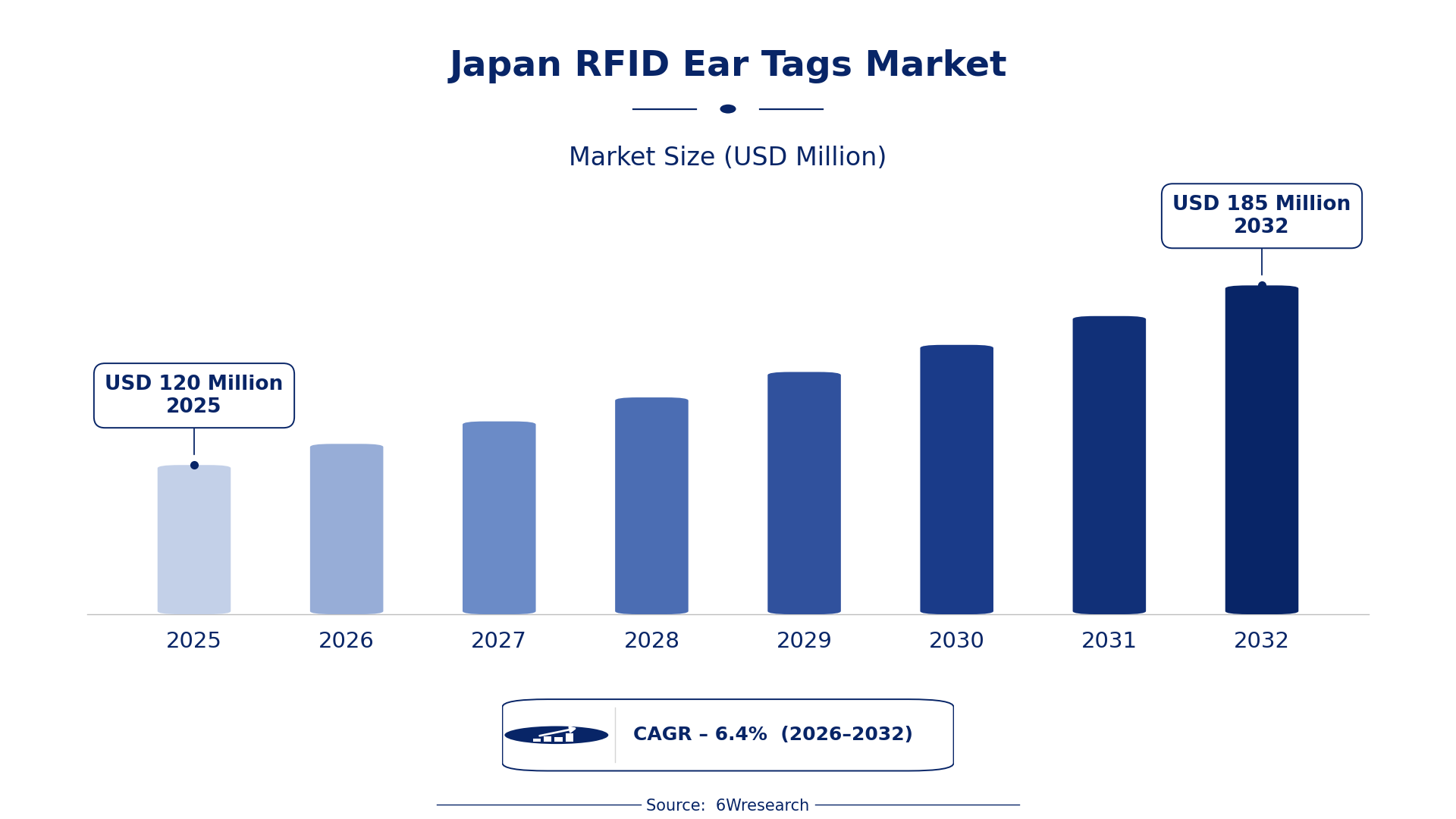
According to 6Wresearch internal database and industry insights, the Japan RFID Ear Tags Market was valued at USD 120 Million in 2025 and is projected to reach USD 185 Million by 2032, growing at a CAGR of approximately 6.4% during 2026–2032.
Japan RFID Ear Tags Market Highlights
| Report Metric | Details |
| Report Name | Japan RFID Ear Tags Market (2026-2032) |
| Market Size 2025 | USD 120 Million |
| Market Size 2032 | USD 185 Million |
| Absolute Growth 2025–2032 | USD 65 Million |
| CAGR 2026–2032 | 6.4% |
| Peak Annual Growth | 7.3% in 2032 |
| Forecast Period | 2026–2032 |
| Historical Data | 2022–2025 |
| Base Year | 2025 |
| Leading Tag Type, 2025 | Visual & RFID Ear Tags (50% share) |
| Leading Frequency Band, 2025 | LF/UHF Bands (51% share) |
| Leading Durability Level, 2025 | Waterproof/UV-Resistant (50% share) |
| Leading End User, 2025 | Dairy & Beef Farms (43% share) |
| Fastest-Growing Tag Type | Tamper-Resistant Tags (9.3% CAGR) |
| Fastest-Growing Frequency Band | Embedded Chips (8.3% CAGR) |
| Fastest-Growing Durability Level | Year-Round Wear (8.6% CAGR) |
| Fastest-Growing End User | Livestock Certification Authorities (8.7% CAGR) |
| Growing Sector | livestock management |
| Key End Users | dairy farms, beef farms, livestock certification authorities, precision livestock farmers |
Japan RFID Ear Tags Market Year-wise Growth Rate and Key Drivers (2022–2032)
This graph illustrates the annual growth rates of the market from 2022 to 2032, highlighting a steady upward trajectory and projected market expansion over the forecast period.
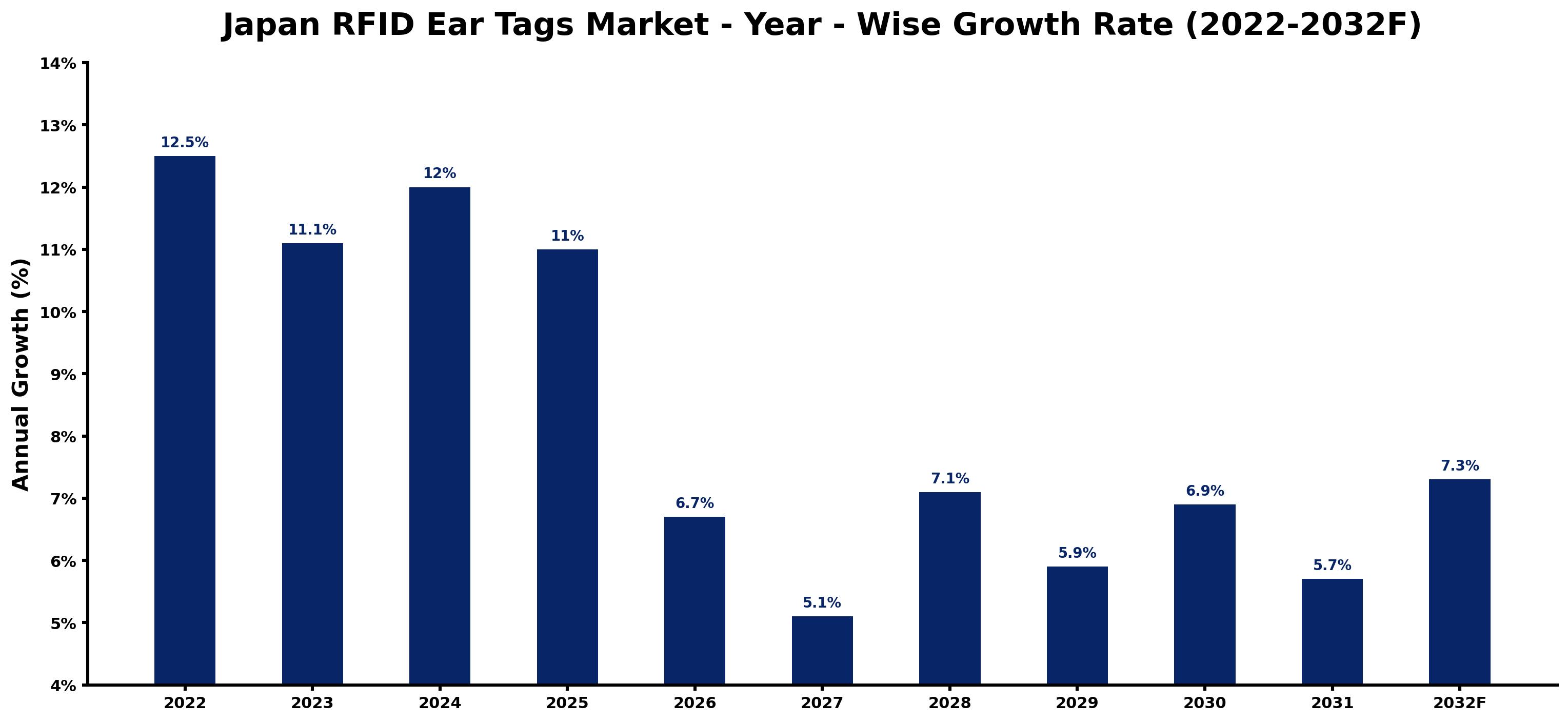
The following figures match every annual growth estimate with the main market development of that year, giving the reasoning behind each rise or slowdown.
| Year | Estimated Annual Growth (%) | Market Rationale |
| 2022 | 12.5 | The market experienced strong growth due to increased adoption of RFID technology. |
| 2023 | 11.1 | Demand growth slowed slightly as the market adjusted after the previous peak. |
| 2024 | 12.0 | Growth accelerated again as more farms adopted RFID solutions for livestock management. |
| 2025 | 11.0 | The market continued to grow, but at a slower rate as saturation began to set in. |
| 2026 | 6.7 | Growth is expected to slow further as competition increases among RFID technology providers. |
| 2027 | 5.1 | Demand growth will remain steady but lower as farms evaluate their technology investments. |
| 2028 | 7.1 | A resurgence in growth is projected as new applications for RFID technology emerge. |
| 2029 | 5.9 | The market is expected to experience a slight slowdown as buyers become more selective in their purchases. |
| 2030 | 6.9 | Growth will pick up again as advancements in RFID technology attract new users. |
| 2031 | 5.7 | The market growth rate is projected to slow as established farms optimise their existing systems. |
| 2032 | 7.3 | An increase in demand is expected as new regulations drive RFID adoption in livestock. |
Note: Market size estimations and growth projections presented in this report are based on 6Wresearch's proprietary forecasting methodology, utilizing the latest available industry data, government publications, and primary research inputs.
Japan RFID Ear Tags Market Synopsis
RFID ear tags are advanced identification devices for livestock management, embedding RFID chips in durable materials. They facilitate tracking and monitoring of animal health and location, primarily used in dairy and beef farming. The Japan RFID Ear Tags Market is growing due to rising investments in agricultural technology, with approximately 1 billion yen invested in 2023. Key regions like Tokyo and Hokkaido are leading the adoption of RFID technology, supported by government initiatives and standards that promote quality assurance and traceability in livestock management.
Market Dynamics Impact Analysis (2026–2032)
| Factor | Type | Impact | Primary Segment Affected |
| Increased investment in agricultural technology | Driver | High | Visual & RFID Ear Tags |
| Growing demand for livestock traceability | Driver | High | Visual & RFID Ear Tags |
| Expansion of precision livestock farming | Opportunity | High | Visual & RFID Ear Tags |
| Rising number of livestock certification authorities | Opportunity | Medium | Livestock Certification Authorities |
| High initial costs for RFID implementation | Restraint | High | Visual & RFID Ear Tags |
| Limited awareness among small-scale farmers | Restraint | Medium | Visual & RFID Ear Tags |
| Compliance with evolving regulations | Challenge | High | Visual & RFID Ear Tags |
| Capacity limitations in RFID production | Challenge | Medium | Visual & RFID Ear Tags |
Evaluation of Drivers in Japan RFID Ear Tags Market (2026–2032)
Demand rests on the following drivers, each shown with the segment it touches most.
| Drivers | Primary Segment Affected | Why It Matters (Evidence) |
| Increased adoption of RFID technology in livestock management | Visual & RFID Ear Tags | Japan's livestock sector invested approximately 1 billion yen in technology upgrades in 2023. |
| Government support for RFID implementation | Visual & RFID Ear Tags | The Ministry of Agriculture, Forestry and Fisheries promotes RFID technology for livestock management. |
| Growing focus on animal health monitoring | Visual & RFID Ear Tags | The average dairy farm in Japan has about 50 cows, many of which use RFID tags. |
| Rising demand for traceability in livestock | Visual & RFID Ear Tags | RFID tags are required for livestock traceability under Japanese law. |
| Technological advancements in RFID systems | Visual & RFID Ear Tags | The use of RFID for livestock tracking has increased by 20% in the last five years. |
Spending rises as Japan's livestock sector invests more in technology, with about 1 billion yen earmarked for upgrades in 2023. The average dairy farm, housing roughly 50 cows, frequently employs RFID tags for health monitoring and identification. The legal requirement for RFID tags in livestock traceability compels farms to implement these systems. Over the past five years, the market has experienced a 20% increase in RFID usage for tracking livestock, highlighting a growing emphasis on efficient farm management.
Evaluation of Restraints in Japan RFID Ear Tags Market
The following restraints limit how fast demand can grow.
| Market Restraint | Primary Segment Affected | Why It Matters (Evidence) |
| High initial costs for RFID technology implementation | Visual & RFID Ear Tags | Many small-scale farmers find the upfront investment for RFID systems prohibitive, limiting adoption. |
| Limited awareness and understanding of RFID benefits | Visual & RFID Ear Tags | Small farmers often lack knowledge about the advantages of RFID, hindering market growth. |
| Compliance with stringent regulations | Visual & RFID Ear Tags | Producers must navigate complex regulations, which can delay RFID implementation. |
| Capacity limitations in RFID production | Visual & RFID Ear Tags | Current production capacities may not meet the increasing demand for RFID tags in livestock. |
| Market saturation in certain regions | Visual & RFID Ear Tags | As RFID adoption increases, some markets may reach saturation, slowing growth. |
Japan RFID Ear Tags Market Challenges
High costs of RFID ear tags pose a challenge for buyers, with each tag priced over 500 yen, which restricts adoption among small-scale farmers. A limited supply of high-quality RFID components in Japan leads to production delays, resulting in longer wait times for farmers needing tags for their livestock. Many producers face difficulties with outdated technology, as 20% of farms still depend on traditional identification methods, which hampers efficiency and traceability. Intense competition from alternative livestock management solutions pressures suppliers to reduce prices, potentially compromising quality and increasing operational risks for farms.
Trends in the Japan RFID Ear Tags Market
Several trends are reshaping the Japan RFID Ear Tags Market; the most important are set out below.
- Shift towards Advanced Health Tracking: Tokyo is witnessing a shift towards advanced health tracking technologies in livestock management, with a 20% increase in RFID usage over the last five years. This trend underscores a growing focus on animal welfare and productivity.
- Dairy & Beef Farms Adopting RFID Solutions: Dairy and beef farms are progressively adopting RFID solutions, capturing 43% of the market share in 2025. This transition is driven by the demand for efficient livestock management and health monitoring.
- Increased Government Support for RFID Adoption: In 2022, the government launched a subsidy programme to promote RFID technology adoption among farmers. This initiative aims to enhance livestock traceability and improve overall farm management.
- Emergence of Tamper-Resistant Tags: Tamper-resistant tags are becoming increasingly popular among livestock producers, with an anticipated CAGR of 9.3% through 2032. This trend reflects the demand for improved security in livestock identification.
Investment Opportunities in the Japan RFID Ear Tags Market
Where to invest in the Japan RFID Ear Tags Market: the main openings are set out below.
- 1 billion yen investment gap in technology upgrades: Japan's livestock sector invested approximately 1 billion yen in technology upgrades in 2023, indicating a clear opportunity for suppliers of RFID technology to fill this gap.
- Supply of Waterproof/UV-Resistant RFID Tags: With the need for durable tags in outdoor environments, suppliers can focus on providing waterproof and UV-resistant RFID tags, essential for livestock management in various weather conditions.
- Partnerships with Livestock Certification Authorities: Establishing partnerships with livestock certification authorities can facilitate the adoption of RFID technology, as these bodies require compliance with traceability standards.
- Expansion into Hokkaido's Dairy Farms: Hokkaido's dairy farms represent a growing market for RFID solutions, with increasing demand for efficient livestock management systems. Local partnerships can support market entry.
Government Initiatives in the Japan RFID Ear Tags Market
The Economic Security Promotion Act, enacted in 2022, strengthens supply-chain resilience for critical products, including RFID ear tags. This measure builds on existing laws, such as the Food Sanitation Act, which mandates hygiene management in food businesses, ensuring that livestock products meet safety standards. Such regulations compel producers to implement RFID technology for traceability, thereby improving overall product quality and consumer trust in the livestock sector.
In 2023, the government allocated approximately 500 million yen to support farmers adopting RFID technology through subsidies. The Ministry of Agriculture, Forestry and Fisheries oversees this initiative, aiming to enhance the efficiency of livestock management practices across the country. This funding encourages more farmers to invest in RFID systems, improving traceability and health monitoring capabilities.
Future Insight of the Japan RFID Ear Tags Market
Technological advancements in RFID systems will revolutionise livestock management by 2032, as farms increasingly prioritise health monitoring and traceability. The government's subsidy programme initiated in 2022 will promote greater adoption of RFID technology among farmers. By 2025, Japan's agricultural technology market is projected to reach 2 trillion yen, indicating a surge in innovation for livestock tracking solutions. As JIS standards evolve, suppliers will need to ensure compliance and maintain product quality to remain competitive.
Market Segmentation Analysis
Japan RFID Ear Tags Market report covers a detailed analysis of the following market segments:
By Tag Type – Visual & RFID Ear Tags Lead, Tamper-Resistant Tags Expected to Grow Fastest
According to Saurav Kr Singh, Senior Research Analyst at 6Wresearch, Visual & RFID Ear Tags accounted for 50% of the market by tag type in 2025. Visual and RFID ear tags dominate the market as they are essential for tracking livestock health and location. The average dairy farm in Japan, with around 50 cows, extensively employs these tags for effective management purposes. The quickest growth will come from Tamper-Resistant Tags, forecast to expand at a CAGR of 9.3% between 2026 and 2032. Tamper-resistant tags are gaining traction because they prevent unauthorized removal or tampering, which is vital for maintaining accurate livestock records. The emphasis on traceability under Japanese law further fuels the demand for these secure tags. Suppliers should prioritise the development of tamper-resistant features in RFID tags to align with regulatory requirements.
By Frequency Band – LF/UHF Bands Lead, Embedded Chips Expected to Grow Fastest
LF/UHF Bands held 51% of the Japan RFID Ear Tags Market by frequency band in 2025. LF/UHF bands dominate the market as they are commonly used for RFID communication in livestock management. Their established presence in the industry ensures a reliable infrastructure for tracking and monitoring. Embedded Chips are set to record the highest CAGR in this split, 8.3% over 2026–2032. Embedded chips are growing quickly because they are essential for the functionality of RFID systems, which are increasingly integrated into livestock management practices. The rising investment in agricultural technology supports this trend. Buyers may benefit from investing in systems that utilise embedded chips to ensure compatibility with future technological advancements.
By Durability Level – Waterproof/UV-Resistant Leads, Year-Round Wear Expected to Grow Fastest
In 2025, Waterproof/UV-Resistant led the durability level split with a 50% share. Waterproof and UV-resistant tags are the leading choice as they are necessary for outdoor use in various weather conditions, ensuring longevity and reliability in livestock management. This durability is particularly important in regions like Tokyo and Hokkaido, where farming conditions can vary. Year-Round Wear is projected to grow fastest, at a CAGR of 8.6% during 2026–2032. Year-round wear tags are gaining traction because they are designed for continuous use on livestock, which is essential for maintaining health monitoring throughout the seasons. This aligns with the increasing focus on livestock health management. Suppliers should prioritise the development of durable products to meet the demands of farmers operating in diverse environmental conditions.
By End User – Dairy & Beef Farms Lead, Livestock Certification Authorities Expected to Grow Fastest
With 43% of end user revenue in 2025, Dairy & Beef Farms was the largest category. Dairy and beef farms represent the primary users of RFID ear tags, essential for effective livestock identification and health monitoring. The presence of over 4 million registered cattle in Japan underscores the importance of these farms in the RFID ear tag market. Over 2026–2032, Livestock Certification Authorities are expected to post the fastest growth, at a CAGR of 8.7%. Livestock certification authorities are witnessing rapid growth as they increasingly rely on RFID tags for compliance with stringent certification processes. This surge is further propelled by government initiatives that mandate enhanced traceability in the livestock sector. This trend indicates that suppliers must ensure their RFID solutions meet the evolving requirements of certification authorities.
Key Attractiveness of the Report
- 10 Years of Market Numbers
- Historical Data Starting from 2022 to 2025
- Base Year 2025
- Forecast Data until 2032
- Key Performance Indicators Impacting the Market
- Major Upcoming Developments and Projects
Key Highlights of the Report:
- Japan RFID Ear Tags Market Outlook
- Market Size of Japan RFID Ear Tags Market, 2025
- Forecast of Japan RFID Ear Tags Market, 2032
- Historical Data and Forecast of Japan RFID Ear Tags Revenues & Volume for the Period 2022-2032F
- Japan RFID Ear Tags Market Trend Evolution
- Japan RFID Ear Tags Market Drivers and Challenges
- Japan RFID Ear Tags Price Trends
- Japan RFID Ear Tags Porter's Five Forces
- Japan RFID Ear Tags Industry Life Cycle
- Historical Data and Forecast of Japan RFID Ear Tags Market Revenues & Volume By Tag Type for the Period 2022-2032F
- Historical Data and Forecast of Japan RFID Ear Tags Market Revenues & Volume By Visual & RFID Ear Tags for the Period 2022-2032F
- Historical Data and Forecast of Japan RFID Ear Tags Market Revenues & Volume By Tamper-Resistant Tags for the Period 2022-2032F
- Historical Data and Forecast of Japan RFID Ear Tags Market Revenues & Volume By Biometric-Enabled Tags for the Period 2022-2032F
- Historical Data and Forecast of Japan RFID Ear Tags Market Revenues & Volume By Frequency Band for the Period 2022-2032F
- Historical Data and Forecast of Japan RFID Ear Tags Market Revenues & Volume By LF/UHF Bands for the Period 2022-2032F
- Historical Data and Forecast of Japan RFID Ear Tags Market Revenues & Volume By Embedded Chips for the Period 2022-2032F
- Historical Data and Forecast of Japan RFID Ear Tags Market Revenues & Volume By IR/Optical for the Period 2022-2032F
- Historical Data and Forecast of Japan RFID Ear Tags Market Revenues & Volume By Durability Level for the Period 2022-2032F
- Historical Data and Forecast of Japan RFID Ear Tags Market Revenues & Volume By Waterproof/UV-Resistant for the Period 2022-2032F
- Historical Data and Forecast of Japan RFID Ear Tags Market Revenues & Volume By Year-Round Wear for the Period 2022-2032F
- Historical Data and Forecast of Japan RFID Ear Tags Market Revenues & Volume By Advanced Health Tracking for the Period 2022-2032F
- Historical Data and Forecast of Japan RFID Ear Tags Market Revenues & Volume By End User for the Period 2022-2032F
- Historical Data and Forecast of Japan RFID Ear Tags Market Revenues & Volume By Dairy & Beef Farms for the Period 2022-2032F
- Historical Data and Forecast of Japan RFID Ear Tags Market Revenues & Volume By Livestock Certification Authorities for the Period 2022-2032F
- Historical Data and Forecast of Japan RFID Ear Tags Market Revenues & Volume By Precision Livestock Farmers for the Period 2022-2032F
- Japan RFID Ear Tags Import Export Trade Statistics
- Market Opportunity Assessment By Tag Type
- Market Opportunity Assessment By Frequency Band
- Market Opportunity Assessment By Durability Level
- Market Opportunity Assessment By End User
- Japan RFID Ear Tags Top Companies Market Share
- Japan RFID Ear Tags Competitive Benchmarking By Technical and Operational Parameters
- Japan RFID Ear Tags Company Profiles
- Japan RFID Ear Tags Key Strategic Recommendations
Market Covered
Coverage by segment is as follows.
By Tag Type
- Visual & RFID Ear Tags
- Tamper-Resistant Tags
- Biometric-Enabled Tags
By Frequency Band
- LF/UHF Bands
- Embedded Chips
- IR/Optical
By Durability Level
- Waterproof/UV-Resistant
- Year-Round Wear
- Advanced Health Tracking
By End User
- Dairy & Beef Farms
- Livestock Certification Authorities
- Precision Livestock Farmers































