Japan RFID in Livestock Market Size & Growth Rate
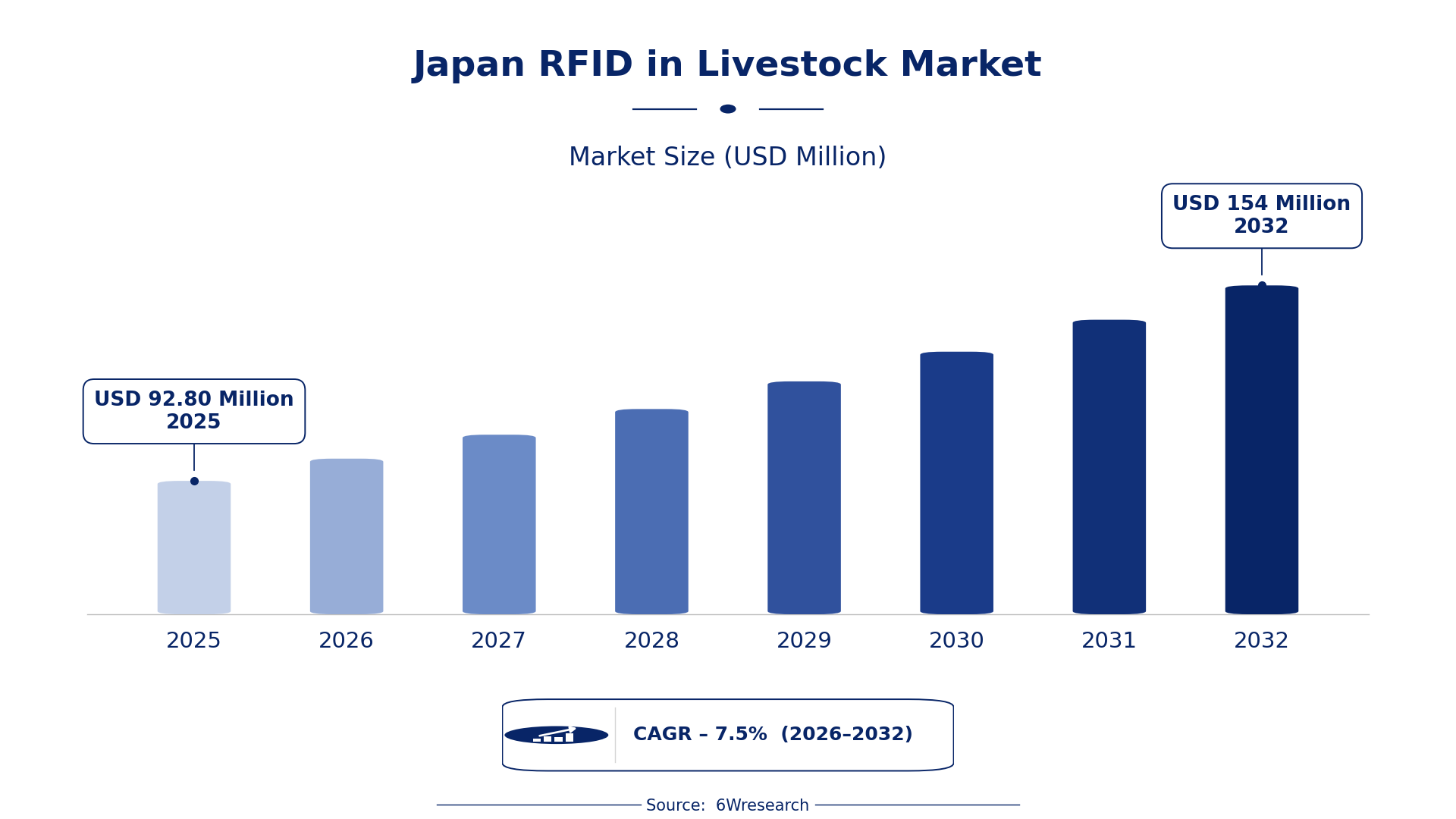
According to 6Wresearch internal database and industry insights, the Japan RFID in Livestock Market was valued at USD 92.80 Million in 2025 and is projected to reach USD 154 Million by 2032, growing at a CAGR of approximately 7.5% during 2026–2032.
Japan RFID in Livestock Market Highlights
| Report Metric | Details |
| Report Name | Japan RFID in Livestock Market (2026-2032) |
| Market Size 2025 | USD 92.80 Million |
| Market Size 2032 | USD 154 Million |
| Absolute Growth 2025–2032 | USD 61.20 Million |
| CAGR 2026–2032 | 7.5% |
| Peak Annual Growth | 8.4% in 2028 |
| Forecast Period | 2026–2032 |
| Historical Data | 2022–2025 |
| Base Year | 2025 |
| Leading Application Area, 2025 | Identification (44% share) |
| Leading Tag Type, 2025 | Passive UHF Ear Tags (44% share) |
| Leading Data Collected, 2025 | Animal ID & Age (43% share) |
| Leading End User, 2025 | Farm Managers (51% share) |
| Fastest-Growing Application Area | Health Monitoring (8.7% CAGR) |
| Fastest-Growing Tag Type | Active/RTLS Tags (10.8% CAGR) |
| Fastest-Growing Data Collected | Temperature/Motion (10.2% CAGR) |
| Fastest-Growing End User | Animal Health Systems (9.5% CAGR) |
| Growing Sector | livestock management |
| Key End Users | Farm Managers, Dairy Producers, Poultry Producers, Animal Health Systems |
Japan RFID in Livestock Market Year-wise Growth Rate and Key Drivers (2022–2032)
This graph illustrates the annual growth rates of the market from 2022 to 2032, highlighting a steady upward trajectory and projected market expansion over the forecast period.
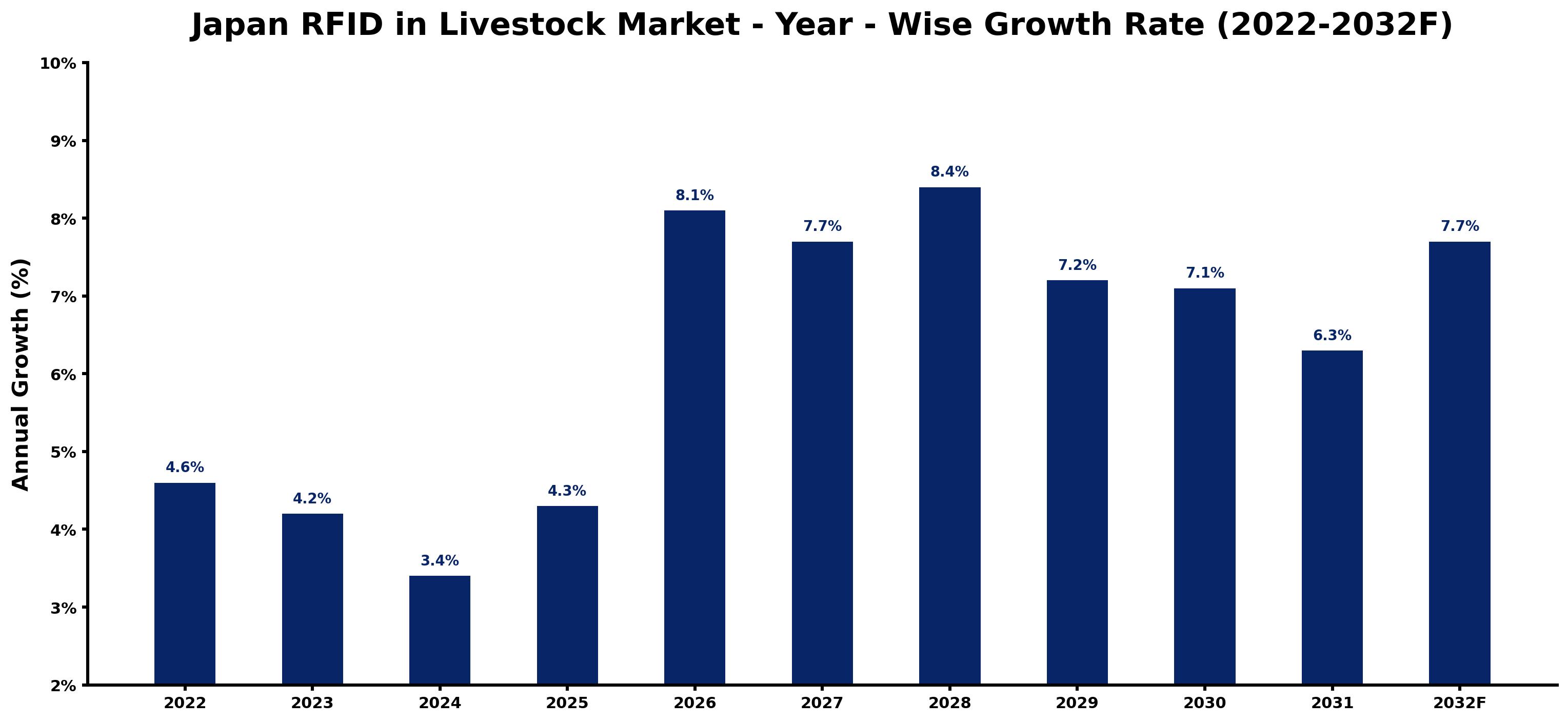
Annual growth estimates for each year appear below with the principal reason behind them, explaining the shifts that set the pace of the market.
| Year | Estimated Annual Growth (%) | Market Rationale |
| 2022 | 4.6 | The market showed solid growth due to increased adoption of RFID technology across the livestock sector. |
| 2023 | 4.2 | Growth slowed as some farms delayed investments in new technologies amid economic uncertainties. |
| 2024 | 3.4 | The market continued to grow, albeit at a slower pace, as regulatory compliance became more pressing. |
| 2025 | 4.3 | Demand accelerated as more farms implemented RFID systems to meet compliance standards and improve management. |
| 2026 | 8.1 | Growth surged as investments in health monitoring systems gained momentum among livestock producers. |
| 2027 | 7.7 | The market experienced a slight slowdown as some producers reassessed their technology investments. |
| 2028 | 8.4 | Demand peaked as the government pushed for full compliance in livestock identification by 2025. |
| 2029 | 7.2 | Growth slowed as the market adjusted to the peak demand levels seen in the previous year. |
| 2030 | 7.1 | The market continued to expand, driven by ongoing investments in health monitoring technologies. |
| 2031 | 6.3 | Growth slowed as the market stabilised following the peak in compliance-driven demand. |
| 2032 | 7.7 | Demand increased again as new initiatives to subsidise RFID costs for small farms were introduced. |
Note: Market size estimations and growth projections presented in this report are based on 6Wresearch's proprietary forecasting methodology, utilizing the latest available industry data, government publications, and primary research inputs.
Japan RFID in Livestock Market Synopsis
RFID in livestock is a technology that uses radio-frequency identification to track and manage animals, primarily through ear tags or collars. According to the Japan RFID in Livestock Market is expanding as the country aims for 100% compliance in livestock identification by 2025, with over 4 million registered livestock currently using RFID technology. Key drivers include increased regulatory requirements and the adoption of health monitoring systems, particularly in regions like Hokkaido where 75% of dairy farms have implemented RFID systems to improve efficiency and traceability.
Market Dynamics Impact Analysis (2026–2032)
| Factor | Type | Impact | Primary Segment Affected |
| Increased regulatory compliance requirements | Driver | High | Regulatory Compliance |
| Growing focus on health monitoring | Driver | High | Health Monitoring |
| Investment in RFID technology subsidies for small farms | Opportunity | Medium | Identification |
| Expansion of RFID applications in large-scale operations | Opportunity | Medium | Active/RTLS Tags |
| High initial costs of RFID implementation | Restraint | High | Identification |
| Limited awareness among smaller farms | Restraint | Medium | Health Monitoring |
| Resistance to technology adoption in traditional farming practices | Challenge | High | Feed Management |
| Potential data privacy concerns with health monitoring | Challenge | Medium | Animal Health Systems |
Evaluation of Drivers in Japan RFID in Livestock Market (2026–2032)
Key forces behind demand, with the segment each one moves most, are listed below.
| Drivers | Primary Segment Affected | Why It Matters (Evidence) |
| Increased regulatory compliance requirements | Regulatory Compliance | Japan aims for 100% compliance in livestock identification by 2025, prompting farms to adopt RFID. |
| Growing focus on health monitoring | Health Monitoring | With over 1.5 million animals tracked annually, health metrics are vital for livestock management. |
| Subsidies for RFID technology | Identification | In 2023, a new initiative subsidised RFID tag costs for small farms, boosting adoption. |
| Expansion of RFID applications in large-scale operations | Active/RTLS Tags | Active tags are increasingly used in large-scale operations for real-time tracking, improving efficiency. |
| Increased consumer demand for traceability | Traceability | The emphasis on food safety drives the need for traceability solutions, leading to higher RFID adoption. |
Orders keep climbing as compliance requirements become more stringent, with Japan targeting 100% identification compliance by 2025. This push has led to over 4 million registered livestock using RFID technology, improving traceability and management. The focus on health monitoring has resulted in over 1.5 million animals tracked annually, driving demand for these solutions. The expansion of active tags in large-scale operations is also contributing to the market's growth.
Evaluation of Restraints in Japan RFID in Livestock Market
These are the pressures that could keep growth below its potential.
| Market Restraint | Primary Segment Affected | Why It Matters (Evidence) |
| High initial costs of RFID implementation | Identification | The average cost of RFID systems can deter smaller farms from adopting the technology. |
| Limited awareness among smaller farms | Health Monitoring | Many small-scale farmers lack knowledge about the benefits of RFID, hindering uptake. |
| Resistance to technology adoption in traditional farming practices | Feed Management | Some farmers prefer traditional methods, which slows the transition to RFID solutions. |
| Concerns over data privacy with health monitoring | Animal Health Systems | Farmers worry about how health data will be used, impacting their willingness to adopt. |
| Insufficient technical support for implementation | Regulatory Compliance | Many farms struggle with the technical aspects of RFID systems, limiting effective use. |
Japan RFID in Livestock Market Challenges
High costs burden producers using RFID technology, as larger operations may invest over 1 million yen on tags and systems, limiting their ability to expand. Compliance with JIS Z 9901 standards imposed by regulatory bodies creates delays and raises operational costs, particularly for smaller farms that may lack resources. Access to subsidised RFID tags remains a challenge for small farms, leading to uneven adoption rates and potential compliance risks. Buyers struggle with livestock identification, as only 75% of dairy farms in Hokkaido have implemented RFID systems, complicating traceability and management efforts.
Trends in the Japan RFID in Livestock Market
The shifts below are changing how Japan RFID in Livestock Market products are bought and supplied.
- Farm Managers Adopting Advanced Tracking: Farm managers are increasingly adopting RFID technology for livestock management, with 51% using it by 2025. This trend reflects a growing emphasis on efficient tracking and compliance.
- Tokyo's Livestock Health Monitoring Initiative: Tokyo has launched a program to improve livestock health monitoring with RFID by 2025, aiming to improve overall animal welfare and management. This initiative is expected to benefit numerous farms.
- Shift Towards Active/RTLS Tags: There is a notable shift towards the use of Active/RTLS tags in large-scale operations, with a CAGR of 10.8% anticipated from 2026 to 2032. This change significantly improves tracking capabilities.
- Increased Focus on Traceability: The emphasis on traceability in food safety is driving RFID adoption, with 60% of poultry farms implementing these systems by 2023. This trend ensures compliance with safety standards.
Investment Opportunities in the Japan RFID in Livestock Market
Investors looking at the Japan RFID in Livestock Market should consider the following areas.
- Partnerships with Local Farms: Establishing partnerships with local farms can facilitate RFID adoption, particularly in rural areas where awareness is low. With 9 million livestock in Japan, this presents a significant opportunity.
- Investment in Health Monitoring Systems: Investing in health monitoring systems can meet the growing demand, particularly among dairy and poultry producers. The government’s push for compliance by 2025 supports this opportunity.
- Expansion of RFID Applications: Expanding RFID applications in large-scale operations presents a lucrative opportunity, especially as active tags gain traction. The adoption rate in poultry farms reached 60% in 2023.
- Subsidised a leading supplier for Small Farms: The initiative to subsidise RFID tag costs for small farms creates an opportunity for suppliers to enter the market. Engaging with small-scale producers can yield significant returns.
Government Initiatives in the Japan RFID in Livestock Market
The Food Sanitation Act amendment, fully applied in June 2021, mandates HACCP-based hygiene management for food businesses, impacting livestock producers by requiring compliance with stringent hygiene standards. This law encourages the adoption of RFID systems for tracking and management, ensuring food safety and traceability.
The Digital Agency, established in September 2021, leads the government's digital transformation efforts. It approves funding for projects that support technology adoption in agriculture, including RFID systems for livestock management, thus improving compliance and efficiency.
Future Insight of the Japan RFID in Livestock Market
The shift towards mandatory livestock identification will drive market changes by 2032, prompting suppliers to innovate RFID solutions. The Tokyo programme for health monitoring will stimulate advancements in tracking systems, enabling buyers to obtain more accurate health data. Increased adoption of RFID in poultry farms, which reached 60% in 2023, will facilitate wider integration across the livestock sector. With over 4 million registered livestock using RFID technology, this trend will improve efficiency and transparency in livestock management.
Market Segmentation Analysis
Japan RFID in Livestock Market report covers a detailed analysis of the following market segments:
By Application Area – Identification Leads, Health Monitoring Expected to Grow Fastest
According to Saurav Kr Singh, Senior Research Analyst at 6Wresearch, in 2025, Identification led the application area split with a 44% share. Identification holds the largest share as it is essential for tracking individual animals, which is critical for effective livestock management. The Ministry of Agriculture, Forestry and Fisheries promotes RFID adoption to ensure compliance with regulations in the livestock sector. Health Monitoring is set to record the highest CAGR in this split, 8.7% over 2026–2032. Health Monitoring is experiencing rapid growth due to the increasing focus on livestock health metrics, exemplified by Tokyo's initiative to enhance health monitoring by 2025. This trend highlights the rising importance of health data in livestock management. Suppliers should develop solutions that enhance health monitoring capabilities to meet the growing demand.
By Tag Type – Passive UHF Ear Tags Lead, Active/RTLS Tags Expected to Grow Fastest
With 44% of tag type revenue in 2025, Passive UHF Ear Tags was the largest category. Passive UHF Ear Tags dominate the market as they are commonly used for animal identification, making them essential for livestock management. Their widespread adoption among farmers contributes to their leading position in the market. Over 2026–2032, Active/RTLS Tags are expected to post the fastest growth, at a CAGR of 10.8%. Active/RTLS Tags are growing quickly as they provide real-time tracking capabilities, particularly in large-scale operations. This trend is driven by the need for more efficient management of livestock locations and health. Buyers may consider investing in Active/RTLS Tags to improve tracking and management efficiency in their operations.
By Data Collected – Animal ID & Age Leads, Temperature/Motion Expected to Grow Fastest
Animal ID & Age held 43% of the Japan RFID in Livestock Market by data collected in 2025. Animal ID & Age data is crucial for herd management, making it the most collected information in the market. This data is vital for maintaining compliance with regulatory standards and ensuring effective livestock management. Temperature/Motion is projected to grow fastest, at a CAGR of 10.2% during 2026–2032. Temperature/Motion data is gaining traction as it is important for monitoring animal health, reflecting a shift towards proactive health management strategies in the industry. This growth indicates a broader trend towards data-driven livestock management. Suppliers should focus on solutions that facilitate the collection of health-related data to align with market demands.
By End User – Farm Managers Lead, Animal Health Systems Expected to Grow Fastest
The largest end user category in 2025 was Farm Managers, at 51% of revenue. Farm Managers represent the largest user group of RFID technology as they are directly involved in livestock management and decision-making. Their reliance on RFID for efficient herd management solidifies their leading position in the market. The quickest growth will come from Animal Health Systems, forecast to expand at a CAGR of 9.5% between 2026 and 2032. Animal Health Systems are experiencing the fastest growth as they integrate RFID technology with health monitoring systems, responding to the increasing demand for comprehensive health management solutions. This integration is vital for improving livestock health outcomes. Suppliers should target Animal Health Systems to expand their market reach and address the growing emphasis on health management.
Key Attractiveness of the Report
- 10 Years of Market Numbers
- Historical Data Starting from 2022 to 2025
- Base Year 2025
- Forecast Data until 2032
- Key Performance Indicators Impacting the Market
- Major Upcoming Developments and Projects
Key Highlights of the Report:
- Japan RFID in Livestock Market Outlook
- Market Size of Japan RFID in Livestock Market, 2025
- Forecast of Japan RFID in Livestock Market, 2032
- Historical Data and Forecast of Japan RFID in Livestock Revenues & Volume for the Period 2022-2032F
- Japan RFID in Livestock Market Trend Evolution
- Japan RFID in Livestock Market Drivers and Challenges
- Japan RFID in Livestock Price Trends
- Japan RFID in Livestock Porter's Five Forces
- Japan RFID in Livestock Industry Life Cycle
- Historical Data and Forecast of Japan RFID in Livestock Market Revenues & Volume By Application Area for the Period 2022-2032F
- Historical Data and Forecast of Japan RFID in Livestock Market Revenues & Volume By Identification for the Period 2022-2032F
- Historical Data and Forecast of Japan RFID in Livestock Market Revenues & Volume By Health Monitoring for the Period 2022-2032F
- Historical Data and Forecast of Japan RFID in Livestock Market Revenues & Volume By Feed Management for the Period 2022-2032F
- Historical Data and Forecast of Japan RFID in Livestock Market Revenues & Volume By Regulatory Compliance for the Period 2022-2032F
- Historical Data and Forecast of Japan RFID in Livestock Market Revenues & Volume By Tag Type for the Period 2022-2032F
- Historical Data and Forecast of Japan RFID in Livestock Market Revenues & Volume By Passive UHF Ear Tags for the Period 2022-2032F
- Historical Data and Forecast of Japan RFID in Livestock Market Revenues & Volume By Active/RTLS Tags for the Period 2022-2032F
- Historical Data and Forecast of Japan RFID in Livestock Market Revenues & Volume By IoT Tags for the Period 2022-2032F
- Historical Data and Forecast of Japan RFID in Livestock Market Revenues & Volume By Tamper-Proof Tags for the Period 2022-2032F
- Historical Data and Forecast of Japan RFID in Livestock Market Revenues & Volume By Data Collected for the Period 2022-2032F
- Historical Data and Forecast of Japan RFID in Livestock Market Revenues & Volume By Animal ID & Age for the Period 2022-2032F
- Historical Data and Forecast of Japan RFID in Livestock Market Revenues & Volume By Temperature/Motion for the Period 2022-2032F
- Historical Data and Forecast of Japan RFID in Livestock Market Revenues & Volume By Feeding Data for the Period 2022-2032F
- Historical Data and Forecast of Japan RFID in Livestock Market Revenues & Volume By Traceability for the Period 2022-2032F
- Historical Data and Forecast of Japan RFID in Livestock Market Revenues & Volume By End User for the Period 2022-2032F
- Historical Data and Forecast of Japan RFID in Livestock Market Revenues & Volume By Farm Managers for the Period 2022-2032F
- Historical Data and Forecast of Japan RFID in Livestock Market Revenues & Volume By Animal Health Systems for the Period 2022-2032F
- Historical Data and Forecast of Japan RFID in Livestock Market Revenues & Volume By Dairy & Poultry Producers for the Period 2022-2032F
- Historical Data and Forecast of Japan RFID in Livestock Market Revenues & Volume By Government Audits for the Period 2022-2032F
- Japan RFID in Livestock Import Export Trade Statistics
- Market Opportunity Assessment By Application Area
- Market Opportunity Assessment By Tag Type
- Market Opportunity Assessment By Data Collected
- Market Opportunity Assessment By End User
- Japan RFID in Livestock Top Companies Market Share
- Japan RFID in Livestock Competitive Benchmarking By Technical and Operational Parameters
- Japan RFID in Livestock Company Profiles
- Japan RFID in Livestock Key Strategic Recommendations
Market Covered
Segments analysed in this report are listed below.
By Application Area
- Identification
- Health Monitoring
- Feed Management
- Regulatory Compliance
By Tag Type
- Passive UHF Ear Tags
- Active/RTLS Tags
- IoT Tags
- Tamper-Proof Tags
By Data Collected
- Animal ID & Age
- Temperature/Motion
- Feeding Data
- Traceability
By End User
- Farm Managers
- Animal Health Systems
- Dairy & Poultry Producers
- Government Audits































