Japan RFID Market Size & Growth Rate
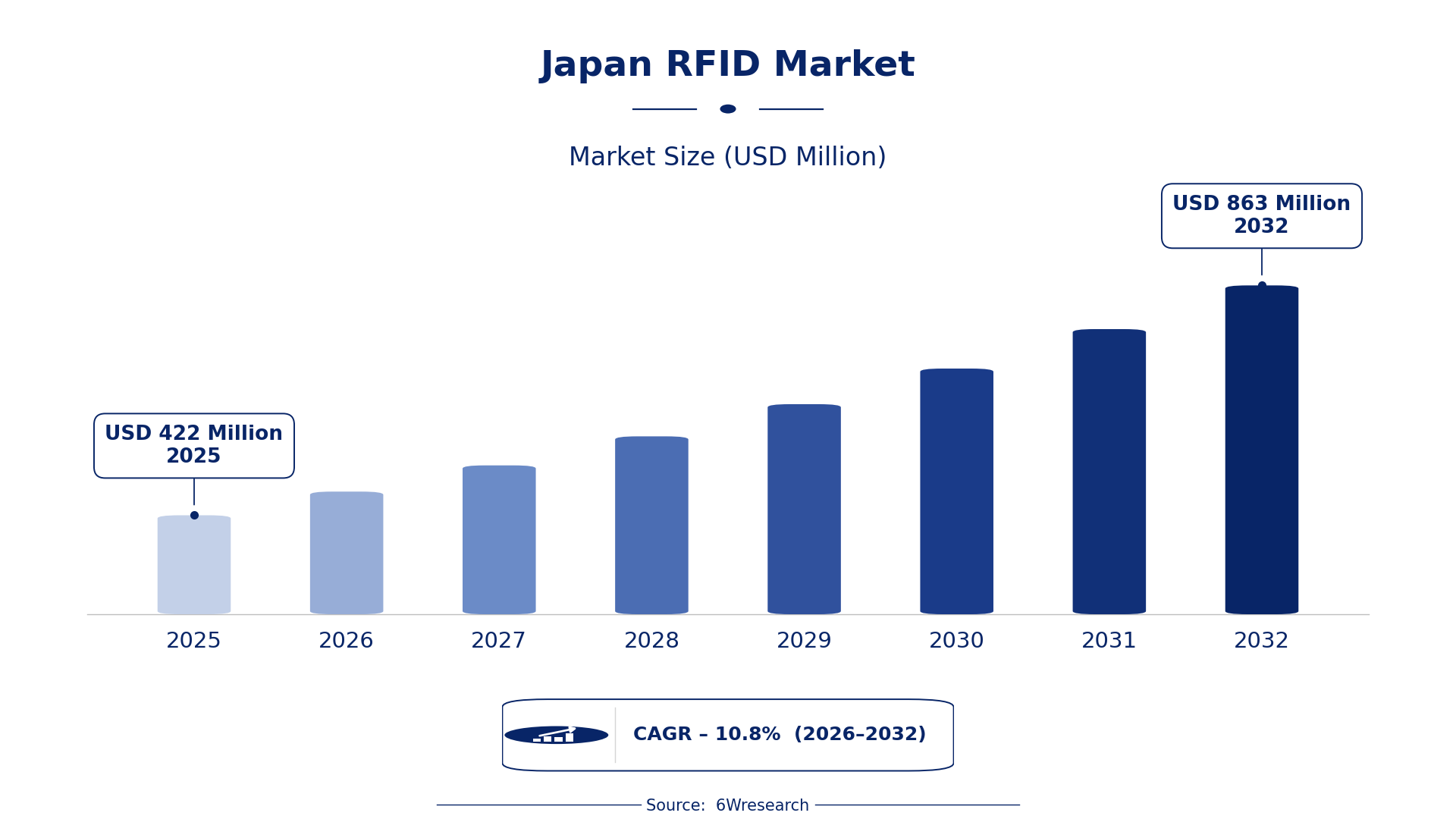
According to 6Wresearch internal database and industry insights, the Japan RFID Market was valued at USD 422 Million in 2025 and is projected to reach USD 863 Million by 2032, growing at a CAGR of approximately 10.8% during 2026–2032.
Japan RFID Market Highlights
| Report Metric | Details |
| Report Name | Japan RFID Market (2026-2032) |
| Market Size 2025 | USD 422 Million |
| Market Size 2032 | USD 863 Million |
| Absolute Growth 2025–2032 | USD 441 Million |
| CAGR 2026–2032 | 10.8% |
| Peak Annual Growth | 12.2% in 2028 |
| Forecast Period | 2026–2032 |
| Historical Data | 2022–2025 |
| Base Year | 2025 |
| Leading Offering, 2025 | Tags (52% share) |
| Leading Wafer Size, 2025 | 8 Inch (45% share) |
| Leading Tag Type, 2025 | Passive (59% share) |
| Leading Frequency, 2025 | Low Frequency (56% share) |
| Leading Form Factor, 2025 | Card (34% share) |
| Fastest-Growing Offering | Readers (15.3% CAGR) |
| Fastest-Growing Wafer Size | 12 Inch (13.2% CAGR) |
| Fastest-Growing Tag Type | Active (14.2% CAGR) |
| Fastest-Growing Frequency | High Frequency (14.1% CAGR) |
| Fastest-Growing Form Factor | Implant (15.6% CAGR) |
| Growing Sector | logistics |
| Key End Users | retail chains, logistics providers, healthcare facilities, manufacturing companies |
Japan RFID Market Year-wise Growth Rate and Key Drivers (2022–2032)
This graph illustrates the annual growth rates of the market from 2022 to 2032, highlighting a steady upward trajectory and projected market expansion over the forecast period.
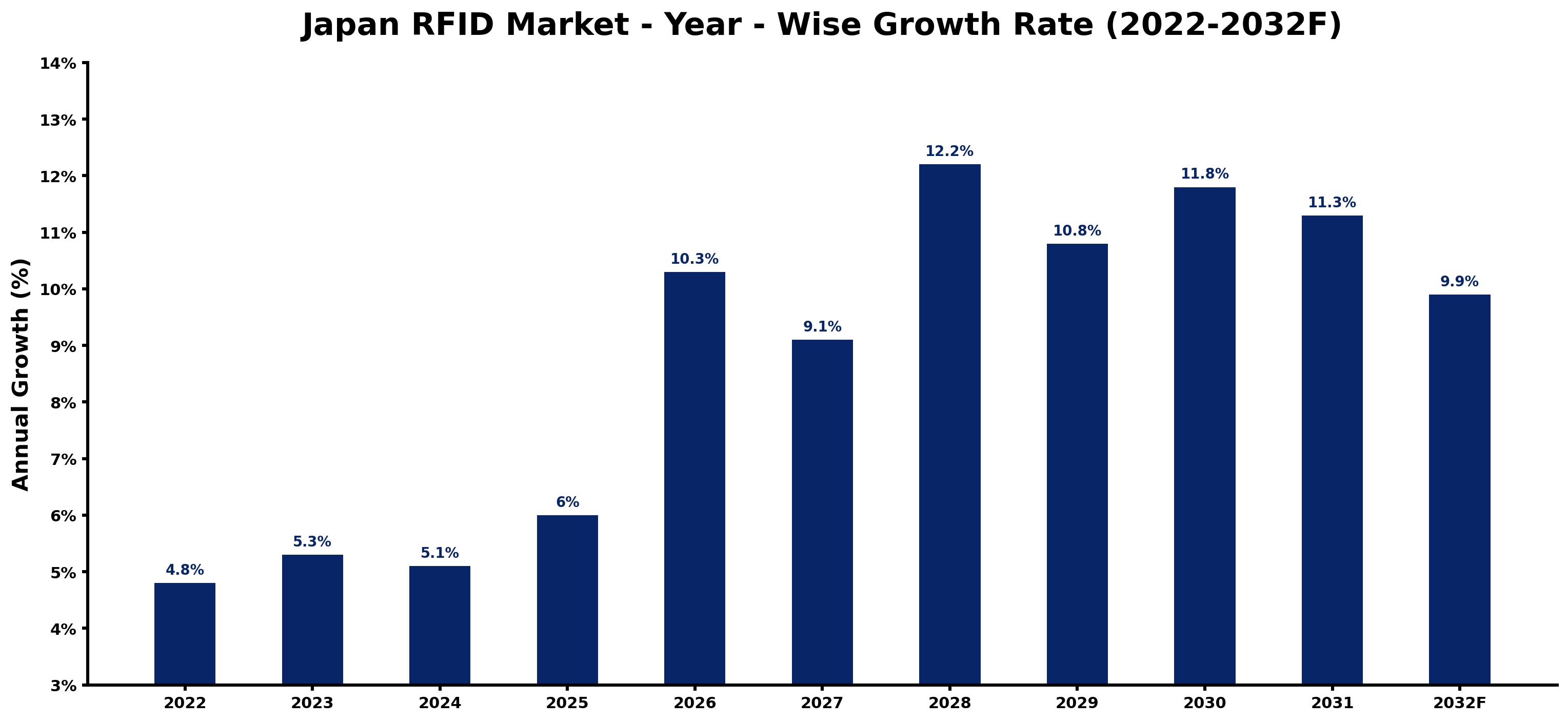
The yearly estimates that follow link every growth rate to its principal driver, so readers can see why the pace changed in each period.
| Year | Estimated Annual Growth (%) | Market Rationale |
| 2022 | 4.8 | The market showed steady growth with increasing adoption of RFID in logistics and retail. |
| 2023 | 5.3 | Growth accelerated as major retail chains expanded RFID usage for inventory management. |
| 2024 | 5.1 | The market experienced a slowdown as RFID integration faced operational challenges in some sectors. |
| 2025 | 6.0 | Growth picked up again due to rising demand from the logistics sector for tracking solutions. |
| 2026 | 10.3 | The market is expected to surge as buyers invest in advanced RFID systems for operational efficiency. |
| 2027 | 9.1 | Growth is projected to slow slightly as some sectors adjust to new technology implementations. |
| 2028 | 12.2 | The market is expected to peak with investments in smart logistics and supply chain management. |
| 2029 | 10.8 | Growth is projected to decelerate as the market begins to stabilise after rapid expansion in previous years. |
| 2030 | 11.8 | Demand is expected to increase again as new applications for RFID emerge in healthcare and retail. |
| 2031 | 11.3 | The market will continue to grow but at a slower pace as saturation begins in some areas. |
| 2032 | 9.9 | Growth is projected to moderate as the market stabilises, reflecting a mature adoption phase. |
Note: Market size estimations and growth projections presented in this report are based on 6Wresearch's proprietary forecasting methodology, utilizing the latest available industry data, government publications, and primary research inputs.
Japan RFID Market Synopsis
RFID technology uses electromagnetic fields to identify and track tags attached to objects, primarily through microchips embedded in tags or labels. The Japan RFID Market is growing due to rising demand from the logistics sector and major retail chains. Government initiatives, such as the 2023 program to promote RFID in supply chains, are driving further adoption, particularly in inventory management and asset tracking applications.
Market Dynamics Impact Analysis (2026–2032)
| Factor | Type | Impact | Primary Segment Affected |
| Growing demand from logistics and retail sectors for efficient inventory management solutions | Driver | High | Tags |
| Increased adoption of RFID technology in healthcare for asset tracking | Driver | High | Active |
| Expansion of RFID applications in smart city initiatives | Opportunity | Medium | Readers |
| Investment in RFID technology for enhanced supply chain transparency | Opportunity | High | Software & Services |
| High initial costs associated with RFID system implementation | Restraint | Medium | Tags |
| Limited awareness among small and medium enterprises about RFID benefits | Restraint | High | Readers |
| Competition from alternative tracking technologies like QR codes | Challenge | Medium | Software & Services |
| Challenges in integrating RFID with existing legacy systems | Challenge | High | Tags |
Evaluation of Drivers in Japan RFID Market (2026–2032)
Demand rests on the following drivers, each shown with the segment it touches most.
| Drivers | Primary Segment Affected | Why It Matters (Evidence) |
| Increased demand for real-time inventory tracking solutions | Tags | The logistics sector in Japan is increasingly adopting RFID tags to improve inventory management, with over 70% of major retail chains utilizing this technology. |
| Growing healthcare sector investments in asset tracking | Active | Active RFID tags are increasingly used in healthcare facilities for asset tracking, improving operational efficiency and reducing loss rates. |
| Rising adoption of RFID in smart logistics | Readers | Investments in smart logistics solutions are enhancing operational capabilities and driving RFID adoption in Tokyo's logistics hub, with a focus on efficiency. |
| Government initiatives promoting RFID usage | Software & Services | Support for RFID technology encourages businesses to invest in software solutions that integrate RFID systems effectively, enhancing operational capabilities. |
| Expansion of RFID applications in retail environments | Tags | High-frequency RFID tags are commonly used in retail environments, facilitating efficient inventory management and customer service. |
Buyers are adding capacity as demand for RFID technology rises in various sectors. The logistics sector is increasingly adopting tags for real-time inventory tracking, with over 70% of major retail chains implementing these systems. In healthcare, investments in active RFID tags for asset tracking are improving efficiency and reducing loss rates. Investments in smart logistics solutions are driving RFID adoption, while support for RFID technology promotes software solutions that integrate RFID systems effectively. Retail environments are also expanding their use of high-frequency RFID tags to enhance operational capabilities, leading to increased purchases.
Evaluation of Restraints in Japan RFID Market
The key brakes on demand, and where they bite hardest, are shown below.
| Market Restraint | Primary Segment Affected | Why It Matters (Evidence) |
| High initial costs associated with RFID system implementation | Tags | The high upfront investment required for RFID systems can deter small and medium enterprises from adopting this technology, limiting market growth. |
| Limited awareness among small and medium enterprises about RFID benefits | Readers | Many small and medium enterprises lack knowledge about the advantages of RFID technology, hindering broader adoption in the market. |
| Integration challenges with existing legacy systems | Software & Services | The difficulty of integrating RFID solutions with outdated systems can delay implementation and reduce overall effectiveness. |
| Competition from alternative tracking technologies like QR codes | Tags | The availability of cost-effective alternatives, such as QR codes, can limit the growth potential of RFID technology in certain applications. |
| Regulatory hurdles in certain industries affecting RFID adoption | Active | Strict regulations in industries like healthcare can slow down the adoption of active RFID solutions due to compliance requirements. |
Japan RFID Market Challenges
Healthcare providers in Japan face high operational costs due to slow adoption of ISO/IEC 18000 standards, which can delay RFID implementation by up to six months. Strict regulations enforced by the Ministry of Economy, Trade and Industry hinder manufacturers, potentially causing project delays and increasing compliance costs. Logistics companies encounter intense competition, resulting in reduced profit margins for suppliers as they compete for contracts. Dependence on a limited number of RFID component suppliers creates supply chain risks, forcing buyers to maintain higher inventory levels, which can raise holding costs by 15%.
Trends in the Japan RFID Market
Several trends are reshaping the Japan RFID Market; the most important are set out below.
- Launch of Smart Logistics Initiatives: Tokyo is advancing smart logistics initiatives that incorporate RFID technology to streamline operations. In 2023, major events focused on RFID integration, showcasing its role in improving supply chain efficiency.
- Shift Towards High-Frequency RFID Tags: The logistics sector is increasingly adopting high-frequency RFID tags for better tracking capabilities. This trend is highlighted as over 70% of major retail chains in Japan have implemented these tags.
- Expansion of RFID in Healthcare Asset Tracking: Healthcare facilities are increasingly integrating active RFID tags for asset tracking, significantly improving operational efficiency. The sector is witnessing a rise in demand for these solutions, reflecting a growing trend.
- Government Support for RFID Adoption: The Japanese government is actively promoting RFID technology through various subsidies and initiatives. This support is vital for increasing RFID adoption across sectors, particularly in logistics and retail.
Investment Opportunities in the Japan RFID Market
Several openings in the Japan RFID Market merit attention from investors.
- Investment in Smart Logistics Facilities: Tokyo is an ideal location for investment in smart logistics facilities, with a growing demand for RFID solutions. The government's initiatives to promote RFID in supply chains create opportunities for new partnerships.
- Supply of RFID Software Solutions: With the increasing adoption of RFID systems, there is a strong demand for software solutions that integrate these technologies. Businesses in the logistics sector are seeking reliable software providers to streamline operations.
- Timing for RFID in Retail Expansion: The current market conditions are favourable for expanding RFID applications in retail, as over 70% of major chains have adopted this technology. Suppliers can enter by partnering with local retailers to provide tailored solutions.
- Entry into Healthcare Asset Tracking: The healthcare sector presents an opportunity for RFID asset tracking solutions. Suppliers can explore partnerships with hospitals and clinics to implement effective tracking systems.
Government Initiatives in the Japan RFID Market
The AI Promotion Act, established in 2025, creates a national framework for the development and use of AI technologies, which includes RFID applications in various sectors. This measure encourages innovation and supports businesses in adopting RFID solutions for improved efficiency and tracking capabilities.
In 2023, the Japanese government launched a program to promote RFID in supply chains, administered by the Digital Agency. This initiative aims to provide funding and resources to businesses adopting RFID technology, promoting its integration across logistics and retail sectors.
Future Insight of the Japan RFID Market
A government programme to improve RFID usage in supply chains is set to roll out in 2023, aiming to optimise logistics operations. By 2032, advancements in smart city technologies will likely facilitate broader RFID integration across urban environments, benefiting retailers with enhanced inventory management. Increased focus on healthcare asset tracking will drive demand for sophisticated RFID solutions, providing opportunities for suppliers. With the RFID market valued at approximately 200 billion yen in 2022, growth is anticipated as the population of Japan, around 125 million, seeks improved tracking solutions.
Market Segmentation Analysis
Japan RFID Market report covers a detailed analysis of the following market segments:
By Offering – Tags Lead, Readers Expected to Grow Fastest
According to Summon Dutta, Assistant Manager at 6Wresearch, the largest offering category in 2025 was Tags, at 52% of revenue. Tags hold the largest market share due to their essential role in tracking and inventory management, particularly in logistics and retail environments. For instance, RFID technology is utilised in over 70% of major retail chains in Japan, indicating a strong dependence on tags for operational efficiency. Readers are projected to grow fastest, at a CAGR of 15.3% during 2026–2032. Readers are experiencing rapid growth as the demand for efficient RFID tag reading escalates, especially in logistics and healthcare sectors. The government's recent programme to enhance RFID in supply chains will likely further stimulate reader adoption. Suppliers should focus on expanding their reader product lines to cater to the increasing demand across various industries.
By Wafer Size – 8 Inch Leads, 12 Inch Expected to Grow Fastest
In 2025, 8 Inch led the wafer size split with a 45% share. The 8 Inch wafer size captures a notable market share due to its application in specialised RFID production processes, effectively serving niche markets. This segment benefits from established manufacturing practices and a dedicated customer base in Japan. Over 2026–2032, 12 Inch is expected to post the fastest growth, at a CAGR of 13.2%. The 12 Inch wafer size is growing swiftly, primarily because of advancements in production techniques that promise higher efficiency. While its current application is limited, the potential for broader adoption in future RFID technologies is promising. Manufacturers should consider investing in 12 Inch wafer technology to capitalise on its anticipated growth opportunities.
By Tag Type – Passive Leads, Active Expected to Grow Fastest
Passive accounted for 59% of the market by tag type in 2025. Passive tags lead the market as they are widely used for cost-effective tagging solutions in various applications, particularly in retail and logistics. Their affordability and efficiency make them a preferred choice among businesses. The quickest growth will come from Active, forecast to expand at a CAGR of 14.2% between 2026 and 2032. Active tags are growing rapidly, driven by their specific applications in healthcare for asset tracking. The increasing need for real-time tracking solutions in medical environments is propelling this segment's growth. Suppliers should explore opportunities in active tag development to cater to the expanding healthcare market.
By Frequency – Low Frequency Leads, High Frequency Expected to Grow Fastest
With 56% of frequency revenue in 2025, Low Frequency was the largest category. Low Frequency tags dominate the market as they are particularly suitable for short-range applications, making them ideal for specific uses in access control and inventory management. This segment enjoys stable demand across various industries in Japan, reinforcing its leading position. High Frequency is set to record the highest CAGR in this split, 14.1% over 2026–2032. High Frequency tags are witnessing rapid growth due to their prevalent use in diverse RFID applications, including retail and logistics. The increasing focus on smart logistics solutions is propelling the adoption of High Frequency technology. Suppliers need to enhance their High Frequency product offerings to address the rising demand across multiple sectors.
By Form Factor – Card Leads, Implant Expected to Grow Fastest
Card held 34% of the Japan RFID Market by form factor in 2025. Card form factors dominate the market, primarily used for access control and identification purposes across various sectors. Their widespread acceptance in both commercial and residential applications solidifies their leading position. Implant is projected to grow fastest, at a CAGR of 15.6% during 2026–2032. Implant form factors are experiencing the fastest growth due to their niche applications in medical and security fields. As the demand for advanced identification solutions increases, the potential for implants is expected to rise. Manufacturers should consider diversifying into implant technologies to capture emerging market opportunities.
Key Attractiveness of the Report
- 10 Years of Market Numbers
- Historical Data Starting from 2022 to 2025
- Base Year 2025
- Forecast Data until 2032
- Key Performance Indicators Impacting the Market
- Major Upcoming Developments and Projects
Key Highlights of the Report:
- Japan RFID Market Outlook
- Market Size of Japan RFID Market, 2025
- Forecast of Japan RFID Market, 2032
- Historical Data and Forecast of Japan RFID Revenues & Volume for the Period 2022-2032
- Japan RFID Market Trend Evolution
- Japan RFID Market Drivers and Challenges
- Japan RFID Price Trends
- Japan RFID Porter's Five Forces
- Japan RFID Industry Life Cycle
- Historical Data and Forecast of Japan RFID Market Revenues & Volume By Offering for the Period 2022-2032
- Historical Data and Forecast of Japan RFID Market Revenues & Volume By Tags for the Period 2022-2032
- Historical Data and Forecast of Japan RFID Market Revenues & Volume By Readers for the Period 2022-2032
- Historical Data and Forecast of Japan RFID Market Revenues & Volume By Software & Services for the Period 2022-2032
- Historical Data and Forecast of Japan RFID Market Revenues & Volume By Wafer Size for the Period 2022-2032
- Historical Data and Forecast of Japan RFID Market Revenues & Volume By 8 Inch for the Period 2022-2032
- Historical Data and Forecast of Japan RFID Market Revenues & Volume By 12 Inch for the Period 2022-2032
- Historical Data and Forecast of Japan RFID Market Revenues & Volume By Others for the Period 2022-2032
- Historical Data and Forecast of Japan RFID Market Revenues & Volume By Tag Type for the Period 2022-2032
- Historical Data and Forecast of Japan RFID Market Revenues & Volume By Passive for the Period 2022-2032
- Historical Data and Forecast of Japan RFID Market Revenues & Volume By Active for the Period 2022-2032
- Historical Data and Forecast of Japan RFID Market Revenues & Volume By Frequency for the Period 2022-2032
- Historical Data and Forecast of Japan RFID Market Revenues & Volume By Low Frequency for the Period 2022-2032
- Historical Data and Forecast of Japan RFID Market Revenues & Volume By High Frequency for the Period 2022-2032
- Historical Data and Forecast of Japan RFID Market Revenues & Volume By Ultra-High Frequency for the Period 2022-2032
- Historical Data and Forecast of Japan RFID Market Revenues & Volume By Form Factor for the Period 2022-2032
- Historical Data and Forecast of Japan RFID Market Revenues & Volume By Card for the Period 2022-2032
- Historical Data and Forecast of Japan RFID Market Revenues & Volume By Implant for the Period 2022-2032
- Historical Data and Forecast of Japan RFID Market Revenues & Volume By Key Fob for the Period 2022-2032
- Historical Data and Forecast of Japan RFID Market Revenues & Volume By Label for the Period 2022-2032
- Historical Data and Forecast of Japan RFID Market Revenues & Volume By Paper Ticket for the Period 2022-2032
- Historical Data and Forecast of Japan RFID Market Revenues & Volume By Band for the Period 2022-2032
- Historical Data and Forecast of Japan RFID Market Revenues & Volume By Others for the Period 2022-2032
- Historical Data and Forecast of Japan RFID Market Revenues & Volume By Material for the Period 2022-2032
- Historical Data and Forecast of Japan RFID Market Revenues & Volume By Plastic for the Period 2022-2032
- Historical Data and Forecast of Japan RFID Market Revenues & Volume By Paper for the Period 2022-2032
- Historical Data and Forecast of Japan RFID Market Revenues & Volume By Glass for the Period 2022-2032
- Historical Data and Forecast of Japan RFID Market Revenues & Volume By Others for the Period 2022-2032
- Historical Data and Forecast of Japan RFID Market Revenues & Volume By Application for the Period 2022-2032
- Historical Data and Forecast of Japan RFID Market Revenues & Volume By Agriculture for the Period 2022-2032
- Historical Data and Forecast of Japan RFID Market Revenues & Volume By Commercial for the Period 2022-2032
- Historical Data and Forecast of Japan RFID Market Revenues & Volume By Transportation for the Period 2022-2032
- Historical Data and Forecast of Japan RFID Market Revenues & Volume By Healthcare for the Period 2022-2032
- Historical Data and Forecast of Japan RFID Market Revenues & Volume By Logistics & Supply Chain for the Period 2022-2032
- Historical Data and Forecast of Japan RFID Market Revenues & Volume By Apparel for the Period 2022-2032
- Historical Data and Forecast of Japan RFID Market Revenues & Volume By Food for the Period 2022-2032
- Historical Data and Forecast of Japan RFID Market Revenues & Volume By Automotive for the Period 2022-2032
- Japan RFID Import Export Trade Statistics
- Market Opportunity Assessment By Offering
- Market Opportunity Assessment By Wafer Size
- Market Opportunity Assessment By Tag Type
- Market Opportunity Assessment By Frequency
- Market Opportunity Assessment By Form Factor
- Market Opportunity Assessment By Material
- Market Opportunity Assessment By Application
- Japan RFID Top Companies Market Share
- Japan RFID Competitive Benchmarking By Technical and Operational Parameters
- Japan RFID Company Profiles
- Japan RFID Key Strategic Recommendations
Market Covered
The study includes the following segmentation.
By Offering
- Tags
- Readers
- Software & Services
By Wafer Size
- 8 Inch
- 12 Inch
- Others
By Tag Type
- Passive
- Active
By Frequency
- Low Frequency
- High Frequency
- Ultra-High Frequency
By Form Factor
- Card
- Implant
- Key Fob
- Label
- Paper Ticket
- Band
- Others































