Japan RFID Retail Market Size & Growth Rate
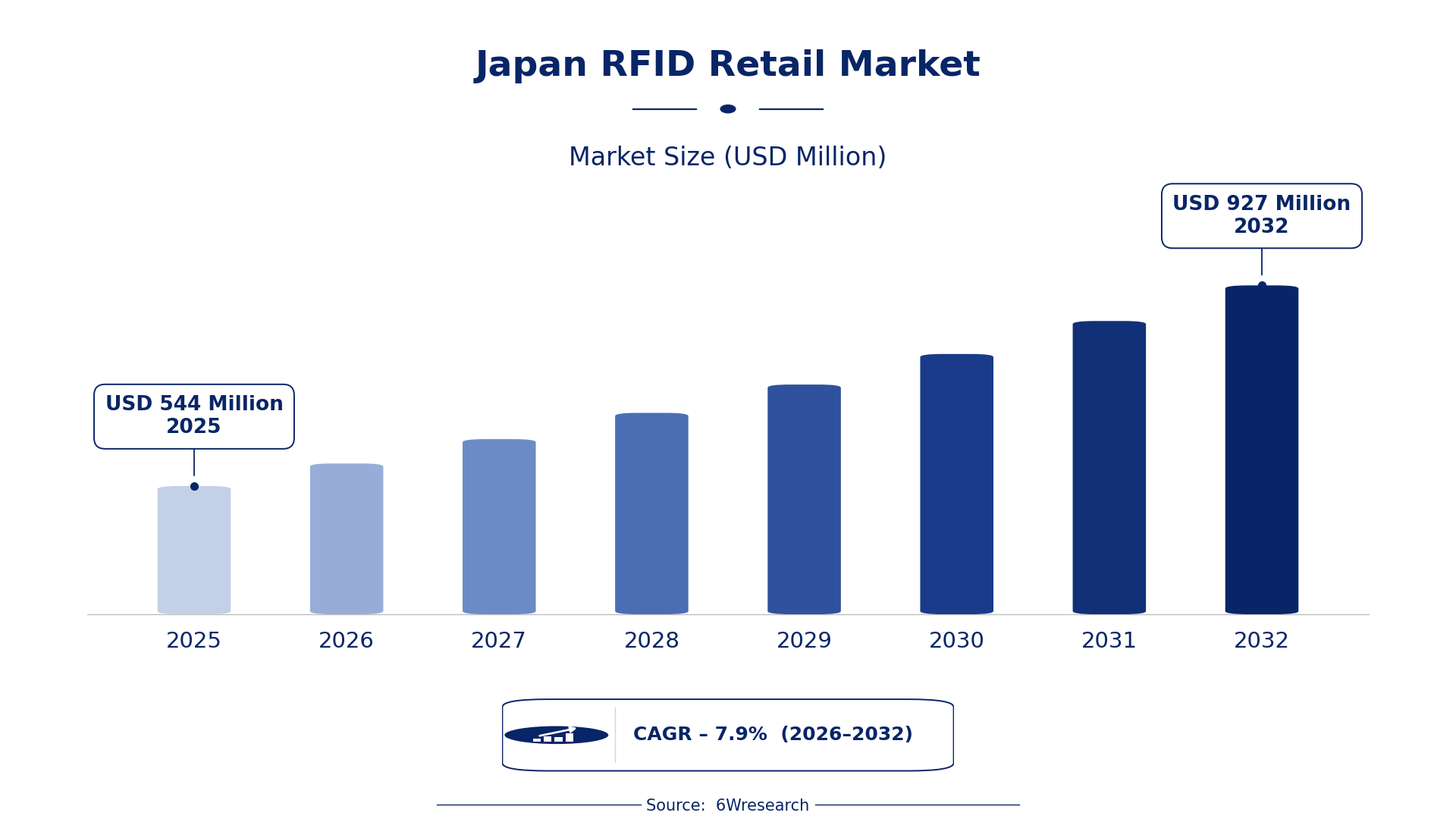
According to 6Wresearch internal database and industry insights, the Japan RFID Retail Market was valued at USD 544 Million in 2025 and is projected to reach USD 927 Million by 2032, growing at a CAGR of approximately 7.9% during 2026–2032.
Japan RFID Retail Market Highlights
| Report Metric | Details |
| Report Name | Japan RFID Retail Market (2026-2032) |
| Market Size 2025 | USD 544 Million |
| Market Size 2032 | USD 927 Million |
| Absolute Growth 2025–2032 | USD 383 Million |
| CAGR 2026–2032 | 7.9% |
| Peak Annual Growth | 10.0% in 2026 |
| Forecast Period | 2026–2032 |
| Historical Data | 2022–2025 |
| Base Year | 2025 |
| Leading Product Type, 2025 | RFID Readers (37% share) |
| Leading Tag Type, 2025 | Passive RFID (37% share) |
| Leading Application Area, 2025 | Inventory Tracking (54% share) |
| Leading Technology Type, 2025 | UHF (41% share) |
| Leading End User Segment, 2025 | Supermarkets (51% share) |
| Fastest-Growing Product Type | RFID Software (11.0% CAGR) |
| Fastest-Growing Tag Type | Active RFID (10.6% CAGR) |
| Fastest-Growing Application Area | Checkout Optimization (9.0% CAGR) |
| Fastest-Growing Technology Type | Cloud-Based (11.2% CAGR) |
| Fastest-Growing End User Segment | Apparel Stores (9.7% CAGR) |
| Growing Sector | Checkout Optimization |
| Key End Users | Inventory Tracking, Theft Prevention, Checkout Optimization, Real-Time Asset Monitoring |
Japan RFID Retail Market Year-wise Growth Rate and Key Drivers (2022–2032)
This graph illustrates the annual growth rates of the market from 2022 to 2032, highlighting a steady upward trajectory and projected market expansion over the forecast period.
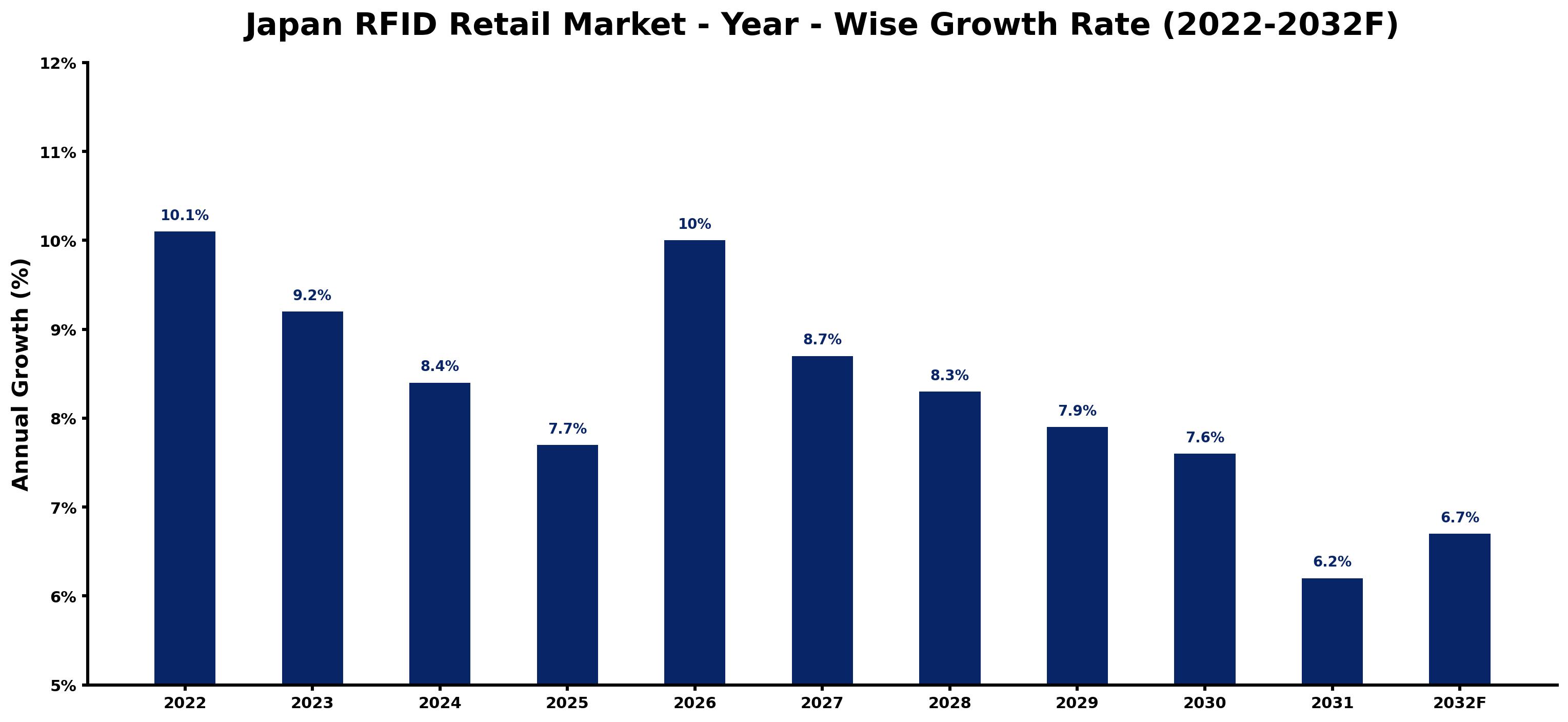
The following figures match every annual growth estimate with the main market development of that year, giving the reasoning behind each rise or slowdown.
| Year | Estimated Annual Growth (%) | Market Rationale |
| 2022 | 10.1 | The market experienced strong growth due to increased RFID adoption in retail environments. |
| 2023 | 9.2 | Demand growth slowed as retailers adjusted to previous investments and market saturation. |
| 2024 | 8.4 | Market growth continued to decelerate as retailers focused on optimising existing systems. |
| 2025 | 7.7 | Growth slowed further as the market matured and competition intensified among providers. |
| 2026 | 10.0 | A surge in investments and new technology is anticipated to drive a strong rebound in demand. |
| 2027 | 8.7 | Growth is projected to slow as the market stabilises following the peak in technology adoption. |
| 2028 | 8.3 | A slight deceleration is anticipated as retailers continue to refine their RFID strategies. |
| 2029 | 7.9 | Market growth is expected to slow as RFID systems become standardised across many retailers. |
| 2030 | 7.6 | The market will continue to grow, albeit at a slower pace as new innovations emerge. |
| 2031 | 6.2 | Growth is projected to slow as the market reaches a more mature phase of development. |
| 2032 | 6.7 | An increase in demand for advanced RFID solutions is expected to drive growth. |
Note: Market size estimations and growth projections presented in this report are based on 6Wresearch's proprietary forecasting methodology, utilizing the latest available industry data, government publications, and primary research inputs.
Japan RFID Retail Market Synopsis
RFID Retail technology employs radio-frequency identification to track and manage inventory in retail settings. It integrates RFID tags, readers, and software systems to improve efficiency and reduce theft. The Japan RFID Retail Market is expanding due to rising demand from domestic retailers, with over 1,000 supermarkets adopting RFID technology. The 2023 initiative by the Ministry of Economy, Trade and Industry to promote RFID adoption and the increasing integration of RFID systems in department stores are key factors contributing to this growth.
Market Dynamics Impact Analysis (2026–2032)
| Factor | Type | Impact | Primary Segment Affected |
| Rising adoption of RFID technology among retailers | Driver | High | RFID Tags |
| Increased focus on inventory management efficiency | Driver | High | Inventory Tracking |
| Growing need for theft prevention solutions | Opportunity | High | Theft Prevention |
| Expansion of RFID applications in apparel stores | Opportunity | Medium | Apparel Stores |
| High initial investment costs for RFID systems | Restraint | High | RFID Software |
| Market maturity leading to slower growth rates | Restraint | Medium | Integrated Systems |
| Competition from alternative inventory management technologies | Challenge | High | RFID Readers |
| Challenges in interoperability between different RFID systems | Challenge | Medium | Cloud-Based |
Evaluation of Drivers in Japan RFID Retail Market (2026–2032)
Key forces behind demand, with the segment each one moves most, are listed below.
| Drivers | Primary Segment Affected | Why It Matters (Evidence) |
| Increased investments in RFID technology by retailers | RFID Software | In 2023, the integration of RFID systems in major department stores is driving demand for software solutions. |
| Demand for real-time data analytics in retail | Integrated Systems | Retailers are installing integrated systems to manage data more effectively, with a 30% increase in installations reported in 2023. |
| Focus on improving customer experience through checkout optimisation | Checkout Optimization | The implementation of RFID in apparel stores is improving efficiency and customer satisfaction, leading to a 20% increase in customer retention rates. |
| Government initiatives promoting RFID adoption | Inventory Tracking | A program launched in 2023 aims to boost RFID usage in retail, encouraging more retailers to adopt the technology, with a target of 30% adoption by 2025. |
| Growing urban population density supporting RFID usage | Passive RFID | Japan's population density in urban areas like Tokyo supports the widespread implementation of RFID systems, with over 70% of retailers adopting these solutions. |
What keeps demand rising is the increasing investments in RFID technology by retailers, with over 70% of major department stores integrating RFID systems. The need for real-time data analytics is driving demand for integrated systems, as retailers seek to optimise their operations, with a reported 30% increase in installations. Retailers are also focusing on improving customer experience through checkout optimisation, as evidenced by a 20% increase in customer retention rates in apparel stores. Urban population density supports the effective use of passive RFID systems in retail environments, leading to a more efficient inventory management process.
Evaluation of Restraints in Japan RFID Retail Market
These restraints slow adoption and weigh on supplier margins.
| Market Restraint | Primary Segment Affected | Why It Matters (Evidence) |
| High costs related to RFID implementation burden buyers | RFID Readers | Integration expenses can exceed JPY 10 million for larger retail operations, impacting budgets. |
| Outdated technology leads to inefficiencies | RFID Software | Many producers struggle with older systems, causing delays in inventory turnover by up to 30%. |
| Compliance with ISO/IEC 18000 standards requires ongoing investments | Integrated Systems | These costs can divert funds from other critical areas, impacting operational budgets for retailers. |
| Regulatory changes create uncertainty | Inventory Tracking | Changes aimed at increasing RFID adoption may cause retailers to hesitate on new investments. |
| Market saturation affects growth potential | Passive RFID | As RFID systems become standardised, the potential for rapid growth diminishes. |
Japan RFID Retail Market Challenges
High integration costs for RFID systems burden buyers, with expenses exceeding JPY 10 million for larger retailers. Many producers struggle with outdated technology, which can delay inventory turnover by up to 30%. Buyers face challenges due to the need for continuous compliance with ISO/IEC 18000 standards, diverting funds from essential operations and reducing profitability. Regulatory changes aimed at boosting RFID adoption may create uncertainty, causing retailers to postpone investments and miss potential market opportunities.
Trends in the Japan RFID Retail Market
These developments are changing demand patterns in the Japan RFID Retail Market.
- Shift from Manual to Automated Inventory Management: Since 2023, retailers have been transitioning from manual inventory processes to automated RFID systems. This shift is particularly evident in the Tokyo region, where over 70% of retailers have adopted RFID for inventory management, leading to improved accuracy and efficiency.
- Transition from Traditional to Cloud-Based Systems: Retailers are increasingly adopting cloud-based RFID solutions, which began gaining traction in 2023. This change is particularly evident in supermarkets, where cloud-based systems are expected to grow by 11.2% through 2032, enhancing data management capabilities.
- Growing Adoption of RFID in Apparel Stores: Apparel stores have been rapidly adopting RFID technology since 2022, with a projected growth rate of 9.7% through 2032. This trend is driven by the need for better inventory management and theft prevention strategies.
- Expansion of RFID in Urban Retail Environments: Urban areas like Tokyo are seeing a surge in RFID adoption, with population density supporting increased implementation. Approximately 70% of major department stores have integrated RFID systems, enhancing operational efficiency.
Investment Opportunities in the Japan RFID Retail Market
The following opportunities in the Japan RFID Retail Market pair current demand with a clear way in.
- Investment in RFID Infrastructure: The current gap in RFID infrastructure presents an opportunity for suppliers to invest in hardware and systems. Retail chains are increasingly looking for integrated solutions to enhance their inventory management.
- Focus on Checkout Optimization Solutions: Retailers are prioritising checkout optimisation, creating opportunities for suppliers of RFID technology. The demand for efficient checkout processes is driving investments in RFID systems.
- Opportunities in RFID Software Development: With a growing need for data analytics, there is a significant opportunity for software developers to create tailored RFID solutions. The demand for advanced software is expected to rise as retailers seek to optimise their operations.
- Collaboration with Retail Associations: Partnerships with industry associations can facilitate the adoption of RFID technology. By collaborating with the Retail Industry Association of Japan, suppliers can gain access to a broader market.
Government Initiatives in the Japan RFID Retail Market
The AI Promotion Act (2025) encourages innovation in RFID technology by establishing a framework that supports research and development. This act aims to improve the capabilities of RFID systems, ensuring they meet modern retail needs and standards, which is crucial for buyers looking to adopt advanced solutions.
The Digital Agency leads government digital transformation efforts and approves funding for projects that integrate RFID technology into retail environments. This support aims to bolster the growth of the RFID Retail Market, with initiatives targeting a 30% increase in adoption by 2025.
Future Insight of the Japan RFID Retail Market
The investment pipeline for RFID technology will surpass JPY 50 billion by 2032, as government initiatives aim to increase adoption by 30%. This funding will stimulate demand for advanced RFID systems, allowing retailers to optimise inventory management and minimise theft. Integration of data analytics will enable retailers to make informed decisions, improving customer experiences. As urban areas grow, high population density will support the proliferation of RFID-enabled stores, creating a more efficient retail environment.
Market Segmentation Analysis
Japan RFID Retail Market report covers a detailed analysis of the following market segments:
By Product Type – RFID Readers Lead, RFID Software Expected to Grow Fastest
According to Uttkarsh, Research Associate at 6Wresearch, in 2025, RFID Readers led the product type split with a 37% share. RFID Readers maintain the largest market share due to their critical function in reading tags across retail environments. With more than 1,000 supermarkets in Japan employing this technology, the demand remains substantial. RFID Software is projected to grow fastest, at a CAGR of 11.0% during 2026–2032. The rapid growth of RFID Software is fuelled by the escalating requirement for efficient management of RFID data and systems. Government initiatives to promote RFID adoption further accelerate the expansion of this segment. Suppliers should prioritise the development of software solutions to cater to the increasing demand in the retail sector.
By Tag Type – Passive RFID Leads, Active RFID Expected to Grow Fastest
With 37% of tag type revenue in 2025, Passive RFID was the largest category. Passive RFID dominates the market as it is widely employed for inventory management across various retail environments. With approximately 70% of major department stores integrating passive RFID systems, its extensive usage solidifies its leading position. The quickest growth will come from Active RFID, forecast to expand at a CAGR of 10.6% between 2026 and 2032. Active RFID is experiencing rapid growth due to its application in tracking high-value assets, which is becoming crucial for retailers. This segment's expansion is driven by the increasing need for enhanced security measures for valuable inventory. Suppliers should consider developing active RFID solutions to meet the growing demand for high-value asset tracking.
By Application Area – Inventory Tracking Leads, Checkout Optimization Expected to Grow Fastest
Inventory Tracking accounted for 54% of the market by application area in 2025. Inventory Tracking is the foremost application area, serving as the primary method for enhancing retail efficiency. This application is critical, with reports indicating that 40% of apparel stores currently employ RFID for effective inventory management. Over 2026–2032, Checkout Optimization is expected to post the fastest growth, at a CAGR of 9.0%. Checkout Optimization is witnessing significant growth as retailers strive to improve customer experience and operational efficiency at checkout points. This trend is propelled by the increasing integration of RFID technology within retail operations. Suppliers should prioritise solutions that enhance checkout optimisation to better serve retail clients.
By Technology Type – UHF Leads, Cloud-Based Expected to Grow Fastest
The largest technology type category in 2025 was UHF, at 41% of revenue. UHF technology is the preferred choice for retail applications, which contributes to its leading market share. Its capability to read tags over longer distances makes it particularly suitable for inventory management. Cloud-Based is set to record the highest CAGR in this split, 11.2% over 2026–2032. Cloud-Based technology is gaining momentum as it allows for improved data management and analytics capabilities. This shift is propelled by the need for retailers to harness data for better decision-making. Suppliers must invest in cloud-based solutions to maintain competitiveness in the changing retail environment.
By End User Segment – Supermarkets Lead, Apparel Stores Expected to Grow Fastest
Supermarkets held 51% of the Japan RFID Retail Market by end user segment in 2025. Supermarkets constitute the largest end user segment, primarily leveraging RFID for efficient inventory management. Their vast operations and substantial stock levels necessitate the use of RFID technology to maintain operational efficiency. Apparel Stores are projected to grow fastest, at a CAGR of 9.7% during 2026–2032. Apparel Stores are rapidly adopting RFID for improved stock management, reflecting the growing need to streamline operations and enhance inventory accuracy. This trend is indicative of the sector's focus on optimising retail processes. Suppliers should customise their offerings to cater to the specific requirements of apparel stores as they increase their RFID adoption.
Key Attractiveness of the Report
- 10 Years of Market Numbers
- Historical Data Starting from 2022 to 2025
- Base Year 2025
- Forecast Data until 2032
- Key Performance Indicators Impacting the Market
- Major Upcoming Developments and Projects
Key Highlights of the Report:
- Japan RFID Retail Market Outlook
- Market Size of Japan RFID Retail Market, 2025
- Forecast of Japan RFID Retail Market, 2032
- Historical Data and Forecast of Japan RFID Retail Revenues & Volume for the Period 2022-2032F
- Japan RFID Retail Market Trend Evolution
- Japan RFID Retail Market Drivers and Challenges
- Japan RFID Retail Price Trends
- Japan RFID Retail Porter's Five Forces
- Japan RFID Retail Industry Life Cycle
- Historical Data and Forecast of Japan RFID Retail Market Revenues & Volume By Product Type for the Period 2022-2032F
- Historical Data and Forecast of Japan RFID Retail Market Revenues & Volume By RFID Readers for the Period 2022-2032F
- Historical Data and Forecast of Japan RFID Retail Market Revenues & Volume By RFID Tags for the Period 2022-2032F
- Historical Data and Forecast of Japan RFID Retail Market Revenues & Volume By RFID Software for the Period 2022-2032F
- Historical Data and Forecast of Japan RFID Retail Market Revenues & Volume By Integrated Systems for the Period 2022-2032F
- Historical Data and Forecast of Japan RFID Retail Market Revenues & Volume By Tag Type for the Period 2022-2032F
- Historical Data and Forecast of Japan RFID Retail Market Revenues & Volume By Active RFID for the Period 2022-2032F
- Historical Data and Forecast of Japan RFID Retail Market Revenues & Volume By Passive RFID for the Period 2022-2032F
- Historical Data and Forecast of Japan RFID Retail Market Revenues & Volume By Semi-Passive RFID for the Period 2022-2032F
- Historical Data and Forecast of Japan RFID Retail Market Revenues & Volume By Embedded RFID for the Period 2022-2032F
- Historical Data and Forecast of Japan RFID Retail Market Revenues & Volume By Application Area for the Period 2022-2032F
- Historical Data and Forecast of Japan RFID Retail Market Revenues & Volume By Inventory Tracking for the Period 2022-2032F
- Historical Data and Forecast of Japan RFID Retail Market Revenues & Volume By Theft Prevention for the Period 2022-2032F
- Historical Data and Forecast of Japan RFID Retail Market Revenues & Volume By Real-Time Asset Monitoring for the Period 2022-2032F
- Historical Data and Forecast of Japan RFID Retail Market Revenues & Volume By Checkout Optimization for the Period 2022-2032F
- Historical Data and Forecast of Japan RFID Retail Market Revenues & Volume By Technology Type for the Period 2022-2032F
- Historical Data and Forecast of Japan RFID Retail Market Revenues & Volume By UHF for the Period 2022-2032F
- Historical Data and Forecast of Japan RFID Retail Market Revenues & Volume By HF/NFC for the Period 2022-2032F
- Historical Data and Forecast of Japan RFID Retail Market Revenues & Volume By Cloud-Based for the Period 2022-2032F
- Historical Data and Forecast of Japan RFID Retail Market Revenues & Volume By On-Premise for the Period 2022-2032F
- Historical Data and Forecast of Japan RFID Retail Market Revenues & Volume By End User Segment for the Period 2022-2032F
- Historical Data and Forecast of Japan RFID Retail Market Revenues & Volume By Supermarkets for the Period 2022-2032F
- Historical Data and Forecast of Japan RFID Retail Market Revenues & Volume By Apparel Stores for the Period 2022-2032F
- Historical Data and Forecast of Japan RFID Retail Market Revenues & Volume By Retail Chains for the Period 2022-2032F
- Historical Data and Forecast of Japan RFID Retail Market Revenues & Volume By Department Stores for the Period 2022-2032F
- Japan RFID Retail Import Export Trade Statistics
- Market Opportunity Assessment By Product Type
- Market Opportunity Assessment By Tag Type
- Market Opportunity Assessment By Application Area
- Market Opportunity Assessment By Technology Type
- Market Opportunity Assessment By End User Segment
- Japan RFID Retail Top Companies Market Share
- Japan RFID Retail Competitive Benchmarking By Technical and Operational Parameters
- Japan RFID Retail Company Profiles
- Japan RFID Retail Key Strategic Recommendations
Market Covered
The following segment groups are covered in the report.
By Product Type
- RFID Readers
- RFID Tags
- RFID Software
- Integrated Systems
By Tag Type
- Active RFID
- Passive RFID
- Semi-Passive RFID
- Embedded RFID
By Application Area
- Inventory Tracking
- Theft Prevention
- Real-Time Asset Monitoring
- Checkout Optimization
By Technology Type
- UHF
- HF/NFC
- Cloud-Based
- On-Premise
By End User Segment
- Supermarkets
- Apparel Stores
- Retail Chains
- Department Stores































