Japan RFID Systems Market Size & Growth Rate
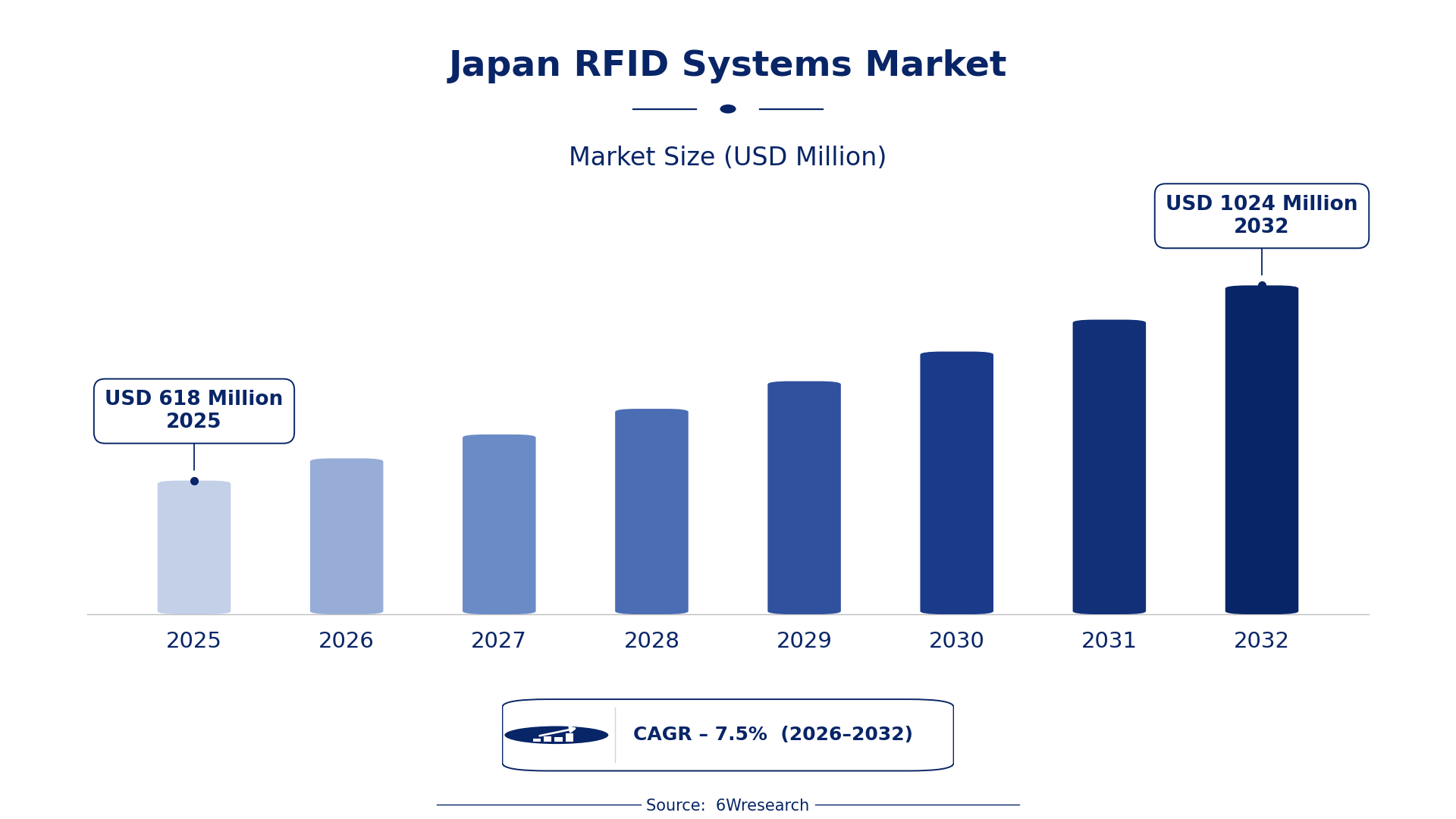
According to 6Wresearch internal database and industry insights, the Japan RFID Systems Market was valued at USD 618 Million in 2025 and is projected to reach USD 1,024 Million by 2032, growing at a CAGR of approximately 7.5% during 2026–2032.
Japan RFID Systems Market Highlights
| Report Metric | Details |
| Report Name | Japan RFID Systems Market (2026-2032) |
| Market Size 2025 | USD 618 Million |
| Market Size 2032 | USD 1,024 Million |
| Absolute Growth 2025–2032 | USD 406 Million |
| CAGR 2026–2032 | 7.5% |
| Peak Annual Growth | 8.3% in 2028 |
| Forecast Period | 2026–2032 |
| Historical Data | 2022–2025 |
| Base Year | 2025 |
| Leading System Type, 2025 | Healthcare RFID (45% share) |
| Leading Integration Scope, 2025 | Warehouse & Distribution (38% share) |
| Leading Deployment Architecture, 2025 | Enterprise Systems (42% share) |
| Leading End User, 2025 | Healthcare Facilities (42% share) |
| Fastest-Growing System Type | Supply Chain RFID (10.5% CAGR) |
| Fastest-Growing Deployment Architecture | Hospital IT Systems (11.0% CAGR) |
| Fastest-Growing End User | SCM Departments (9.7% CAGR) |
| Growing Sector | logistics and retail |
| Key End Users | logistics companies, healthcare facilities, retail chains, supply chain managers |
Japan RFID Systems Market Year-wise Growth Rate and Key Drivers (2022–2032)
This graph illustrates the annual growth rates of the market from 2022 to 2032, highlighting a steady upward trajectory and projected market expansion over the forecast period.
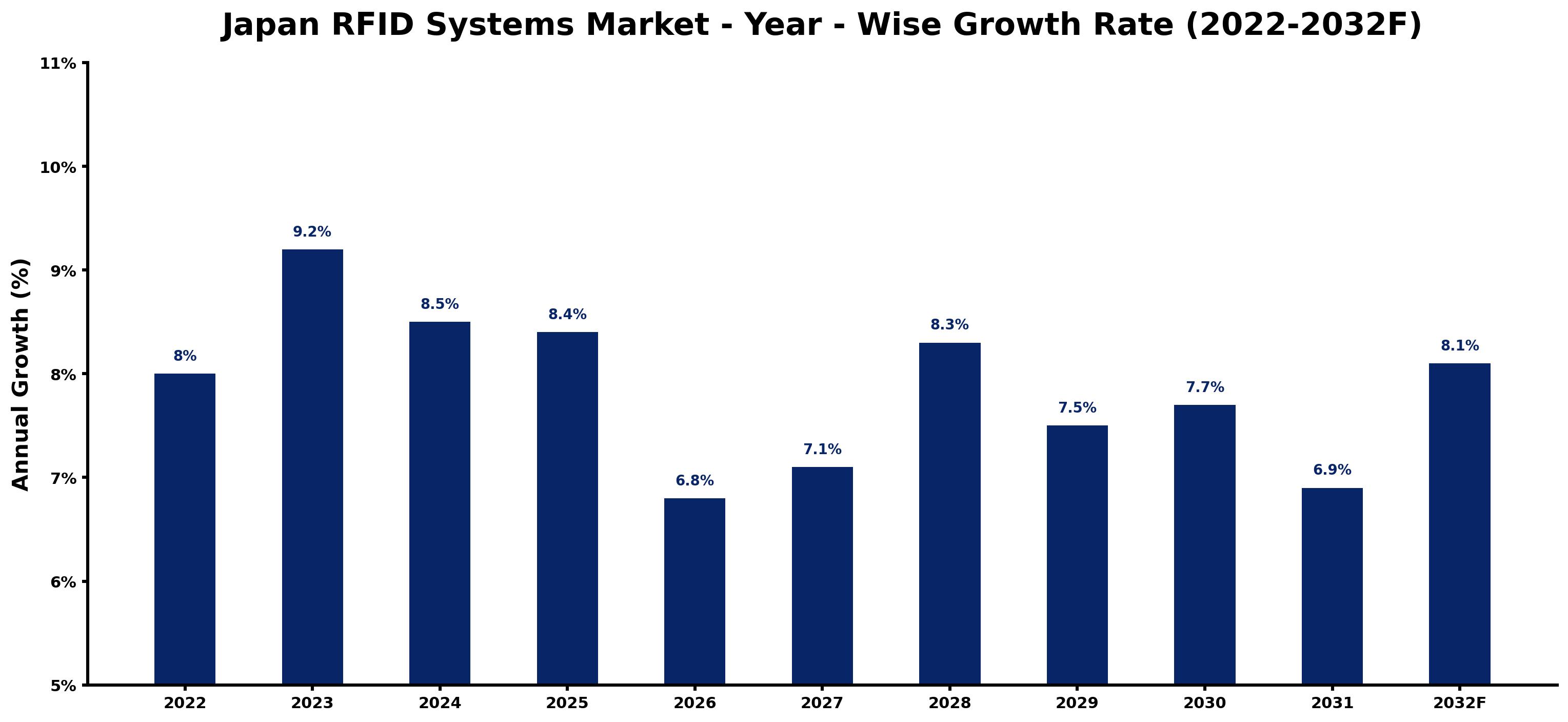
Each row of the following table gives one year's estimated growth and the event or demand shift that explains it.
| Year | Estimated Annual Growth (%) | Market Rationale |
| 2022 | 8.0 | The market experienced steady growth, reflecting strong adoption in key sectors. |
| 2023 | 9.2 | Growth accelerated due to increased investments in RFID technology across industries. |
| 2024 | 8.5 | Growth slowed slightly as market saturation began to affect new installations. |
| 2025 | 8.4 | A further slowdown occurred as retailers optimised existing RFID systems. |
| 2026 | 6.8 | Growth is expected to decelerate as competition intensifies among providers. |
| 2027 | 7.1 | Demand is projected to rise again, driven by advancements in supply chain management technologies. |
| 2028 | 8.3 | An increase in growth is anticipated as logistics operations expand. |
| 2029 | 7.5 | Growth will slow as the market adjusts to new technological standards. |
| 2030 | 7.7 | A rebound in growth is expected due to renewed interest in healthcare applications. |
| 2031 | 6.9 | Growth is projected to decelerate slightly as the market stabilises after rapid expansion. |
| 2032 | 8.1 | A resurgence in demand is anticipated as new applications emerge. |
Note: Market size estimations and growth projections presented in this report are based on 6Wresearch's proprietary forecasting methodology, utilizing the latest available industry data, government publications, and primary research inputs.
Japan RFID Systems Market Synopsis
RFID systems utilise radio waves for automatic identification and tracking of tags attached to objects, which are essential for supply chain management, inventory tracking, and access control. The Japan RFID Systems Market is expanding due to rising demand from logistics and retail sectors, with over 1,500 retail stores implementing RFID technology. Government initiatives, including a 2023 programme to promote RFID usage in logistics, stimulate growth, alongside a notable increase in efficiency reported by healthcare facilities using RFID systems.
Market Dynamics Impact Analysis (2026–2032)
| Factor | Type | Impact | Primary Segment Affected |
| Increased adoption in logistics and retail sectors | Driver | High | Supply Chain RFID |
| Government support for technology initiatives | Driver | High | Healthcare RFID |
| Growing demand for efficient inventory management | Opportunity | High | Retail RFID |
| Expansion of smart logistics initiatives | Opportunity | Medium | Warehouse & Distribution |
| High initial investment costs | Restraint | High | Access Control RFID |
| Limited awareness among smaller businesses | Restraint | Medium | Healthcare RFID |
| Challenges in compliance with standards | Challenge | High | Enterprise Systems |
| Capacity constraints in production and supply chains | Challenge | Medium | RFID + POS Integration |
Evaluation of Drivers in Japan RFID Systems Market (2026–2032)
The table below links each growth driver to the segment it affects and the evidence for it.
| Drivers | Primary Segment Affected | Why It Matters (Evidence) |
| Increased efficiency in supply chain operations | Supply Chain RFID | The average adoption rate of RFID in supply chains is around 40%, leading to more accurate tracking and reduced losses. |
| Government initiatives promoting healthcare technology | Healthcare RFID | The Ministry of Health, Labour and Welfare encourages RFID use, supporting patient tracking and asset management in over 300 hospitals. |
| Rising need for loss prevention in retail | Retail RFID | Retail RFID technology is utilized in over 1,500 retail stores nationwide, improving inventory management and reducing theft. |
| Operational efficiency in logistics | Warehouse & Distribution | The Tokyo Metropolitan Government promotes smart logistics, increasing the demand for RFID systems in logistics operations. |
| Integration with point-of-sale systems | RFID + POS Integration | The integration of RFID with POS systems is becoming standard in major retail chains, improving sales accuracy. |
The strongest pull on demand comes from the logistics sector, which is one of the largest consumers of RFID systems, with an average adoption rate of around 40%. Retailers are increasingly implementing RFID technology for inventory management and loss prevention. Healthcare facilities report a 30% increase in efficiency using RFID systems, driven by advancements in patient tracking.
Evaluation of Restraints in Japan RFID Systems Market
Several factors work against faster growth; the main ones are summarised below.
| Market Restraint | Primary Segment Affected | Why It Matters (Evidence) |
| High initial investment costs for RFID systems | Access Control RFID | The average patient tracking system in hospitals costs around 5 million JPY, deterring smaller facilities from adoption. |
| Limited awareness among smaller businesses about RFID benefits | Healthcare RFID | Many smaller healthcare facilities lack knowledge of RFID's advantages, hindering widespread adoption. |
| Challenges in compliance with standards | Enterprise Systems | Compliance with ISO/IEC 18000 standards can be complex, limiting adoption among businesses. |
| Capacity constraints in production and supply chains | RFID + POS Integration | Supply chain disruptions have affected the availability of RFID components, delaying implementations. |
| Slow integration with existing IT systems | Warehouse & Distribution | Many logistics companies face challenges integrating RFID with their current IT infrastructure. |
Japan RFID Systems Market Challenges
Reliance on imported components creates supply issues, causing production delays for producers that can extend timelines by up to three months. High import costs inflate overall RFID system prices by 20%, which directly impacts buyers in logistics and retail sectors. Limited technological advancements in local manufacturing capabilities hinder the development of efficient RFID solutions, resulting in stagnation for producers. Intense competition among retailers for RFID integration drives prices down, forcing suppliers to reduce margins and constraining their ability to invest in quality improvements.
Trends in the Japan RFID Systems Market
The trends below show where the Japan RFID Systems Market is heading.
- Tokyo Metropolitan Government Initiatives: Smart logistics are being promoted by the Tokyo Metropolitan Government through RFID technology, which improves operational efficiency. This is clear as logistics operations increasingly adopt RFID systems, contributing to the sector's growth, with a notable rise in efficiency reported.
- Shift towards Enhanced Patient Tracking: Healthcare facilities are increasingly adopting RFID for patient tracking, resulting in improved asset management. Over 300 hospitals have implemented RFID systems, leading to a reported 30% increase in operational efficiency.
- Retail Chains Embracing RFID Integration: Retail chains are rapidly integrating RFID with point-of-sale systems, improving inventory management. This trend is clear as over 1,500 retail stores have adopted RFID technology nationwide.
- Expansion of Supply Chain RFID Applications: Supply Chain RFID applications are expanding as logistics companies seek to optimise operations. The average adoption rate of RFID in supply chains is around 40%, driving demand for more efficient tracking solutions.
Investment Opportunities in the Japan RFID Systems Market
The openings below show where demand in the Japan RFID Systems Market is visible and how suppliers can enter.
- Logistics Facilities in Tokyo: Tokyo's logistics facilities are increasingly adopting RFID systems, with a notable gap in technology integration. The average adoption rate of RFID in supply chains is around 40%, presenting an opportunity for suppliers to meet this demand.
- Healthcare Facilities Seeking Efficiency: Healthcare facilities are looking to invest in RFID systems to improve patient tracking and asset management. With over 300 hospitals already using RFID, there is room for expansion and improvement.
- Retail Stores Upgrading Inventory Management: Retail stores are in need of advanced RFID solutions for better inventory management. The 1,500 retail stores using RFID technology indicate a growing market for innovative solutions.
- Warehouse Operations in Need of Optimisation: Warehouse operations are seeking to optimise logistics through RFID technology. The growing demand for efficient inventory management presents an opportunity for suppliers to provide tailored solutions.
Government Initiatives in the Japan RFID Systems Market
The Electrical Appliance and Material Safety Act, enacted in 1961, regulates the safety of electrical appliances, including RFID systems. Following this, the Long-Term Care Insurance Act of 1997 supports the integration of technology in healthcare, improving patient care through RFID systems. The Economic Security Promotion Act, introduced in 2022, encourages the adoption of RFID technology to strengthen supply-chain resilience for critical products.
In 2023, the Japanese government launched a programme to promote RFID usage in logistics, with funding of approximately 1 billion JPY allocated for this initiative. The Ministry of Economy, Trade and Industry oversees this programme, promoting the integration of RFID systems to improve efficiency in logistics operations.
Future Insight of the Japan RFID Systems Market
By 2032, buyers in logistics will see a transformation as RFID adoption expands, influenced by government initiatives and enhanced integration with point-of-sale systems. The logistics sector is expected to achieve a 40% adoption rate, which will improve operational efficiency significantly. Healthcare will benefit from improved patient tracking systems, streamlining processes in hospitals. Standards like ISO/IEC 18000 will simplify RFID implementation, ensuring compatibility and supporting growth for suppliers.
Market Segmentation Analysis
Japan RFID Systems Market report covers a detailed analysis of the following market segments:
By System Type – Healthcare RFID Leads, Supply Chain RFID Expected to Grow Fastest
According to Saurav Kr Singh, Senior Research Analyst at 6Wresearch, with 45% of system type revenue in 2025, Healthcare RFID was the largest category. Healthcare RFID holds a dominant position as it is implemented in over 300 hospitals across Japan, where it plays a vital role in patient tracking and asset management. This extensive usage highlights RFID's critical contribution to improving operational workflows in healthcare settings. Supply Chain RFID is projected to grow fastest, at a CAGR of 10.5% during 2026–2032. Supply Chain RFID is experiencing rapid growth due to the logistics sector's increasing reliance on RFID for tracking goods throughout the supply chain. The average adoption rate of 40% in supply chains indicates a strong push for more efficient inventory management practices. Suppliers should focus on developing solutions tailored to the healthcare sector's specific requirements, capitalising on its established market presence.
By Integration Scope – Warehouse & Distribution Leads and Records the Fastest Growth
Warehouse & Distribution held 38% of the Japan RFID Systems Market by integration scope in 2025. Warehouse & Distribution leads the market as it is essential for managing inventory and logistics operations, particularly in logistics and retail sectors. The extensive use of RFID in distribution centres underscores its importance in enhancing operational efficiency. Its lead should widen, with a projected CAGR of 10.1% during 2026–2032, the highest in this split. The growth of Warehouse & Distribution is poised to accelerate, driven by ongoing investments in automation and efficiency within logistics operations. This segment's strong performance will likely solidify its leading position in the market. Buyers must invest in advanced warehouse solutions to remain competitive in the logistics industry.
By Deployment Architecture – Enterprise Systems Lead, Hospital IT Systems Expected to Grow Fastest
Enterprise Systems took 42% of deployment architecture revenue in 2025, more than any other category. Enterprise Systems dominate the market as they support broader IT infrastructure, enabling the integration of RFID technology across various applications. Their crucial role in enhancing operational efficiency makes them a key component in large-scale deployments. Hospital IT Systems are set to record the highest CAGR in this split, 11.0% over 2026–2032. Hospital IT Systems are witnessing rapid growth due to the increasing demand for effective patient tracking and asset management in healthcare environments. The focus on improving healthcare outcomes is driving substantial investments in this area. Suppliers should refine their solutions to ensure compatibility with existing enterprise systems, addressing diverse sector needs.
By End User – Healthcare Facilities Lead, SCM Departments Expected to Grow Fastest
Healthcare Facilities accounted for 42% of the market by end user in 2025. Healthcare Facilities account for the largest share as they have widely adopted RFID for patient and asset tracking, resulting in significant improvements in operational efficiency. This sector's dependence on RFID technology is evident in its extensive application across numerous hospitals. Over 2026–2032, SCM Departments are expected to post the fastest growth, at a CAGR of 9.7%. SCM Departments are experiencing the fastest growth, driven by the urgent need for efficient supply chain management operations. The logistics sector's focus on enhanced tracking solutions is propelling this segment's upward trend. Buyers in supply chain management must invest in advanced RFID technologies to optimise their operations and maintain a competitive advantage.
Key Attractiveness of the Report
- 10 Years of Market Numbers
- Historical Data Starting from 2022 to 2025
- Base Year 2025
- Forecast Data until 2032
- Key Performance Indicators Impacting the Market
- Major Upcoming Developments and Projects
Key Highlights of the Report:
- Japan RFID Systems Market Outlook
- Market Size of Japan RFID Systems Market, 2025
- Forecast of Japan RFID Systems Market, 2032
- Historical Data and Forecast of Japan RFID Systems Revenues & Volume for the Period 2022-2032F
- Japan RFID Systems Market Trend Evolution
- Japan RFID Systems Market Drivers and Challenges
- Japan RFID Systems Price Trends
- Japan RFID Systems Porter's Five Forces
- Japan RFID Systems Industry Life Cycle
- Historical Data and Forecast of Japan RFID Systems Market Revenues & Volume By System Type for the Period 2022-2032F
- Historical Data and Forecast of Japan RFID Systems Market Revenues & Volume By Supply Chain RFID for the Period 2022-2032F
- Historical Data and Forecast of Japan RFID Systems Market Revenues & Volume By Retail RFID for the Period 2022-2032F
- Historical Data and Forecast of Japan RFID Systems Market Revenues & Volume By Healthcare RFID for the Period 2022-2032F
- Historical Data and Forecast of Japan RFID Systems Market Revenues & Volume By Access Control RFID for the Period 2022-2032F
- Historical Data and Forecast of Japan RFID Systems Market Revenues & Volume By Integration Scope for the Period 2022-2032F
- Historical Data and Forecast of Japan RFID Systems Market Revenues & Volume By Warehouse & Distribution for the Period 2022-2032F
- Historical Data and Forecast of Japan RFID Systems Market Revenues & Volume By Store-Infrastructure for the Period 2022-2032F
- Historical Data and Forecast of Japan RFID Systems Market Revenues & Volume By Asset & Patient Tracking for the Period 2022-2032F
- Historical Data and Forecast of Japan RFID Systems Market Revenues & Volume By Secure Entry Systems for the Period 2022-2032F
- Historical Data and Forecast of Japan RFID Systems Market Revenues & Volume By Deployment Architecture for the Period 2022-2032F
- Historical Data and Forecast of Japan RFID Systems Market Revenues & Volume By Enterprise Systems for the Period 2022-2032F
- Historical Data and Forecast of Japan RFID Systems Market Revenues & Volume By RFID + POS Integration for the Period 2022-2032F
- Historical Data and Forecast of Japan RFID Systems Market Revenues & Volume By Hospital IT Systems for the Period 2022-2032F
- Historical Data and Forecast of Japan RFID Systems Market Revenues & Volume By Campus Deployment for the Period 2022-2032F
- Historical Data and Forecast of Japan RFID Systems Market Revenues & Volume By End User for the Period 2022-2032F
- Historical Data and Forecast of Japan RFID Systems Market Revenues & Volume By SCM Departments for the Period 2022-2032F
- Historical Data and Forecast of Japan RFID Systems Market Revenues & Volume By Retail Chains for the Period 2022-2032F
- Historical Data and Forecast of Japan RFID Systems Market Revenues & Volume By Healthcare Facilities for the Period 2022-2032F
- Historical Data and Forecast of Japan RFID Systems Market Revenues & Volume By Office Complexes for the Period 2022-2032F
- Japan RFID Systems Import Export Trade Statistics
- Market Opportunity Assessment By System Type
- Market Opportunity Assessment By Integration Scope
- Market Opportunity Assessment By Deployment Architecture
- Market Opportunity Assessment By End User
- Japan RFID Systems Top Companies Market Share
- Japan RFID Systems Competitive Benchmarking By Technical and Operational Parameters
- Japan RFID Systems Company Profiles
- Japan RFID Systems Key Strategic Recommendations
Market Covered
This report examines the market across the segments below.
By System Type
- Supply Chain RFID
- Retail RFID
- Healthcare RFID
- Access Control RFID
By Integration Scope
- Warehouse & Distribution
- Store-Infrastructure
- Asset & Patient Tracking
- Secure Entry Systems
By Deployment Architecture
- Enterprise Systems
- RFID + POS Integration
- Hospital IT Systems
- Campus Deployment
By End User
- SCM Departments
- Retail Chains
- Healthcare Facilities
- Office Complexes































