Japan Rice Husk Ash Market Size & Growth Rate
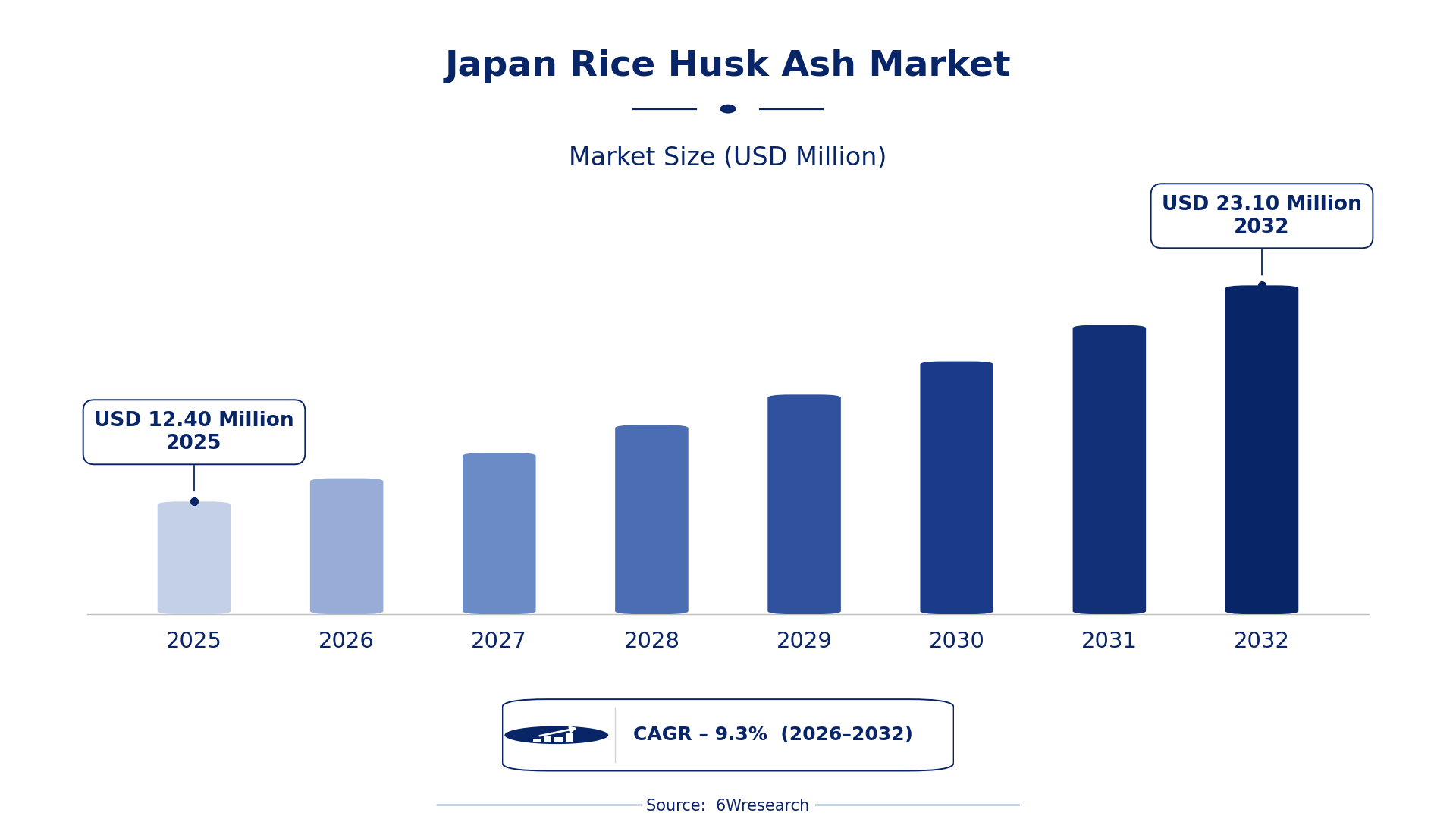
According to 6Wresearch internal database and industry insights, the Japan Rice Husk Ash Market was valued at USD 12.40 Million in 2025 and is projected to reach USD 23.10 Million by 2032, growing at a CAGR of approximately 9.3% during 2026–2032.
Japan Rice Husk Ash Market Highlights
| Report Metric | Details |
| Report Name | Japan Rice Husk Ash Market (2026-2032) |
| Market Size 2025 | USD 12.40 Million |
| Market Size 2032 | USD 23.10 Million |
| Absolute Growth 2025–2032 | USD 10.70 Million |
| CAGR 2026–2032 | 9.3% |
| Peak Annual Growth | 10.1% in 2028 |
| Forecast Period | 2026–2032 |
| Historical Data | 2022–2025 |
| Base Year | 2025 |
| Leading Silica Content, 2025 | 80-84% (36% share) |
| Leading Silica Extraction Process, 2025 | Alkaline Extraction (41% share) |
| Leading Application, 2025 | Building and Construction (35% share) |
| Fastest-Growing Silica Content | 85-89% (11.9% CAGR) |
| Fastest-Growing Silica Extraction Process | Precipitated Silica Extraction (12.8% CAGR) |
| Fastest-Growing Application | Steel Industry (12.7% CAGR) |
| Growing Sector | Building and Construction |
| Key End Users | Construction firms, ceramics manufacturers, rubber producers, agricultural waste recyclers |
Japan Rice Husk Ash Market Year-wise Growth Rate and Key Drivers (2022–2032)
This graph illustrates the annual growth rates of the market from 2022 to 2032, highlighting a steady upward trajectory and projected market expansion over the forecast period.
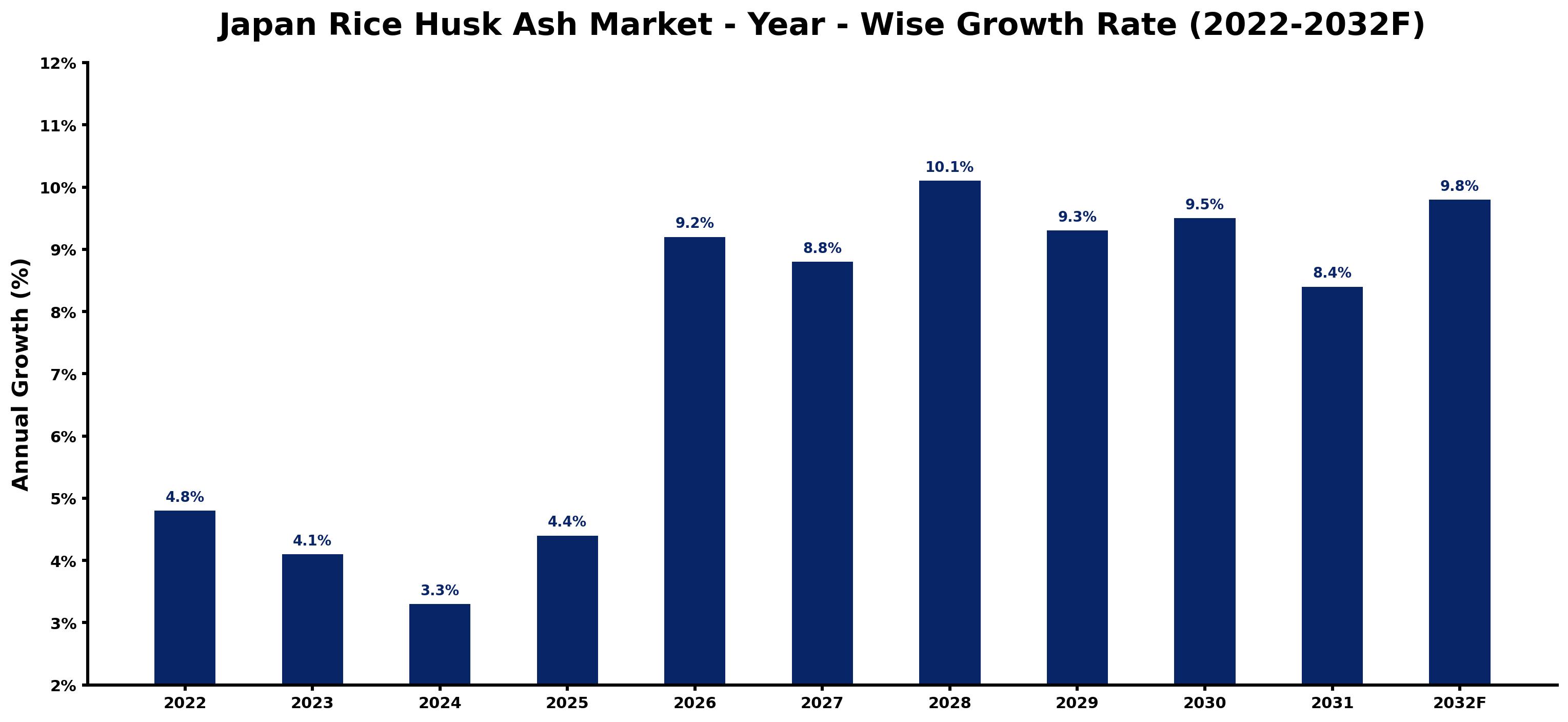
The following figures match every annual growth estimate with the main market development of that year, giving the reasoning behind each rise or slowdown.
| Year | Estimated Annual Growth (%) | Market Rationale |
| 2022 | 4.8 | The market experienced steady growth due to ongoing construction activities. |
| 2023 | 4.1 | Demand growth slowed as the market adjusted to post-Olympic construction levels. |
| 2024 | 3.3 | Market growth continued to slow as construction projects faced delays. |
| 2025 | 4.4 | Increased interest in sustainable materials boosted demand for Rice Husk Ash. |
| 2026 | 9.2 | Demand is expected to surge as the building materials sector expands. |
| 2027 | 8.8 | Growth is projected to slow slightly as the market stabilises after rapid expansion. |
| 2028 | 10.1 | A peak in demand will occur as new construction projects are initiated. |
| 2029 | 9.3 | Growth is expected to moderate as the market begins to normalise after the peak. |
| 2030 | 9.5 | Sustainable practices will gain traction, leading to increased demand for eco-friendly materials. |
| 2031 | 8.4 | The market is projected to see a slowdown as competition intensifies among suppliers. |
| 2032 | 9.8 | Growth will accelerate as new applications for Rice Husk Ash emerge. |
Note: Market size estimations and growth projections presented in this report are based on 6Wresearch's proprietary forecasting methodology, utilizing the latest available industry data, government publications, and primary research inputs.
Japan Rice Husk Ash Market Synopsis
Rice Husk Ash, a byproduct of rice milling, is rich in silica and produced by burning rice husks. It serves as a pozzolanic material in construction, a filler in rubber and plastics, and is used in ceramics. The Japan Rice Husk Ash Market is growing due to increased demand from the construction and ceramics sectors, driven by sustainability initiatives and recycling efforts. The ceramics industry, valued at approximately 1 trillion yen, highlights the potential for Rice Husk Ash as a sustainable ingredient across various applications.
Market Dynamics Impact Analysis (2026–2032)
| Factor | Type | Impact | Primary Segment Affected |
| Growing construction activities in urban areas | Driver | High | Building and Construction |
| Increased adoption of sustainable materials | Driver | High | Building and Construction |
| Expansion of the ceramics industry | Opportunity | High | Ceramics and Refractory |
| Rising demand for eco-friendly fillers in rubber production | Opportunity | Medium | Rubber |
| High purity requirements limit some applications | Restraint | High | Greater Than 95% |
| Competition from alternative materials in construction | Restraint | Medium | Building and Construction |
| Cost pressures from raw material sourcing | Challenge | High | Building and Construction |
| Capacity constraints in production facilities | Challenge | Medium | Precipitated Silica Extraction |
Evaluation of Drivers in Japan Rice Husk Ash Market (2026–2032)
Demand rests on the following drivers, each shown with the segment it touches most.
| Drivers | Primary Segment Affected | Why It Matters (Evidence) |
| Increased construction projects in the Tokyo metropolitan area | Building and Construction | The Tokyo metropolitan area generated 7.5 million tons of rice in 2022, driving demand for Rice Husk Ash as a sustainable material. |
| Growing interest in sustainable building practices | Building and Construction | The adoption of eco-friendly materials is rising, leading to increased purchases of Rice Husk Ash, bolstered by the Tokyo 2020 Olympics. |
| Expansion of the ceramics industry in Japan | Ceramics and Refractory | The ceramics industry, valued at approximately 1 trillion yen, is a significant consumer of Rice Husk Ash. |
| Rising demand for rubber products using eco-friendly fillers | Rubber | Industry associations are advocating for the use of Rice Husk Ash as a sustainable filler in rubber applications. |
| High silica content in Rice Husk Ash | 80-84% | The average silica content of around 85% makes it suitable for various applications. |
Purchasing is picking up as the construction sector in the Tokyo metropolitan area grows, driving demand for Rice Husk Ash. The ceramics industry, valued at approximately 1 trillion yen, is also increasing its consumption of this material. With a high silica content averaging around 85%, Rice Husk Ash is becoming a preferred choice for eco-friendly fillers in various applications. Industry associations are advocating for sustainable practices, further boosting demand. The focus on sustainable building materials following the Tokyo 2020 Olympics has led to increased interest in Rice Husk Ash applications.
Evaluation of Restraints in Japan Rice Husk Ash Market
The key brakes on demand, and where they bite hardest, are shown below.
| Market Restraint | Primary Segment Affected | Why It Matters (Evidence) |
| High purity requirements limit the use of Rice Husk Ash in certain applications | Greater Than 95% | The stringent purity standards restrict its usage in high-end applications, impacting market potential. |
| Competition from alternative materials in construction | Building and Construction | Alternative materials are often favoured for their cost-effectiveness, limiting the growth of Rice Husk Ash. |
| Fluctuating raw material prices affect production costs | Building and Construction | Rising costs of rice husks can lead to increased prices for Rice Husk Ash, deterring buyers. |
| Limited production capacity for specialized applications | Precipitated Silica Extraction | Insufficient production capacity can hinder the supply of Rice Husk Ash for niche markets. |
| Regulatory compliance costs for producers | Building and Construction | Producers face additional costs to meet environmental regulations, impacting profitability. |
Japan Rice Husk Ash Market Challenges
Buyers in the construction sector face supply disruptions due to limited local production of Rice Husk Ash, which can delay projects by up to three months. Suppliers contend with competition from alternative pozzolanic materials, inflating production costs for buyers by around 20%. A shortage of skilled workers in the processing of Rice Husk Ash reduces production efficiency, making it difficult for suppliers to meet the rising demands of the ceramics industry. Buyers also deal with price fluctuations, as the average price of Rice Husk Ash is approximately 15,000 yen per ton, complicating budgeting and project timelines.
Trends in the Japan Rice Husk Ash Market
The trends below show where the Japan Rice Husk Ash Market is heading.
- Shift towards Sustainable Construction Materials: The Tokyo 2020 Olympics spurred interest in sustainable building materials, including Rice Husk Ash. This shift is reflected in the building materials sector increasingly adopting eco-friendly practices, with a projected growth rate of 9.3%.
- Increased Use of Rice Husk Ash in Ceramics: The ceramics industry is increasingly utilising Rice Husk Ash for improved product strength. With the industry valued at approximately 1 trillion yen, this trend indicates a growing market for sustainable materials.
- Rising Demand for Eco-Friendly Fillers in Rubber: The rubber industry is transitioning towards eco-friendly fillers, with Rice Husk Ash gaining traction. This change is supported by industry associations promoting sustainable practices, reflecting a notable market shift.
- Adoption of JIS A 5308 Standard: The implementation of JIS A 5308 standard for pozzolanic materials in Japan is improving the quality assurance of Rice Husk Ash. This standardisation is expected to boost buyer confidence and demand.
Investment Opportunities in the Japan Rice Husk Ash Market
Several openings in the Japan Rice Husk Ash Market merit attention from investors.
- Partnerships for Sustainable Material Supply: Local partnerships with construction firms can facilitate the supply of Rice Husk Ash, addressing the increasing demand for sustainable materials in urban development, projected to rise by 9.3%.
- Investment in Production Facilities for Ceramics: Investing in production facilities for Rice Husk Ash tailored to the ceramics industry can capture a share of the 1 trillion yen market, meeting the growing demand for sustainable ingredients.
- Expansion into Eco-Friendly Rubber Applications: With the rubber industry seeking eco-friendly fillers, suppliers can target this sector by providing Rice Husk Ash, which is gaining traction for its sustainability benefits.
- Certification for Agricultural Byproduct Utilisation: Obtaining certification for Rice Husk Ash as an agricultural byproduct can open new markets, particularly in construction, where sustainable materials are increasingly sought after.
Government Initiatives in the Japan Rice Husk Ash Market
The Building Energy Efficiency Act, amended in 2022, requires all new buildings to meet energy standards from April 2025. This law encourages the use of sustainable materials, including Rice Husk Ash, to improve energy efficiency in construction projects. Additionally, the Act on the Rational Use of Energy mandates that large energy users enhance energy efficiency and report their energy consumption, further supporting the adoption of eco-friendly materials.
In 2023, a program was initiated to promote the recycling of agricultural byproducts, focusing on Rice Husk Ash. This initiative, administered by the Ministry of Agriculture, aims to enhance the utilisation of agricultural waste, providing funding and support for producers to incorporate Rice Husk Ash into their products.
Future Insight of the Japan Rice Husk Ash Market
By 2032, advancements in agricultural waste recycling will significantly boost the availability of Rice Husk Ash, enhancing its use in construction and ceramics. The construction sector in the Tokyo metropolitan area is expected to grow as sustainable building practices gain traction. The ceramics industry will increasingly incorporate Rice Husk Ash, driven by new standards like JIS A 5308 that ensure product quality. These changes will open new avenues for collaboration and innovation for buyers and suppliers alike.
Market Segmentation Analysis
Japan Rice Husk Ash Market report covers a detailed analysis of the following market segments:
By Silica Content – 80-84% Leads, 85-89% Expected to Grow Fastest
According to Shubham Padhi, Research Analyst at 6Wresearch, 80-84% accounted for 36% of the market by silica content in 2025. The 80-84% silica content segment maintains a strong position due to its prevalent use in construction, particularly as a pozzolanic material. Compliance with the JIS A 5308 standard ensures its effectiveness and reliability in various construction projects throughout Japan. 85-89% is projected to grow fastest, at a CAGR of 11.9% during 2026–2032. The 85-89% silica content segment is rapidly gaining traction as it finds increased application in the ceramics industry, which is valued at approximately 1 trillion yen. This growth reflects a broader trend towards enhancing the strength and durability of ceramic products. Suppliers should prioritise the 85-89% segment to leverage the expanding ceramics market.
By Silica Extraction Process – Alkaline Extraction Leads, Precipitated Silica Extraction Expected to Grow Fastest
With 41% of silica extraction process revenue in 2025, Alkaline Extraction was the largest category. Alkaline Extraction leads the market as it is widely used for specialized silica applications, ensuring high-quality output. This method is essential for meeting the specific requirements of various industries, including construction. Over 2026–2032, Precipitated Silica Extraction is expected to post the fastest growth, at a CAGR of 12.8%. Precipitated Silica Extraction is growing quickly due to its common application in rubber production, which is supported by industry associations promoting eco-friendly practices. The increasing demand for sustainable materials in rubber is driving this segment's growth. Buyers in the rubber industry should consider sourcing from suppliers that utilise Precipitated Silica Extraction to align with sustainability goals.
By Application – Building and Construction Leads, Steel Industry Expected to Grow Fastest
Building and Construction held 35% of the Japan Rice Husk Ash Market by application in 2025. The Building and Construction segment leads the market as it represents the primary application for structural materials, particularly in densely populated urban areas like Tokyo. The continuous growth in the building materials sector further solidifies this segment's dominance. Steel Industry is set to record the highest CAGR in this split, 12.7% over 2026–2032. The Steel Industry is experiencing notable growth, albeit from a smaller base, as interest in utilising Rice Husk Ash for its potential benefits in steel production rises. This trend is likely to accelerate as research continues to uncover its advantages in improving steel properties. Suppliers should consider the Steel Industry for potential growth opportunities in demand for Rice Husk Ash.
Key Attractiveness of the Report
- 10 Years of Market Numbers
- Historical Data Starting from 2022 to 2025
- Base Year 2025
- Forecast Data until 2032
- Key Performance Indicators Impacting the Market
- Major Upcoming Developments and Projects
Key Highlights of the Report:
- Japan Rice Husk Ash Market Outlook
- Market Size of Japan Rice Husk Ash Market, 2025
- Forecast of Japan Rice Husk Ash Market, 2032
- Historical Data and Forecast of Japan Rice Husk Ash Revenues & Volume for the Period 2022-2032
- Japan Rice Husk Ash Market Trend Evolution
- Japan Rice Husk Ash Market Drivers and Challenges
- Japan Rice Husk Ash Price Trends
- Japan Rice Husk Ash Porter's Five Forces
- Japan Rice Husk Ash Industry Life Cycle
- Historical Data and Forecast of Japan Rice Husk Ash Market Revenues & Volume By Silica Content for the Period 2022-2032
- Historical Data and Forecast of Japan Rice Husk Ash Market Revenues & Volume By 80-84% for the Period 2022-2032
- Historical Data and Forecast of Japan Rice Husk Ash Market Revenues & Volume By 85-89% for the Period 2022-2032
- Historical Data and Forecast of Japan Rice Husk Ash Market Revenues & Volume By 90-94% for the Period 2022-2032
- Historical Data and Forecast of Japan Rice Husk Ash Market Revenues & Volume By Greater Than 95% for the Period 2022-2032
- Historical Data and Forecast of Japan Rice Husk Ash Market Revenues & Volume By Silica Extraction Process for the Period 2022-2032
- Historical Data and Forecast of Japan Rice Husk Ash Market Revenues & Volume By Alkaline Extraction for the Period 2022-2032
- Historical Data and Forecast of Japan Rice Husk Ash Market Revenues & Volume By Precipitated Silica Extraction for the Period 2022-2032
- Historical Data and Forecast of Japan Rice Husk Ash Market Revenues & Volume By Mesoporous Silica Extraction for the Period 2022-2032
- Historical Data and Forecast of Japan Rice Husk Ash Market Revenues & Volume By Sol-Gel Method for the Period 2022-2032
- Historical Data and Forecast of Japan Rice Husk Ash Market Revenues & Volume By Application for the Period 2022-2032
- Historical Data and Forecast of Japan Rice Husk Ash Market Revenues & Volume By Building and Construction for the Period 2022-2032
- Historical Data and Forecast of Japan Rice Husk Ash Market Revenues & Volume By Steel Industry for the Period 2022-2032
- Historical Data and Forecast of Japan Rice Husk Ash Market Revenues & Volume By Ceramics and Refractory for the Period 2022-2032
- Historical Data and Forecast of Japan Rice Husk Ash Market Revenues & Volume By Rubber for the Period 2022-2032
- Historical Data and Forecast of Japan Rice Husk Ash Market Revenues & Volume By Others for the Period 2022-2032
- Japan Rice Husk Ash Import Export Trade Statistics
- Market Opportunity Assessment By Silica Content
- Market Opportunity Assessment By Silica Extraction Process
- Market Opportunity Assessment By Application
- Japan Rice Husk Ash Top Companies Market Share
- Japan Rice Husk Ash Competitive Benchmarking By Technical and Operational Parameters
- Japan Rice Husk Ash Company Profiles
- Japan Rice Husk Ash Key Strategic Recommendations
Market Covered
The report covers the following segments.
By Silica Content
- 80-84%
- 85-89%
- 90-94%
- Greater Than 95%
By Silica Extraction Process
- Alkaline Extraction
- Precipitated Silica Extraction
- Mesoporous Silica Extraction
- Sol-Gel Method
By Application
- Building and Construction
- Steel Industry
- Ceramics and Refractory
- Rubber
- Others































