Japan Risk Assessment AI Market Size & Growth Rate
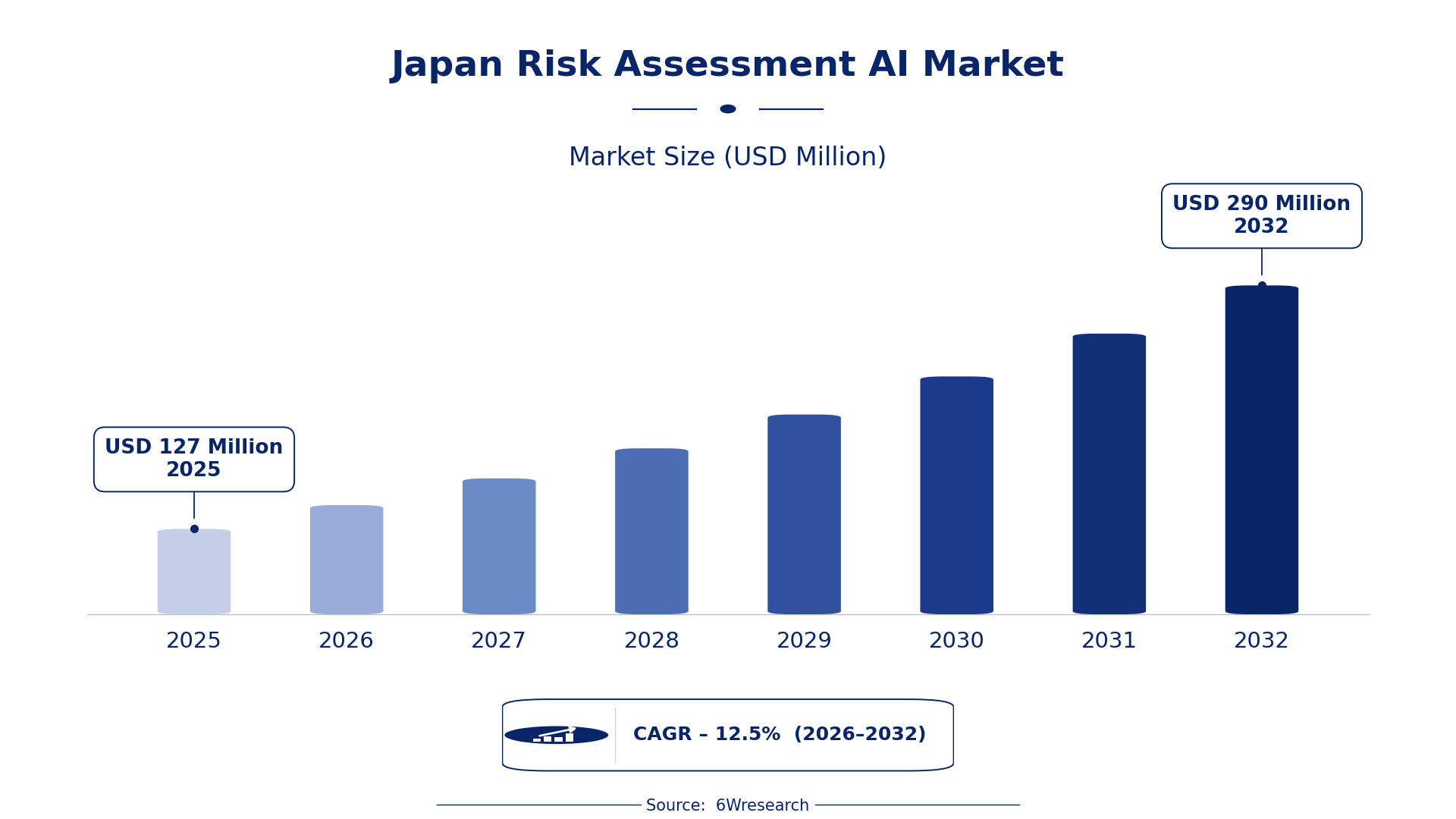
According to 6Wresearch internal database and industry insights, the Japan Risk Assessment AI Market was valued at USD 127 Million in 2025 and is projected to reach USD 290 Million by 2032, growing at a CAGR of approximately 12.5% during 2026–2032.
Japan Risk Assessment AI Market Highlights
| Report Metric | Details |
| Report Name | Japan Risk Assessment AI Market (2026-2032) |
| Market Size 2025 | USD 127 Million |
| Market Size 2032 | USD 290 Million |
| Absolute Growth 2025–2032 | USD 163 Million |
| CAGR 2026–2032 | 12.5% |
| Peak Annual Growth | 13.3% in 2026 |
| Forecast Period | 2026–2032 |
| Historical Data | 2022–2025 |
| Base Year | 2025 |
| Leading Risk Category, 2025 | Financial Risk (47% share) |
| Leading AI Application, 2025 | Anomaly Detection (48% share) |
| Leading Data Type, 2025 | Transaction Data (47% share) |
| Leading End User, 2025 | Banks & Fintech Firms (44% share) |
| Fastest-Growing Risk Category | Cybersecurity Risk (15.7% CAGR) |
| Fastest-Growing AI Application | Threat Intelligence (16.2% CAGR) |
| Fastest-Growing Data Type | Network Logs (17.9% CAGR) |
| Fastest-Growing End User | Cloud Providers (16.4% CAGR) |
| Growing Sector | Financial Services |
| Key End Users | Banks, Fintech Firms, Insurance Companies, Manufacturing Units |
Japan Risk Assessment AI Market Year-wise Growth Rate and Key Drivers (2022–2032)
This graph illustrates the annual growth rates of the market from 2022 to 2032, highlighting a steady upward trajectory and projected market expansion over the forecast period.
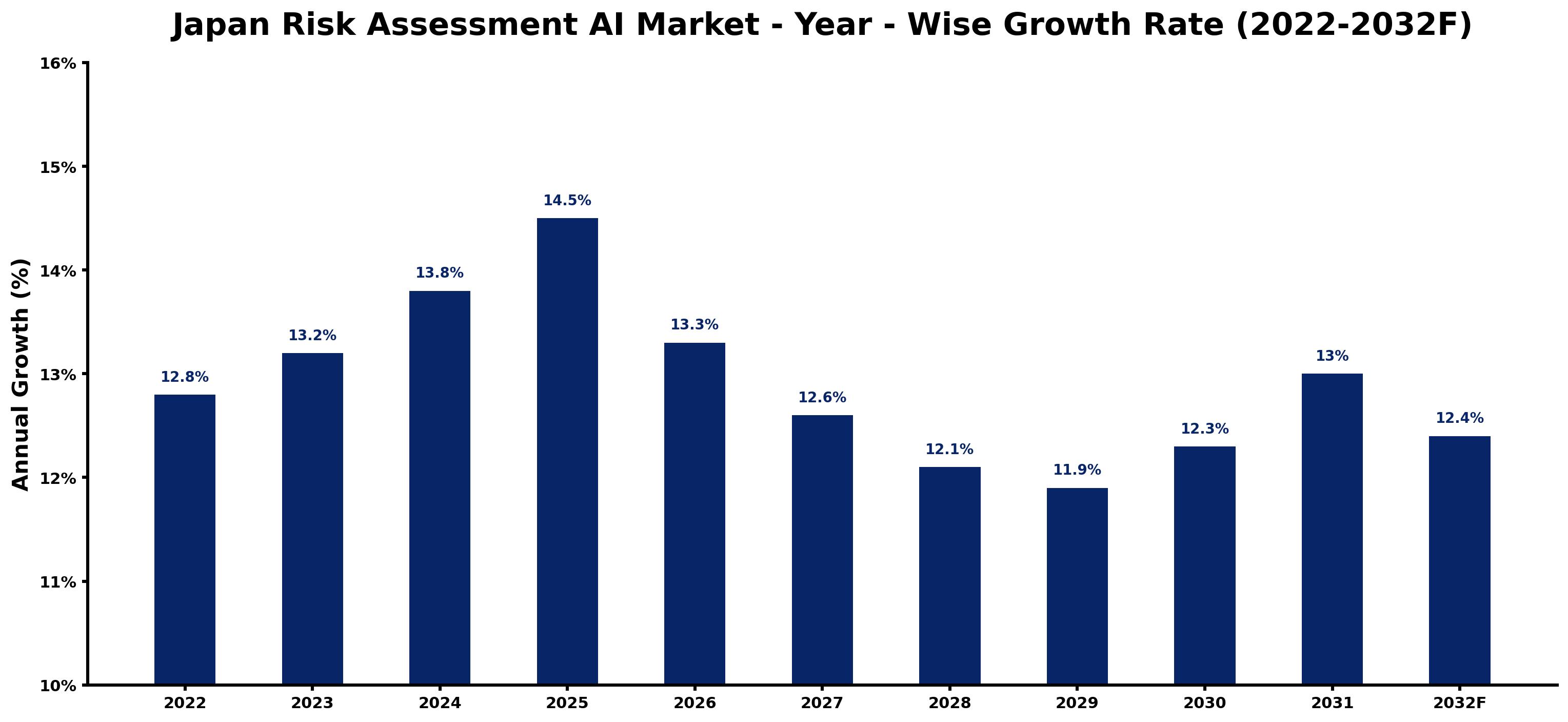
Year by year, the estimates below pair each growth rate with the development that shaped it.
| Year | Estimated Annual Growth (%) | Market Rationale |
| 2022 | 12.8 | The market exhibited strong performance due to ongoing digital transformation efforts. |
| 2023 | 13.2 | Growth accelerated as financial institutions increasingly adopted AI technologies. |
| 2024 | 13.8 | Demand surged with a focus on cybersecurity measures across sectors. |
| 2025 | 14.5 | The market reached its historical peak as risk assessment solutions became essential. |
| 2026 | 13.3 | Growth slowed as the market is expected to stabilise after rapid expansion. |
| 2027 | 12.6 | The market is projected to continue growing, albeit at a slower rate than previous years. |
| 2028 | 12.1 | Demand is expected to remain steady, driven by investments in operational risk management. |
| 2029 | 11.9 | Growth is projected to decelerate further as the market matures and competition intensifies. |
| 2030 | 12.3 | An uptick in demand is expected as new technologies enter the market. |
| 2031 | 13.0 | The market will experience a resurgence in growth driven by evolving buyer needs. |
| 2032 | 12.4 | Growth is projected to slow again as the market stabilises, reflecting a mature phase. |
Note: Market size estimations and growth projections presented in this report are based on 6Wresearch's proprietary forecasting methodology, utilizing the latest available industry data, government publications, and primary research inputs.
Japan Risk Assessment AI Market Synopsis
Risk Assessment AI utilises algorithms and machine learning to evaluate potential risks across sectors, including financial forecasting and cybersecurity threat detection. The Japan Risk Assessment AI Market is expanding due to strong demand from the financial sector, which includes over 1,000 banks and fintech firms. The Tokyo region serves as a hub for financial technology innovation, while the national strategy for AI development launched in 2023 focuses on risk management, driving further investments in this technology. The insurance market, valued at over $400 billion, is also a contributor to growth.
Market Dynamics Impact Analysis (2026–2032)
| Factor | Type | Impact | Primary Segment Affected |
| Increased adoption of AI technologies in the financial sector | Driver | High | Financial Risk |
| Growing concerns over cybersecurity threats | Driver | High | Cybersecurity Risk |
| Expansion of AI applications in operational risk management | Opportunity | Medium | Operational Risk |
| Rising demand for anomaly detection in data analysis | Opportunity | Medium | Anomaly Detection |
| High implementation costs for advanced AI systems | Restraint | High | Cybersecurity Risk |
| Limited awareness of AI benefits among smaller firms | Restraint | Medium | Financial Risk |
| Shortage of skilled professionals in AI and data science | Challenge | High | Operational Risk |
| Intense competition among AI solution providers | Challenge | Medium | Cybersecurity Risk |
Evaluation of Drivers in Japan Risk Assessment AI Market (2026–2032)
The following drivers explain most of the expected growth.
| Drivers | Primary Segment Affected | Why It Matters (Evidence) |
| Growing digital transformation initiatives in Japan | Financial Risk | Over 1,000 banks and fintech firms are investing in AI technologies to improve risk assessment capabilities. |
| Rising cybersecurity threats in various sectors | Cybersecurity Risk | The increasing frequency of cyberattacks drives companies to invest in AI for threat detection and mitigation. |
| Demand for operational efficiency improvements | Operational Risk | Companies are adopting AI to identify inefficiencies and reduce operational risks, especially in manufacturing. |
| Regulatory pressures for improved risk management | Financial Risk | The Financial Services Agency mandates enhanced risk assessment practices, pushing firms to adopt AI solutions. |
| Need for predictive modelling in financial forecasting | Predictive Modelling | Financial institutions are using AI to forecast risks based on historical data, improving decision-making. |
Several shifts outside the market lift sales. As cybersecurity threats rise, companies are increasingly adopting AI for threat detection, leading to heightened demand in the cybersecurity risk segment. Operational efficiency improvements drive firms to utilise AI for identifying inefficiencies, particularly in manufacturing.
Evaluation of Restraints in Japan Risk Assessment AI Market
The following restraints limit how fast demand can grow.
| Market Restraint | Primary Segment Affected | Why It Matters (Evidence) |
| High costs associated with implementing advanced AI systems | Cybersecurity Risk | Many firms face challenges in allocating budgets for sophisticated AI solutions, limiting their adoption. |
| Limited understanding of AI benefits among smaller enterprises | Financial Risk | Small firms often lack the resources to invest in AI, hindering their ability to compete effectively. |
| Shortage of skilled professionals in AI and data science | Operational Risk | The demand for AI expertise exceeds supply, making it difficult for companies to implement effective solutions. |
| Intense competition among AI solution providers | Cybersecurity Risk | Fierce competition can lead to price wars, impacting profitability for AI providers. |
| Regulatory compliance challenges for AI systems | Financial Risk | Navigating complex regulations can delay AI implementation and increase operational costs. |
Japan Risk Assessment AI Market Challenges
Producers face implementation delays in risk assessment AI due to dependence on local data sources, which can extend project timelines by six months. Distributors encounter regulatory hurdles, as oversight from the Financial Services Agency raises operational costs by around 20%. Buyers experience skills shortages, with a reported 30% gap in qualified AI professionals limiting effective deployment. Domestic companies feel pressure from competition with international firms, necessitating an additional 15% investment in technology to maintain their market position.
Trends in the Japan Risk Assessment AI Market
The shifts below are changing how Japan Risk Assessment AI Market products are bought and supplied.
- Banks & Fintech Firms Increasing AI Adoption: Financial institutions are increasingly adopting AI for risk assessment, with over 1,000 banks and fintech firms in Japan using these technologies to improve their operations.
- Shift Towards Cybersecurity Risk Management: The focus on cybersecurity is intensifying, as evidenced by the AI & Cybersecurity Conference held in 2023, which highlighted the need for advanced threat detection solutions.
- Anomaly Detection Gaining Traction: Anomaly detection is becoming essential for data analysis, with a significant share of firms adopting AI technologies to identify unusual patterns in financial transactions.
- Increased Regulatory Focus on AI Compliance: The Financial Services Agency's regulations are pushing firms to implement AI solutions for better risk management, ensuring compliance with evolving standards.
Investment Opportunities in the Japan Risk Assessment AI Market
Below are the investment opportunities with the strongest case in the Japan Risk Assessment AI Market.
- Banks & Fintech Firms Seeking Advanced Solutions: With over 1,000 banks and fintech firms in Japan, there is a rising demand for sophisticated risk assessment AI solutions to enhance operational efficiency and compliance.
- Entry into the Cybersecurity Market: Now is an opportune moment to collaborate with local firms to deliver AI-driven cybersecurity solutions, as demand surges due to escalating cyber threats across various sectors.
- Investment in Operational Risk Management Technologies: The operational risk management sector is expanding, presenting opportunities to provide AI solutions that enhance efficiency and mitigate risks for manufacturing units.
- Focus on Regulatory Compliance Solutions: As regulatory pressures mount, firms are seeking AI solutions that ensure compliance with the Financial Services Agency's standards, creating a demand for advanced technologies.
Government Initiatives in the Japan Risk Assessment AI Market
The AI Promotion Act (2025) provides a national framework for AI research and development, enhancing previous laws by offering clear guidelines for AI applications in various sectors. This act aims to stimulate innovation in risk assessment AI, ensuring that companies adhere to best practices while developing and deploying these technologies. It also includes provisions for funding AI projects that align with national priorities, promoting growth in the sector.
The Digital Agency, established in September 2021, leads the government's digital transformation efforts. It supports financial institutions in implementing AI solutions for risk management, ensuring that they meet regulatory standards while improving their operational capabilities. The agency also funds projects that promote the use of AI in risk assessment across various sectors, enabling firms to adopt advanced technologies more effectively.
Future Insight of the Japan Risk Assessment AI Market
New research initiatives will promote collaboration between academia and industry, leading to advancements in risk assessment technologies. By 2032, the insurance market, valued at over $400 billion, will adopt AI for underwriting, streamlining processes and reducing costs. The national strategy for AI development will encourage innovation across sectors, benefiting both buyers and suppliers. As standards like ISO 27001 gain traction, firms will adopt best practices in cybersecurity management, strengthening their operational resilience.
Market Segmentation Analysis
Japan Risk Assessment AI Market report covers a detailed analysis of the following market segments:
By Risk Category – Financial Risk Leads, Cybersecurity Risk Expected to Grow Fastest
According to Saurav Kr Singh, Senior Research Analyst at 6Wresearch, Financial Risk accounted for 47% of the market by risk category in 2025. Financial Risk holds the largest share as over 1,000 banks and fintech firms depend on these technologies for assessing credit and market risks. The regulatory oversight by the Financial Services Agency further solidifies the demand for reliable risk assessment solutions in the financial sector. Cybersecurity Risk is set to record the highest CAGR in this split, 15.7% over 2026–2032. Cybersecurity Risk is witnessing rapid growth due to the heightened focus on threat detection by organisations. The national strategy for AI development launched in 2023, which prioritises risk management, acts as a catalyst for this segment's expansion. This trend suggests that suppliers must prioritise the development of cybersecurity solutions to cater to the increasing market demand.
By AI Application – Anomaly Detection Leads, Threat Intelligence Expected to Grow Fastest
Anomaly Detection held 48% of the Japan Risk Assessment AI Market by ai application in 2025. Anomaly Detection is the leading application as it is essential for identifying unusual patterns in data, which is critical for financial institutions managing risks. This application is heavily utilised by banks and fintech firms to ensure compliance and mitigate potential threats. Threat Intelligence is projected to grow fastest, at a CAGR of 16.2% during 2026–2032. Threat Intelligence is growing swiftly due to the rising need for organisations to gather and analyse threat data effectively. The increasing frequency of cyber threats necessitates advanced analytical capabilities, propelling this segment forward. Buyers must invest in advanced threat intelligence solutions to stay ahead of evolving cybersecurity challenges.
By Data Type – Transaction Data Leads, Network Logs Expected to Grow Fastest
With 47% of data type revenue in 2025, Transaction Data was the largest category. Transaction Data leads the market as it is vital for conducting effective financial risk assessments, allowing firms to evaluate and manage risks thoroughly. Its widespread use among banks and fintech firms underscores its essential role in the financial ecosystem. Over 2026–2032, Network Logs are expected to post the fastest growth, at a CAGR of 17.9%. Network Logs are growing at the fastest rate due to their critical role in cybersecurity analysis, enabling organisations to swiftly detect and respond to threats. The rising incidence of cyber threats significantly fuels the demand for insights derived from these logs. Suppliers should concentrate on creating solutions that leverage network logs to meet the escalating cybersecurity requirements.
By End User – Banks & Fintech Firms Lead, Cloud Providers Expected to Grow Fastest
The largest end user category in 2025 was Banks & Fintech Firms, at 44% of revenue. Banks & Fintech Firms represent the largest user group, serving as the primary consumers of risk assessment solutions for effective risk management. Their substantial investments in these technologies reflect the critical need for financial stability and adherence to regulatory standards. The quickest growth will come from Cloud Providers, forecast to expand at a CAGR of 16.4% between 2026 and 2032. Cloud Providers are rapidly becoming the fastest-growing end user group as they increasingly implement AI to enhance security measures in their services. The ongoing shift towards cloud-based operations across various sectors accelerates this trend. Vendors should customise their solutions for cloud providers to capitalise on this burgeoning market opportunity.
Key Attractiveness of the Report
- 10 Years of Market Numbers
- Historical Data Starting from 2022 to 2025
- Base Year 2025
- Forecast Data until 2032
- Key Performance Indicators Impacting the Market
- Major Upcoming Developments and Projects
Key Highlights of the Report:
- Japan Risk Assessment AI Market Outlook
- Market Size of Japan Risk Assessment AI Market, 2025
- Forecast of Japan Risk Assessment AI Market, 2032
- Historical Data and Forecast of Japan Risk Assessment AI Revenues & Volume for the Period 2022-2032F
- Japan Risk Assessment AI Market Trend Evolution
- Japan Risk Assessment AI Market Drivers and Challenges
- Japan Risk Assessment AI Price Trends
- Japan Risk Assessment AI Porter's Five Forces
- Japan Risk Assessment AI Industry Life Cycle
- Historical Data and Forecast of Japan Risk Assessment AI Market Revenues & Volume By Risk Category for the Period 2022-2032F
- Historical Data and Forecast of Japan Risk Assessment AI Market Revenues & Volume By Financial Risk for the Period 2022-2032F
- Historical Data and Forecast of Japan Risk Assessment AI Market Revenues & Volume By Cybersecurity Risk for the Period 2022-2032F
- Historical Data and Forecast of Japan Risk Assessment AI Market Revenues & Volume By Environmental Risk for the Period 2022-2032F
- Historical Data and Forecast of Japan Risk Assessment AI Market Revenues & Volume By Operational Risk for the Period 2022-2032F
- Historical Data and Forecast of Japan Risk Assessment AI Market Revenues & Volume By AI Application for the Period 2022-2032F
- Historical Data and Forecast of Japan Risk Assessment AI Market Revenues & Volume By Anomaly Detection for the Period 2022-2032F
- Historical Data and Forecast of Japan Risk Assessment AI Market Revenues & Volume By Threat Intelligence for the Period 2022-2032F
- Historical Data and Forecast of Japan Risk Assessment AI Market Revenues & Volume By Predictive Modelling for the Period 2022-2032F
- Historical Data and Forecast of Japan Risk Assessment AI Market Revenues & Volume By Root Cause Analysis for the Period 2022-2032F
- Historical Data and Forecast of Japan Risk Assessment AI Market Revenues & Volume By Data Type for the Period 2022-2032F
- Historical Data and Forecast of Japan Risk Assessment AI Market Revenues & Volume By Transaction Data for the Period 2022-2032F
- Historical Data and Forecast of Japan Risk Assessment AI Market Revenues & Volume By Network Logs for the Period 2022-2032F
- Historical Data and Forecast of Japan Risk Assessment AI Market Revenues & Volume By Satellite & Weather Data for the Period 2022-2032F
- Historical Data and Forecast of Japan Risk Assessment AI Market Revenues & Volume By Process Metrics for the Period 2022-2032F
- Historical Data and Forecast of Japan Risk Assessment AI Market Revenues & Volume By End User for the Period 2022-2032F
- Historical Data and Forecast of Japan Risk Assessment AI Market Revenues & Volume By Banks & Fintech Firms for the Period 2022-2032F
- Historical Data and Forecast of Japan Risk Assessment AI Market Revenues & Volume By Cloud Providers for the Period 2022-2032F
- Historical Data and Forecast of Japan Risk Assessment AI Market Revenues & Volume By Insurance Companies for the Period 2022-2032F
- Historical Data and Forecast of Japan Risk Assessment AI Market Revenues & Volume By Manufacturing Units for the Period 2022-2032F
- Japan Risk Assessment AI Import Export Trade Statistics
- Market Opportunity Assessment By Risk Category
- Market Opportunity Assessment By AI Application
- Market Opportunity Assessment By Data Type
- Market Opportunity Assessment By End User
- Japan Risk Assessment AI Top Companies Market Share
- Japan Risk Assessment AI Competitive Benchmarking By Technical and Operational Parameters
- Japan Risk Assessment AI Company Profiles
- Japan Risk Assessment AI Key Strategic Recommendations
Market Covered
The study includes the following segmentation.
By Risk Category
- Financial Risk
- Cybersecurity Risk
- Environmental Risk
- Operational Risk
By AI Application
- Anomaly Detection
- Threat Intelligence
- Predictive Modelling
- Root Cause Analysis
By Data Type
- Transaction Data
- Network Logs
- Satellite & Weather Data
- Process Metrics
By End User
- Banks & Fintech Firms
- Cloud Providers
- Insurance Companies
- Manufacturing Units































