Japan Risk-Based Inspection Market Size & Growth Rate
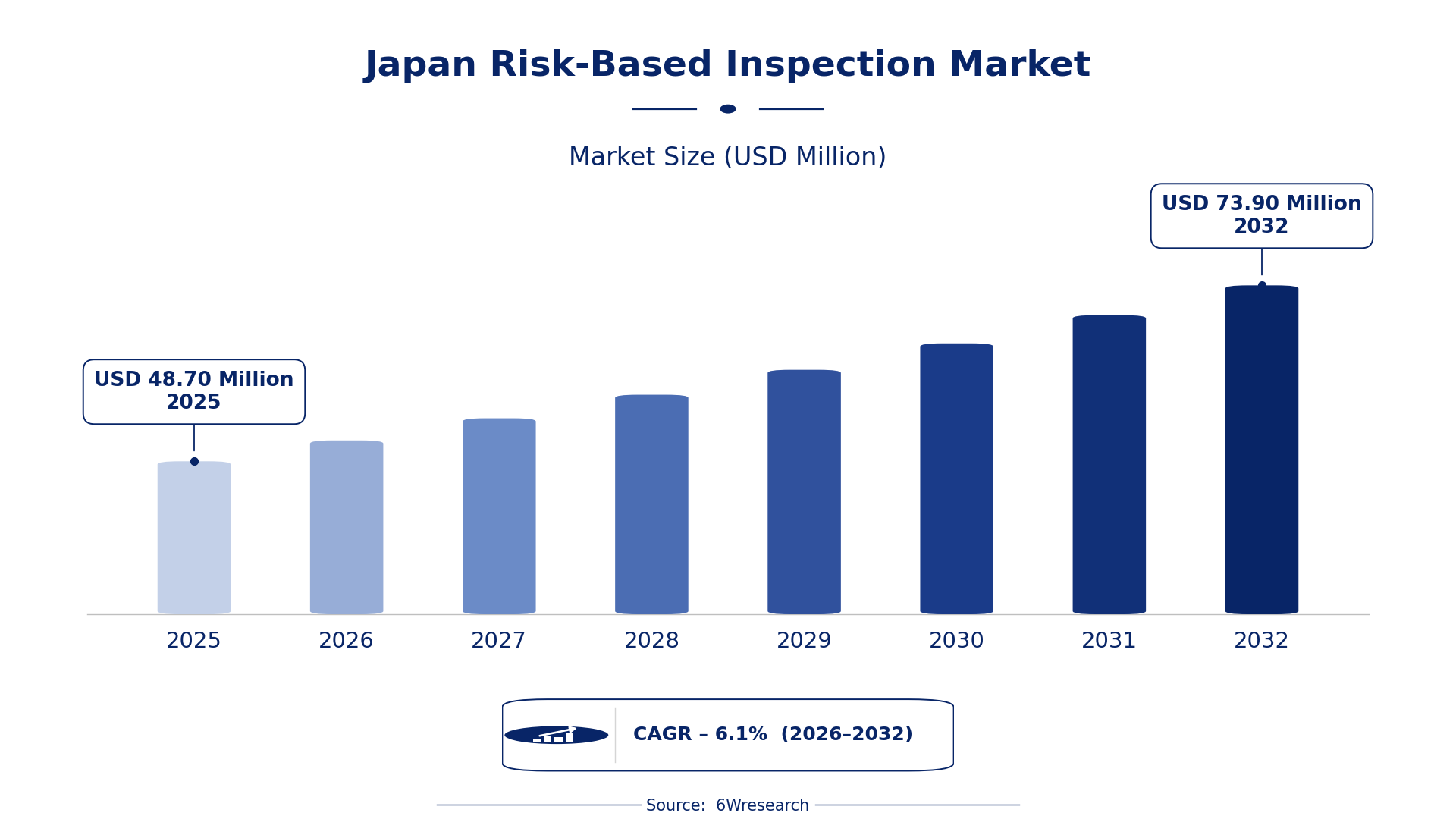
According to 6Wresearch internal database and industry insights, the Japan Risk-Based Inspection Market was valued at USD 48.70 Million in 2025 and is projected to reach USD 73.90 Million by 2032, growing at a CAGR of approximately 6.1% during 2026–2032.
Japan Risk-Based Inspection Market Highlights
| Report Metric | Details |
| Report Name | Japan Risk-Based Inspection Market (2026-2032) |
| Market Size 2025 | USD 48.70 Million |
| Market Size 2032 | USD 73.90 Million |
| Absolute Growth 2025–2032 | USD 25.20 Million |
| CAGR 2026–2032 | 6.1% |
| Peak Annual Growth | 7.4% in 2028 |
| Forecast Period | 2026–2032 |
| Historical Data | 2022–2025 |
| Base Year | 2025 |
| Leading Inspection Type, 2025 | Static Equipment (37% share) |
| Leading Risk Priority Category, 2025 | High Risk (39% share) |
| Leading Technique Used, 2025 | Ultrasonic Testing (37% share) |
| Leading End User, 2025 | Oil Refineries (35% share) |
| Fastest-Growing Inspection Type | Pipelines (8.6% CAGR) |
| Fastest-Growing Risk Priority Category | Critical Infrastructure (8.0% CAGR) |
| Fastest-Growing Technique Used | Vibration Monitoring (8.2% CAGR) |
| Fastest-Growing End User | Gas Distribution Units (7.9% CAGR) |
| Growing Sector | Oil and Gas |
| Key End Users | Oil Refineries, Power Plants, Gas Distribution Units, Petrochemical Plants |
Japan Risk-Based Inspection Market Year-wise Growth Rate and Key Drivers (2022–2032)
This graph illustrates the annual growth rates of the market from 2022 to 2032, highlighting a steady upward trajectory and projected market expansion over the forecast period.
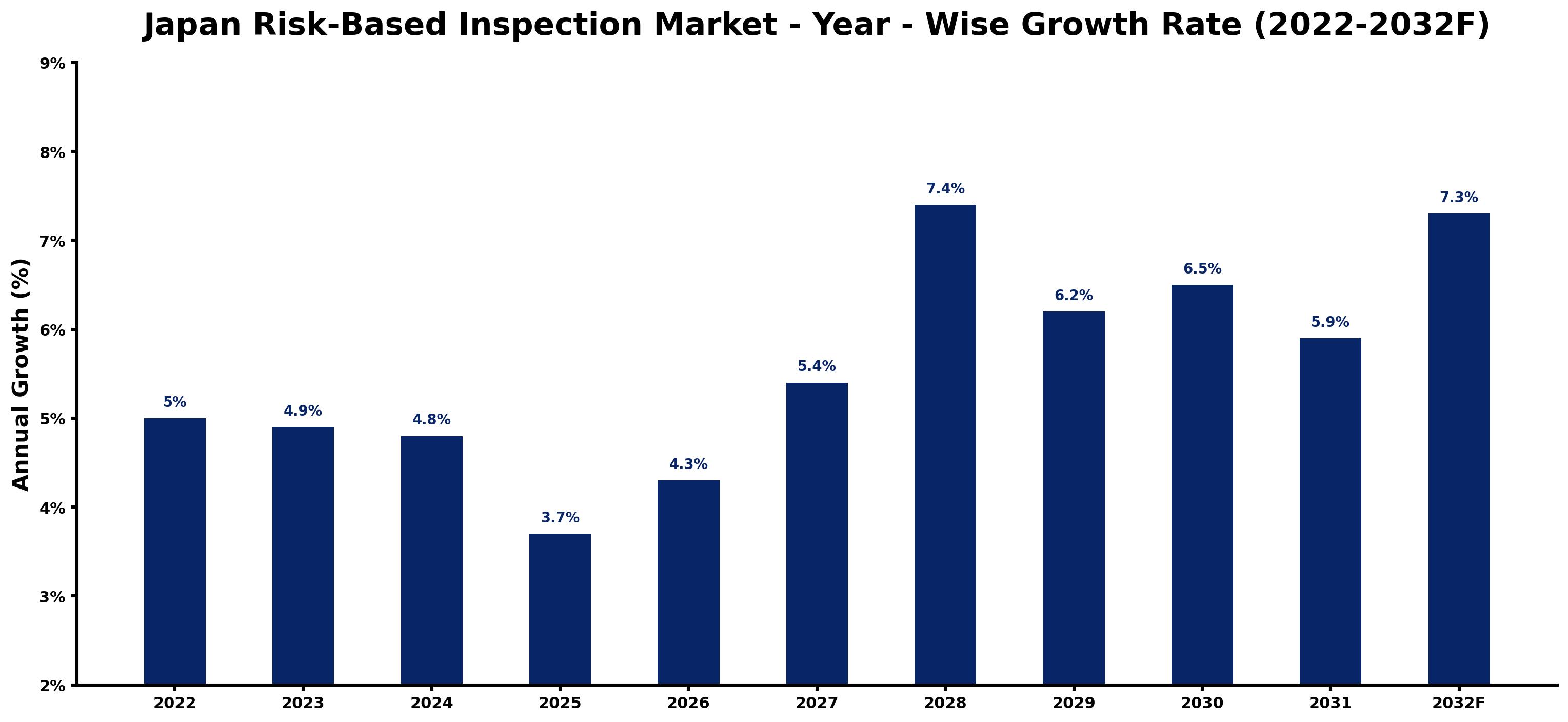
The table below sets out the estimated growth rate for each year and the main factor behind it.
| Year | Estimated Annual Growth (%) | Market Rationale |
| 2022 | 5.0 | The market experienced solid growth due to increased safety regulations and infrastructure investments. |
| 2023 | 4.9 | Growth slowed as companies adjusted to new safety standards and inspection protocols. |
| 2024 | 4.8 | Market growth continued to decelerate as industries faced challenges in operational efficiency. |
| 2025 | 3.7 | A further slowdown occurred as firms focused on optimising existing inspection processes. |
| 2026 | 4.3 | Growth is expected to accelerate with rising investments in advanced inspection technologies and methodologies. |
| 2027 | 5.4 | Demand is projected to increase as industries adopt predictive maintenance practices to improve safety. |
| 2028 | 7.4 | The market is expected to peak as investments in critical infrastructure drive demand for inspections. |
| 2029 | 6.2 | Growth is projected to slow as the market begins to stabilise after the peak in investment activities. |
| 2030 | 6.5 | Demand is anticipated to rise again as industries seek to modernise aging infrastructure and improve safety. |
| 2031 | 5.9 | Growth is expected to slow as the market adjusts to the new normal of inspection practices. |
| 2032 | 7.3 | A resurgence in demand is anticipated as new safety initiatives are implemented. |
Note: Market size estimations and growth projections presented in this report are based on 6Wresearch's proprietary forecasting methodology, utilizing the latest available industry data, government publications, and primary research inputs.
Japan Risk-Based Inspection Market Synopsis
This approach improves safety and optimises maintenance schedules, particularly in the oil and gas and power generation sectors. The oil and gas industry, along with power generation, primarily drives demand, with domestic users focusing on operational safety and compliance. Japan's oil refinery capacity is approximately 3.5 million barrels per day, further highlighting the need for RBI services.
Market Dynamics Impact Analysis (2026–2032)
| Factor | Type | Impact | Primary Segment Affected |
| Increased safety regulations drive demand for inspections in high-risk sectors. | Driver | High | High Risk |
| Investment in advanced inspection technologies enhances operational efficiency. | Driver | High | Static Equipment |
| Growing infrastructure projects create opportunities for RBI services. | Opportunity | High | Critical Infrastructure |
| Rising awareness of risk management leads to more companies adopting RBI. | Opportunity | Medium | Pipelines |
| High costs associated with implementing advanced inspection technologies may limit adoption. | Restraint | High | Rotating Machinery |
| Aging infrastructure increases the complexity of inspections, posing challenges. | Restraint | Medium | Storage Tanks |
| The initial investment in RBI systems can be prohibitive for smaller firms. | Challenge | High | Gas Distribution Units |
| Limited skilled workforce for advanced inspection techniques hampers growth. | Challenge | Medium | Oil Refineries |
Evaluation of Drivers in Japan Risk-Based Inspection Market (2026–2032)
The table below links each growth driver to the segment it affects and the evidence for it.
| Drivers | Primary Segment Affected | Why It Matters (Evidence) |
| Rising safety regulations mandate more frequent inspections. | High Risk | Japan's stringent safety laws require regular assessments to prevent catastrophic failures. |
| Investment in predictive maintenance technologies improves reliability. | Static Equipment | With over 100 operational power plants, the need for reliable equipment drives RBI adoption. |
| Increased focus on infrastructure safety boosts demand for RBI services. | Critical Infrastructure | The government allocated ¥5 billion for infrastructure safety improvements, increasing inspection needs. |
| Growing awareness of risk management practices encourages RBI adoption. | Pipelines | The oil and gas industry, with a capacity of 3.5 million barrels per day, seeks better risk management. |
| Technological advancements in inspection methods improve efficiency. | Rotating Machinery | Ultrasonic testing is used in over 50% of inspections, improving monitoring capabilities. |
Several shifts outside the market lift sales. The oil and gas industry, with a capacity of approximately 3.5 million barrels per day, increasingly seeks to improve operational safety through RBI services. Investment in predictive maintenance technologies has become essential, especially in over 100 operational power plants, where reliability is critical. Technological advancements, such as ultrasonic testing employed in more than half of inspections, improve monitoring capabilities and efficiency.
Evaluation of Restraints in Japan Risk-Based Inspection Market
Several factors work against faster growth; the main ones are summarised below.
| Market Restraint | Primary Segment Affected | Why It Matters (Evidence) |
| High costs associated with implementing advanced inspection technologies limit adoption. | Rotating Machinery | The average investment in advanced inspection systems can exceed several million yen, deterring smaller firms. |
| Aging infrastructure complicates inspection processes and increases costs. | Storage Tanks | With an average age of over 30 years, many storage tanks require extensive assessments. |
| Limited skilled workforce for advanced inspection techniques hampers growth. | Gas Distribution Units | The shortage of trained professionals affects the quality and frequency of inspections. |
| Regulatory compliance can be time-consuming and costly for companies. | High Risk | Navigating complex regulations often leads to delays in implementing RBI systems. |
| Market saturation in some sectors may limit growth opportunities. | Pipelines | As more companies adopt RBI, competition increases, potentially reducing profit margins. |
Japan Risk-Based Inspection Market Challenges
Radiographic testing is mandated for critical infrastructure inspections, leading to compliance delays for producers who must adhere to stringent regulations. Aging infrastructure complicates supply chains; the average age of storage tanks exceeds 30 years, causing maintenance challenges for importers and distributors. Buyers face difficulties in optimising maintenance schedules as the government allocates ¥5 billion for infrastructure safety improvements, which may not sufficiently meet rising demands. Cost pressures arise as ultrasonic testing is utilised in over 50% of inspections, increasing operational expenses for producers reliant on outdated technologies.
Trends in the Japan Risk-Based Inspection Market
These developments are changing demand patterns in the Japan Risk-Based Inspection Market.
- Shift towards Predictive Maintenance: Industries are increasingly adopting predictive maintenance strategies, particularly in oil refineries, to improve safety and efficiency. In 2023, over 60% of refineries implemented such strategies, reflecting a growing trend towards risk management.
- Rise of Advanced Inspection Technologies: The use of advanced inspection technologies is on the rise, especially in power plants. In 2023, ultrasonic testing was employed in over 50% of inspections, indicating a shift towards more precise and efficient methodologies.
- Growing Emphasis on Infrastructure Safety: The focus on infrastructure safety has intensified since 2023, with the government allocating ¥5 billion for improvements. This funding is driving demand for RBI services across various sectors, particularly critical infrastructure.
- Increased Adoption of Risk Management Practices: More companies are recognising the importance of risk management practices, particularly in the oil and gas sector. The trend has led to a 20% increase in RBI service contracts in 2023.
Investment Opportunities in the Japan Risk-Based Inspection Market
Below are the investment opportunities with the strongest case in the Japan Risk-Based Inspection Market.
- Timing aligns with infrastructure investments: With the government allocating ¥5 billion for infrastructure safety improvements, there is an opportunity for RBI service providers to engage with critical infrastructure projects, improving safety and compliance.
- Partnerships with local firms: Forming joint ventures with local inspection firms can facilitate market entry. This strategy is particularly beneficial for foreign companies looking to supply advanced RBI technologies.
- Growing need in oil refineries: Oil refineries are increasingly seeking RBI services to ensure operational safety. The sector's demand for compliance and risk management presents a promising opportunity for service providers.
- Focus on gas distribution units: Gas distribution units require enhanced inspection services to ensure safety. With approximately 10 million units in Japan, the demand for RBI services is substantial, creating a need for skilled providers.
Government Initiatives in the Japan Risk-Based Inspection Market
The GX Promotion Act, launched in 2023, introduces a new regulatory framework for risk management in critical industries. This act supports the implementation of advanced inspection methodologies, improving compliance and safety standards beyond previous laws. The act aims to improve the overall safety of critical infrastructure, directly benefiting RBI services and their buyers.
The Japan Society for Non-Destructive Testing oversees the approval of inspection methodologies and funds initiatives aimed at improving infrastructure safety. In 2023, the society allocated ¥5 billion specifically for infrastructure safety improvements, benefiting various sectors by facilitating the adoption of advanced inspection techniques.
Future Insight of the Japan Risk-Based Inspection Market
The shift towards enhanced infrastructure safety will drive suppliers to implement advanced technologies like predictive maintenance by 2032. The integration of ISO 55000 standards will standardise asset management practices across various industries. With Japan's government investing ¥5 billion in infrastructure safety improvements, the demand for risk-based inspection services will grow. As the population of around 125 million continues to require reliable energy, buyers will benefit from improved safety and reduced downtime through more effective inspection methodologies.
Market Segmentation Analysis
Japan Risk-Based Inspection Market report covers a detailed analysis of the following market segments:
By Inspection Type – Static Equipment Leads, Pipelines Expected to Grow Fastest
According to Saurav Kr Singh, Senior Research Analyst at 6Wresearch, the largest inspection type category in 2025 was Static Equipment, at 37% of revenue. Static Equipment holds the largest share due to its critical role in assessing the integrity of fixed assets across various industries, particularly in oil and gas. The substantial inspection requirements associated with Japan's oil refinery capacity of approximately 3.5 million barrels per day highlight its significance. Pipelines are projected to grow fastest, at a CAGR of 8.6% during 2026–2032. Pipelines are experiencing the fastest growth as they are essential for ensuring the safety and reliability of transport systems, especially with Japan's recent emphasis on infrastructure safety improvements. The government's allocation of ¥5 billion for these initiatives in 2023 underscores the urgency of enhancing pipeline inspections. Suppliers should focus on developing advanced solutions tailored for pipeline inspections to capture this growing demand.
By Risk Priority Category – High Risk Leads, Critical Infrastructure Expected to Grow Fastest
High Risk accounted for 39% of the market by risk priority category in 2025. High Risk dominates the market as it requires immediate attention to prevent catastrophic failures, making it a priority for industries dependent on safety. This is particularly relevant in Japan, where strict safety regulations are enforced by the Ministry of Economy, Trade and Industry. Critical Infrastructure is set to record the highest CAGR in this split, 8.0% over 2026–2032. Critical Infrastructure is growing rapidly due to its essential role in maintaining the integrity of key facilities and systems, particularly in light of Japan's aging infrastructure. The launch of a new safety program for aging infrastructure in 2023 exemplifies the increasing focus on this category. Buyers must prioritise high-risk inspections to ensure compliance and safety in critical operations.
By Technique Used – Ultrasonic Testing Leads, Vibration Monitoring Expected to Grow Fastest
Ultrasonic Testing held 37% of the Japan Risk-Based Inspection Market by technique used in 2025. Ultrasonic Testing is the leading technique, widely utilised for thickness measurement and flaw detection, making it indispensable in various inspection scenarios. Its application in over 50% of inspections demonstrates its effectiveness and reliability in maintaining safety standards. The quickest growth will come from Vibration Monitoring, forecast to expand at a CAGR of 8.2% between 2026 and 2032. Vibration Monitoring is the fastest-growing technique, crucial for early detection of mechanical issues in rotating equipment, particularly in power plants. The increasing adoption of this technique reflects the industry's shift towards predictive maintenance practices. Suppliers should invest in enhancing vibration monitoring technologies to meet the rising demand for predictive maintenance solutions.
By End User – Oil Refineries Lead, Gas Distribution Units Expected to Grow Fastest
Oil Refineries took 35% of end user revenue in 2025, more than any other category. Oil Refineries are the largest end user of RBI services, playing a major role in ensuring operational safety and compliance with regulations. The high operational standards required in this sector make RBI essential for maintaining safety in facilities handling significant volumes of crude oil. Over 2026–2032, Gas Distribution Units are expected to post the fastest growth, at a CAGR of 7.9%. Gas Distribution Units are witnessing the fastest growth due to their critical role in ensuring the safety of gas transport systems, particularly in densely populated areas like Japan. The total installed base of around 10 million units highlights the extensive need for effective inspection services. Suppliers should tailor their offerings to meet the specific needs of gas distribution units to capitalise on this growth opportunity.
Key Attractiveness of the Report
- 10 Years of Market Numbers
- Historical Data Starting from 2022 to 2025
- Base Year 2025
- Forecast Data until 2032
- Key Performance Indicators Impacting the Market
- Major Upcoming Developments and Projects
Key Highlights of the Report:
- Japan Risk-Based Inspection Market Outlook
- Market Size of Japan Risk-Based Inspection Market, 2025
- Forecast of Japan Risk-Based Inspection Market, 2032
- Historical Data and Forecast of Japan Risk-Based Inspection Revenues & Volume for the Period 2022-2032F
- Japan Risk-Based Inspection Market Trend Evolution
- Japan Risk-Based Inspection Market Drivers and Challenges
- Japan Risk-Based Inspection Price Trends
- Japan Risk-Based Inspection Porter's Five Forces
- Japan Risk-Based Inspection Industry Life Cycle
- Historical Data and Forecast of Japan Risk-Based Inspection Market Revenues & Volume By Inspection Type for the Period 2022-2032F
- Historical Data and Forecast of Japan Risk-Based Inspection Market Revenues & Volume By Static Equipment for the Period 2022-2032F
- Historical Data and Forecast of Japan Risk-Based Inspection Market Revenues & Volume By Rotating Machinery for the Period 2022-2032F
- Historical Data and Forecast of Japan Risk-Based Inspection Market Revenues & Volume By Pipelines for the Period 2022-2032F
- Historical Data and Forecast of Japan Risk-Based Inspection Market Revenues & Volume By Storage Tanks for the Period 2022-2032F
- Historical Data and Forecast of Japan Risk-Based Inspection Market Revenues & Volume By Risk Priority Category for the Period 2022-2032F
- Historical Data and Forecast of Japan Risk-Based Inspection Market Revenues & Volume By High Risk for the Period 2022-2032F
- Historical Data and Forecast of Japan Risk-Based Inspection Market Revenues & Volume By Medium Risk for the Period 2022-2032F
- Historical Data and Forecast of Japan Risk-Based Inspection Market Revenues & Volume By Critical Infrastructure for the Period 2022-2032F
- Historical Data and Forecast of Japan Risk-Based Inspection Market Revenues & Volume By Low Risk for the Period 2022-2032F
- Historical Data and Forecast of Japan Risk-Based Inspection Market Revenues & Volume By Technique Used for the Period 2022-2032F
- Historical Data and Forecast of Japan Risk-Based Inspection Market Revenues & Volume By Ultrasonic Testing for the Period 2022-2032F
- Historical Data and Forecast of Japan Risk-Based Inspection Market Revenues & Volume By Vibration Monitoring for the Period 2022-2032F
- Historical Data and Forecast of Japan Risk-Based Inspection Market Revenues & Volume By Radiographic Testing for the Period 2022-2032F
- Historical Data and Forecast of Japan Risk-Based Inspection Market Revenues & Volume By Visual & Acoustic Methods for the Period 2022-2032F
- Historical Data and Forecast of Japan Risk-Based Inspection Market Revenues & Volume By End User for the Period 2022-2032F
- Historical Data and Forecast of Japan Risk-Based Inspection Market Revenues & Volume By Oil Refineries for the Period 2022-2032F
- Historical Data and Forecast of Japan Risk-Based Inspection Market Revenues & Volume By Power Plants for the Period 2022-2032F
- Historical Data and Forecast of Japan Risk-Based Inspection Market Revenues & Volume By Gas Distribution Units for the Period 2022-2032F
- Historical Data and Forecast of Japan Risk-Based Inspection Market Revenues & Volume By Petrochemical Plants for the Period 2022-2032F
- Japan Risk-Based Inspection Import Export Trade Statistics
- Market Opportunity Assessment By Inspection Type
- Market Opportunity Assessment By Risk Priority Category
- Market Opportunity Assessment By Technique Used
- Market Opportunity Assessment By End User
- Japan Risk-Based Inspection Top Companies Market Share
- Japan Risk-Based Inspection Competitive Benchmarking By Technical and Operational Parameters
- Japan Risk-Based Inspection Company Profiles
- Japan Risk-Based Inspection Key Strategic Recommendations
Market Covered
The following segment groups are covered in the report.
By Inspection Type
- Static Equipment
- Rotating Machinery
- Pipelines
- Storage Tanks
By Risk Priority Category
- High Risk
- Medium Risk
- Critical Infrastructure
- Low Risk
By Technique Used
- Ultrasonic Testing
- Vibration Monitoring
- Radiographic Testing
- Visual & Acoustic Methods
By End User
- Oil Refineries
- Power Plants
- Gas Distribution Units
- Petrochemical Plants































