Japan Rivets and Nuts for Aerospace Market Size & Growth Rate
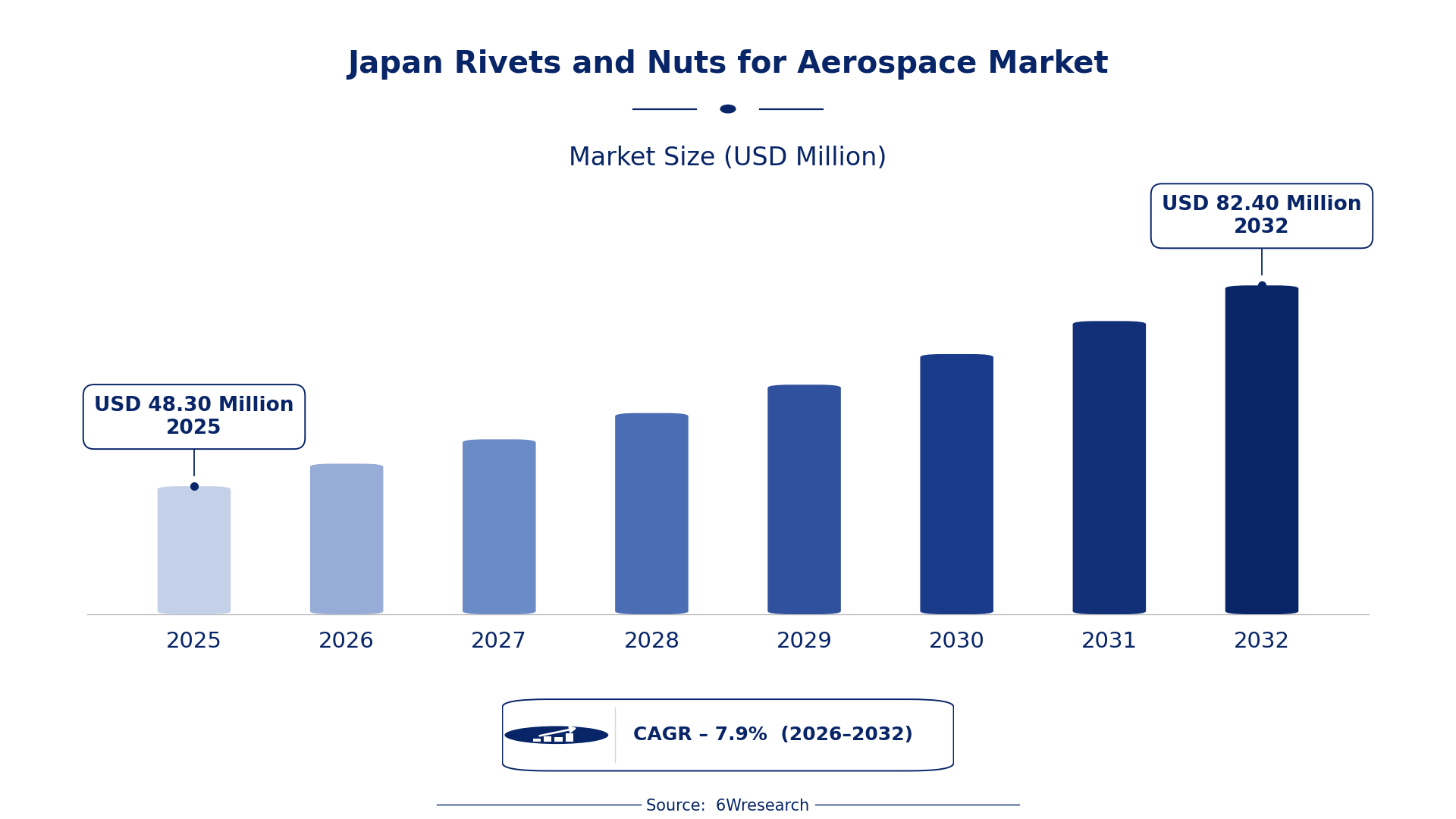
According to 6Wresearch internal database and industry insights, the Japan Rivets and Nuts for Aerospace Market was valued at USD 48.30 Million in 2025 and is projected to reach USD 82.40 Million by 2032, growing at a CAGR of approximately 7.9% during 2026–2032.
Japan Rivets and Nuts for Aerospace Market Highlights
| Report Metric | Details |
| Report Name | Japan Rivets and Nuts for Aerospace Market (2026-2032) |
| Market Size 2025 | USD 48.30 Million |
| Market Size 2032 | USD 82.40 Million |
| Absolute Growth 2025–2032 | USD 34.10 Million |
| CAGR 2026–2032 | 7.9% |
| Peak Annual Growth | 9.3% in 2030 |
| Forecast Period | 2026–2032 |
| Historical Data | 2022–2025 |
| Base Year | 2025 |
| Leading Component Type, 2025 | Blind Rivets (36% share) |
| Leading Material Used, 2025 | Titanium (38% share) |
| Leading Aircraft Type, 2025 | Commercial Aircraft (38% share) |
| Leading End User, 2025 | Aircraft OEMs (36% share) |
| Fastest-Growing Component Type | Solid Rivets (10.9% CAGR) |
| Fastest-Growing Material Used | Aluminum Alloy (11.2% CAGR) |
| Fastest-Growing Aircraft Type | Military Jets (11.1% CAGR) |
| Fastest-Growing End User | Defense Contractors (10.1% CAGR) |
| Growing Sector | Aerospace Manufacturing |
| Key End Users | Aircraft OEMs, Defense Contractors, Maintenance Facilities |
Japan Rivets and Nuts for Aerospace Market Year-wise Growth Rate and Key Drivers (2022–2032)
This graph illustrates the annual growth rates of the market from 2022 to 2032, highlighting a steady upward trajectory and projected market expansion over the forecast period.
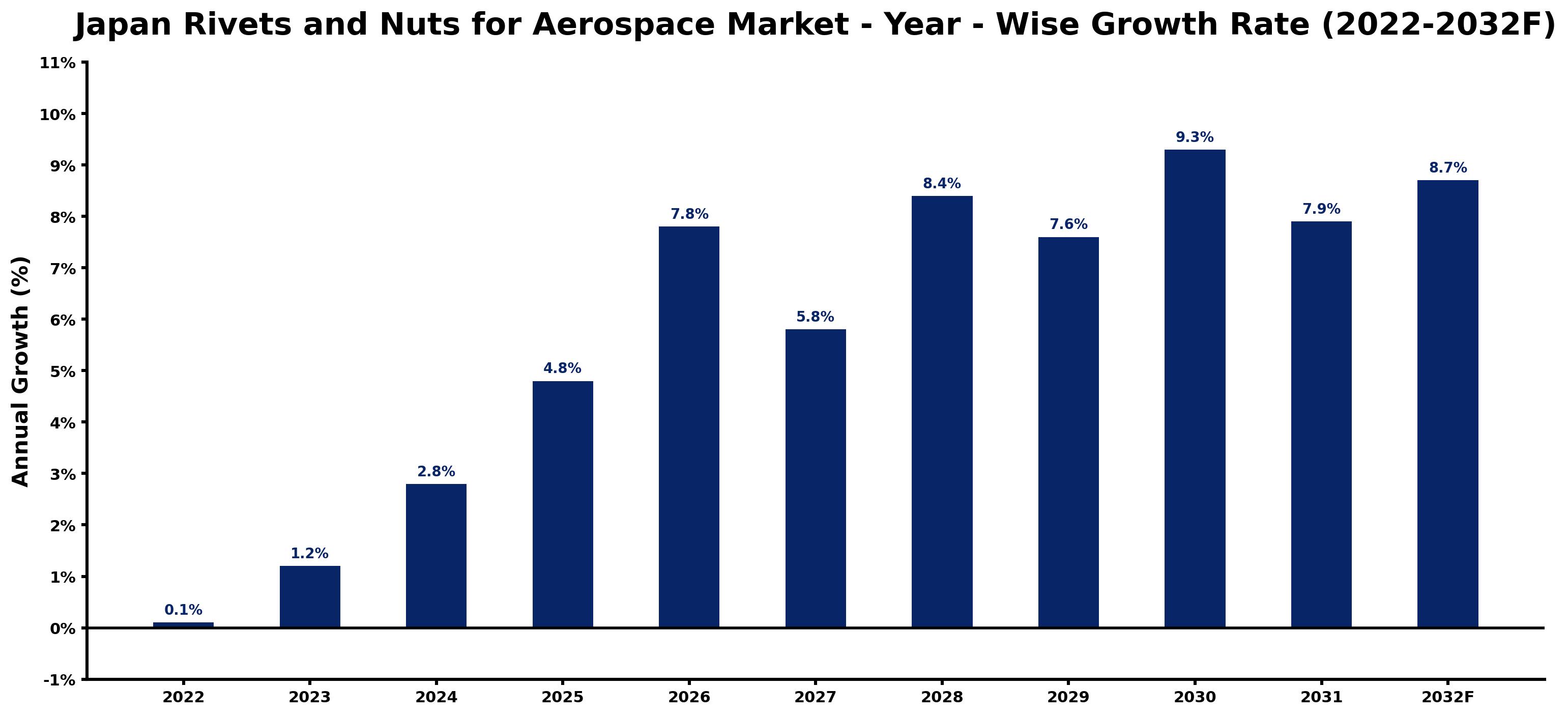
The table below sets out the estimated growth rate for each year and the main factor behind it.
| Year | Estimated Annual Growth (%) | Market Rationale |
| 2022 | 0.1 | The market showed slight growth as demand from aircraft OEMs began to increase. |
| 2023 | 1.2 | Growth accelerated as demand from aircraft OEMs rose due to increased production. |
| 2024 | 2.8 | Demand continued to rise, driven by an uptick in commercial aircraft production. |
| 2025 | 4.8 | The market reached its historical peak as production levels surged. |
| 2026 | 7.8 | Growth is expected to remain strong due to increased military spending on defense contracts. |
| 2027 | 5.8 | Growth is projected to slow as the market begins to stabilise after rapid expansion. |
| 2028 | 8.4 | Demand is expected to pick up again, driven by new aerospace projects in the region. |
| 2029 | 7.6 | Growth is projected to decelerate slightly as production levels normalise across sectors. |
| 2030 | 9.3 | The market is expected to peak again due to heightened demand for military jets. |
| 2031 | 7.9 | Growth is projected to slow as the market adjusts to the previous peak levels. |
| 2032 | 8.7 | Demand is expected to rise again as domestic aircraft production increases. |
Note: Market size estimations and growth projections presented in this report are based on 6Wresearch's proprietary forecasting methodology, utilizing the latest available industry data, government publications, and primary research inputs.
Japan Rivets and Nuts for Aerospace Market Synopsis
Rivets and nuts for aerospace are essential fasteners used to join components in aircraft and spacecraft, primarily made from titanium, aluminum alloys, and stainless steel. The Japan Rivets and Nuts for Aerospace Market is expanding due to increased domestic aircraft production, projected to rise by 20% by 2025. Demand is driven by aircraft OEMs and defense contractors, supported by investments in aerospace technology and manufacturing capabilities.
Market Dynamics Impact Analysis (2026–2032)
| Factor | Type | Impact | Primary Segment Affected |
| Increased domestic aircraft production | Driver | High | Commercial Aircraft |
| Growing military expenditures | Driver | High | Military Jets |
| Emerging demand for lightweight materials | Opportunity | Medium | Titanium |
| Rising need for high-strength fasteners in spacecraft | Opportunity | Medium | High-Strength Fasteners |
| Supply chain vulnerabilities in materials | Restraint | High | Aluminum Alloy |
| High production costs for advanced materials | Restraint | Medium | Titanium |
| Skilled labor shortages in aerospace manufacturing | Challenge | High | Aircraft OEMs |
| Technological advancements in fastener production | Challenge | Medium | Self-Locking Nuts |
Evaluation of Drivers in Japan Rivets and Nuts for Aerospace Market (2026–2032)
Key forces behind demand, with the segment each one moves most, are listed below.
| Drivers | Primary Segment Affected | Why It Matters (Evidence) |
| Increased production of commercial aircraft | Commercial Aircraft | Japan produced 200 commercial aircraft in 2022, driving demand for fasteners. |
| Rising military spending | Military Jets | The Ministry of Defense allocates ¥1 trillion annually for defense procurement, boosting demand. |
| Technological advancements in materials | Aluminum Alloy | The Japanese government aims to increase domestic aircraft production by 20% by 2025, increasing the need for lightweight materials. |
| Growing maintenance operations | Maintenance Facilities | Maintenance facilities in Japan manage over 500 aircraft annually, requiring a steady supply of fasteners. |
| Focus on aerospace innovation | Aerospace Assemblers | The Japan Aerospace Exploration Agency promotes innovation, leading to increased fastener demand. |
Spending rises because Japan's aerospace industry produced 200 commercial aircraft in 2022, increasing demand for fasteners. Military spending has risen, with a budget allocation of ¥1 trillion for defense procurement, boosting the production of military jets. Maintenance operations are expanding, with facilities managing over 500 aircraft annually, necessitating a consistent supply of fasteners. Innovation is being promoted, resulting in greater demand for advanced aerospace components.
Evaluation of Restraints in Japan Rivets and Nuts for Aerospace Market
Below are the constraints most often cited by buyers and suppliers, with the segment each affects.
| Market Restraint | Primary Segment Affected | Why It Matters (Evidence) |
| Supply chain vulnerabilities in critical materials | Aluminum Alloy | Japan's aerospace industry relies heavily on imported materials, which can disrupt production. |
| High production costs for advanced materials | Titanium | The cost of titanium remains high, limiting its widespread use in fasteners. |
| Regulatory compliance costs for manufacturers | Self-Locking Nuts | Compliance with ISO 9001 increases operational costs for fastener producers. |
| Limited skilled labor availability | Aircraft OEMs | Japan's aerospace sector faces a shortage of skilled workers, affecting production efficiency. |
| Technological adaptation challenges | High-Strength Fasteners | Manufacturers struggle to keep up with rapid technological advancements in fastener production. |
Japan Rivets and Nuts for Aerospace Market Challenges
Buyers in the aerospace sector face rising costs due to material shortages, particularly in aluminium alloys, which account for 60% of fasteners used in aircraft. This shortage stems from increased global demand and local production limitations, causing project delays of up to three months for manufacturers. Struggles with technology integration arise from a lack of skilled workers, leading to potential contract losses and reduced competitiveness for producers. Regulatory changes from the Japanese Civil Aviation Bureau can impose compliance costs, forcing buyers to allocate additional budgets for quality assurance, potentially reaching ¥500 million annually.
Trends in the Japan Rivets and Nuts for Aerospace Market
The following changes are redrawing the Japan Rivets and Nuts for Aerospace Market.
- Shift from Aluminium to Titanium: Titanium is increasingly preferred over aluminium alloys for aerospace fasteners due to its lightweight and strength properties. In 2022, titanium accounted for 38% of fasteners used in aircraft, reflecting a shift in material preference.
- Transition to Advanced Manufacturing Techniques: Since 2023, aerospace manufacturers have been adopting advanced manufacturing techniques to improve efficiency. The Tokyo region has seen a 20% increase in production efficiency due to these innovations.
- Emergence of Self-Locking Fasteners: Self-locking nuts are gaining traction in military jets, driven by their ability to prevent loosening under vibration. In 2023, demand for these fasteners increased by 15% as defence contractors sought improved reliability.
- Focus on Sustainability in Aerospace: Aerospace manufacturers are prioritising sustainable practices, with funding for sustainable aerospace projects reaching ¥50 billion in 2022.
Investment Opportunities in the Japan Rivets and Nuts for Aerospace Market
The following opportunities in the Japan Rivets and Nuts for Aerospace Market pair current demand with a clear way in.
- Supply of High-Strength Fasteners: With Japan's defence budget for 2023 including provisions for aerospace technology development, there is a growing need for high-strength fasteners. This segment is expanding, offering opportunities for suppliers.
- Investment in Aerospace Startups: The Tokyo Metropolitan Government supports aerospace startups through funding programs, creating a gap in innovative fastener solutions. In 2023, funding for startups reached ¥10 billion, attracting new entrants.
- Expansion of Maintenance Facilities: As maintenance facilities manage over 500 aircraft annually, the demand for fasteners is increasing. Suppliers can tap into this growing market by establishing partnerships with these facilities.
- Development of Lightweight Fasteners: The shift towards lightweight materials in aerospace is creating opportunities for manufacturers of titanium fasteners. The market is expected to grow as aircraft OEMs seek to enhance fuel efficiency.
Government Initiatives in the Japan Rivets and Nuts for Aerospace Market
The Economic Security Promotion Act, enacted in 2022, supports supply-chain resilience for critical aerospace materials, building on existing laws like the Chemical Substances Control Law. This act ensures that producers must evaluate and control new materials, improving the reliability of fastener supply chains.
The Ministry of Economy, Trade and Industry approves funding for aerospace innovation programs, supporting projects that improve production capabilities. In 2023, the agency allocated ¥50 billion to support advancements in aerospace technology.
Future Insight of the Japan Rivets and Nuts for Aerospace Market
By 2032, buyers will benefit from enhanced production capabilities as the government prioritises domestic aircraft manufacturing. This transformation will support a more resilient supply chain, reducing previous vulnerabilities. Technological advancements from aerospace innovation programmes will streamline manufacturing processes, improving efficiency. The adoption of ISO 9001 standards will ensure higher quality and safety in fasteners, crucial for critical applications. Japan's defence budget for 2023 includes substantial investments in aerospace technology development, creating new opportunities for suppliers.
Market Segmentation Analysis
Japan Rivets and Nuts for Aerospace Market report covers a detailed analysis of the following market segments:
By Component Type – Blind Rivets Lead, Solid Rivets Expected to Grow Fastest
According to Saurav Kr Singh, Senior Research Analyst at 6Wresearch, Blind Rivets held 36% of the Japan Rivets and Nuts for Aerospace Market by component type in 2025. Blind rivets hold the largest share as they are widely used in aircraft assembly, where their ease of installation is crucial. Their significant application in the production of commercial aircraft in the Tokyo region highlights their importance in the market. The quickest growth will come from Solid Rivets, forecast to expand at a CAGR of 10.9% between 2026 and 2032. Solid rivets are witnessing rapid growth due to their essential role in high-strength applications necessary for airframes. The increasing focus on structural integrity in military jets drives the demand for this segment. Suppliers should focus on enhancing solid rivet offerings to meet the rising demands of military applications.
By Material Used – Titanium Leads, Aluminum Alloy Expected to Grow Fastest
Titanium took 38% of material used revenue in 2025, more than any other category. Titanium leads the market as it is used for lightweight and strong components, which are critical in aerospace applications. Its adoption in the manufacturing of commercial aircraft in Japan underscores its significance. Aluminum Alloy is set to record the highest CAGR in this split, 11.2% over 2026–2032. Aluminum alloys are growing quickly due to their common use in various aircraft structures, making them a preferred choice among manufacturers. The Japanese government's push to increase domestic aircraft production by 20% by 2025 is likely to further accelerate this trend. Buyers should consider sourcing more aluminum alloy fasteners to align with the anticipated growth in aircraft production.
By Aircraft Type – Commercial Aircraft Leads, Military Jets Expected to Grow Fastest
In 2025, Commercial Aircraft led the aircraft type split with a 38% share. Commercial aircraft dominate the market as they account for the primary usage of rivets and nuts in Japan's aerospace industry. The production of 200 commercial aircraft in 2022 illustrates the robust demand in this segment. Over 2026–2032, Military Jets are expected to post the fastest growth, at a CAGR of 11.1%. Military jets are growing the fastest due to rising demand for defence applications, particularly from government contracts. The substantial annual defence procurement budget allocated by the Japanese government supports this increasing need. Suppliers need to adapt their strategies to cater to the growing requirements of military jet manufacturers.
By End User – Aircraft OEMs Lead, Defense Contractors Expected to Grow Fastest
With 36% of end user revenue in 2025, Aircraft OEMs was the largest category. Aircraft OEMs are the largest consumers of aerospace fasteners, driven by their central role in aircraft production. Their substantial procurement activities in the Tokyo region highlight their dominance in the market. Defense Contractors are projected to grow fastest, at a CAGR of 10.1% during 2026–2032. Defense contractors are experiencing rapid growth as key users in military applications, particularly with the increasing focus on aerospace technology development. The allocation of ¥1 trillion for defense procurement annually fuels this demand. Suppliers should prioritise partnerships with defense contractors to capitalise on this growing segment.
Key Attractiveness of the Report
- 10 Years of Market Numbers
- Historical Data Starting from 2022 to 2025
- Base Year 2025
- Forecast Data until 2032
- Key Performance Indicators Impacting the Market
- Major Upcoming Developments and Projects
Key Highlights of the Report:
- Japan Rivets and Nuts for Aerospace Market Outlook
- Market Size of Japan Rivets and Nuts for Aerospace Market, 2025
- Forecast of Japan Rivets and Nuts for Aerospace Market, 2032
- Historical Data and Forecast of Japan Rivets and Nuts for Aerospace Revenues & Volume for the Period 2022-2032F
- Japan Rivets and Nuts for Aerospace Market Trend Evolution
- Japan Rivets and Nuts for Aerospace Market Drivers and Challenges
- Japan Rivets and Nuts for Aerospace Price Trends
- Japan Rivets and Nuts for Aerospace Porter's Five Forces
- Japan Rivets and Nuts for Aerospace Industry Life Cycle
- Historical Data and Forecast of Japan Rivets and Nuts for Aerospace Market Revenues & Volume By Component Type for the Period 2022-2032F
- Historical Data and Forecast of Japan Rivets and Nuts for Aerospace Market Revenues & Volume By Blind Rivets for the Period 2022-2032F
- Historical Data and Forecast of Japan Rivets and Nuts for Aerospace Market Revenues & Volume By Solid Rivets for the Period 2022-2032F
- Historical Data and Forecast of Japan Rivets and Nuts for Aerospace Market Revenues & Volume By Self-Locking Nuts for the Period 2022-2032F
- Historical Data and Forecast of Japan Rivets and Nuts for Aerospace Market Revenues & Volume By High-Strength Fasteners for the Period 2022-2032F
- Historical Data and Forecast of Japan Rivets and Nuts for Aerospace Market Revenues & Volume By Material Used for the Period 2022-2032F
- Historical Data and Forecast of Japan Rivets and Nuts for Aerospace Market Revenues & Volume By Titanium for the Period 2022-2032F
- Historical Data and Forecast of Japan Rivets and Nuts for Aerospace Market Revenues & Volume By Aluminum Alloy for the Period 2022-2032F
- Historical Data and Forecast of Japan Rivets and Nuts for Aerospace Market Revenues & Volume By Stainless Steel for the Period 2022-2032F
- Historical Data and Forecast of Japan Rivets and Nuts for Aerospace Market Revenues & Volume By Alloy Steel for the Period 2022-2032F
- Historical Data and Forecast of Japan Rivets and Nuts for Aerospace Market Revenues & Volume By Aircraft Type for the Period 2022-2032F
- Historical Data and Forecast of Japan Rivets and Nuts for Aerospace Market Revenues & Volume By Commercial Aircraft for the Period 2022-2032F
- Historical Data and Forecast of Japan Rivets and Nuts for Aerospace Market Revenues & Volume By Military Jets for the Period 2022-2032F
- Historical Data and Forecast of Japan Rivets and Nuts for Aerospace Market Revenues & Volume By Helicopters for the Period 2022-2032F
- Historical Data and Forecast of Japan Rivets and Nuts for Aerospace Market Revenues & Volume By Spacecraft for the Period 2022-2032F
- Historical Data and Forecast of Japan Rivets and Nuts for Aerospace Market Revenues & Volume By End User for the Period 2022-2032F
- Historical Data and Forecast of Japan Rivets and Nuts for Aerospace Market Revenues & Volume By Aircraft OEMs for the Period 2022-2032F
- Historical Data and Forecast of Japan Rivets and Nuts for Aerospace Market Revenues & Volume By Defense Contractors for the Period 2022-2032F
- Historical Data and Forecast of Japan Rivets and Nuts for Aerospace Market Revenues & Volume By Maintenance Facilities for the Period 2022-2032F
- Historical Data and Forecast of Japan Rivets and Nuts for Aerospace Market Revenues & Volume By Aerospace Assemblers for the Period 2022-2032F
- Japan Rivets and Nuts for Aerospace Import Export Trade Statistics
- Market Opportunity Assessment By Component Type
- Market Opportunity Assessment By Material Used
- Market Opportunity Assessment By Aircraft Type
- Market Opportunity Assessment By End User
- Japan Rivets and Nuts for Aerospace Top Companies Market Share
- Japan Rivets and Nuts for Aerospace Competitive Benchmarking By Technical and Operational Parameters
- Japan Rivets and Nuts for Aerospace Company Profiles
- Japan Rivets and Nuts for Aerospace Key Strategic Recommendations
Market Covered
The study includes the following segmentation.
By Component Type
- Blind Rivets
- Solid Rivets
- Self-Locking Nuts
- High-Strength Fasteners
By Material Used
- Titanium
- Aluminum Alloy
- Stainless Steel
- Alloy Steel
By Aircraft Type
- Commercial Aircraft
- Military Jets
- Helicopters
- Spacecraft
By End User
- Aircraft OEMs
- Defense Contractors
- Maintenance Facilities
- Aerospace Assemblers






































