Japan Road Safety Barriers Market Size & Growth Rate
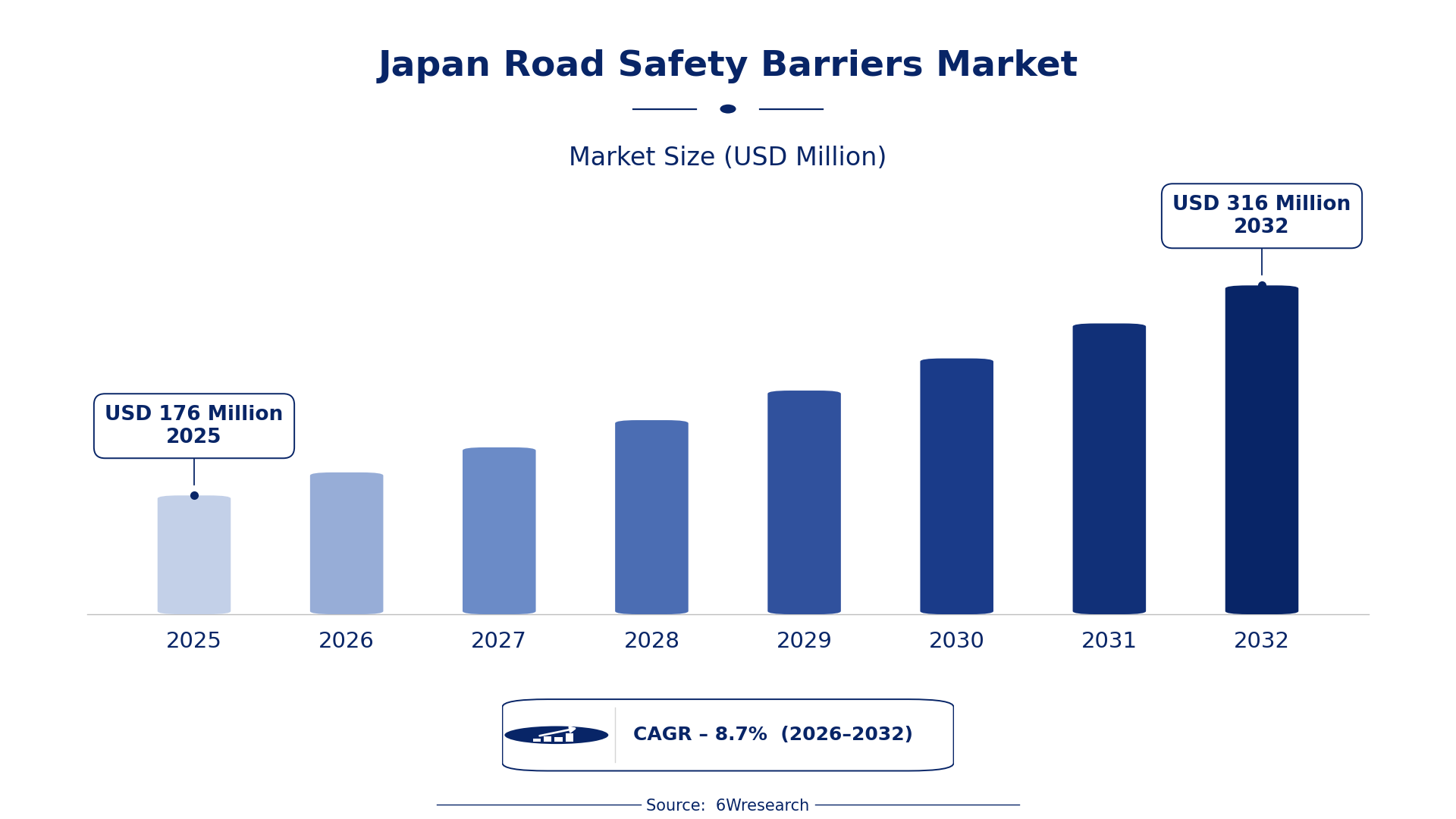
According to 6Wresearch internal database and industry insights, the Japan Road Safety Barriers Market was valued at USD 176 Million in 2025 and is projected to reach USD 316 Million by 2032, growing at a CAGR of approximately 8.7% during 2026–2032.
Japan Road Safety Barriers Market Highlights
| Report Metric | Details |
| Report Name | Japan Road Safety Barriers Market (2026-2032) |
| Market Size 2025 | USD 176 Million |
| Market Size 2032 | USD 316 Million |
| Absolute Growth 2025–2032 | USD 140 Million |
| CAGR 2026–2032 | 8.7% |
| Peak Annual Growth | 9.4% in 2032 |
| Forecast Period | 2026–2032 |
| Historical Data | 2022–2025 |
| Base Year | 2025 |
| Leading Barrier Type, 2025 | W-Beam Guardrails (39% share) |
| Leading Material Type, 2025 | Galvanized Steel (41% share) |
| Leading Installation Type, 2025 | Permanent (56% share) |
| Leading End User, 2025 | Highway Authorities (42% share) |
| Fastest-Growing Barrier Type | Plastic Water-Filled (12.2% CAGR) |
| Fastest-Growing Material Type | Polyethylene (12.7% CAGR) |
| Fastest-Growing Installation Type | Portable (12.6% CAGR) |
| Fastest-Growing End User | Traffic Management Firms (11.2% CAGR) |
| Growing Sector | Traffic Management Firms |
| Key End Users | Highway Authorities, Toll Road Operators, Traffic Management Firms, Safety Equipment Suppliers |
Japan Road Safety Barriers Market Year-wise Growth Rate and Key Drivers (2022–2032)
This graph illustrates the annual growth rates of the market from 2022 to 2032, highlighting a steady upward trajectory and projected market expansion over the forecast period.
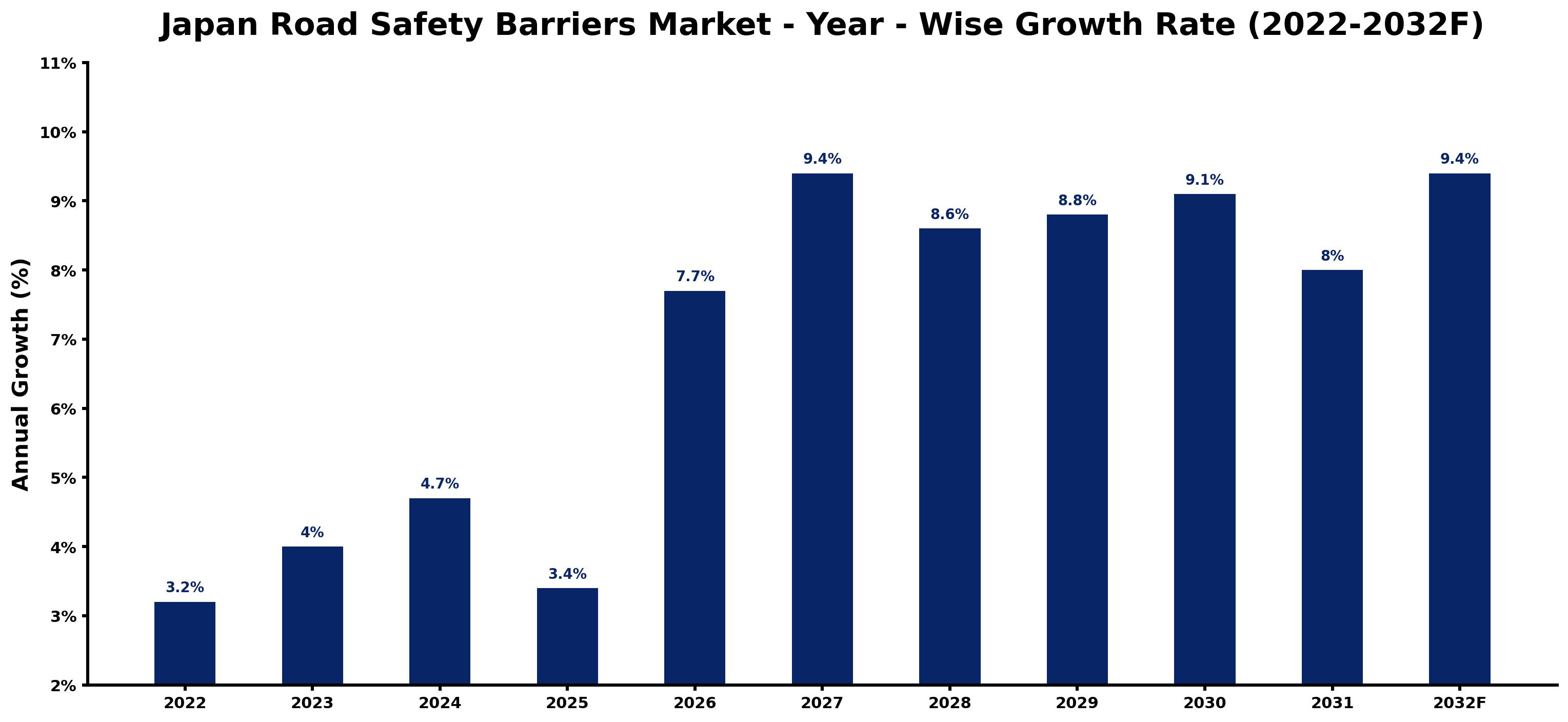
The yearly estimates that follow link every growth rate to its principal driver, so readers can see why the pace changed in each period.
| Year | Estimated Annual Growth (%) | Market Rationale |
| 2022 | 3.2 | The market showed steady growth supported by ongoing infrastructure projects. |
| 2023 | 4.0 | Investment in road safety measures increased, leading to higher demand for barriers. |
| 2024 | 4.7 | The introduction of new safety standards boosted market activity and growth. |
| 2025 | 3.4 | A slight slowdown occurred as projects reached completion, yet demand remained strong. |
| 2026 | 7.7 | Growth is expected to accelerate as highway authorities expand infrastructure development initiatives. |
| 2027 | 9.4 | The peak growth year, driven by substantial investments in road safety improvements. |
| 2028 | 8.6 | Growth is projected to moderate slightly as projects transition to maintenance and upgrades. |
| 2029 | 8.8 | Demand is expected to surge again as urban areas focus on traffic management improvements. |
| 2030 | 9.1 | Continued investments in road safety initiatives will sustain market momentum. |
| 2031 | 8.0 | Growth is projected to slow as the market stabilises following peak investments in infrastructure. |
| 2032 | 9.4 | The market will experience renewed growth driven by new government initiatives. |
Note: Market size estimations and growth projections presented in this report are based on 6Wresearch's proprietary forecasting methodology, utilizing the latest available industry data, government publications, and primary research inputs.
Japan Road Safety Barriers Market Synopsis
Road safety barriers play a vital role in protecting vehicles from roadside hazards and guiding traffic. In Japan, these barriers are primarily made from galvanized steel, precast concrete, and polyethylene, manufactured through welding and molding processes. The Japan Road Safety Association supports market growth, with highway authorities and toll road operators driving demand for over 1,200 km of expressways equipped with these systems. The government allocated ¥5 billion for road safety improvements in 2023, reflecting a strong commitment to enhancing infrastructure and reducing traffic accidents, which decreased by 15% in areas with installed barriers from 2020 to 2022.
Market Dynamics Impact Analysis (2026–2032)
| Factor | Type | Impact | Primary Segment Affected |
| Growing investment in highway infrastructure | Driver | High | W-Beam Guardrails |
| Increased focus on traffic safety standards | Driver | High | Concrete Barriers |
| Rising demand for temporary barriers in urban settings | Opportunity | Medium | Plastic Water-Filled |
| Expansion of traffic management firms seeking effective solutions | Opportunity | Medium | Traffic Management Firms |
| High installation costs of advanced barriers | Restraint | High | W-Beam Guardrails |
| Limited awareness of barrier effectiveness in rural areas | Restraint | Medium | Concrete Barriers |
| Challenges in meeting new height standards for barriers | Challenge | High | Cable Barriers |
| Delays in barrier replacement programs due to funding issues | Challenge | Medium | Precast Concrete |
Evaluation of Drivers in Japan Road Safety Barriers Market (2026–2032)
The following drivers explain most of the expected growth.
| Drivers | Primary Segment Affected | Why It Matters (Evidence) |
| Increased highway construction projects | W-Beam Guardrails | Highway authorities are investing heavily in new expressways, which increases demand for durable barriers, with over 50,000 km of national highways maintained. |
| Implementation of stricter safety regulations | Concrete Barriers | New regulations require upgraded safety measures, prompting authorities to improve existing installations, with a focus on reducing accident severity. |
| Growing urbanisation leading to higher traffic volumes | Plastic Water-Filled | Urban areas are increasingly adopting temporary barriers for events, with a notable rise in demand for lightweight solutions. |
| Expansion of toll road networks | Traffic Management Firms | Toll operators are installing more barriers to manage vehicle flow effectively, ensuring improved safety across their networks. |
| Rising public awareness of road safety | Cable Barriers | Increased focus on reducing accident severity is driving demand for effective barrier solutions, particularly in high-risk areas. |
Volumes grow on the back of highway construction projects, with over 50,000 km of national highways maintained by authorities. Urbanisation is driving demand for temporary solutions, particularly in the Tokyo metropolitan area, where lightweight polyethylene barriers are increasingly used. The growing focus on traffic safety standards compels toll road operators to improve their barrier installations, ensuring better vehicle control and safety. Authorities are investing significantly in durable W-beam guardrails to meet these evolving demands.
Evaluation of Restraints in Japan Road Safety Barriers Market
These restraints slow adoption and weigh on supplier margins.
| Market Restraint | Primary Segment Affected | Why It Matters (Evidence) |
| Producers face a skills gap in advanced barrier manufacturing techniques | W-Beam Guardrails | This gap delays production schedules and increases costs, impacting highway authorities that rely on timely installations. |
| The average installation cost of a W-beam guardrail is approximately ¥15,000 per meter | Concrete Barriers | This cost places financial pressure on buyers, particularly for large-scale projects. |
| Regulatory compliance with JIS standards adds complexity | Plastic Water-Filled | This complexity leads to potential project delays for distributors who must ensure adherence to these guidelines. |
| Supply chain disruptions can occur due to limited material availability | Cable Barriers | Such disruptions force producers to extend lead times, impacting timely delivery to infrastructure projects. |
| Market competition can drive down profit margins | Concrete Barriers | This competition pressures producers to reduce prices, affecting their overall profitability. |
Japan Road Safety Barriers Market Challenges
Producers encounter a skills gap in advanced manufacturing techniques, which delays project timelines and raises installation costs, impacting highway authorities. The average installation cost of a W-beam guardrail is approximately ¥15,000 per meter, creating budget constraints for buyers who must secure additional funding. Regulatory compliance with JIS standards complicates operations, causing potential project delays for distributors navigating these requirements. Supply chain disruptions stem from limited material availability, forcing producers to extend lead times and delaying the delivery of essential safety infrastructure to road projects.
Trends in the Japan Road Safety Barriers Market
These developments are changing demand patterns in the Japan Road Safety Barriers Market.
- New Government Initiative for Rural Roads: In 2023, a new government initiative aims to improve barrier installation on rural roads, with a budget of ¥5 billion allocated for upgrades. This shift indicates a growing focus on safety in less urbanised areas, creating opportunities for suppliers.
- Shift Towards Lightweight Barriers: The Tokyo Metropolitan Government is increasingly adopting lightweight polyethylene barriers for temporary traffic management applications. This trend is driven by the need for flexibility in urban planning, with demand rising significantly as events and construction projects increase.
- Focus on Barrier Height Standards: In 2023, the government proposed new regulations for barrier height standards on highways, aiming to standardise safety measures. This initiative is expected to improve compliance and overall road safety across the country.
- Expansion of Cable Barrier Testing: The installation of cable barriers is being tested in high-speed zones to improve safety. This development reflects a growing interest in innovative solutions to enhance road safety, particularly in areas with high traffic volumes.
Investment Opportunities in the Japan Road Safety Barriers Market
Where to invest in the Japan Road Safety Barriers Market: the main openings are set out below.
- Highway Authorities Seeking Durable Solutions: Highway authorities are increasingly looking for durable road safety barriers, with a projected market size of USD 316 million by 2032. Collaborating with local manufacturers can facilitate entry into this expanding market.
- Growing Demand for Temporary Barriers: The market for temporary barriers is rising, particularly in urban areas, as events become more frequent. Suppliers can enter this market by partnering with traffic management firms.
- Investment in Road Safety Improvements: With the government allocating ¥5 billion for road safety improvements in 2023, there is a strong opportunity for suppliers of advanced barrier systems. Establishing joint ventures with local firms can enhance market entry.
- Focus on Urban Traffic Management: Traffic management firms are increasingly investing in effective barrier solutions to improve urban safety. Suppliers can capitalise on this trend by providing innovative products that meet evolving safety standards.
Government Initiatives in the Japan Road Safety Barriers Market
The 2023 initiative aims to improve barrier installation on rural roads, adding to existing laws that govern road safety. This initiative complements the Building Energy Efficiency Act (2015, amended 2022), which sets standards for infrastructure projects, ensuring compliance with safety regulations.
In 2023, the government allocated ¥5 billion for road safety improvements, overseen by the Ministry of Land, Infrastructure, Transport and Tourism. This funding aims to support barrier installation and maintenance, ensuring that road safety standards are met effectively.
Future Insight of the Japan Road Safety Barriers Market
The government has allocated ¥5 billion for road safety improvements, which will drive demand for enhanced barrier systems. By 2032, the introduction of updated regulations on barrier height standards will standardise installations, benefiting both buyers and suppliers. New initiatives to improve installations on rural roads will create additional market opportunities. Advancements in technology, such as the testing of innovative barrier designs in high-speed zones, will improve road safety and contribute to a further decrease in accident severity.
Market Segmentation Analysis
Japan Road Safety Barriers Market report covers a detailed analysis of the following market segments:
By Barrier Type – W-Beam Guardrails Lead, Plastic Water-Filled Expected to Grow Fastest
According to Saurav Kr Singh, Senior Research Analyst at 6Wresearch, W-Beam Guardrails accounted for 39% of the market by barrier type in 2025. W-Beam Guardrails command the largest share due to their extensive application for vehicle containment and guidance, particularly on Japan's expressways. Their proven effectiveness in accident prevention has resulted in their installation along over 1,200 km of expressways. Plastic Water-Filled is projected to grow fastest, at a CAGR of 12.2% during 2026–2032. Plastic Water-Filled barriers are growing rapidly as they are increasingly used in temporary setups for events and construction, indicating a shift towards more adaptable traffic management solutions. This trend is driven by the rising demand for portable barriers in urban settings. Suppliers should prioritise the development of portable barrier options to cater to the increasing demand from temporary usage scenarios.
By Material Type – Galvanized Steel Leads, Polyethylene Expected to Grow Fastest
Galvanized Steel took 41% of material type revenue in 2025, more than any other category. Galvanized Steel leads the market as it is the primary material recognised for its durability and resistance to corrosion, making it suitable for long-term installations. Its reliability has resulted in widespread application across various road safety initiatives in Japan. The quickest growth will come from Polyethylene, forecast to expand at a CAGR of 12.7% between 2026 and 2032. Polyethylene is experiencing the fastest growth due to its lightweight and portable characteristics, making it ideal for temporary barriers in traffic management. This material's versatility is becoming increasingly attractive to firms seeking flexible solutions. Buyers should consider lightweight materials to improve the efficiency of their road safety implementations.
By Installation Type – Permanent Leads, Portable Expected to Grow Fastest
In 2025, Permanent led the installation type split with a 56% share. Permanent installations are the most prevalent as they are designed for long-term road safety, ensuring consistent protection on highways. The commitment of highway authorities to maintain over 50,000 km of national highways reinforces the demand for permanent solutions. Over 2026–2032, Portable is expected to post the fastest growth, at a CAGR of 12.6%. Portable installations are growing rapidly as they cater to temporary setups, which are increasingly required for events and construction projects. This shift reflects a broader trend towards flexibility in traffic management. Suppliers should consider expanding their product lines to include more portable solutions to capture the growing temporary installation market.
By End User – Highway Authorities Lead, Traffic Management Firms Expected to Grow Fastest
The largest end user category in 2025 was Highway Authorities, at 42% of revenue. Highway Authorities hold the largest share as they manage over 50,000 km of national highways and are directly responsible for implementing road safety measures. Their commitment to maintaining and improving road safety drives consistent demand for effective barrier solutions throughout Japan. Traffic Management Firms are set to record the highest CAGR in this split, 11.2% over 2026–2032. Traffic Management Firms are experiencing rapid growth due to their increasing role in optimising barrier placement, which is essential for enhancing road safety. This trend is particularly evident as infrastructure projects expand, necessitating expert consultation for effective traffic management. This indicates that suppliers must engage with traffic management firms to ensure their products meet the specific needs of road safety initiatives.
Key Attractiveness of the Report
- 10 Years of Market Numbers
- Historical Data Starting from 2022 to 2025
- Base Year 2025
- Forecast Data until 2032
- Key Performance Indicators Impacting the Market
- Major Upcoming Developments and Projects
Key Highlights of the Report:
- Japan Road Safety Barriers Market Outlook
- Market Size of Japan Road Safety Barriers Market, 2025
- Forecast of Japan Road Safety Barriers Market, 2032
- Historical Data and Forecast of Japan Road Safety Barriers Revenues & Volume for the Period 2022-2032F
- Japan Road Safety Barriers Market Trend Evolution
- Japan Road Safety Barriers Market Drivers and Challenges
- Japan Road Safety Barriers Price Trends
- Japan Road Safety Barriers Porter's Five Forces
- Japan Road Safety Barriers Industry Life Cycle
- Historical Data and Forecast of Japan Road Safety Barriers Market Revenues & Volume By Barrier Type for the Period 2022-2032F
- Historical Data and Forecast of Japan Road Safety Barriers Market Revenues & Volume By W-Beam Guardrails for the Period 2022-2032F
- Historical Data and Forecast of Japan Road Safety Barriers Market Revenues & Volume By Concrete Barriers for the Period 2022-2032F
- Historical Data and Forecast of Japan Road Safety Barriers Market Revenues & Volume By Plastic Water-Filled for the Period 2022-2032F
- Historical Data and Forecast of Japan Road Safety Barriers Market Revenues & Volume By Cable Barriers for the Period 2022-2032F
- Historical Data and Forecast of Japan Road Safety Barriers Market Revenues & Volume By Material Type for the Period 2022-2032F
- Historical Data and Forecast of Japan Road Safety Barriers Market Revenues & Volume By Galvanized Steel for the Period 2022-2032F
- Historical Data and Forecast of Japan Road Safety Barriers Market Revenues & Volume By Precast Concrete for the Period 2022-2032F
- Historical Data and Forecast of Japan Road Safety Barriers Market Revenues & Volume By Polyethylene for the Period 2022-2032F
- Historical Data and Forecast of Japan Road Safety Barriers Market Revenues & Volume By Steel Wire Rope for the Period 2022-2032F
- Historical Data and Forecast of Japan Road Safety Barriers Market Revenues & Volume By Installation Type for the Period 2022-2032F
- Historical Data and Forecast of Japan Road Safety Barriers Market Revenues & Volume By Permanent for the Period 2022-2032F
- Historical Data and Forecast of Japan Road Safety Barriers Market Revenues & Volume By Fixed for the Period 2022-2032F
- Historical Data and Forecast of Japan Road Safety Barriers Market Revenues & Volume By Portable for the Period 2022-2032F
- Historical Data and Forecast of Japan Road Safety Barriers Market Revenues & Volume By Semi-Rigid for the Period 2022-2032F
- Historical Data and Forecast of Japan Road Safety Barriers Market Revenues & Volume By End User for the Period 2022-2032F
- Historical Data and Forecast of Japan Road Safety Barriers Market Revenues & Volume By Highway Authorities for the Period 2022-2032F
- Historical Data and Forecast of Japan Road Safety Barriers Market Revenues & Volume By Toll Road Operators for the Period 2022-2032F
- Historical Data and Forecast of Japan Road Safety Barriers Market Revenues & Volume By Traffic Management Firms for the Period 2022-2032F
- Historical Data and Forecast of Japan Road Safety Barriers Market Revenues & Volume By Safety Equipment Suppliers for the Period 2022-2032F
- Japan Road Safety Barriers Import Export Trade Statistics
- Market Opportunity Assessment By Barrier Type
- Market Opportunity Assessment By Material Type
- Market Opportunity Assessment By Installation Type
- Market Opportunity Assessment By End User
- Japan Road Safety Barriers Top Companies Market Share
- Japan Road Safety Barriers Competitive Benchmarking By Technical and Operational Parameters
- Japan Road Safety Barriers Company Profiles
- Japan Road Safety Barriers Key Strategic Recommendations
Market Covered
The report covers the following segments.
By Barrier Type
- W-Beam Guardrails
- Concrete Barriers
- Plastic Water-Filled
- Cable Barriers
By Material Type
- Galvanized Steel
- Precast Concrete
- Polyethylene
- Steel Wire Rope
By Installation Type
- Permanent
- Fixed
- Portable
- Semi-Rigid
By End User
- Highway Authorities
- Toll Road Operators
- Traffic Management Firms
- Safety Equipment Suppliers































