Japan Robot Control Software Market Size & Growth Rate
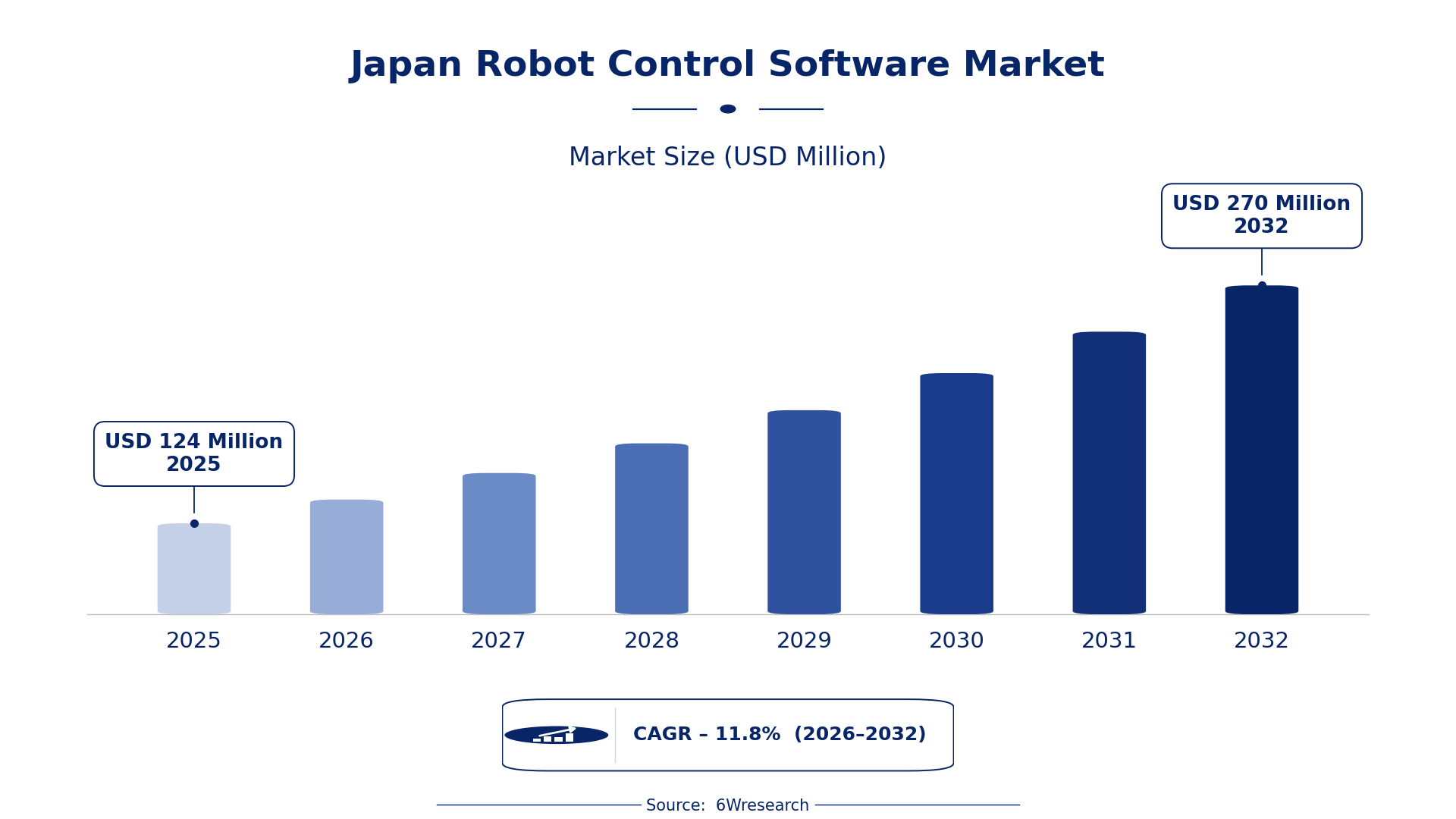
According to 6Wresearch internal database and industry insights, the Japan Robot Control Software Market was valued at USD 124 Million in 2025 and is projected to reach USD 270 Million by 2032, growing at a CAGR of approximately 11.8% during 2026–2032.
Japan Robot Control Software Market Highlights
| Report Metric | Details |
| Report Name | Japan Robot Control Software Market (2026-2032) |
| Market Size 2025 | USD 124 Million |
| Market Size 2032 | USD 270 Million |
| Absolute Growth 2025–2032 | USD 146 Million |
| CAGR 2026–2032 | 11.8% |
| Peak Annual Growth | 12.7% in 2029 |
| Forecast Period | 2026–2032 |
| Historical Data | 2022–2025 |
| Base Year | 2025 |
| Leading Software Type, 2025 | Motion Control (52% share) |
| Leading Control Method, 2025 | Trajectory-Based (38% share) |
| Leading Application Area, 2025 | Industrial Automation (46% share) |
| Leading End User, 2025 | Manufacturing Plants (45% share) |
| Fastest-Growing Software Type | PLC-Based (16.8% CAGR) |
| Fastest-Growing Control Method | Ladder Logic (17.1% CAGR) |
| Fastest-Growing Application Area | Assembly Lines (14.4% CAGR) |
| Fastest-Growing End User | System Integrators (15.3% CAGR) |
| Growing Sector | Industrial Automation |
| Key End Users | Manufacturing Plants, System Integrators, Robotics Developers, Engineering Teams |
Japan Robot Control Software Market Year-wise Growth Rate and Key Drivers (2022–2032)
This graph illustrates the annual growth rates of the market from 2022 to 2032, highlighting a steady upward trajectory and projected market expansion over the forecast period.
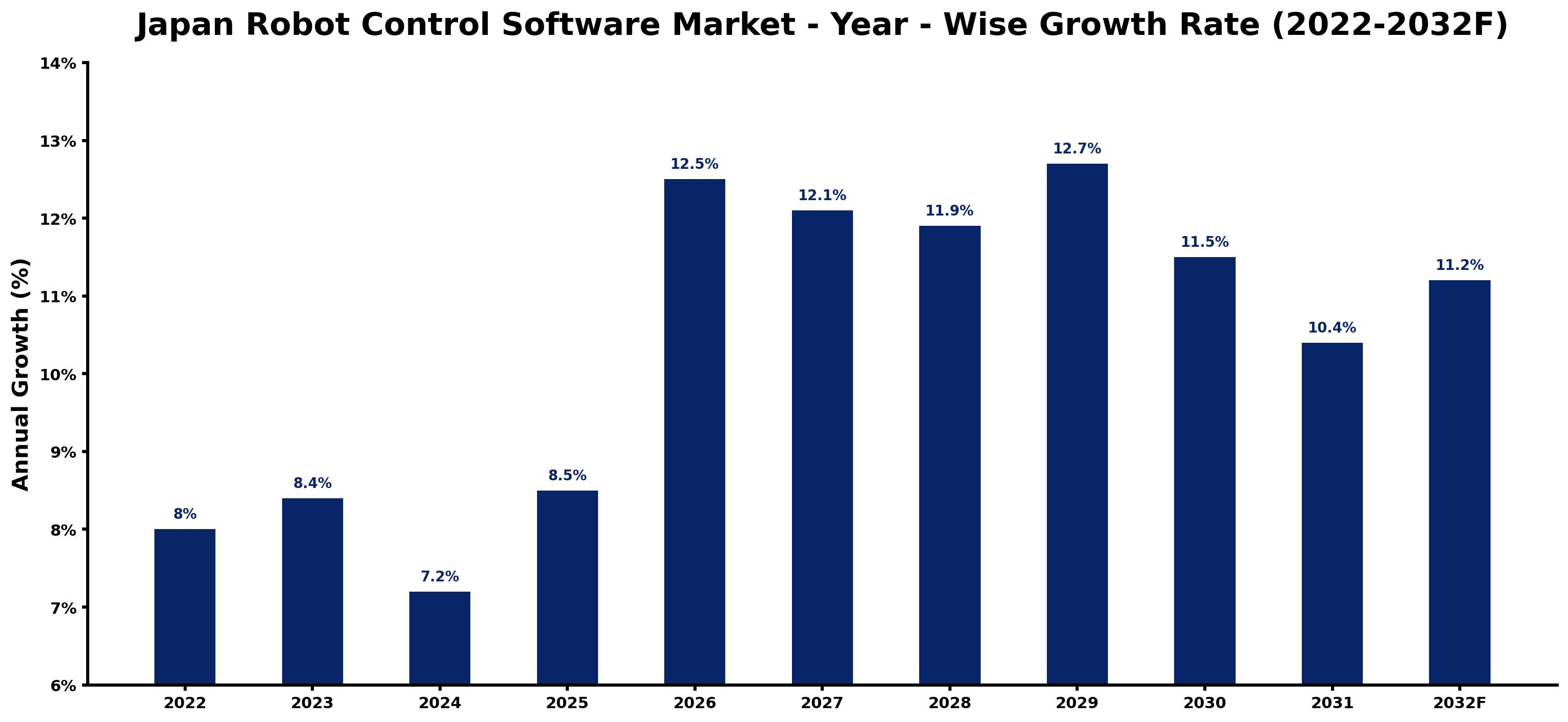
Each row of the following table gives one year's estimated growth and the event or demand shift that explains it.
| Year | Estimated Annual Growth (%) | Market Rationale |
| 2022 | 8.0 | The market showed solid growth, driven by increased automation in manufacturing. |
| 2023 | 8.4 | Demand surged as local manufacturers sought advanced automation solutions. |
| 2024 | 7.2 | Growth slowed slightly due to market saturation in some sectors. |
| 2025 | 8.5 | The market rebounded, supported by new robotics initiatives and investments. |
| 2026 | 12.5 | Investment in automation technologies is expected to accelerate, boosting demand. |
| 2027 | 12.1 | A slight slowdown is projected as the market adjusts to previous growth rates. |
| 2028 | 11.9 | Demand will remain strong, although growth rates are expected to stabilise. |
| 2029 | 12.7 | The peak growth year will see heightened investments in robotics technology. |
| 2030 | 11.5 | Growth will slow as the market matures and competition intensifies. |
| 2031 | 10.4 | A further slowdown will reflect market saturation in certain applications. |
| 2032 | 11.2 | Demand will increase again, driven by new innovations and applications. |
Note: Market size estimations and growth projections presented in this report are based on 6Wresearch's proprietary forecasting methodology, utilizing the latest available industry data, government publications, and primary research inputs.
Japan Robot Control Software Market Synopsis
Robot control software automates robotic systems across various sectors, particularly in industrial automation and robotics research. Japan's manufacturing sector, which employs over 10 million workers, relies heavily on this technology to improve operational efficiency. The Japan Robot Control Software Market is growing due to increased investments in automation, primarily from local manufacturers and system integrators. The 'New Robot Strategy' and 'Society 5.0' programme are key drivers, promoting the integration of robotics into daily life.
Market Dynamics Impact Analysis (2026–2032)
| Factor | Type | Impact | Primary Segment Affected |
| Rising investments in automation technologies | Driver | High | Motion Control |
| Increased demand for industrial robots in manufacturing | Driver | High | Industrial Automation |
| Growing need for advanced robotics solutions | Opportunity | High | AI-Based Controllers |
| Expansion of robotics applications in various sectors | Opportunity | Medium | Robotics R&D |
| Challenges in compliance with safety standards | Restraint | High | PLC-Based |
| Limited awareness of advanced robot control systems | Restraint | Medium | Simulation Software |
| High initial investment costs for advanced systems | Challenge | High | Trajectory-Based |
| Shortage of skilled workforce in robotics | Challenge | Medium | Manufacturing Plants |
Evaluation of Drivers in Japan Robot Control Software Market (2026–2032)
Below are the drivers that matter most for revenue growth, with supporting evidence.
| Drivers | Primary Segment Affected | Why It Matters (Evidence) |
| Increased automation in manufacturing processes | Motion Control | This trend is clear as Japan's manufacturing sector employs over 10 million workers, driving demand for precise robot movements. |
| Rising production of industrial robots | Industrial Automation | In 2022, Japan produced approximately 200,000 industrial robots, reflecting the growing need for automation. |
| Investment in robotics research and development | AI-Based Controllers | Advancements at the Tokyo Institute of Technology boost demand for AI-based solutions. |
| Expansion of robotics in diverse applications | Robotics R&D | The 'Society 5.0' initiative aims to integrate robotics into everyday life, increasing demand for various applications. |
| Government support for robotics initiatives | Simulation Software | The 'New Robot Strategy' programme promotes innovation and development in robotics, driving software demand. |
The strongest pull on demand comes from increased automation in manufacturing processes, with Japan's manufacturing sector employing over 10 million workers. In 2022, the production of approximately 200,000 industrial robots highlighted the rising need for industrial automation. Investment in robotics research at the Tokyo Institute of Technology is driving demand for advanced solutions.
Evaluation of Restraints in Japan Robot Control Software Market
The main factors holding the market back are set out below.
| Market Restraint | Primary Segment Affected | Why It Matters (Evidence) |
| Compliance with safety standards is challenging | PLC-Based | The JIS B 8430 standard governs robot safety, requiring manufacturers to invest in compliance. |
| Limited awareness of advanced control systems | Simulation Software | Many manufacturers lack knowledge about the benefits of simulation software, hindering adoption. |
| High initial investment costs for advanced systems | Trajectory-Based | The cost of implementing advanced systems can deter smaller manufacturers from investing. |
| Shortage of skilled workforce in robotics | Manufacturing Plants | The average age of manufacturing plants in Japan is 25 years, complicating workforce training. |
| Market saturation in certain sectors | AI-Based Controllers | As the market matures, growth rates are stabilising due to saturation in established applications. |
Japan Robot Control Software Market Challenges
Manufacturers are contending with a skills gap as Japan's workforce ages, limiting the pool of qualified personnel for robotics programming and maintenance, which can delay project timelines. Regulatory requirements, including compliance with ISO 10218 and JIS B 8430 standards, add costs for system integrators, compelling them to invest in safety upgrades that may prolong project durations. Development costs for robotics software often exceed ¥10 million, making it challenging for smaller firms to compete and hindering innovation. Supply chain disruptions in sourcing critical components result in production delays, affecting delivery schedules for buyers and raising their operational risks.
Trends in the Japan Robot Control Software Market
Buyers and suppliers in the Japan Robot Control Software Market are adjusting to the following trends.
- Shift from Traditional to Advanced Control Systems: Japan is transitioning from traditional control systems to advanced AI-based controllers, driven by the need for efficiency. The Tokyo region is leading this change, with over 1,500 robotics-related companies registered.
- Increasing Integration of Robotics in Everyday Life: The 'Society 5.0' initiative, launched in 2020, aims to integrate robotics into daily activities, improving productivity. This shift is supported by a growing installed base of over 400,000 industrial robots.
- Growing Demand for Simulation Software: There is a rising need for simulation software to test and develop robotic systems, particularly in research. In 2023, the government allocated ¥10 billion for robotics research funding, boosting this trend.
- Expansion of Robotics in Manufacturing: The Chubu region is experiencing a surge in robotics integration within automotive manufacturing. In 2022, Japan produced approximately 200,000 industrial robots, reflecting this growing trend.
Investment Opportunities in the Japan Robot Control Software Market
The opportunities below stand out in the Japan Robot Control Software Market for new entrants and existing suppliers.
- Tokyo as a Robotics Development Hub: Tokyo is a leading hub for robotics development, with over 1,500 registered companies. This presents an opportunity for investment in advanced robotics solutions, driven by local manufacturers.
- Investment Gap in AI-Based Controllers: The demand for AI-based controllers is rising, with a projected CAGR of 16.8%. System integrators are seeking innovative solutions, providing an entry point for new suppliers.
- Need for Robotics in Manufacturing Plants: Manufacturing plants are increasingly adopting automation technologies. With over 10 million workers in the sector, there is a growing need for advanced robot control software.
- Collaboration with Robotics Developers: Robotics developers are focusing on creating advanced applications, presenting opportunities for partnerships. Engaging in joint ventures can facilitate market entry and innovation.
Government Initiatives in the Japan Robot Control Software Market
The 'New Robot Strategy' initiated in 2015 aims to improve robot utilisation across various sectors, including manufacturing and services. This strategy encourages producers to adopt advanced technologies and comply with safety standards, such as ISO 10218 and JIS B 8430. By promoting automation, the strategy is expected to boost the demand for robot control software, benefiting local manufacturers and system integrators.
In 2023, the government allocated ¥10 billion for robotics research funding through the Ministry of Economy, Trade and Industry. This funding supports projects that enhance automation and robotics integration in industries. The Digital Agency oversees the implementation of common system standards, ensuring compliance and safety in robotic applications, which directly impacts buyers and producers in the market.
Future Insight of the Japan Robot Control Software Market
Investment in robotics will increase, driven by government initiatives and funding, creating strong demand for control software. By 2032, the installed base of industrial robots is projected to exceed 600,000 units, necessitating advanced programming solutions. The Tokyo region will continue to develop as a key innovation centre, encouraging collaboration among over 1,500 robotics-related companies. New safety and performance standards will simplify compliance, benefiting both buyers and suppliers in the robotics market.
Market Segmentation Analysis
Japan Robot Control Software Market report covers a detailed analysis of the following market segments:
By Software Type – Motion Control Leads, PLC-Based Expected to Grow Fastest
According to Saurav Kr Singh, Senior Research Analyst at 6Wresearch, Motion Control held 52% of the Japan Robot Control Software Market by software type in 2025. Motion Control holds the largest share due to its essential role in ensuring precise movements of robots, which is critical for various applications. This software type is vital for the installed base of over 400,000 industrial robots in Japan, ensuring optimal performance across manufacturing sectors. PLC-Based is projected to grow fastest, at a CAGR of 16.8% during 2026–2032. PLC-Based software is experiencing rapid growth as it is widely adopted in industrial settings for automation, driven by the need for efficient manufacturing processes. The government's backing through initiatives like the 'Smart Manufacturing Strategy' is accelerating its adoption in the industry. Suppliers should focus on enhancing their PLC-Based offerings to meet the increasing demand from manufacturers.
By Control Method – Trajectory-Based Leads, Ladder Logic Expected to Grow Fastest
Trajectory-Based took 38% of control method revenue in 2025, more than any other category. Trajectory-Based control methods dominate the market as they are crucial for effective path planning in robotics, which is vital for various industrial applications. The emphasis on robotics development in the Tokyo region highlights the importance of this method in enhancing operational efficiency. The quickest growth will come from Ladder Logic, forecast to expand at a CAGR of 17.1% between 2026 and 2032. Ladder Logic is growing quickly due to its common use in industrial control systems, which are essential for automating processes in manufacturing. The integration of Ladder Logic into existing systems is supported by initiatives like the 'Robot Revolution Initiative' program, further boosting its adoption. Buyers should consider investing in Ladder Logic solutions to improve their automation capabilities.
By Application Area – Industrial Automation Leads, Assembly Lines Expected to Grow Fastest
With 46% of application area revenue in 2025, Industrial Automation was the largest category. Industrial Automation is the leading application area as it serves as the core focus for enhancing efficiency in manufacturing processes. The substantial employment of over 10 million workers in Japan's manufacturing sector underscores the critical role of automation in this area. Over 2026–2032, Assembly Lines are expected to post the fastest growth, at a CAGR of 14.4%. Assembly Lines are witnessing the fastest growth as they are integral to modern manufacturing processes, particularly in sectors like automotive. The Chubu region's reputation for automotive manufacturing further drives the demand for advanced assembly line solutions, enhancing overall productivity. Suppliers must tailor their products to meet the specific needs of assembly line applications to capture this growing market.
By End User – Manufacturing Plants Lead, System Integrators Expected to Grow Fastest
The largest end user category in 2025 was Manufacturing Plants, at 45% of revenue. Manufacturing Plants are the primary end users of robot control software, as they directly implement automation technologies to enhance productivity. The average age of manufacturing plants in Japan, at 25 years, indicates a pressing need for modernisation through automation solutions. System Integrators are set to record the highest CAGR in this split, 15.3% over 2026–2032. System Integrators are experiencing the fastest growth as they play a critical role in implementing automation solutions across various sectors. The increasing complexity of automation projects necessitates the expertise of system integrators, further driving their demand in the market. Suppliers should strengthen partnerships with system integrators to effectively penetrate the market.
Key Attractiveness of the Report
- 10 Years of Market Numbers
- Historical Data Starting from 2022 to 2025
- Base Year 2025
- Forecast Data until 2032
- Key Performance Indicators Impacting the Market
- Major Upcoming Developments and Projects
Key Highlights of the Report:
- Japan Robot Control Software Market Outlook
- Market Size of Japan Robot Control Software Market, 2025
- Forecast of Japan Robot Control Software Market, 2032
- Historical Data and Forecast of Japan Robot Control Software Revenues & Volume for the Period 2022-2032F
- Japan Robot Control Software Market Trend Evolution
- Japan Robot Control Software Market Drivers and Challenges
- Japan Robot Control Software Price Trends
- Japan Robot Control Software Porter's Five Forces
- Japan Robot Control Software Industry Life Cycle
- Historical Data and Forecast of Japan Robot Control Software Market Revenues & Volume By Software Type for the Period 2022-2032F
- Historical Data and Forecast of Japan Robot Control Software Market Revenues & Volume By Motion Control for the Period 2022-2032F
- Historical Data and Forecast of Japan Robot Control Software Market Revenues & Volume By PLC-Based for the Period 2022-2032F
- Historical Data and Forecast of Japan Robot Control Software Market Revenues & Volume By AI-Based Controllers for the Period 2022-2032F
- Historical Data and Forecast of Japan Robot Control Software Market Revenues & Volume By Simulation Software for the Period 2022-2032F
- Historical Data and Forecast of Japan Robot Control Software Market Revenues & Volume By Control Method for the Period 2022-2032F
- Historical Data and Forecast of Japan Robot Control Software Market Revenues & Volume By Trajectory-Based for the Period 2022-2032F
- Historical Data and Forecast of Japan Robot Control Software Market Revenues & Volume By Ladder Logic for the Period 2022-2032F
- Historical Data and Forecast of Japan Robot Control Software Market Revenues & Volume By Reinforcement Learning for the Period 2022-2032F
- Historical Data and Forecast of Japan Robot Control Software Market Revenues & Volume By Digital Twin for the Period 2022-2032F
- Historical Data and Forecast of Japan Robot Control Software Market Revenues & Volume By Application Area for the Period 2022-2032F
- Historical Data and Forecast of Japan Robot Control Software Market Revenues & Volume By Industrial Automation for the Period 2022-2032F
- Historical Data and Forecast of Japan Robot Control Software Market Revenues & Volume By Assembly Lines for the Period 2022-2032F
- Historical Data and Forecast of Japan Robot Control Software Market Revenues & Volume By Autonomous Systems for the Period 2022-2032F
- Historical Data and Forecast of Japan Robot Control Software Market Revenues & Volume By Robotics R&D for the Period 2022-2032F
- Historical Data and Forecast of Japan Robot Control Software Market Revenues & Volume By End User for the Period 2022-2032F
- Historical Data and Forecast of Japan Robot Control Software Market Revenues & Volume By Manufacturing Plants for the Period 2022-2032F
- Historical Data and Forecast of Japan Robot Control Software Market Revenues & Volume By System Integrators for the Period 2022-2032F
- Historical Data and Forecast of Japan Robot Control Software Market Revenues & Volume By Robotics Developers for the Period 2022-2032F
- Historical Data and Forecast of Japan Robot Control Software Market Revenues & Volume By Engineering Teams for the Period 2022-2032F
- Japan Robot Control Software Import Export Trade Statistics
- Market Opportunity Assessment By Software Type
- Market Opportunity Assessment By Control Method
- Market Opportunity Assessment By Application Area
- Market Opportunity Assessment By End User
- Japan Robot Control Software Top Companies Market Share
- Japan Robot Control Software Competitive Benchmarking By Technical and Operational Parameters
- Japan Robot Control Software Company Profiles
- Japan Robot Control Software Key Strategic Recommendations
Market Covered
Coverage by segment is as follows.
By Software Type
- Motion Control
- PLC-Based
- AI-Based Controllers
- Simulation Software
By Control Method
- Trajectory-Based
- Ladder Logic
- Reinforcement Learning
- Digital Twin
By Application Area
- Industrial Automation
- Assembly Lines
- Autonomous Systems
- Robotics R&D
By End User
- Manufacturing Plants
- System Integrators
- Robotics Developers
- Engineering Teams































