Japan Robotic Assembly Systems Market Size & Growth Rate
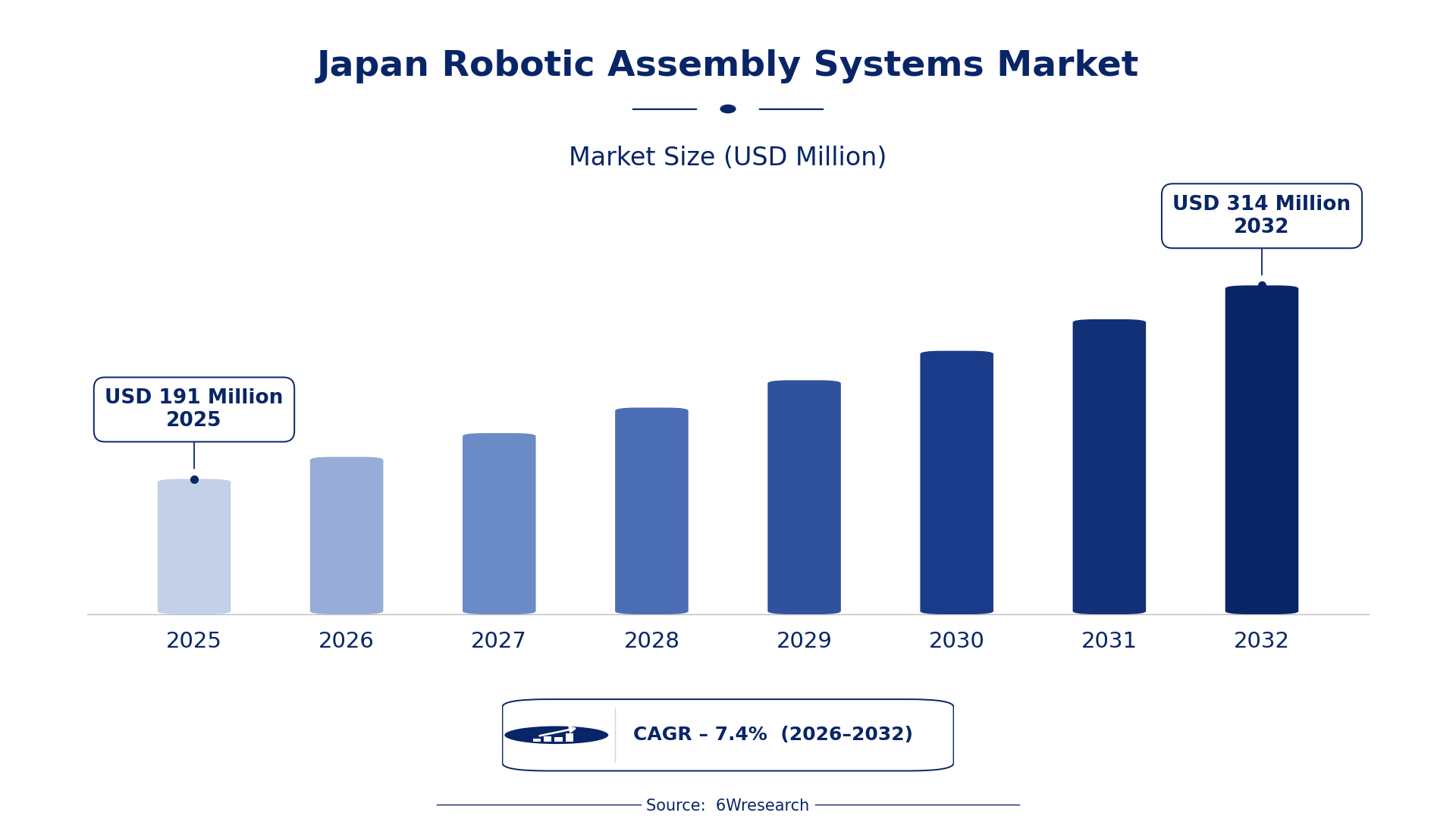
According to 6Wresearch internal database and industry insights, the Japan Robotic Assembly Systems Market was valued at USD 191 Million in 2025 and is projected to reach USD 314 Million by 2032, growing at a CAGR of approximately 7.4% during 2026–2032.
Japan Robotic Assembly Systems Market Highlights
| Report Metric | Details |
| Report Name | Japan Robotic Assembly Systems Market (2026-2032) |
| Market Size 2025 | USD 191 Million |
| Market Size 2032 | USD 314 Million |
| Absolute Growth 2025–2032 | USD 123 Million |
| CAGR 2026–2032 | 7.4% |
| Peak Annual Growth | 8.7% in 2031 |
| Forecast Period | 2026–2032 |
| Historical Data | 2022–2025 |
| Base Year | 2025 |
| Leading Assembly Type, 2025 | Automotive Assembly (47% share) |
| Leading Robot Type, 2025 | Articulated Arms (42% share) |
| Leading Automation Level, 2025 | Fully Automated (41% share) |
| Leading End User, 2025 | Auto OEMs (54% share) |
| Fastest-Growing Assembly Type | Electronics Assembly (10.2% CAGR) |
| Fastest-Growing Robot Type | Cobot Solutions (10.8% CAGR) |
| Fastest-Growing Automation Level | Collaborative (9.7% CAGR) |
| Fastest-Growing End User | Consumer Electronics (9.4% CAGR) |
| Growing Sector | automotive manufacturing |
| Key End Users | automotive manufacturers, electronics manufacturers, appliance manufacturers |
Japan Robotic Assembly Systems Market Year-wise Growth Rate and Key Drivers (2022–2032)
This graph illustrates the annual growth rates of the market from 2022 to 2032, highlighting a steady upward trajectory and projected market expansion over the forecast period.
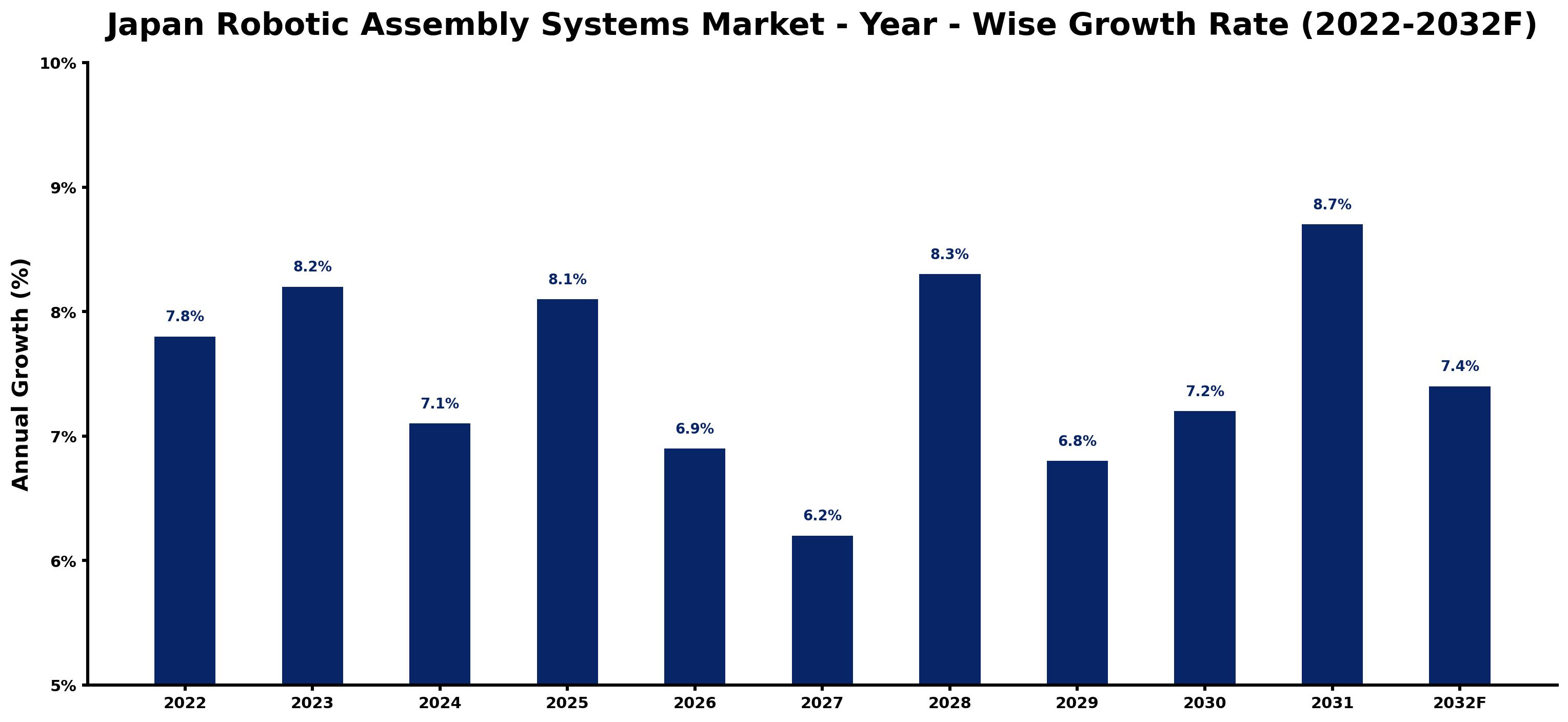
Year by year, the estimates below pair each growth rate with the development that shaped it.
| Year | Estimated Annual Growth (%) | Market Rationale |
| 2022 | 7.8 | Demand remained strong, driven by the automotive sector's production levels. |
| 2023 | 8.2 | Growth was propelled by increased automation in manufacturing processes. |
| 2024 | 7.1 | Market growth slowed slightly due to stabilising demand in key sectors. |
| 2025 | 8.1 | A resurgence in automotive production led to faster growth compared to 2024. |
| 2026 | 6.9 | Growth decelerated as manufacturers adjusted to market saturation. |
| 2027 | 6.2 | Continued adjustments in production strategies contributed to slower growth. |
| 2028 | 8.3 | Demand accelerated again as new technologies were adopted in factories. |
| 2029 | 6.8 | Market growth slowed as competition intensified among manufacturers. |
| 2030 | 7.2 | A renewed focus on automation led to a faster growth rate compared to 2029. |
| 2031 | 8.7 | Peak growth was achieved due to substantial investments in robotic systems. |
| 2032 | 7.4 | Growth moderated as market conditions stabilised after peak investments. |
Note: Market size estimations and growth projections presented in this report are based on 6Wresearch's proprietary forecasting methodology, utilizing the latest available industry data, government publications, and primary research inputs.
Japan Robotic Assembly Systems Market Synopsis
Robotic assembly systems are advanced automation technologies integrating robotics for various assembly tasks. The Japan Robotic Assembly Systems Market is projected to grow, driven by the automotive sector's production of over 8 million vehicles in 2022 and the electronics assembly segment, which is expected to account for 40% of market share by 2025. Factors such as increasing demand for automation and government initiatives are propelling this growth in Japan.
Market Dynamics Impact Analysis (2026–2032)
| Factor | Type | Impact | Primary Segment Affected |
| Rising automotive production levels | Driver | High | Automotive Assembly |
| Growing demand for precision in electronics manufacturing | Driver | High | Electronics Assembly |
| Increasing adoption of collaborative robots | Opportunity | Medium | Cobot Solutions |
| Expansion of the electronics assembly sector | Opportunity | High | Electronics Assembly |
| High initial investment costs for robotic systems | Restraint | High | Fully Automated |
| Limited skilled workforce for advanced robotics | Restraint | Medium | Cobot Solutions |
| Technological advancements outpacing current systems | Challenge | High | Articulated Arms |
| Intense competition leading to price pressures | Challenge | Medium | Automotive Assembly |
Evaluation of Drivers in Japan Robotic Assembly Systems Market (2026–2032)
Key forces behind demand, with the segment each one moves most, are listed below.
| Drivers | Primary Segment Affected | Why It Matters (Evidence) |
| Increased automotive production | Automotive Assembly | The automotive sector produced over 8 million vehicles in 2022, driving demand for robotic systems to enhance efficiency. |
| Demand for precision in electronics | Electronics Assembly | The electronics assembly segment is expected to account for 40% of the market share by 2025, increasing orders for robotic systems. |
| Adoption of collaborative robots | Cobot Solutions | The demand for collaborative robots is projected to grow at 15% annually, prompting manufacturers to invest in these technologies. |
| Investment in robotics research and development | Automotive Assembly | The government allocated ¥10 billion for robotics R&D in 2023, encouraging innovation and adoption in manufacturing. |
| Focus on automation in manufacturing | Fully Automated | The 'Advanced Manufacturing Strategy' aims to increase automation by 30% by 2030, leading to higher demand for robotic systems. |
Behind the steady rise in orders sits the automotive sector's production of over 8 million vehicles in 2022, which drives manufacturers to improve efficiency with robotic systems. The electronics assembly segment is projected to account for 40% of the market share by 2025, boosting demand for precision automation. The push for automation in manufacturing will increase efficiency and reduce labour costs, further driving orders for robotic assembly systems.
Evaluation of Restraints in Japan Robotic Assembly Systems Market
The key brakes on demand, and where they bite hardest, are shown below.
| Market Restraint | Primary Segment Affected | Why It Matters (Evidence) |
| High initial investment costs for robotic systems | Fully Automated | The average investment in robotic systems per facility is around ¥100 million, limiting adoption for smaller manufacturers. |
| Limited skilled workforce for advanced robotics | Cobot Solutions | Japan's ageing population results in a shortage of skilled workers to operate and maintain advanced robotic systems. |
| Technological advancements outpacing current systems | Articulated Arms | Rapid developments in robotics technology can render existing systems obsolete, affecting return on investment for buyers. |
| Intense competition leading to price pressures | Automotive Assembly | Increased competition among manufacturers results in price reductions, impacting profitability for robotic system suppliers. |
| Market saturation in key sectors | Electronics Assembly | As the electronics sector matures, growth rates are expected to stabilise, limiting new investments in robotic systems. |
Japan Robotic Assembly Systems Market Challenges
Producers in Japan's automotive sector face a skills shortage as the workforce ages, leading to assembly delays that impact production timelines for over 5 million employees. High initial investment costs, averaging around ¥100 million per facility, deter technology adoption, making it difficult for buyers to upgrade systems. Increasing complexity in robotic systems requires longer training periods, which can postpone production schedules for manufacturers. Rising operational costs, driven by the national minimum wage increase to JPY 1,055 per hour, squeeze profit margins, forcing producers to reconsider pricing strategies.
Trends in the Japan Robotic Assembly Systems Market
These developments are changing demand patterns in the Japan Robotic Assembly Systems Market.
- Shift from Traditional to Collaborative Robots: Tokyo is experiencing a shift towards collaborative robots in manufacturing, with a projected growth rate of 15% annually. This trend enables safer human-robot interactions, improving productivity in assembly lines.
- Transition from Manual to Fully Automated Systems: Auto OEMs are increasingly adopting fully automated assembly lines, with 41% market share in 2025. This transition is driven by the need for efficiency and reduced labour costs.
- Emergence of AI-Integrated Robotics: The introduction of AI technologies in robotics began in 2025, improving operational capabilities. This integration allows for smarter decision-making and enhanced assembly processes across industries.
- Prioritisation of Precision in Electronics Manufacturing: The electronics assembly sector is focusing on precision automation, expected to account for 40% of market share by 2025. This shift is essential for meeting the high standards of electronic component assembly.
Investment Opportunities in the Japan Robotic Assembly Systems Market
The following areas offer the clearest openings for investors and suppliers in the Japan Robotic Assembly Systems Market.
- Auto OEMs seeking advanced automation solutions: With the automotive sector producing over 8 million vehicles in 2022, there is a strong demand for advanced robotic systems to improve production efficiency.
- Electronics manufacturers investing in precision automation: The electronics assembly segment is projected to account for 40% of the market share by 2025, creating opportunities for suppliers of robotic systems.
- Collaborative robots for flexible manufacturing: The demand for collaborative robots is increasing, with a projected growth rate of 15% annually, presenting opportunities for partnerships with manufacturers.
- Investment in robotics research and development: The government’s ¥10 billion allocation for robotics R&D in 2023 opens avenues for innovation and collaboration in the robotic assembly market.
Government Initiatives in the Japan Robotic Assembly Systems Market
The Industrial Standardization Act, amended in 2019, governs product and test standards for robotic systems, ensuring compliance with safety and performance requirements. This law mandates that manufacturers adhere to JIS B 8432, a standard for industrial robots, promoting quality and reliability in production processes.
In 2023, the Ministry of Economy, Trade and Industry (METI) allocated ¥10 billion for robotics research and development. This initiative aims to boost the competitiveness of Japan's manufacturing sector by promoting the integration of robotics across industries.
Future Insight of the Japan Robotic Assembly Systems Market
By 2032, Japan's manufacturing sector will undergo a transformation, with increased automation driven by the 'Advanced Manufacturing Strategy' aiming for a 30% rise in automation by 2030. This shift will improve production efficiency for buyers, allowing for faster assembly processes and enhanced quality control. The government’s investment in robotics research will lead to advancements in robotic systems that meet standards like ISO 10218. As collaborative robots become more prevalent, suppliers will be able to offer flexible solutions that address specific industry needs, solidifying Japan's position in global markets.
Market Segmentation Analysis
Japan Robotic Assembly Systems Market report covers a detailed analysis of the following market segments:
By Assembly Type – Automotive Assembly Leads, Electronics Assembly Expected to Grow Fastest
According to Saurav Kr Singh, Senior Research Analyst at 6Wresearch, Automotive Assembly accounted for 47% of the market by assembly type in 2025. Automotive assembly holds the largest market share due to its critical role in Japan's automotive industry, which produced over 8 million vehicles in 2022. The extensive use of robotic systems in automotive assembly lines further reinforces this segment's dominance. Electronics Assembly is projected to grow fastest, at a CAGR of 10.2% during 2026–2032. The electronics assembly segment is experiencing rapid growth, driven by the increasing demand for precision in electronics manufacturing. With projections indicating it will account for 40% of the market share by 2025, this segment's expansion is expected to continue as technology advances. Suppliers should focus on enhancing their solutions for the electronics assembly segment to capture emerging market opportunities.
By Robot Type – Articulated Arms Lead, Cobot Solutions Expected to Grow Fastest
Articulated Arms took 42% of robot type revenue in 2025, more than any other category. Articulated arms dominate the market as they are highly versatile and suitable for complex assembly tasks. Their widespread adoption, particularly in the automotive sector, strengthens their leading position in robotic assembly systems. Over 2026–2032, Cobot Solutions are expected to post the fastest growth, at a CAGR of 10.8%. Cobot solutions are witnessing significant growth due to their rising application in collaborative tasks that promote safer interactions between humans and robots. This trend is supported by initiatives that encourage automation in flexible manufacturing settings. Buyers should explore the integration of cobot solutions to enhance operational flexibility and efficiency.
By Automation Level – Fully Automated Leads, Collaborative Expected to Grow Fastest
The largest automation level category in 2025 was Fully Automated, at 41% of revenue. Fully automated systems are preferred for high-volume production, particularly in the automotive sector where efficiency is paramount. This preference is reflected in the extensive deployment of robotic assembly systems across automotive assembly lines in Japan. Collaborative is set to record the highest CAGR in this split, 9.7% over 2026–2032. Collaborative automation is gaining traction as manufacturers seek greater flexibility in production processes, enabling effective human-robot collaboration. This shift aligns with the industry's broader trend towards adaptable and responsive manufacturing solutions. Suppliers must develop collaborative solutions that meet the changing demands of manufacturers.
By End User – Auto OEMs Lead, Consumer Electronics Expected to Grow Fastest
With 54% of end user revenue in 2025, Auto OEMs was the largest category. Auto OEMs are the largest end users of robotic assembly systems, extensively employing them in automotive assembly lines. Their significant investments in automation highlight the critical need for efficiency in vehicle production processes. The quickest growth will come from Consumer Electronics, forecast to expand at a CAGR of 9.4% between 2026 and 2032. The consumer electronics sector is rapidly increasing its adoption of robotic systems, driven by strong demand from electronics manufacturers. This growth is expected to persist as the consumer electronics market remains robust and competitive. Suppliers should tailor their products to meet the specific needs of the consumer electronics sector to take advantage of this growth.
Key Attractiveness of the Report
- 10 Years of Market Numbers
- Historical Data Starting from 2022 to 2025
- Base Year 2025
- Forecast Data until 2032
- Key Performance Indicators Impacting the Market
- Major Upcoming Developments and Projects
Key Highlights of the Report:
- Japan Robotic Assembly Systems Market Outlook
- Market Size of Japan Robotic Assembly Systems Market, 2025
- Forecast of Japan Robotic Assembly Systems Market, 2032
- Historical Data and Forecast of Japan Robotic Assembly Systems Revenues & Volume for the Period 2022-2032F
- Japan Robotic Assembly Systems Market Trend Evolution
- Japan Robotic Assembly Systems Market Drivers and Challenges
- Japan Robotic Assembly Systems Price Trends
- Japan Robotic Assembly Systems Porter's Five Forces
- Japan Robotic Assembly Systems Industry Life Cycle
- Historical Data and Forecast of Japan Robotic Assembly Systems Market Revenues & Volume By Assembly Type for the Period 2022-2032F
- Historical Data and Forecast of Japan Robotic Assembly Systems Market Revenues & Volume By Electronics Assembly for the Period 2022-2032F
- Historical Data and Forecast of Japan Robotic Assembly Systems Market Revenues & Volume By Automotive Assembly for the Period 2022-2032F
- Historical Data and Forecast of Japan Robotic Assembly Systems Market Revenues & Volume By PCB Mounting for the Period 2022-2032F
- Historical Data and Forecast of Japan Robotic Assembly Systems Market Revenues & Volume By White Goods Assembly for the Period 2022-2032F
- Historical Data and Forecast of Japan Robotic Assembly Systems Market Revenues & Volume By Robot Type for the Period 2022-2032F
- Historical Data and Forecast of Japan Robotic Assembly Systems Market Revenues & Volume By SCARA Robots for the Period 2022-2032F
- Historical Data and Forecast of Japan Robotic Assembly Systems Market Revenues & Volume By Articulated Arms for the Period 2022-2032F
- Historical Data and Forecast of Japan Robotic Assembly Systems Market Revenues & Volume By Pick & Place Robots for the Period 2022-2032F
- Historical Data and Forecast of Japan Robotic Assembly Systems Market Revenues & Volume By Cobot Solutions for the Period 2022-2032F
- Historical Data and Forecast of Japan Robotic Assembly Systems Market Revenues & Volume By Automation Level for the Period 2022-2032F
- Historical Data and Forecast of Japan Robotic Assembly Systems Market Revenues & Volume By Semi-Automated for the Period 2022-2032F
- Historical Data and Forecast of Japan Robotic Assembly Systems Market Revenues & Volume By Fully Automated for the Period 2022-2032F
- Historical Data and Forecast of Japan Robotic Assembly Systems Market Revenues & Volume By Programmable for the Period 2022-2032F
- Historical Data and Forecast of Japan Robotic Assembly Systems Market Revenues & Volume By Collaborative for the Period 2022-2032F
- Historical Data and Forecast of Japan Robotic Assembly Systems Market Revenues & Volume By End User for the Period 2022-2032F
- Historical Data and Forecast of Japan Robotic Assembly Systems Market Revenues & Volume By Consumer Electronics for the Period 2022-2032F
- Historical Data and Forecast of Japan Robotic Assembly Systems Market Revenues & Volume By Auto OEMs for the Period 2022-2032F
- Historical Data and Forecast of Japan Robotic Assembly Systems Market Revenues & Volume By EMS Providers for the Period 2022-2032F
- Historical Data and Forecast of Japan Robotic Assembly Systems Market Revenues & Volume By Appliance Manufacturers for the Period 2022-2032F
- Japan Robotic Assembly Systems Import Export Trade Statistics
- Market Opportunity Assessment By Assembly Type
- Market Opportunity Assessment By Robot Type
- Market Opportunity Assessment By Automation Level
- Market Opportunity Assessment By End User
- Japan Robotic Assembly Systems Top Companies Market Share
- Japan Robotic Assembly Systems Competitive Benchmarking By Technical and Operational Parameters
- Japan Robotic Assembly Systems Company Profiles
- Japan Robotic Assembly Systems Key Strategic Recommendations
Market Covered
Segments analysed in this report are listed below.
By Assembly Type
- Electronics Assembly
- Automotive Assembly
- PCB Mounting
- White Goods Assembly
By Robot Type
- SCARA Robots
- Articulated Arms
- Pick & Place Robots
- Cobot Solutions
By Automation Level
- Semi-Automated
- Fully Automated
- Programmable
- Collaborative
By End User
- Consumer Electronics
- Auto OEMs
- EMS Providers
- Appliance Manufacturers































